Checked on 24 September 2026 against the landing-standards ordinance on e-Gov (before and after the 2024 amendment), the Immigration Services Agency’s pages on Student status, the Engineer/Specialist in Humanities/International Services visa, Designated Activities 46 and Japanese ability for higher education, the Ministry of Education’s pages on the senmonshi titles and vocational practice courses, and JASSO’s study-in-Japan pages and enrollment survey.
The short answer
- A vocational school (senmon gakko) is the “specialised course” of a specialised training college. International students study there on the same Student status as at university.
- The Japanese-language entry rule is set by law. You need one year or more at a Japanese language school, or a pass at JLPT N2 or above (or an equivalent score), or one year or more at a Japanese school such as a high school.
- The old “six months at a language school” became “one year” on 26 April 2024. Some guides still say six months.
- Even with one year of study, clearly lacking N2-level Japanese can count against you at Immigration. Aim for N2.
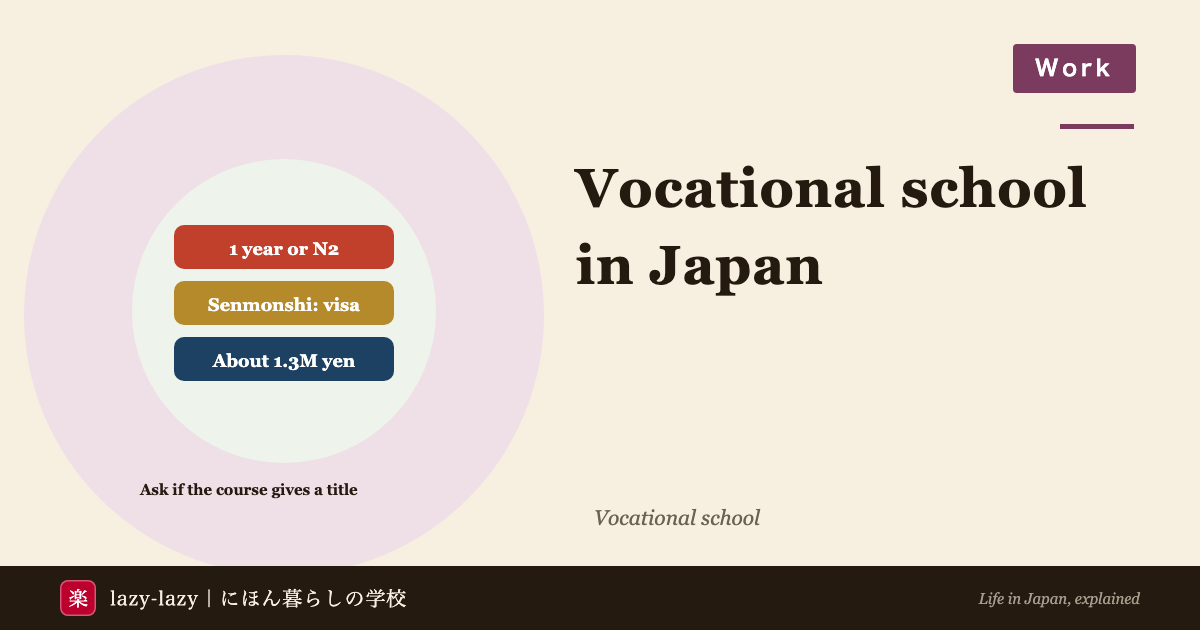
- For a work visa after graduation you need the senmonshi or kodo senmonshi title, and the job must relate to what you studied. Designated Activities 46 is open only to kodo senmonshi from certified courses. First-year entrance and tuition fees average about 1.3 million yen (JASSO).
Knowing this, you can check which entry route you meet, and whether the course carries a title, while you are still at language school, instead of hitting a visa problem after you enrol or after you graduate.
It is autumn of your second year at language school. At the school fair you collected a stack of vocational school brochures, each with a job-placement rate and photos of shiny workshops. You ask a Japanese friend: how much Japanese do you need to get in, and can you work in Japan afterwards? Your friend has no idea. Japanese students enter without a language test, and they never need a visa after graduation. For you, both the entrance and the exit run through Immigration.
- How can an international student get into a vocational school in Japan?
- Six months or one year? What changed in 2024
- Is one year at language school enough?
- What is a senmon gakko? Senmonshi and kodo senmonshi
- Can a vocational school graduate get a work visa in Japan?
- Can kodo senmonshi holders get Designated Activities 46?
- What is a “vocational practice course”?
- How much does vocational school in Japan cost?
- Moving from language school to vocational school: visa renewal and two notices
- What if you can’t meet the rule in time, or can’t pay?
- What if you break the rules?
- Which one are you?
- FAQ
- Summary
- Related reading
How can an international student get into a vocational school in Japan?
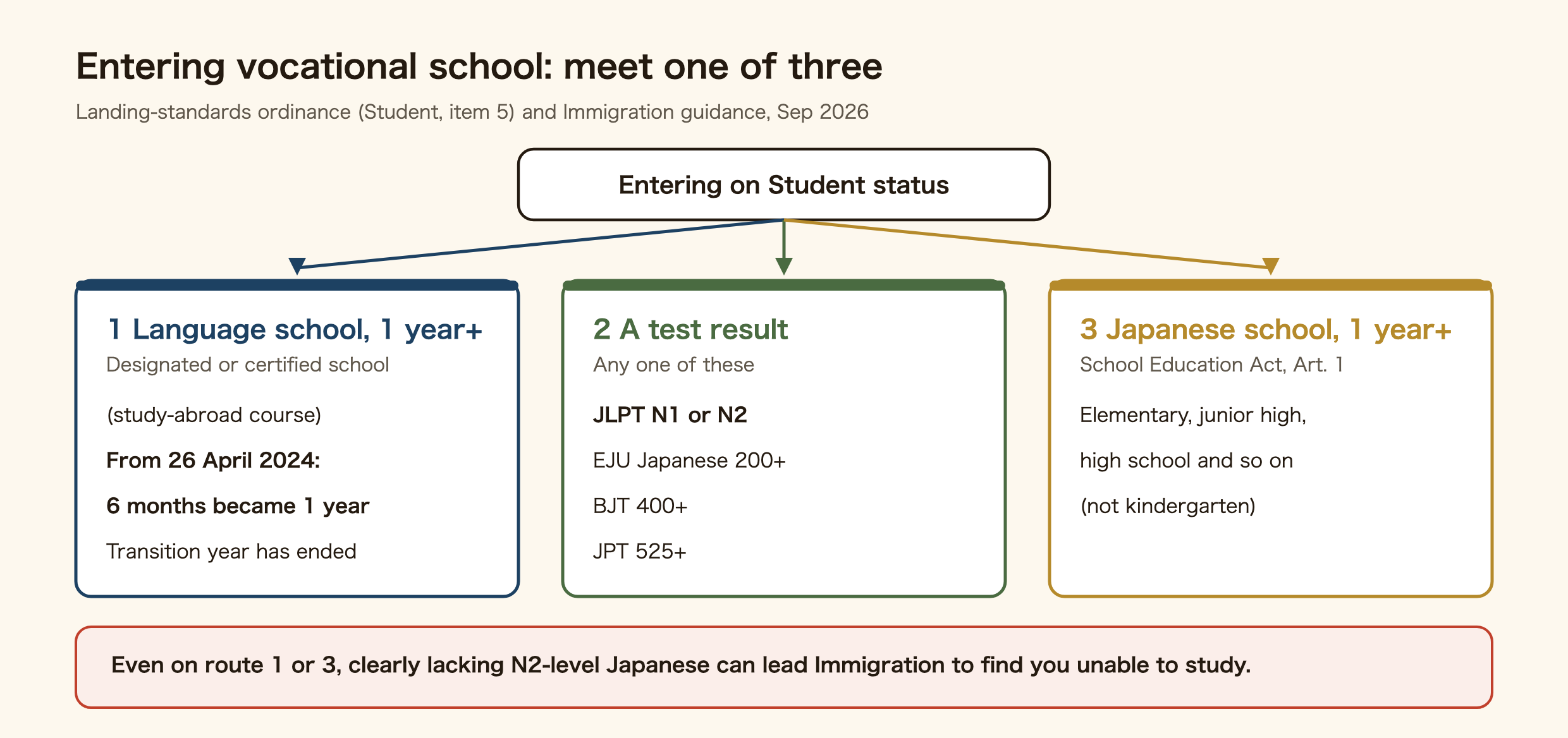
The language requirement is written into Immigration’s landing-standards ordinance. If you enter a specialised training college on Student status, you must meet one of these three.
- One year or more of Japanese-language education at a language school designated by the Minister of Justice, or in the study-abroad course of a certified Japanese language institution
- Japanese ability, proven by a test, that is enough to study at a specialised training college
- One year or more of education at a Japanese school under Article 1 of the School Education Act (elementary, junior high, high school and so on, not kindergarten)
Immigration’s guidance lists which tests count for the second route: JLPT N1 or N2; 200 or more in EJU Japanese (reading, listening and listening-reading combined); 400 or more in the BJT Business Japanese Proficiency Test; or 525 or more in the JPT Japanese Proficiency Test. Any one of them is enough.
JLPT and EJU close registration long before the test day. Once you have picked a sitting, check JLPT registration dates and fees and the EJU schedule and how its scores work.
The school has conditions too. It must have a full-time staff member in charge of international students’ daily life, and a system for managing attendance and part-time work.
Six months or one year? What changed in 2024
The old ordinance accepted six months or more at a designated language school. An amendment that took effect on 26 April 2024 (Ministry of Justice Ordinance No. 33 of 2024) changed it to one year or more. For the first year after that, a transitional rule still read it as six months. That period is over.
Some study-in-Japan pages still say “six months”. Advice from older students may also date from before 2024.
A worked example. If you entered language school in October and want to start vocational school the following April, you will have about six months of language school. The one-year route is closed to you, so you need a test result. Finer points, such as how a course of exactly one year is counted, are not set out in the ordinance or in Immigration’s guidance. Ask your language school and the vocational school.
Is one year at language school enough?
Legally, one year means you do not need a test result. But the same Immigration guidance adds a clear warning. Even on the one-year or Japanese-school route, if you clearly lack N2-level Japanese, the level needed to follow the course, Immigration may decide you are not able to carry out your studies.
Vocational classes, practical instructions and exams are all in Japanese. Even if the one-year route gets you in, holding N2 is the safest position. The visa application form also has a “Japanese ability” box that you must fill in.
What is a senmon gakko? Senmonshi and kodo senmonshi
A vocational school is a specialised training college that has a “specialised course” (senmon katei). It teaches the knowledge and skills for a job, across eight fields such as engineering, medical care, business and culture (JASSO). On 1 May 2025 there were 106,829 international students at vocational schools. That was 30,427 more than a year before, and the largest group in Japanese higher education (JASSO enrollment survey).
Depending on the course, you graduate with a title. The Ministry of Education sets these requirements.
| Senmonshi | Kodo senmonshi | |
|---|---|---|
| Length | 2 years or more | 4 years or more |
| Class hours | 1,700 or more (62 credits) | 3,400 or more (124 credits) |
| Other | Completion based on exams or other grading | Systematic curriculum, plus grading |
| Next step | Eligible to transfer into a university | Eligible for graduate school (courses designated by the Minister) |
People often ask whether kodo senmonshi counts as a university degree. It is a title, not a bachelor’s degree. Immigration does, however, treat kodo senmonshi from certified courses as equivalent to university graduation for Designated Activities 46.
Not every course carries a title, and schools without official approval cannot award one (JASSO). Before you apply, ask the school: “Will this course give me senmonshi (or kodo senmonshi)?”
Can a vocational school graduate get a work visa in Japan?
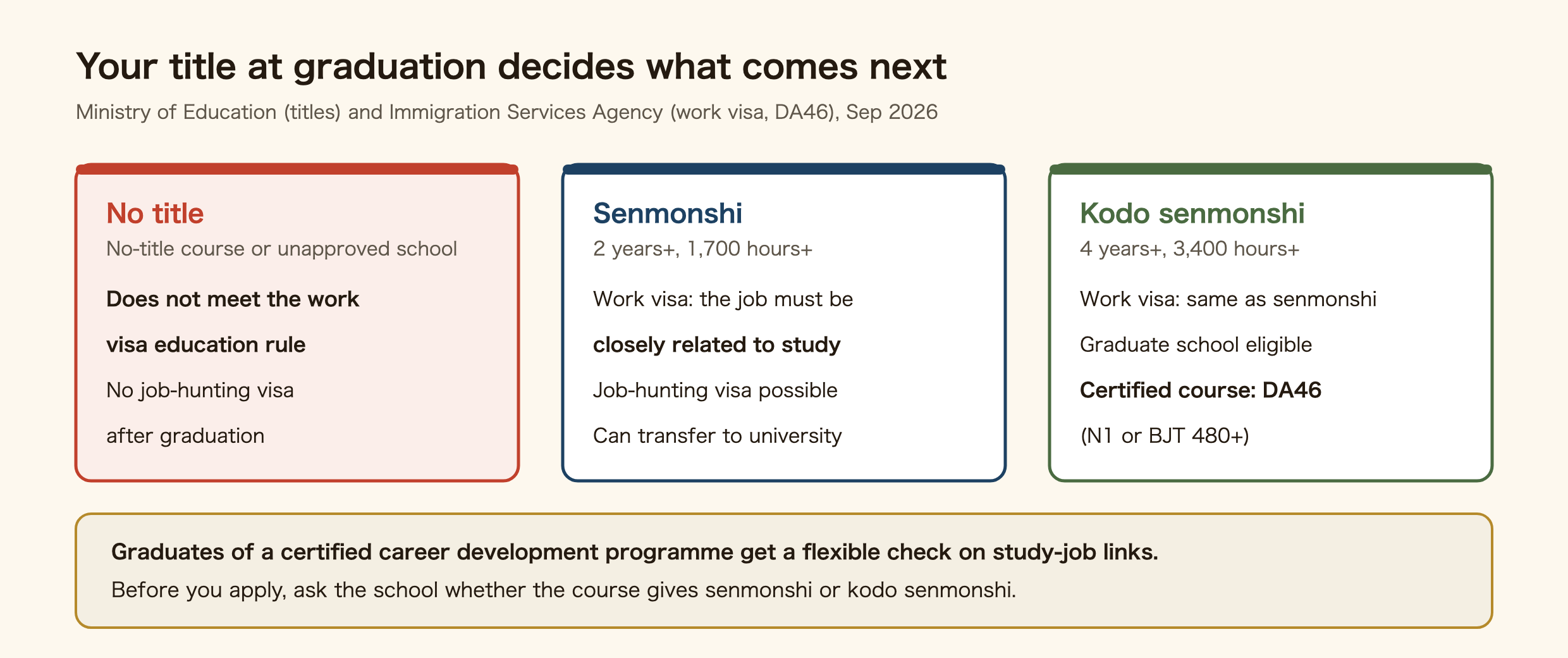
Most international students who get jobs switch to the Engineer/Specialist in Humanities/International Services visa. Its education rule includes finishing a Japanese vocational course in a related subject, and Immigration requires senmonshi or kodo senmonshi (or completion of an advanced course) for that. In 2024, 24.5% of students who switched from Student status to a work status had a specialised training college as their highest education (ISA, employment of international students in 2024).
It is not the same as a degree, though. Immigration’s guideline judges the link between a university major and the job “flexibly”. Vocational schools train for specific jobs, so as a rule the job must be closely related to what you studied. There are two exceptions.
- Graduates of a course certified by the Minister of Education as a “career development programme for international students” are judged flexibly
- After about three years in a job accepted as related, later jobs are judged flexibly
The rule that waives three years’ experience for translation, interpreting and language teaching also applies only to university graduates (landing-standards ordinance).
Before you choose a course, check which jobs fall within the visa in what the humanities visa allows and what gets refused, based on Immigration’s own approved and refused cases. If you have no job offer by graduation, senmonshi holders may be able to keep looking on the job-hunting visa after graduation.
Can kodo senmonshi holders get Designated Activities 46?
Designated Activities 46 lets Japanese university graduates with N1 take jobs that include customer service or on-site work, as long as the work involves communicating in Japanese. A change to the public notice on 29 February 2024 added some vocational graduates.
You qualify only if both are true.
- You finished a course certified by the Minister of Education as a “career development programme for international students”
- You received the kodo senmonshi title (a course of four years or more)
Two-year senmonshi does not qualify, and neither does kodo senmonshi from an uncertified course. You also need JLPT N1 or 480 or more on the BJT. The Ministry of Education publishes the list of certified courses. The jobs allowed and how it differs from the humanities visa are in the Designated Activities 46 guide.
What is a “vocational practice course”?
A vocational practice course (shokugyo jissen senmon katei) is a vocational school department that the Minister of Education certifies for building its curriculum and training closely with companies. The system started in April 2014, and by the end of March 2026 about 40% of vocational schools were certified.
The requirements include being a senmonshi or kodo senmonshi course, practical training and teacher training with companies, and publishing information about the course (Ministry of Education). Certification is reviewed every three years and withdrawn if the requirements are no longer met.
For you, it does two things: it confirms the course carries a title, and the published information makes schools easier to compare.
How much does vocational school in Japan cost?
According to JASSO, the average entrance fee plus tuition for the first year at a vocational school is about 1.3 million yen. Materials and practical training can cost extra. For comparison, a Japanese language school’s first year is about 610,000 to 1.9 million yen depending on the course.
| Item | Cost |
|---|---|
| Entrance fee + tuition (first year) | About 1.3 million yen on average (varies by school and course) |
| Materials and practical training | Depends on the school (sometimes extra) |
| Application fee | Depends on the school |
| Status renewal (from 1 October 2026) | Set by the length granted: 1 year is 33,000 yen at the counter, over 1 and under 3 years is 48,000 yen (27,000 and 42,000 yen online) |
Tuition in later years and payment dates differ by school. JASSO also advises checking the total to graduation and when each payment is due.
The government’s non-repayable grant for international students can pay 48,000 yen a month to regular vocational school students. Language school students aiming for vocational school can get 30,000 yen a month. Schools nominate the students, so read how the JASSO grant works and how to apply, then ask your international office.
Moving from language school to vocational school: visa renewal and two notices
Language school and vocational school both use Student status. So you do not change status. When your period of stay runs out, you apply to renew it. The length of a Student period of stay is set for each person, up to four years and three months.
The documents depend on whether Immigration has classed the school as “appropriate”. For an appropriate school (Class I), the basics are these.
- Application for extension of period of stay
- Certificate of enrolment (a letter of admission if you are about to start)
- Attendance certificate (if the school can issue one), transcript and graduation certificate, for every school you attended since your last application
- Proof of Japanese ability (not needed if you renew at the same school)
If Immigration gave you guidance about part-time work at your last renewal, you also need papers showing how you pay your living costs. At schools not classed as appropriate, the list grows further depending on nationality. Japanese certificates must be issued within the last three months.
If your period of stay is six months or longer, you can apply from three months before it ends. From 1 October 2026 the fee depends on the length granted; see the October fee rise for each band.
Separately, you must notify Immigration twice, each within 14 days: once when you leave the language school and once when you join the vocational school. How to file them is the same as in changing schools on a Student visa.
What if you can’t meet the rule in time, or can’t pay?
If your language school time will fall short of a year, switch to the test route: N2, EJU Japanese 200, BJT 400 or JPT 525. Find a sitting whose results arrive before the school’s start date.
If the tests will not work out either, consider a later start. But if you finish language school with no next school decided, you no longer have a reason to be in Japan on Student status. Three months or more without studying also makes your status liable to cancellation. Decide your next school and start date before your language school course ends. If you are unsure, talk to both your language school’s career adviser and the vocational school.
If you cannot pay, ask about instalments or the school’s own reductions before you commit. A plan to cover fees with part-time work has to fit inside the 28-hour weekly limit.
What if you break the rules?
At vocational school, part-time work stays within your work permission: 28 hours a week, or 8 hours a day during long breaks set by the school. Regularly working more than 28 hours means you will not be seen as of good conduct when you apply to switch to the humanities visa after graduation (Immigration guideline). The details are in the 28-hour rule for student jobs.
Not filing the 14-day notices can bring a fine of up to 200,000 yen. Whether you filed them is also checked when you apply for a work visa.
Attendance and grades are checked through certificates at every renewal. There is no published attendance line for vocational schools. If absences are building up, read attendance and visa renewal and talk to your school early.
Which one are you?
- Less than a year into language school — assume the one-year route is closed. Today, look up the next JLPT or EJU registration period and pick a sitting.
- A year or more at language school, but no N2 yet — you may get in legally, but clearly lacking N2-level Japanese can count against you. Today, put the next JLPT registration date in your calendar.
- Narrowing down schools — today, call and ask three questions: does the course give senmonshi (or kodo senmonshi), is it a vocational practice course, and what is the total cost to graduation.
- Thinking of jobs with customer service or on-site work later — Designated Activities 46 needs kodo senmonshi from a certified course. Today, ask the school whether the course is a certified career development programme, and start working towards N1.
FAQ
Q. How much Japanese do I need to enter a vocational school in Japan?
By law, you need one of three: one year or more at a Japanese language school, a pass at JLPT N2 or above (or an equivalent test score), or one year or more at a Japanese school. Even on the one-year route, clearly lacking N2-level Japanese can count against you at Immigration, so aim for N2.
Q. Can I enter a vocational school after six months at a language school?
Not any more. An amendment that took effect on 26 April 2024 changed the language school period from six months to one year, and the transitional period has ended. If you have less than a year, you need a test result such as N2 or 200 in EJU Japanese.
Q. Can I get a work visa after graduating from a vocational school in Japan?
If your course gave you the senmonshi or kodo senmonshi title, you meet the education rule for the Engineer/Specialist in Humanities/International Services visa. For vocational graduates, though, the job must be closely related to what you studied. A course without a title does not meet the rule.
Q. What is the difference between senmonshi and kodo senmonshi?
Senmonshi comes from a course of two years or more and at least 1,700 class hours; kodo senmonshi from a course of four years or more and at least 3,400 class hours. Senmonshi makes you eligible to transfer into a university, and kodo senmonshi to enter graduate school (for courses designated by the Minister). Only kodo senmonshi from certified courses can qualify for Designated Activities 46.
Q. How much does vocational school in Japan cost for international students?
According to JASSO, the average first-year entrance fee plus tuition is about 1.3 million yen. Materials and practical training can cost extra. Later years and the total to graduation vary by school, so check the application guide.
Q. What visa steps do I take when moving from language school to vocational school?
Both use Student status, so you renew your period of stay when it runs out. Before you start, submit the letter of admission and the attendance, grade and graduation certificates from every school since your last application. Separately, notify Immigration within 14 days when you leave the language school and within 14 days when you join the vocational school.
Summary
To enter a vocational school, you need one year or more at a language school, N2 or an equivalent test score, or one year or more at a Japanese school. Since 26 April 2024 the language school period has been one year, not six months. Even on that route, Immigration looks for N2-level Japanese.
Whether you can work in Japan afterwards is largely decided the day you choose a course. Does it give senmonshi or kodo senmonshi? Does it connect to the job you want? If you are thinking about Designated Activities 46, is it a certified course with kodo senmonshi? Get the school’s answer to all three, not the brochure’s, before you apply.
Official sources: e-Gov, landing-standards ordinance (Japanese) / Immigration Services Agency, Japanese ability for entering higher education (Japanese) / ISA, Student status (Japanese) / ISA, Engineer/Specialist in Humanities/International Services (Japanese) / ISA, Designated Activities for graduates of Japanese universities (Japanese) / ISA, employment of international students in 2024 (Japanese) / Ministry of Education, senmonshi and kodo senmonshi (Japanese) / Ministry of Education, vocational practice courses FY2025 (Japanese) / JASSO, academic fees / JASSO, 2025 international student enrollment survey (Japanese). Checked on 24 September 2026. Always confirm entry rules and fees in the school’s own application guide.
Related reading
Found this useful? Share it
Send it to a friend who lives in Japan.
WHO WROTE THIS

mori
Japanese. I read the ministries’ own notices, orders and Q&As in the original, and I start from what my Nepalese and Sri Lankan friends in Japan actually ran into. I do not write about what I have not checked or been told.
What this site can and cannot do →Looking for something else?