Checked on 23 September 2026 against the National Police Agency (its SOS47 anti-fraud pages and the final 2025 figures published on 5 June 2026), the Immigration Services Agency’s warnings, the Tokyo Metropolitan Police, the Financial Services Agency and the Deposit Insurance Corporation, the Consumer Affairs Agency and the National Consumer Affairs Center, and the text of the Furikome Sagi Relief Act (e-Gov).
The short answer
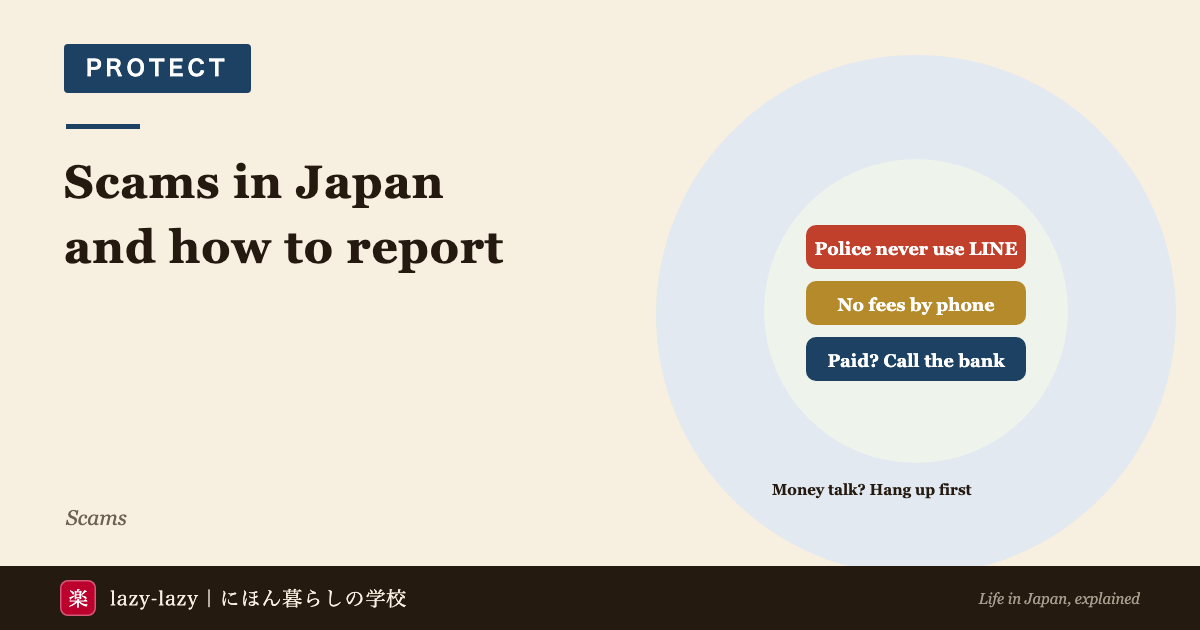
- A caller who says he is a police officer and that “your bank account is being used for crime” is running a fake-police scam. Real officers do not tell you by phone that you are under investigation, contact you on LINE, or send you a photo of an arrest warrant.
- Immigration never asks for money by phone or email, and never calls from an overseas number starting with “+”. A call from “your embassy” gets the same treatment: hang up first.
- If someone you met online starts talking about investing or money, do not send any. Tokyo police warn specifically about scammers who open with “we’re both international students”.
- Not sure? Call #9110 (police advice). Shopping problems: 188. Danger right now: 110.
- If you already sent money by bank transfer, call the receiving bank and the police the same day. If the account is frozen before the scammer empties it, the Furikome Sagi Relief Act may return some or all of it.
Knowing this, you can tell on the spot whether a call or message is real, and stop before any money leaves your account. And if it already has, you will know who to call today to keep a way back open.
Late one evening an unknown number rings. The caller speaks your language and says he is from your embassy. “Your passport was used in a crime. Pay, or you will be deported.” Then he asks you to switch to a video call, and an arrest warrant with your name on it fills the screen. You ask a Japanese friend what to do, and they have no idea. Nobody calls Japanese people pretending to be your country’s embassy.
- What scams target foreigners in Japan? 43,000 cases in 2025
- Is a call from “the police” a scam? Four ways to tell
- Calls or emails from “Immigration” or your embassy
- Investment and romance scams on social media
- “Lend me your bank account” or “just pick up a package”
- Bought something from a fake shopping site?
- How to report a scam in Japan: 110, #9110 and 188
- Can I get my money back? The Furikome Sagi Relief Act
- Deadlines: how the days are counted
- Does it cost anything? Beware of “we’ll get your money back”
- Which one are you?
- FAQ
- Summary
- Related reading
What scams target foreigners in Japan? 43,000 cases in 2025
The National Police Agency calls these “special fraud” (tokushu sagi): crimes where the scammer never meets you, builds your trust by phone or social media, and gets you to hand over money, usually by bank transfer. Investment scams and romance scams run through social media work the same way, without a face-to-face meeting.
The final 2025 figures, published on 5 June 2026, counted 43,000 cases of these scams combined, with losses of 325.7 billion yen. Special fraud alone was 27,832 cases and 142.3 billion yen, the worst on record for both.
- Fake-police scams: 11,014 cases, 100.5 billion yen (70.6% of all special-fraud losses)
- Social-media investment scams: 9,523 cases, 128.8 billion yen
- Social-media romance scams: 5,645 cases, 54.6 billion yen
2026 has not been better. Provisional figures for January to July (published 4 September) show 6,566 investment-scam cases, up 75.6% on the same months of 2025, and 5,422 fake-police cases.
The police figures do not break victims down by nationality. But the Tokyo Metropolitan Police have issued separate warnings about calls posing as the Chinese, Vietnamese and Thai embassies, and about social-media investment scams aimed at foreign residents. And the age group hit most often by fake-police scams was people in their 30s. This is not only a problem for the elderly.
Is a call from “the police” a scam? Four ways to tell
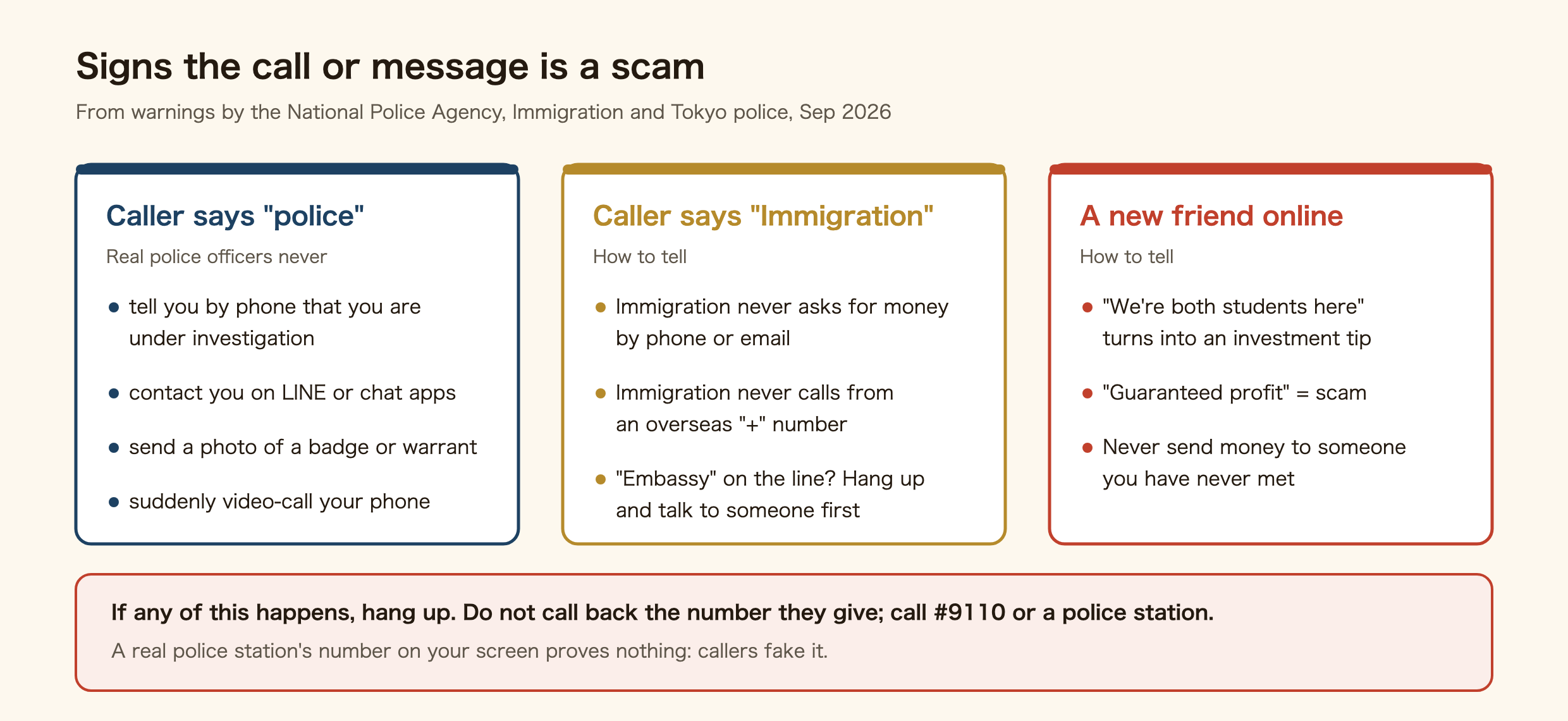
In a fake-police scam, the caller poses as a police officer and demands money under the cover of an “investigation”. He says an account in your name is being used for crime, or that a phone was contracted in your name. He says you may be arrested. Then he moves you to a LINE video call and shows a fake police badge and a fake arrest warrant with your real name. He tells you not to discuss the “investigation” with anyone.
The National Police Agency lists four things a real officer does not do.
- Tell you by phone that you are the subject of an investigation
- Contact you through LINE or another messaging app
- Send you images of a police badge or arrest warrant
- Video-call your personal phone out of the blue
If even one of these happens, it is a scam. Hang up, and call back on a number you looked up yourself, a police station or #9110, never the number the caller gives you.
A real police number on your screen is no guarantee. In one case, a scammer made the main number of a prefectural police headquarters appear on the victim’s phone and talked them into transferring 2.5 million yen. Many calls also come from international numbers starting with “+” and ending in “0110”. In 2025, 75.5% of the phone numbers used in special fraud were international numbers. The police recommend installing an app on your smartphone that blocks incoming international calls.
Calls or emails from “Immigration” or your embassy
The Immigration Services Agency receives many reports of calls and emails from people claiming to be its staff. Its answer is plain: Immigration staff never ask for money by phone or email.
Examples the agency has published:
- A caller said you had travelled abroad on certain dates and your passport might be being misused, then asked for your date of birth and address
- An automated voice said “important documents are being held”, “documents are missing” or “a deadline has passed”, and told you to press a number
- A recorded message in Chinese said your residence card would be invalidated because of “an abnormality”
- A caller said a foreign acquaintance was held at the airport and asked you to transfer an entry fee or bail
- An email said you would be fined 2 million yen if you did not update your visa information
Immigration never calls from an overseas number starting with “+”. Scammers can fake real numbers and email addresses, so if you are worried, call your regional immigration bureau on a number you looked up yourself.
Watch out for fake fee emails too. From 1 October 2026, fees for online applications are paid at a convenience store or by bank payment, and the payment notice comes only from an address ending in “@service-dgft.com”. Immigration states that any email from another address asking you to pay the fee is a scam. You can check the real amounts in the October 2026 fee increase and compare them with the email.
Some calls claim to be from your own country’s embassy or police. Tokyo police report calls posing as the Chinese embassy or China’s public security bureau to Chinese residents, as the Vietnamese embassy or Ministry of Public Security to Vietnamese residents, and as the Thai embassy to Thai residents. The script is similar: your name was used in a crime, there is a warrant for your arrest, pay or be deported. In the Chinese-embassy version, people who could not pay were told to fake their own kidnapping so their parents would pay a ransom. One victim sent more than 20 million yen.
Tokyo police give three rules. Do not answer withheld or unknown numbers. Never send a photo of your ID. When money comes up, hang up and talk to a friend or the police. Do not decide alone.
Investment and romance scams on social media
Tokyo police say plainly that foreign residents are targets too, and describe how the social-media investment scam unfolds.
- A message arrives: “Same nationality!” or “I’m an international student too”
- Once you are friendly, it becomes “a great project” that is “guaranteed to make money”
- A small “dividend” lands in your account, and you start to believe
- You are told you need to send more to earn more, and you transfer money
- The person disappears
Step 3 is the trap. The small early payment exists to win your trust. No investment is guaranteed to make money.
Romance scams start with affection instead. In 2025, 92.8% of romance scams began with a direct message, and the first contact came through a dating app in 32.7% of cases, Instagram in 22.8% and Facebook in 18.6%. If someone you have never met starts talking about investing, transfers or crypto, stop there.
Investment scams also use ads that borrow photos or videos of famous people without permission, then pull you into an “investment group” on LINE. Fake websites dressed up as the Prime Minister’s Office have been found too.
“Lend me your bank account” or “just pick up a package”
Every scam needs people on the other side as well. Social media carries job posts that promise “high pay”, “same-day cash” or “totally legal work” without saying what the work is. The National Police Agency says these are recruitment ads for criminals. The person sent to collect the victim’s money or parcel is called the ukeko, the receiver. In 2025, the agency noted a marked rise in foreign nationals arrested as receivers in social-media investment and romance scams.
Fraud carries up to 10 years in prison under the Penal Code (Article 246). Handing your bank account to someone is also a crime, paid or unpaid. The penalties and the effect on your visa are in things that are illegal in Japan for foreign residents, so read it before you reply to any such offer.
If you already applied: the National Police Agency says that if you go to #9110 or a police station, the police will protect you and your family. You can get out, even if you are being threatened. An account you no longer use should be closed at the bank, not handed over.
Bought something from a fake shopping site?
The National Consumer Affairs Center lists the warning signs of a bad shopping site. The Japanese on the site reads strangely. It has items that are rare everywhere else. Brand goods are far below normal prices. Payment options are limited, and the bank account is in a private person’s name. There are no rules for cancellations or refunds, and no clear company name, address or phone number.
If you realise you ordered from one, what you do depends on how you paid.
| You paid by | Do this now |
|---|---|
| Credit card | Call the card company |
| Bank transfer | Call the receiving bank and ask for relief under the Furikome Sagi Relief Act. Report it to the police too |
| Cash on delivery | If you just ordered, email to cancel. When a parcel arrives, check the sender on the label before paying, and refuse it if it is not the shop you ordered from |
Next may come a message: “The item is out of stock, so we will refund you through a payment app.” If you are asked to add someone on LINE or share your screen, that is a scam too. The Center has received reports from people who followed the “refund” steps and found they had sent money instead. Never share your screen.
How to report a scam in Japan: 110, #9110 and 188
| Number | When | Good to know |
|---|---|---|
| 110 | It is happening now and you need an officer to come | For emergencies only |
| #9110 | You got a suspicious call or message, or think you have been scammed | Connects to the police advice line for the area you call from. Weekdays 8:30 to 17:15 (varies by prefecture). Nights and weekends: duty staff or a recorded message |
| 188 | Shopping problems: fake shops, “refund” tricks | Enter your postcode to reach your local consumer centre. Advice is free; you pay for the call |
#9110 does not work from rotary-dial phones or some IP phones. In that case, use your prefectural police’s advice number or go to a police station. If 188 is busy, the National Consumer Affairs Center has a backup line: 03-3446-0999, weekdays 10:00 to 16:00.
Before you call, keep the caller’s number, screenshots of messages and emails, and your transfer receipt. Do not delete the chat.
Can I get my money back? The Furikome Sagi Relief Act
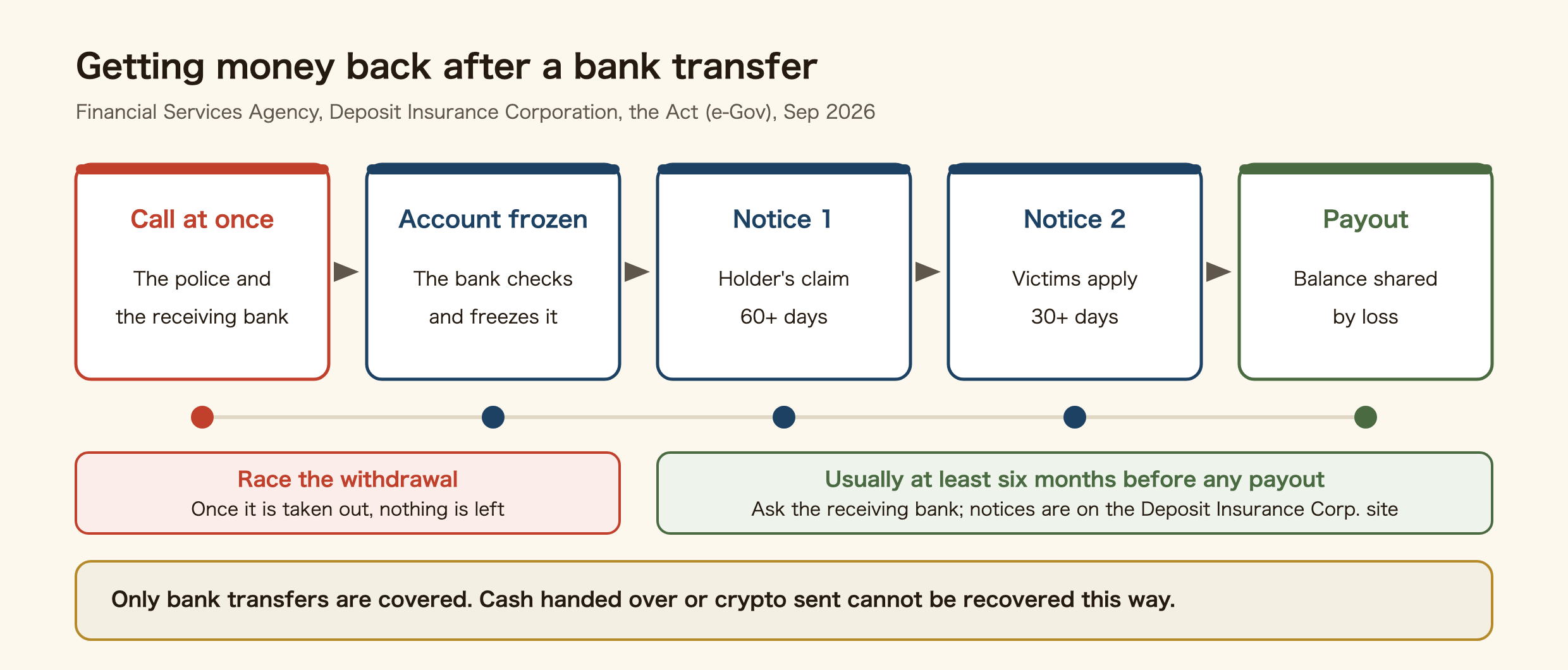
Possibly, under conditions. The Furikome Sagi Relief Act lets the money left in an account used for fraud be shared out among the people who were cheated into paying into it.
It covers fraud where you paid into a bank account. That includes fake-police scams, and it also includes investment and romance scams if you paid by bank transfer. Cash handed over in person and crypto you sent yourself are not covered.
Speed matters more than anything. Once the scammer withdraws the money, there is nothing left to return. As soon as you realise, call the receiving bank and the police the same day and ask them to freeze the account.
What happens next:
- The bank investigates and freezes the account
- The Deposit Insurance Corporation publishes a first notice. The account holder has at least 60 days to claim the money; if they do not, their claim is extinguished
- A second notice opens a period of at least 30 days for victims to apply
- You send the application form, proof of identity and proof of your loss (such as the transfer receipt) to the receiving bank
- The bank decides who is paid and how much, and pays
Expect at least six months before you receive anything. You may not get it all back: if victims’ claims add up to more than the balance, it is split in proportion to each loss. If less than 1,000 yen is left, nothing is paid.
Deadlines: how the days are counted
Both periods start the day after the notice is published: at least 60 days for the account holder to claim, and at least 30 days for victims to apply. The exact length is set for each account.
Miss the application period and you cannot be paid. If you have reported the loss to the receiving bank, the bank will tell you your application period directly. You can also search by account number on the Deposit Insurance Corporation’s notice site. Notices go up twice a month, in principle on the 1st and the 16th.
Lost your transfer receipt? You can still apply. Explain to the bank when, where and how much you transferred.
Does it cost anything? Beware of “we’ll get your money back”
Advice through 188 is free; you pay only for the call. With #9110 you also pay just the call charge. The relief application form can be downloaded from the Financial Services Agency’s website.
Be careful with messages that arrive after you have been scammed. Fake sites using the National Consumer Affairs Center’s name have promised to “refund money collected from bad websites”. The Center says it never contacts people by email or phone unless they have consulted it first. If anyone offers to recover your money for a fee, ask 188 or #9110 before you pay.
If the scammer is convicted and their assets are confiscated, the Ministry of Justice’s victim recovery payment system may also apply.
Which one are you?
- Someone on the phone or a video call is asking for money right now — hang up. Do not call back the number they give you. Today, call a police station you looked up yourself, or #9110.
- You already transferred money — today, call the receiving bank and the police and ask for the account to be frozen. Save the receipt and screenshots of the chat.
- Someone online wants you to invest or send money — send nothing. Screenshot their account and messages, and call #9110 today.
- Someone asked to borrow your account or offered pay for “picking up a package” — do not reply, and block them. If you already applied, go to #9110 or a police station today.
- You ordered from a fake shop — card: call the card company. Bank transfer: the receiving bank and the police. Cash on delivery: refuse the parcel. Not sure? Call 188 today.
FAQ
Q. “The police” called and said my bank account is being used for crime. Is it real?
Treat it as a scam. According to the National Police Agency, real officers do not tell you by phone that you are under investigation, contact you on LINE, or send images of a badge or warrant. Hang up and call a police station you looked up yourself, or #9110.
Q. Does Immigration ever call foreign residents about money?
Immigration staff never ask for money by phone or email. Immigration also never calls from an overseas number starting with “+”. If you are worried, call your regional immigration bureau on a number you found yourself.
Q. How do I report a scammer in Japan?
Call #9110 for police advice, or 188 for shopping problems. If it is happening now and you need an officer, call 110. #9110 is mainly staffed on weekday daytimes, and hours differ by prefecture.
Q. I got scammed in Japan and sent money by bank transfer. Can I get it back?
If money is still in the account, the Furikome Sagi Relief Act may return some or all of it. Call the receiving bank and the police at once so the account is frozen. It usually takes six months or more, and you may not get the full amount.
Q. Does the relief cover investment and romance scams?
Yes, if you paid into a bank account. Cash handed over in person and crypto you sent are not covered by this system.
Q. What should I do if I ordered from a fake shopping site?
It depends on how you paid. Card: call the card company. Bank transfer: call the receiving bank and the police. Cash on delivery: check the sender on the label before paying, and refuse the parcel if it is not the shop you ordered from. If unsure, call 188.
Summary
A call from “the police”, “Immigration” or “your embassy” that says you are involved in a crime and asks for money is a scam. Real police do not contact you on LINE or send warrant photos, and Immigration never asks for money by phone or email. When someone you met online starts talking about investing, stop there.
If you have already paid, do not let embarrassment slow you down. The sooner you call the receiving bank and the police, the better your chance of getting money back. Not sure: #9110. Shopping: 188. Danger now: 110.
Official sources: National Police Agency, special fraud and SNS investment/romance scams in 2025 (final figures, Japanese) / NPA, figures to end of July 2026 (provisional, Japanese) / NPA, beware of fake-police scams (Japanese) / Immigration Services Agency, beware of suspicious calls and emails claiming to be Immigration / ISA, online application fees and payment (Japanese) / Tokyo Metropolitan Police, avoiding crime (Japanese) / Financial Services Agency, for victims of transfer fraud (Japanese) / Deposit Insurance Corporation, if you are a victim (Japanese) / Consumer Affairs Agency, consumer hotline 188 (Japanese) / National Consumer Affairs Center, fake shopping sites (Japanese). Checked on 23 September 2026.
Related reading
WHO WROTE THIS

mori
Japanese. I read the ministries’ own notices, orders and Q&As in the original, and I start from what my Nepalese and Sri Lankan friends in Japan actually ran into. I do not write about what I have not checked or been told.
What this site can and cannot do →Looking for something else?