Figures, prices and terms were checked against the property sites themselves (opened to see whether each has an English version) and the MLIT guideline on restoration costs on 20 August 2026. They change — check the current terms yourself before you sign up or file anything.
This article contains affiliate links.
Last updated: 2 October 2026
In short
- SUUMO has no English version (checked August 2026). Neither do the other big Japanese listing sites. Stop looking for one.
- That leaves three routes: read the Japanese sites, walk into an agency, or use a service built for foreigners.
- You only need seven words to read a Japanese listing. Translating the whole page wastes your time.
- The usual mistake is finding out the total move-in cost after choosing a room. A normal rental wants 4 to 7 months of rent upfront.
- If your Japanese is not there yet, start in multilingual housing and move to a normal rental later, once you have the language, a bank account and a card.
Once you know this, you stop hunting for an English SUUMO and have three real candidates from the Japanese sites today – and you know the full move-in cost before you commit.
“I want to find a room, but I cannot read the Japanese sites.” Almost everyone hits this in their first weeks. This article is only about where to look. Contracts and the cost breakdown are in how renting works in Japan.
Does SUUMO have an English version?
No. There is no English SUUMO – suumo.jp/en/ does not open (checked August 2026) – and LIFULL HOME’S and the other large listing sites only let you search rooms in Japanese (one way to find an agency that speaks your language is in the agency section below). Do not spend your evening hunting for an English button. Knowing this settles what you do next.
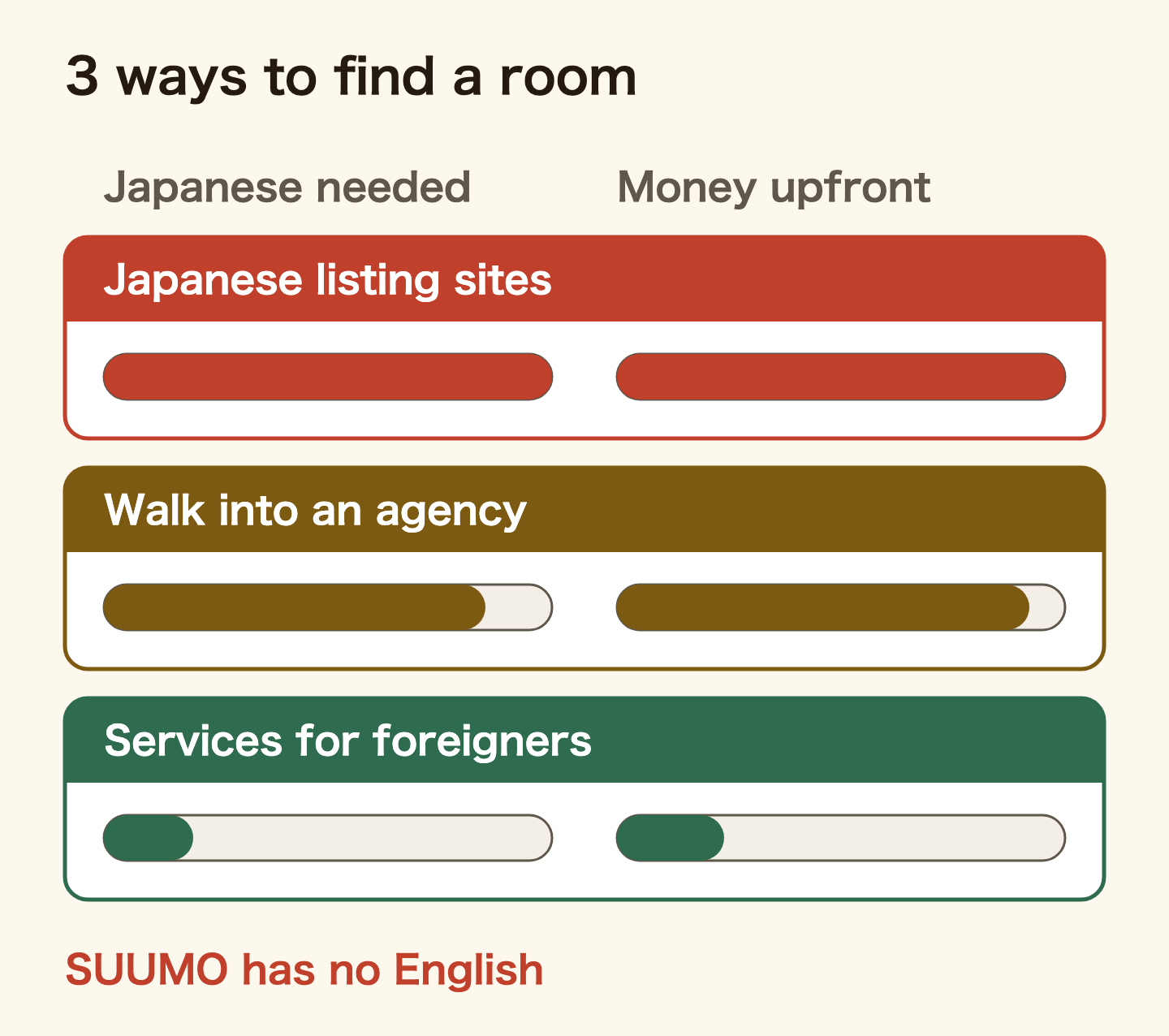
Choose on two things only: how much Japanese you have right now, and how much cash you can put down. Starting from the room you want is what makes this take months.
Seven words are enough to read a Japanese listing
A listing page looks long, but seven lines decide the money and the conditions. Feeding the whole page to a translation app usually makes it harder to read, not easier. Learn these seven and you can compare rooms.
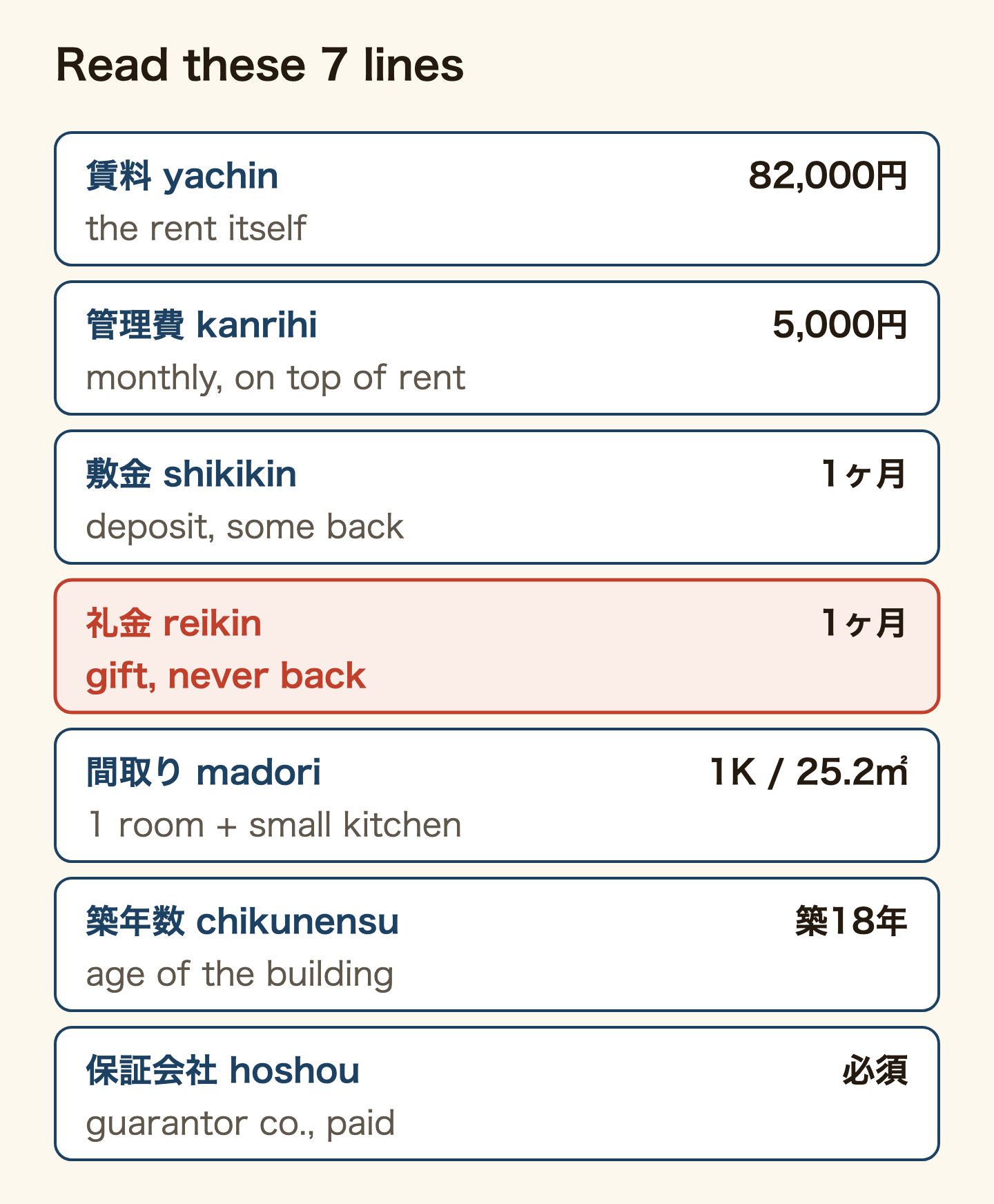
The one that costs people money is reikin (礼金). It is a gift to the landlord and you never see it again (Ministry of Land, Infrastructure, Transport and Tourism, Apartment Search Guidebook (English)). Shikikin (敷金) is a deposit, so part of it comes back if you did not damage the room (e-Gov law search, Civil Code Article 622-2 on deposits (Japanese)). Both may say “one month” – they are not the same thing at all.
The other is kanrihi (管理費), a building fee. A room listed at 82,000 yen with 5,000 yen kanrihi costs you 87,000 yen every month. Search on rent plus kanrihi, not rent.
What happens if you walk into an agency?
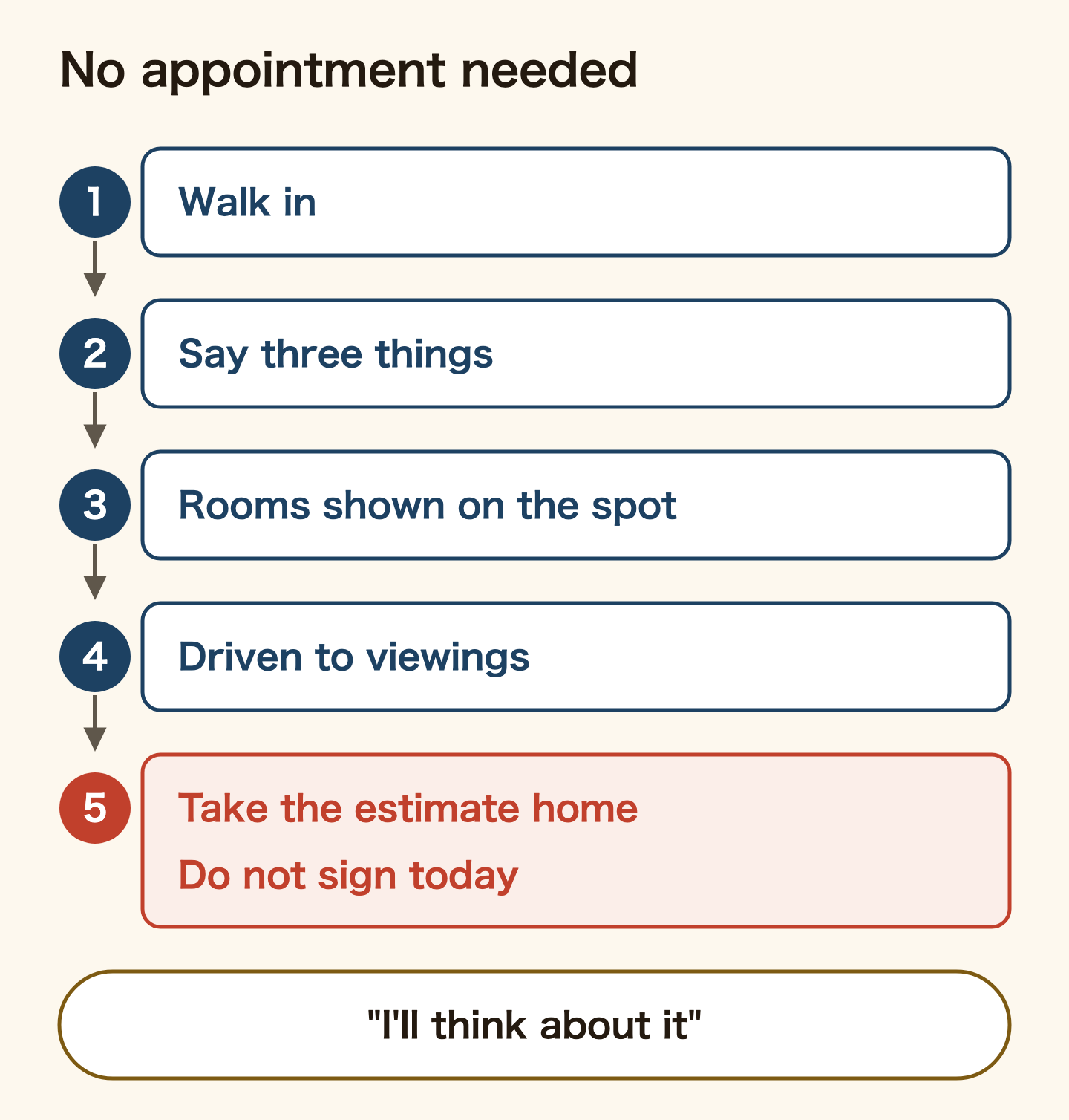
In Japan, walking into one of the property shops outside the station is the normal way to do this. No appointment. You say what you want – area, maximum rent, when you need to move – and they print out rooms on the spot, then drive you to see the ones you like.
The catch is that it all happens in Japanese, and some shops are not used to foreign tenants.
If you cannot hold that conversation yet, find a shop that speaks your language before you walk in. The listing site LIFULL HOME’S runs FRIENDLY DOOR, a page where you pick your prefecture and get real estate agencies that offer support in English, Chinese, Vietnamese, Korean or Portuguese. The page itself is in those languages, and contacting an agency through it is free. LIFULL also says it lists rooms that do not refuse tenants for being foreign, and runs a support desk you can message on LINE (LIFULL announcement, June 2026 (Japanese)). The listings themselves are still in Japanese, so the seven words above still do the work.
Whichever shop you choose, take these three on a note in your phone. Written in Japanese is best, but even numbers work.
- Budget: one ceiling, like “80,000 yen including kanrihi”
- Area: the station nearest your school or job, or “within 30 minutes of X station”
- Move-in date: “sometime in September”. Whether you are in a hurry changes what they show you
Do not sign anything that day. “I will think about it and come back” is a complete sentence. Ask for the move-in cost estimate on paper and read the breakdown first.
Money: know the total before you choose the room
You set aside about a month’s rent and go to view rooms. Where you come from, that may be enough to get the keys. In Japan, a normal rental asks for several times that before you move in.
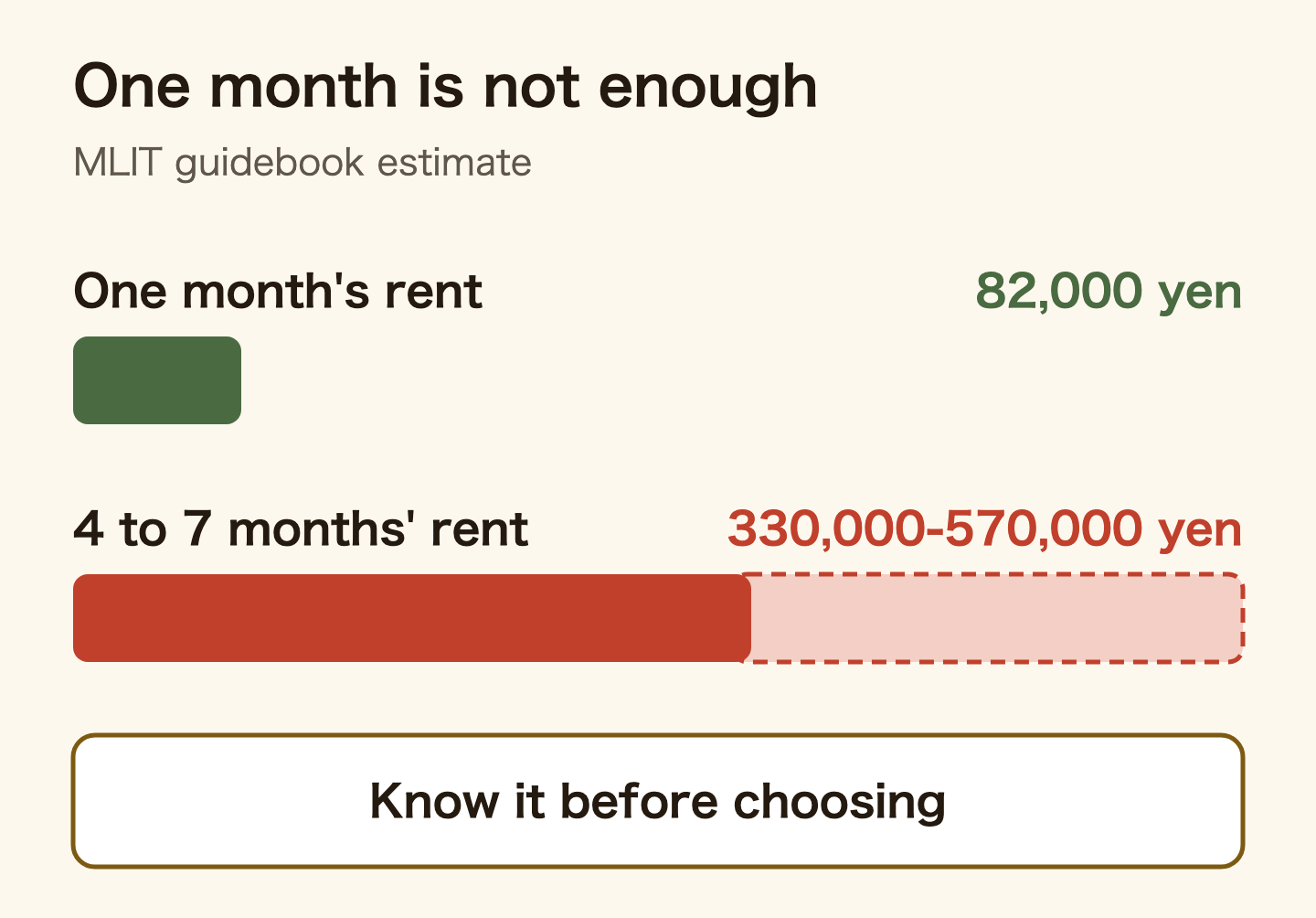
The most common mistake is choosing a room and then learning the total. A normal Japanese rental asks for 4 to 7 months of rent before you get the key, according to the housing guidebook from Japan’s Ministry of Land, Infrastructure, Transport and Tourism. On an 82,000 yen room that is roughly 330,000 to 570,000 yen.
The breakdown, and the ways to bring it down, are in our guide to rental contracts. Read that part before you start looking – it changes what you search for. Before paying private move-in costs, also check whether you qualify for public housing or UR housing, which foreign residents can apply for too.
If your Japanese is not there yet
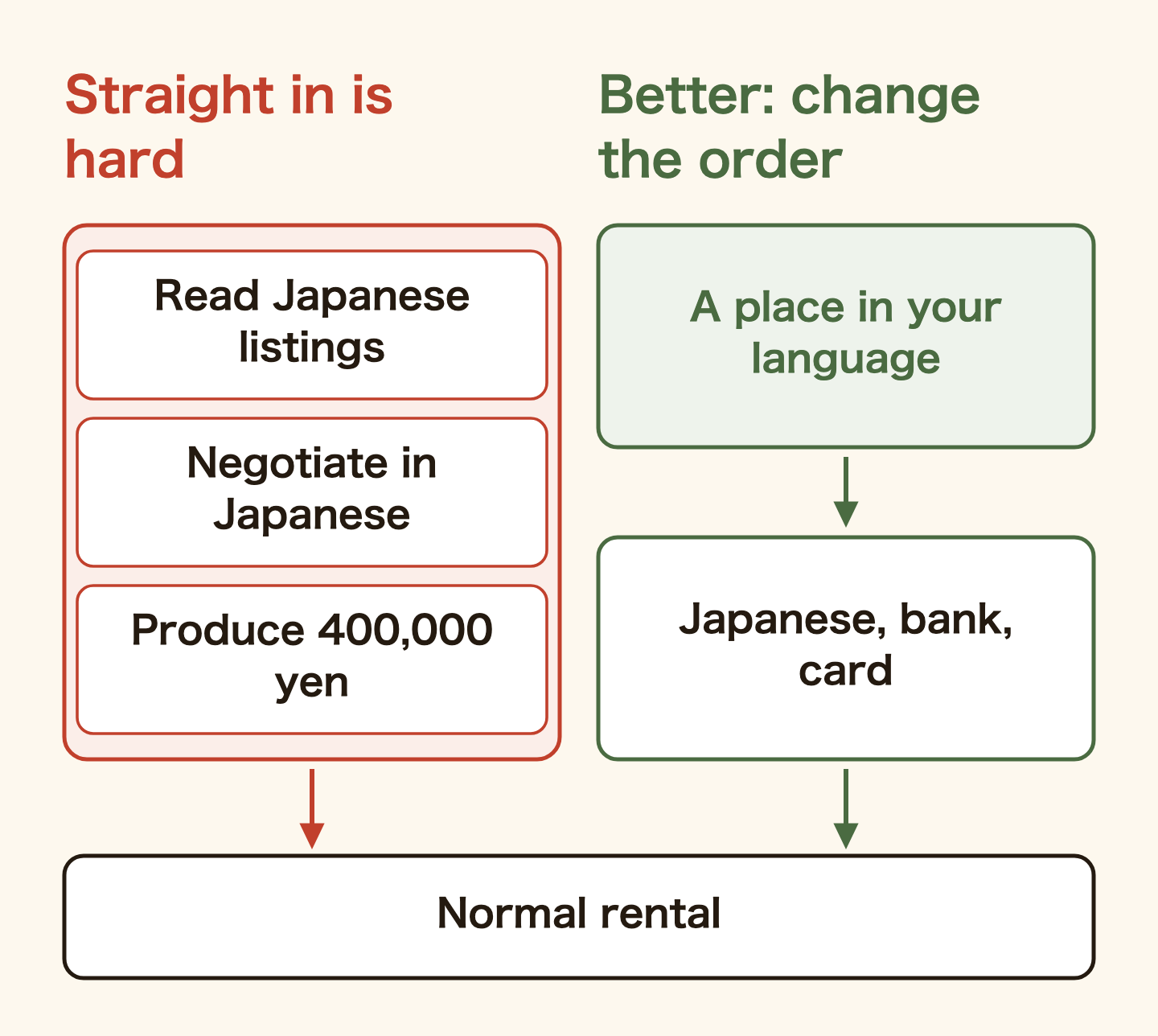
Reading Japanese listings, negotiating in Japanese, and producing 400,000 yen in your first month is a lot to ask of anyone who just landed. Often the faster route is to change the order: start somewhere that speaks your language, then move to a normal rental once your Japanese, your bank account and your card are in place.
Housing you can arrange without Japanese: X-House
X-House (Cross House) runs share houses and furnished rentals in Tokyo. Support is available in Nepali, Sinhala and other languages. No deposit, no key money, no agency fee, and no guarantor.
- Share house rooms from 24,800 yen a month (official site, checked August 2026)
- Furnished, so you can live there from the day you arrive
- From one month, so you are not locked in if it does not suit you
- Honest note: the “30,000 yen to move in” you see in the ads is not the total. Your first month of rent comes on top
Share houses do not suit everyone – if you need silence and your own bathroom, they are not for you. We say so plainly in our share house guide. Read the part about who should think twice before you decide.
Whether these sites have an English version was checked by opening them on 20 August 2026. Official sources: Ministry of Land, Infrastructure, Transport and Tourism, Apartment Search Guidebook (English) / e-Gov law search, Civil Code Article 622-2 on deposits (Japanese) / Ministry of Land, Infrastructure, Transport and Tourism, guideline on restoration costs / LIFULL HOME’S FRIENDLY DOOR: English-speaking real estate agencies / LIFULL, FRIENDLY DOOR passes 7,000 agencies, 16 June 2026 (Japanese) (checked 26 September 2026; FRIENDLY DOOR checked 2 October 2026)
Frequently asked questions
Does SUUMO have an English version?
No. As of August 2026 there is no English SUUMO, and the other large Japanese listing sites only let you search rooms in Japanese. To search in English you use a foreign-resident property site or a multilingual operator instead.
Can I just use a translation app on the Japanese sites?
You can. But translating whole pages is slow. Learn seven terms – yachin, kanrihi, shikikin, reikin, madori, chikunensu, hoshou gaisha – and you can compare listings without translating anything else.
Do I need an appointment at a property agency?
No. Walk in during opening hours and tell them what you want. They will show you rooms the same day. It happens in Japanese, so bring a note with your budget, your area and your move-in date.
Can I rent without speaking Japanese?
Yes. Multilingual operators exist, and some agencies are used to foreign tenants. For English, Chinese, Vietnamese, Korean or Portuguese, LIFULL HOME’S FRIENDLY DOOR lets you find agencies by prefecture that will talk to you in that language. But a normal rental still wants 4 to 7 months of rent upfront, which is why many people start in a share house and move later.
What is the difference between reikin and shikikin?
Shikikin is a deposit and part of it comes back if the room is undamaged. Reikin is a gift to the landlord and never comes back. Both are often quoted as “one month” of rent.
Summary
- There is no English SUUMO. Three routes: Japanese sites, an agency, or a service for foreigners
- Seven words are enough to read any Japanese listing
- Reikin never comes back. Kanrihi is charged every month. Do not mix these up
- A normal rental wants 4 to 7 months of rent upfront – know the total before you choose
- If the Japanese is not there yet, start multilingual and move later
Related guides
Found this useful? Share it
Send it to a friend who lives in Japan.
If you would rather not negotiate in Japanese, housing built for foreign residents is faster.
Share House in Japan →WHO WROTE THIS

mori
Japanese. I read the ministries’ own notices, orders and Q&As in the original, and I start from what my Nepalese and Sri Lankan friends in Japan actually ran into. I do not write about what I have not checked or been told.
What this site can and cannot do →Looking for something else?
You may use the figures in this article, including commercially, if you credit this site with a link. How to use our figures