This article contains affiliate links.
Last updated: July 2026
In short
- You can work in Japan without a degree. The degree does not decide whether you can come, only which route you take.
- The standard work visa does require education: a university degree, a Japanese vocational school diploma, or 10 years of experience.
- Specified Skilled Worker asks for no degree at all. Instead you must pass a skills test and a Japanese test.
- Permanent residents and spouses of Japanese nationals have no restrictions on what work they do. Only they can take dispatch jobs freely.
- On Specified Skilled Worker, dispatch work is allowed in only 2 of the 12 sectors – agriculture and fishery. Check this before you start applying.
Your residence status (zairyu shikaku), commonly called your visa, is what decides what work you may legally do in Japan. Education matters only because it is one of the conditions for getting certain residence statuses. Get that order right and the rest becomes clear.
- First, work out which of the three routes is yours
- Route 1: the standard work visa, where the degree wall sits
- Route 2: Specified Skilled Worker, where tests replace the degree
- Route 3: status-based residence, the only one with no limits
- You can also acquire the education later
- Frequently asked questions
- Summary
- Related guides
First, work out which of the three routes is yours
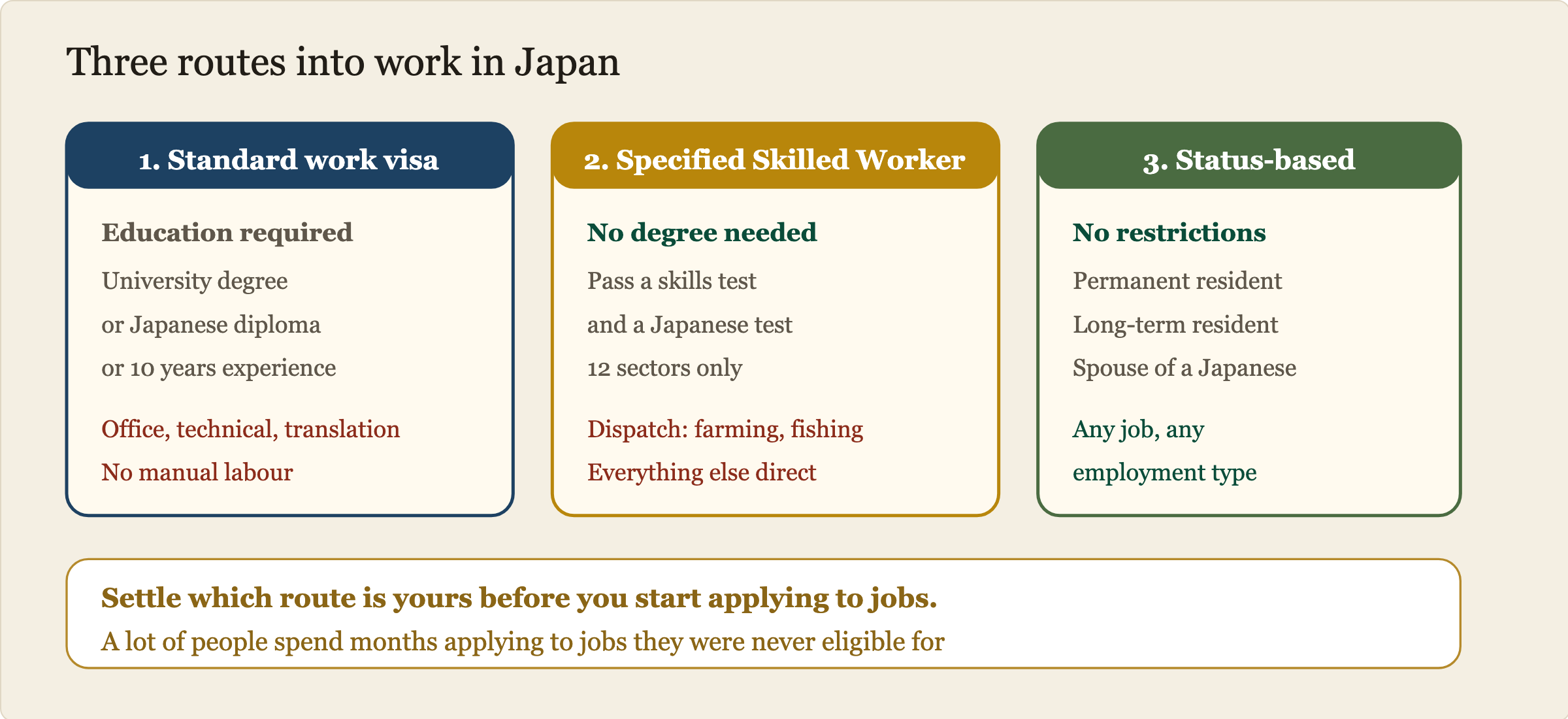
There are three broad routes. You do not really choose between them – you find out which one you fall into.
Route 1: the standard work visa, where the degree wall sits
The main work visa is called Engineer / Specialist in Humanities / International Services, shortened in Japanese to gijinkoku. This is the one with an education requirement.
There are three ways to satisfy it, and you only need one.
- A university degree. For graduates, how closely your major matches the job is judged flexibly, because universities are treated as providing broad knowledge
- A Japanese vocational school diploma (senmonshi). Here the link between what you studied and the job is checked more strictly than for graduates
- Ten years of practical experience. For work classed as International Services – translation, interpreting, language teaching – three years is enough
There is a useful exception worth remembering. If you hold a Japanese vocational diploma and the job is International Services work such as translation, interpreting or language teaching, it is treated under the Humanities category and no work experience is required. For people who go from language school to vocational school, this is a realistic path.
One hard limit applies throughout: this visa does not permit manual or routine labour. Factory line work, convenience store tills, cleaning – none of them qualify. A degree does not change that.
Route 2: Specified Skilled Worker, where tests replace the degree
If you have no degree, this is the realistic route. Created in April 2019, it covers 12 sectors facing labour shortages in Japan.
No education requirement at all. Instead you must pass two tests.
- A skills test for the sector you want to work in
- A Japanese language test covering the Japanese the work needs
People who have completed the Technical Intern Training Program may be exempt from the tests. Ask the employer or the registered support organisation whether that applies to you.
The mistake that stops people working: dispatch
Specified Skilled Worker is a direct employment status. Dispatch work is permitted in only two of the twelve sectors: agriculture and fishery.
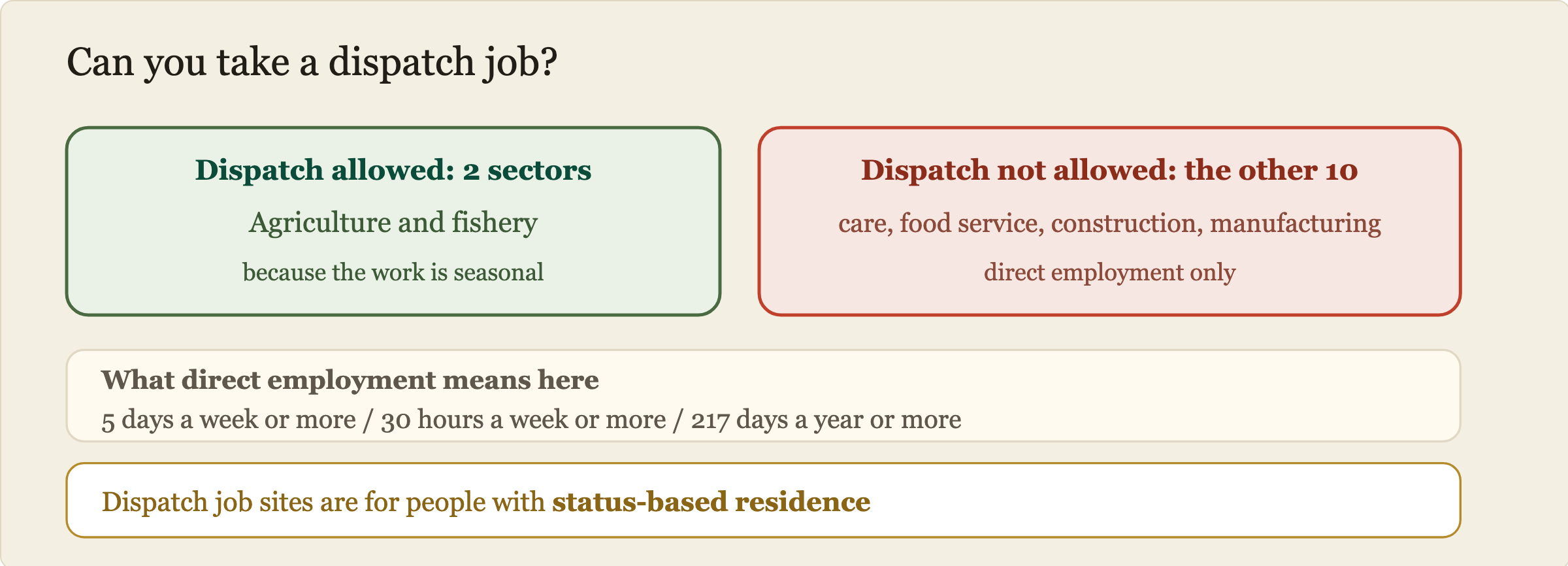
The reason those two sectors are exempt is that the volume of work swings sharply with the season. Everywhere else, direct employment is the rule, and it means genuine full time work: at least 5 days and 30 hours a week, and 217 days a year.
People do apply to dispatch listings for months without realising they are not eligible. Check your own status before you send applications.
Route 3: status-based residence, the only one with no limits
Permanent Resident, Long-Term Resident, Spouse or Child of a Japanese National, Spouse of a Permanent Resident. These are the status-based categories, and they carry no restriction on the type of work or the form of employment.
You can work on exactly the same terms as a Japanese national. Factory line work, dispatch, several part-time jobs at once – all fine. Education is irrelevant here.
If this is your status, your options are the widest of anyone’s. Manufacturing outside the big cities is worth a look, because many roles come with company housing, which settles your job and your accommodation in one move. That matters a lot when you are trying to avoid large upfront costs. Dispatch-focused job sites such as Koujou Kyuujin Folder (factory jobs, Japanese site) are usable only by people in this category.
Note: dispatch job sites are not usable on Specified Skilled Worker or the standard work visa. On Specified Skilled Worker look for direct employment; on the work visa, look for roles that are not manual labour.
One more thing helps outside the cities: a driving licence. Factory and logistics sites are often not reachable without a car, and holding a licence widens the set of jobs you can apply for. We cover the cost and the language requirement in getting a driving licence in Japan.
You can also acquire the education later
If you have no degree now, a Japanese vocational school diploma will satisfy the work visa requirement. That is exactly why so many people move from a language school into a vocational school.
Be clear about the cost though. One year of language school plus two years of vocational school, tuition and living costs together, runs into millions of yen. We break the numbers down in what a Japanese language school actually costs. Compare that against starting work sooner on Specified Skilled Worker before you commit.
If you are already here as a student, you will need to change status when you graduate. About 1 in 30 applications is refused (96.7% approved in 2024). The reasons are in student visa to work visa.
Frequently asked questions
Q. I only finished high school. Can I work in Japan?
A. Yes. The standard work visa is out of reach, so the realistic target is Specified Skilled Worker. Pass the skills test and the Japanese test and no education is required. Alternatively, study at a Japanese vocational school and obtain the diploma.
Q. Is a degree from my home country enough?
A. It satisfies the education requirement for the standard work visa, and graduates get flexible treatment on how closely the major matches the job. The ban on manual labour still applies.
Q. How do I prove ten years of experience?
A. Through employment certificates from previous employers. Time spent studying related subjects at university, high school or vocational school can sometimes be counted toward the ten years. It is judged case by case, so consult an immigration lawyer or administrative scrivener.
Q. Can I apply to dispatch agencies on Specified Skilled Worker?
A. In agriculture and fishery, yes. In any other sector, no. Look for direct employment instead. Dispatch job sites are for people with status-based residence.
Q. Can I do factory line work on the standard work visa?
A. No. That visa does not cover routine manual work, and having a degree makes no difference to this rule.
Official source:Immigration Services Agency: the Specified Skilled Worker system
Summary
A degree is not what decides whether you can work in Japan. It decides which route you take.
With a degree or a Japanese diploma, the standard work visa is open. Without one, Specified Skilled Worker is the route, and it turns on two tests rather than schooling. If you hold status-based residence, none of these limits apply to you at all.
Before you start applying, settle which of the three you are. The dispatch rule catches people out most often: outside agriculture and fishery, Specified Skilled Worker cannot use dispatch at all. Knowing that saves months.
Related guides
Found this useful? Share it
Send it to a friend who lives in Japan.
WHO WROTE THIS

mori
Japanese. I read the ministries’ own notices, orders and Q&As in the original, and I start from what my Nepalese and Sri Lankan friends in Japan actually ran into. I do not write about what I have not checked or been told.
What this site can and cannot do →Looking for something else?