Last updated: July 2026 (covers the May 2026 rule change)
In short
- Medicine you brought from home may be illegal here. Cold medicines containing pseudoephedrine cannot be brought into Japan, even with a prescription.
- Since May 2026, buying cold and cough medicine has changed. Under 18s can buy one small pack only, and you will be asked for ID.
- Over 18s can buy more, but you will be asked why, and can be refused. Buying online now requires a video call at any age.
- Japanese over-the-counter medicine is usually milder than what you are used to. Taking extra because it feels weak is dangerous.
- OTC medicine costs 1,000 to 2,000 yen. With national health insurance a clinic costs you 30 percent, so for anything lasting it is cheaper and more certain than buying pack after pack.
Over-the-counter medicine (shihan-yaku) is medicine you can choose and buy yourself without a prescription. Medicine a doctor prescribes is called shohou-yaku. This guide covers both what you can bring with you and what you can buy once you are here, because in Japan those two questions are connected.
- First: what you brought may not be allowed in
- What changed in May 2026
- Japanese medicine is not weak, it is deliberately mild
- Drugstore or pharmacy?
- Find it by symptom – the words to use in the shop
- Some medicines need a pharmacist present
- Shop or clinic? The cost question
- Frequently asked questions
- Summary
- Related guides
First: what you brought may not be allowed in
Japan bans the import of some ingredients that are sold openly in other countries. The one that catches people most often is pseudoephedrine, found in ordinary cold and sinus medicine. You cannot bring it in, even with a prescription.
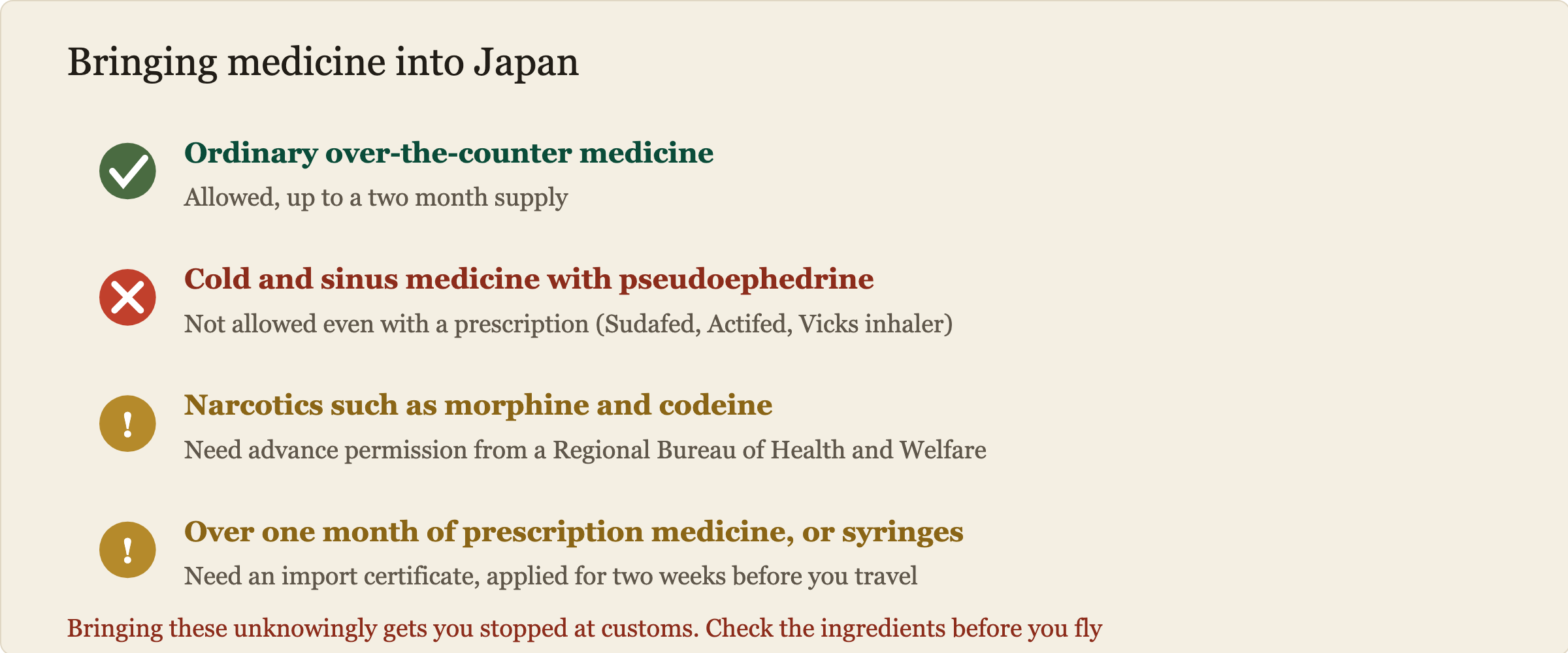
The reason matters, so remember it: pseudoephedrine cannot be imported because it is a controlled ingredient inside Japan. That same ingredient appears again in the May 2026 rules below. What you cannot bring in and what is restricted at the till are the same list.
What changed in May 2026
On 1 May 2026 Japan introduced a category called “designated abuse-prevention medicines”. Cold, cough, fever and allergy products containing any of eight listed ingredients now come with limits on how you can buy them.
The reason is overdose among young people becoming a public issue. This is not about you personally – the rule is applied to everyone the same way, and knowing that in advance makes the counter conversation much less alarming.
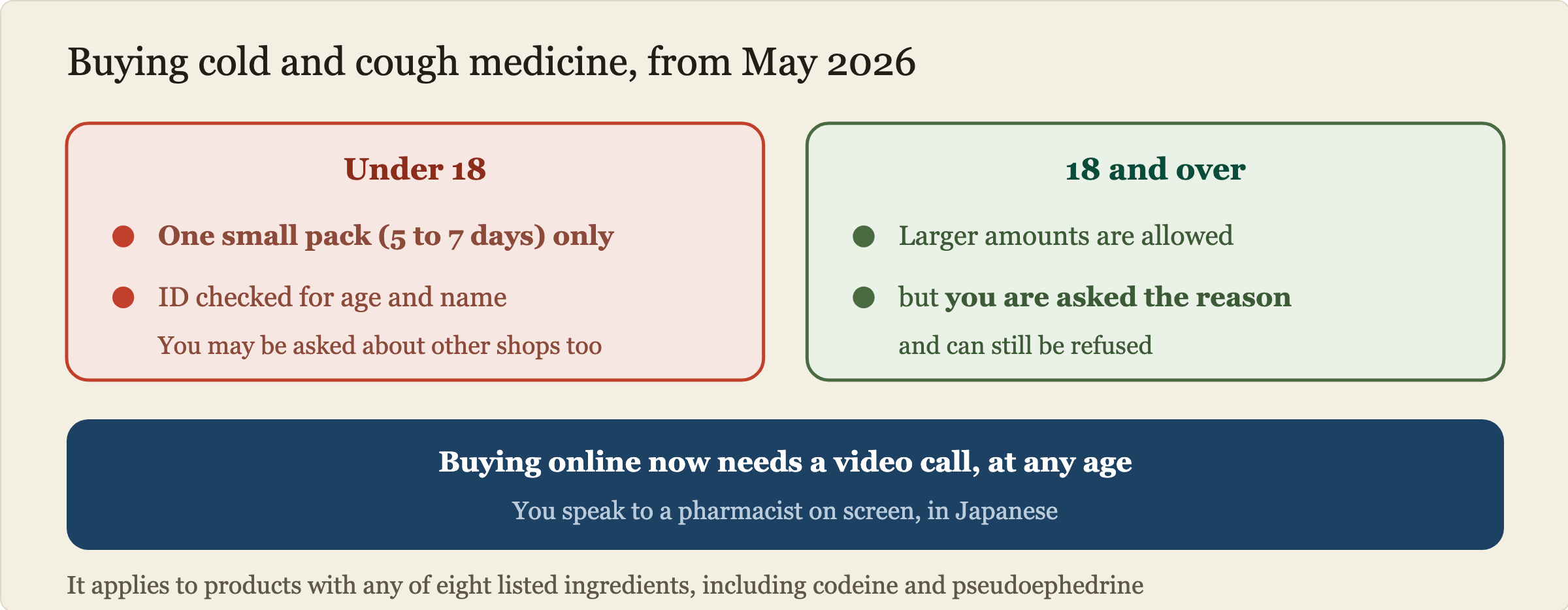
Two parts of this hit foreign residents harder than anyone else:
- You will be asked for ID more often. If you are 18 or 19 at a language school, you are squarely in the affected group. At the till you will end up showing your residence card. This is not you being singled out – it is the same rule for every customer, so just hand it over
- The online video call is in Japanese. You have to explain your symptoms and why you want the product, out loud. If your Japanese is limited, buying in a shop is actually easier, because you can point at what hurts
Japanese medicine is not weak, it is deliberately mild
Japanese over-the-counter products usually contain smaller doses than the equivalents sold abroad. If you are used to stronger medicine it will feel like nothing is happening – but taking more than the stated dose is genuinely dangerous.
The mildness is a safety decision, not a mistake. If it is not working, the answer is a doctor, not a bigger dose. That also gets you better in less time.
Drugstore or pharmacy?
There are two kinds of place, and they do different jobs: one fills prescriptions, the other sells what you choose yourself.
| Drugstore | Pharmacy (yakkyoku) | |
|---|---|---|
| What they sell | OTC medicine, toiletries, food | Mainly prescription medicine |
| Prescription | Not needed | You hand in the one from the clinic |
| Staff | Registered seller or pharmacist | Pharmacist |
| When to go | Mild cold, headache, stomach | After seeing a doctor |
Staff may ask about your symptoms, age, allergies, other medicines you take, and whether you will be driving. These questions are not an obstacle course – they exist so you are not sold something that will harm you. Answer honestly.
Find it by symptom – the words to use in the shop
What actually stops people in a drugstore is standing at the shelf unable to say what is wrong. Here are the common symptoms with the Japanese to use. Show the staff the phrase directly.
| Symptom | What to say | Which shelf |
|---|---|---|
| Sore throat | のどが痛いです (nodo ga itai desu) | Throat lozenges, gargle |
| Headache | 頭が痛いです (atama ga itai desu) | Painkillers / fever reducers |
| Fever | 熱があります (netsu ga arimasu) | Painkillers / fever reducers |
| Stomach ache | おなかが痛いです (onaka ga itai desu) | Stomach medicine |
| Constipation | 便秘です (benpi desu) | Laxatives |
| Diarrhoea | 下痢です (geri desu) | Anti-diarrhoeal |
| Toothache | 歯が痛いです (ha ga itai desu) | Painkillers (read below) |
| Itchy eyes, runny nose | 花粉症です (kafunsho desu) | Allergy medicine |
Toothache needs saying separately. Over-the-counter painkillers will stop the pain, but they do nothing for the tooth. The medicine is a bridge until you see a dentist. Ignore it once the pain fades and you end up having the nerve removed later. Book the appointment while the painkiller is still working.
Some medicines need a pharmacist present
One more thing that saves a wasted trip. Over-the-counter medicines are graded by risk, and who may sell them differs.
Guidance-required medicines and Class 1 medicines can only be sold by a pharmacist, who is required to explain them face to face. Class 2 and Class 3 may also be sold by a registered seller – someone who has passed a prefectural exam, and who most drugstores have on staff.
What that means in practice: go late at night and the Class 1 shelf may be off limits, because the pharmacist’s hours have ended. If you think you need something stronger, going during the day is the safer bet.
Shop or clinic? The cost question
OTC medicine runs 1,000 to 2,000 yen a box. With national health insurance you pay 30 percent at a clinic. Once something drags on, the clinic is both cheaper and more likely to actually fix it.
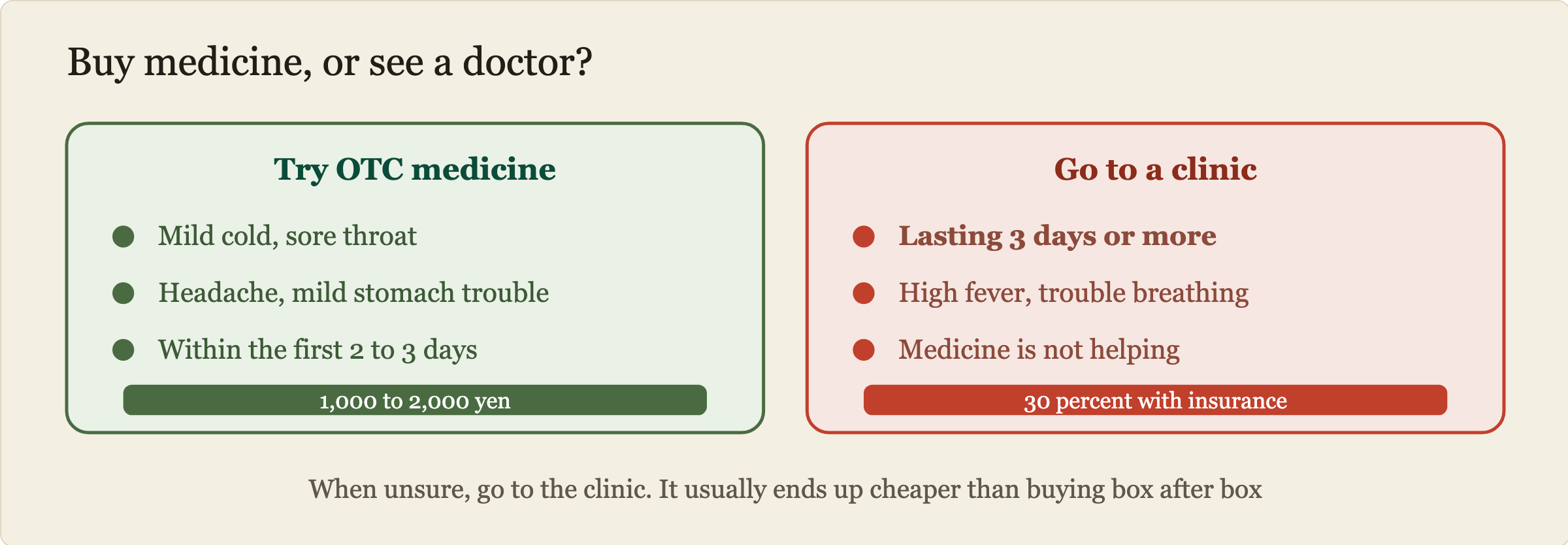
How to choose a clinic and which department to visit is covered in our guide to seeing a doctor in Japan. If you do not have an insurance card yet, sort out national health insurance first – without it the same appointment costs more than three times as much.
This article explains the rules and is not medical advice. Ask a pharmacist when choosing medicine, and a doctor when you are worried about your health. Reference (official): Ministry of Health, Labour and Welfare
Frequently asked questions
Q. Can I bring cold medicine from my home country?
Ordinary over-the-counter medicine is fine up to a two month supply. Anything containing pseudoephedrine (Sudafed, Actifed, Vicks inhalers) cannot be brought in, even with a prescription. Check the ingredient list before you fly.
Q. Can under 18s buy cold medicine at all?
Yes, but since May 2026 only one small pack of five to seven days at a time. Your ID is checked for age and name, and you may be asked whether you have bought the same thing elsewhere. It applies to every customer equally.
Q. Can I buy medicine if I do not speak Japanese?
Yes. Showing a note with your symptoms, pointing at where it hurts, or showing a translation app all work fine. Buying online is harder, because the video call with a pharmacist is in Japanese, so a shop is usually the easier option.
Q. Japanese medicine does not work for me. Can I take more?
No. Japanese OTC products deliberately use smaller doses, which is why they feel weak if you are used to stronger medicine. Taking extra is dangerous. If it is not working, see a doctor instead.
Q. Is it cheaper to buy medicine or see a doctor?
A box costs 1,000 to 2,000 yen, but buying repeatedly adds up. With national health insurance a clinic visit costs you 30 percent, so anything lasting three days or more is cheaper and more reliable at the clinic.
Summary
- Cold medicine with pseudoephedrine cannot be brought in, prescription or not
- More than a month of prescription medicine needs an import certificate, two weeks ahead
- Since May 2026, under 18s get one small pack and ID is checked
- Online buying needs a video call in Japanese at any age – a shop is easier
- Japanese medicine is deliberately mild. Never take extra to compensate
- Three days or more means a clinic. With insurance it costs you 30 percent
Related guides
Found this useful? Share it
Send it to a friend who lives in Japan.
WHO WROTE THIS

mori
Japanese. I read the ministries’ own notices, orders and Q&As in the original, and I start from what my Nepalese and Sri Lankan friends in Japan actually ran into. I do not write about what I have not checked or been told.
What this site can and cannot do →Looking for something else?