Figures, prices and terms were checked against Articles 26, 28 and 32 of the Act on Land and Building Leases and Article 24-2 of the Civil Conciliation Act on 30 October 2026. They change — check the current terms yourself before you sign up or file anything.
This article contains affiliate links.
Last updated: 30 October 2026
In short
- Your landlord cannot raise your rent unilaterally. If the two of you cannot agree, you first go to mediation at the summary court, and only then to a lawsuit (Civil Conciliation Act, Art. 24-2).
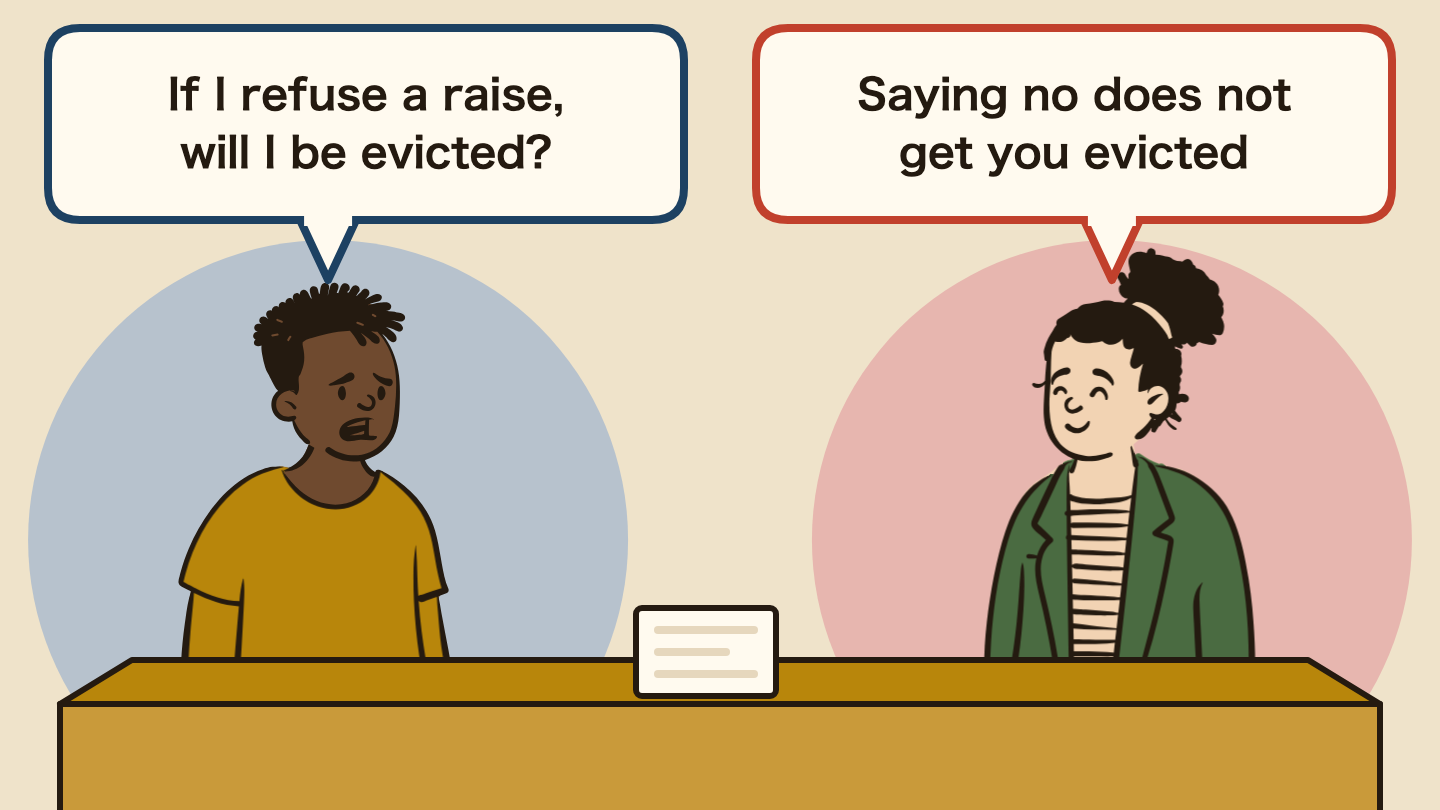
- You are strongly protected by the Act on Land and Building Leases. Saying no does not get you evicted.
- If you do not agree, paying your current rent is enough until a court decides. But if the court rules the increase is justified, you pay the shortfall plus 10% interest a year.
- Three things matter most: do not sign anything on the spot, check your contract, and keep a record of every exchange.
- The same goes for an increase at renewal. Without notice, the lease renews on the current terms, and the landlord needs justifiable grounds to refuse renewal.
- That said, if the reason is reasonable and cheaper than moving, accepting it can be the smart choice. The decision is yours.
Knowing this, when the rent-increase letter arrives you sign nothing in a panic – because you know your current rent is enough until the matter is settled.
- Bottom line first: your landlord cannot decide a rent increase alone
- Why rent increases are becoming more common
- 5 steps for when a rent increase notice arrives
- Is there a reason for the increase?
- If you are told “no renewal unless you pay more”
- When talks do not settle it: conciliation, and depositing your rent
- Say no, or accept? The choice is yours
- Frequently asked questions
- Summary
- Related guides
Bottom line first: your landlord cannot decide a rent increase alone
Many students worry about the same two things. The landlord suddenly says the rent is going up. Saying no feels like it could get you kicked out. You can relax: in Japan, tenants are protected by strong, specific law.
Under the standard fixed-term-free lease (futsu shakka keiyaku) that most renters have, changing the rent starts with a discussion with your landlord. Your landlord may announce a higher rent. If you tell them you do not agree, the increase is not settled on the spot. If you still cannot agree, it goes to court mediation first, then to a lawsuit.
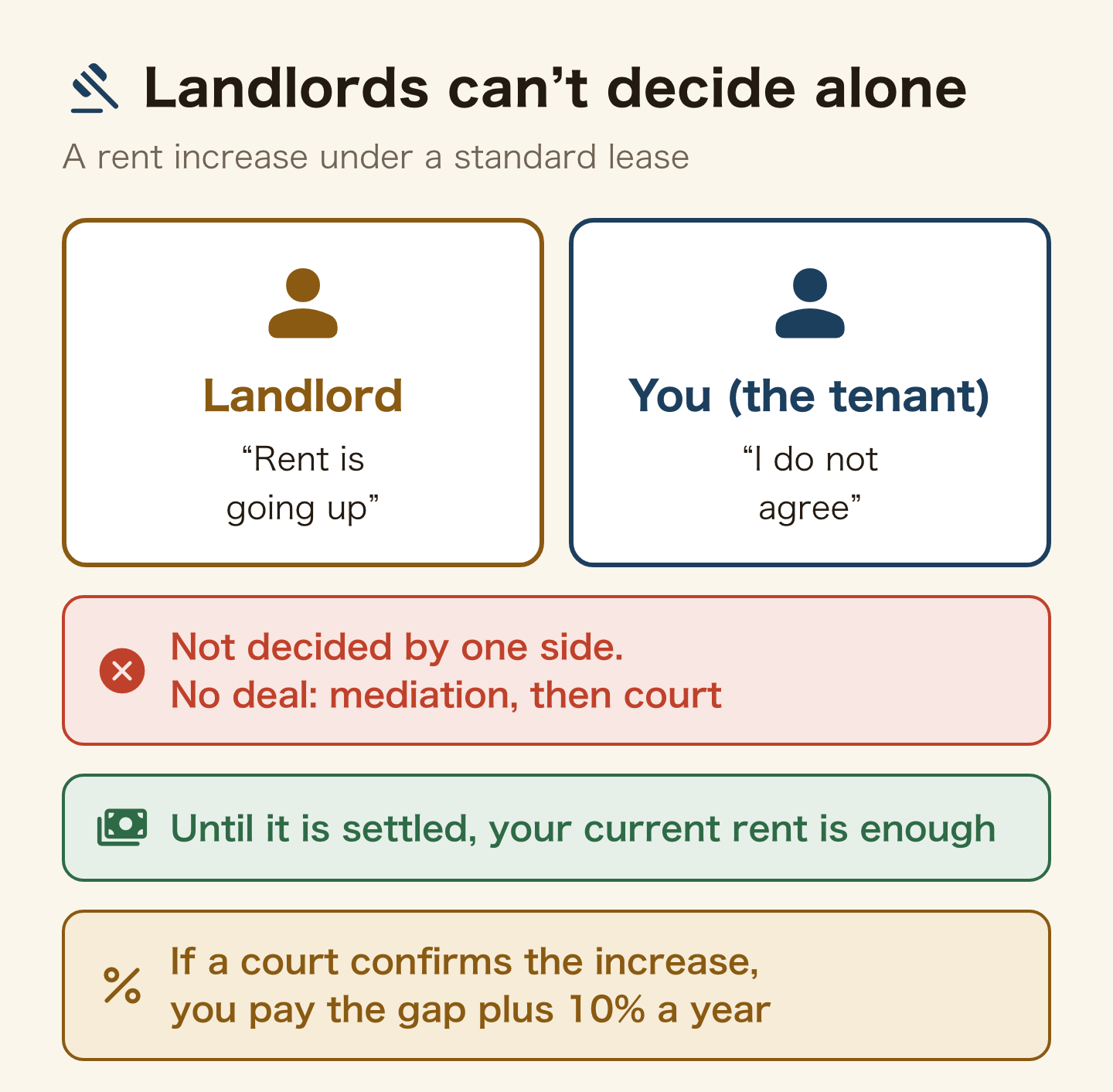
The law behind this is the Act on Land and Building Leases (shakuchi shakka ho). Under Article 32, if you and the landlord cannot agree, you only have to pay what you consider a fair amount until a court rules that the increase is justified. Usually that is your current rent. But if the court confirms the increase, you must pay the shortfall plus interest of 10% a year. Landlords do sometimes win these cases, so your current rent is not guaranteed forever.
Why rent increases are becoming more common
Rents are climbing across Japan. The drivers include:
- Rising land prices and property taxes: landlords face higher holding costs (land prices: Ministry of Land, Infrastructure, Transport and Tourism, 2026 official land prices, in Japanese)
- Higher construction and labor costs: new-build rents go up, and existing units follow
- Demand in major cities: vacancies are shrinking in places like Tokyo and Osaka, pushing rents higher
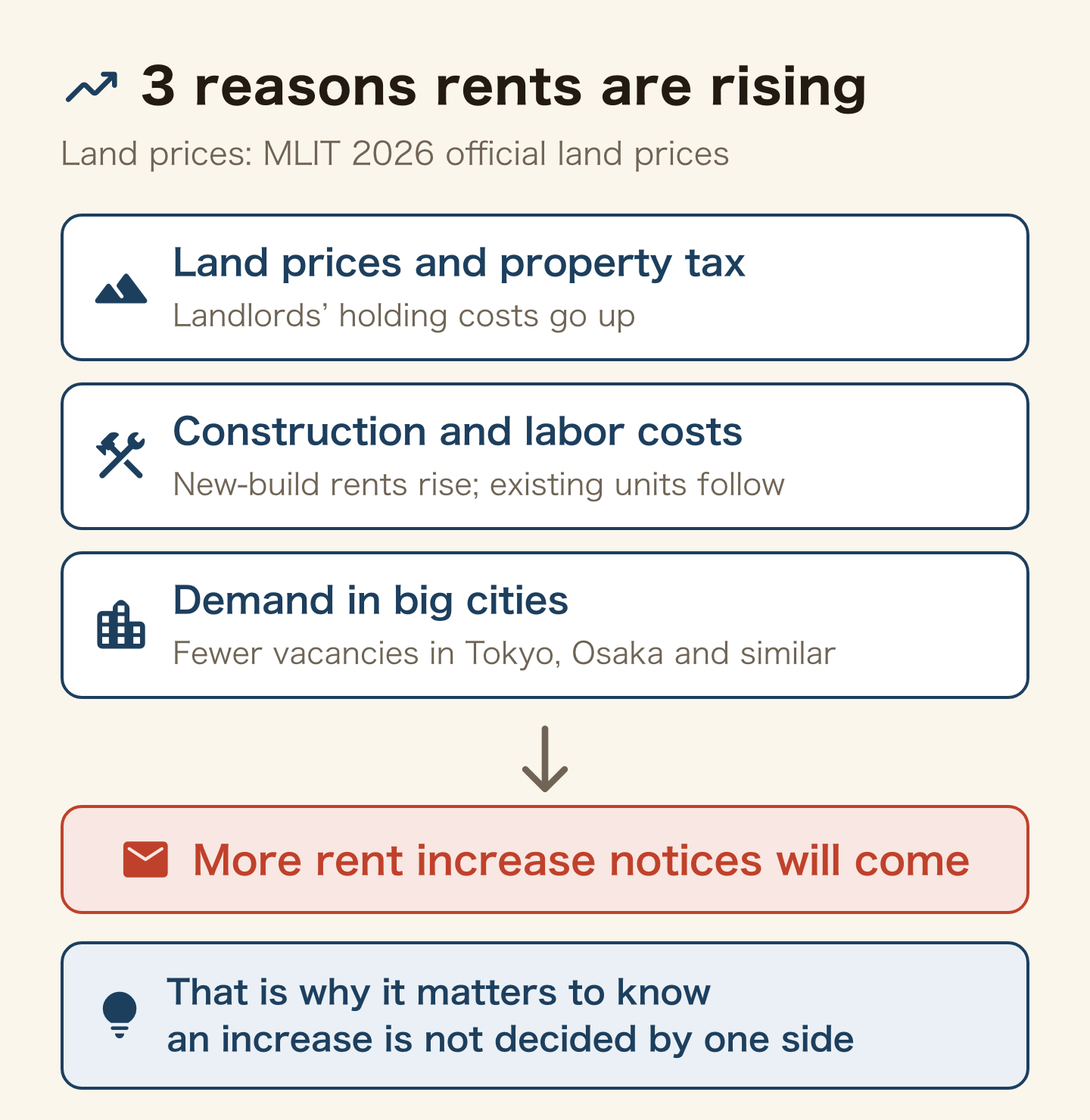
In other words, rent increase notices are only going to become more common. That is exactly why knowing that an increase is not decided by one side matters.
5 steps for when a rent increase notice arrives
Your landlord hands you a notice saying the rent is going up, and you sign it there and then. Where you come from, a tenant may simply have to accept whatever rent the landlord sets. In Japan, the landlord cannot set a new rent alone, and your signature is treated as agreement, which is hard to take back later.
If you actually receive a “we are raising your rent” notice, work through these steps calmly, in this order.
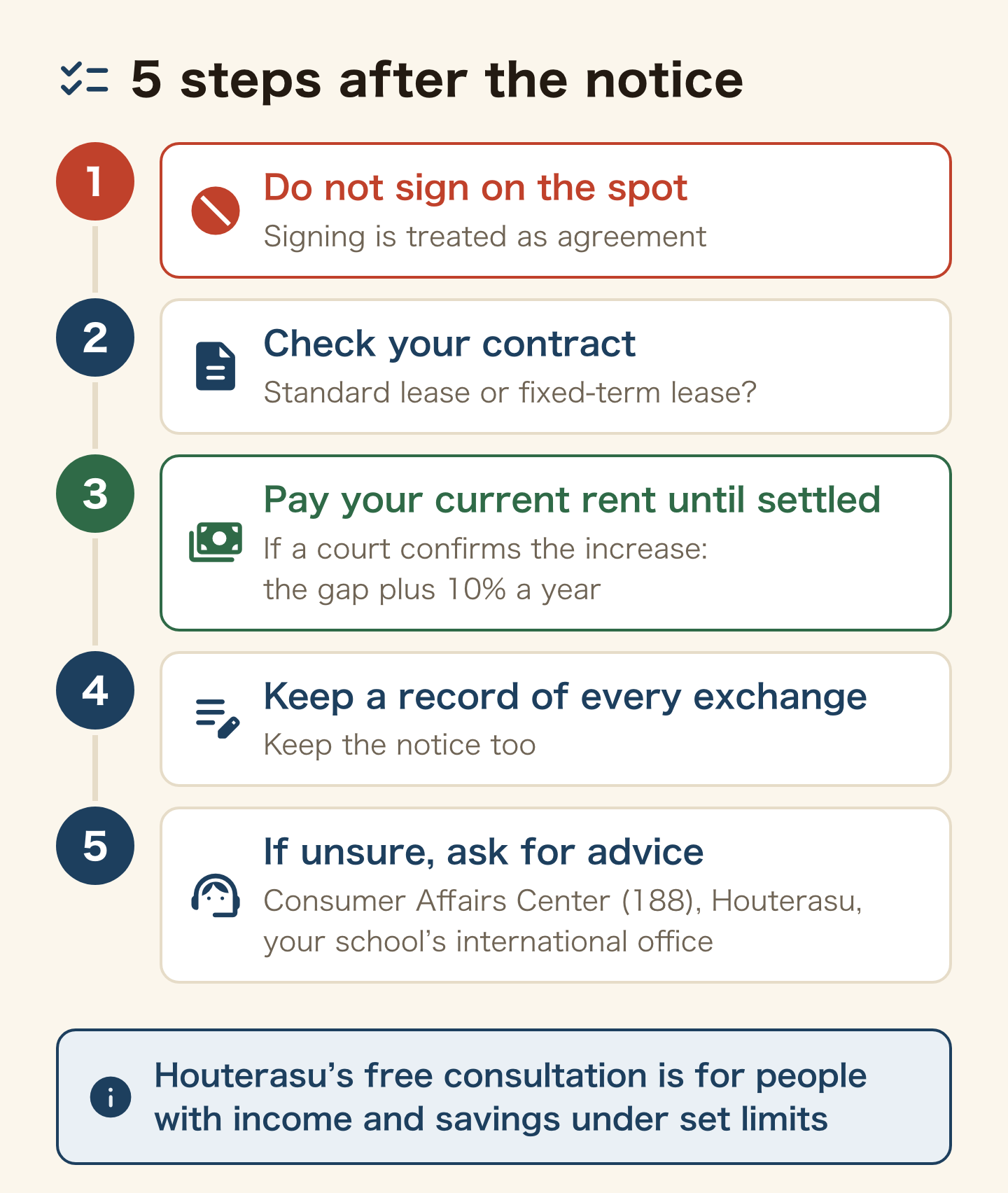
Step 1, do not sign anything on the spot, matters most. Signing a notice or a consent form gets treated as agreement, which is hard to reverse later. It is fine to simply say “let me check and get back to you.” A lease is not covered by Japan’s 8-day cooling-off rule (the covered transactions are listed by the National Consumer Affairs Center: cooling-off, in Japanese), so the only safe moment to stop is before you sign.
Is there a reason for the increase?
The letter may only say “due to various circumstances.” You do not have to stop there. Article 32(1) of the Act on Land and Building Leases lists three situations in which a rent increase can be requested.
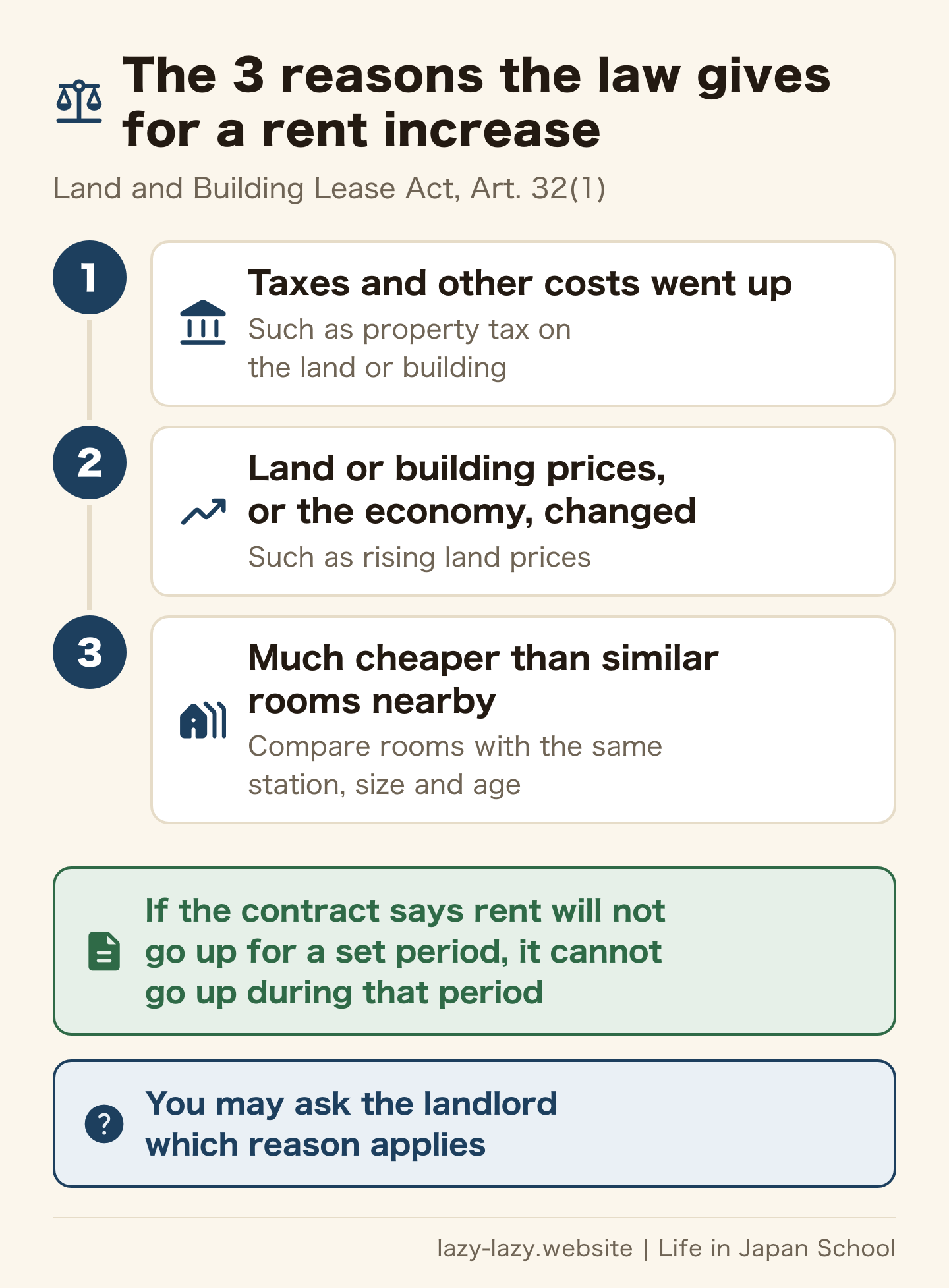
You can check the third one yourself. On an apartment search site, look at about five rooms near the same station, of a similar size and age, and note their rent. If your current rent is not lower than theirs, the case for an increase is weaker. Save the screens so you can show them when you talk.
Read your contract again too. If it promises that the rent will not go up for a set period (a special clause), the landlord cannot request an increase during that period (the proviso to the same Article 32(1)).
To ask for the reason politely, you can say:
- 「値上げの理由を、教えていただけますか。」 (Neage no riyū o, oshiete itadakemasu ka.) Could you tell me the reason for the increase?
- 「近くの同じような部屋の家賃と、比べた資料はありますか。」 (Chikaku no onaji yō na heya no yachin to, kurabeta shiryō wa arimasu ka.) Do you have anything comparing it with similar rooms nearby?
- 「少し考えたいので、お返事は来週でもいいですか。」 (Sukoshi kangaetai node, o-henji wa raishū demo ii desu ka.) I would like some time to think. May I reply next week?
If you are told “no renewal unless you pay more”
Shortly before a two-year contract ends, renewal papers arrive with a new rent written on them. An increase often comes up at this point. For an ordinary lease, the law has rules here as well.
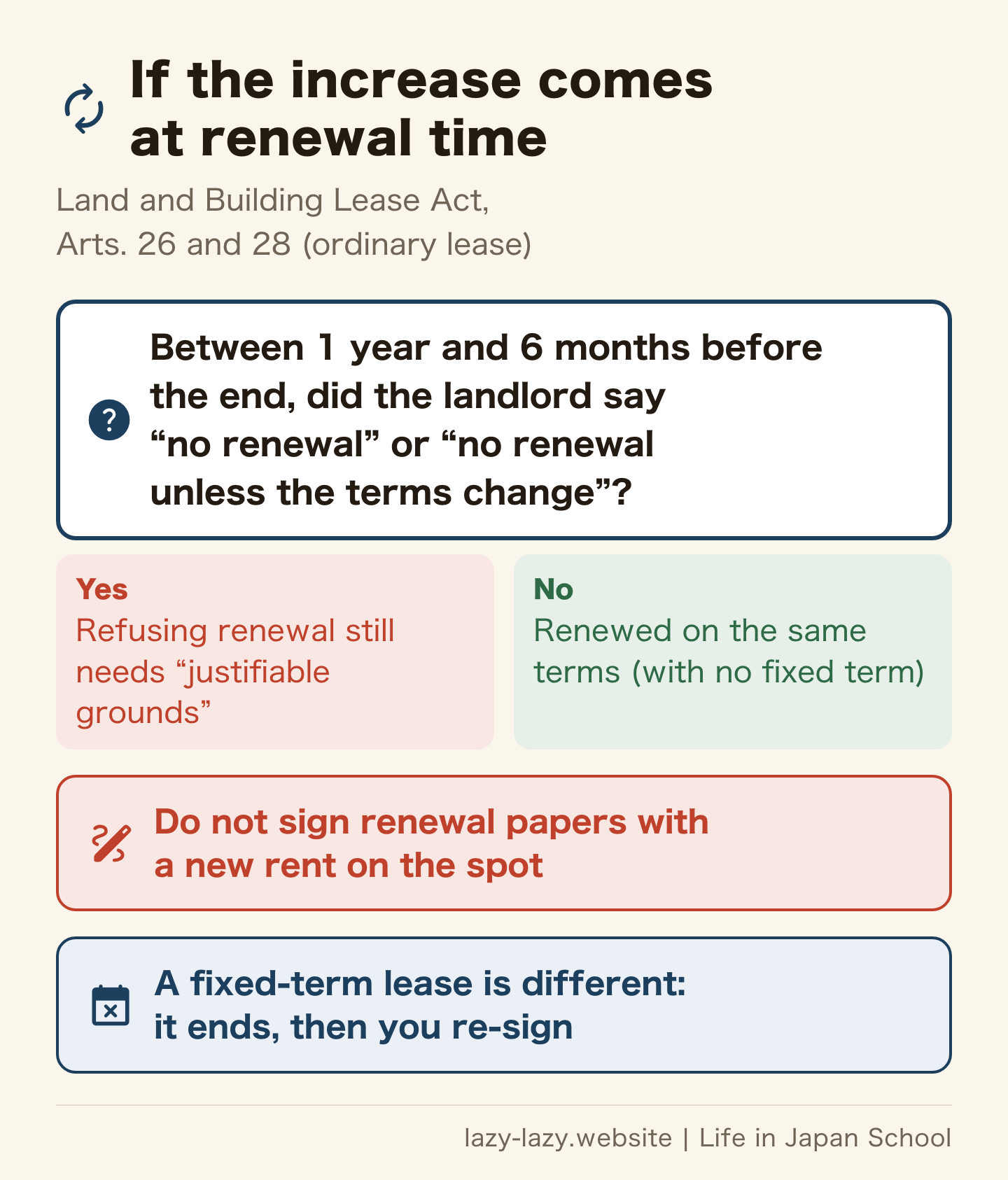
Under Article 26, if the landlord does not tell you, in the window from one year to six months before the end of the term, that they will not renew, or will not renew unless the terms change, the lease is treated as renewed on the same terms (though the renewed lease no longer has a fixed term). Even with such notice, if you keep living there after the term ends and the landlord does not object without delay, the result is the same.
Even when notice was given, the landlord needs “justifiable grounds” to refuse renewal (Article 28). This is judged by weighing how much the landlord and the tenant each need the building, the history of the lease, the state of the building and similar factors. The law does not say you must leave at once because you did not accept an increase.
So do not sign renewal papers with a new rent on the spot. Signing means you agree to the new rent. A fixed-term lease ends and is followed by a new contract, so it works differently (see the FAQ below).
When talks do not settle it: conciliation, and depositing your rent
“Court” sounds frightening, but a rent increase does not normally go straight to court. Under Article 24-2 of the Civil Conciliation Act, conciliation (a mediated discussion at the summary court) must come first, before a lawsuit.
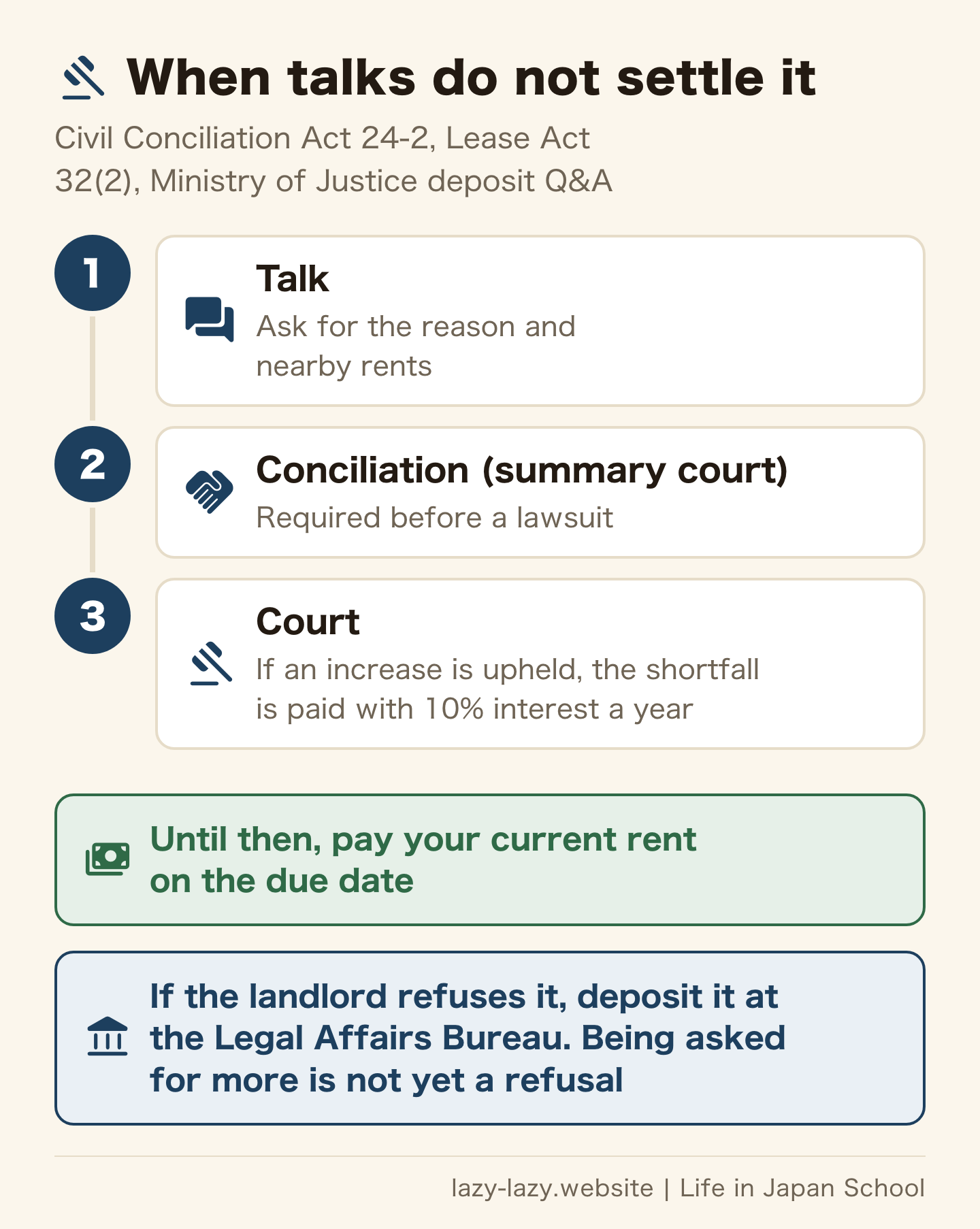
Meanwhile, keep paying your current rent on the due date. If you stop paying, you fall into rent arrears, which is a separate problem from the increase.
Sometimes a landlord refuses to accept the current rent and says they will only take the new amount. In that case you can deposit the rent with the Legal Affairs Bureau (供託, kyōtaku). However, according to the Ministry of Justice deposit Q&A (Q23, Japanese), simply being asked for more rent does not yet count as a refusal. First try to pay your current rent on the due date. If the landlord still will not accept it, then you deposit it. You can do this at the bureau counter or online.
Say no, or accept? The choice is yours
So far this has been about why the landlord cannot decide alone – but accepting can sometimes be the better deal. Use this logic to decide.
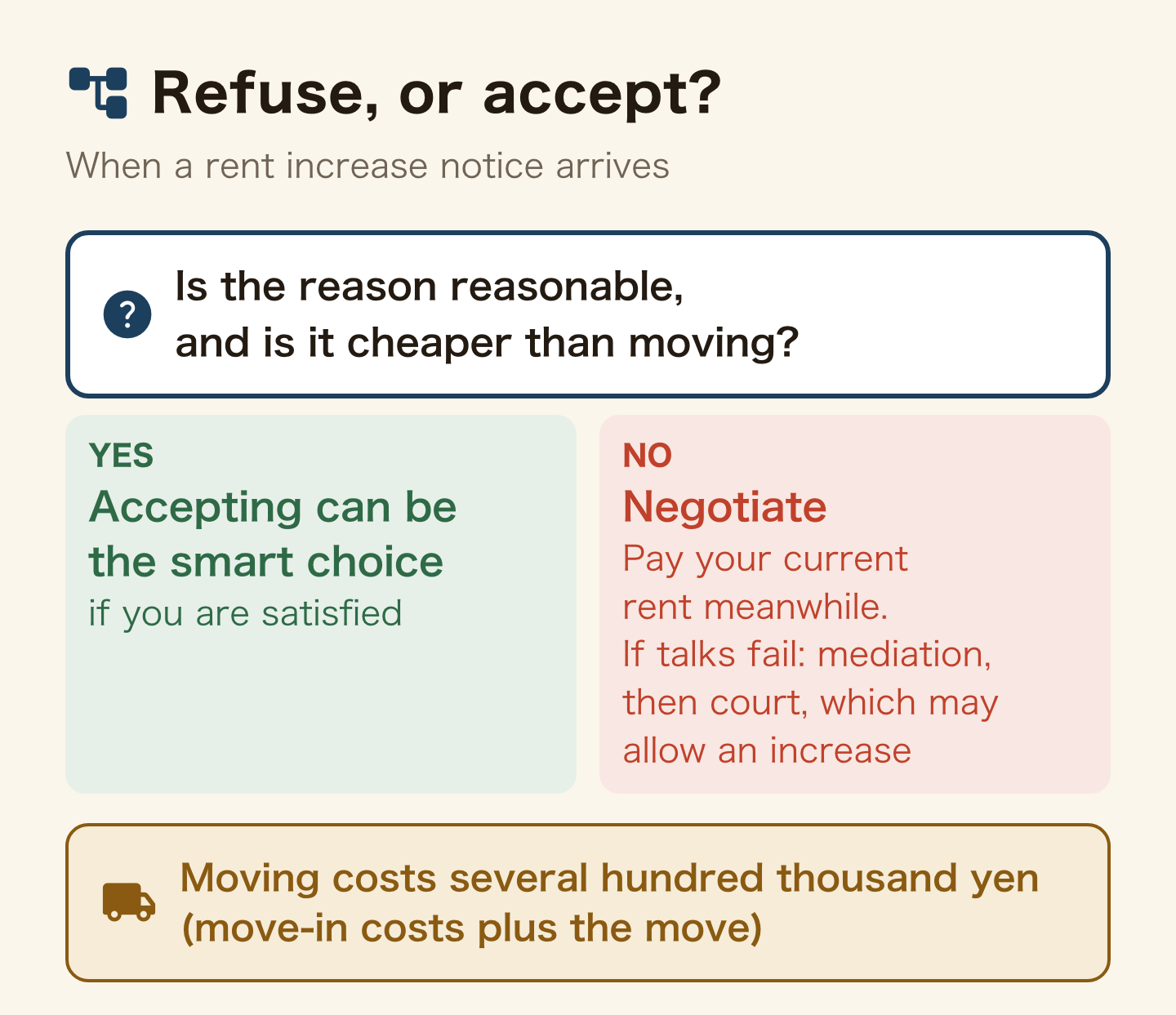
Moving comes with move-in costs (deposit, key money, agency fees) plus the cost of the move itself, often several hundred thousand yen in total. Move-in costs alone are typically 4 to 7 months’ rent, according to the MLIT apartment-hunting guidebook (PDF, Japanese), p.8. A small increase can genuinely be cheaper to accept than to move away from. On the other hand, if the increase is large or the reason is unclear, negotiate. If talks fail it can go to court, and the court may allow an increase. The first step is always a discussion between the two of you – meaning the final call belongs to you.
Official sources: Act on Land and Building Leases (e-Gov, Japanese) / MLIT: 2026 official land prices (Japanese) / National Consumer Affairs Center: cooling-off (Japanese) / MLIT apartment-hunting guidebook (PDF, Japanese) / Houterasu: free legal consultation (Japanese) / Civil Conciliation Act (e-Gov, Japanese) / Ministry of Justice deposit Q&A (Japanese) (checked 30 October 2026)
Frequently asked questions
Q. If I refuse the increase, will I be evicted?
No. Under a standard lease, refusing a rent increase alone is not grounds for forced eviction. If you cannot agree, paying your current rent is enough until a court decides (Article 32 of the Act on Land and Building Leases).
Q. I was asked to sign a rent increase notice.
Do not sign it on the spot. Signing gets treated as agreement. Say “let me check the details and get back to you,” then review your contract and where to get advice.
Q. If I refuse, which rent amount should I pay?
Until a court decides, you pay what you consider a fair amount, which is usually your current rent (Article 32(2)). If the court confirms the increase, you pay the shortfall plus interest of 10% a year. If the landlord refuses to accept the payment, there is a legal deposit procedure (kyotaku) through the Legal Affairs Bureau. If you are unsure, contact a Consumer Affairs Center or Houterasu.
Q. Does a fixed-term lease work differently?
Yes. A fixed-term lease (teiki shakka) ends at a set date, and terms can change when you sign a new contract. If a fixed-term lease has a clause on how the rent is revised, the Article 32 rule that lets you pay what you consider fair until a court decides does not apply (Article 38(9)). Check your own contract first to see whether you have a standard lease or a fixed-term one. A fixed-term lease is re-signed rather than renewed, with its own rules for leaving early, set out in fixed-term vs standard leases and renewal fees.
Q. Where can I get advice?
Your municipal Consumer Affairs Center (call 188) and your school’s international student office offer free consultations. Houterasu (Japan Legal Support Center) offers free legal consultations to people whose income and savings are under set limits (Japanese). Bring your evidence – the notice and any records of communication – when you go.
Summary
- Your landlord cannot decide a rent increase alone. If you cannot agree, a court decides
- You are protected by the Act on Land and Building Leases. Saying no does not get you evicted
- Until it is settled, your current rent is enough. If the increase is confirmed, you pay the gap plus 10% a year
- Follow three rules: do not sign, check your contract, keep a record
- The law gives three reasons for an increase. Check the rent of similar rooms nearby yourself
- At renewal too, do not sign on the spot. If you cannot agree, conciliation comes first
- Whether to accept is your call, weighed against the cost of moving. If unsure, call 188
Related guides
Found this useful? Share it
Send it to a friend who lives in Japan.
WHO WROTE THIS

mori
Japanese. I read the ministries’ own notices, orders and Q&As in the original, and I start from what my Nepalese and Sri Lankan friends in Japan actually ran into. I do not write about what I have not checked or been told.
What this site can and cannot do →Looking for something else?
You may use the figures in this article, including commercially, if you credit this site with a link. How to use our figures