Checked on 30 September 2026 against the Immigration Control Act on e-Gov, the Immigration Services Agency’s official Q&A pages and procedure pages, and the lost-property pages of the Tokyo Metropolitan Police and the National Police Agency.
The short answer
- You renew your passport at your own country’s embassy or consulate in Japan, not at a Japanese city office or Immigration.
- A new passport does not change your residence card. The card has no passport number on it, so there is nothing to tell Immigration. The exception: if your name, date of birth, sex or nationality changed, notify Immigration within 14 days.
- Keep the old passport and carry both. If a re-entry permit or other stamp is in the old one, having both passports is enough for every procedure.
- Lost it in Japan? Police first (a lost-property report at any police box), then your embassy. If your residence card went with it, apply for a new card at Immigration within 14 days.
- The document you must always carry is the residence card. While you carry it, the passport can stay at home.
Knowing this, you skip a pointless trip to Immigration, and if the passport is lost you go to the police, the embassy and Immigration in the right order. Before a trip home, you will also know which of your two passports to take.
Six months left on your passport. You collect the new one at your embassy, and on the way home the questions start. Do I need a new residence card? Do I have to report this to Immigration? Can I throw the old passport away? You ask a Japanese friend, and they have no idea. A Japanese passport has nothing to do with residence cards or re-entry permits.
- Where do I renew my passport in Japan?
- New passport — does my residence card change?
- What do I do with the old passport?
- Does a new passport affect my re-entry permit?
- What should I do if I lose my passport in Japan?
- Do I need to carry my passport in Japan?
- What documents and fees are involved?
- My passport expired and the new one is not ready — what now?
- What if I break the rules?
- Which one are you?
- Frequently asked questions
- Summary
- Related reading
Where do I renew my passport in Japan?
Your passport is issued by your own government, so no Japanese office can make one. Renewal, and a replacement after a loss, both happen at your country’s embassy or consulate in Japan.
The Immigration Services Agency’s Living and Working Guidebook says the same thing for babies born in Japan: the child’s passport comes from the embassy or consulate of the parents’ country.
Documents, fees and waiting times differ from country to country, so they are not covered here. Check your embassy’s own page. This guide covers the Japanese side: what happens after you have the new passport in your hand.
New passport — does my residence card change?
No. The Immigration Control Act lists what goes on a residence card: name, date of birth, sex and nationality; address; status and period of stay; card number; work restrictions and a few other items (Article 19-4). There is no passport number. A new passport leaves the card exactly as it was.
Even when a mid- to long-term resident’s stay is extended, no sticker goes into the passport; you just get a new residence card (residence management Q&A, Q17). Think of your status as living on the card, not in the passport.
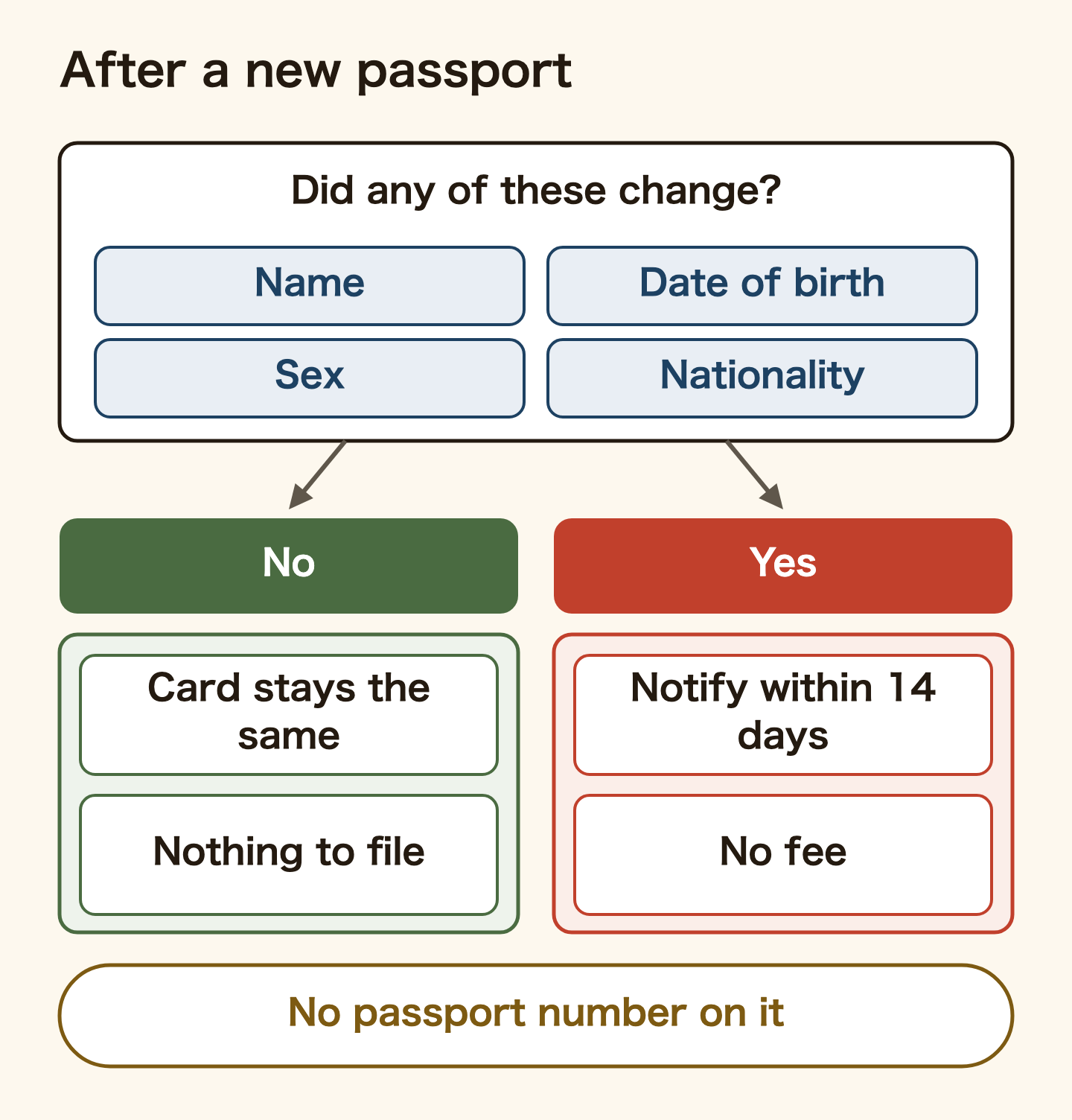
You only have to file something when one of the four items on the card changes: name, date of birth, sex, or nationality/region. You married, took your spouse’s surname and got a passport in the new name. You changed nationality and now hold another country’s passport. In those cases, notify the regional immigration office for your address within 14 days of the change. There is no fee (notification of change in particulars other than address).
Bring the notification form, one photo, proof of the change, your passport and your residence card. For a name change by marriage, the proof is the passport in your new name and the marriage certificate. Immigration warns that if you have not had your passport corrected or reissued first, the new card may not be issued the same day. So: embassy first, then Immigration.
What do I do with the old passport?
The old passport may still hold your landing permission or a re-entry permit stamp. Asked about going through the airport with two passports, the agency’s Q&A answers that if you bring both the old and the new passport, every procedure can be done without any problem (immigration and residence Q&A, Q14).
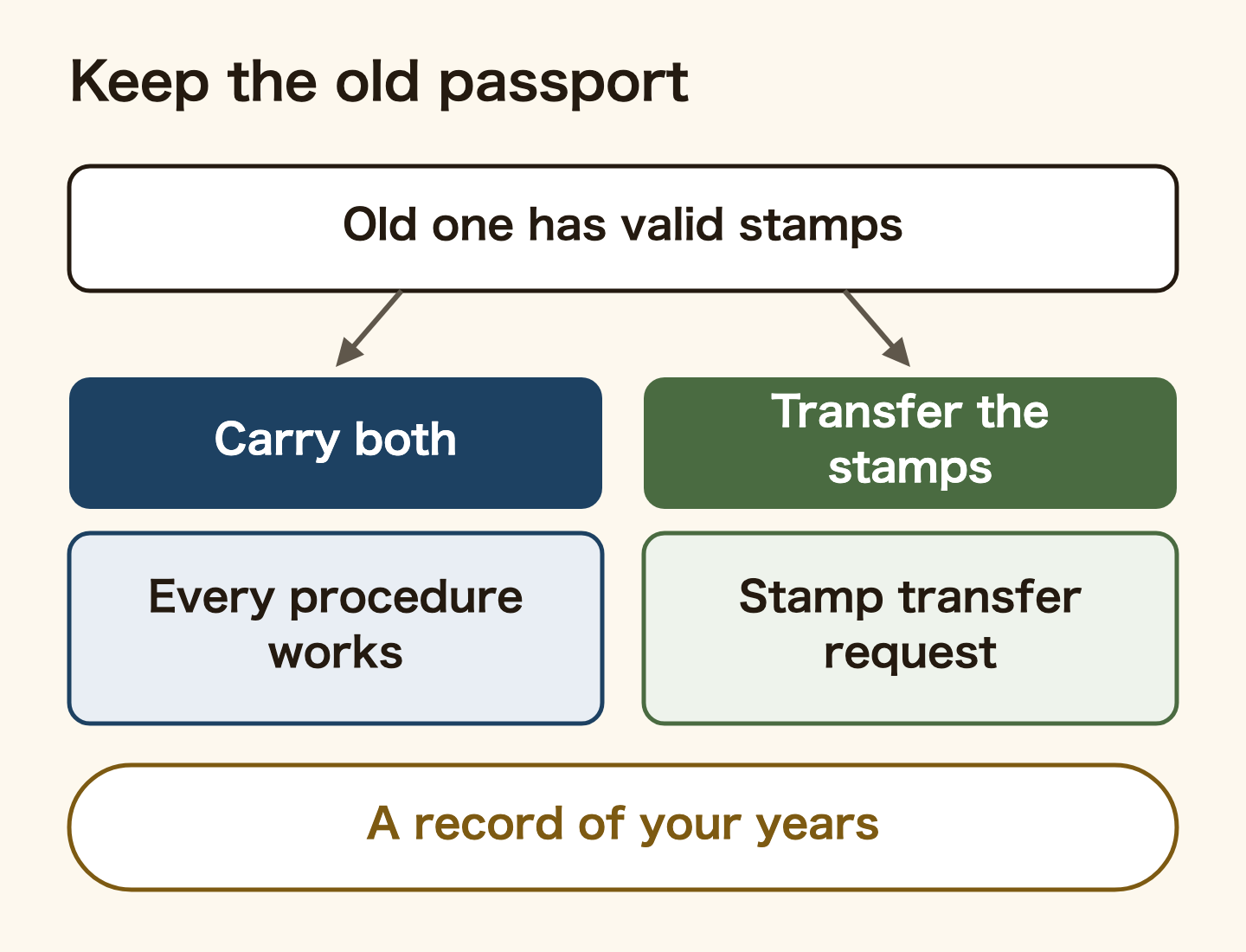
If you would rather have one passport, you can move the stamps. This covers stamps in the old passport that are still valid: landing permission, re-entry permit, permission to work outside your status and similar (the residence permission stamp is excluded for residence card holders). Submit a stamp transfer request (shoin tenki negaidesho) at the regional immigration office for your address, and bring both passports. Whether to transfer is up to you.
Keep the old passport even if it has no valid stamps. Your residence card does not show the date you first landed in Japan. The agency says you can keep track of your years in Japan by holding on to the passport with your landing stamp (residence management Q&A, Q45). Those years matter when you count toward the residence requirement for permanent residency.
Does a new passport affect my re-entry permit?
Special re-entry permission (minashi sainyukoku) lets you leave and come back within one year of departure without any application, as long as you hold a valid passport and your residence card. If your period of stay ends sooner than one year, the deadline is the end of your stay (special re-entry permission).
The requirement is a valid passport, so leaving on the new one is enough. Nothing needs to be moved from the old passport.
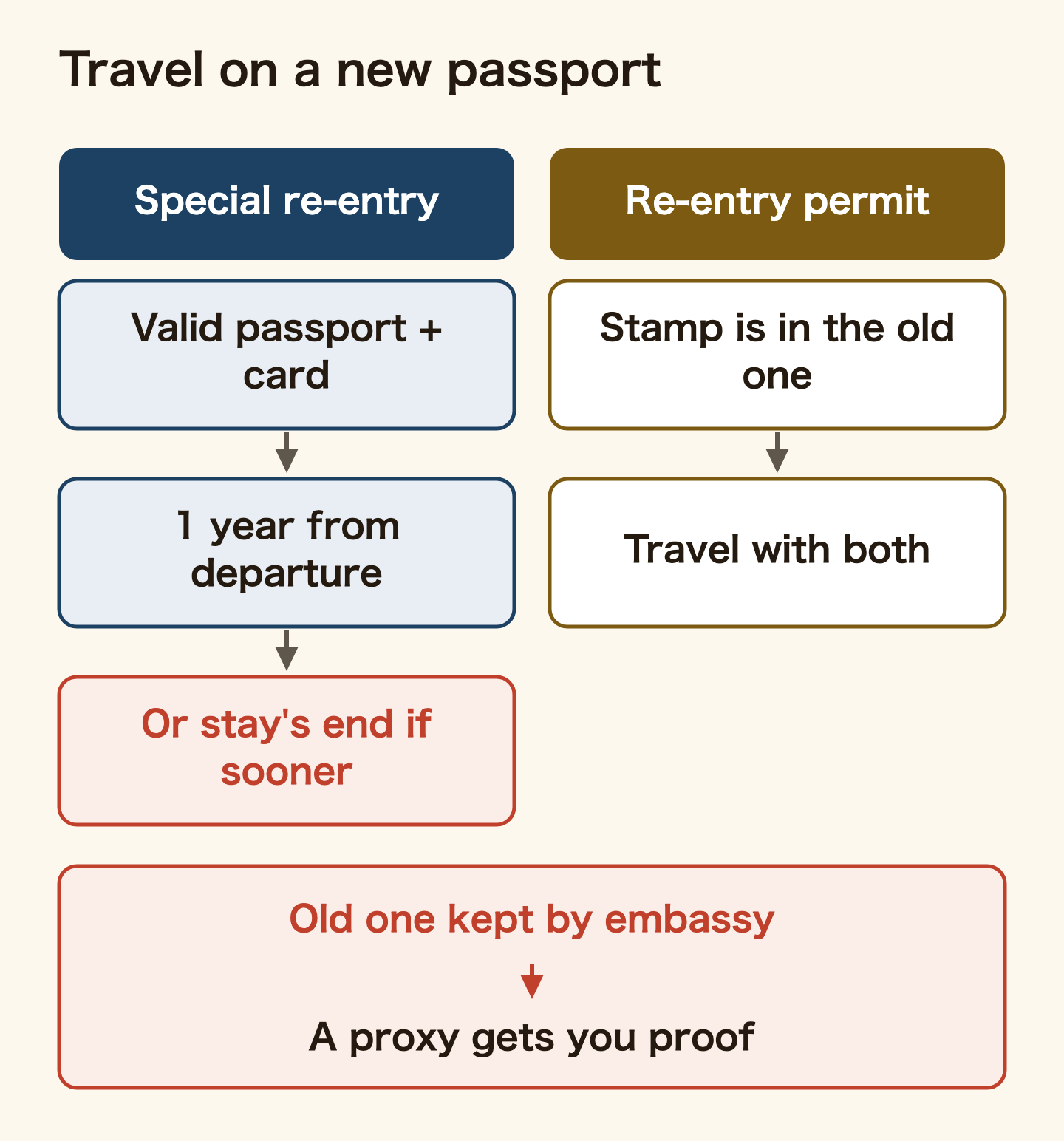
The people who need to be careful are those holding a regular re-entry permit from Immigration. That permit is stamped into whichever passport you had at the time. After renewing, take the old passport with you when you leave and when you come back. Or transfer the stamp to the new one.
If you renew while abroad and the old passport is taken back when the new one is issued, you no longer carry anything showing you can re-enter Japan. A proxy in Japan (a relative living with you, or someone holding your letter of authorisation) can submit a request for a certificate of your re-entry permit deadline at the regional immigration office for your address (re-entry permit page).
What should I do if I lose my passport in Japan?
Start with the police. You can file a lost-property report (ishitsu todoke) at any police station or police box (koban); the Tokyo Metropolitan Police says any station or box will do. In Tokyo, if the lost items include less than 1 million yen in cash, you can also file online.
There are two reasons to go to the police first. One: if someone hands the passport in, the police can match it to your report and contact you. According to the National Police Agency, found items are kept for three months, and without a report they may not be able to reach you. Two: if your residence card was lost too, Immigration needs the police report’s receipt number for the new card.
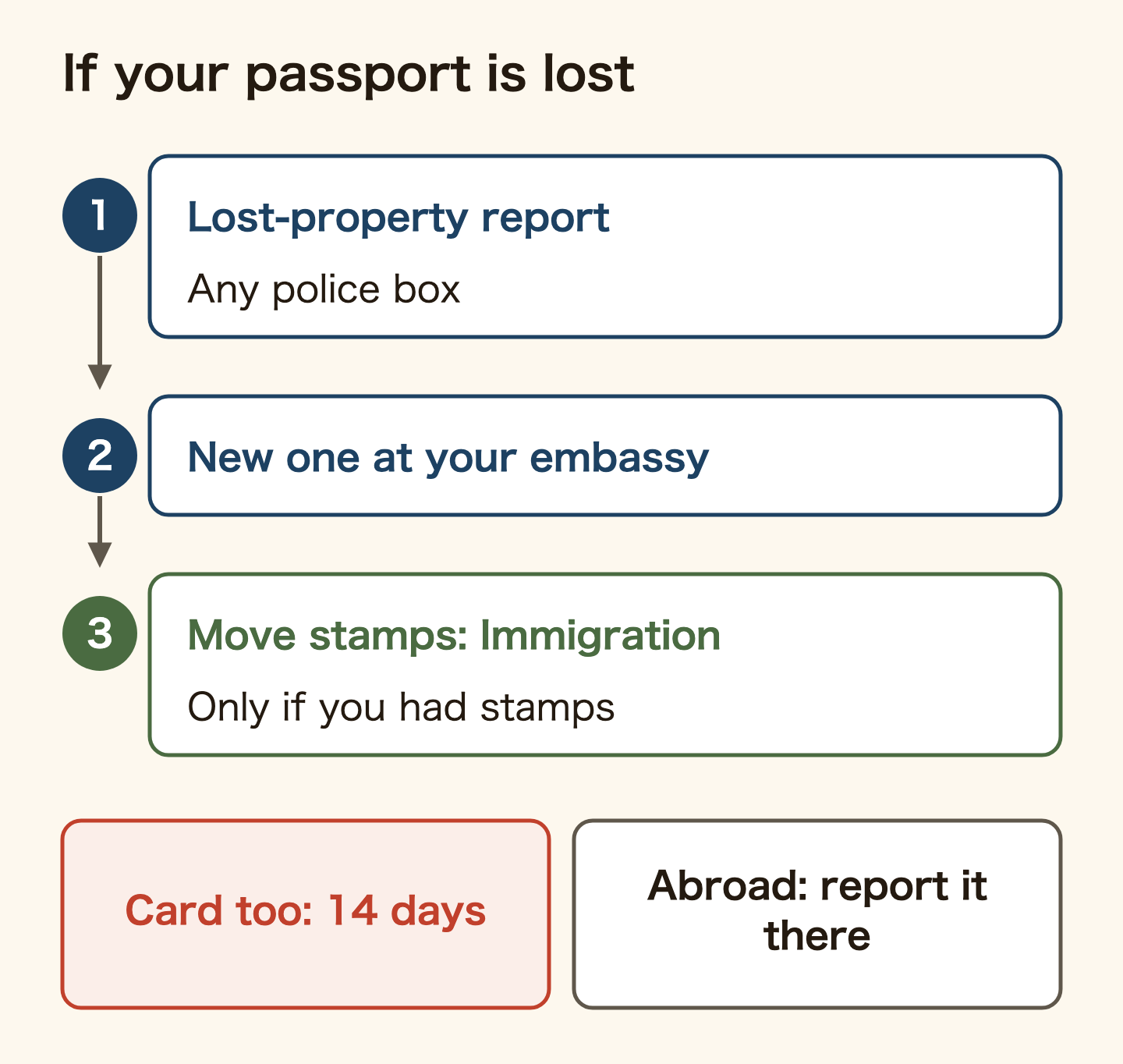
Then go to your embassy or consulate for a new passport and ask them what they need. The National Police Agency notes that a lost-property report records what you told them; it is not proof that you lost something. Your embassy may ask for other documents.
Once you have the new passport, you only need Immigration if the lost passport had valid stamps such as landing permission or a re-entry permit. The Q&A says to bring a certificate of loss or similar if you have one (Q29). As long as you still have your residence card, your status itself is unaffected.
If the residence card is gone too, apply for a replacement residence card within 14 days of finding out. There is no fee, and it is normally issued the same day. If you cannot show a passport at that point, you submit a written reason and another identity document (reissue of a lost residence card).
Lost it abroad? The Japanese police cannot take that report. The Tokyo police FAQ explains that Japan’s Lost Property Act covers only items lost within Japan’s territory and waters. Contact the body that handles lost property (the police, for example) in the country where you lost it. Proof that you can return to Japan can be obtained by a proxy, as described above.
Do I need to carry my passport in Japan?
Your passport is your ID, so it lives in your bag whenever you go out. Where you come from, that may be normal. In Japan, what a mid- to long-term resident must always carry is the residence card. The passport can stay at home.
The Immigration Control Act says foreign nationals in Japan must always carry their passport, and then exempts mid- to long-term residents who carry their residence card (Article 23; ISA, carrying a passport). Children under 16 do not have to carry either.
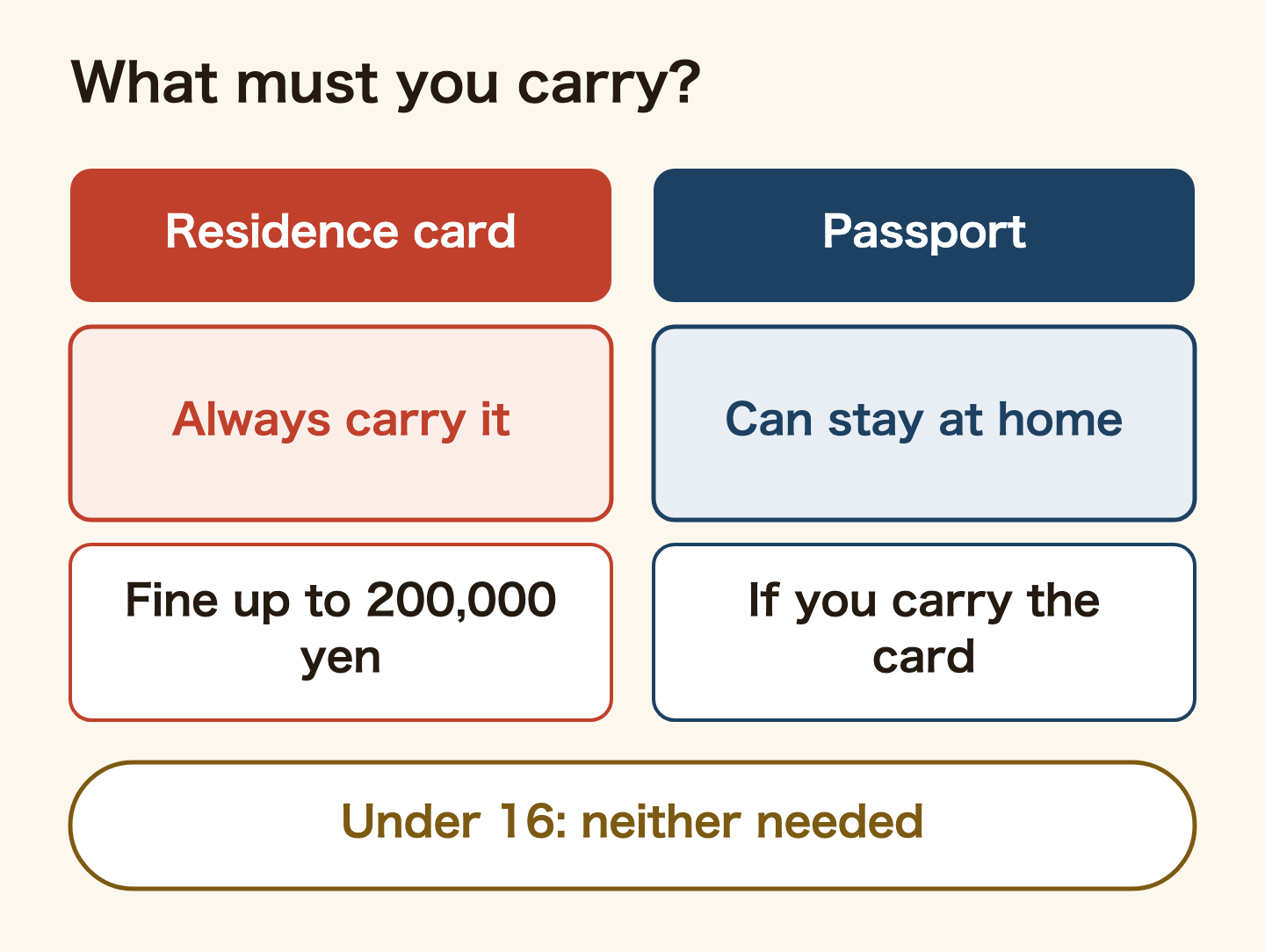
It does not work the other way round. Carrying your passport without the residence card still breaks the card-carrying rule (residence management Q&A, Q35). Once you know the residence card carrying rule, leaving the passport at home also removes most chances of losing it.
What documents and fees are involved?
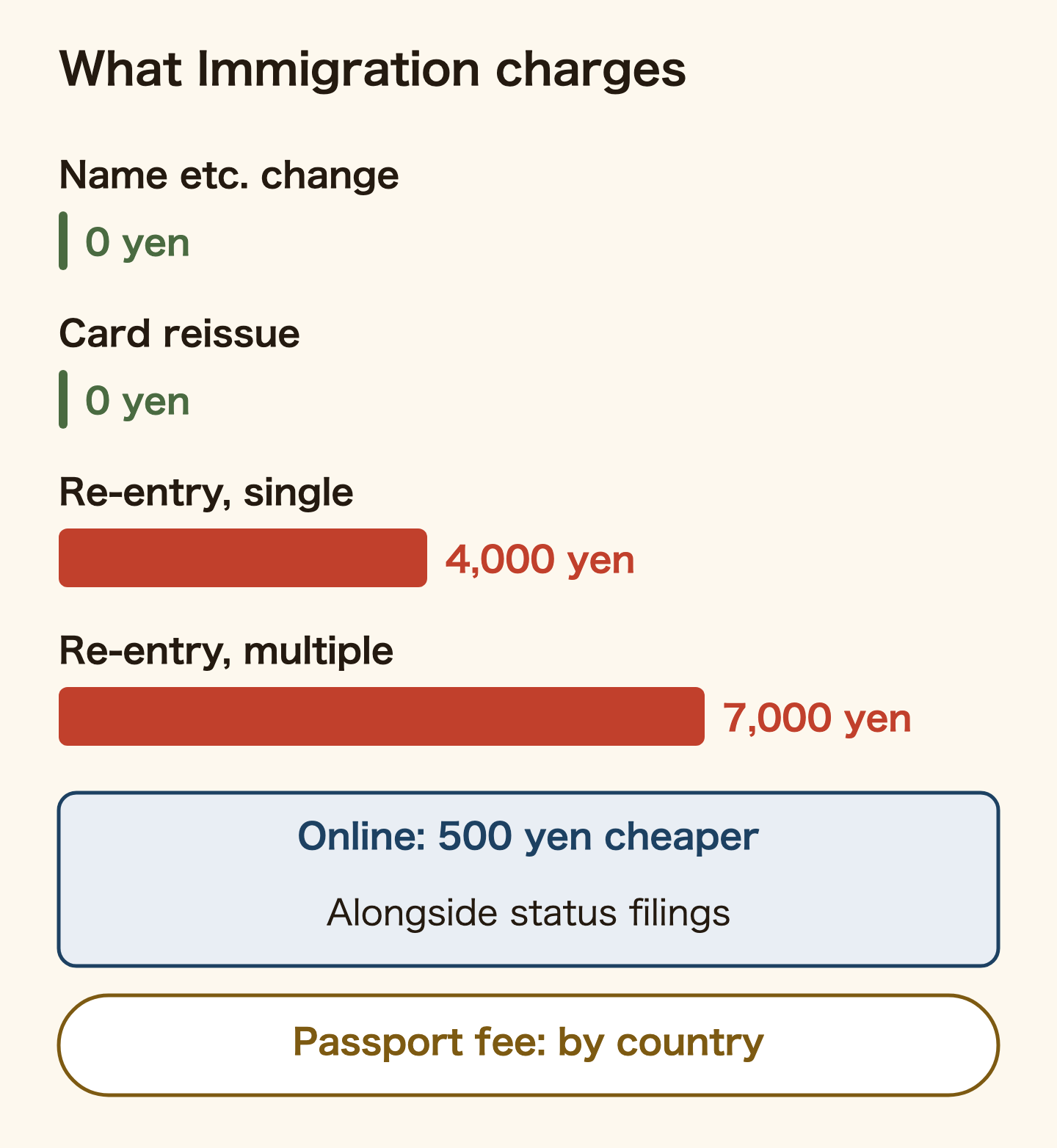
Of the Immigration procedures in this guide, the regular re-entry permit is the one with a set fee. Notifying a change in particulars and replacing a lost residence card are free. The passport itself costs whatever your country charges.
| Procedure | When | Main documents | Fee |
|---|---|---|---|
| Passport renewal or replacement | Near expiry, or after a loss | Ask your embassy | Set by your country |
| Change of particulars on the residence card | Within 14 days of the change | Form, photo, proof of change, passport, residence card | None |
| Stamp transfer | If you want it | Stamp transfer request, old and new passports | Not stated in the Q&A |
| Residence card reissue (lost) | Within 14 days of finding out | Form, photo, statement with police receipt number, passport | None |
| Re-entry permit | Before you leave | Form, residence card, passport | 4,000 yen (single) / 7,000 yen (multiple) |
Online, a re-entry permit costs 3,500 or 6,500 yen, but you can only apply online together with an extension of stay, a change of status or an acquisition of status (re-entry permit page).
My passport expired and the new one is not ready — what now?
Immigration applications such as a visa extension ask you to show your passport. If your embassy has not issued the new one in time and you cannot show it, you submit a written statement of the reason; the procedure pages include a form for this. Forgetting it at home does not count as a reason.
Some people cannot get a valid passport at all because of the situation in their country. The agency’s Q&A says that if the reason is reasonable, you can still apply for an extension of stay by explaining why you have no valid passport (Q80). Your deadline will not wait, so do not delay the application because the passport is missing.
Special re-entry permission, on the other hand, requires a valid passport. You cannot leave on it with an expired one.
What if I break the rules?
The penalties in the Immigration Control Act:
- Not carrying your residence card: a fine of up to 200,000 yen (Article 75-3)
- Not notifying a change of name, nationality etc. within 14 days: a fine of up to 200,000 yen (Article 71-5)
- Not carrying a passport when you are not someone who carries a residence card: a fine of up to 100,000 yen (Article 76)
Missing the 14 days does not close the door. Both the change notification page and the card reissue page say that after the deadline you add a document explaining the reason. Staying away because you are late is the worst option. Go to Immigration the day you notice.
Which one are you?
- New passport, same name and nationality — file nothing with Immigration. Keep the old passport with the new one instead of throwing it away.
- New passport in a new name after marriage — go to Immigration within 14 days of the change. Gather the passport and marriage certificate and pick the day today.
- Re-entry permit stamp in the old passport — take both passports on your next trip. If you want one book, pick a day to request a stamp transfer.
- Lost your passport in Japan — file a report at a police box today. Note the receipt number and ask your embassy what it needs. If the residence card is gone too, go to Immigration within 14 days.
Frequently asked questions
Q. Where do foreigners renew their passport in Japan?
At your own country’s embassy or consulate in Japan. City offices and Immigration cannot issue passports. Documents and fees vary by country, so check with your embassy.
Q. Do I need a new residence card after renewing my passport?
No. The residence card has no passport number on it, so you do not need to notify Immigration. You only notify within 14 days if your name, date of birth, sex or nationality changed.
Q. My re-entry permit is in my old passport. What should I do?
Carry both passports together, and procedures at the airport and at Immigration work as normal. If you want the stamp in the new passport, submit a stamp transfer request at the regional immigration office for your address.
Q. I lost my passport. Police or embassy first?
File a lost-property report at a police station or police box first, then get a new passport at your embassy. If you also lost your residence card, Immigration needs the police receipt number for the replacement.
Q. Do I have to carry my passport in Japan?
Mid- to long-term residents who carry their residence card do not have to carry a passport. The residence card itself must always be carried, with a fine of up to 200,000 yen if you do not. Children under 16 need to carry neither.
Q. Can I extend my visa if my passport has expired?
If you cannot show a passport, you apply with a written statement of the reason. Immigration says that people who truly cannot get a passport because of their country’s situation can still apply for an extension if the reason is reasonable. Special re-entry permission requires a valid passport, so it cannot be used with an expired one.
Summary
A new passport changes nothing on the Japanese side, because your status sits on the residence card, not in the passport. The only thing to file is a change of name, date of birth, sex or nationality, within 14 days. The old passport holds stamps and the record of your years in Japan, so keep it and carry both.
If the passport is lost: police box, then embassy, and Immigration within 14 days if the card went too. Carry the residence card day to day and leave the passport at home, and there are far fewer chances to lose it in the first place.
Official sources: e-Gov, Immigration Control and Refugee Recognition Act (Arts. 19-4, 19-10, 23, 26-2, 71-5, 75-3, 76) / Immigration Services Agency, immigration and residence Q&A (Q14, Q29, Q80) / residence management Q&A (Q17, Q35, Q45) / change of particulars other than address / special re-entry permission / re-entry permit / reissue of a lost residence card / carrying a passport (Art. 23) / Living and Working Guidebook / Tokyo Metropolitan Police, if you lost something / lost property FAQ / National Police Agency, what a lost-property report is (all in Japanese, checked 30 September 2026). For the passport itself, check with your own embassy or consulate.
Related reading
Found this useful? Share it
Send it to a friend who lives in Japan.
WHO WROTE THIS

mori
Japanese. I read the ministries’ own notices, orders and Q&As in the original, and I start from what my Nepalese and Sri Lankan friends in Japan actually ran into. I do not write about what I have not checked or been told.
What this site can and cannot do →Looking for something else?