Checked on 26 September 2026 against the government’s keigo guidelines (Council for Cultural Affairs), the Agency for Cultural Affairs’ Japanese-language opinion surveys (FY2024 and FY2013), the National Institute for Japanese Language and Linguistics, the Japan Foundation’s free textbook Irodori, the Ministry of Health, Labour and Welfare’s guidance on shift work and student part-time jobs, and the Immigration Services Agency’s page on work permission for students.
The short answer
- You can start a part-time job in Japan with polite desu/masu Japanese and the 35 set phrases below. Even the government’s keigo guidelines say it is not right to treat keigo as “this exact form, every time, for everyone”.
- Otsukaresama desu is what people who work together say to each other. In its polite form you can say it to your manager. Do not say gokurousama to your manager.
- When you leave before others, say osaki ni shitsurei shimasu. The people staying reply otsukaresama deshita.
- If you are sick or late, contact the shop yourself, before your shift, in the way the shop has set. The order is: your name, the reason, “so…”, what happens, an apology. Changing a fixed shift needs agreement between you and the shop.
- Ryokai desu (“roger”) carries no element of respect, says Japan’s national language institute. Say wakarimashita or kashikomarimashita to your manager and you avoid the question entirely.
Knowing this, you already have the words ready before the phone call, at the back door on day one, and on the morning you wake up with a fever. You will also know which words are for your manager and which are for customers.
Your first shift. You come in through the back door at five in the evening, and a coworker says ohayo gozaimasu — good morning. It is not morning. When you leave, you wave and say sayonara, and people look slightly puzzled. You ask a Japanese friend why anyone says good morning at 5 p.m. “That’s just how it is,” they say. Your friend probably picked it up at a part-time job too.
That is not a guess about your friend alone. When the Agency for Cultural Affairs asked people where they had learned keigo, the most common answer, at 63.5%, was “training at work, including part-time jobs” (FY2013 Japanese-language opinion survey, multiple answers allowed). Japanese people learn these phrases on the job. Not knowing them yet is normal.
- How much keigo do you need for a part-time job in Japan?
- What do you say when you call to apply for a part-time job?
- Useful Japanese phrases for a job interview
- Greetings on a shift: ohayo gozaimasu, otsukaresama desu, osaki ni shitsurei shimasu
- What to say to your manager and senior coworkers
- How to call in sick (or late) in Japanese
- How to ask for a day off or a shift change
- Japanese phrases for customers
- Talking to your manager vs talking to customers
- Is “ryokai desu” rude? Common mistakes and fixes
- Fined for being late? Some rules an employer cannot set
- Does practising cost anything?
- Which one are you?
- Frequently asked questions
- Summary
- Related guides
How much keigo do you need for a part-time job in Japan?
You do not have to build every sentence from grammar. The phone call, the greetings, calling in sick, the till: each situation has a small set of things you say. If you can say the lines in the tables below out loud, you can get through your first day.
The official view is close to this. The Council for Cultural Affairs’ keigo guidelines (a 2007 report to the education minister) say it is not appropriate to think of keigo rigidly, as “for this kind of person, always, everyone must use this form”. Keigo, in their words, is a form of self-expression: you choose how to show respect.
So the phrases here are not “the only correct answer”. They are one form you can say today. If you want the system behind them first — respectful, humble and polite forms — read keigo vs casual Japanese at work, and the shapes of these phrases will make more sense.
What do you say when you call to apply for a part-time job?
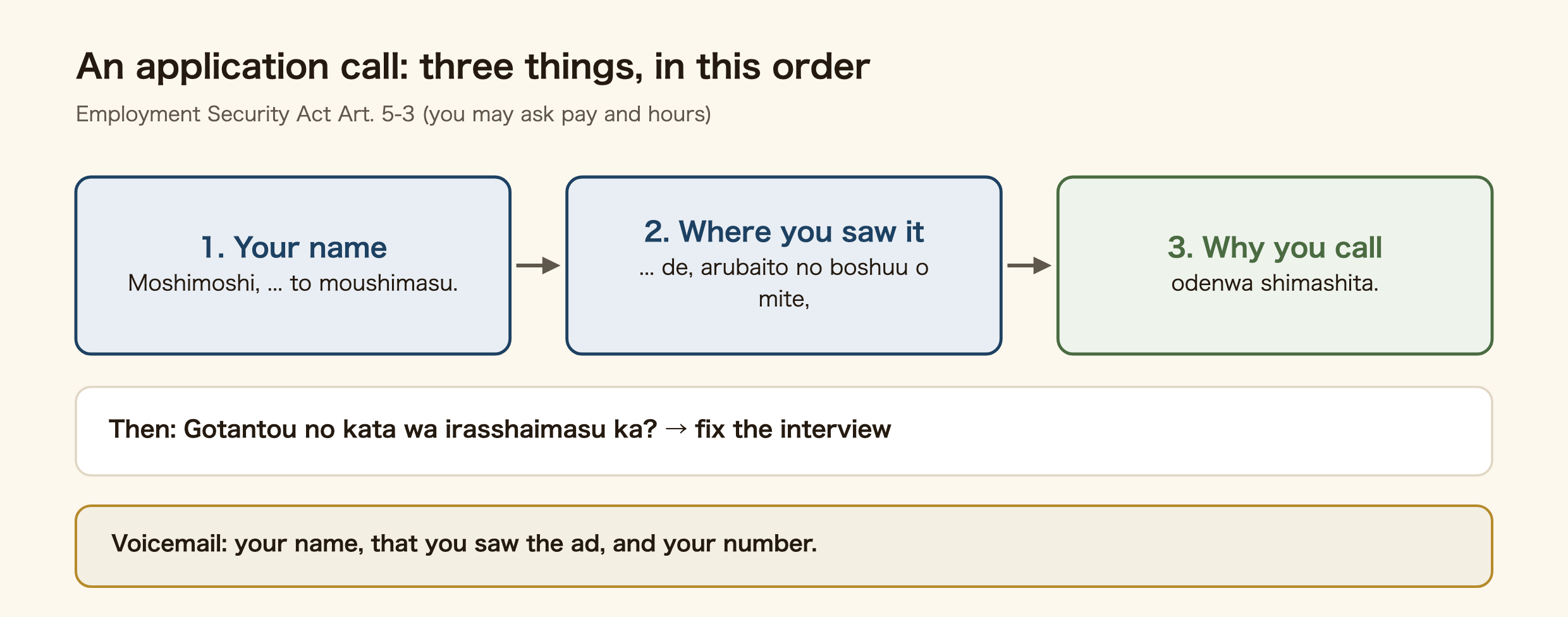
An application call has three parts: who you are, where you saw the ad, and why you are calling. Say them in that order and the person who answers knows who to pass you to.
| What you are doing | Japanese | Meaning |
|---|---|---|
| Giving your name | Moshimoshi, (name) to moushimasu. | Hello, my name is … |
| Where you saw it, and why you are calling | (site or shop poster) de, arubaito no boshuu o mite, odenwa shimashita. | I saw your part-time job ad on … and I am calling about it. |
| Asking for the person in charge | Gotantou no kata wa irasshaimasu ka? | Is the person in charge available? |
| Checking the job is still open | Arubaito wa, mada boshuu shite imasu ka? | Are you still looking for part-timers? |
| Fixing the interview | (day) no (time) ikou deshitara, ukagaemasu. | I can come any time after … on … |
| Before hanging up | Dewa, (day) no (time) ni ukagaimasu. Yoroshiku onegai itashimasu. Shitsurei itashimasu. | Then I will come at … on …. Thank you. Goodbye. |
Moushimasu is what the keigo guidelines call a “courteous” humble form. It presents your own action politely to the person you are talking to, which suits the first words you say to a stranger.
You can ask about pay and hours on the call. By law, an employer recruiting staff has to show the job, the pay and the working hours (Employment Security Act, Art. 5-3; see the labour ministry’s leaflet for workers). Try: Jikyuu to, ichinichi nan-jikan gurai no shifuto ka, oshiete itadakemasu ka? — “Could you tell me the hourly pay and roughly how long a shift is?”
If the ad gives times for phone calls, call in those hours. If nobody answers, a voicemail needs three things: your name, that you saw the ad, and your phone number.
Useful Japanese phrases for a job interview
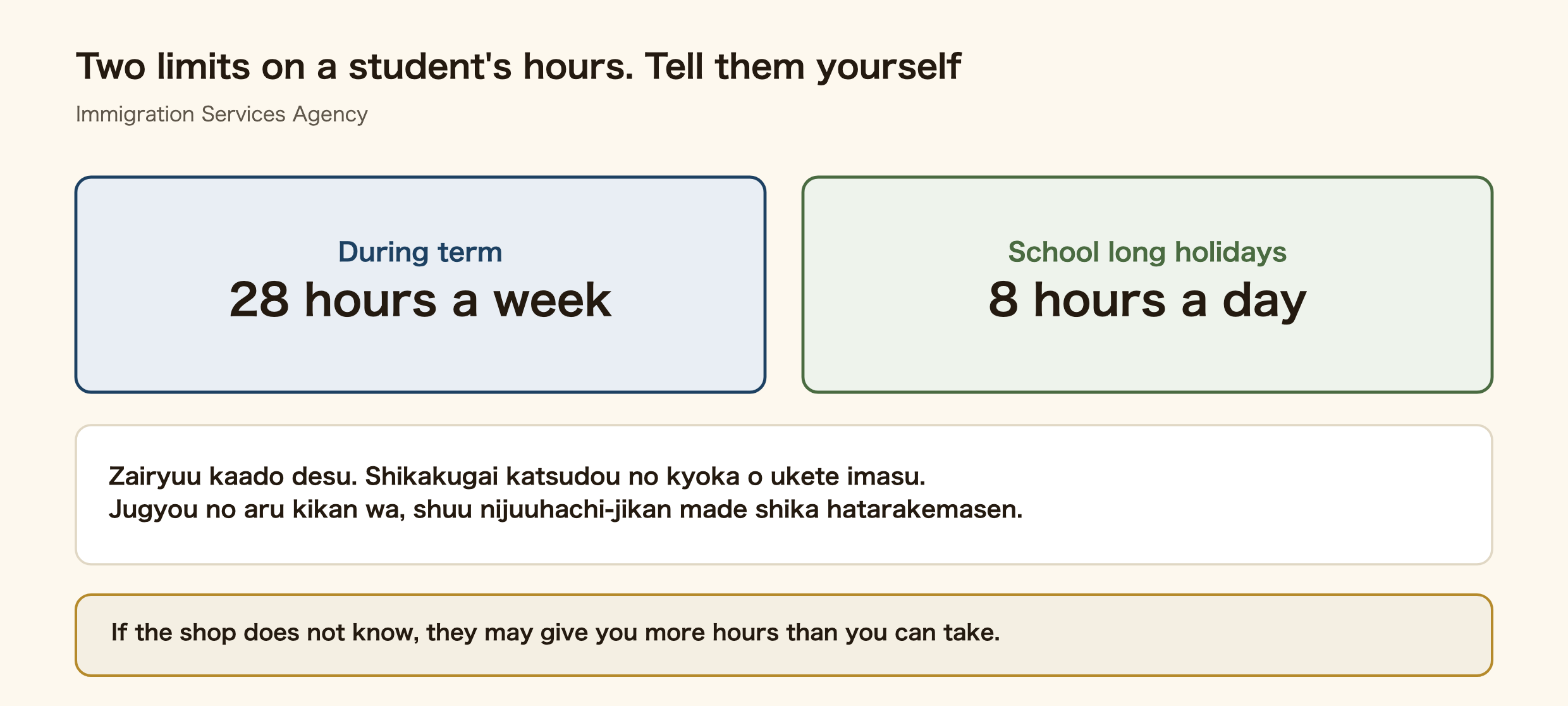
In the interview, what matters more than perfect keigo is telling them when you can work. On a Student visa, during term you can work up to 28 hours a week, and up to 8 hours a day during your school’s long holidays (Immigration Services Agency). If the shop does not know this, they may give you more hours than you can legally take.
| When | Japanese | Meaning |
|---|---|---|
| Walking in | (name) to moushimasu. Honjitsu wa yoroshiku onegai itashimasu. | My name is …. Thank you for seeing me today. |
| Showing your residence card | Zairyuu kaado desu. Shikakugai katsudou no kyoka o ukete imasu. | Here is my residence card. I have permission to work. |
| Your hours | Jugyou no aru kikan wa, shuu nijuuhachi-jikan made shika hatarakemasen. | During term I can only work up to 28 hours a week. |
| Exam periods | Shiken no mae no shuu wa, shifuto o herashite itadakemasu ka? | Could I have fewer shifts in the week before exams? |
| Leaving | Honjitsu wa, arigatou gozaimashita. | Thank you for today. |
Do not be shy about the exam request. The self-check sheet on student part-time work from the labour and education ministries tells employers they need to check a student’s wishes and take exam periods into account when setting shifts.
How the 28 hours are counted (which day the week starts, whether two jobs are added together) is in the 28-hour rule for student jobs. For the written side of applying, and what an interviewer is not allowed to ask you, see the Japanese resume (rirekisho).
Greetings on a shift: ohayo gozaimasu, otsukaresama desu, osaki ni shitsurei shimasu
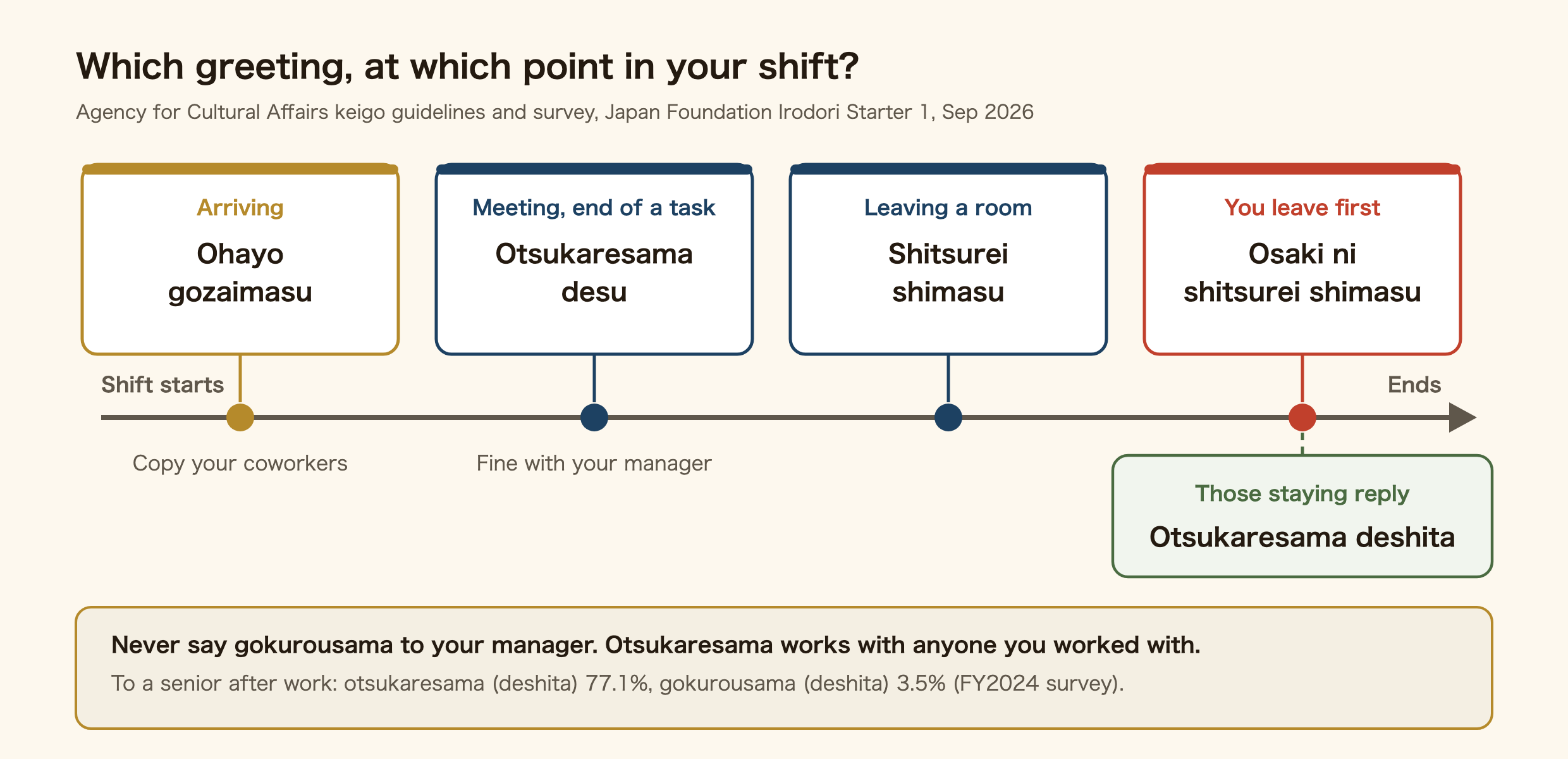
Your shift ends, you wave and say sayonara on your way out. Where you come from, that may be the normal goodbye. In Japan, sayonara is rarely said to people you see every day. The Japan Foundation’s textbook Irodori, Starter Lesson 1, explains that with people you meet all the time, the usual formal goodbye is shitsurei shimasu. The line it teaches for leaving work before others is osaki ni shitsurei shimasu.
| When | Japanese | Meaning |
|---|---|---|
| Arriving at work | Ohayo gozaimasu. | Good morning (used as the arrival greeting) |
| Meeting a coworker, or at the end of a task | Otsukaresama desu. | Thanks for your hard work |
| You leave first | Osaki ni shitsurei shimasu. | Excuse me for leaving before you |
| To someone leaving first | Otsukaresama deshita. | Thanks for your hard work (today) |
| Leaving the office or break room | Shitsurei shimasu. | Excuse me |
What does otsukaresama desu mean, and can you say it to your manager? Yes. The keigo guidelines describe otsukaresama as something people say to each other after working together, and say that in a polite form it can be used with anyone, including a boss. They also say gokurousama is better not used to people above you, because it expresses appreciation from a senior to a junior.
The numbers point the same way. In the Agency for Cultural Affairs’ FY2024 Japanese-language opinion survey (January to March 2025, 3,498 respondents aged 16 and over), 77.1% said they would say otsukaresama (deshita) to a colleague of higher rank after working together. Only 3.5% chose gokurousama (deshita).
If someone says ohayo gozaimasu to you on an evening shift, you did not mishear. But the keigo guidelines say nothing about this use, and we found no official rule on which greeting goes with which time of day. On your first day, listen to what your coworkers say when they arrive, and say the same.
What to say to your manager and senior coworkers
Most of what you say to your manager during a shift is a reply, a way to get their attention, or a check.
| When | Japanese | Meaning |
|---|---|---|
| You have been given an instruction | Wakarimashita. | Understood. |
| The same, more formally | Kashikomarimashita. | Certainly. |
| Getting their attention | Chotto, ii deshou ka? | Excuse me, do you have a moment? |
| Checking your work | Kore de ii desu ka? | Is this right? |
| Reporting that you have finished | Kochira, owarimashita. | This one is done. |
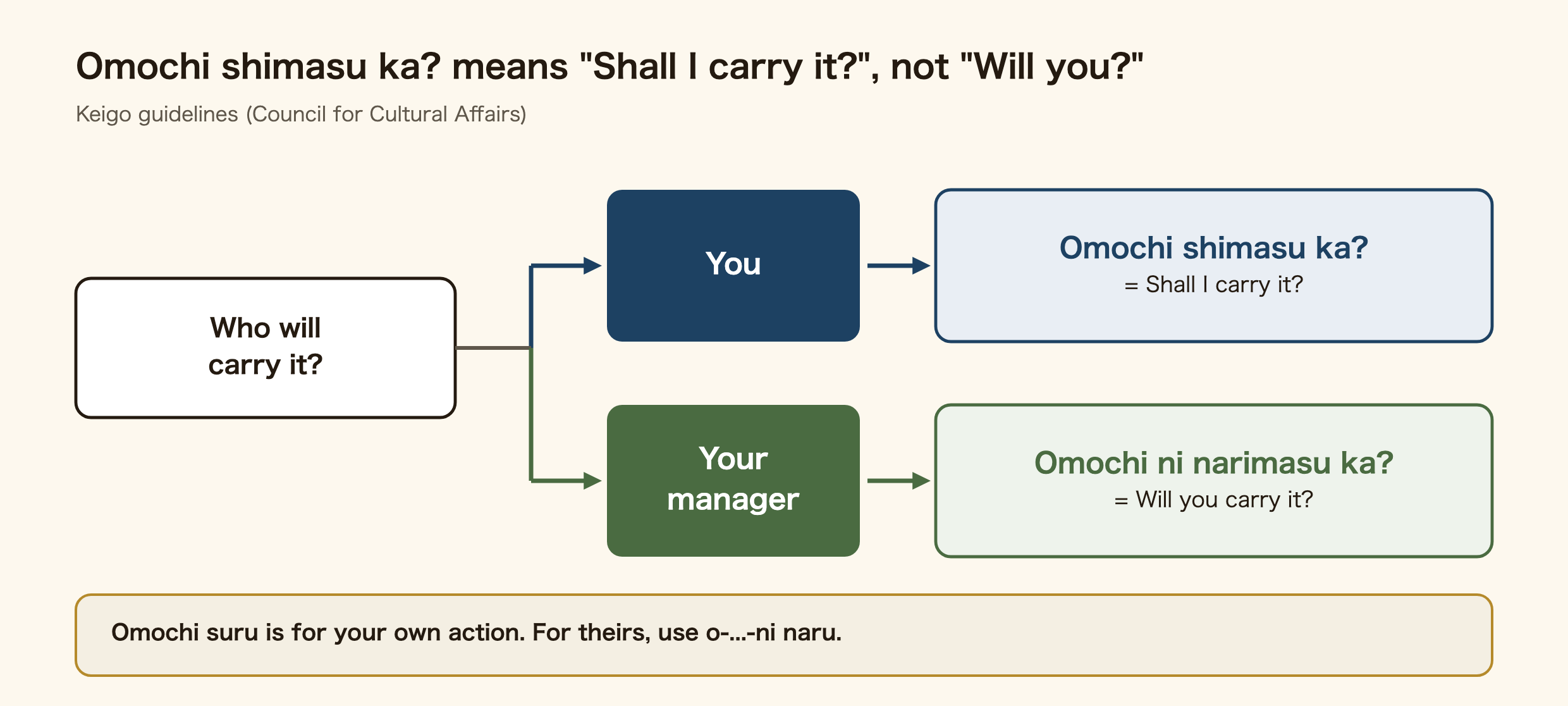
One form trips people up. If you want to ask whether your manager will carry something, and you say omochi shimasu ka?, you have asked “Shall I carry it?” In the keigo guidelines’ example, asking whether your boss will take it is omochi ni narimasu ka? Omochi suru is the form for your own action.
How to call in sick (or late) in Japanese
You wake up with a fever and message a friend on the same shift: “Tell the manager I’m not coming.” Where you come from, that may be enough. In Japan, changing the days or hours of a shift once it is fixed is a change in working conditions, and the labour ministry’s guidance on shift work says it should be done with the agreement of both the employer and the worker. The agreement is with the shop, so you are the one who contacts the shop.
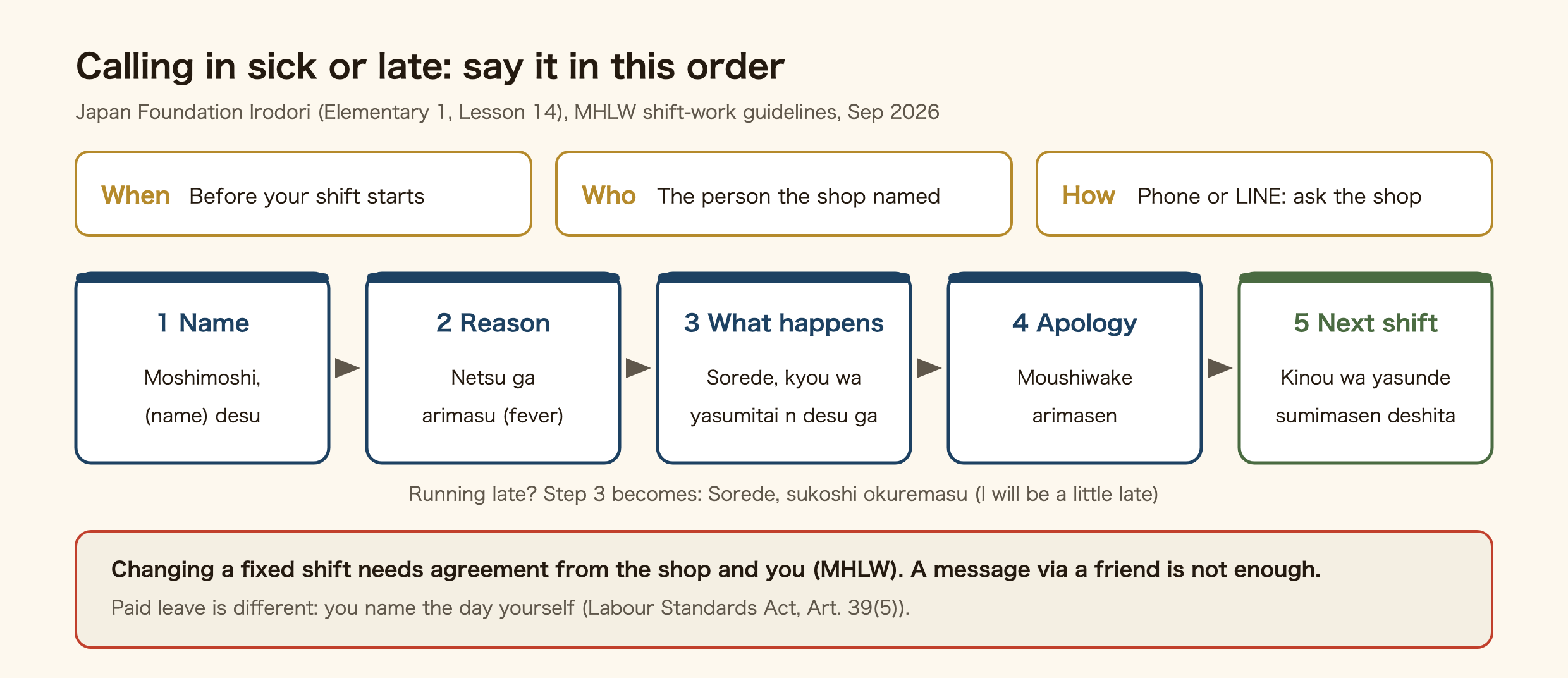
How many hours ahead, to whom, by phone or by LINE? The same guidance recommends that the shop and the worker agree in advance on the deadline and procedure for asking to change a shift. So the answer is set by each shop. On your first day, ask once: Yasumi no renraku wa, itsu made ni, dare ni, denwa to LINE no dochira de shimasu ka? — “For days off, by when, to whom, and by phone or LINE?”
For the words themselves, the Japan Foundation’s Irodori, Elementary 1 Lesson 14 practises exactly this, with the goal “can call your workplace to say that you will be late or take the day off”. The pattern is: name, reason, sorede (“so”), what happens.
| When | Japanese | Meaning |
|---|---|---|
| Taking the day off | Moshimoshi, (name) desu. Netsu ga arimasu. Sorede, kyou wa yasumitai n desu ga… | Hello, it’s …. I have a fever, so I would like to take today off… |
| Running late | Michi ga konde ite, sukoshi okuremasu. | The roads are jammed, so I will be a little late. |
| Arriving late | Osoku natte, moushiwake arimasen. | I am very sorry I am late. |
| The next shift after a day off | Kinou wa, yasunde sumimasen deshita. | Sorry for being off yesterday. |
Trying hard to be polite, some people say yasumasasete itadakimasu. In the FY2013 survey, 54.5% said this form bothered them. The form the survey gives as standard is yasumasete itadakimasu (“I will take the day off, with your permission”).
How to ask for a day off or a shift change
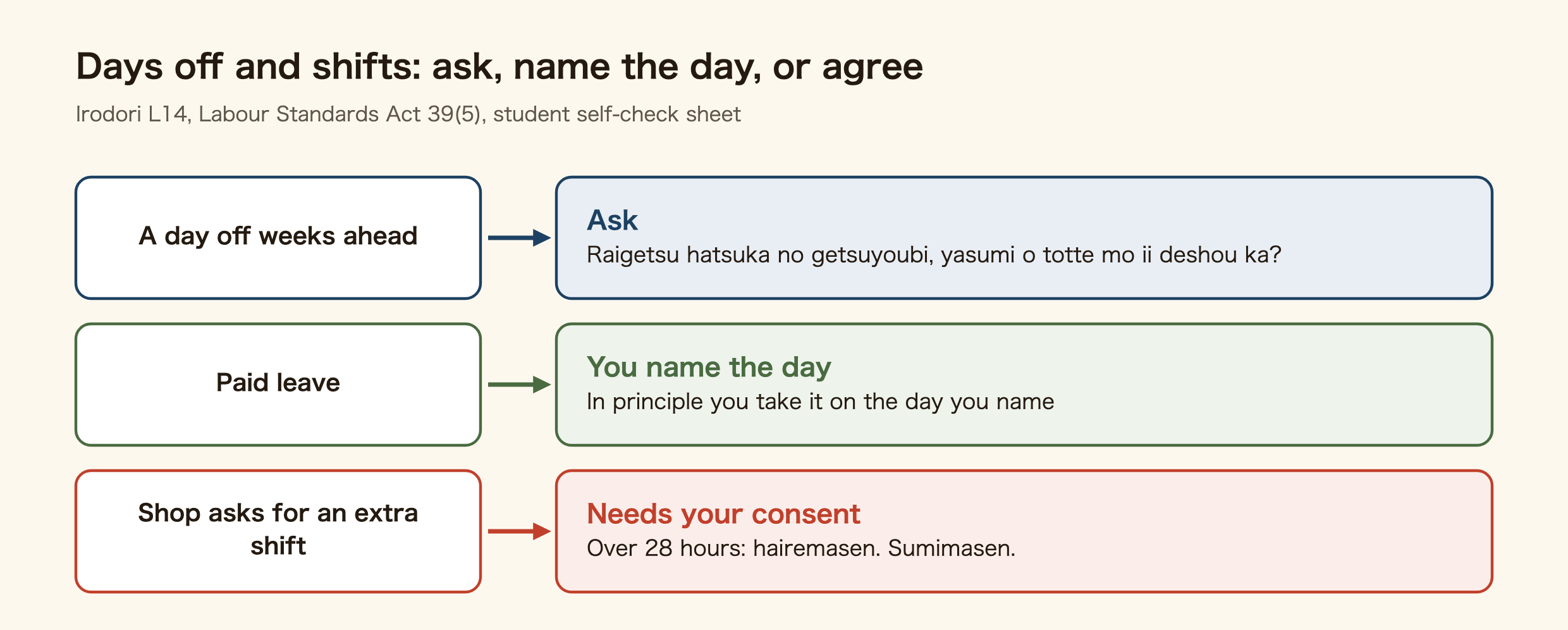
A day off weeks from now is not a call-in. It is a request. Irodori Lesson 14 practises asking a boss “may I take the Monday, the 20th of next month, off?” and adding the reason with …n desu.
| When | Japanese | Meaning |
|---|---|---|
| Asking | Raigetsu hatsuka no getsuyoubi, yasumi o totte mo ii deshou ka? | May I take Monday the 20th next month off? |
| Giving the reason | Sono shuu ni, gakkou no shiken ga aru n desu. | I have exams at school that week. |
| After the day off | Kinou wa, oyasumi, arigatou gozaimashita. | Thank you for the day off yesterday. |
Paid leave is a different matter. In principle you take paid leave on the day you name (Labour Standards Act, Art. 39(5)). Part-timers get it too, from one day a week; count your days in paid leave for part-timers in Japan.
It works the other way as well. If the shop asks you to take an extra shift this week, putting you on more shifts than you agreed when hired needs your consent (student part-time self-check sheet). If it would take you over 28 hours, say: Nijuuhachi-jikan o koete shimau node, hairemasen. Sumimasen. — “I can’t, it would take me over 28 hours. Sorry.”
Japanese phrases for customers
Some shops set customer phrases in a manual. The keigo guidelines accept these “manual keigo” phrases as a way to keep the language of service at a certain standard, and also say they should not be treated as the one absolute answer. These are the ones to learn first.
| When | Japanese | Meaning |
|---|---|---|
| A customer comes in | Irasshaimase. | Welcome. |
| Asking them to wait | Shoushou omachi kudasai. | One moment, please. |
| After making them wait | Omatase itashimashita. | Thank you for waiting. |
| Apologising | Moushiwake gozaimasen. | I am very sorry. |
| Seeing them off | Arigatou gozaimashita. | Thank you very much. |
| Checking the order is complete | Gochuumon no shina wa, ijou de yoroshii deshou ka? | Is that everything you ordered? |
| Sending them to someone else | Tantou no mono ni okiki kudasai. | Please ask the person in charge. |
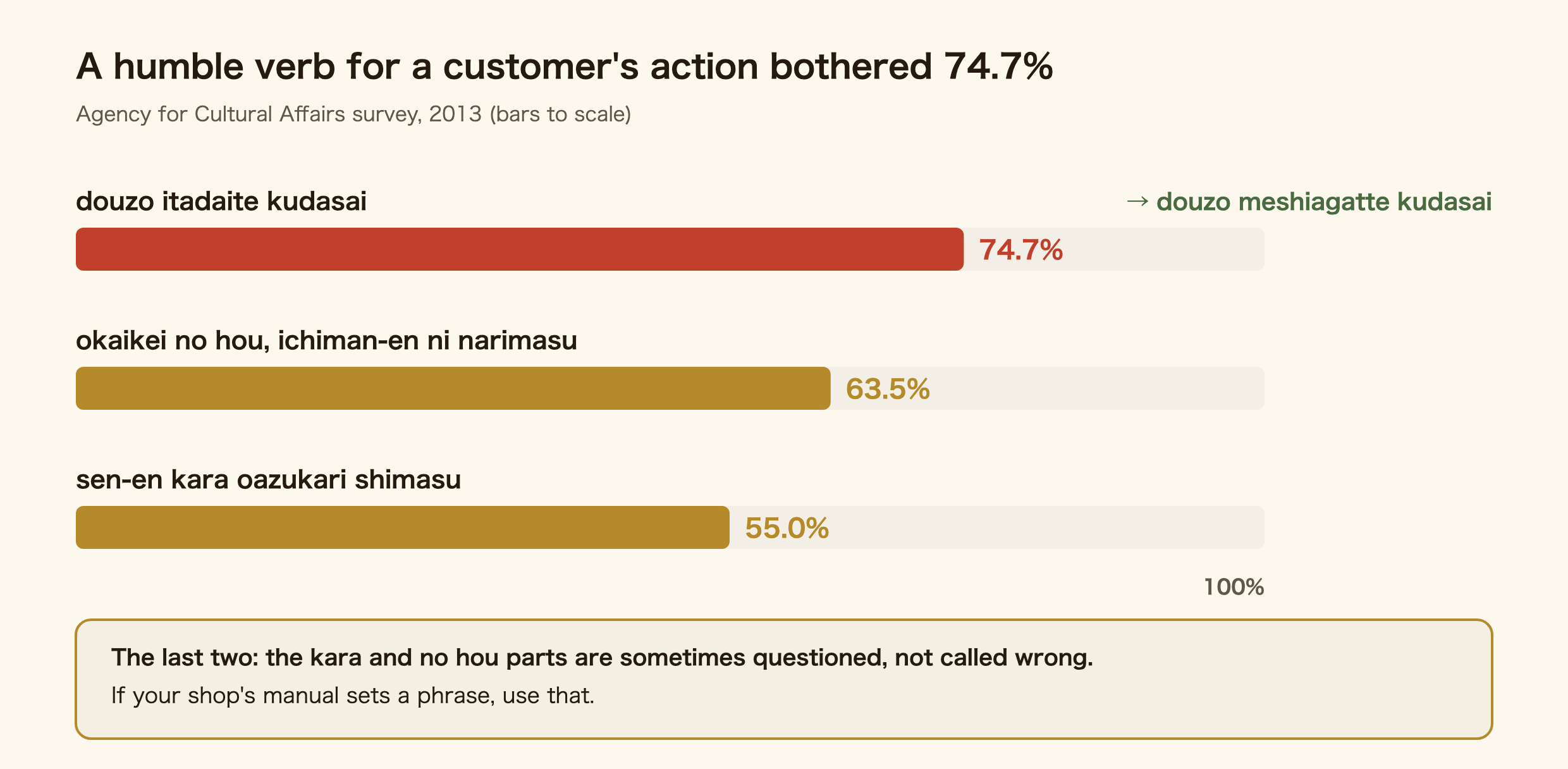
The usual slip with customers is describing their action with a word that lowers yourself. The keigo guidelines use the example of a receptionist telling a customer tantousha ni ukagatte kudasai: ukagau is a humble verb and is not used for a customer’s action. The fix is tantousha ni okiki kudasai. For the same reason, okyakusama, douzo itadaite kudasai (“please eat”, with the humble verb) bothered 74.7% of people in the FY2013 survey. The standard form is douzo meshiagatte kudasai.
Two lines you hear at every till, sen-en kara oazukari shimasu (“from 1,000 yen, I’ll take…”) and okaikei no hou, ichiman-en ni narimasu, bothered 55.0% and 63.5% of people in the same survey. The survey only says that the kara and no hou parts are “sometimes questioned”. It does not call them wrong. If your shop’s manual sets a phrase, use that.
Talking to your manager vs talking to customers
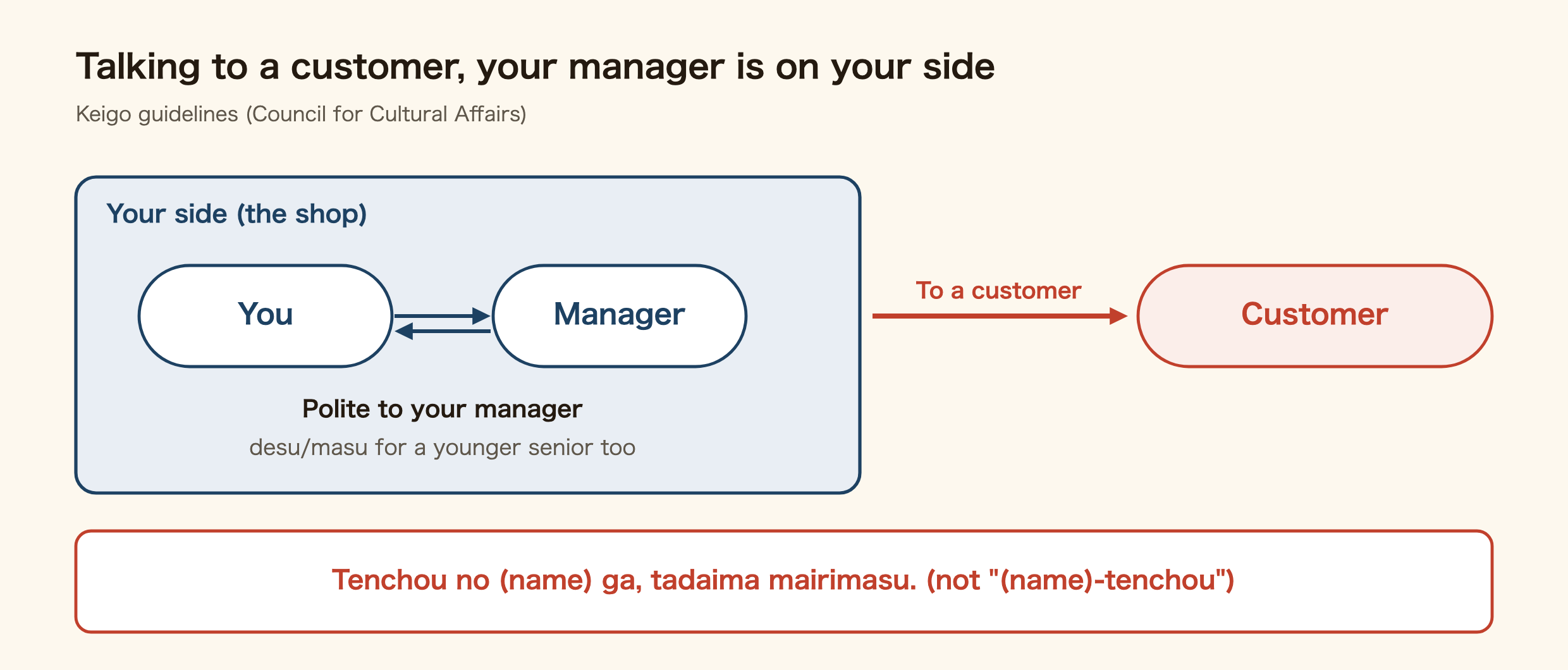
You speak politely to your manager. But when you mention your manager to a customer, your manager is on “your side”. The keigo guidelines give the example of talking about your own company’s department head to someone from another company: you say “Tanaka” or “our department head, Tanaka”, not “Tanaka-buchou”. Applied to a shop, you would tell a customer tenchou no (name) ga, tadaima mairimasu — “our manager, …, is coming now”.
What about a senior coworker who is younger than you? The keigo guidelines take for granted that there are differences in age and differences in position at work (senior and junior, for example), and put mutual respect at the base of keigo. You do not have to decide who ranks higher: desu/masu works for both.
Is “ryokai desu” rude? Common mistakes and fixes
Whether ryokai desu is rude is something even specialists disagree on. The National Institute for Japanese Language and Linguistics (NINJAL) explains that the word ryokai (“understood”, “roger”) contains no element of respect. It adds that there are more fitting words, such as wakarimashita, kashikomarimashita and uketamawarimashita.
A paper presented at a NINJAL workshop traces the idea that “ryokai is rude” to etiquette books and websites from around 2008, and notes that others argue against it. The simplest way to stay out of the debate is to answer your manager with wakarimashita or kashikomarimashita.
| Common form | Fixed form | Source |
|---|---|---|
| (to your manager) Gokurousama desu | Otsukaresama desu | Keigo guidelines |
| (to your manager) Ryokai desu | Wakarimashita / Kashikomarimashita | NINJAL |
| Yasumasasete itadakimasu | Yasumasete itadakimasu | FY2013 survey |
| (to a customer) Tantousha ni ukagatte kudasai | Tantousha ni okiki kudasai | Keigo guidelines |
| (to a customer) Douzo itadaite kudasai | Douzo meshiagatte kudasai | FY2013 survey |
| Gochuumon no shina wa osoroi ni narimashita deshou ka | Gochuumon no shina wa, soroimashita deshou ka | Keigo guidelines |
| (asking if your manager will carry it) Omochi shimasu ka | Omochi ni narimasu ka | Keigo guidelines |
Fined for being late? Some rules an employer cannot set
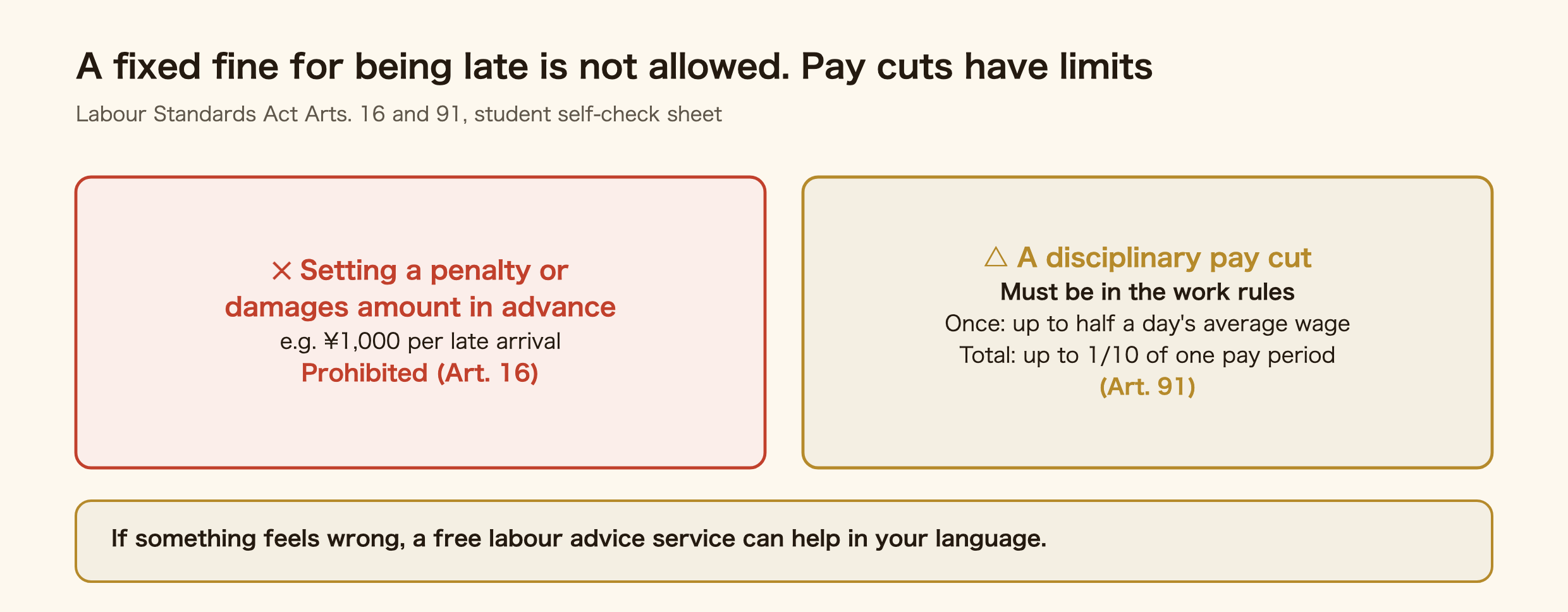
Separate from language, lateness and absence can bring their own trouble — say, a shop rule of “1,000 yen fine per late arrival”. The self-check sheet explains that setting a penalty or damages amount in advance is prohibited (Labour Standards Act, Art. 16).
A pay cut as a disciplinary measure has to be written in the work rules. One cut can be no more than half a day’s average wage, and the total no more than one tenth of a single pay period’s wages (Art. 91). If something feels wrong, you can talk to a free labour advice service in your language.
Does practising cost anything?
No. Irodori: Japanese for Life in Japan is a textbook made by the Japan Foundation, and all of it is free to download. Lesson 14 of Elementary 1 comes with audio of the sick and late calls.
If you want someone to practise with, ask at a free local Japanese class: “I want to practise calling my part-time job.”
Which one are you?
- You are about to call about a job — write the six lines of the phone table on paper, fill in where you saw the ad and when you can come, and make the call today.
- Your first shift is next week — say the five greetings out loud. Put a note in your phone to ask on day one: “For days off, by when, to whom, phone or LINE?”
- You woke up with a fever, or you are running late — call the person the shop named yourself, before your shift: “(name) desu. Netsu ga arimasu. Sorede, kyou wa yasumitai n desu ga…” Do not leave it to a friend.
- You have been saying ryokai desu or gokurousama to your manager — switch to kashikomarimashita and otsukaresama desu from today. If you were told you will be fined for lateness, call a labour advice service.
Frequently asked questions
Q. What does otsukaresama desu mean, and can I say it to my manager?
It is what people who work together say to each other, and yes, you can say it to your manager. The government’s keigo guidelines say otsukaresama is used between people after working together and, in a polite form, can be used with anyone, including a boss. They also say gokurousama is better not used to people above you.
Q. Is ryokai desu rude in Japanese?
Specialists disagree. NINJAL explains that ryokai contains no element of respect and that there are more fitting words, such as wakarimashita, kashikomarimashita and uketamawarimashita. Using wakarimashita or kashikomarimashita with your manager keeps you clear of the question.
Q. How far in advance do I have to call in sick at a part-time job in Japan?
Before your shift starts, by the deadline and method your shop has set. The labour ministry’s shift-work guidance recommends that the shop and the worker agree in advance on the deadline and procedure for changing a shift. Ask on your first day: by when, to whom, and by phone or LINE.
Q. How do I call in sick in Japanese?
Say your name, the reason, sorede (“so”), and what happens. The Japan Foundation’s Irodori uses “Netsu ga arimasu. Sorede, kyou wa ichinichi yasumitai n desu ga…” (I have a fever, so I would like to take today off). On your next shift, say “Kinou wa, yasunde sumimasen deshita.”
Q. What do I say when I call to apply for a part-time job?
Open with your name, where you saw the ad, and why you are calling: “(name) to moushimasu. (site) de, arubaito no boshuu o mite, odenwa shimashita.” When the person in charge comes on, give the days and times you can come for an interview. You can ask about pay and hours: the law requires employers to show them when recruiting.
Q. My shop says I will be fined for being late. Do I have to pay?
Setting a penalty or damages amount in advance is prohibited by Article 16 of the Labour Standards Act. A disciplinary pay cut must be in the work rules, and is limited to half a day’s average wage per cut and one tenth of a pay period’s wages in total. If something seems wrong, talk to a free labour advice service.
Summary
You do not need to master keigo before you start a part-time job. With desu/masu as the base and a set of lines for the phone call, the interview, greetings, replies to your manager, calling in sick and serving customers, you are far less likely to freeze on day one. Use otsukaresama desu and kashikomarimashita with your manager, and skip gokurousama and ryokai desu.
If you are sick or late, tell the shop yourself before your shift, because changing a fixed shift needs the shop’s agreement as well as yours. By when, to whom and how are different at every shop, so ask once on your first day.
Official sources: Council for Cultural Affairs, “Keigo no Shishin” (keigo guidelines, report of 2 February 2007) / Agency for Cultural Affairs, FY2024 Japanese-language opinion survey / FY2013 survey / NINJAL, “Is ryokai shimashita not a respectful expression?” / Takahashi, Higashiizumi and Sato, “Don’t Say ‘Roger'”, NINJAL Language Resources Workshop 2018 / Japan Foundation, Irodori Starter Lesson 1 and Elementary 1 Lesson 14 / Ministry of Health, Labour and Welfare, guidance on shift work and leaflet for workers / MHLW and MEXT, self-check sheet on student part-time work / Immigration Services Agency, work permission for Student status. Checked on 26 September 2026. For deadlines and methods for calling in, check your own shop’s rules.
Related guides
Found this useful? Share it
Send it to a friend who lives in Japan.
WHO WROTE THIS

mori
Japanese. I read the ministries’ own notices, orders and Q&As in the original, and I start from what my Nepalese and Sri Lankan friends in Japan actually ran into. I do not write about what I have not checked or been told.
What this site can and cannot do →Looking for something else?