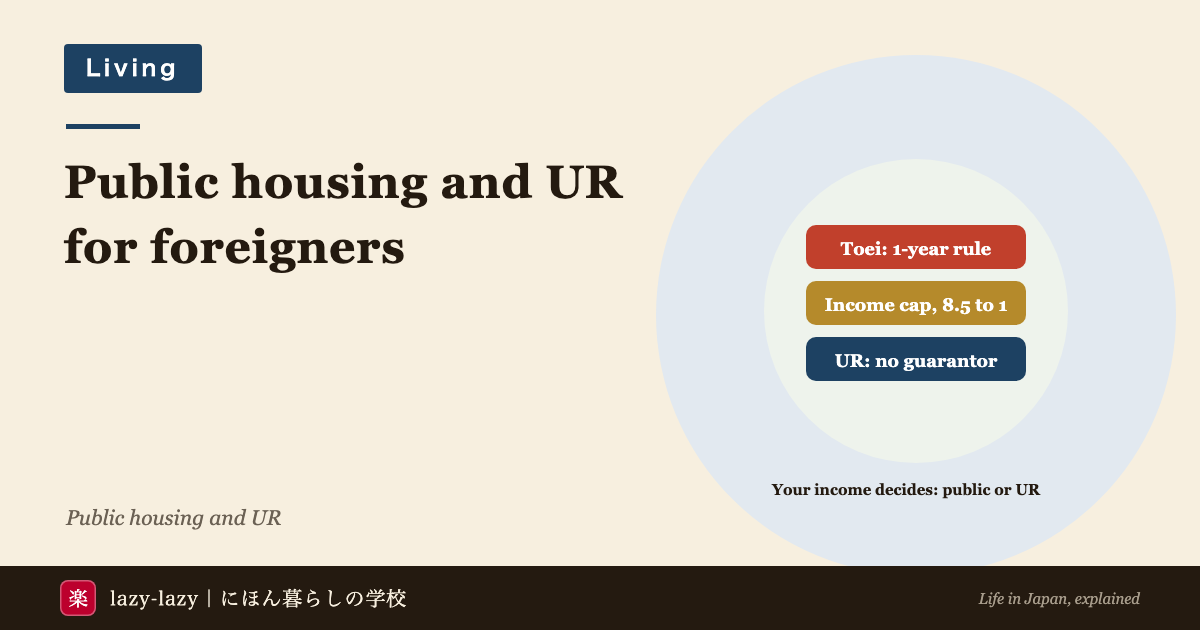
Checked on 24 September 2026 against the Public Housing Act and its Cabinet Order (e-Gov), notices and surveys from the Ministry of Land, Infrastructure, Transport and Tourism, the Tokyo Metropolitan Government and JKK Tokyo pages and lottery tables for metropolitan housing, Osaka City’s eligibility rules and application guide, and UR’s official pages on eligibility and documents.
The short answer
- Public housing (koei jutaku) is low-rent housing that prefectures and cities let to lower-income households who need a home. Tokyo metropolitan housing (toei), city housing (shiei) and prefectural housing (kenei) are all public housing, and foreign residents can apply.
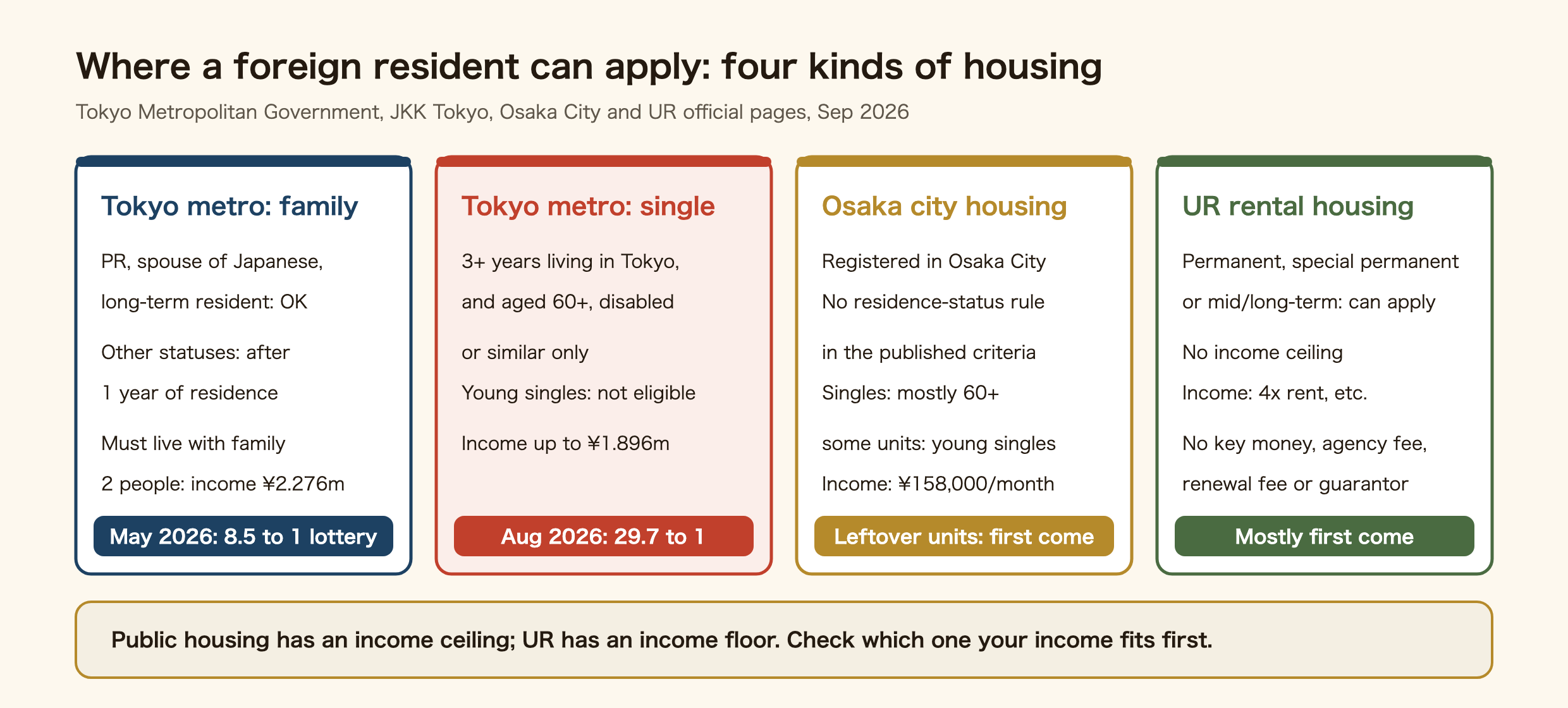
- In Tokyo, permanent residents, spouses of Japanese nationals and long-term residents can apply straight away; other statuses need one year of residence. But you must live with family. Single-person housing is limited to people aged 60 and over and similar groups.
- There is an income ceiling, and the lottery is hard to win. For a two-person household in Tokyo the limit is ¥2,276,000 of annual income. The May 2026 family lottery averaged 8.5 applicants per unit, and 15.3 in the 23 wards.
- UR housing has no income ceiling, and no key money, agency fee, renewal fee or guarantor. Permanent, special permanent and mid- to long-term residents can apply, and most flats go first come, first served.
- UR’s test is a monthly income of four times the rent, or a fixed amount. If you fall short, savings of 100 times the rent, or paying a year or more of rent upfront, also qualifies you.
Knowing this, you can tell from your status and income whether public housing or UR is within reach, instead of entering lotteries you cannot win or being turned away at a UR office. If neither fits, you can switch to the private market the same day.
Your lease renewal fee is due again. A baby has arrived and the flat feels small. A Japanese colleague says, “Why not apply for toei housing? It’s cheap.” Then you ask whether foreigners can apply, and they have no idea. Nationality is a condition they have never had to think about.
- Can foreigners get public housing in Japan?
- Who can apply for Tokyo metropolitan housing?
- What about Osaka city housing?
- What is the income limit for public housing in Japan?
- How hard is the lottery? Tokyo’s odds
- Can foreigners rent UR housing? Status and income
- What documents do I need?
- How much does it cost, and how is it different from a private rental?
- Do I need a guarantor for public housing?
- What if I give false information or break the rules?
- What if I lose the lottery or UR says my income is too low?
- Which one are you?
- FAQ
- Summary
- Related reading
Can foreigners get public housing in Japan?
Yes. The Public Housing Act asks two things of tenants: income below the ceiling, and a real need for housing (Article 23). It sets no nationality condition.
How foreign residents are treated comes from a 1992 notice by the Ministry of Construction (now MLIT). Permanent residents and special permanent residents are to be accepted. Other foreign residents are to be given, “as far as possible”, the same eligibility as local residents, taking local circumstances into account. The notice dates from the old alien registration system, but it is still on MLIT’s website. Because it says “as far as possible”, the detailed rules differ by municipality.
Who can apply for Tokyo metropolitan housing?
The Tokyo Metropolitan Government’s eligibility page requires a foreign applicant to hold one of the following from the application period until the screening date, shown on a copy of the resident record (juminhyo):
- Special permanent resident, or their spouse and family
- Mid- to long-term resident with Permanent Resident, Spouse or Child of Permanent Resident, Spouse or Child of Japanese National, or Long-Term Resident status
- Any other mid- to long-term resident (Engineer/Specialist in Humanities/International Services, Specified Skilled Worker, Student and so on), provided you have been resident continuously for at least one year at the time of applying
Family housing requires someone to live with you. A fiancé(e) or a registered partner counts.
Single-person housing is only for people who have lived in Tokyo for three years or more and are also aged 60 or over, hold a disability certificate, receive public assistance, or are domestic-violence survivors within five years of protection, among a few other groups. If you are under 60 and none of those apply, you cannot enter the single-person lottery, whatever your visa.
You also need to be in housing need: no one in the household owns a home or land, and no one is already the named tenant of UR, public corporation or public housing (with exceptions, such as rent that is high compared with income).
What about Osaka city housing?
Osaka City’s 2026 eligibility documents for general households and single people say nothing about nationality or residence status. What they list is living in the city with a registered address, having family to live with, income within the limit, and being in housing need. To confirm your own status qualifies, call the Osaka Municipal Housing Recruitment Center (06-6882-7024).
Single-person applications are limited, as in Tokyo, to people 60 and over, people with disabilities, people on public assistance and similar groups. The difference is the rolling recruitment (zuiji boshu). Some units left over from the regular lotteries are open to single people under 60 who can live independently. Units still empty after each batch are taken first come, first served. For any other prefecture or city, read the eligibility section of that municipality’s application guide.
What is the income limit for public housing in Japan?
The national standard is set by Cabinet Order and each municipality fixes its limit by ordinance. For ordinary households the figure is a “Cabinet Order monthly income” of ¥158,000. For elderly, disabled and child-raising households, the municipality can go up to ¥259,000 (Article 6 of the Order).
This is not your gross salary. It is worked out like this:
- Add up last year’s income for everyone in the household (for employees, the “amount after employment income deduction” on the withholding slip)
- Subtract ¥380,000 for each family member other than the applicant, and any special deductions such as for disability
- Divide by 12. At ¥158,000 or less, you are inside the ordinary limit
Tokyo publishes this as an annual table. For standard households the limit is ¥1,896,000 of annual income for one person, ¥2,276,000 for two and ¥2,656,000 for three. For someone living on salary alone, Tokyo’s rough guide is gross pay up to about ¥3.51 million for a two-person household and ¥2.96 million for a single person. Osaka’s public housing, where one person earns a salary, allows gross pay up to ¥3,511,999 for a two-person family and ¥2,967,999 for a single person.
Income is checked on last year’s residence tax certificate. If you arrived recently and had no Japanese income last year, ask the housing office which document to use before applying. How the certificate works is explained in residence tax in Japan.
How hard is the lottery? Tokyo’s odds
When applications exceed the number of units, tenants are chosen by lottery or selection (Article 25). JKK Tokyo (Tokyo Metropolitan Housing Supply Corporation) publishes the figures after every round.
| Round | Units | Applicants | Ratio |
|---|---|---|---|
| May 2026, household housing | 3,050 | 25,781 | 8.5 |
| of which 23-ward average | 1,344 | 20,541 | 15.3 |
| of which Tama cities average | 1,706 | 5,240 | 3.1 |
| November 2025, household (previous) | 3,542 | 23,714 | 6.7 |
| August 2026, single-person | 420 | 12,491 | 29.7 |
Location matters enormously. In May 2026 Shibuya was 99.0 to 1 and Meguro 83.4 to 1. Musashimurayama was 0.8 and Ome 0.7: fewer applicants than flats. Looking at the Tama cities instead of central Tokyo changes your odds by an order of magnitude. Add commuting time and fares to the calculation, though.
Osaka even runs a separate round for people who have lost 11 or more times. Treat public housing as a place you move to if you win, alongside a private flat, not as your next address.
Can foreigners rent UR housing? Status and income
UR housing is rented out by the Urban Renaissance Agency, an independent administrative agency. Unlike public housing, it has no income ceiling. It has an income floor instead.
A foreign national must be able to understand the lease fully and fall into one of these groups: permanent resident (including diplomatic and official status), special permanent resident, or mid- to long-term resident. Anyone holding a residence card is a mid- to long-term resident. UR has no one-year residence rule like Tokyo’s.
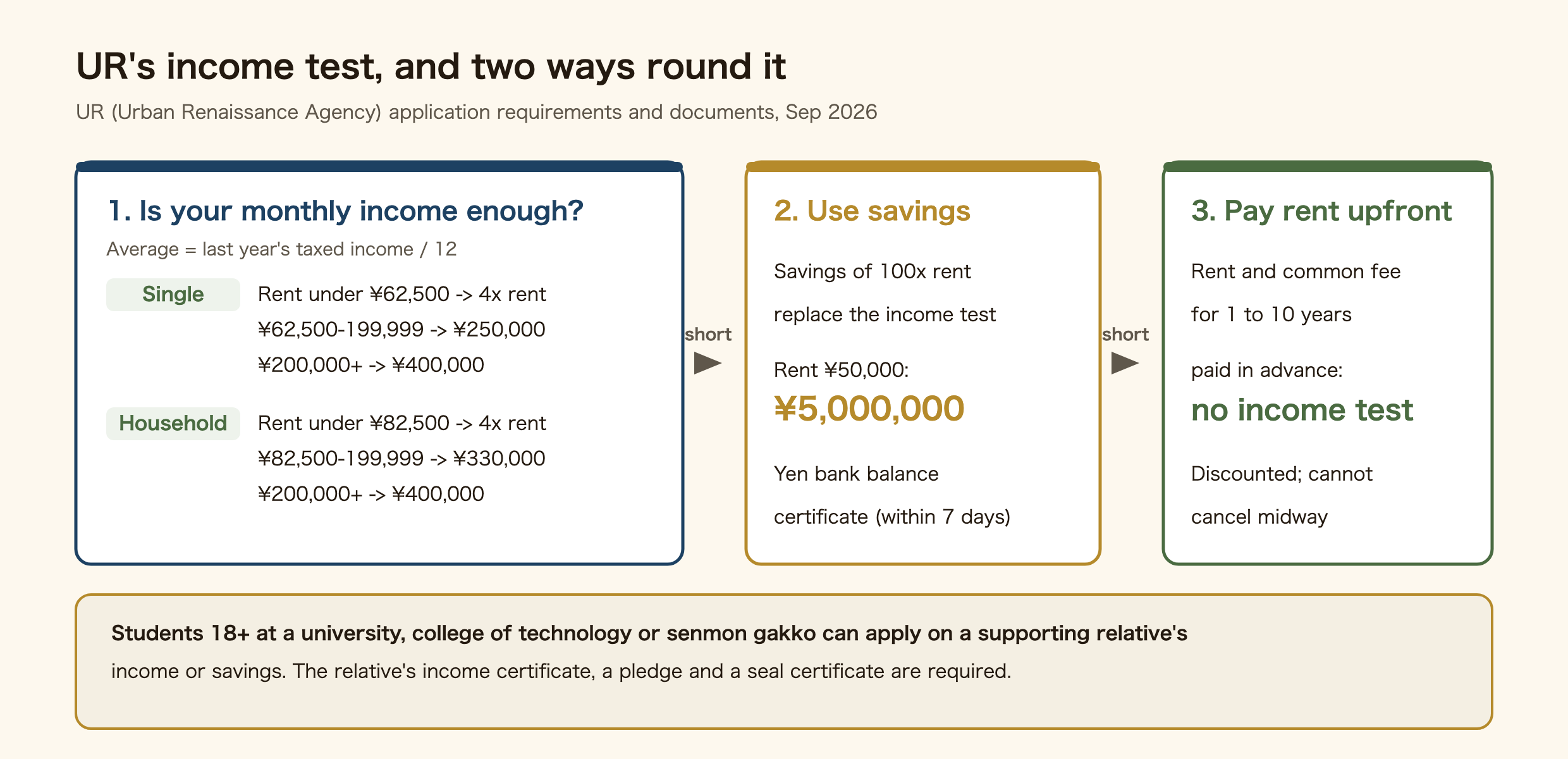
The income test is called the “standard monthly income”. A single person renting at ¥50,000 needs ¥200,000 a month; a household renting at ¥80,000 needs ¥320,000. Monthly income means, as a rule, the last 12 months’ total divided by 12, counting only income that is taxed and can be proved.
If you fall short, there are two other routes:
- Savings standard: bank savings of 100 times the rent replace the income test. For a ¥50,000 flat, that is ¥5 million
- Advance rent payment: pay rent and the common-area fee for 1 to 10 years upfront and income is not tested. There is a discount, but you generally cannot cancel partway
What about students? Students aged 18 and over at a university, college of technology or senmon gakko (professional training college) can apply on the income or savings of a relative who supports them. The relative must provide an income certificate, a written pledge to share liability for the rent, and a seal registration certificate. UR does not say whether this works when your parents live abroad, so ask at a UR office. The rule names schools under the School Education Act, so if you attend a Japanese language school, ask your school whether it is a senmon gakko.
Most of UR’s roughly 700,000 homes are let first come, first served, without a lottery; only new buildings and a few others use one. After a provisional application, you submit documents within a week and sign within 10 days. How to search without Japanese is covered in finding an apartment in Japan in English. UR also publishes guides in English, Chinese, Korean, Portuguese and Vietnamese; the English one asks people who need Japanese support to have a Japanese-speaking colleague or friend contact them.
What documents do I need?
Both UR and Tokyo start with your resident record. For foreign residents, some items are left off the juminhyo unless you ask. UR tells you to write on the request form that you need your family relationship, nationality, date of becoming a foreign resident, mid- to long-term resident status, residence status, period of stay, expiry date and residence card number. Leave off your My Number, and submit an original issued within the last three months. How to get the record is in residence registration in Japan.
| UR housing | Tokyo metropolitan housing (screening after you win) | |
|---|---|---|
| Address and status | Resident record with the items above | Resident record and passport |
| Family | Resident record showing relationships (or another proof) | Resident record; for foreign nationals, an embassy certificate |
| Income | Last year’s withholding slip and tax certificate (under one year in the job: UR’s own income form and a copy of your staff ID) | Residence tax certificate, employer’s certificate and so on |
| At signing | Registered seal and seal certificate (foreign nationals without a seal: a signature certificate from a consulate or similar) | Signed undertaking and deposit |
Tokyo does not want documents when you apply; winners are told what to bring two to three weeks before screening. UR drops the seal certificate if you sign in person with photo ID, which helps if you have never done seal registration.
How much does it cost, and how is it different from a private rental?
| Tokyo metro housing | Osaka city housing | UR housing | |
|---|---|---|---|
| Rent | Set by household income, area, size and age | Set by household income, size and age | Fixed per flat |
| Deposit | 2 months’ rent | 3 months’ rent | 2 months’ rent |
| Key money, agency fee, renewal fee | Not mentioned in the guides | None | |
Public housing rent falls as income falls. Tokyo’s own example, a 2DK in Nerima built in 1969 for a two-person household, ranges from ¥17,600 to ¥38,600 a month by income. Osaka reviews rent every year after you move in.
Private rentals may charge key money, an agency fee, a renewal fee and a guarantor company fee. The agency fee has a legal cap: one month’s rent plus tax, split between landlord and tenant. UR charges none of key money, agency fee or renewal fee, and needs no guarantor. The full breakdown of private costs is in renting an apartment in Japan.
Do I need a guarantor for public housing?
Since 2018, MLIT has told municipalities to stop making a guarantor a condition of public housing. Its survey as of 1 April 2025 found that 69.1% of about 2.1 million public housing units do not require one, and all 20 designated cities have dropped it.
An emergency contact may still be required. Osaka’s guide asks for someone who does not live with you, has an address in Japan and is, as a rule, a relative. If you have no relatives in Japan, ask who you can name before you apply.
UR checks only your own eligibility and asks for no guarantor. For private flats without a guarantor, see renting in Japan without a guarantor.
What if I give false information or break the rules?
Osaka disqualifies applications that differ from the facts or cannot be confirmed. Tokyo says you may be refused if your application differs from your screening documents. Misstate your household size or income and you will not get in even if you win. UR refuses to sign if any document is false.
UR may also turn you down if you previously fell behind on rent, disturbed neighbours or broke the lease in a UR home. Once you live in public housing, you may not sublet the flat or hand over your right to live there (Article 27).
What if I lose the lottery or UR says my income is too low?
You can apply again in the next round. Tokyo runs regular rounds in May, August, November and February; Osaka takes leftover units first come. Meanwhile you need somewhere to live in the private market. The same applies if UR’s income test, savings standard and advance payment are all out of reach.
Private flats can be rented through a guarantor company even without a personal guarantor. For low move-in costs, a share house with no deposit or key money is another option. If a rent increase is what started your search, know first that you can sometimes refuse it.
Which one are you?
- Permanent resident, spouse of a Japanese national or long-term resident, living with family — you can apply for metropolitan or city housing. Check last year’s income against the limit on your tax certificate. Today, look up when your municipality’s next round opens.
- On a work or other visa for a year or more, living with family — you can enter Tokyo’s family lottery. If your income is over the limit, go to UR instead. Today, get one tax certificate and read the income line.
- Living alone and working full time — under 60, Tokyo’s single-person housing is closed to you (some Osaka rolling units are the exception). For UR, monthly income divided by four is your rent ceiling (for single-person rents under ¥62,500). Today, search UR listings at or below that rent.
- A student, newly arrived, or on a low income — public housing is mostly out of reach for singles, and UR needs the savings standard, advance payment or the student rule. Today, work out whether your savings reach 100 times the rent; if not, focus on private flats with a guarantor company.
FAQ
Q. Can foreigners get public housing in Japan?
Yes. The national government accepts permanent and special permanent residents and asks municipalities to treat other foreign residents like local residents as far as possible. Check the details in your municipality’s application guide.
Q. Who can apply for Tokyo metropolitan (toei) housing as a foreigner?
Special permanent residents; permanent residents, spouses of Japanese nationals and long-term residents; and other mid- to long-term residents with one year of residence. Family housing needs someone to live with you; single-person housing needs you to be 60 or over or in a similar group.
Q. What is the income limit for public housing in Japan?
The national standard is a Cabinet Order monthly income of ¥158,000. In Tokyo that is annual income of up to ¥1,896,000 for one person and ¥2,276,000 for two.
Q. What are the odds in the Tokyo public housing lottery?
The May 2026 household lottery averaged 8.5 applicants per unit. It was 15.3 in the 23 wards and 3.1 in the Tama cities. The August 2026 single-person lottery averaged 29.7.
Q. What are the UR housing requirements for foreigners?
Permanent, special permanent or mid- to long-term resident status, and the ability to understand the lease. You also need monthly income at UR’s standard, such as four times the rent for single-person flats under ¥62,500.
Q. Can international students rent UR housing?
The status qualifies, but the income test is the obstacle. Savings of 100 times the rent, or paying rent upfront, removes the income test. Students at a university, college of technology or senmon gakko can also apply on a supporting relative’s income.
Summary
Foreign residents can apply for public housing. In Tokyo, permanent residents, spouses of Japanese nationals and long-term residents qualify straight away, and other statuses after a year. The real barriers are not nationality but living with family, the income ceiling and the odds. Some Tama cities have almost no competition.
UR is the mirror image: no income ceiling, but an income floor. No key money, agency fee, renewal fee or guarantor, and mostly first come. If four times the rent is out of reach, savings or advance payment can still get you in. Work out which one your income fits, and apply to that one.
Official sources: Public Housing Act (Japanese) / Order for Enforcement of the Public Housing Act (Japanese) / Ministry of Construction notice on foreign residents in public housing, 1992 (Japanese) / MLIT survey on guarantors in public housing (Japanese) / Tokyo Metropolitan Government, metropolitan housing eligibility (Japanese) / JKK Tokyo, May 2026 round (Japanese) / Osaka City, city housing (Japanese) / Osaka City, rolling recruitment (Japanese) / UR, eligibility (Japanese) / UR, documents (Japanese) / UR, English guide (PDF). Checked on 24 September 2026. Conditions change with each round, so read that round’s application guide before you apply.
Related reading
Found this useful? Share it
Send it to a friend who lives in Japan.
READ THIS NEXT
Home Internet in Japan →Home internet in Japan for foreigners: fibre vs home router vs pocket Wi-Fi.WHO WROTE THIS

mori
Japanese. I read the ministries’ own notices, orders and Q&As in the original, and I start from what my Nepalese and Sri Lankan friends in Japan actually ran into. I do not write about what I have not checked or been told.
What this site can and cannot do →Looking for something else?