Checked on 23 September 2026 against Japan Post’s relocation and forwarding service pages, the e-tenkyo guide and Japan Post’s FAQ, the official My Number Card site, and the Immigration Services Agency’s page on changing your residential address together with the Immigration Control Act.
The short answer
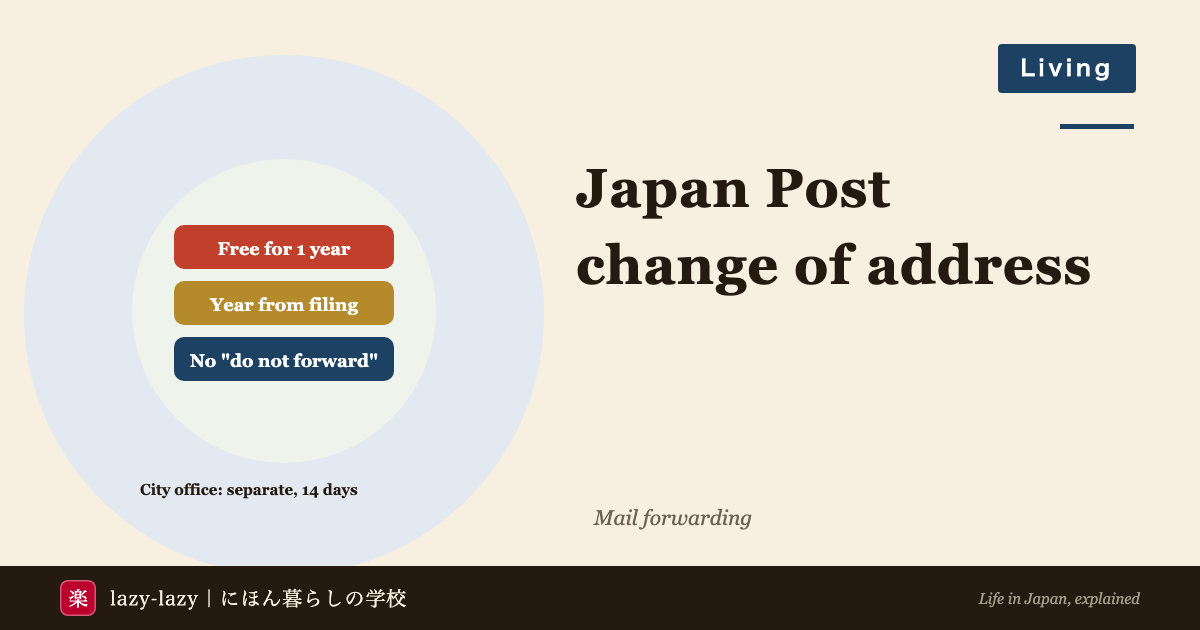
- Japan Post’s change-of-address form (転居届, tenkyo todoke) forwards mail sent to your old address to your new one, free, for one year. Foreign residents can file it with a residence card.
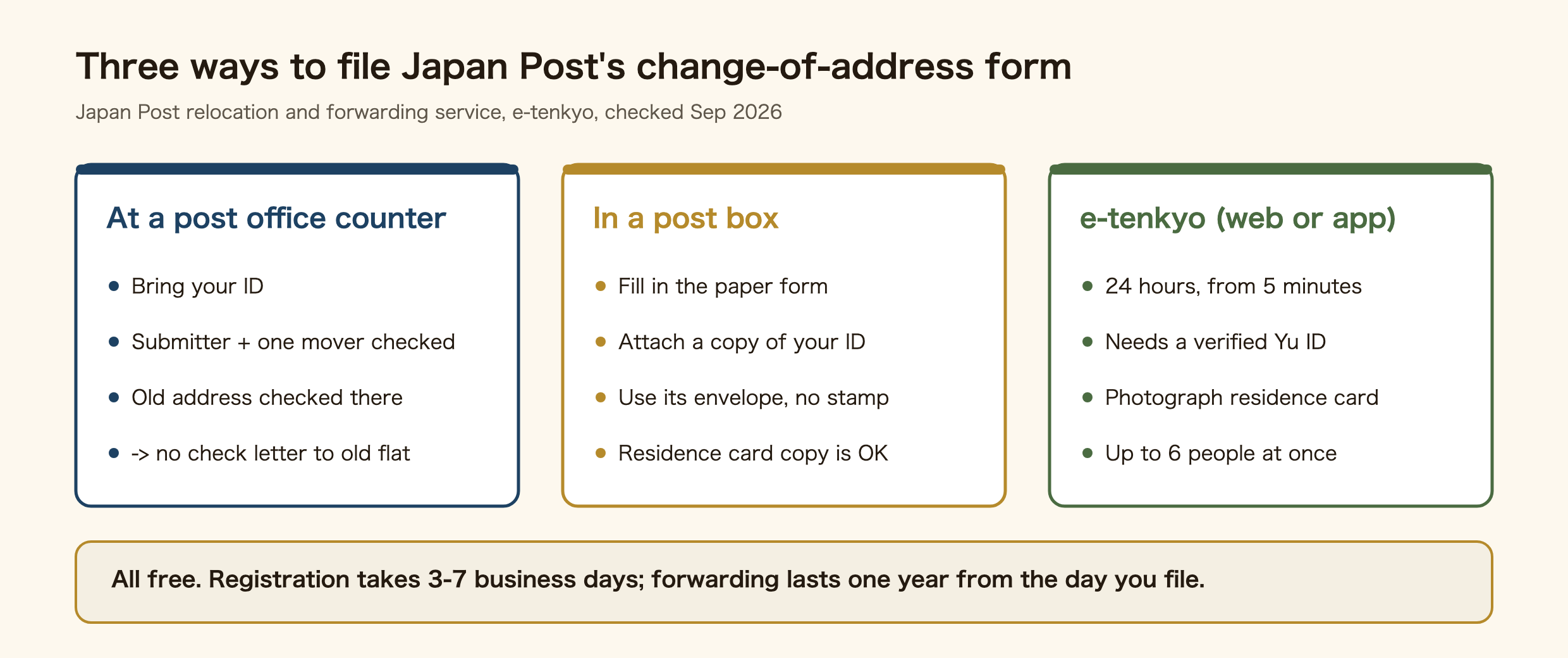
- There are three ways to file: at a post office counter, in a post box, or online through e-tenkyo. Registration takes 3 to 7 business days, so file before you move.
- The year runs from the day you file, not from the day forwarding starts. To keep it going, file again.
- Mail marked “do not forward” (転送不要, tenso fuyo) will not reach you. Your My Number notification letter and card-pickup notice are sent this way and go back to the city office.
- It is separate from the city-office move-in notice, which updates your residence card address and is due within 14 days. Japan Post does not forward domestic mail abroad.
Knowing this, you can file the post office form and the city office notice as two separate jobs before you move, so your My Number letters and important mail do not get stranded at your old flat. If you are leaving Japan, you will also know how to stop mail going to your old address.
Two weeks after the move, the ward office part is done and your new address is printed on the back of your residence card. But a letter from your card company, sent to your old flat, never turns up. A Japanese friend asks, “Did you file a tenkyo todoke?” You say yes, at the ward office. The conversation goes in circles, because the city office has a form with exactly the same name. Then your friend says, “File one at the post office and everything reaches you for a year.” Not everything.
- What is Japan Post’s change of address and mail forwarding service?
- How do I file the change of address? Counter, post box, or e-tenkyo
- When does forwarding start, and how long does it last?
- Which mail is not forwarded? Anything marked “do not forward”
- Is residence card and My Number mail forwarded? My Number letters go back
- Is it the same as the city office move-in notice? No, and that one has a 14-day deadline
- What if I forget to file?
- How much does Japan Post mail forwarding cost? Nothing
- Can Japan Post forward my mail abroad when I leave Japan? No
- Mail still not arriving, or I filed too late?
- Which one are you?
- FAQ
- Summary
- Related reading
What is Japan Post’s change of address and mail forwarding service?
Japan Post’s change-of-address form is how you sign up for its relocation and forwarding service. Once it is registered, mail sent to your old address is redirected to your new one. It costs nothing. Some people call it a forwarding request (転送届, tenso todoke), but the form itself is called tenkyo todoke.
Only items that Japan Post carries are forwarded. The e-tenkyo guide says so in plain words: forwarding covers mail and parcels handled by Japan Post only. A parcel from another delivery company is outside this service.
You can file for just one person in a household, which is useful if you are leaving a share house or a family flat. Write only the mover’s name in the “person moving” box. e-tenkyo takes up to six people in one application. You cannot, however, forward mail to a place where the recipient does not live: a relative in hospital cannot have their mail sent to your home, for example. There is also no option to send all your mail to your workplace.
If you bank with Japan Post Bank (Yucho), changing the address on your account is a separate procedure, and Japan Post’s own page points you to it.
How do I file the change of address? Counter, post box, or e-tenkyo
Whichever way you file, the person submitting the form has to prove who they are. The ID documents Japan Post lists for a posted form are:
- residence card, or special permanent resident certificate
- My Number Card
- driving licence, or certificate of driving history
- a health insurance eligibility certificate (shikaku kakunin sho)
No driving licence and no My Number Card? Your residence card is enough, and it is also on the list for e-tenkyo’s online ID check.
At a post office counter
The paper form is at any post office. At the counter they check the person submitting it and one of the people moving. If those are different people, a copy of the mover’s ID is fine. When the counter confirms both your identity and your old address, Japan Post does not need to send a check letter to your old address later.
In a post box
Fill in the form from the counter and stick a copy of the submitter’s ID on it. Put it in the envelope that comes with the form and drop it in any post box, with no stamp. A copy of your residence card works. If you use a My Number Card, only the front is needed. A form with no ID copy may have to be filed again.
Online with e-tenkyo (website or Japan Post app)
It is open 24 hours and can take as little as five minutes. The catch: you need a Yu ID (Japan Post’s user account) whose identity check is complete, and that check is done on a smartphone. You either read your My Number Card with the phone, or photograph a photo ID. The residence card is one of the documents you can photograph.
Register your Yu ID with the address printed on the card you use for the check. If your residence card still shows the old address, that means the old address.
e-tenkyo also asks everyone moving to agree that Japan Post staff may visit the old or new address and tell whoever lives there what they need to know about the move. If you would rather not agree to that, for example in a share house, file at a counter. You cannot edit an e-tenkyo application online afterwards. If you made a mistake, file again or ask at a post office.
For any method, Japan Post may check that you really moved: a staff visit, a question to a housemate if you are out, or a check letter sent to the old address.
When does forwarding start, and how long does it last?
Forwarding starts on the date you write as the requested start date. But registration takes 3 to 7 business days after you file, and the e-tenkyo guide warns it can take around a week.
The part people get wrong is the length. The one year is counted from the day you file the form, not from the day forwarding starts.
Say you file on 10 March and ask for forwarding from your moving day, 20 March. Forwarding runs from 20 March, but the year is counted from 10 March. File too early and you lose that time. Seven business days can be about ten calendar days once a weekend is in the way, so filing roughly ten days before your move gets it registered in time without wasting much of the year.
After a year, mail to the old address goes back to the sender. To extend, file the form again for another year. Japan Post also asks you to tell senders your new address, so use that year to update your bank, card company, school and employer.
Which mail is not forwarded? Anything marked “do not forward”
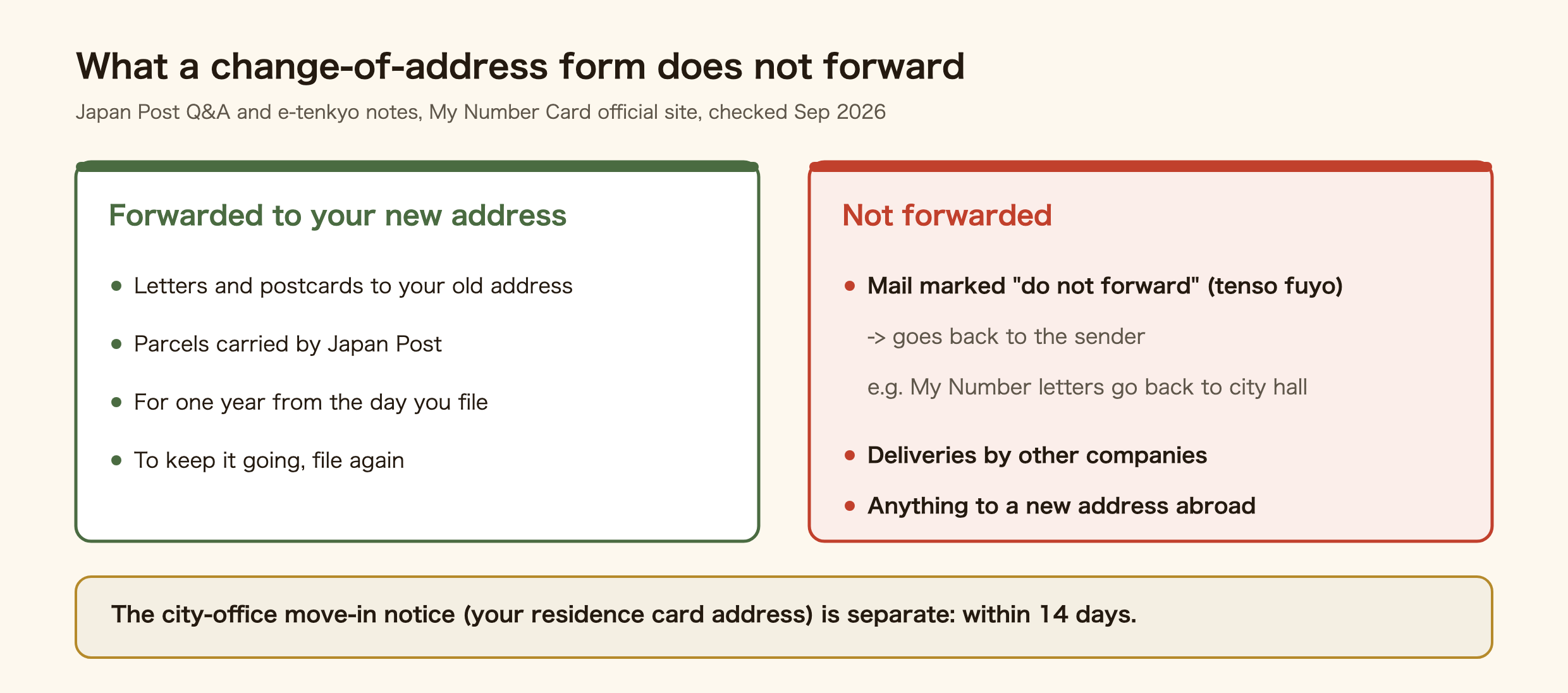
Mail marked 転送不要 (tenso fuyo, “do not forward”) is not forwarded, even if your change of address is registered. Japan Post explains the mark as the sender saying: if this person no longer lives here, send it back to me. So it goes back to the sender, not to you.
Senders use it when they need to know you actually live at that address. For one type of Japan Post’s “addressee-only” mail (the special type used for identity checks), the sender must mark it “do not forward”. That type can only be handed over at the address on the envelope or at a post office counter.
Whether something is registered mail is a separate question. What Japan Post’s FAQ lists as not forwarded is mail marked “do not forward”. If an expected letter never arrives, ask the sender whether they sent it that way. You will then know where it went back to.
Is residence card and My Number mail forwarded? My Number letters go back
Two pieces of My Number mail are never forwarded, even with a change of address registered.
- The notification letter (個人番号通知書, kojin bango tsuchisho): sent by simple registered mail to your registered address about two to three weeks after you register as a resident. It is non-forwardable, so if forwarding is set up at that address it goes back to the city office instead.
- The card-pickup notice (交付通知書, kofu tsuchisho) for the My Number Card: sent as non-forwardable mail in principle. If you have filed a forwarding request, it does not reach you and returns to the city that sent it.
If you register as a resident soon after arriving and then move within a few weeks, both of these hit you. When a My Number letter does not arrive, call the city office where you registered, not the post office. If you moved to a different city and your moving-out notice has been processed, the old city can no longer hand you the card. You withdraw the application at the new city and apply again there. The rules that are different for foreign residents, like the card’s expiry date, are in My Number Card for foreigners.
Your residence card can also come by post if you apply online and choose postal receipt. It is sent only to the address registered as the user’s residence, and you cannot change the destination. If you move during the application, update your address in My Page of the online residence application system (“Confirm user information”), and write your current address on the return envelope. The difference between collecting at a counter and by post is covered in renewing your visa online.
Is it the same as the city office move-in notice? No, and that one has a 14-day deadline
No. Japan Post’s form is a request to a company, and Japan Post says it does not pass the information on to government offices or other companies. Filing at the post office does not change your address anywhere else.
The confusing part is the name. The city office also has a tenkyo todoke: the resident registration notice for a move within the same city or ward. Moving to a different city means a moving-out notice at the old office and a move-in notice at the new one. Both are due within 14 days of the move, and the steps are in residence registration in Japan.
For residence card holders it matters twice. Under the Immigration Control Act, you must report a new residential address within 14 days. According to the Immigration Services Agency, if you take your residence card to the city office and file the resident registration notice, that counts as the immigration notification too. You do not go to Immigration separately.
What if I forget to file?
Japan Post’s form is an application for a company’s service. Forget it and your mail keeps going to the old address.
The city office side is the one with teeth. Not reporting your new address can bring a fine of up to 200,000 yen under the Immigration Control Act. And if you leave your registered address and do not report a new one within 90 days, without a legitimate reason, your status of residence becomes liable to cancellation. The rules on carrying and renewing the card itself are in the residence card guide.
How much does Japan Post mail forwarding cost? Nothing
| What | Cost |
|---|---|
| Japan Post change of address (counter, post box, e-tenkyo) | Free |
| Posting the paper form | Free (envelope included, no stamp) |
| Extending after one year | Free (file the form again) |
| Reporting your new address at the city office | No fee |
What costs you is the hassle of chasing mail that went back to a sender, and replacing documents you never received. A lost My Number notification letter is not reissued.
Can Japan Post forward my mail abroad when I leave Japan? No
Japan Post does not forward domestic mail to other countries. Once you are home, letters to your old Japanese address will not follow you.
If you have moved abroad and no longer want mail delivered in Japan, file a change-of-address form with every box filled in except the new address, at a counter or in a post box. Only the person moving can file it, and e-tenkyo cannot be used. For the order of the city office, insurance and pension steps, use the leaving Japan checklist.
Going home for the summer is different. For a trip or a visit home, an absence notice (不在届, fuzai todoke) has the post office hold your mail for up to 30 days. A longer trip home is beyond what that covers.
Mail still not arriving, or I filed too late?
- Filed, but mail still goes to the old address: keep the customer copy of the form and contact the post office. The reception number on it also lets you check the status on Japan Post’s website.
- You moved before filing: file today. Forwarding starts once it is registered, and the year runs from the day you file.
- You want to stop forwarding: file a form with the old and new addresses swapped, or ask at a post office counter.
- Mail for the previous tenant keeps arriving: tell the post office that delivers to you. Staff will visit to check who lives there.
- e-tenkyo shows an error: try again later, and if you are in a hurry, file at a counter.
Which one are you?
- Moving within Japan soon — about ten days before the move, take your residence card to a post office counter and file the form. Put “city office within 14 days of moving” in your calendar today.
- Already moved and never filed — file today on e-tenkyo or at a counter. Ask your old landlord or management company whether any mail is still sitting at the old flat.
- Just registered as a resident and moving again soon — My Number letters will not be forwarded. Call the city office where you registered today and ask whether your letters were sent or came back.
- Leaving Japan — before you fly, file a form with the new-address box left blank, at a counter or in a post box. Start telling your bank, card company and school about your address change or closure today.
FAQ
Q. Can foreigners file a change of address with Japan Post?
Yes. Japan Post lists the residence card as an accepted ID. You can use it at a counter, in a post box, or for e-tenkyo.
Q. How much does Japan Post mail forwarding cost?
Nothing. Mail to your old address is forwarded to your new one free for one year. A posted form needs no stamp either, because it comes with its own envelope.
Q. When does mail forwarding start?
From the start date you write on the form. Registration takes 3 to 7 business days, so file before you move. The one year is counted from the day you file.
Q. Is there mail that will not be forwarded?
Yes. Mail marked “do not forward” (tenso fuyo) goes back to the sender. The My Number notification letter and the card-pickup notice are sent that way, so they return to the city office. Parcels from companies other than Japan Post are not covered.
Q. If I file with Japan Post, do I still need to go to the city office?
Yes. Japan Post’s form does not change your address with the government. Take your residence card to the city office within 14 days of moving and file the move-in notice (or the in-city moving notice). That also counts as your address notification to Immigration.
Q. Will Japan Post forward my mail abroad after I leave Japan?
No. Japan Post does not forward domestic mail abroad. If you no longer want delivery to your Japanese address, file a form with everything filled in except the new address, yourself, at a counter or in a post box. e-tenkyo cannot be used for this.
Summary
Japan Post’s change-of-address form is free and forwards mail from your old address for one year. The year counts from the day you file, and registration takes 3 to 7 business days. A residence card is all the ID you need.
But anything marked “do not forward” will not reach you, and My Number letters are the obvious example: they go back to the city office. The city office move-in notice is a separate job with a 14-day deadline, and nothing is forwarded abroad. The post office and the city office, both done, and the move is finished.
Official sources: Japan Post, Relocation and forwarding service (Japanese) / Japan Post, Relocation/forwarding service (English) / Japan Post, Moving and absence Q&A / Japan Post, e-tenkyo / My Number Card official site, When does the notification letter arrive? / Immigration Services Agency, Notification of change of residential address / ISA, Online application Q&A. Checked on 23 September 2026. Japan Post’s English page is older than the Japanese one; where they differ, this article follows the Japanese page.
Related reading
Found this useful? Share it
Send it to a friend who lives in Japan.
WHO WROTE THIS

mori
Japanese. I read the ministries’ own notices, orders and Q&As in the original, and I start from what my Nepalese and Sri Lankan friends in Japan actually ran into. I do not write about what I have not checked or been told.
What this site can and cannot do →Looking for something else?