Checked on 23 September 2026 against the Labor Standards Act (Articles 39 and 115) and its Enforcement Regulations on e-Gov, and the Ministry of Health, Labour and Welfare’s paid-leave leaflet, its explainer on the 5-day rule, its “Check your working conditions” site, its handbook for foreign workers, and its consultation pages.
The short answer
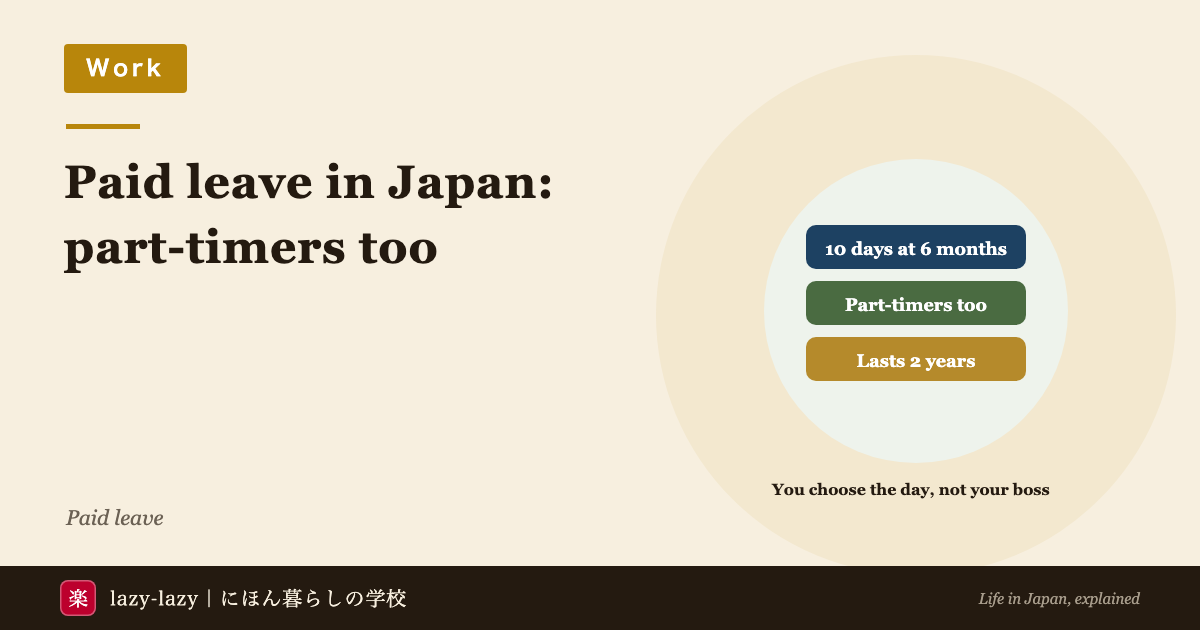
- Paid leave (yukyu, officially nenji yukyu kyuka) is time off on full pay that the law gives to anyone who has worked six months and turned up on 80% of their scheduled days. Nationality does not matter, and neither does being part-time.
- You start with 10 days. It grows with service to 20 days after six and a half years. Part-timers on 4 days a week or fewer and under 30 hours start with 7, 5, 3 or 1 day, depending on days a week.
- You choose the day. Your employer can only move it if your absence would “prevent the normal operation of the business”. Being short-staffed all the time is not a reason.
- Days last two years, so unused days carry over once. Leave you take right before quitting cannot be moved.
- If you get 10 or more days a year, your employer must make sure you take at least 5. If you are refused, go to the Labour Standards Inspection Office or a General Labour Consultation Corner. There is a free hotline in English.
Knowing this, you can count your own days, so when someone says “part-timers don’t get paid leave”, you can answer with a number. You will not lose the pay for days off, or the days that vanish when you leave a job.
Your sister is getting married back home, and you want two weeks off. You ask the manager at the convenience store about your shifts. “Fine, but part-timers don’t get paid leave,” he says. Your Japanese friends shrug: they work part-time too, and nobody at their shop has ever taken paid leave. Will those two weeks be unpaid, or will some of them be paid? The answer is not up to the manager. It is written in the Labor Standards Act.
- Do foreigners and part-time students get paid leave in Japan?
- How many days of paid leave do you get in Japan?
- Paid leave for part-time workers: pro-rated by days a week
- If a student takes paid leave, does it count toward the 28 hours?
- How much are you paid on a day of paid leave?
- When can you take it? You pick the day; the employer can only move it
- The 5-day rule: an obligation on the employer, not on you
- Does paid leave expire in Japan? After two years
- Can you use all your paid leave before you quit?
- Refused paid leave? Free help, and penalties for the employer
- Which one are you?
- FAQ
- Q. Do foreign part-time workers and international students get paid leave in Japan?
- Q. How many days of paid leave do you get in Japan?
- Q. How is pay on a day of paid leave calculated?
- Q. Does paid leave expire in Japan?
- Q. Can I use all my paid leave before I quit?
- Q. Where can I get help if my employer refuses paid leave?
- Summary
- Related reading
Do foreigners and part-time students get paid leave in Japan?
Yes. Article 39 of the Labor Standards Act says an employer must give 10 days of paid leave to a worker who has been employed continuously for six months and has come to work on at least 80% of all working days.
The Ministry of Health, Labour and Welfare’s leaflet says this applies to every worker who meets the conditions, “whether regular employee or part-time worker”. For people told “our company has no paid leave”, its answer is that the right arises whenever the conditions are met.
Nationality makes no difference. Article 3 of the same Act bans discrimination in working conditions based on nationality, and the ministry’s handbook for foreign workers says Japan’s labour laws apply to you exactly as they do to Japanese workers, whatever your nationality. That covers students working on a work permit, Technical Interns and Specified Skilled Workers alike.
How the two conditions are counted (MHLW, “Check your working conditions”):
- Six months continuously — the time you have been on the payroll. A long sick absence still counts as long as you remain employed.
- 80% of all working days — “working days” means the calendar days minus your scheduled days off. In practice: 80% of the days you were rostered.
Some absences count as days worked: time off to recover from a work injury or illness (rosai work-injury leave), maternity and childcare leave, family-care leave, and days of paid leave themselves (Art. 39(10) and the MHLW site).
How many days of paid leave do you get in Japan?
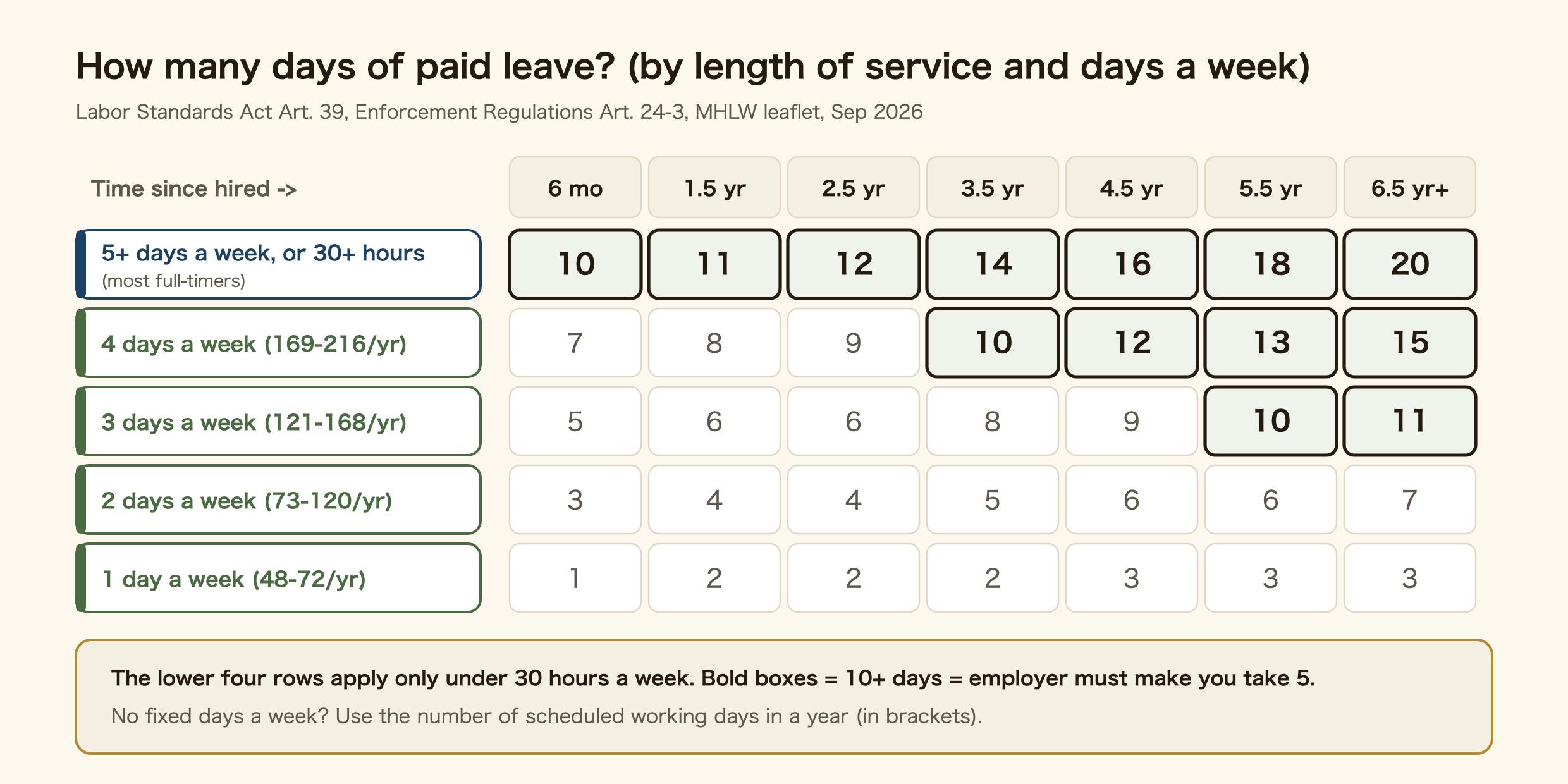
Your first 10 days arrive six months after the day you were hired. After that, you get a new batch every year.
| Time since hired | Days of paid leave |
|---|---|
| 6 months | 10 |
| 1.5 years | 11 |
| 2.5 years | 12 |
| 3.5 years | 14 |
| 4.5 years | 16 |
| 5.5 years | 18 |
| 6.5 years or more | 20 |
Hired on 1 April? You get 10 days on 1 October and 11 more on 1 October the next year. That date is your “reference date” (kijunbi). You only get the new batch if you attended at least 80% in the year before it (Art. 39(2)).
Paid leave for part-time workers: pro-rated by days a week
Part-timers may get fewer days than the table above. This is called pro-rated leave (hirei fuyo), and it applies only if both of these are true (Enforcement Regulations, Art. 24-3):
- You are scheduled for under 30 hours a week
- You are scheduled for 4 days a week or fewer (or, if your days are not set by the week, 216 days a year or fewer)
| Days a week (days a year) | 6 mo | 1.5 yr | 2.5 yr | 3.5 yr | 4.5 yr | 5.5 yr | 6.5 yr+ |
|---|---|---|---|---|---|---|---|
| 4 days (169-216) | 7 | 8 | 9 | 10 | 12 | 13 | 15 |
| 3 days (121-168) | 5 | 6 | 6 | 8 | 9 | 10 | 11 |
| 2 days (73-120) | 3 | 4 | 4 | 5 | 6 | 6 | 7 |
| 1 day (48-72) | 1 | 2 | 2 | 2 | 3 | 3 | 3 |
If your shifts change every week, pick the row by the number of working days a year in your contract (in brackets).
International students can work up to 28 hours a week during term, so they are always under 30 hours. What decides your days is how many days a week you work. A student contracted for five shifts a week is not pro-rated, however short the shifts, and gets the full 10 days after six months. Four days a week starts at 7; five days starts at 10.
If a student takes paid leave, does it count toward the 28 hours?
We could not find an official answer. Neither the Immigration Services Agency’s page on permission to work nor its official Q&A says whether paid-leave hours count toward the 28-hour weekly limit (checked 23 September 2026).
When the rule is unclear, plan a week that stays inside it either way: in a week with paid leave, keep your worked hours plus your paid-leave hours at 28 or less. For example, 24 hours Monday to Thursday plus a 4-hour shift on Friday taken as paid leave makes 28. If you are worried, ask your school’s international office before you apply.
How much are you paid on a day of paid leave?
The law allows three ways to calculate it (Art. 39(9)), and the employer has to fix which one in its work rules in advance.
- Normal pay for your scheduled hours — for hourly workers, your hourly rate times that day’s scheduled hours. At 1,200 yen an hour on a 5-hour shift, that is 6,000 yen (Enforcement Regulations, Art. 25).
- Average wage (heikin chingin) — your pay over the previous three months divided by the calendar days in that period (Art. 12). For hourly workers it cannot be lower than 60% of total pay divided by the days actually worked. With 300,000 yen over 92 calendar days and 50 days worked, 300,000 / 92 is about 3,260 yen, but 300,000 / 50 x 60% is 3,600 yen, so you get 3,600 yen.
- One-thirtieth of your standard monthly remuneration for health insurance — only where there is a labour-management agreement.
The same day off can be worth different amounts depending on the method. Check your work rules or your written statement of working conditions to see which one your employer uses. Leave is one of the conditions an employer must give you in writing (Enforcement Regulations, Art. 5).
The Act also says employers must not treat you badly for taking paid leave, such as cutting your pay (Supplementary Provisions, Art. 136). The ministry reads this as covering anything that discourages people from taking it.
When can you take it? You pick the day; the employer can only move it
You take paid leave on the day you name (Art. 39(5)). The ministry’s guidance says the worker decides, in principle, whether to take it in one block or in pieces, and the employer’s approval is not required.
The only thing the employer can do is ask you to take it on another day when your absence would “prevent the normal operation of the business”. This is the employer’s right to change the timing (jiki henkoken). The ministry’s example is many workers asking for the same day. “Simply being busy” is not enough, and the handbook for foreign workers says constant understaffing cannot be the reason. Moving your day without even trying to find someone to cover is not allowed either (the Hirosaki Telegraph and Telephone Office Supreme Court case).
Long blocks are different. For leave of a month or so, the courts have given employers some room to decide how much to move it (the Jiji Tsushin case). If you want two weeks or more to go home, talk the dates through with your manager early, because the employer’s judgement comes into it. Check how to leave and come back on your residence card with the special re-entry permit.
The basic unit is a full day. Half days are possible where the work rules provide for them. Hourly leave needs a labour-management agreement and is capped at 5 days’ worth a year (Art. 39(4)). Some workplaces also have an agreement to schedule the days beyond 5 for everyone, called planned leave (Art. 39(6)).
The 5-day rule: an obligation on the employer, not on you
Since April 2019, if you get 10 or more days in a year, your employer must make sure you take 5 of them within one year of your reference date (Art. 39(7)).
- It covers people granted 10 or more days that year. Days carried over from last year do not count toward the 10.
- Part-timers are covered once pro-rating reaches 10 days: after 3.5 years at 4 days a week, or 5.5 years at 3 days.
- Days you take yourself are subtracted from the 5. A half day counts as 0.5. Hours taken as hourly leave are not subtracted.
- When the employer sets the dates, it must ask your views first and try to respect them (Enforcement Regulations, Art. 24-6).
An employer that fails to do this faces a fine of up to 300,000 yen (Art. 120), and the ministry’s explainer says each worker affected counts as a separate violation.
Does paid leave expire in Japan? After two years
Paid leave expires two years after it is granted (Art. 115, MHLW leaflet). Days you do not use in the first year carry over to the next. After that, they are gone.
Even if the work rules say “no carry-over”, the ministry says the two-year right does not disappear. Someone who gets 20 days a year could therefore be holding up to 40. Check your balance on your payslip or attendance system, and ask the company if it is not shown. Employers must keep a paid-leave register for each worker, recording the dates, the number of days and the reference date (Enforcement Regulations, Art. 24-7).
Can you use all your paid leave before you quit?
Yes. Your paid leave ends on your last day of employment. So when you ask to use the rest before you leave, the employer cannot move the dates and has no choice but to grant them, according to the ministry’s guidance. There is no later day to move them to.
You may be asked to push your leaving date back for a handover. Whether you agree is up to you (same source).
What you cannot fix afterwards is leave left over on your last day. Article 39 contains nothing about buying back unused days. Check your balance before you set your last working day, and build the leave into your leaving date. What you must do after leaving — the 14-day immigration notification, health insurance and pension — is in order in what to do when you leave a job.
Refused paid leave? Free help, and penalties for the employer
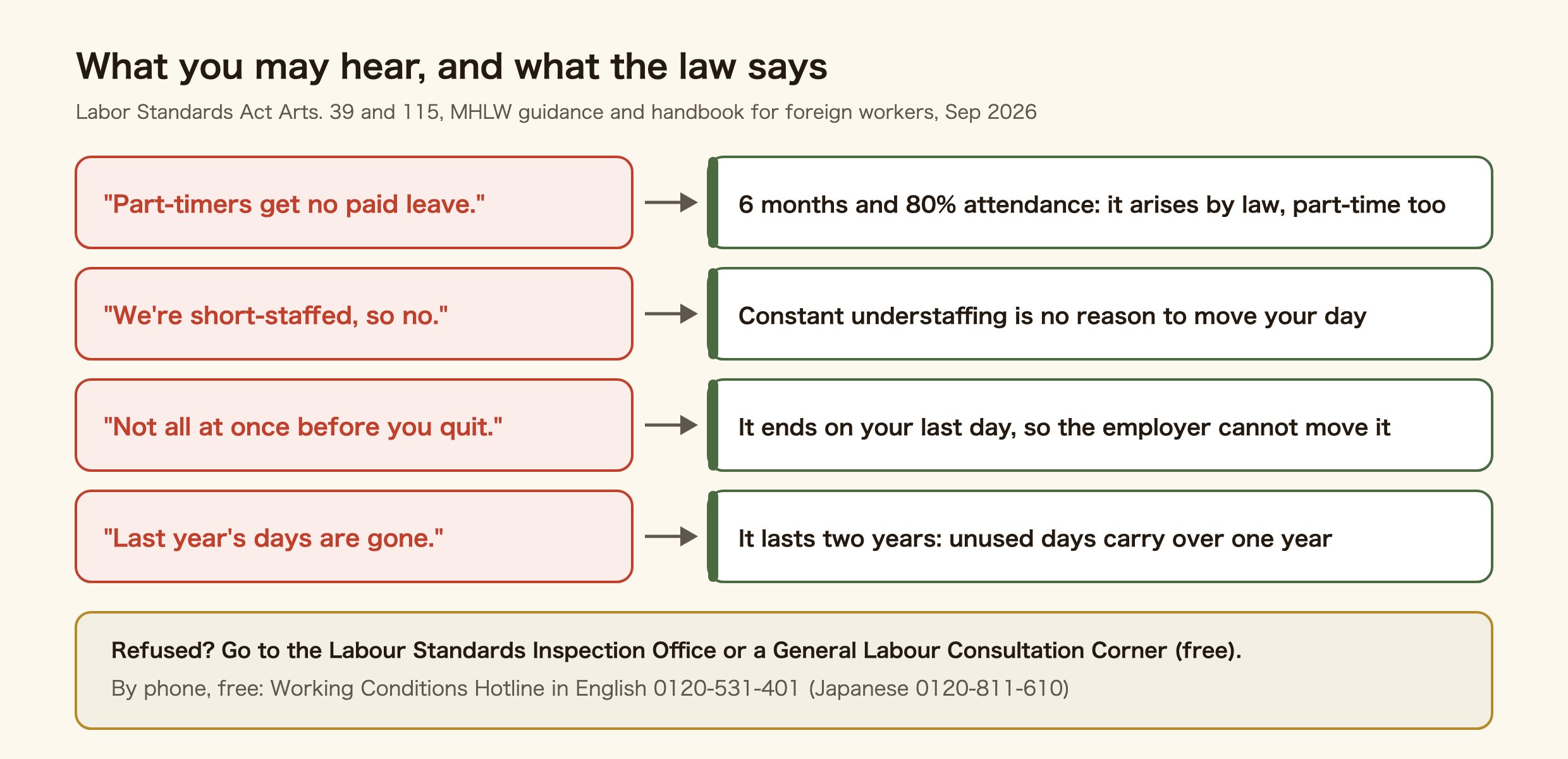
Refusing to give paid leave breaks Article 39. The penalty is up to six months’ imprisonment or a fine of up to 300,000 yen (Art. 119).
If you are refused, keep a record first: when you asked, whom you asked, which dates, and what you were told. A request sent by LINE or email is a record in itself. Keep your statement of working conditions and payslips to hand.
There are three places to go, all free. If harassment or unpaid wages are part of the problem too, the list of which office handles which workplace problem tells you where to start.
- Labour Standards Inspection Office (rodo kijun kantokusho) — the office that tells employers to fix breaches of the law.
- General Labour Consultation Corner (sogo rodo sodan corner) — 378 of them, in prefectural labour bureaus, inspection offices and elsewhere. No appointment, in person or by phone. They take questions from students and consultations in many languages. Closed weekends, public holidays and over New Year.
- Working Conditions Consultation Hotline — a free line run for the ministry: weekdays 5pm to 10pm, weekends and holidays 9am to 9pm. English 0120-531-401, Chinese 0120-531-402 and Japanese 0120-811-610 every day; Vietnamese 0120-531-406 on Tuesday, Wednesday and Friday to Sunday; Nepali 0120-531-408 on Wednesday and Sunday.
For a weekday daytime call in another language there is also the Telephone Consultation Service for Foreign Workers (English 0570-001-701 and others, 10am to 3pm except noon to 1pm). Call charges apply to that one.
If a workplace keeps refusing, leaving becomes a real option. The data on how foreigners actually find jobs in Japan can help you pick where to look next. Use up your remaining leave before you go.
Which one are you?
- Told “part-timers don’t get paid leave” — write down your hiring date and how many days a week you work. Find your number in the table above, then message your manager on LINE: “I would like to use paid leave on 2026/09/24.”
- Want a long trip home — once your flight dates are set, raise them with your manager that same week. Check your balance, and book knowing that any days beyond it will be unpaid.
- Leaving your job — check your remaining days on your payslip or attendance system. Work back from the day the leave runs out to set your last working day, and put that date in your resignation letter.
- Asked and was refused — note the date you asked and the words you were told. Call the hotline or visit a General Labour Consultation Corner.
FAQ
Q. Do foreign part-time workers and international students get paid leave in Japan?
Yes. After six months of continuous employment and at least 80% attendance on scheduled days, paid leave arises regardless of nationality or part-time status. On 4 days a week or fewer and under 30 hours, the number of days depends on your days a week (from 1 day for one day a week).
Q. How many days of paid leave do you get in Japan?
Workers on 5 or more days or 30 or more hours a week get 10 days after six months, then 11, 12, 14, 16 and 18 each year, and 20 after six and a half years. Part-timers on 4 days or fewer and under 30 hours start with 7 (4 days a week), 5 (3 days), 3 (2 days) or 1 (1 day).
Q. How is pay on a day of paid leave calculated?
By the method your employer sets in its work rules: normal pay for the scheduled hours (hourly rate times that day’s hours), the average wage (three months’ pay divided by calendar days), or, with a labour-management agreement, one-thirtieth of your standard monthly remuneration for health insurance.
Q. Does paid leave expire in Japan?
Yes, two years after it is granted. Unused days carry over to the next year. Work rules that say “no carry-over” do not remove the two-year right.
Q. Can I use all my paid leave before I quit?
Yes. Paid leave ends on your last day of employment, so the employer cannot use its right to move the dates. If asked to delay your leaving date, it is your choice whether to agree.
Q. Where can I get help if my employer refuses paid leave?
The Labour Standards Inspection Office or a General Labour Consultation Corner (free, no appointment). By phone, the free Working Conditions Consultation Hotline answers in English on 0120-531-401 and in Japanese on 0120-811-610, among other languages.
Summary
Paid leave in Japan arises by law once you have worked six months and attended 80% of your scheduled days. Nationality and part-time status make no difference. You start with 10 days, or 1 to 7 days if you work 4 days a week or fewer and under 30 hours. You choose the day, and “we’re always short-staffed” is not a reason to refuse it.
Days last two years, so one year’s worth carries over. If you get 10 or more, your employer must see that you take at least 5. Leave taken before quitting cannot be moved, so count what is left before you fix your leaving date. If you are refused, three free places will listen.
Official sources: Labor Standards Act, Arts. 3, 12, 39, 115, 119, 120 and Supplementary Provisions Art. 136 (e-Gov, Japanese) / Enforcement Regulations of the Labor Standards Act, Arts. 5, 24-3, 24-6, 24-7, 25 (e-Gov, Japanese) / MHLW leaflet on paid leave days (Japanese) / MHLW explainer on the 5-day rule (Japanese) / MHLW “Check your working conditions”: paid leave (Japanese) / MHLW consultation services for foreign workers / MHLW General Labour Consultation Corners. Checked on 23 September 2026.
Related reading
Found this useful? Share it
Send it to a friend who lives in Japan.
WHO WROTE THIS

mori
Japanese. I read the ministries’ own notices, orders and Q&As in the original, and I start from what my Nepalese and Sri Lankan friends in Japan actually ran into. I do not write about what I have not checked or been told.
What this site can and cannot do →Looking for something else?