Last updated: 29 August 2026
Summary
- Language school students get 30,000 yen a month. University, graduate school and vocational college get 48,000 yen. None of it is repaid.
- Language school students face no Japanese-language requirement. The official text excludes them from the N2 condition in so many words.
- You cannot apply yourself. Your school nominates you. Which means nothing happens until you ask the school office.
- Each school has a fixed number of nominations. The people who ask early fill them.
- The condition is a grade coefficient of 2.30 or above. Take on more shifts, let your grades slip, and this is where you lose it.
What changes: you know the 30,000 yen a month goes through the school office – and one visit there puts you in the queue.
Before you take on more hours, read this.
The 28-hour weekly cap is fixed in law and will not move (Immigration Services Agency, permission for part-time work on a Student status (Japanese)). But there is money that sits outside that cap and does not require you to work for it. This guide covers one thing only: that.
- 30,000 yen a month, even at a language school
- Which schools qualify
- No N2 needed if you are at a language school
- You cannot apply for this yourself
- The 2.30 grade coefficient, and what more shifts cost you
- The remaining conditions
- How to find the other scholarships
- One thing to do today
- Frequently asked questions
- Summary
30,000 yen a month, even at a language school
The Monbukagakusho Honors Scholarship for Privately Financed International Students (学習奨励費 / gakushu shoreihi) is money from the Ministry of Education, paid out by JASSO, that you never repay. Its formal name is the Student Exchange Support Program.
The amount depends on where you are enrolled.
- Graduate and undergraduate level: 48,000 yen a month
- Japanese language institutions: 30,000 yen a month
It runs for one year, April to the following March, or six months, October to March. (JASSO, about the Monbukagakusho Honors Scholarship programme (Japanese))
If you searched for whether it has to be repaid: it does not. This is a grant, not a loan. Nobody bills you after graduation.
Which schools qualify
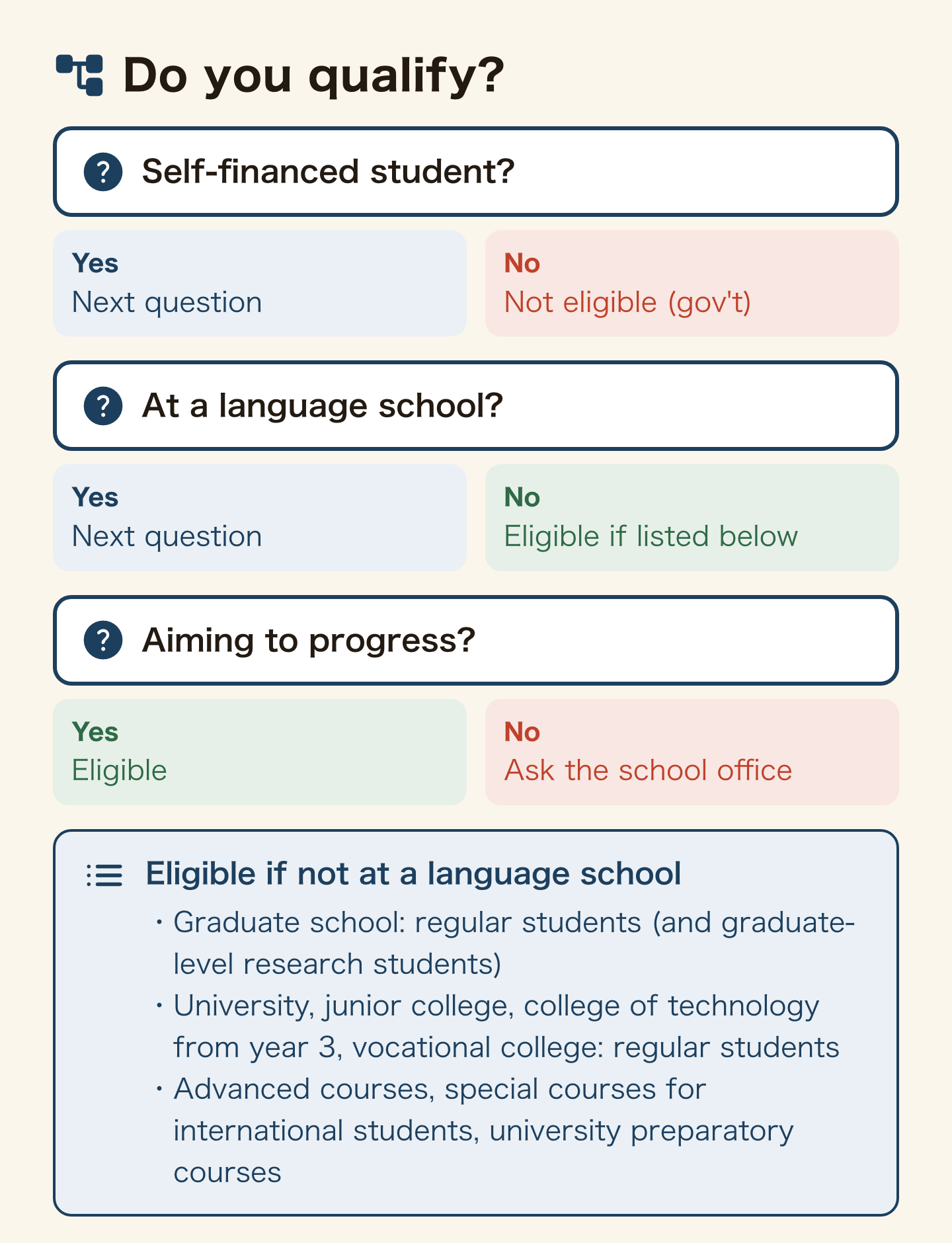
The official list covers these students, all of whom must hold the Student status of residence and be privately financed (government-sponsored students and those sent by foreign governments are excluded).
- Regular students in graduate school (and research students with a bachelor’s doing graduate-level research)
- Regular students at universities, junior colleges, colleges of technology from year 3, and vocational colleges (specialised courses of specialised training colleges)
- Advanced courses, special courses for international students, and university preparatory courses
- Students at a Japanese language institution who are aiming to progress to a university, graduate school, junior college, college of technology or vocational college
Vocational colleges and language schools are both on the list, explicitly. Plenty of people assume their school does not count. If you are about to enter a university or vocational college, you can also apply through the EJU and, with a top score, reserve 48,000 yen a month before you enrol (JASSO, reservation for top EJU scorers (Japanese)).
Language school students: “aiming to progress” is the condition
The wording is that you are enrolled at a language institution while aiming to move on to further study. If your plan after language school is a job rather than more study, you may fall outside it. If your case is borderline, ask the school office rather than guessing.
No N2 needed if you are at a language school
This part is not widely known.
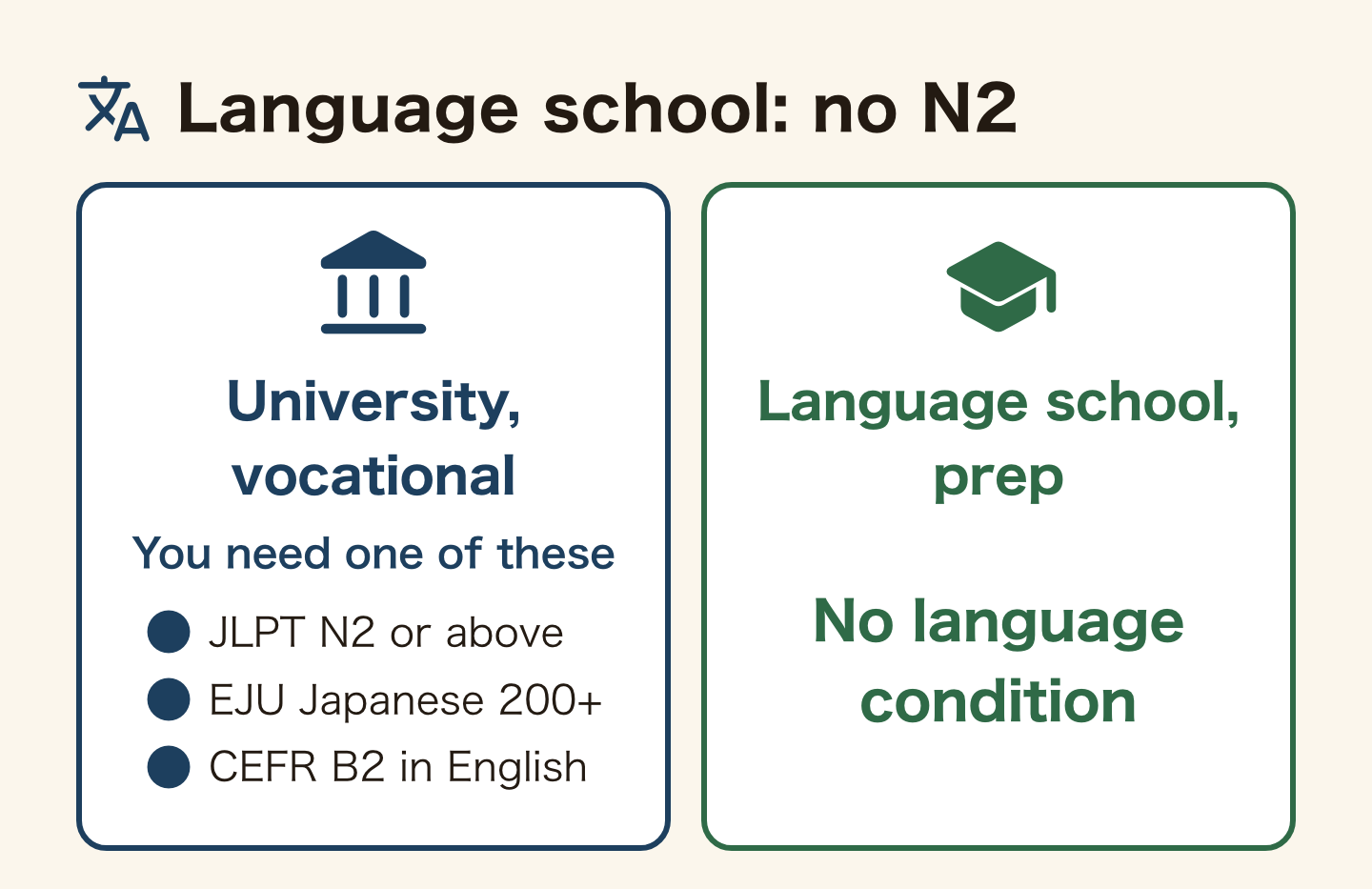
The conditions list a language standard: JLPT N2 or above, or 200 points on the Japanese section of the EJU, or CEFR B2 in English. But look at what immediately follows it.
Must meet the Japanese or English language standard below. (Excluding special courses for international students, preparatory courses, and Japanese language institutions.)
JASSO, about the Student Exchange Support Program – translated from the Japanese original
If you are at a Japanese language school, the language condition does not apply to you. No N2, no EJU score, and you can still be nominated.
“I do not have N2 yet, so this is not for me” is the thought that costs people the most.
You cannot apply for this yourself
You look for the application page, planning to send in the form yourself. Where you are from, scholarships may be something students apply for directly. This one only opens to you if your school nominates you.
This is the practical heart of it. JASSO puts it plainly:
Recipients are decided on the basis of nomination by the university or school.
JASSO, Student Exchange Support Program – translated from the Japanese original
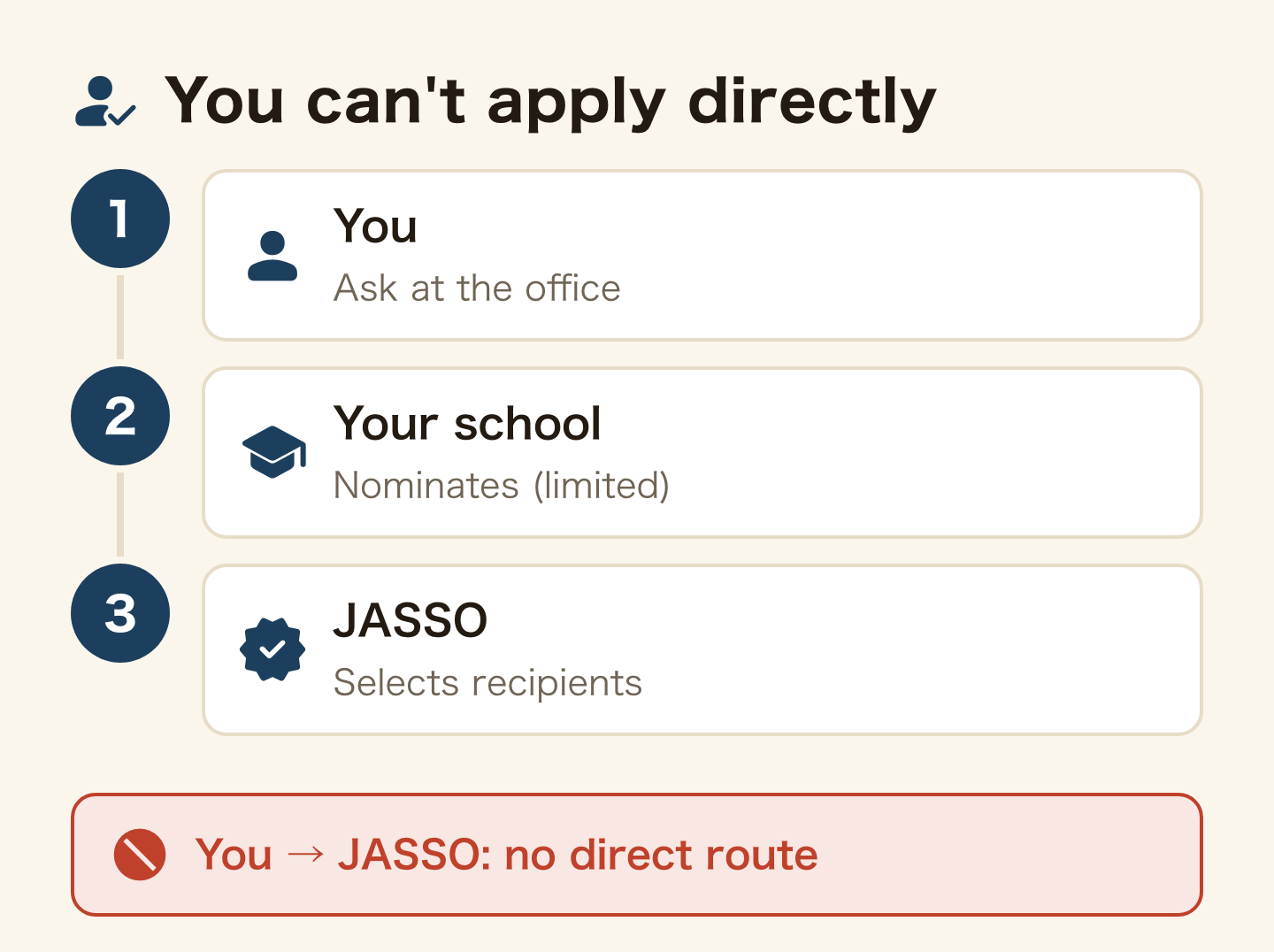
Which means you cannot send an application to JASSO. You enter the selection only once your school has put you forward.
And there is this:
Because the number of nominations per school is set according to how many international students are enrolled, at some schools it may not be possible to apply.
JASSO, about the Student Exchange Support Program – translated from the Japanese original
The places are counted. When your school decides who to nominate, anyone who does not know the scheme exists is not even a candidate.
One sentence to say at the office today
“JASSO no gakushu shoreihi ni suisen shite moraemasu ka” (JASSOの学習奨励費に推薦してもらえますか) – can I be nominated for the JASSO honors scholarship? Student affairs, the international student desk, the office: the name varies. Timing varies by school too, so earlier is safer.
The 2.30 grade coefficient, and what more shifts cost you
One of the conditions:
A grade coefficient for the previous year of 2.30 or above at graduate, undergraduate and Japanese language institution level alike, with the prospect of maintaining it during the grant period.
JASSO, about the Student Exchange Support Program – translated from the Japanese original
Now do the arithmetic.
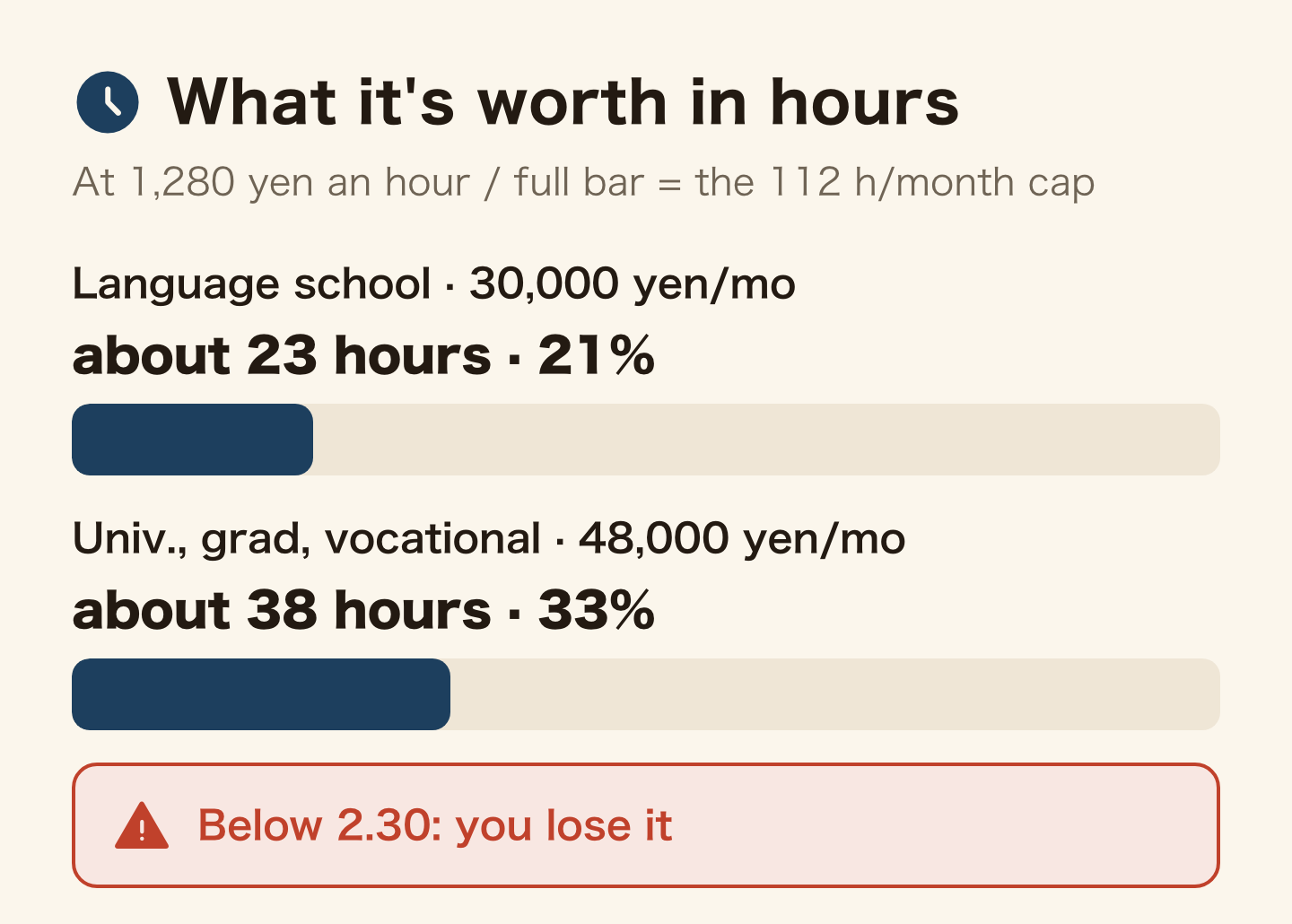
Thirty thousand yen a month, divided by the Tokyo minimum wage of 1,280 yen (from 1 October 2026), is about 23 hours of work (30,000 / 1,280 = 23.4). (Tokyo Labour Bureau, Tokyo minimum wage raised to 1,280 yen (Japanese)) The 28-hour cap gives you 112 hours a month, so it is roughly 21 percent (23.4 / 112) of everything you are allowed to work.
At 48,000 yen it is about 38 hours (48,000 / 1,280 = 37.5), roughly 33 percent (37.5 / 112).
So: add shifts, stop making it to class, drop below 2.30, and you can lose more than you gained.
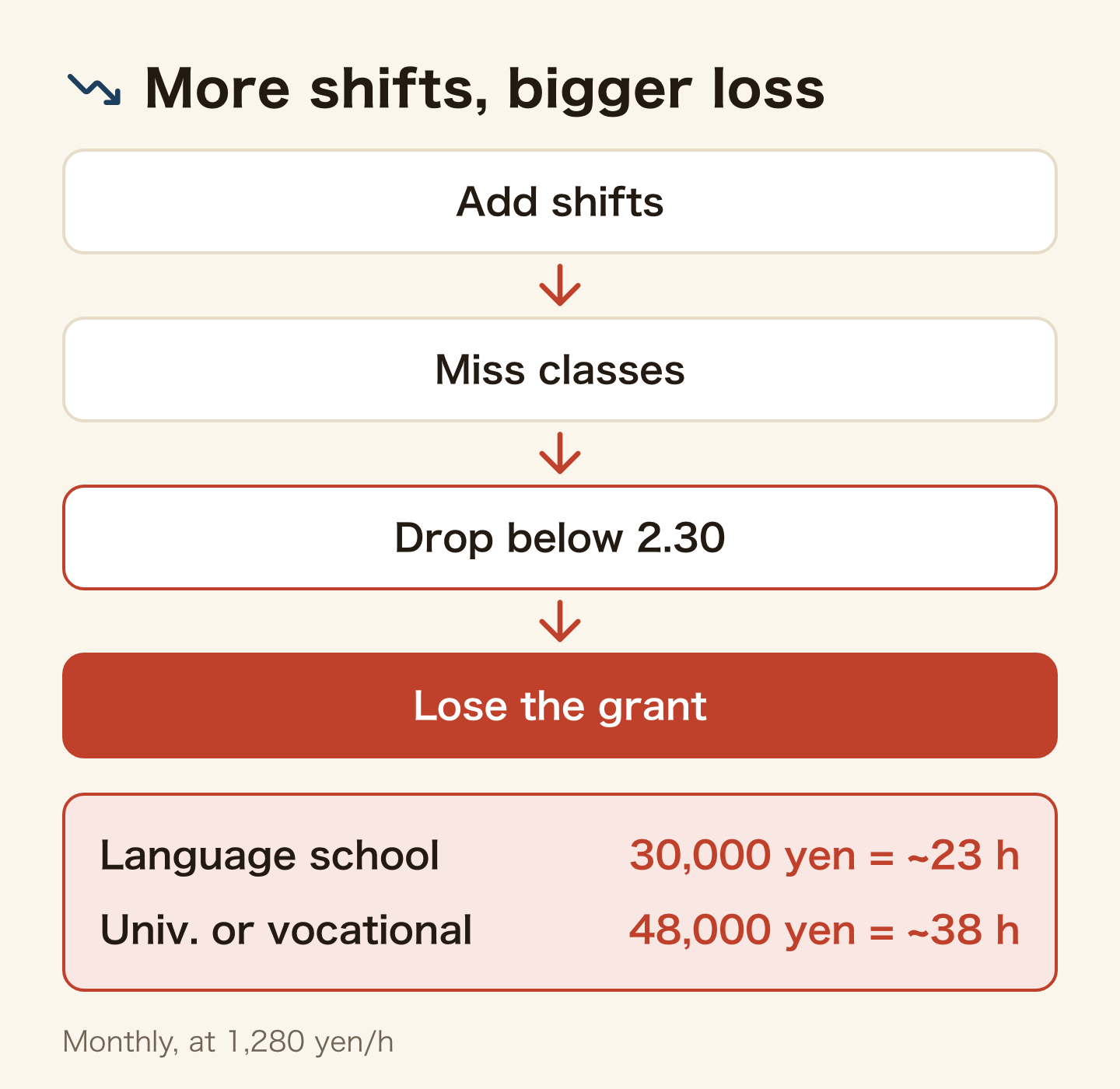
This is not a lecture about studying hard. It is a calculation about take-home pay. Hours spent in class may be worth more per hour than hours spent at work.
The remaining conditions
Two of them are about money, and both point the same way: less support from home means a stronger case.
- Remittances from home (excluding entrance fees and tuition) averaging 90,000 yen a month or less
- Where you have a supporter living in Japan, their annual income must be under 5 million yen
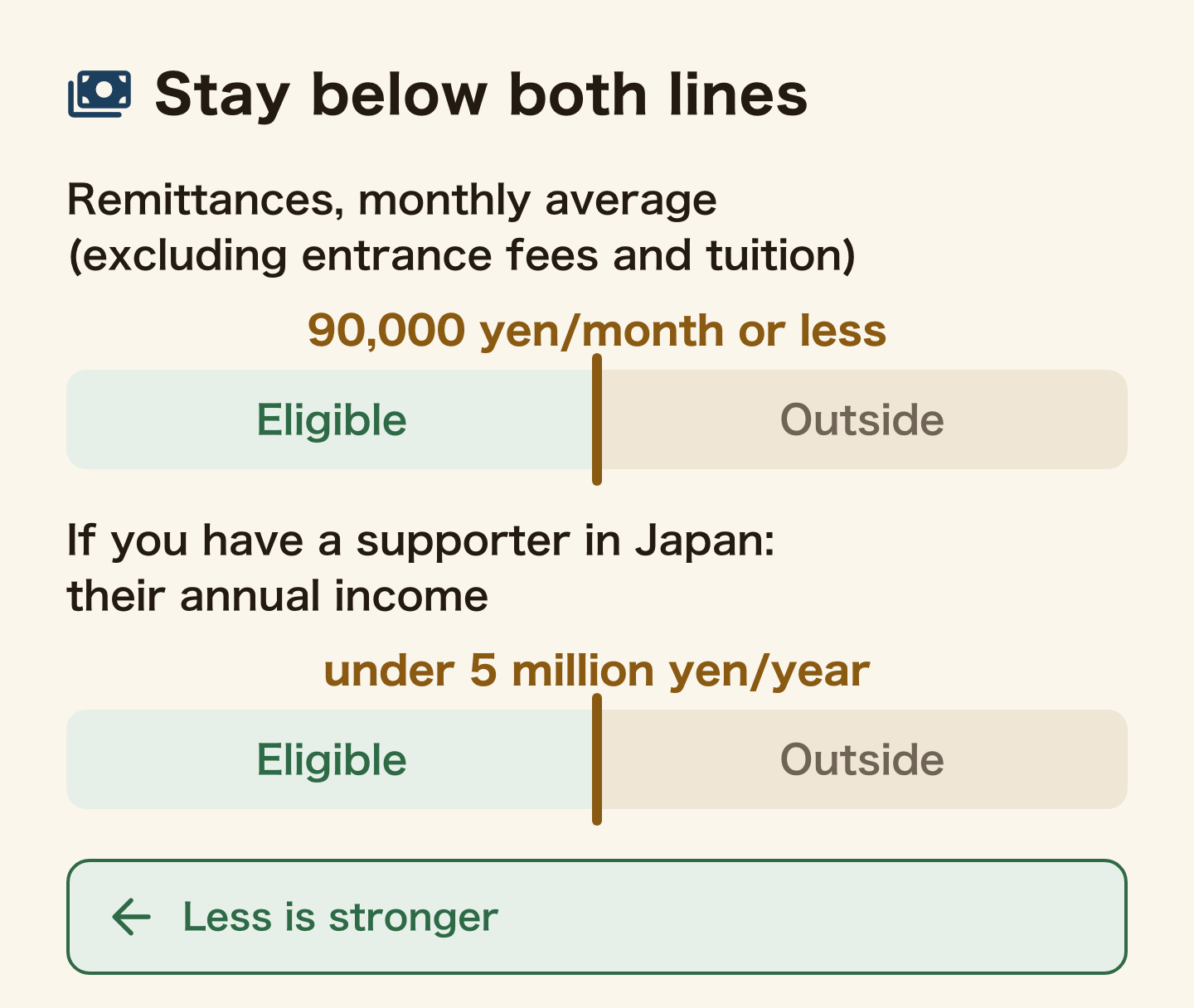
Beyond those: you must not be receiving a scholarship that cannot be combined with this one, you must not be on a JASSO overseas study support programme, and you must be willing to take part in the post-graduation careers survey.
Once you are receiving it, you sign an attendance confirmation register at your school’s office every month. Forgetting can stop that month’s payment, so put it in your calendar.
The scheme is described as being for students who are “excellent in both academic performance and character, and for whom study is difficult for financial reasons.” Being short of money is not something to apologise for here. It is a premise of the scheme.
How to find the other scholarships
Local governments and private foundations run scholarships too. There are many and the openings change year to year, so this guide does not list them.
Two ways to find them.
First, ask at the school office whether any scholarship notices have come in. Most are advertised through schools, which makes this the reliable route.
Second, look at “Scholarships offered by universities and local governments” on the JASSO site. It is reachable from the same page as the honors scholarship (JASSO, scholarships offered by universities and local governments (Japanese)).
There is also tuition reduction, which lowers the cost rather than adding income. Conditions and amounts differ by school, so ask about it in the same conversation.
One thing to do today
Go to your school office and ask this:
“Can I be nominated for the JASSO honors scholarship? And have any other scholarship notices come in?”
That is the whole action. Without a nomination, this money never reaches you. Places are limited and timings differ by school. Ask this week.
Then look at your fixed costs. As set out in our guide to living costs, rent is the number that actually moves. The student pension exemption and reductions on National Health Insurance are two more that people pay in full without knowing they need not.
Frequently asked questions
Q. Is there a JASSO scholarship for language school students?
Yes. The Monbukagakusho Honors Scholarship covers Japanese language institutions at 30,000 yen a month, provided you are enrolled while aiming to progress to further study.
Q. Can I apply without N2?
If you are at a Japanese language school, yes. The official text excludes special courses, preparatory courses and Japanese language institutions from the language requirement. University, graduate and vocational college students do need JLPT N2 or above, 200 points on the EJU Japanese section, or CEFR B2 in English.
Q. Does the JASSO honors scholarship have to be repaid?
No. It is a grant, not a loan.
Q. How do I apply for the JASSO scholarship?
You do not apply directly. Recipients are decided by nomination from the school, so ask your school office to nominate you. Each school has a limited number of nominations.
Q. What is the JASSO scholarship amount?
48,000 yen a month at graduate and undergraduate level, 30,000 yen a month at a Japanese language institution. It runs one year from April, or six months from October.
Q. Can I hold this while working part-time?
There is no condition banning part-time work. But remittances from home must average 90,000 yen a month or less, and your grade coefficient for the previous year must be 2.30 or above (JASSO, programme conditions (Japanese)). Adding shifts and letting grades slip is what puts this at risk.
Summary
- 30,000 yen a month at a language school, 48,000 yen at university, graduate school or vocational college. Never repaid
- No language requirement for language school students – the official text excludes them by name
- You cannot apply yourself. Schools nominate, with a fixed number of places, so asking early matters
- Conditions: grade coefficient 2.30 or above, remittances 90,000 yen a month or less, and a supporter in Japan earning under 5 million yen a year
- 30,000 yen is about 23 hours of work at 1,280 yen (30,000 / 1,280 = 23.4), roughly 21 percent of the 112 hours the cap allows. Protecting your grades can pay better than adding shifts
Official sources: JASSO, Student Exchange Support Program (Monbukagakusho Honors Scholarship for Privately Financed International Students) / JASSO, about the programme / JASSO, scholarships offered by universities and local governments (Japanese) / Tokyo Labour Bureau, Tokyo minimum wage raised to 1,280 yen (Japanese) / Immigration Services Agency, permission for part-time work on a Student status (Japanese) (checked 26 September 2026)
Amounts and conditions were checked against JASSO pages on 28 August 2026. Application windows, deadlines and nomination procedures differ by school. Confirm with your own school office.
Found this useful? Share it
Send it to a friend who lives in Japan.
WHO WROTE THIS

mori
Japanese. I read the ministries’ own notices, orders and Q&As in the original, and I start from what my Nepalese and Sri Lankan friends in Japan actually ran into. I do not write about what I have not checked or been told.
What this site can and cannot do →Looking for something else?
You may use the figures in this article, including commercially, if you credit this site with a link. How to use our figures