Checked on 21 November 2026 against the Japan Foundation’s free textbook Irodori (Elementary 1, Lessons 7 and 14), JR East’s delay certificate page, a Tokyo Metropolitan Government guide for schools with international students, Okayama University’s Japanese class policy, and the immigration agency’s standards for Japanese language schools. The example lines are our own, based on these sources.
The short answer
- Say 5 things, before class starts: your class, your name, absent or late, the reason, and when you will come.
- Short, simple Japanese is enough. “Netsu ga arimasu. Sorede, kyō wa yasumitai n desu ga…” (I have a fever, so I would like to take today off) is based on a beginner textbook.
- Who to tell, how, and by when depends on your school. It may be a phone call to the office, an email to your teacher, or a school app. Ask once.
- If your train is late, get a delay certificate and give it to your school. JR East keeps the last 45 days on its website.
- The worst choice is saying nothing. It becomes an absence without notice, and the school will try to reach you. For sick days, a doctor’s note may keep the day out of your attendance rate.
Knowing this, on a sick morning or a train-delay morning, you only need to edit one saved message and send it. You will not freeze on the phone and end up absent without a word.
It is 7 a.m. You have a fever. You open your phone to call school, but the first words will not come. What comes after “moshi moshi”? Do you need keigo? Your Japanese friend says, “Just say you’re taking the day off.” That is exactly the part you do not know how to say. So you send nothing and go back to sleep. The register says: absent without notice.
- How do you tell school you are absent in Japanese? The 5 things to say
- Calling in sick in Japanese: what to say on the phone
- Email, app or LINE: a message you can copy
- Late for class in Japanese: train delays and delay certificates
- Off sick: tell school, then bring a doctor’s note
- What happens if you are absent without telling school?
- What differs by school? 3 things to ask the office
- Nervous about phone calls in Japanese? Practise out loud
- Everything on one page: what to say, what to bring
- Which one are you?
- FAQ
- Summary
- Related reading
How do you tell school you are absent in Japanese? The 5 things to say
First, three places where people get stuck. Each one comes from an official guide or a school’s own rules.
- Each school has its own contact. Okayama University’s Japanese classes for international students say: email your teacher. Other schools use the office phone or an app.
- After class starts is too late. The Tokyo guide tells schools to teach students to contact school before an absence.
- Contacting is not the last step. Later you give a doctor’s note (if sick) or a delay certificate (if the train was late).
What you say is always the same 5 things. The Japan Foundation’s Irodori Elementary 1, Lesson 14 practises calling work to say you are late or absent. Its order is: name, reason, “sorede” (so), what happens. For school, add your class and when you will come.
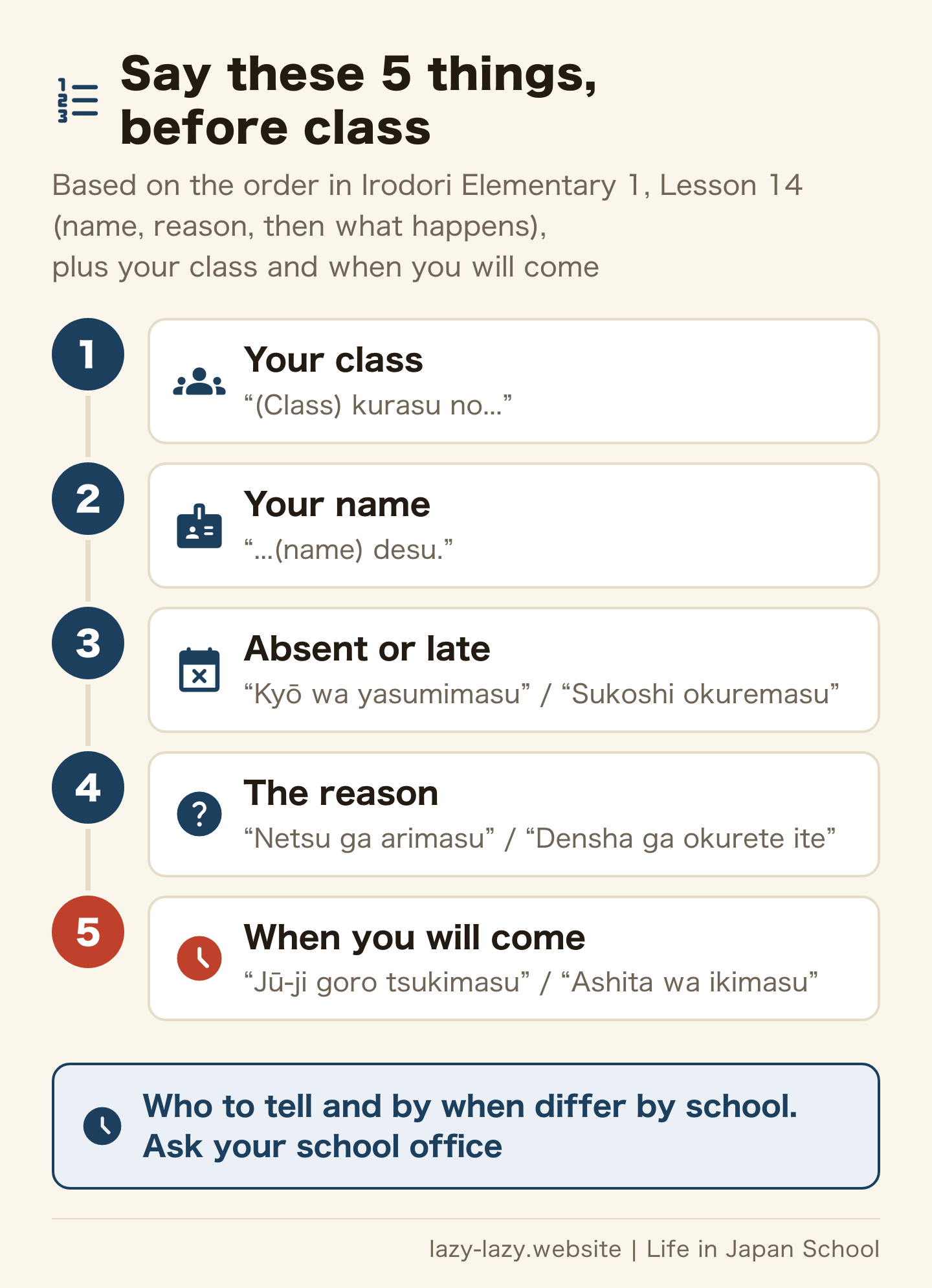
Why your class? Many students share the same name. Why “when you will come”? Your teacher can plan the lesson. With all 5 things, small mistakes in your Japanese do not matter.
Calling in sick in Japanese: what to say on the phone
When someone answers, say who you are first: “Ohayō gozaimasu. (Class) kurasu no (name) desu.” Then add one line for your situation. The lines below are examples based on Irodori Lesson 14.
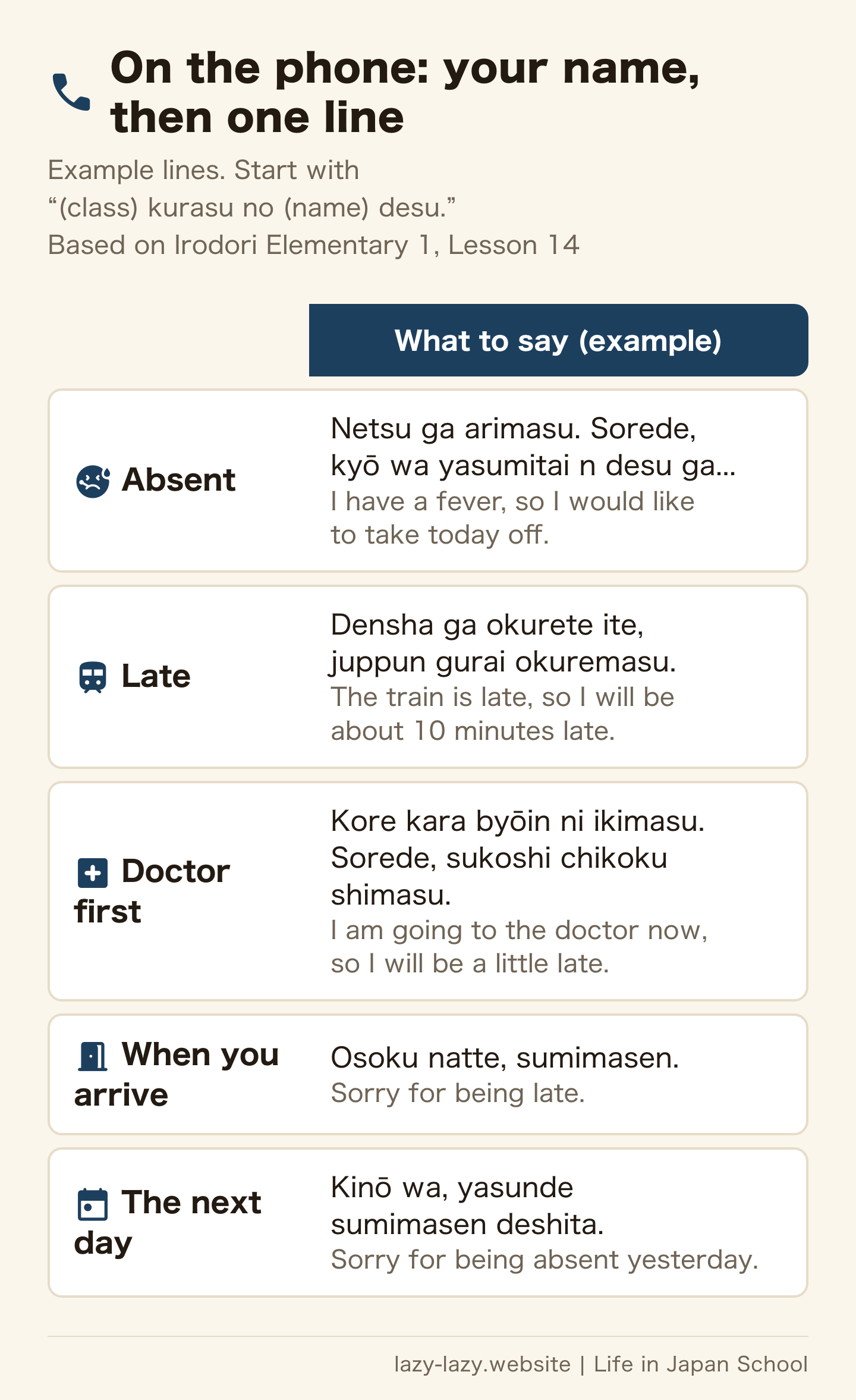
Put “sorede” after the reason. It links your two sentences, even with basic Japanese. “Netsu ga arimasu. Sorede, kyō wa yasumitai n desu ga…” Irodori’s grammar note says “~n desu ga…” explains your situation and asks for a response.
Overslept? Say so: “Sumimasen, nebō shimashita. Sorede, sanjuppun gurai okuremasu.” (Sorry, I overslept, so I will be about 30 minutes late.) If you invent a reason, your story may not match later.
When the teacher says “Wakarimashita. Odaiji ni,” answer “Arigatō gozaimasu. Shitsurei shimasu,” and hang up. If nobody answers, send the same 5 things by your school’s other method, such as email or an app.
Email, app or LINE: a message you can copy
A written message has the same 5 things. Add the date. For email, add a subject line that shows who you are and why you are writing.
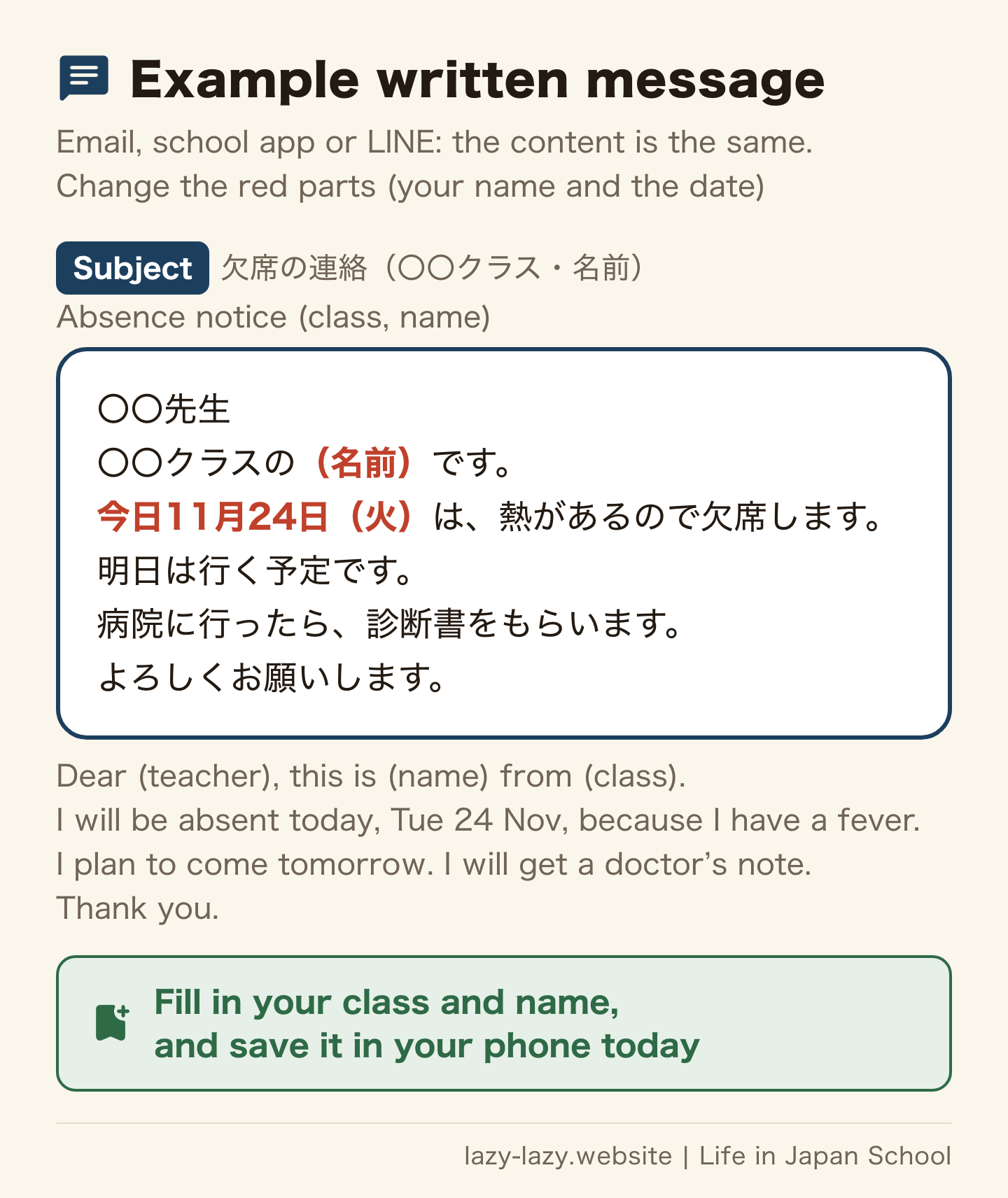
Here is the same example as text. Replace 〇〇 and (名前) with your class and name today.
(Example) 件名:欠席の連絡(〇〇クラス・名前)
〇〇先生
〇〇クラスの(名前)です。
今日〇月〇日(〇)は、熱があるので欠席します。
明日は行く予定です。
よろしくお願いします。
Subject: Absence notice (class, name) / Dear (teacher), this is (name) from (class). I will be absent today, (date), because I have a fever. I plan to come tomorrow. Thank you.
Running late instead? Change the third line to 「電車が遅れていて、10時ごろ着きます」 (The train is late. I will arrive around 10). Irodori Elementary 1, Lesson 7 also practises a late message with three parts: an apology, the reason, and how long.
Some schools use LINE with teachers. But asking a friend to “tell the teacher I’m off” is not contacting school. Send it yourself, to the person your school chose.
Late for class in Japanese: train delays and delay certificates
Even 5 minutes late, contact school as soon as you know. The Irodori Lesson 7 column, about meeting someone, says to tell the other person early, even for 5 or 10 minutes. The line is: “Densha ga okurete ite, sukoshi okuremasu.”
If your train is late, get a delay certificate (chien shōmeisho). It is a note from the railway showing how late the line was. You can get one at the station or online.
JR East’s delay certificate page lists lines delayed by about 5 minutes or more. Only local (non-express) trains are covered. It keeps the last 45 days. It shows the largest delay on that line. It does not prove you were on the train.
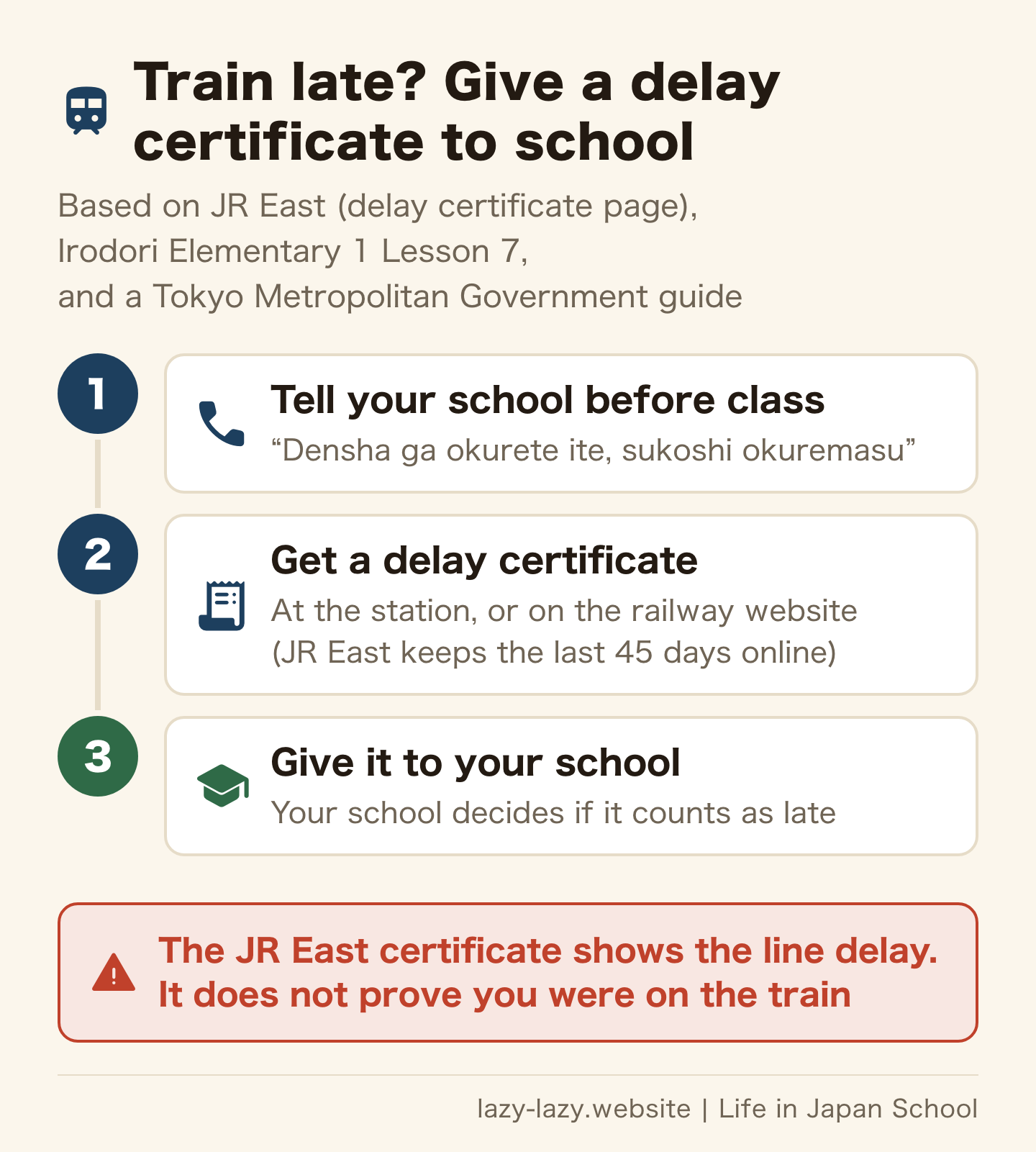
Does the certificate cancel your lateness? Your school decides. The Tokyo guide for schools says a train delay can be treated as an approved absence. “Can” is not “must”. Other railways and buses have their own rules, so check their websites.
Off sick: tell school, then bring a doctor’s note
You are off for 2 days with a fever, then go back to class without a word. Where you come from, that may be normal. In Japan, you contact school that morning, and bring a doctor’s note or similar paper when you return.
Japanese language schools follow national standards: under 80% attendance in a month means guidance, under 50% means a report to immigration. Unavoidable absences such as illness are left out, and the school decides which ones count. For how the rate works and what it means for your visa, see Japan student visa attendance requirements.
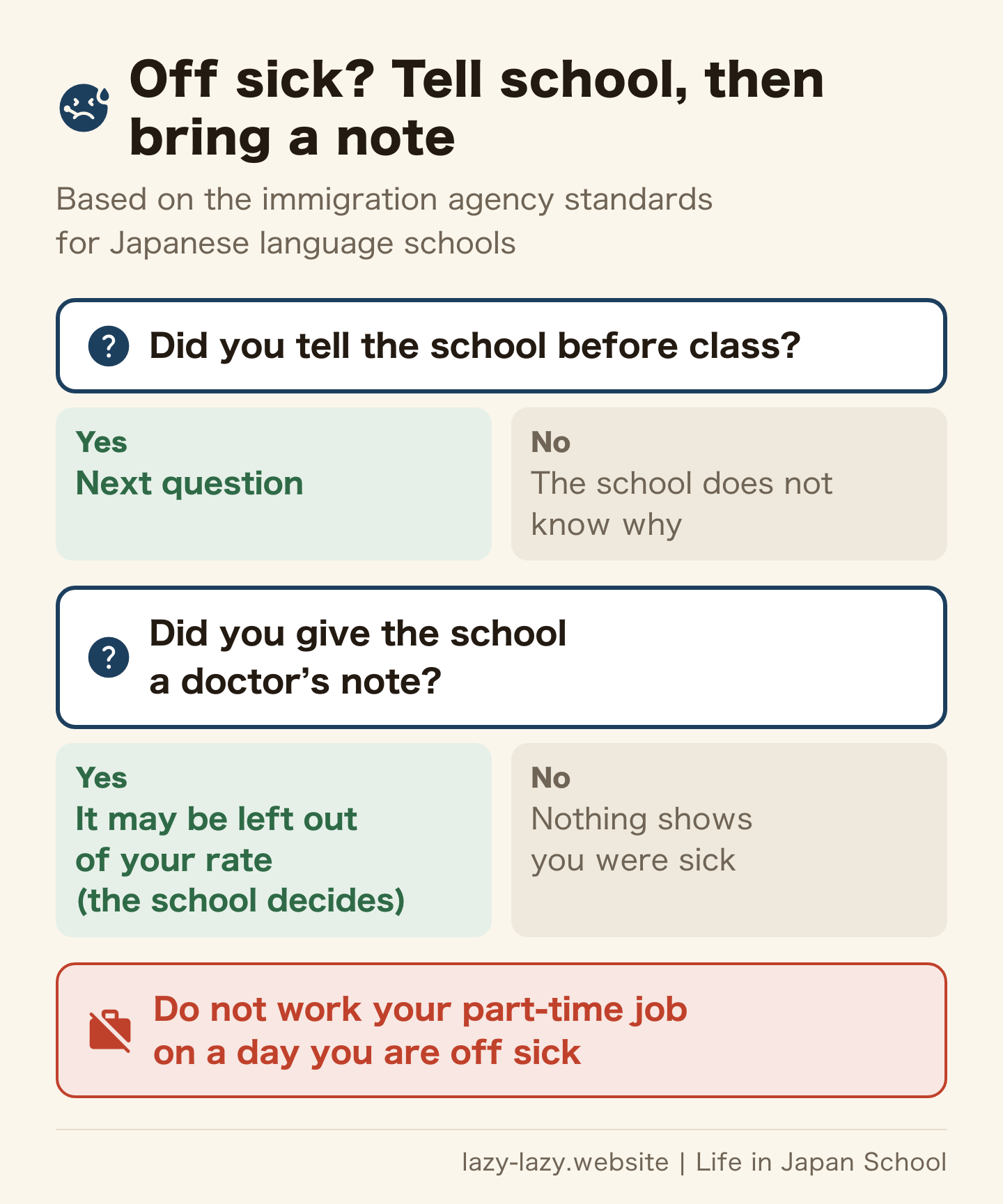
Add one line to your message: 「病院に行ったら、診断書をもらいます」 (I will get a doctor’s note at the clinic). Then your teacher knows what to expect. Schools differ on what to bring, such as a note or a receipt, so ask.
The immigration agency’s guidelines say a school may ask for a doctor’s note if it suspects you work while off sick. On a sick day, skip your part-time job too. For calling your workplace, see Japanese phrases for work.
Not sure where to go? Seeing a doctor in Japan explains clinics and departments. For a fever at night or on a holiday, see urgent care in Japan.
What happens if you are absent without telling school?
It becomes an absence without notice (mudan kesseki). Your school does not know if you are sick, hurt, or have quit.
The Tokyo guide tells schools that contacting the student on the same day is important. If the phone does not work, it lists email, close friends, the workplace, a home visit, and parents back home.
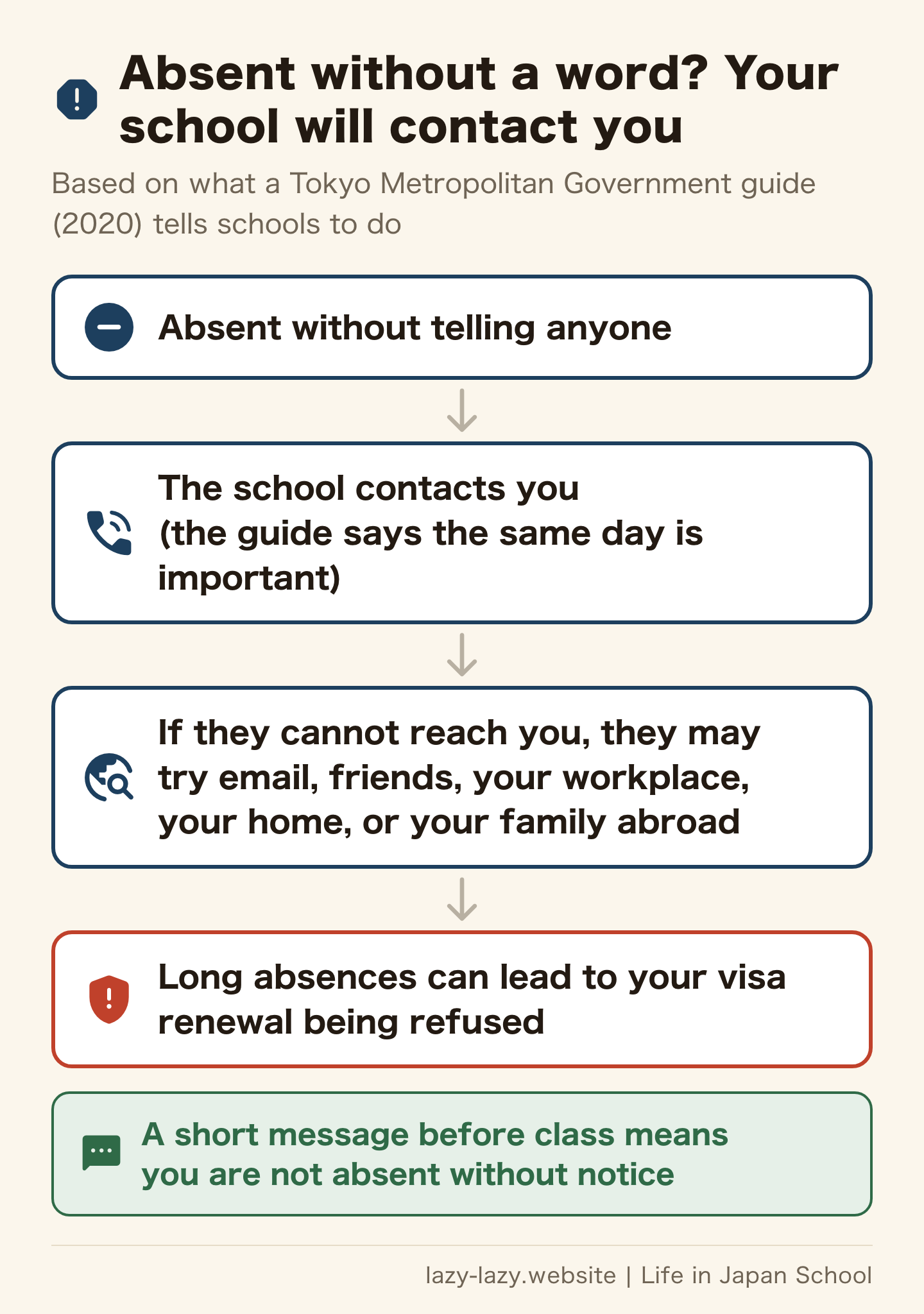
The same guide says long absences can lead to a refused visa renewal. The good news: one short line before class, like “I have a fever, so I’m off today,” is not an absence without notice. If phone calls scare you, write instead. A short message works far better than silence.
Forgot to tell them? Send a message as soon as you notice: 「昨日は、連絡しないで休んで、すみませんでした。熱がありました」 (Sorry I was absent yesterday without contacting you. I had a fever.) Say the same to your teacher in person the next day.
What differs by school? 3 things to ask the office
There is no single national rule for how to contact school. The Tokyo guide asks each school to set its own lateness rule and tell students. Its example: in a 90-minute class, over 20 minutes late counts as absent, and 2 lates make 1 absence.
Universities set rules too. Okayama University’s Japanese class policy says: email your teacher if absent, 3 lates make 1 absence, and 20 minutes or more late counts as absent. Same word “late”, different counting.
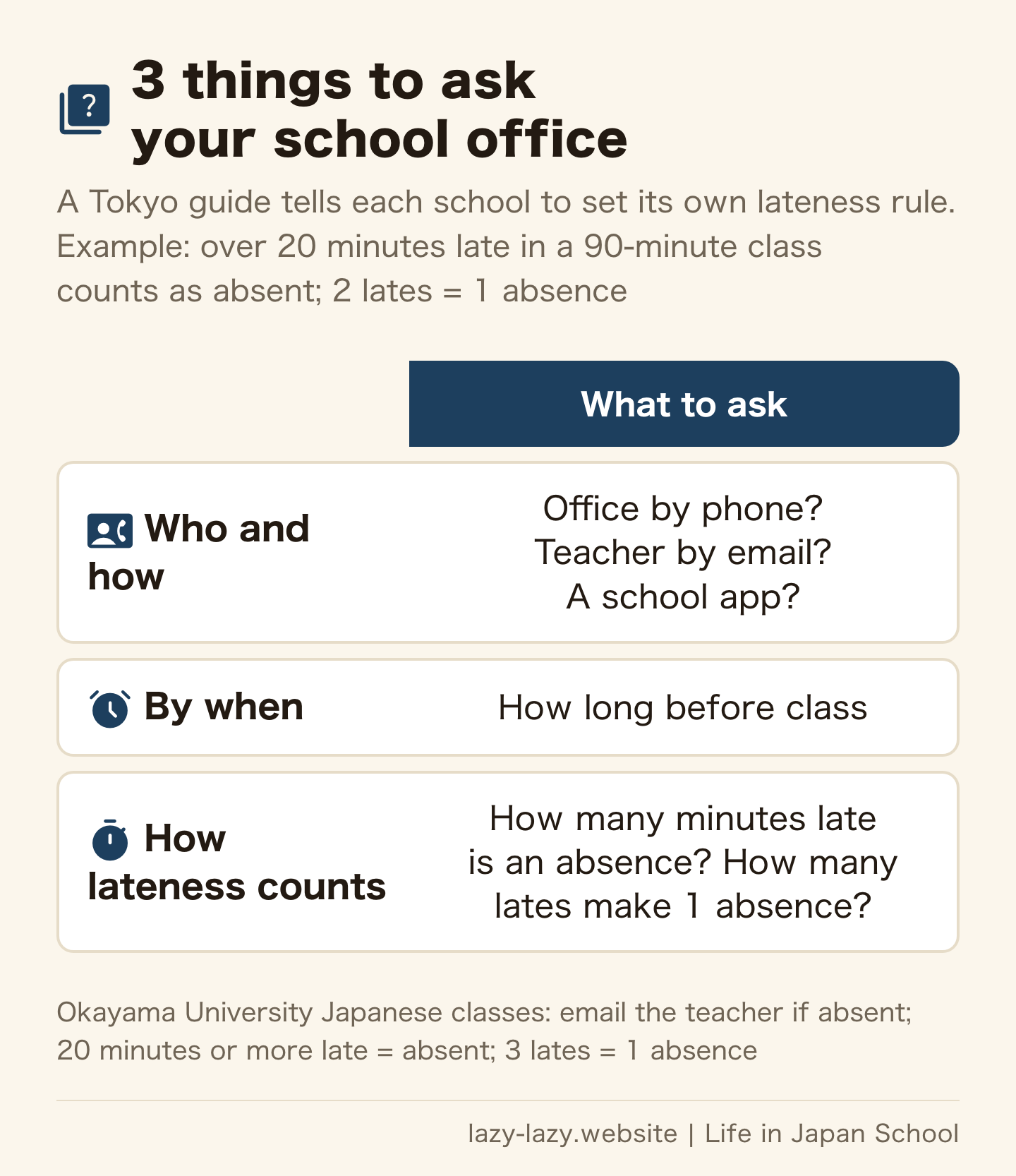
Your student handbook may already answer this. If not, ask the office once: 「休むときは、誰に、何で、何時までに連絡しますか」 (When I am absent, who do I contact, how, and by what time?). Save that contact in your phone. Ask the same 3 things when you move to a vocational school or university.
Nervous about phone calls in Japanese? Practise out loud
Knowing the lines is one thing. Saying them with a fever is another. Read them out loud once on a healthy day. Irodori is free from the Japan Foundation, and Lesson 14 has audio of similar calls to work.
Want to practise with a real person? You can buy one-to-one Japanese lessons one at a time. italki showed 1,218 Japanese teachers available for lessons (checked 21 November 2026). No subscription is needed. Prices differ by teacher. Book a trial lesson first and say you want to practise calling school. Teaching style and fit vary from teacher to teacher. Find a Japanese teacher on italki (ad)
Want to sound more polite with teachers? Read keigo vs casual Japanese. The lines in this guide are already enough to be understood.
Everything on one page: what to say, what to bring
| Situation | Say or send before class (example) | Bring later |
|---|---|---|
| Off sick | 〇〇クラスの(名前)です。熱があります。それで、今日は休みたいんですが……。 (Class) kurasu no (name) desu. Netsu ga arimasu. Sorede, kyō wa yasumitai n desu ga… |
Doctor’s note or similar (ask your school) |
| Doctor first, then school | これから病院に行きます。それで、少し遅刻します。11時ごろ着きます。 Kore kara byōin ni ikimasu. Sorede, sukoshi chikoku shimasu. Jūichi-ji goro tsukimasu. |
Ask your school |
| Train delay | 電車が遅れていて、10分ぐらい遅れます。 Densha ga okurete ite, juppun gurai okuremasu. |
Delay certificate (JR East: last 45 days online) |
| Overslept | すみません、寝坊しました。30分ぐらい遅れます。 Sumimasen, nebō shimashita. Sanjuppun gurai okuremasu. |
Nothing |
| Forgot to contact | 昨日は、連絡しないで休んで、すみませんでした。 Kinō wa, renraku shinaide yasunde, sumimasen deshita. |
Doctor’s note if you were sick |
All lines are examples. Follow your own school’s rules for who, how and by when.
Which one are you?
- You have a fever and will miss class today: before class, send the 5 things by phone or message. At the clinic, ask for the paper your school needs.
- Your train is stopped: tell school now, “Densha ga okurete ite, sukoshi okuremasu.” Get the delay certificate and hand it in.
- You were absent without telling anyone: today, send “Kinō wa, renraku shinaide yasunde, sumimasen deshita” with the reason. If you were sick, ask about a doctor’s note.
- You are well and have never missed class: ask the office who, how and by when. Save the template with your class and name in your phone.
FAQ
Q. What do I say first when I call school to say I am absent?
Say “Ohayō gozaimasu. (Class) kurasu no (name) desu.” Then give the reason and say you are absent, for example “Netsu ga arimasu. Sorede, kyō wa yasumitai n desu ga…” End with when you will come.
Q. Should I call or send an email?
Use the method your school chose. Some schools use the office phone, others use email to the teacher or an app. For example, Okayama University’s Japanese classes ask students to email the teacher. If you do not know, ask the office.
Q. How do I say I will be late for class in Japanese?
Give the reason and how late, for example “Densha ga okurete ite, juppun gurai okuremasu” (the train is late, so I will be about 10 minutes late). When you arrive, say “Osoku natte, sumimasen.” Contact school even for 5 minutes.
Q. If my train is late, am I still marked late?
Your school decides. Get a delay certificate at the station or online and give it to school. JR East keeps the last 45 days on its website. The Tokyo guide says schools can treat train delays as approved absence.
Q. What happens to my attendance rate if I am sick?
At Japanese language schools, unavoidable absences such as illness may be left out of the 80% and 50% checks. The school decides, so contact school that day and bring a doctor’s note or similar paper.
Q. What happens if I am absent without telling school?
It is an absence without notice. The Tokyo guide says contacting you the same day is important. The school may also reach out to friends, your workplace or your family abroad. Long absences can lead to a refused visa renewal.
Summary
When you are absent or late, say 5 things: class, name, absent or late, reason, and when you will come. Short Japanese is fine. A line based on the textbook, “Netsu ga arimasu. Sorede, kyō wa yasumitai n desu ga…” gets the message across.
What matters is contacting school yourself, before class, by your school’s method. Bring a delay certificate for train delays and a doctor’s note for sick days. Today, save one template with your class and name in your phone. Next, read Japan student visa attendance requirements to see how missed days affect your visa.
Official sources: Japan Foundation, Irodori Elementary 1, Lesson 14 (PDF) / Lesson 7 (PDF) / JR East, delay certificate (Japanese) / Tokyo Metropolitan Government, guide on supporting international students 2020 (PDF, Japanese) / Okayama University, Japanese Language Class Policy 2024 (PDF) / Immigration Services Agency, Standards for Japanese Language Institutions (PDF, Japanese) / ISA, Interpretation Guidelines (PDF, Japanese) (all checked 21 November 2026). Always confirm your own school’s contact method and deadline.
Related reading
Found this useful? Share it
Send it to a friend who lives in Japan.
WHO WROTE THIS

mori
Japanese. I read the ministries’ own notices, orders and Q&As in the original, and I start from what my Nepalese and Sri Lankan friends in Japan actually ran into. I do not write about what I have not checked or been told.
What this site can and cannot do →Looking for something else?
You may use the figures in this article, including commercially, if you credit this site with a link. How to use our figures