Checked on 20 November 2026 against the Immigration Services Agency pages for Student status (including the document lists by school type), the renewal procedure page and renewal guideline, and the official pages for international students at the University of Tokyo, Kyoto University and Kobe University.
The short answer
- You can apply from 3 months before your residence card expires. If it expires on 31 March, you can apply from late December.
- Your school issues most of the papers. You need a certificate of enrolment, plus attendance, grades and graduation papers. The school also fills in part of the form.
- Only some students need money papers. For example, students warned about part-time work at the last renewal.
- Grades, attendance and part-time work show up in your papers. But there is no published pass mark. Some universities ask for a letter if you repeat a year.
- The fee depends on the period you get. One year costs 33,000 yen at the counter or 27,000 yen online. You pay only when approved.
Knowing this, you will know what to ask your school for, 3 months ahead, so you are not short of papers on the last day. If you are moving on to a new school or repeating a year, you can prepare the extra papers early.
You take your residence card out of your wallet and look at the date. 31 March. Your classes go on in April. You ask a Japanese friend what you need for a visa renewal. They have no idea. Japanese people don’t carry a residence card. The school notice board only says, “Renew early.”
- When can you apply for a student visa extension in Japan? From 3 months before
- What documents do you need to renew a student visa in Japan? Ask your school office
- Do you need money papers? Only in some cases
- Do grades, attendance and part-time work matter? Yes, but there is no pass mark
- Moving on to a higher school: the admission letter and your graduation papers
- Can you extend your student visa if you repeat a year? Some universities ask for a letter
- How much is the student visa extension fee? It depends on the period, 33,000 yen for 1 year
- What if you run out of time, or are refused? Apply by the expiry date
- Which one are you?
- FAQ
- Summary
- Related reading
When can you apply for a student visa extension in Japan? From 3 months before
The official name is “Application for Extension of Period of Stay.” Immigration offices use this name. In Japanese it is zairyu kikan koshin kyoka shinsei.
You can apply from 3 months before your card expires, up to the expiry date. This applies if your period of stay is 6 months or longer (Immigration Services Agency: Extension of Period of Stay). If your card expires on 31 March, you can apply from late December. If it expires on 30 April, you can apply from late January.
A late-March or late-April expiry means your window opens around the New Year holidays. The University of Tokyo warns that immigration offices get very busy around new terms and long holidays (University of Tokyo: Extension of Period of Stay). Pick a day to visit your school office before the winter break.
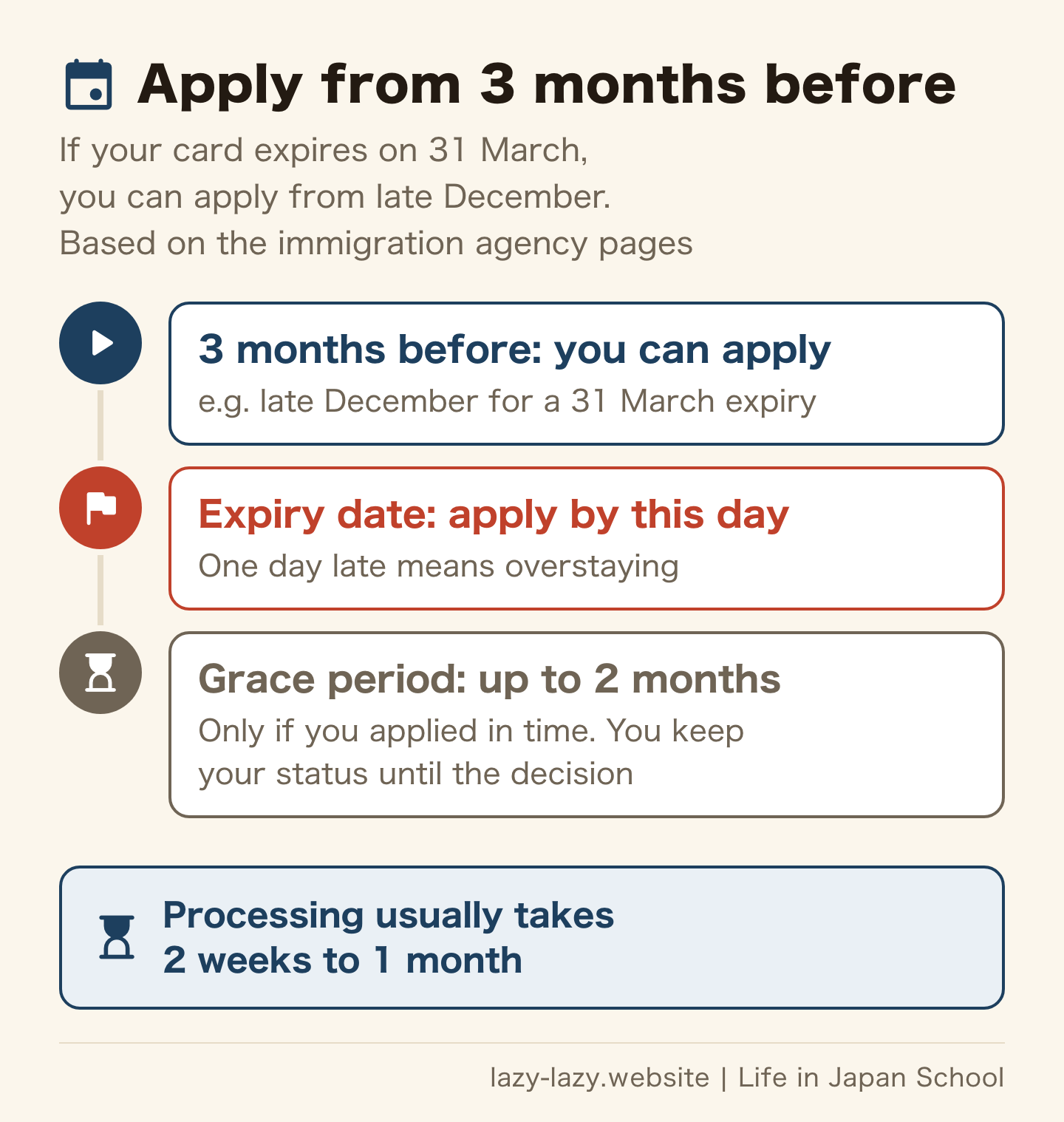
Processing usually takes 2 weeks to 1 month. The agency calls this the standard processing period. Applying 3 months ahead leaves plenty of time.
You can go to the immigration office, or apply online. Online needs a My Number Card. See how to renew your visa online. There is a third way, too. Approved school staff can submit the papers for you. This is called toritsugi. You still need to be in Japan. Ask your school office if they do this.
What documents do you need to renew a student visa in Japan? Ask your school office
The agency’s Student status page has document lists for each type of school. Japanese language schools, vocational schools and universities have separate lists. But the core papers are the same for everyone.
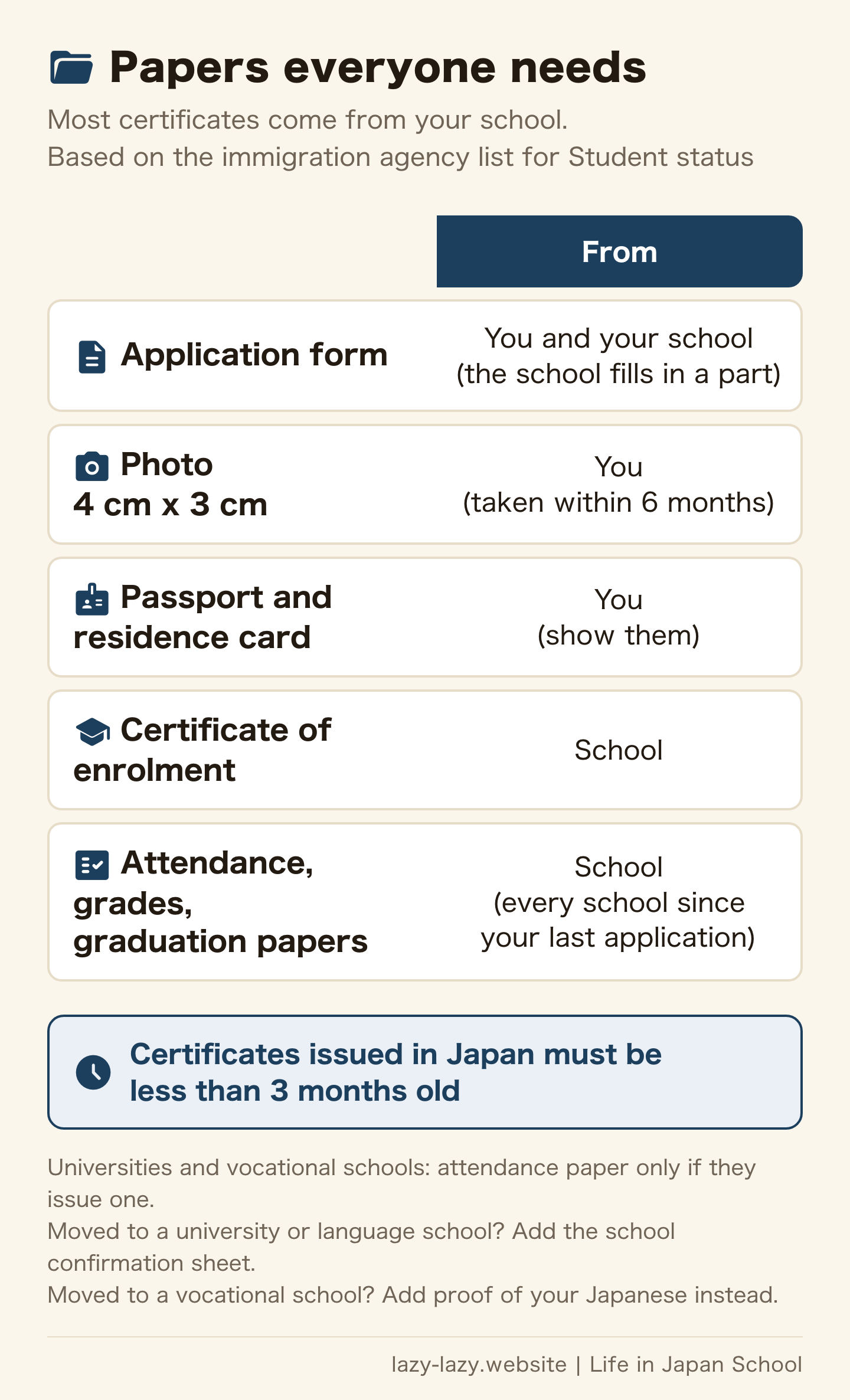
- Application form for Student status. The back pages are for your school to fill in
- A photo, 4 cm tall and 3 cm wide, taken within 6 months (photo rules)
- Your passport and residence card, shown at the counter
- A certificate of enrolment from your current school
- Attendance, grades and graduation papers from every school since your last application
- The document checklist for your school type, with each paper ticked
For universities and vocational schools, the attendance paper is needed “if it can be issued.” For Japanese language schools, it is always needed.
Watch the dates. Certificates issued in Japan must be less than 3 months old. Ask too early, and they may expire before you apply. Ask a little before your 3-month window opens.
The school’s part of the form is the “for organization” page. The University of Tokyo tells students to get it from their faculty office. Ask for it with your certificates, and one visit is enough. If you have not changed schools, you do not need the school confirmation sheet. One exception: you studied only Japanese there and now move to another course at the same school. Then you need it.
Do you need money papers? Only in some cases
The lists include a form about how you pay your living costs. You add proof, such as tax papers or remittance records.
Three questions decide if you need it.
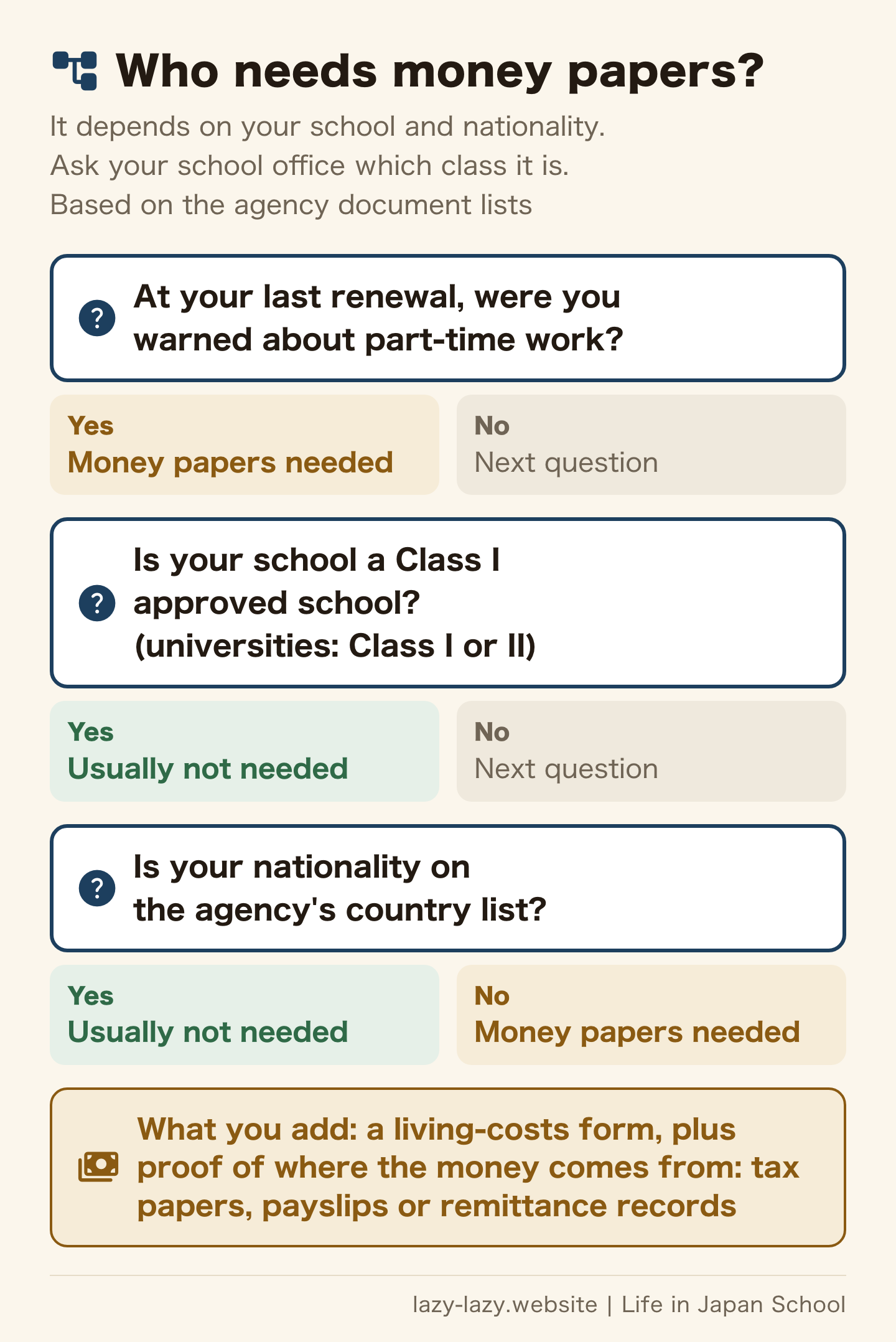
First: were you warned about part-time work at your last renewal? If so, you need money papers at any school.
Second: what class is your school? The agency rates schools as “approved” or not. At a Class I language or vocational school, you usually skip money papers. The same goes for a Class I or II university. Ask your school office which class it is.
Third: your nationality. At other schools, you always need money papers if your country is not on the agency’s country list.
Do you live on your part-time pay? Then the proof changes. After a year or more of work, bring your resident tax certificate and tax payment certificate. A bank book showing a year of income and tax can replace them. Under a year of work, bring copies of your payslips.
Some papers apply in every case. If the person paying your costs has changed, show how you are related. If you started a new scholarship, bring proof of it. University and vocational school lists leave out Japanese government (MEXT) scholarships.
Do grades, attendance and part-time work matter? Yes, but there is no pass mark
Yes. Attendance and grades reach immigration through your certificates. Part-time work goes on the form itself. The Student application form asks about work outside your status. You write your workplace, weekly hours and pay.
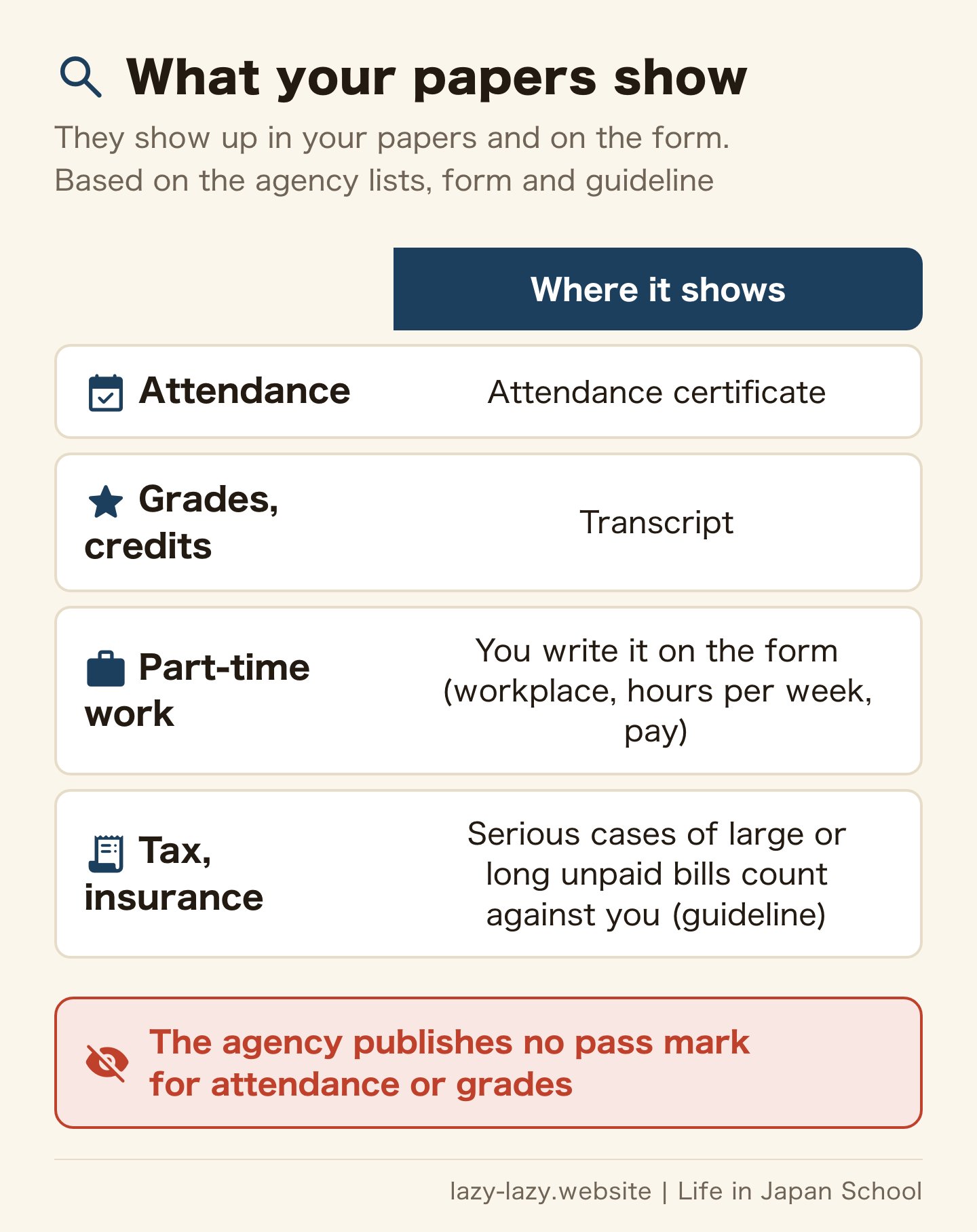
But the agency publishes no pass mark for attendance or grades. The national attendance rules and how to count them are in our guide to student visa attendance requirements.
Some universities are clear about it. Kyoto University says poor grades, very few credits or unpaid fees can lead to a refused renewal.
The agency’s renewal guideline lists what it weighs. Staying in Japan after leaving school counts against you, unless you had a good reason. Your work, including part-time work, must follow labour law. Large or long unpaid taxes or health insurance also count against you, if the case is serious. Behind on National Health Insurance? Talk to your city office before you renew.
You work as many hours as you can to pay your fees. Where you come from, that may be normal. In Japan, students can work up to 28 hours a week. During long school holidays, the limit is 8 hours a day (Immigration Services Agency: part-time work on Student status). A warning at your last renewal means more money papers. How to count the 28 hours is in our part-time job guide.
One more thing is easy to miss. Kobe University says your work permission ends with your period of stay. To keep working, apply again. You can apply together with your renewal, and it is free. Online, too, you can apply as long as it is with your renewal (Immigration Services Agency: permission for other activities).
Moving on to a higher school: the admission letter and your graduation papers
Language school to vocational school. Vocational school to university. You stay on Student status. When your card is about to expire, you renew as usual.
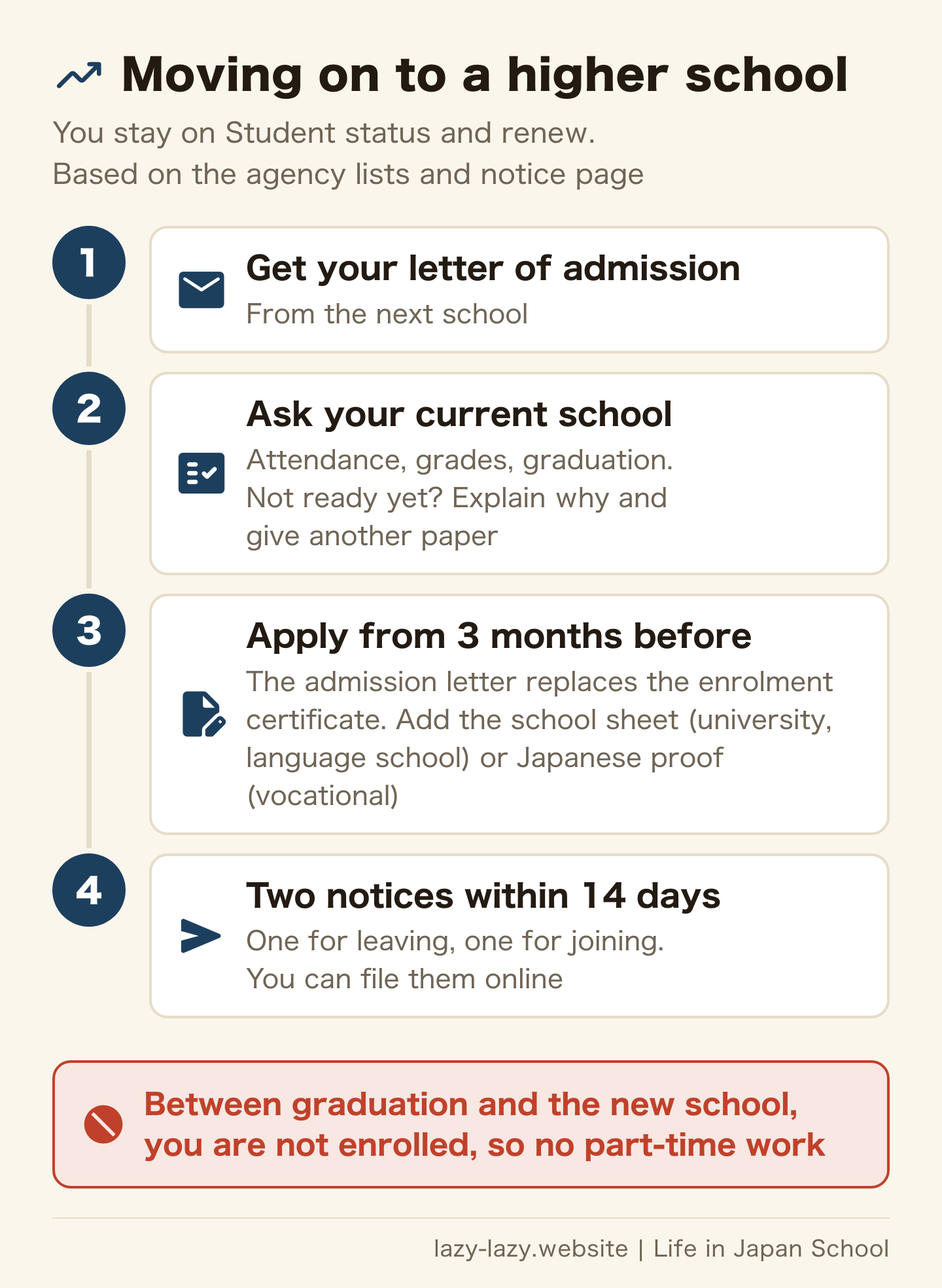
The papers change a little. Instead of a certificate of enrolment, you give the new school’s admission letter. You still need attendance, grades and graduation papers from your current school.
Where you go decides one more paper. Moving to a university or another language school? Add the school confirmation sheet. Going to a vocational school? You skip that sheet. Instead, you give proof of your Japanese. For example, a year or more at a Japanese language school, or JLPT N2 or higher (application notes).
If you apply before graduating, your graduation paper may not exist yet. The agency’s application notes cover this. If you cannot submit a paper, explain why and give another one instead. Ask your current school what to give.
You also file two notices. One when you graduate, and one when you join the new school. Each is due within 14 days, and you file it yourself (Immigration Services Agency: notification of your school). You can file them online. The steps are the same as in our guide to changing schools on a student visa.
Between graduation and the new school, you cannot do part-time work. The agency’s Q&A says work permission is valid only while you are enrolled. Plan your March budget for this gap. Still choosing a path? Read what to do after Japanese language school first.
Can you extend your student visa if you repeat a year? Some universities ask for a letter
You did not earn enough credits, and graduation moves back a year. Your period of stay may now end before you finish. You start to worry about your visa.
First, the agency publishes no rule that repeating a year means refusal. There is no “safe number” of repeats either. What we have are the universities’ own guides.
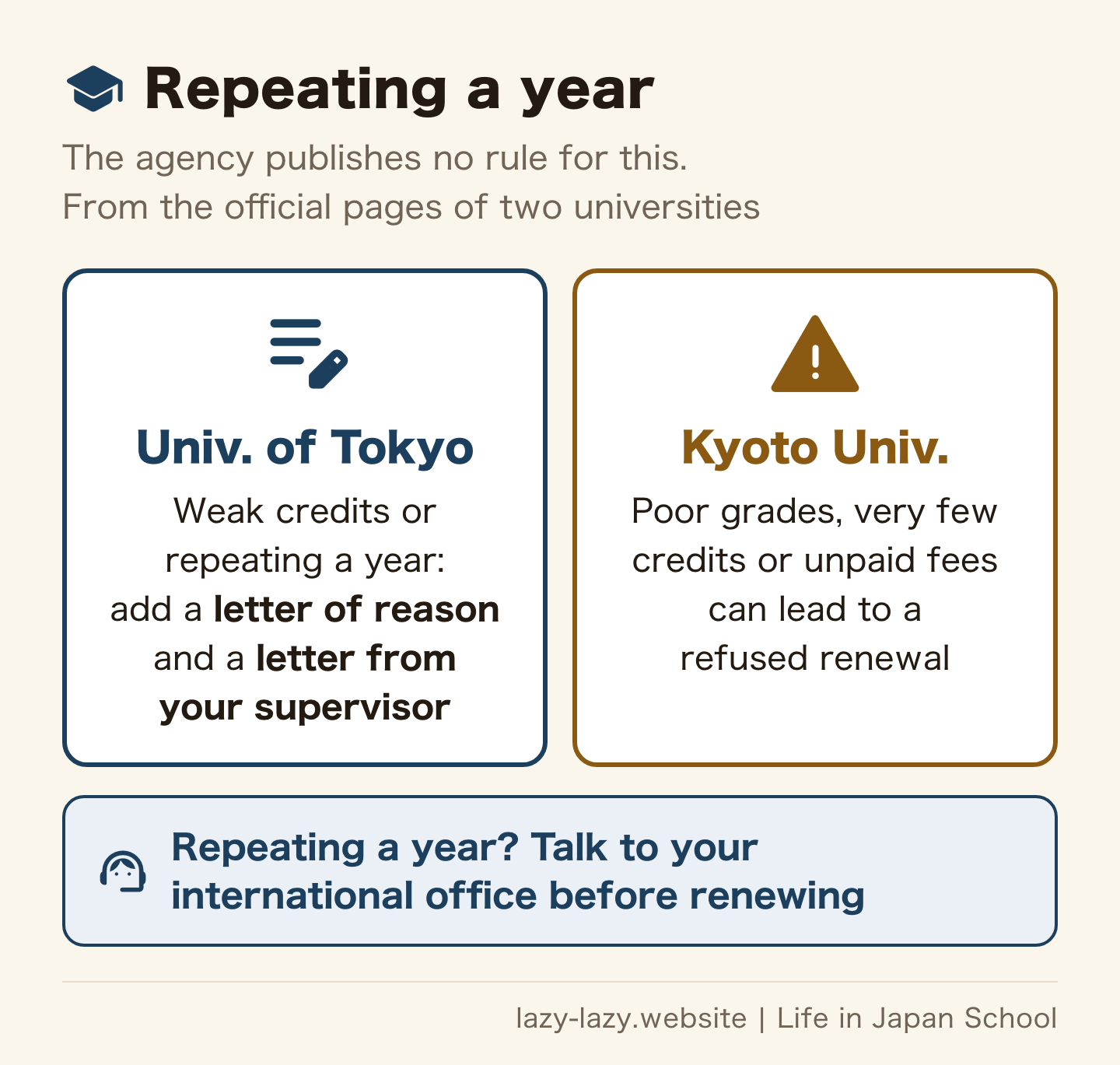
The University of Tokyo asks students with weak credits, or who repeat a year, for a detailed letter of reason and a letter from their supervisor. After a leave of absence, it asks for a letter of reason and proof of the leave period. Kyoto University says poor grades or very few credits can lead to a refusal.
A letter of reason explains why you fell short and how you will graduate. If illness was the cause, keep your medical records. They make it easier to explain. Ask your international office what to write. At a language or vocational school, follow your school’s guidance.
A leave of absence is different. If you do not study for 3 months or more without a good reason, your status can be cancelled (Immigration Services Agency: cancellation of status). Read our guide to a leave of absence on a student visa.
How much is the student visa extension fee? It depends on the period, 33,000 yen for 1 year
Since 1 October 2026, the fee depends on the period of stay you get. You pay nothing when you apply. You pay when you are approved (Immigration Services Agency: Extension of Period of Stay).
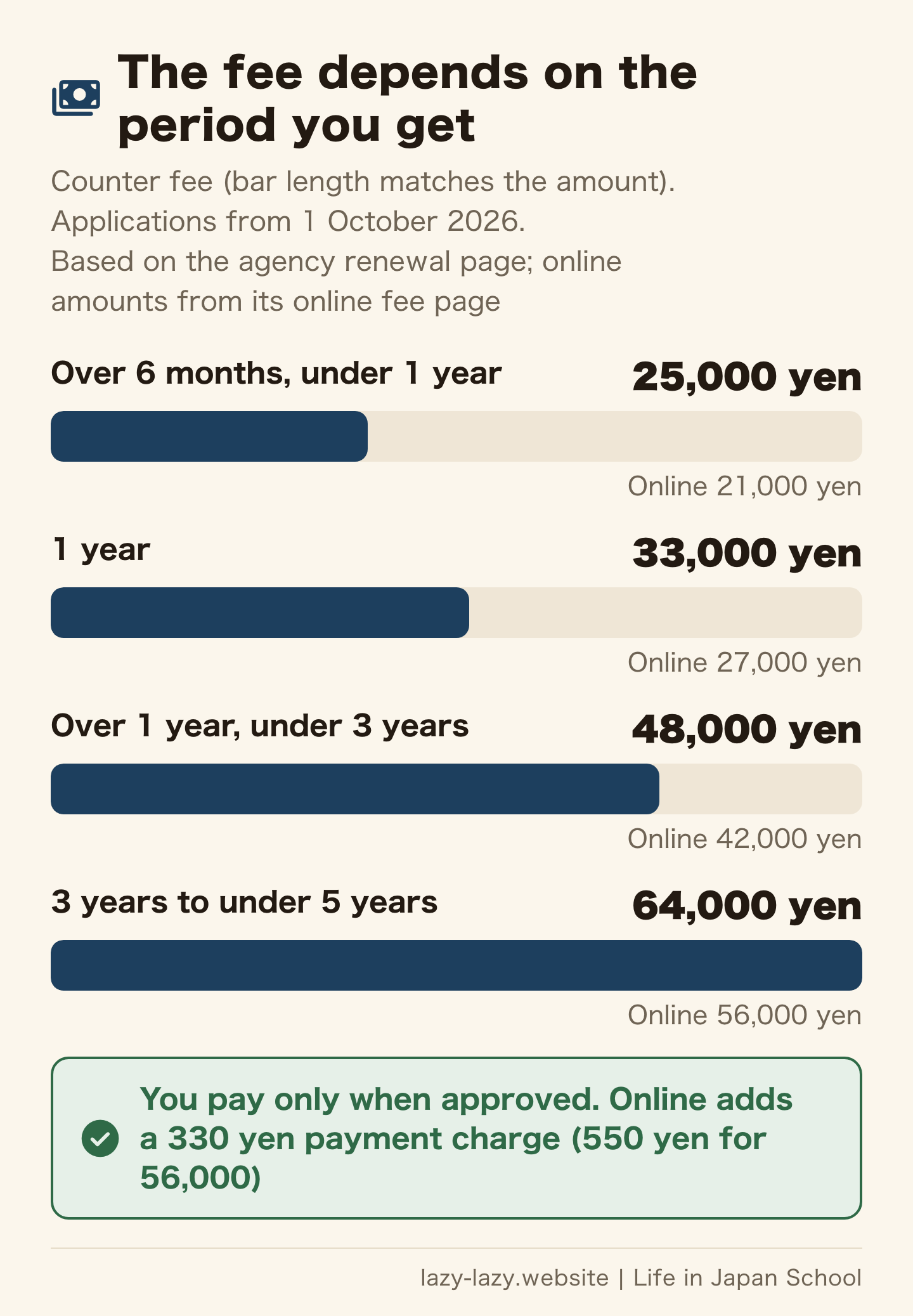
| Period you get | Counter | Online (fee + payment charge) |
|---|---|---|
| Over 6 months, under 1 year | 25,000 yen | 21,000 + 330 = 21,330 yen |
| 1 year | 33,000 yen | 27,000 + 330 = 27,330 yen |
| Over 1 year, under 3 years | 48,000 yen | 42,000 + 330 = 42,330 yen |
| 3 years to under 5 years | 64,000 yen | 56,000 + 550 = 56,550 yen |
At the counter, you pay with revenue stamps. Online, you pay at a convenience store or by bank (Immigration Services Agency: online fees and payment). Credit cards are not accepted.
Student periods of stay are set case by case, up to 4 years and 3 months. You only learn your period when you are approved. A longer period costs more. A period of 3 years or more costs 64,000 yen at the counter. Being short of money alone does not qualify you for a lower fee. The rules are in our guide to the visa fee increase.
Your school may charge for certificates, and photos cost money too. The amounts differ by school and shop.
What if you run out of time, or are refused? Apply by the expiry date
Even if a certificate is late, do not miss the expiry date. The University of Tokyo warns that one day past expiry means overstaying.
If you apply by the expiry date, you are protected for a while. Say no decision comes before your card expires. You keep your status until the decision, or for up to 2 months after expiry (Immigration Services Agency: special period). Missing a paper? Tell the counter and ask how to send it later. Immigration may also ask for more papers during review.
Past your expiry date, or got a refusal? Talk to your international office and immigration right away. What to do next is in our guide to a refused visa renewal. The general steps are in our visa renewal guide.
Which one are you?
- Staying at the same school: check your card and put the 3-months-before date in your calendar. Just before then, ask the office for your enrolment, attendance and grades papers.
- Moving to a new school in spring: when the admission letter arrives, ask your current school for attendance, grades and graduation papers. Put the two notice dates in your calendar too.
- Repeating a year or short on credits: ask your international office how to write the letter of reason. At university, ask your supervisor about a letter today.
- Warned about part-time work last time: start gathering tax papers, payslips or bank book copies today. Check this week’s shifts stay within 28 hours.
FAQ
Q. When can I apply to extend my student visa in Japan?
From 3 months before your card expires, up to the expiry date, if your period of stay is 6 months or more. For a 31 March expiry, that is from late December. Processing usually takes 2 weeks to 1 month.
Q. What documents do I need to renew a student visa in Japan?
The application form, a 4 cm by 3 cm photo, your passport and residence card, a certificate of enrolment, and attendance, grades and graduation papers. Your school issues most of them. Certificates issued in Japan must be less than 3 months old.
Q. Can low grades or attendance stop my renewal?
The agency publishes no pass mark. But your attendance and grade papers are part of the review. Kyoto University says poor grades or very few credits can lead to a refused renewal.
Q. What happens to my visa if I repeat a year?
There is no published rule. The University of Tokyo asks students who repeat a year for a detailed letter of reason and a letter from their supervisor. Talk to your international office before you renew.
Q. What happens to my visa when I move on to a higher school?
You stay on Student status and renew when your card is due. You give the new school’s admission letter instead of a certificate of enrolment. You also notify immigration within 14 days of graduating and of joining the new school.
Q. How much is the student visa extension fee in Japan?
It depends on the period you get. One year costs 33,000 yen at the counter or 27,000 yen online. Over 1 year and under 3 years costs 48,000 or 42,000 yen. You pay when approved, and online adds a 330 yen payment charge.
Summary
You can apply to extend your student visa from 3 months before your card expires. Your school issues most of the papers, so your first step is asking the office. Only some students, such as those warned about part-time work, need money papers.
Grades, attendance and work show up in your papers and on the form, but there is no pass mark. Moving schools? Prepare the admission letter and two notices. Repeating a year? Prepare a letter of reason. The fee depends on your period, and 1 year costs 33,000 yen at the counter. Today, check your card and put the 3-months-before date in your calendar.
Sources (official): Immigration Services Agency, Student status (renewal document lists) / Extension of Period of Stay / application form (PDF) / application notes (PDF) / country list (PDF) / renewal guideline / special period / online fees and payment / part-time work on Student status / permission for other activities / Q&A / notification of your school / cancellation of status / University of Tokyo, Extension of Period of Stay / Kyoto University, status of residence procedures (Japanese) / Kobe University, part-time work (Japanese) (checked 20 November 2026). Always confirm with your school office and the official immigration pages before you apply.
Related reading
Found this useful? Share it
Send it to a friend who lives in Japan.
WHO WROTE THIS

mori
Japanese. I read the ministries’ own notices, orders and Q&As in the original, and I start from what my Nepalese and Sri Lankan friends in Japan actually ran into. I do not write about what I have not checked or been told.
What this site can and cannot do →Looking for something else?
You may use the figures in this article, including commercially, if you credit this site with a link. How to use our figures