Checked on 19 November 2026. We used the Tokyo Metropolitan Government’s housing health guidelines, a March 2026 warning on chlorine cleaners from the National Consumer Affairs Center of Japan, the MLIT guideline on restoring rented homes, Tokyo’s rental trouble guideline, and the Civil Code.
The short answer
- Condensation is warm, damp air turning into water on a cold window or wall. If you leave the water there, mold grows.
- Do 4 things every day. Wipe the windows. Open a window for a few minutes while heating. Keep humidity at 40-60%. Keep furniture 5 cm or more from the wall.
- Use chlorine (bleach-type) mold cleaners on their own. Mixed with acid cleaners or alcohol, they make chlorine gas.
- When you see condensation or mold, take photos and email the management company. Say since when, where, and that you wipe it daily.
- Condensation is often caused by the building. If you wipe it and tell them, the cost is less likely to fall on you. If you never told anyone and never wiped it, and the wall got damaged, the cost often falls on you.
Knowing this, you can keep winter condensation down in a few minutes a morning, and keep a record that protects you if mold appears.
It is a December morning. You pull back the curtains. The window is dripping wet. The wooden frame under it is turning black. Your Japanese friend just says, “That’s winter.” Should you wipe it? Should you tell the management company? Can you clean the black spots yourself? Will you pay for it when you move out? Official Japanese sources answer each of these.
- Why does mold grow in Japanese apartments? Condensation on cold windows
- How to prevent mold in a Japanese apartment: 4 daily habits
- What adds moisture to the room? Kerosene heaters and humidifiers
- What to do if your apartment has mold: remove it safely
- How do I tell the management company? Photos, dates and email
- Who pays for mold from condensation? The building, or a lack of care
- How much does it cost? Prevention is almost free
- What if I ignored it, or the mold has already spread?
- Which one are you?
- Frequently asked questions
- Summary
- Related reading
Why does mold grow in Japanese apartments? Condensation on cold windows
In winter, condensation forms inside warm rooms. Cooking, baths and breathing add water vapour to the air. When that air touches a cold window or wall, it cools. The vapour turns into water drops (Tokyo housing health guideline No.8, Japanese).
The same guideline lists the usual places. Windows, north-facing walls, closets, shoe cupboards, room corners, behind wardrobes, toilets, and unheated rooms. Toilets are colder than living rooms, and humidity rises easily there.
You are not alone. In a Tokyo survey (2016), 58.4% of homes had condensation in the past 3 years. In 83.8% of those, it was on windows only.
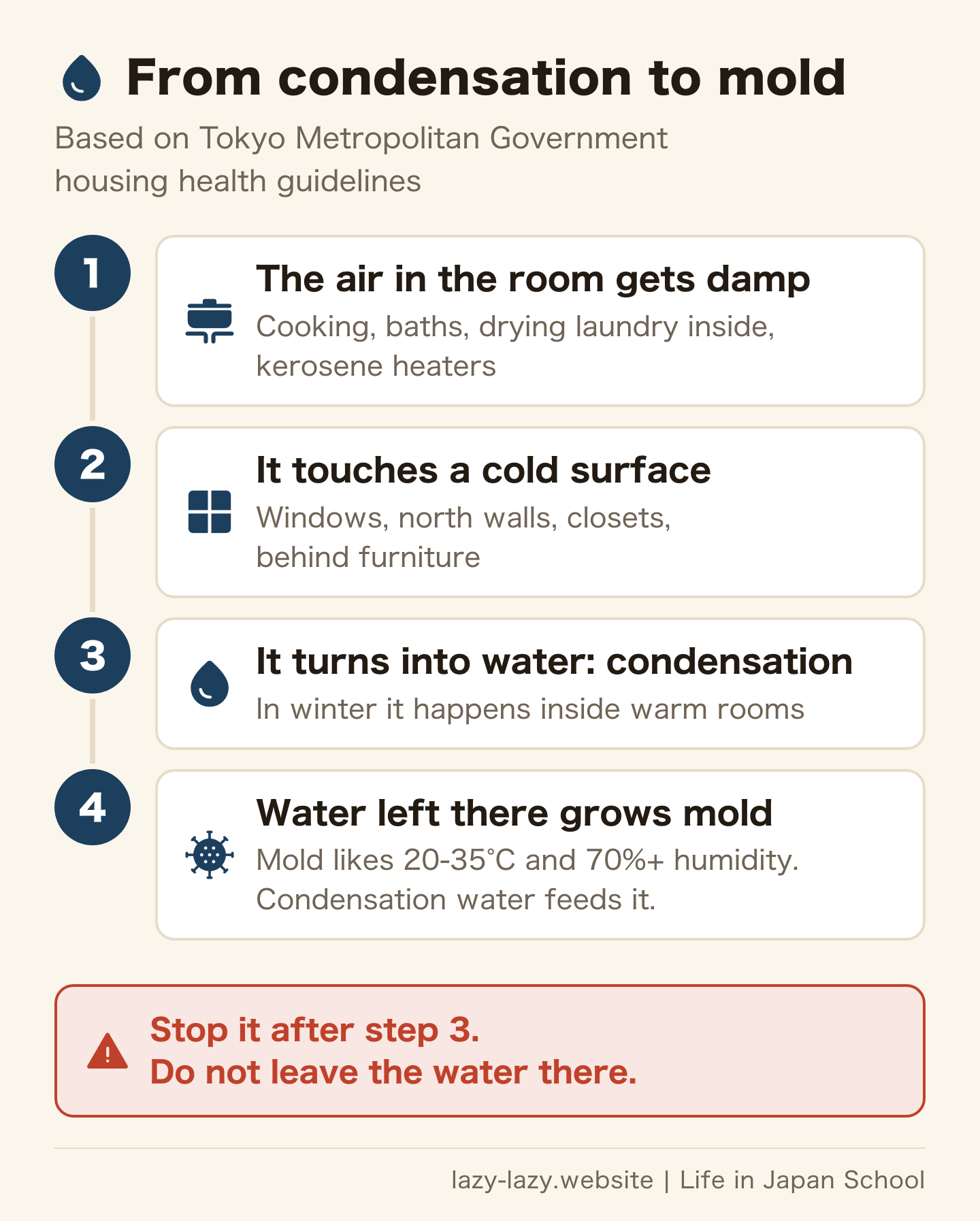
The problem is water that stays. Tokyo’s guideline No.9 says mold likes about 20-35°C and 70% or higher humidity. Condensation water feeds it. Breathing in mold spores can cause asthma and similar problems in some people.
How to prevent mold in a Japanese apartment: 4 daily habits
It is cold, so you switch off the 24-hour ventilation and cover the wall air vent. Where you come from, that may be normal. In Japan, the Building Standards Act was changed in July 2003. Since then, rooms in new homes must, as a rule, have ventilation that runs all day. Tokyo’s guideline says 24-hour ventilation should, as a rule, always stay on (guideline No.1).
On top of that, do these 4 things. All of them come from Tokyo’s guidelines.
- Wipe: wipe water off windows often. Keep the drain channel at the bottom of the window frame clear, so water runs outside.
- Air out: while heating, open a window for 2-3 minutes every hour. Open it for about 5 minutes before bed. Opening two windows across the room makes the air move.
- Humidity: aim for 40-60%. Above 60%, mold and dust mites grow more easily. Use a dehumidifier if needed.
- Furniture: leave a gap of 5 cm or more from the wall. In a north-side closet, put slatted boards (sunoko) on the floor and walls.
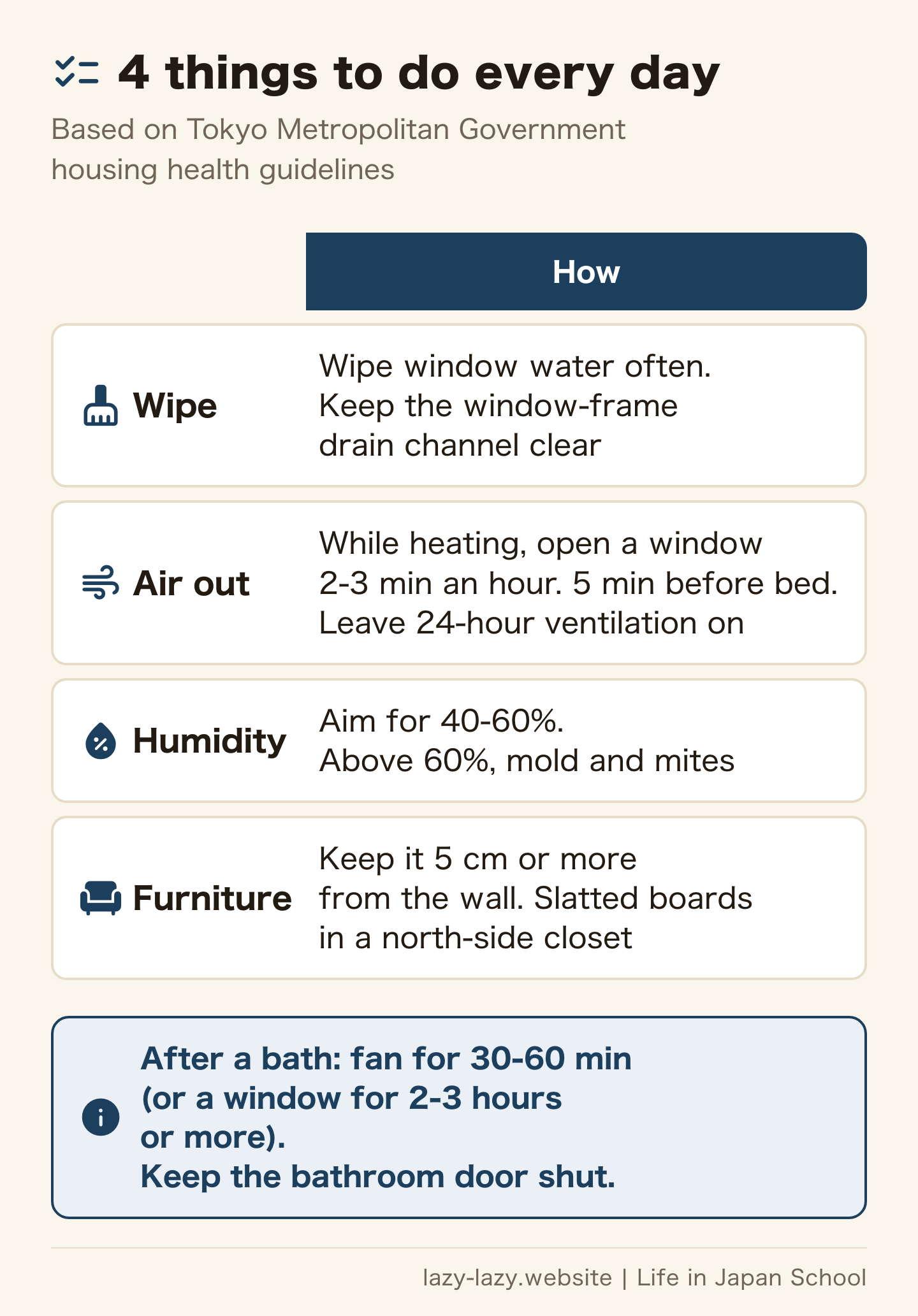
Baths and kitchens add moisture too. After a bath, keep the bathroom door shut and run the fan for 30-60 minutes. With a window instead, air it for 2-3 hours or more. Run the kitchen fan while cooking. The guideline also says to avoid drying laundry indoors when you can.
You cannot see humidity. A simple thermometer with a humidity reading lets you decide by numbers. Opening a window makes the room cold for a moment. The guideline says the room warms up again fairly fast, because the walls and ceiling stay warm. For heating temperatures and costs, see our guide to winter electricity bills.
What adds moisture to the room? Kerosene heaters and humidifiers
Your heater makes a big difference. Tokyo’s guideline says kerosene and gas heaters that burn inside the room (called “open-type”) add a lot of moisture. Air conditioners and electric heaters add none.
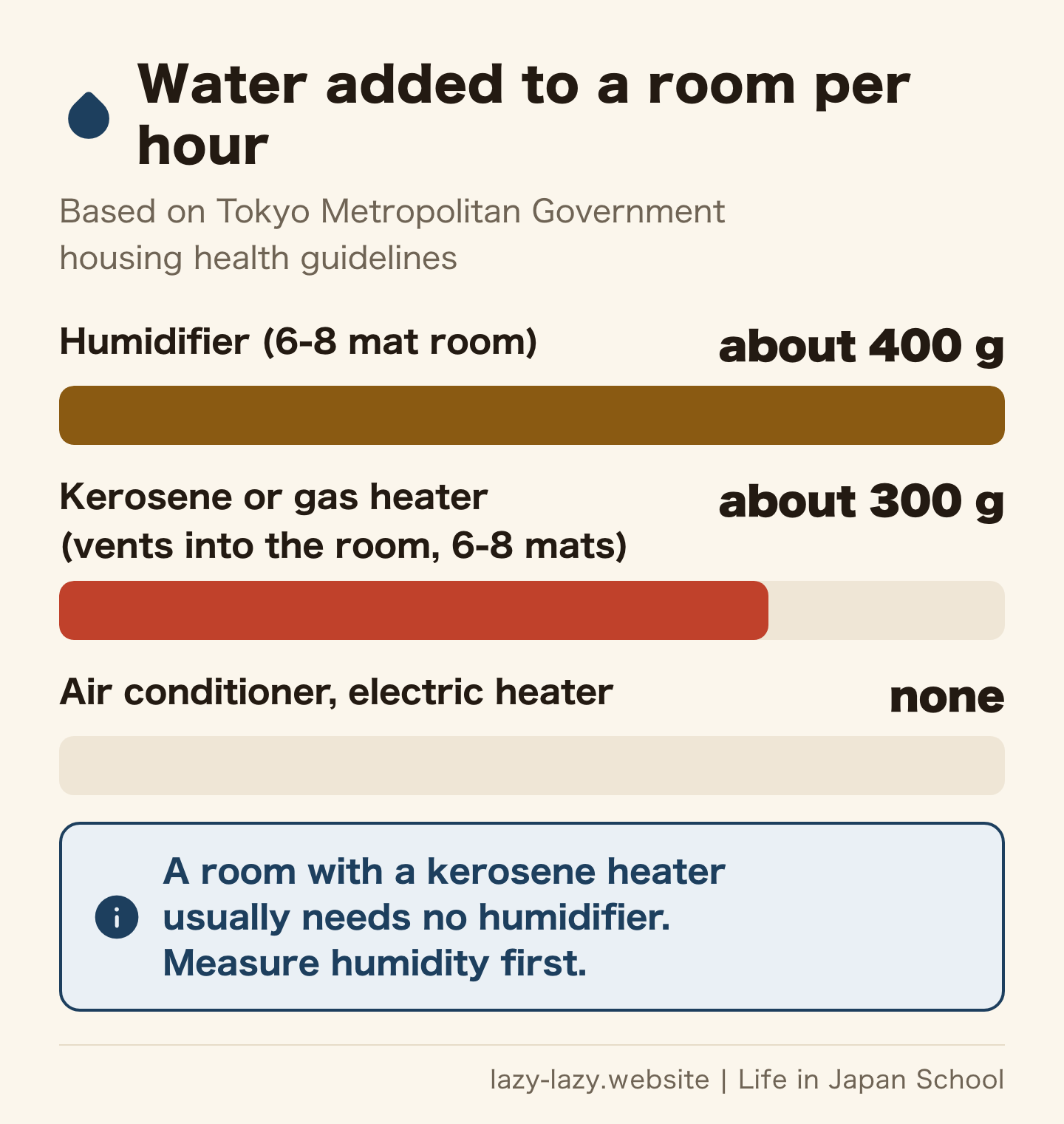
In the guideline’s chart, an open-type heater for a 6-8 mat room puts out about 300 g of water an hour. A humidifier for the same room puts out about 400 g. So a room with a kerosene heater usually needs no humidifier. Use one only with an air conditioner or electric heater, and only when you have measured low humidity. The guideline also says not to put a kettle on top of an open-type heater.
If you use a humidifier, change the water every day. Clean the tank and filter regularly. Otherwise, bacteria and mold in the tank can spray into the room.
What to do if your apartment has mold: remove it safely
Small spots on a window frame or rubber seal are fine to clean yourself. Tokyo’s guideline No.9 says to open the windows and wear rubber gloves and a mask. Do not vacuum mold directly. That spreads the spores.
Most mold cleaners sold in Japan are chlorine-based, with sodium hypochlorite. In tests by the National Consumer Affairs Center (March 2026, Japanese), chlorine cleaners mixed with acid or ethanol made chlorine gas. A chlorine spray used with an acid cleaner in a bathroom passed 16 ppm of chlorine gas within minutes.
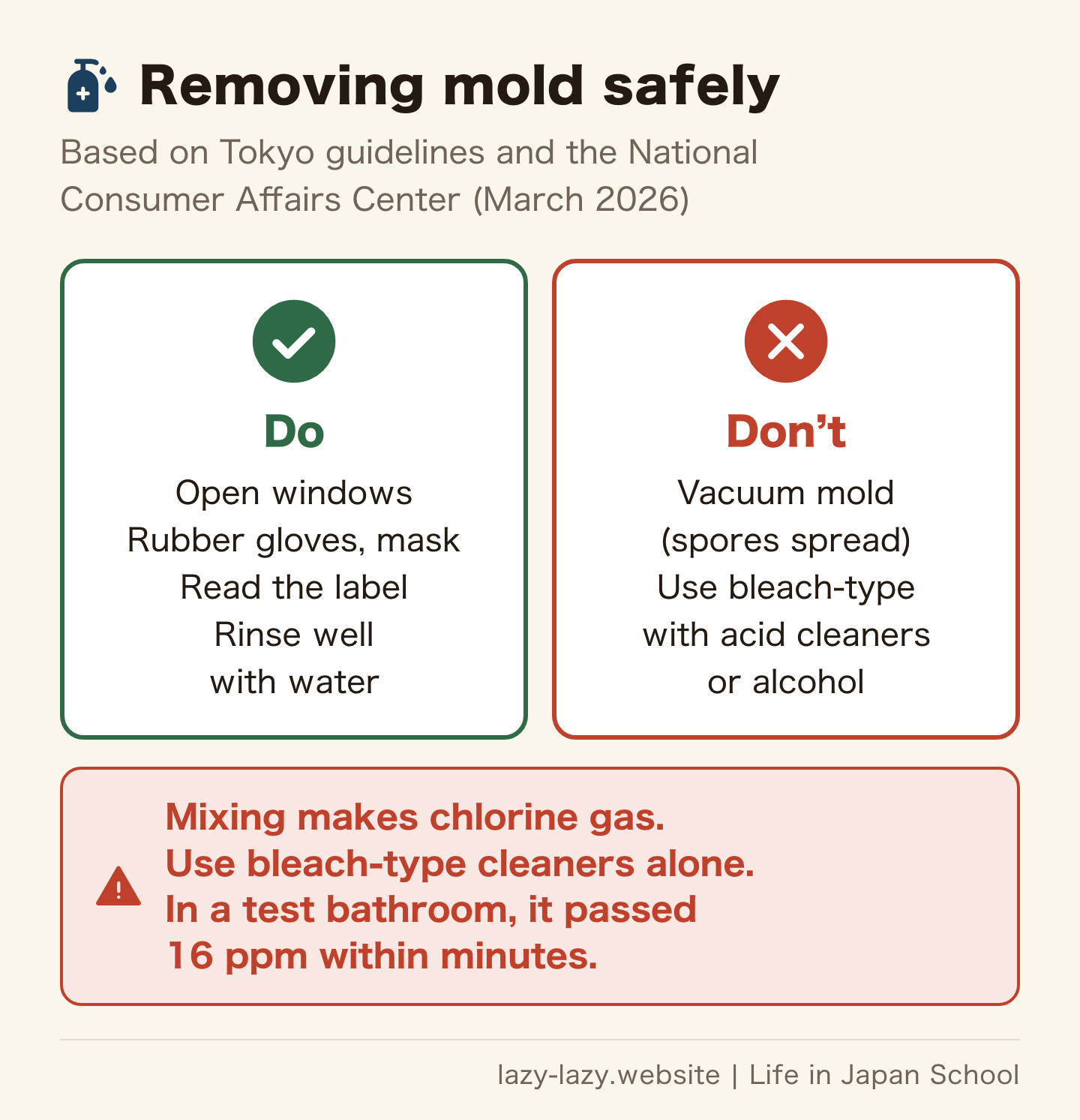
The Center’s advice:
- Always use chlorine cleaners on their own.
- Air the room well and wear gloves and other protection.
- Rinse with plenty of water after use. Old cleaner can stay in the drain, so do not use another cleaner straight after.
- If chlorine gas forms, leave the room. If you breathed it in, see a doctor.
Alcohol is also on the “do not mix” list. Tokyo’s guideline suggests disinfecting alcohol for mold on tatami mats. So never use alcohol and a chlorine cleaner one after the other in the same place. Also check the label for surfaces the product must not be used on.
Do not scrub black mold that has spread over wallpaper, or mold that keeps coming back. Ask the management company to look at it, as below.
How do I tell the management company? Photos, dates and email
Article 615 of the Civil Code says you must tell the landlord “without delay” when the home needs repair (e-Gov, Civil Code, Japanese). For most people, that means the management company. If there is none, tell the landlord.
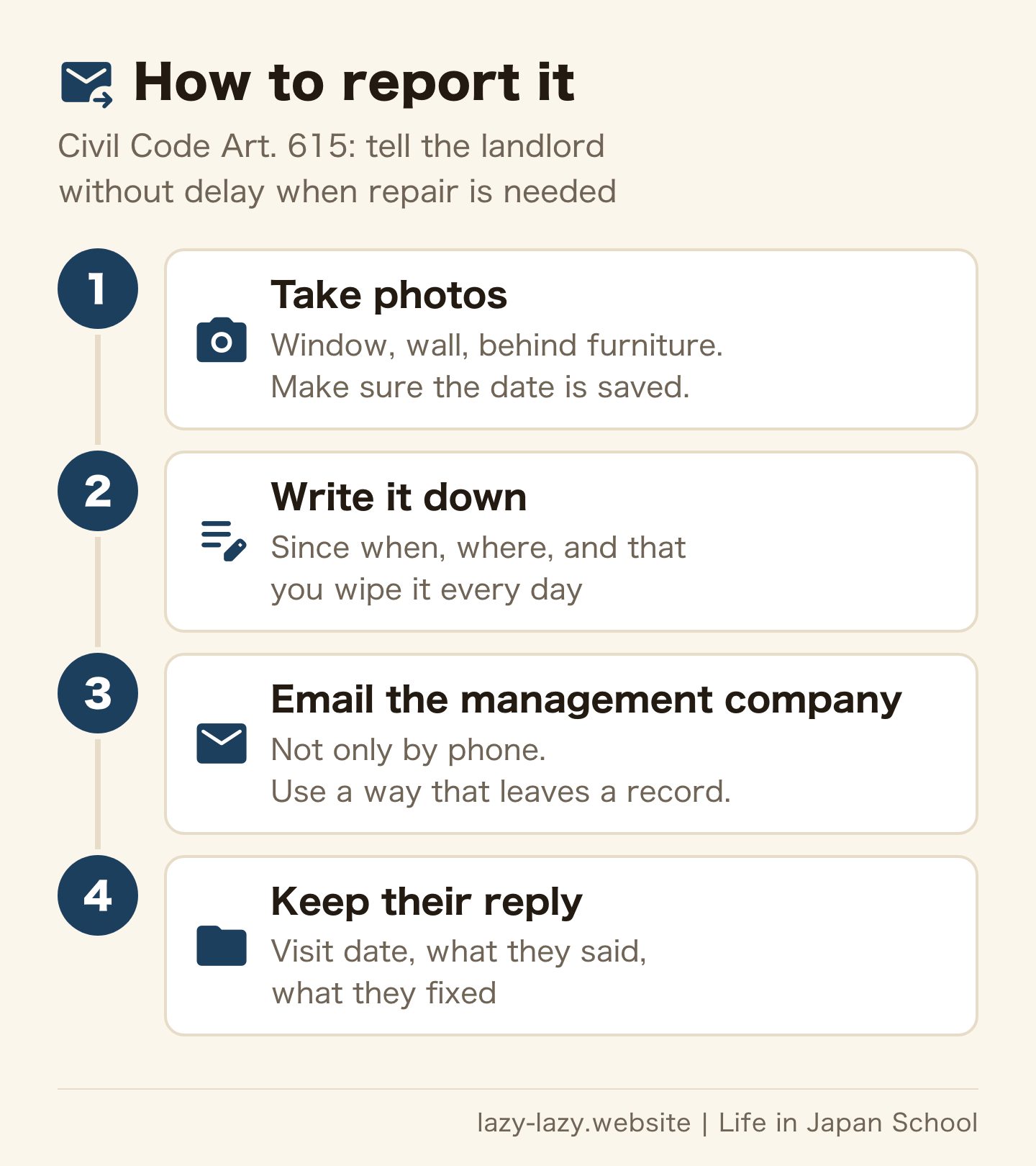
A phone call leaves no record. An email or a contact form keeps the date and what you said. If writing in Japanese is hard, you can copy this.
件名:〇〇号室 結露とカビのご相談
〇〇(建物名)〇〇号室の(名前)です。
11月〇日ごろから、寝室の北側の窓と壁に、毎朝結露が出ています。
毎日拭いて、換気もしていますが、壁の下のほうに黒いカビが出てきました。
写真を3枚付けます。一度見ていただけますか。
In English: “Subject: Room ○○, condensation and mold. I live in room ○○ of (building). Since about November ○, the north window and wall in my bedroom are wet every morning. I wipe them daily and air the room, but black mold has appeared low on the wall. I attach 3 photos. Could you come and look?”
If the cupboard under the sink is wet, do not guess whether it is condensation or a leak. For a leak, turn off the water valve first. The steps are in our guide to apartment repairs.
Keep their reply. Do not delete it. Note the day someone came, what they said, and what they fixed. This record protects you until you move out.
Who pays for mold from condensation? The building, or a lack of care
The MLIT guideline on restoring rented homes (Japanese) says condensation is often a problem with the building itself. But say you saw condensation, never told the landlord and never wiped it. If that damaged the wall, the guideline says the cost is often the tenant’s (Tables 1 and 3). Tokyo’s rental trouble guideline (Japanese) says the same.
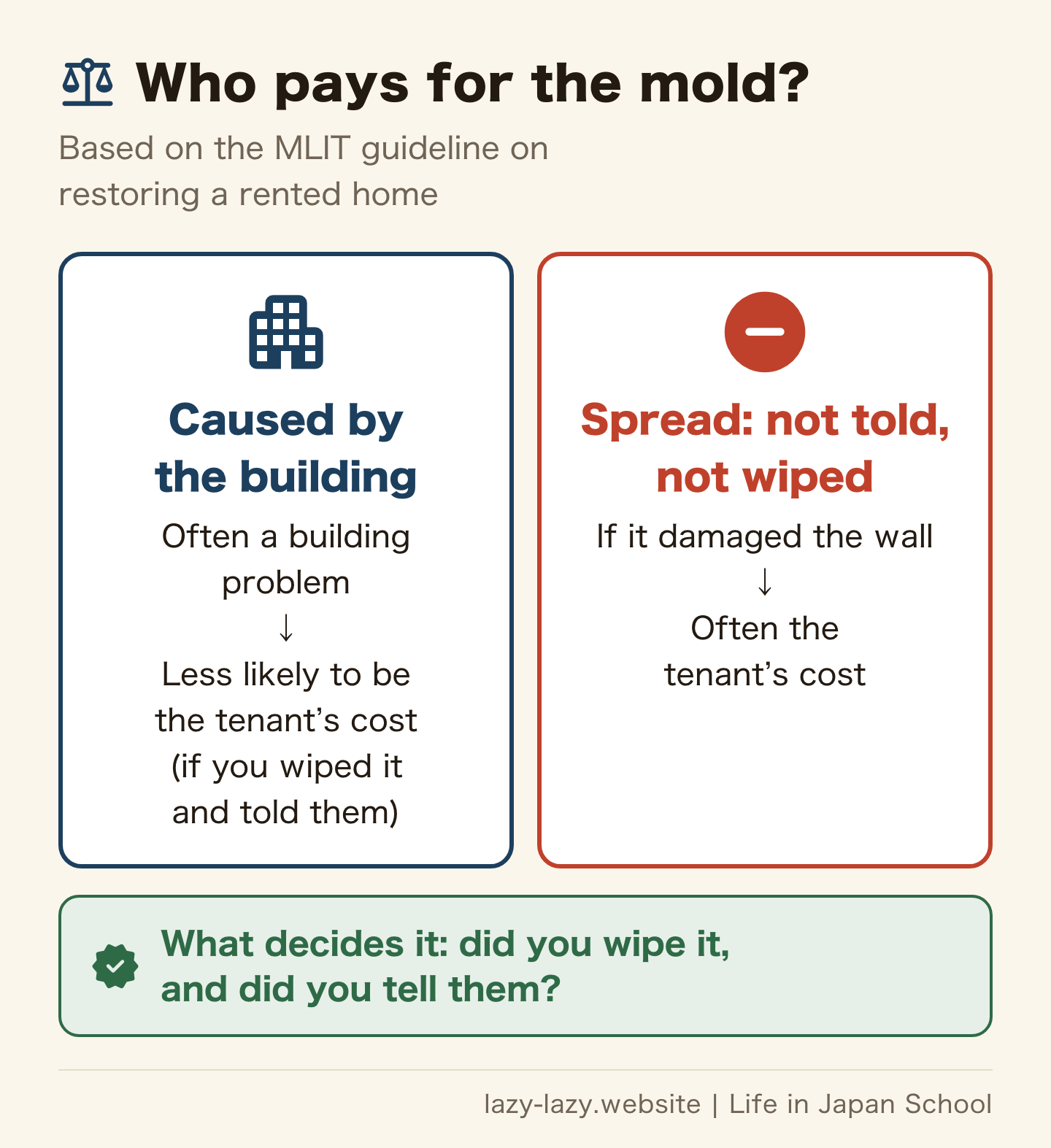
The guideline also shows a court case. In 2005, a summary court in Hirakata found the mold was mainly caused by condensation from the building’s structure. The tenant had wiped the condensation each time they saw it. The court found the tenant was not at fault for the mold. What decides it is whether you wiped it and told them.
How much can be taken from your deposit, special clauses and how age is counted are in our guide to move-out costs.
How much does it cost? Prevention is almost free
Wiping, airing out and moving furniture cost nothing. You pay only for things you choose to buy, such as cloths, a humidity meter or a dehumidifier. The government gives no price guide for these.
Repairs needed to use the home are the landlord’s job (Civil Code Article 606). The exception is damage the tenant caused. So keeping a record and telling them early is the cheapest way to protect yourself.
What if I ignored it, or the mold has already spread?
Condensation water damages building materials and wallpaper (Tokyo guideline No.8). If you tell them only after mold has damaged the wall, it can look like you “did not tell and did not care for it.”
Even if it has spread, it is not too late. Take photos and email the management company today. Start wiping visible water today. Do not hide old damage or replace wallpaper yourself. Let the management company look before anything is fixed.
Which one are you?
- The windows are wet every morning, but there is no mold yet. Wipe them from this morning, and open a window for 5 minutes before bed. Today, move furniture 5 cm or more from the wall.
- You use a kerosene heater. Stop the humidifier, and open a window 2-3 minutes an hour. Today, take the kettle off the heater.
- There are small mold spots on a window frame or seal. Open the window, wear gloves and a mask, and use a chlorine cleaner alone. Today, store acid cleaners and alcohol away from it.
- There is mold or water on wallpaper, under the sink or in a closet. Do not scrub it. Today, take photos and email the management company.
Frequently asked questions
Q. Is condensation in a rented apartment the tenant’s fault?
The MLIT guideline says condensation is often a problem with the building. If you never told the landlord and never wiped it, and the wall was damaged, the cost is often the tenant’s.
Q. How do I prevent mold in a Japanese apartment?
Do 4 things. Wipe window water, open a window 2-3 minutes an hour while heating, keep humidity at 40-60%, and keep furniture 5 cm or more from the wall. These come from Tokyo’s guidelines.
Q. Should I tell the management company about mold?
Yes. Take photos, and say since when, where, and that you wipe it daily. Send it by email or another way that leaves a record. Civil Code Article 615 says to tell the landlord without delay when repair is needed.
Q. Can I use a mold cleaner and alcohol together?
No. In tests by the National Consumer Affairs Center, chlorine cleaners mixed with acid or ethanol made chlorine gas. Use chlorine cleaners alone, and rinse with plenty of water afterwards.
Q. Should I use a humidifier?
Not usually in a room with a kerosene or gas heater that burns indoors. Use one with an air conditioner or electric heater, and only when humidity is below 40%.
Q. What if the cupboard under the sink is wet?
Do not guess whether it is condensation or a leak. Contact the management company. If it is a leak, turn off the water valve first, then call.
Summary
Condensation forms when warm, damp air cools on a cold window or wall. Every day, wipe, air out, keep humidity at 40-60%, and keep furniture 5 cm or more from the wall. A kerosene heater room usually needs no humidifier. Use mold cleaners alone, never with acid cleaners or alcohol.
Condensation itself is often caused by the building. Keep photos and emails that show you wiped it and told them. Then it is much harder to call it “a lack of care” when you move out. Start with this morning’s window.
Sources (official, Japanese): Tokyo Metropolitan Government, housing health guideline No.8 (condensation) / same, No.1-5 (ventilation, heating, humidity) / same, No.9 (mold) / National Consumer Affairs Center, using chlorine cleaners (18 March 2026) / MLIT, guideline on restoring rented homes (revised edition) / Tokyo Bureau of Housing, rental trouble prevention guideline / e-Gov, Civil Code (Arts. 606, 615, 621). All checked on 19 November 2026.
Related reading
Found this useful? Share it
Send it to a friend who lives in Japan.
WHO WROTE THIS

mori
Japanese. I read the ministries’ own notices, orders and Q&As in the original, and I start from what my Nepalese and Sri Lankan friends in Japan actually ran into. I do not write about what I have not checked or been told.
What this site can and cannot do →Looking for something else?
You may use the figures in this article, including commercially, if you credit this site with a link. How to use our figures