Checked on 17 November 2026. Sources: the Financial Services Agency (FSA) NISA website and slides, and the National Tax Agency. Also the Investment Management Association of Japan (IMAJ) and the tax law on e-Gov. This is not a market forecast. It does not tell you to sell or to hold.
The short answer
- A crash here means fund or share prices fall a lot in a short time. No one knows when prices will come back.
- Before you sell, check 3 things. When you will use the money. Whether you have an emergency fund (money kept apart for bad times). Whether the monthly amount is too hard on you.
- While prices are down, what you get is not fixed yet. For a fund, the price on the day you ask to sell fixes it. For funds that invest overseas, it is the next business day. Your principal (the money you put in) is not guaranteed.
- If you sell inside NISA, space comes back from next year. It comes back at the price you paid. But a loss inside NISA cannot cut tax on other gains.
- If you need money, you can sell just part. For funds, the money usually arrives on business day 4 or later, counted from the request day. If you are leaving Japan, count back to a sell date.
Knowing this, you can decide whether to sell, and how much. You decide from your own plans, not from the news. You also avoid a rush just before you leave Japan.
You open your phone in the morning. Your NISA screen is full of red numbers. It is tens of thousands of yen lower than last month. A Japanese coworker says, “Just leave it.” Social media says, “Sell now.” You may go home next year. You planned to use this money then. You do not know whose advice to follow.
- What to do when your funds or NISA crash: 3 checks before you sell
- Is the loss fixed when prices fall? The day you ask to sell fixes it
- When will you use the money? Money you need soon cannot wait
- Do you have an emergency fund? Without one, you may have to sell on a bad day
- Keep investing monthly, or stop? What to look at
- What happens if you sell in NISA? Space comes back next year, at the price you paid
- A loss outside NISA? You can carry it forward 3 years with a tax return
- Need the money? Take out only what you need, paid on business day 4 or later
- Leaving Japan? Count back to a sell date
- Someone says you can win the loss back? This site does not recommend borrowing or margin trading
- Which one are you?
- FAQ
- Summary
- Related reading
What to do when your funds or NISA crash: 3 checks before you sell
When prices fall hard, you want to act at once. But look at your plans first, not the price. The FSA says each person needs money at different times and in different amounts. So the answer is different for each person.
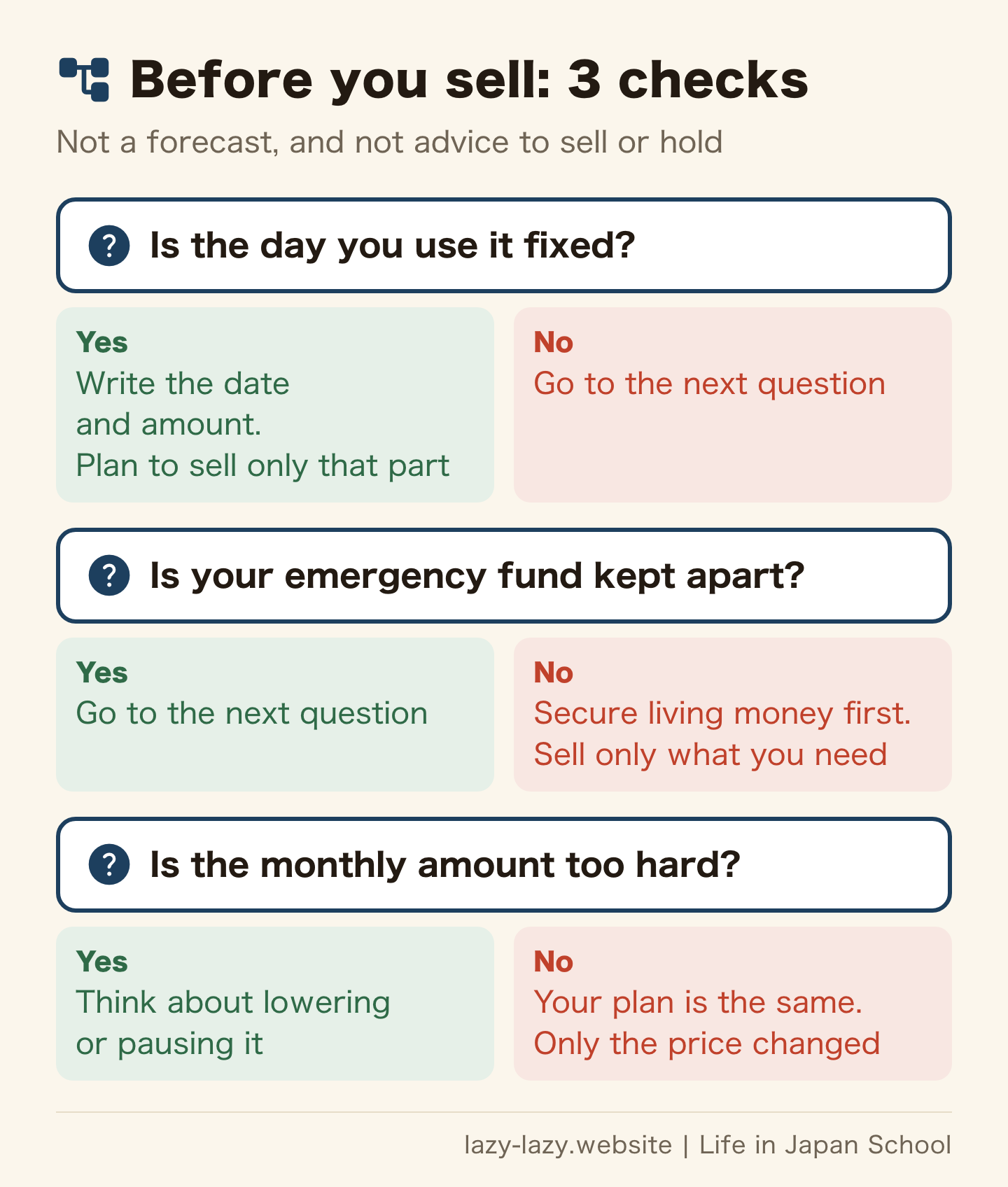
- Do you know when you will use this money? Think of school fees, a flight home or a move. Write the date and the amount.
- Do you have an emergency fund apart from this? It is savings you can live on for a while if you lose your job.
- Is the monthly amount too hard on you? Check that rent and food are not a problem.
If none of the 3 has changed, only the price has changed. What you do is your choice. This guide does not tell you to sell or to hold. It gives you the facts to decide.
Is the loss fixed when prices fall? The day you ask to sell fixes it
The red number on your screen is the current value. It shows what you would get if you sold today. It moves every day while you hold.
A fund price is set once a day. It is called the NAV. The IMAJ explains which price you get. It is the NAV on the day you ask to sell. For funds that invest overseas, it is the next business day, because of the time gap. The NAV comes out after the cut-off for requests. So when you ask to sell, you do not know the price yet.
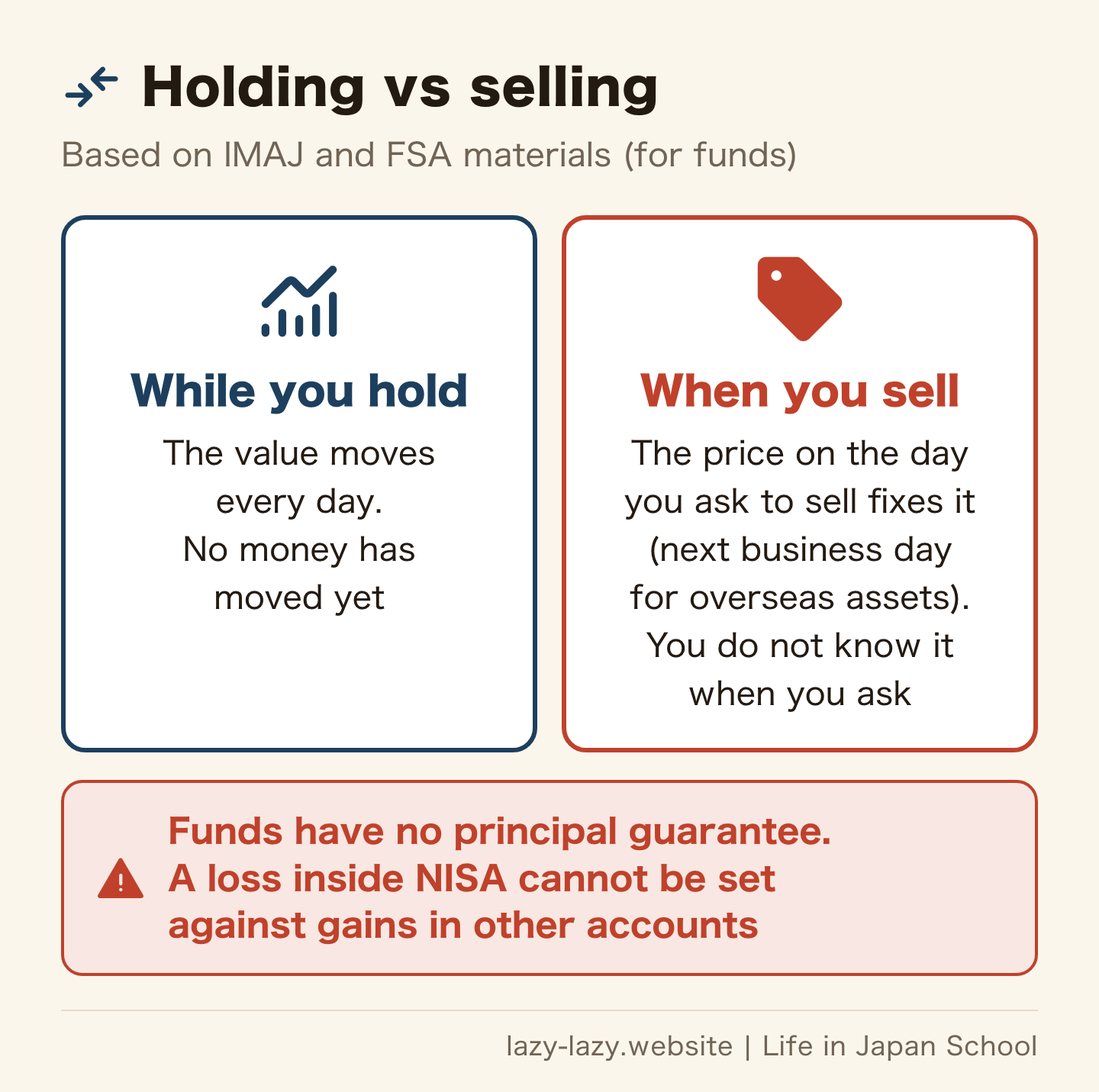
This does not mean prices come back if you wait. The IMAJ says investment funds have no principal guarantee. Prices can stay low.
The IMAJ also says markets can swing a lot in a short time. It adds that, over a long time, the risk of swings tends to get smaller. That is a tendency, not a promise. What matters is how long you can wait. Your answer depends on when you will use the money.
When will you use the money? Money you need soon cannot wait
The FSA NISA slides say to look at your life plans. Think about what money you will need, and when. A fall hurts most for money you need soon. When that day comes, you must sell at the price of that time.
- You need it soon (school fees, a flight home, a move). You have little time to wait. You may not be able to wait for prices to recover.
- You do not need it yet, or only far in the future. You have more time to wait.
The FSA page on the basics of building assets uses the word “liquidity.” It means how fast you can turn something into cash. The FSA says no product is top for safety, growth and liquidity all at once. That is why money you need soon fits better in a savings account. Its value does not move, and you can take it out fast.
Do you have an emergency fund? Without one, you may have to sell on a bad day
An emergency fund is money to live on for a while if you lose your job or get sick. You keep it in savings, apart from your investments.
Without it, you may have to sell your funds when trouble comes. That day may be a day when prices are low. The FSA money guide says to invest only spare money, separate from living money. The NISA slides also say to start with an amount you could live without.
Is your emergency fund not big enough yet? Then start with how big an emergency fund foreigners in Japan need. It shows how to work it out from your monthly spending.
Keep investing monthly, or stop? What to look at
Monthly investing means you buy the same fund for a fixed amount each month. The IMAJ explains how a fixed amount works. When the price is high, you get fewer units. When it is low, you get more units. The FSA says this helps you avoid buying only when prices are high.
To decide whether to keep going, look at these points.
- Is the monthly amount too hard on you? If yes, think about lowering or pausing it.
- Has the time until you use the money changed? If you will leave Japan sooner, review your plan.
- Is your emergency fund big enough? If not, build up savings first.
You can change the monthly amount along the way. The FSA slides show an example that raises the amount every 5 years as income grows. Ask your bank or broker how to lower or pause it.
What happens if you sell in NISA? Space comes back next year, at the price you paid
NISA is a government scheme. Gains from investing in it are not taxed. Normally about 20% of a gain goes to tax. Your NISA space is the amount you can buy without tax. The FSA sets the limits. You can buy up to 3.6 million yen a year. You can hold up to 18 million yen in your lifetime, counted at the price you paid.
Some people think the space is gone forever once they sell. It is not. The FSA Q&A says the space comes back from the next year. The amount is the book value of what you sold. Book value means the price you paid.
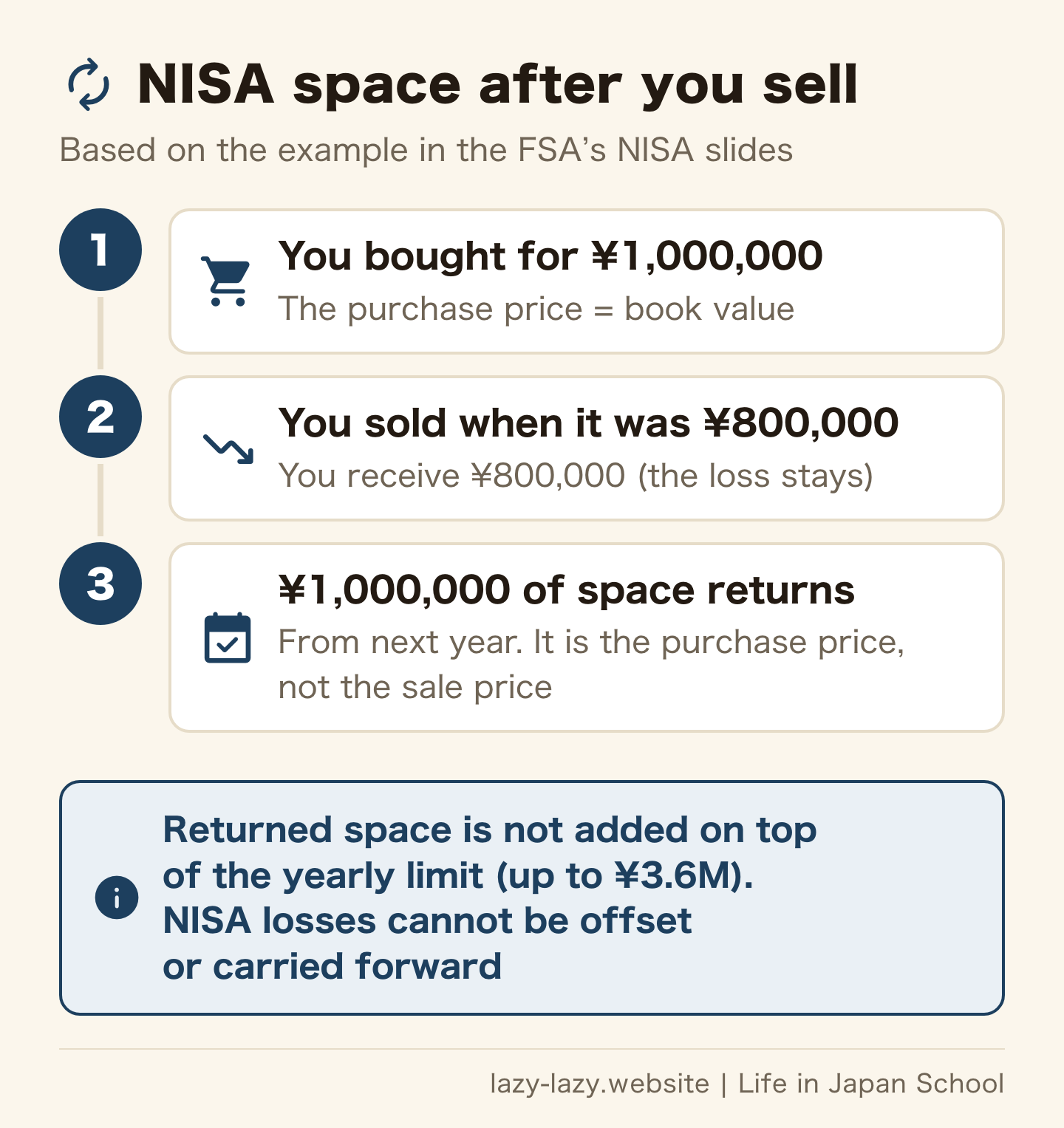
Here is the example from the FSA slides. You bought something for 1,000,000 yen. It fell to 800,000 yen, and you sold. You receive 800,000 yen. From next year, the space that returns is 1,000,000 yen. That is the price you paid, not the 800,000 yen you got.
Keep 2 points in mind.
- The space returns from the next year. It does not return in the year you sell.
- Returned space is not added on top of the yearly limit of 3.6 million yen. You cannot buy more in one year.
A friend says, “Just use the loss to cut tax on other gains.” Where you come from, that may be normal. In Japan, a loss inside NISA cannot be set against gains in other accounts. The FSA slides say you also cannot carry it to later years. For tax, a NISA loss counts as if it never happened.
A loss outside NISA? You can carry it forward 3 years with a tax return
Accounts outside NISA (tokutei or ippan accounts) work differently. The National Tax Agency explains the rule. If you sell shares or funds at a loss, you can offset it. Offset means you subtract the loss from gains, such as dividends, in the same year. You need to file a tax return for this.
Any loss left over can be carried forward for 3 years. Carry forward means you can use it against gains in later years. To carry it forward, file a tax return every year in a row. Do this even in years you sell nothing (National Tax Agency). How to file is in who must file a tax return in Japan.
Need the money? Take out only what you need, paid on business day 4 or later
Taking money out here means selling some of your saved funds and using the cash. The FSA slides say you can sell NISA investments at any point. When you need money, you can sell just part. You do not have to sell everything.
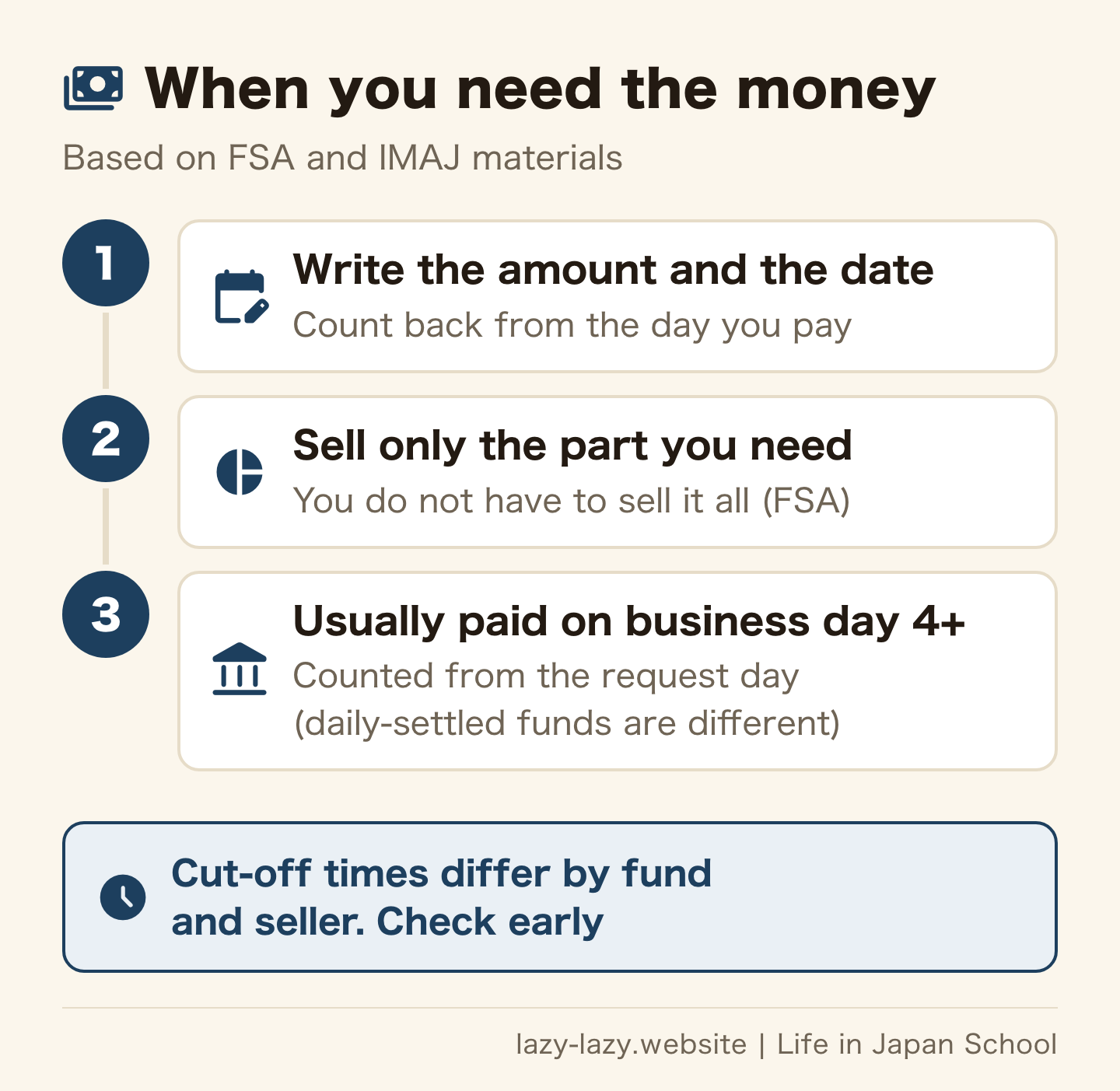
The money does not arrive on the day you sell. The IMAJ explains the usual rule. Funds other than daily-settled ones (like MRF) usually pay on business day 4 or later. You count from the day you ask to sell. Business days do not include weekends or holidays. With a weekend in the middle, it can take close to a week.
The cut-off time for a sell request differs by fund and seller. In the IMAJ example, it is 3:30 pm. Some funds also have a closed period when you cannot sell. If you must pay on a set date, ask to sell early.
Leaving Japan? Count back to a sell date
For people who will leave, a crash hurts most just before they go. NISA is for people who live in Japan. Article 37-14 of the tax law sets one case for keeping it tax-free after you leave. Your employer transfers you abroad for a time, or something similar. You also plan to come back and use NISA again. Ending your studies or going home by choice is not covered.
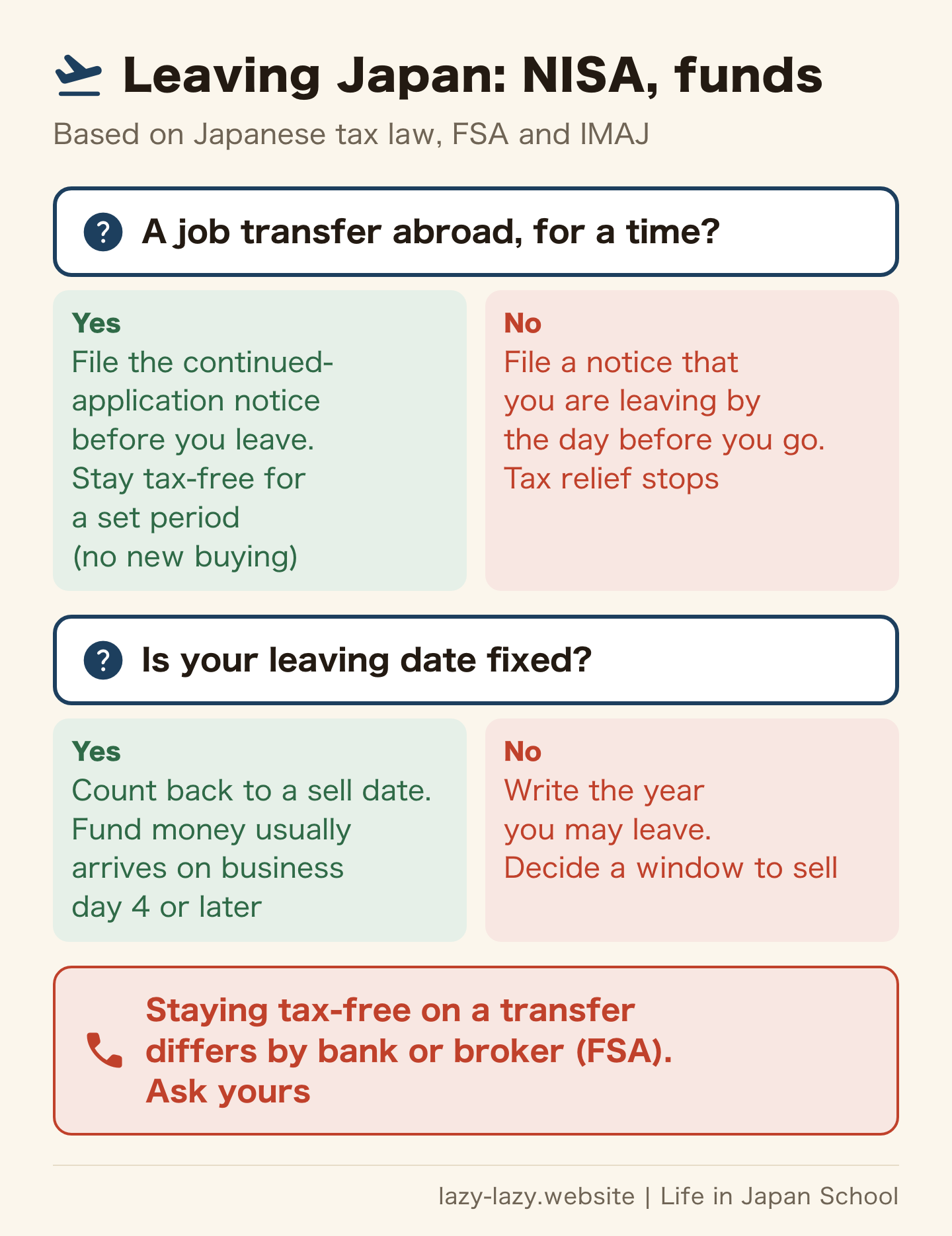
If you leave Japan for any other reason, NISA tax relief does not continue. You still must file a notice that you are leaving. Give it to your bank or broker by the day before you leave (Article 37-14). What happens to what you hold depends on your bank or broker. You may sell, or you may be able to move it. Ask your bank or broker.
The closer your leaving date, the less time you have to wait for prices. Once you can see the year you will leave, decide a time window to sell. When and how much to sell is up to you.
Fund money usually arrives on business day 4 or later. If you send it home, the transfer takes time too. The order of tasks before you go is in the leaving Japan checklist. The NISA steps for leaving are in NISA for foreigners in Japan. The FSA says one thing differs by bank or broker. That is whether you can stay tax-free during a job transfer abroad for a time. Once you decide to leave, ask yours early.
Someone says you can win the loss back? This site does not recommend borrowing or margin trading
After a fall, someone may say, “This is your chance” or “Win it back fast.” Some people borrow money to invest, hoping to win back losses fast. The Japan Exchange Group explains margin trading. You leave money with a broker as security. Then you borrow money or shares from the broker to trade. You can trade up to about 3 times the money you left.
With borrowed money, a fall also makes your loss bigger. This site does not recommend investing borrowed money or margin trading. Walk away from anyone who says “guaranteed gains” or “no risk.” You can check whether a firm is registered with the FSA on the FSA list of registered firms. Common tricks are in scams in Japan.
Which one are you?
- You plan to use this money soon, such as within a year. Today, write the date and amount. Decide how many business days before it you will ask to sell.
- Your emergency fund is not big enough yet. Today, list your monthly spending. Decide how much to keep in savings.
- The monthly amount is too hard on you. Today, ask your bank or broker how to change or pause it.
- You have decided to leave, or you can see the year you will leave. Today, write the date. Read the NISA rules for leaving, and decide a window to sell.
FAQ
Q. What happens to my NISA in a crash?
The current value of what you hold goes down. If you do not sell, the amount you get is not fixed yet. For a fund, the price on the day you ask to sell fixes it. For funds that invest overseas, it is the next business day. You do not know the price when you ask. There is no principal guarantee. Prices may not come back.
Q. Should I sell in a market crash, or hold?
This guide does not tell you to do either. First check when you will use the money. Check that you have an emergency fund. Check that the monthly amount is not too hard. The sooner you need the money, the less time you have to wait.
Q. If I sell in NISA, does the space come back?
Yes. The FSA says the space comes back from the next year. The amount is the book value, which is the price you paid. It does not return in the year you sell. It is not added on top of the yearly limit of 3.6 million yen.
Q. When does the money arrive after I sell?
The IMAJ explains the usual rule. Funds other than daily-settled ones (like MRF) usually pay on business day 4 or later. You count from the day you ask to sell. Cut-off times differ by fund and seller. If you must pay on a set date, ask to sell early.
Q. Can a NISA loss lower my tax?
No. A loss inside NISA cannot be set against gains in other accounts. It also cannot be carried to later years. A loss in an account outside NISA can be offset with a tax return. What is left can be carried forward for 3 years. You must file every year, even in years you sell nothing.
Q. How do I take money out of NISA?
You sell some of your funds and use the cash. The FSA says you can sell NISA investments at any point. You can sell just the part you need. Write the date and amount first. Then count back and ask to sell in time.
Summary
In a crash, look at your plans first, not the price. When will you use the money? Do you have an emergency fund? Is the monthly amount too hard? If none of these has changed, only the price has changed. While prices are down, the amount you get is not fixed yet. But there is no guarantee, and prices may not come back.
If you sell in NISA, space comes back from the next year, at the price you paid. A NISA loss cannot be offset or carried forward. Fund money usually arrives on business day 4 or later. Today, write when you will use this money and how much. If you may leave Japan soon, read the NISA rules for leaving.
Official sources: FSA, About NISA / FSA, NISA Q&A / FSA, NISA slides / FSA, Basics of building assets / FSA, Basic money guide / FSA, List of registered firms / National Tax Agency, No.1474 (losses on listed shares) / IMAJ, Selling funds / IMAJ, Fund Q&A (trading) / IMAJ, NAV and distributions / IMAJ, Fund risks / IMAJ, What matters in investing / Act on Special Measures Concerning Taxation (e-Gov) / Japan Exchange Group, Margin trading (all checked on 17 November 2026)
Related reading
Found this useful? Share it
Send it to a friend who lives in Japan.
WHO WROTE THIS

mori
Japanese. I read the ministries’ own notices, orders and Q&As in the original, and I start from what my Nepalese and Sri Lankan friends in Japan actually ran into. I do not write about what I have not checked or been told.
What this site can and cannot do →Looking for something else?
You may use the figures in this article, including commercially, if you credit this site with a link. How to use our figures