Checked on 7 November 2026 against the Agency for Cultural Affairs and its Council, the National Institute for Japanese Language and Linguistics, Japan Foundation textbooks, Japanese dictionaries, the Ministry of Health, Labour and Welfare, e-Gov, the Tokyo Fire Department and the Tokyo police. How words land depends on the person and the moment. These lines are examples, not rules.
The short answer
- A simple pattern for saying no to an invitation in Japanese: thanks, can’t go, next time. “Sasotte kurete arigatō. Konkai wa yamete oku ne” (Thanks for asking. I’ll skip this one) is enough. Add “next time” only if you mean it.
- With friends, you can say you have no money. Investment, side-job and product pitches are different: say “Keiyaku shimasen” (I won’t sign up).
- Enryo means holding back in what you say or do, and also declining (dictionary meanings). The enryo words daijoubu desu, kekkou desu and ii desu can be heard as yes or as no. To accept, say “Onegai shimasu.” To decline, add a reason.
- “Mata kondo”, “iketara iku” and “kangaete okimasu” do not settle anything by themselves. Ask about one date.
- You can always refuse alcohol. The law bans drinking under 20. The health ministry says nobody should push others to drink.
Knowing this, you can answer on the spot, protect your money and time, and still keep the friendship.
After class, someone says “Kondo gohan ikō yo” (Let’s get food sometime). At your part-time job it is “Friday’s nomikai, you in?” Rent has left you almost nothing this month. Does “ii ne” commit you? Is “daijōbu desu” a no? You can’t exactly ask them, “Was that a refusal?”
- How do you say no politely in Japanese? Thanks, can’t go, next time
- What reason should you give? Short and true
- Can you say you have no money? What does a nomikai cost?
- What does daijoubu desu mean? Enryo words can go either way
- What does mata kondo mean? Ask about a date, don’t guess
- Can you decline an invitation by LINE? Email overall, social media for teens
- How do you refuse alcohol in Japanese? Under 20, the law says no
- What if someone pushes you to drink?
- Friends, seniors, coworkers: what changes when you decline?
- Said yes, now can’t go? Cancelling late
- Which one are you?
- FAQ
- Summary
- Related reading
How do you say no politely in Japanese? Thanks, can’t go, next time
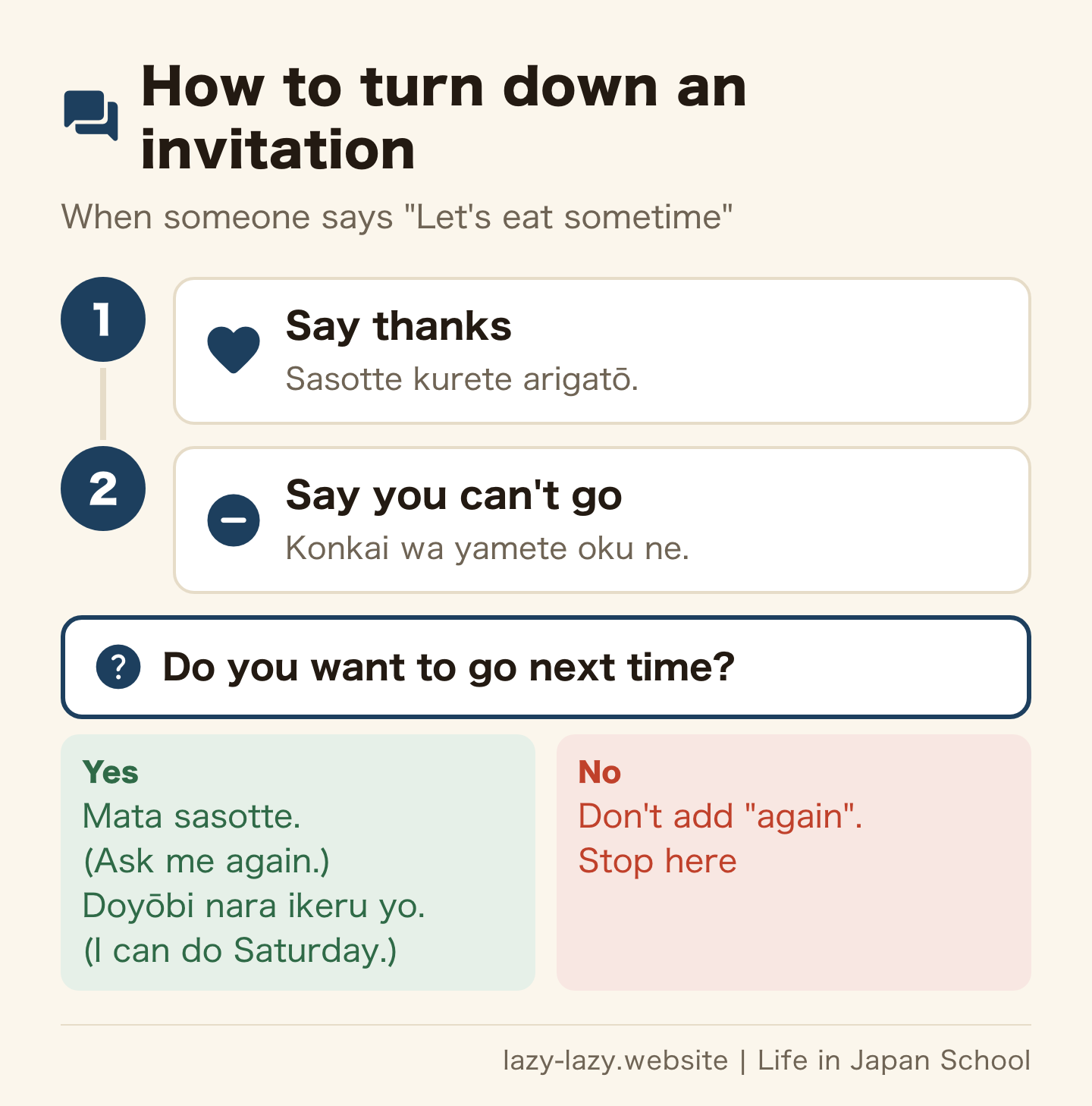
Worried it is rude to say no in Japan? This site’s pattern for replying to an invitation has just three parts. The Japan Foundation’s Irodori textbook has a beginner dialogue where someone turns down an outing, starting with “sumimasen”.
| Meaning | Japanese & romaji |
|---|---|
| Thanks for asking. I'll skip this one. | 誘ってくれてありがとう。今回はやめておくね。 Sasotte kurete arigatō. Konkai wa yamete oku ne. |
| Sorry, I can't make that day. | ごめん、その日は行けない。 Gomen, sono hi wa ikenai. |
| I can do Saturday. | 土曜日なら行けます。 Doyōbi nara ikemasu. |
| Please ask me again. (to seniors, coworkers) | また誘ってください。 Mata sasotte kudasai. |
Say “mata sasotte kudasai” only if you really want to go. If you don’t, you may simply be invited again. A report by Japan’s Council for Cultural Affairs warns that vague endings can raise someone’s hopes.
What reason should you give? Short and true
One short reason is enough. Irodori explains that for personal reasons, “node” sounds more polite and softer than “kara”.
| Meaning | Japanese & romaji |
|---|---|
| I have work, so I can't go. | バイトがあるので、行けません。 Baito ga aru node, ikemasen. |
| I have something on, so I can't come this time. | 用事があるので、今回は行けません。 Yōji ga aru node, konkai wa ikemasen. |
You do not have to say what the yōji is. This site’s advice is not to invent a reason. Say you have a test, then get asked about another day, and the story stops adding up.
Can you say you have no money? What does a nomikai cost?
With friends, yes. The price varies by place and group, and we found no official figure. So ask first.
| Meaning | Japanese & romaji |
|---|---|
| Money's tight this month, so I'll pass. | 今月はお金が厳しいから、やめておくね。 Kongetsu wa okane ga kibishii kara, yamete oku ne. |
| How much is it per person? | 会費はいくらですか? Kaihi wa ikura desu ka? |
| Can I join for just an hour? | 1時間だけ参加してもいいですか? Ichijikan dake sanka shite mo ii desu ka? |
| Dinner won't work, but want to talk at lunch break? | ごはんは難しいけど、昼休みに話さない? Gohan wa muzukashii kedo, hiruyasumi ni hanasanai? |
For example, a 3,000 yen event twice a month is 3,000 yen × 2 × 12 months = 72,000 yen a year. Irodori notes that splitting the bill (warikan) is common in Japan. A treat is a kindness, not a custom or a duty. Please do not borrow for social spending. This site basically does not recommend debt that carries interest or fees.
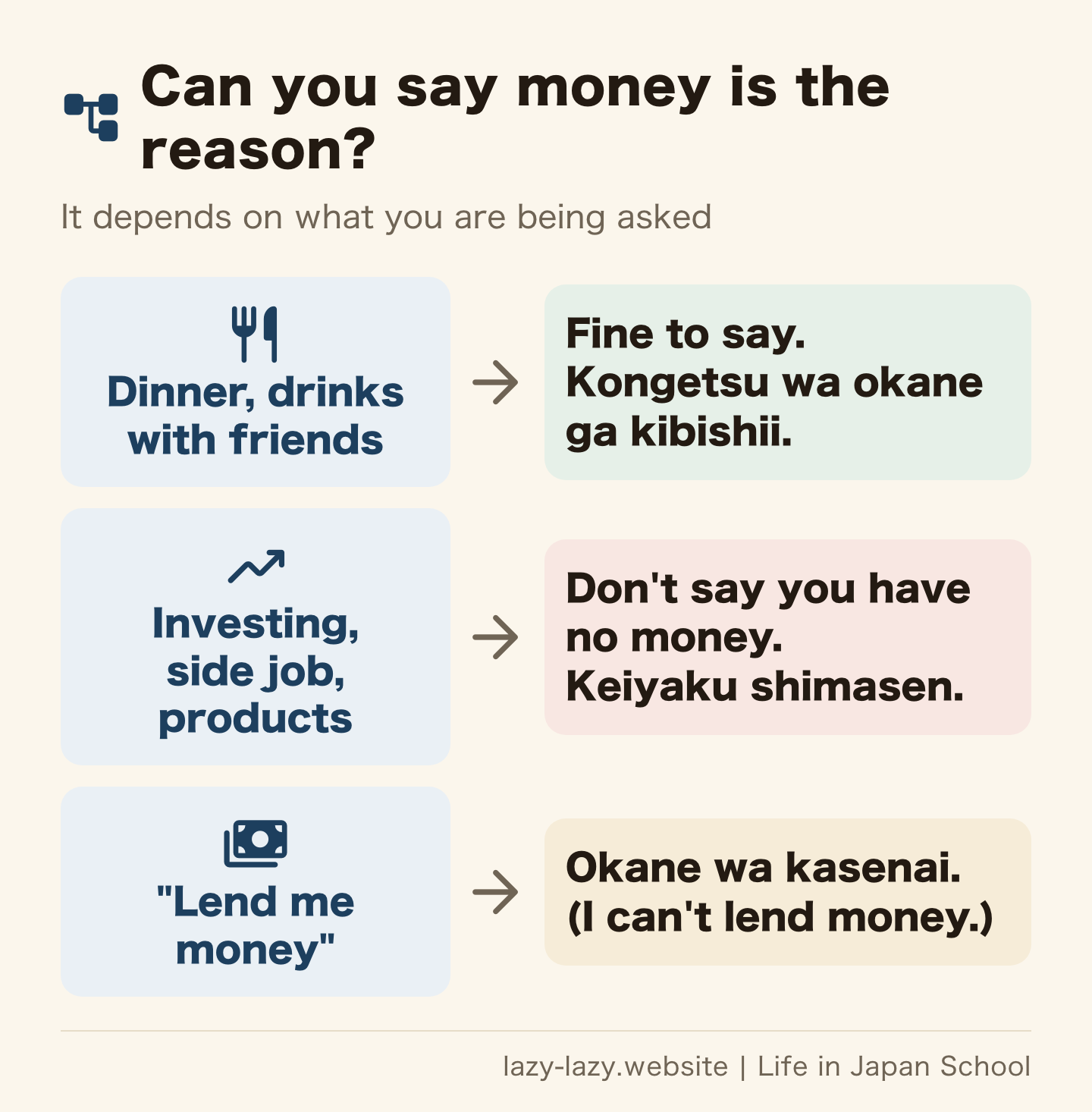
Investment, side-job and product pitches are different. Japan’s National Consumer Affairs Center describes people who said they had no money, then were steered to credit cards or loans. Say “Keiyaku shimasen.” If someone asks you for money directly, see how to say no when a friend wants to borrow money.
What does daijoubu desu mean? Enryo words can go either way
A server asks, “Kōhī wa ikaga desu ka?” You answer “Ii desu.” Where you come from, a phrase like that may be a yes. In Japan, the coffee may never come. The National Institute for Japanese Language and Linguistics mentions exactly this story from learners.
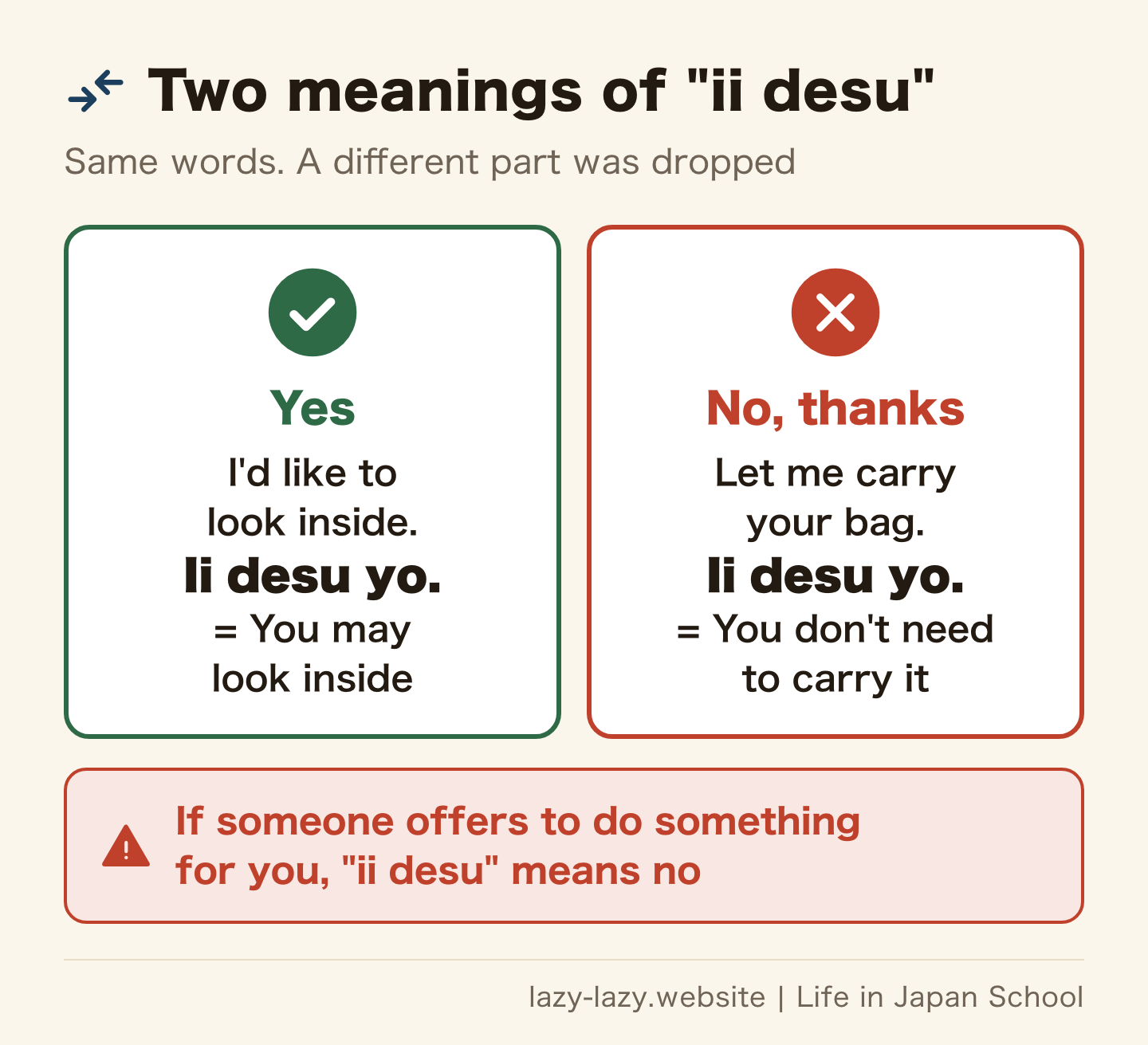
The same article explains that ii desu and kekkou desu are shortened forms. The yes comes from “shite mo ii desu” (it is fine to do it). The no comes from “shinakute mo ii desu” (there is no need to do it). When listening, use nods, head shakes, a leading “ee” or “iya”, and the situation. If the person is offering to do something for you, it is a no.
Daijōbu desu has two meanings as well. A note in the Daijisen dictionary gives “Hai, daijōbu desu” as possible or agreed, and “Ie, daijōbu desu” as not needed. Irodori also has a dialogue where someone is offered more food and says “Daijōbu desu. Mō onaka ga ippai desu”. Putting “hai” or “ie” in front, or adding a reason, makes it harder to misread. The Council’s report also suggests, where “kekkou desu” or “ii desu” alone could confuse, adding a word or saying it plainly.
| They say | To accept | To decline |
|---|---|---|
| Kōhī wa ikaga desu ka? (Coffee?) |
お願いします。 Onegai shimasu. Yes, please. |
今は大丈夫です。ありがとうございます。 Ima wa daijōbu desu. Arigatō gozaimasu. I'm fine for now, thank you. |
| Mō hitotsu dō desu ka? (One more?) |
じゃあ、いただきます。 Jā, itadakimasu. Then I'll have one. |
大丈夫です。もうお腹がいっぱいです。 Daijōbu desu. Mō onaka ga ippai desu. I'm good. I'm full. |
| Nimotsu, mochimashō ka? (Shall I carry that?) |
すみません、お願いします。 Sumimasen, onegai shimasu. Thanks, please do. |
大丈夫です。自分で持てます。 Daijōbu desu. Jibun de motemasu. I'm OK. I can carry it. |
“Enryo shimasu” is a polite no. “Go-enryo kudasai” means please don’t. If someone says “enryo shinaide” or “enryo naku” (don’t hold back), you can answer “Dewa, itadakimasu.” With door-to-door sales, skip “kekkou desu” and say “irimasen.” Consumer Affairs Agency guidance accepts “kekkou desu” as a refusal, but also says sellers have often claimed it meant yes.
What does mata kondo mean? Ask about a date, don’t guess
When you invite someone and they answer like this, the words alone do not tell you it is a no. The Council’s report says “chotto muzukashii” can be understood as “hard but possible”. It adds that “soon” (chikai uchi) means different lengths to different people, and that when you are unsure, you should ask.
| They say | What to ask |
|---|---|
| Mata kondo (Next time) |
いつごろがいいですか? Itsu goro ga ii desu ka? Around when would be good? |
| Iketara iku (I'll go if I can) |
人数を決めたいので、金曜までに教えてください。 Ninzū o kimetai node, kin'yō made ni oshiete kudasai. I need a headcount, so tell me by Friday. |
| Kangaete okimasu (I'll think about it) |
いつごろお返事をもらえますか? Itsu goro ohenji o moraemasu ka? When could I hear back? |
| Chotto muzukashii desu (That's a little hard) |
別の日ならどうですか? Betsu no hi nara dō desu ka? How about another day? |
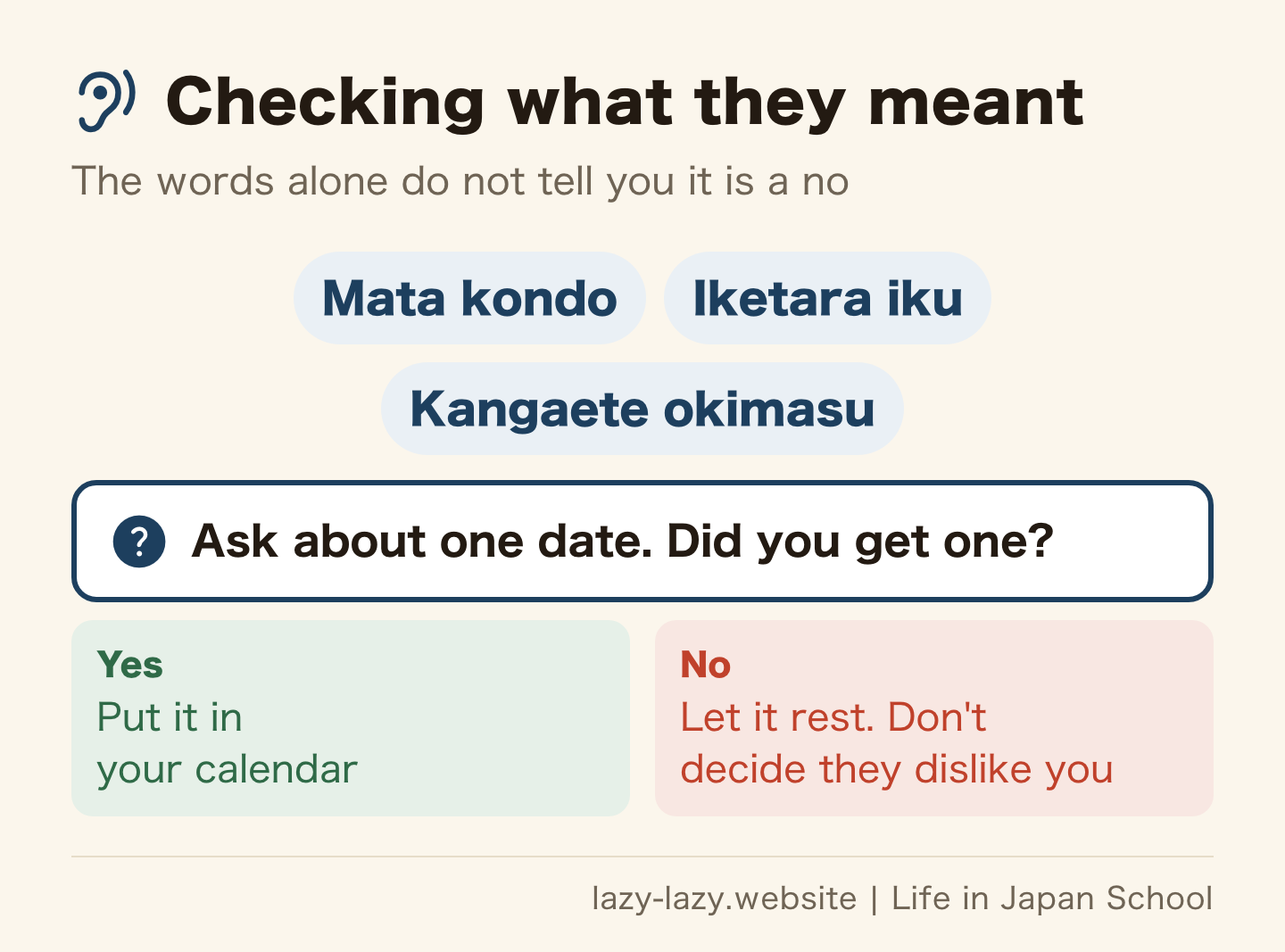
Asking once is enough. That is this site’s advice too. If no date comes, let it rest. It does not prove they dislike you. They may just be busy.
Can you decline an invitation by LINE? Email overall, social media for teens
Some people do say no in writing. A Council survey (online survey of pre-registered panel members, March 2017, 1,287 people aged 16 to 69) asked which means people use most often to say no. In person was 31.3%, phone 29.9%, and email 26.4%. Overall, email leads among written means, with social media and similar at 5.1%. Among ages 16 to 19, though, social media and similar at 25.7% beat email at 17.6%.
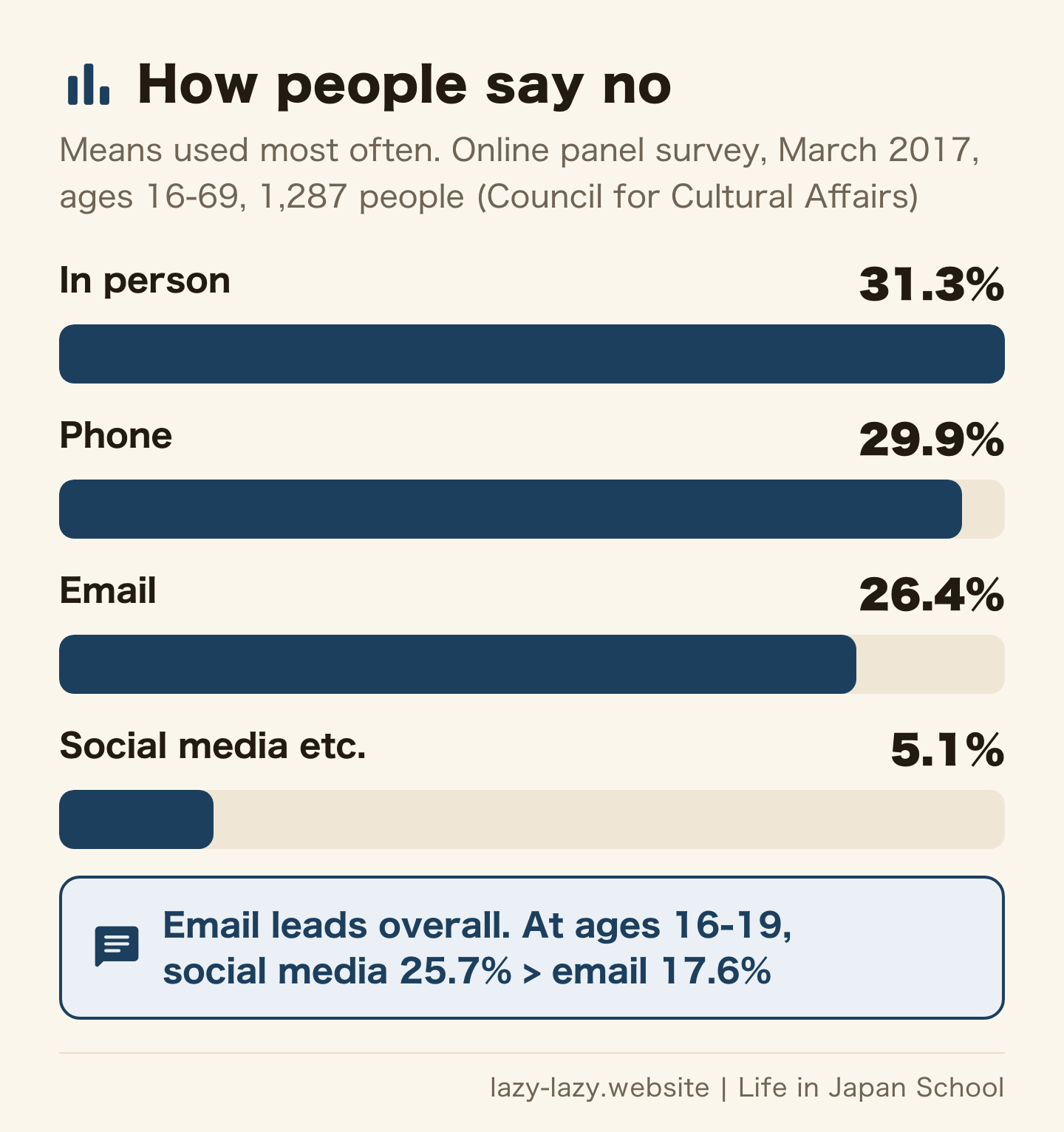
On LINE, you can send “Sasotte kurete arigatō. Konkai wa yamete oku ne” as it is. A quick reply lets the other person make plans. Big refusals are different. Decline a job offer by phone, not just by email.
How do you refuse alcohol in Japanese? Under 20, the law says no
Someone hands you a glass for the toast, and you think, “I’m 19, but just a little.” Where you come from, that may be normal. In Japan, you cannot drink under 20. The law makes no exception by nationality. Adulthood is 18 now, but the alcohol age stayed at 20. The penalties in the law are aimed at shops that knowingly serve you (fines up to 500,000 yen) and at parents and guardians.
| Meaning | Japanese & romaji |
|---|---|
| I'll skip alcohol today. | 今日はお酒はやめておきます。 Kyō wa osake wa yamete okimasu. |
| My body can't handle alcohol. | お酒が飲めない体質です。 Osake ga nomenai taishitsu desu. |
| Oolong tea, please. | ウーロン茶をお願いします。 Ūroncha o onegai shimasu. |
| I came by bike, so I can't drink. | 自転車で来たので、飲めないんです。 Jitensha de kita node, nomenai n desu. |
| I don't drink for religious reasons. | 宗教上の理由で、お酒は飲みません。 Shūkyō-jō no riyū de, osake wa nomimasen. |
| I'm under 20, so I can't drink. | 20歳未満なので、飲めません。 Hatachi miman na node, nomemasen. |
| I said I can't drink. No more for me. | 飲めないと言いました。これ以上は飲みません。 Nomenai to iimashita. Kore ijō wa nomimasen. |
| I'll head home here today. | 今日はここで失礼します。 Kyō wa koko de shitsurei shimasu. |
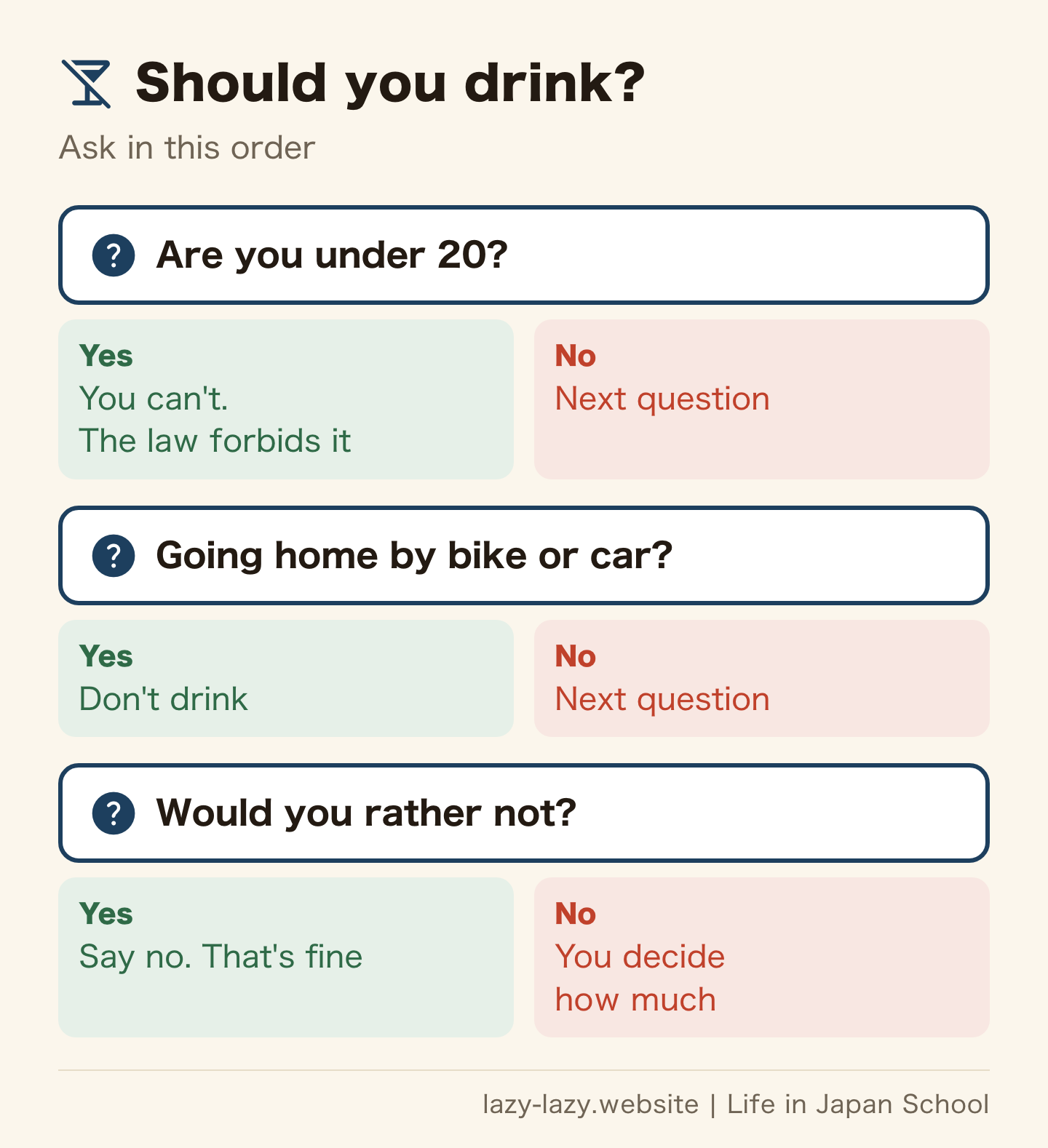
“Osake ga nomenai taishitsu desu” is the wording the Tokyo Fire Department suggests people who cannot drink use in advance. According to the health ministry’s e-Health Net, just under 10% of Japanese people have a type that reacts strongly to a small amount.
Bikes count as drink-driving. Riding with alcohol in your system can mean up to three years in prison or a fine up to 500,000 yen. See Japan’s bicycle rules. If you avoid pork and alcohol, the halal guide has lines for ordering. To skip the after-party (nijikai), use “Kyō wa koko de shitsurei shimasu.”
What if someone pushes you to drink?
The health ministry’s guidelines say people should avoid pushing others to drink. The Tokyo Fire Department also asks people not to force drinks. In its area, 14,190 people were taken to hospital with acute alcohol poisoning in 2024, with people in their 20s far ahead of any other age group.
In one case (Tokyo High Court, 2013), a boss at an after-work meeting kept pressing a subordinate who had refused, and forced more drink even after they vomited. The court held this was a tort. If it continues after you refuse, use the firm line in the table and leave your seat. If someone collapses and does not respond, or you are not sure whether they respond, call 119. If they are breathing normally, lay them on their side and stay with them.
Friends, seniors, coworkers: what changes when you decline?
The politeness changes. Your right to say no does not. The Council’s keigo guidelines rest on “mutual respect”: hierarchy such as senior and junior exists, and people respect each other within it. That includes seniors considering a junior’s situation. If you need the forms first, read keigo vs casual Japanese.
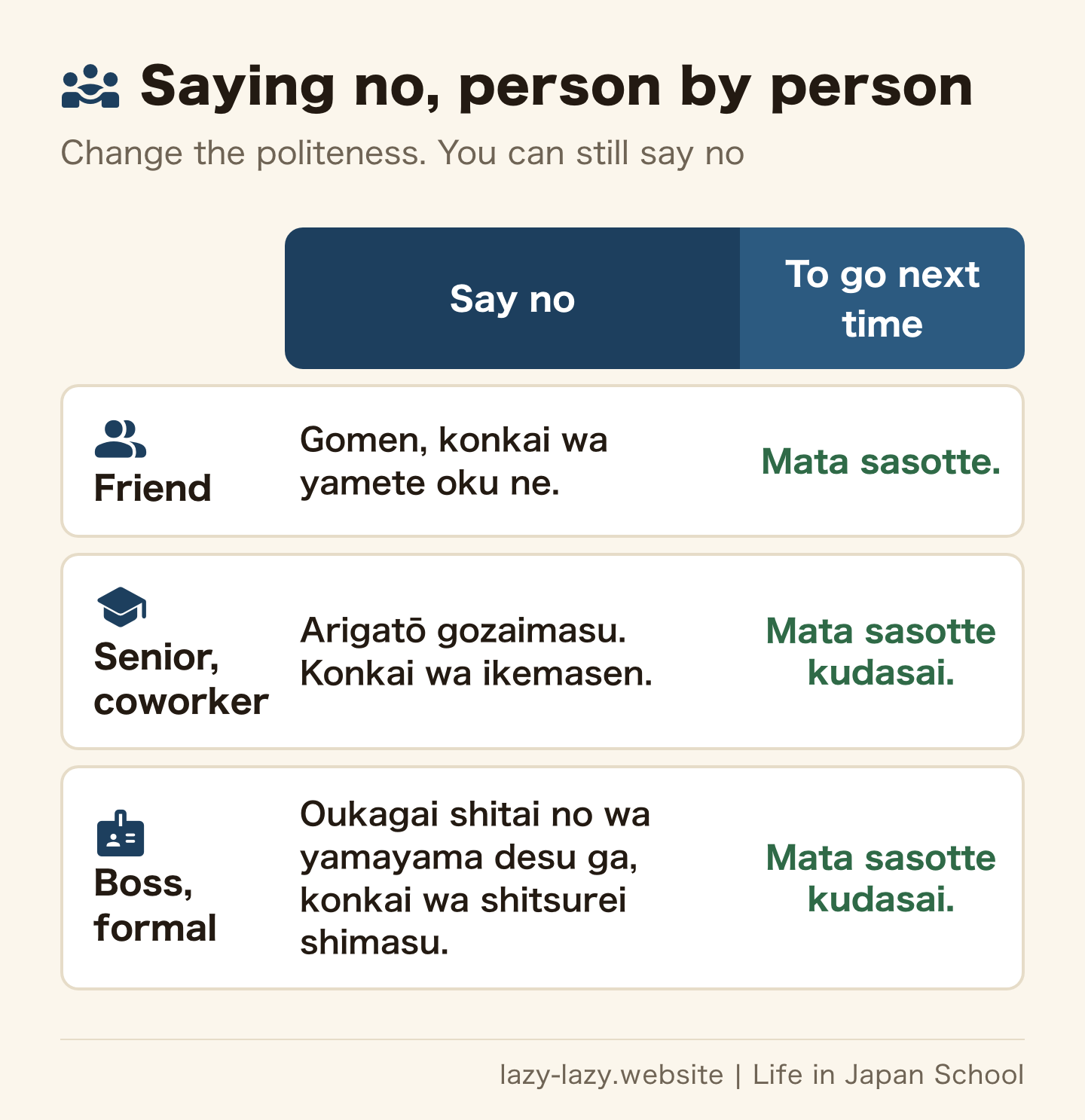
| Meaning | Japanese & romaji |
|---|---|
| Thank you for inviting me. I can't come this time. | 誘ってくださって、ありがとうございます。今回は行けません。 Sasotte kudasatte, arigatō gozaimasu. Konkai wa ikemasen. |
| I'd love to come, but I must decline this time. (to a boss, in formal settings) | お伺いしたいのは山々ですが、今回は失礼します。 Oukagai shitai no wa yamayama desu ga, konkai wa shitsurei shimasu. |
| Is attendance required? | 参加は必須ですか? Sanka wa hissu desu ka? |
In a 2012 Agency for Cultural Affairs survey (2,069 people aged 16 or over, nationwide), 40.3% said they might use “oukagai shitai no wa yamayama desu ga”, or something similar, to turn down an invitation.
For a work nomikai, first ask “Sanka wa hissu desu ka?” Under health ministry guidelines, training you are required to attend counts as working time. Those guidelines do not mention drinking parties. This site’s view is that it depends on what the party is. If you are harassed for saying no, you can ask a free labor consultation line for foreign workers whether it meets the definition of power harassment.
Said yes, now can’t go? Cancelling late
Tell the organizer (kanji) as soon as you know. Restaurants prepare set courses per person. A Ministry of Economy, Trade and Industry article cites a commissioned 2018 study estimating about 200 billion yen a year in losses from no-shows. Whether a fee applies depends on the restaurant, so ask the organizer.
| Meaning | Japanese & romaji |
|---|---|
| I'm very sorry. I can no longer come. | 申し訳ありません。行けなくなりました。 Mōshiwake arimasen. Ikenaku narimashita. |
| If there's a cancellation fee, I'll pay it. | キャンセル料がかかるなら、払います。 Kyanseruryō ga kakaru nara, haraimasu. |
Which one are you?
- A friend invited you, and you are short of money or time — today, pick a line from the first table and send it.
- Your “daijōbu desu” was misunderstood — from today, accept with “onegai shimasu” and decline with “daijōbu desu” plus a reason.
- You can’t read their “mata kondo” — today, ask “Itsu goro ga ii desu ka?” once.
- Drinks may be pushed on you — today, pick your line from the alcohol table and tell the organizer before the party.
- A work party is hard to refuse — today, ask “Sanka wa hissu desu ka?” If harassment continues, save the messages and contact a consultation line.
FAQ
Q. What is the shortest way to turn down an invitation in Japanese?
“Sasotte kurete arigatō. Konkai wa yamete oku ne” (Thanks for asking. I’ll skip this one) is enough. To a senior or a coworker, use the polite form: “Arigatō gozaimasu. Konkai wa ikemasen.” With a boss or in a formal setting, you can also say “Oukagai shitai no wa yamayama desu ga, konkai wa shitsurei shimasu.”
Q. Does “daijoubu desu” mean no?
It can. It can also be taken as yes. Add a reason so it is clear: “Daijōbu desu. Mō onaka ga ippai desu” (I’m good. I’m full). To accept, say “Onegai shimasu.”
Q. Does “mata kondo” mean no?
The words alone do not settle it. Ask once, “Itsu goro ga ii desu ka?” (Around when would be good?), and see whether a date comes back.
Q. Can I say I have no money when I turn down a drinking party?
With friends, yes: “Kongetsu wa okane ga kibishii kara, yamete oku ne.” Do not use it against an investment, side job or product pitch. There, say “Keiyaku shimasen” (I won’t sign up).
Q. Can I say no to a work drinking party?
First ask “Sanka wa hissu desu ka?” (Is attendance required?). If it is optional, the lines here are all you need. If you are told it is required, check whether that time counts as working hours. If unsure, ask a labor consultation line for foreign workers.
Q. I am 19. What do I do when someone offers me a drink?
Say “Hatachi miman na node, nomemasen” (I’m under 20, so I can’t drink). The law bans drinking under 20. It has no exception by nationality. The age stayed at 20 even after adulthood moved to 18.
Summary
This site’s pattern for saying no in Japanese has three parts: thanks, can’t go, next time. One short, true reason is enough. With friends, you can say money is tight. Against a sales or investment pitch, say “Keiyaku shimasen.”
Daijōbu desu, kekkou desu and ii desu can go either way. Accept with “onegai shimasu”, and decline with a reason. If someone says “mata kondo”, ask about a date once. You can always refuse alcohol, and under 20 the law refuses for you.
Sources: Council for Cultural Affairs, report on language communication (2018) / Keigo guidelines / Agency for Cultural Affairs, FY2011 national language survey / NINJAL on ii desu / JapanKnowledge on daijoubu (Daijisen note) / Kotobank, enryo / Japan Foundation Irodori: Elementary 1, Lesson 8, Lesson 12, Elementary 2, Lesson 3 / Act on under-20 drinking (e-Gov) / Ministry of Justice, age of adulthood Q&A / MHLW drinking guidelines / e-Health Net, ALDH2 / MHLW court case summary / MHLW on power harassment / MHLW working hours guidelines / Tokyo Fire Department, alcohol poisoning / first aid steps / Tokyo Metropolitan Police / METI Journal / National Consumer Affairs Center (2019) / Consumer Affairs Agency guidance. Checked 7 November 2026.
Related reading
Found this useful? Share it
Send it to a friend who lives in Japan.
WHO WROTE THIS
mori
Japanese. I read the ministries’ own notices, orders and Q&As in the original, and I start from what my Nepalese and Sri Lankan friends in Japan actually ran into. I do not write about what I have not checked or been told.
What this site can and cannot do →Looking for something else?
You may use the figures in this article, including commercially, if you credit this site with a link. How to use our figures