This article was checked on 25 October 2026 against the Tokyo Metropolitan Police pages on the moped licence test and traffic fines, the Osaka Prefectural Police page on the new moped standard, Sapporo City and Sagamihara City pages on moped registration, the Financial Services Agency’s jibaiseki rate table, the transport ministry’s jibaiseki page, and the Road Traffic Act and its Order (e-Gov). Fees, premiums and taxes change, so check the official pages on the day you apply.
The short answer
- A gentsuki (moped, legally a “motorised bicycle”) is a two-wheeler of up to 50cc, or up to 125cc with a maximum output of 4.0 kW or less, that you can ride on a moped licence. From 1 April 2025, these “new-standard” mopeds of up to 125cc and 4.0 kW count as mopeds too.
- To ride one you need three things: a licence, number plates (registered at your city office) and jibaiseki, the compulsory liability insurance. A Japanese car licence already covers mopeds.
- In Tokyo, a moped licence costs 9,200 yen: 1,600 yen for the test, 2,350 yen to issue the licence and 5,250 yen for the moped course. You must be 16 or over, and the written test is also offered in English and four other languages (checked 25 October 2026).
- Moped jibaiseki goes up to 7,730 yen for 12 months (outside remote islands and Okinawa) from November 2026. Starting with no licence, the first year costs 18,930 yen in our example (licence in Tokyo, plate fee from Sagamihara, tax from Sapporo; bike, helmet and fuel not included).
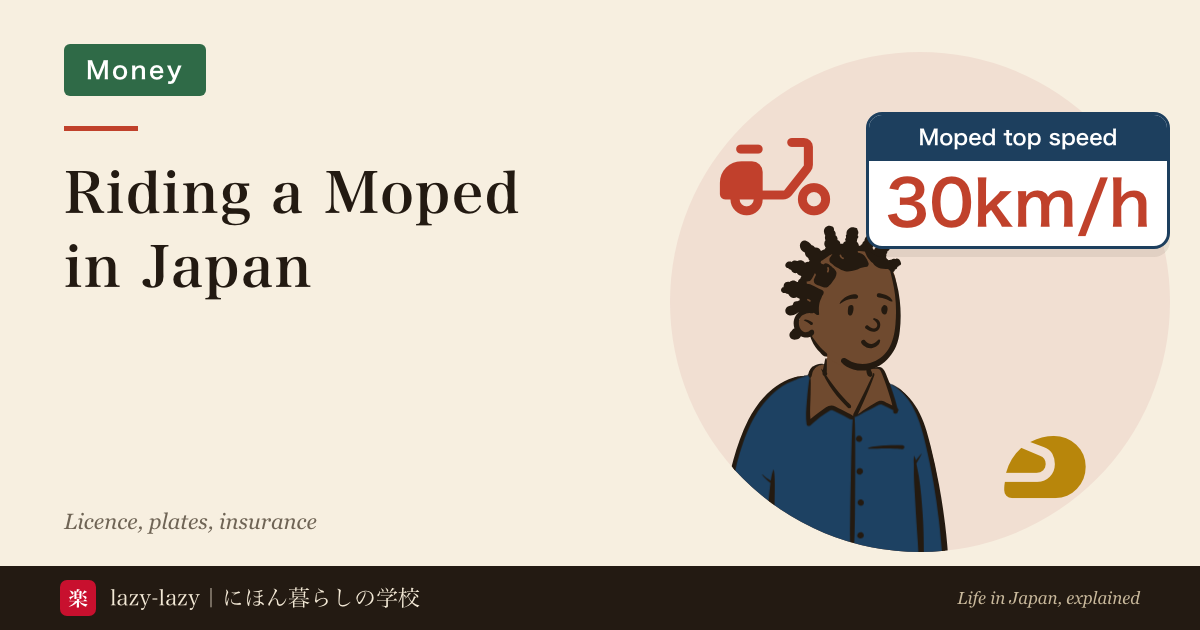
- Mopeds are limited to 30 km/h, cannot carry a passenger, and must make a two-stage right turn at signalled junctions on roads with three or more lanes on your side. A 40 km/h sign still means 30 km/h for a moped.
Knowing this, you can get the licence, plates and jibaiseki in the right order, count the first year’s cost, and then decide between a moped, a bicycle and the train.
Two months into a Japanese language school in the suburbs. From the station to your flat is a 25-minute walk. A senior colleague at your part-time job offers you his old scooter cheaply. You ask a Japanese friend how to get a licence, and she says “go to a driving school”. Another friend says “your international licence is fine”. You can get a moped licence without a driving school, through a written test and a moped course at the test centre. Whether an international licence works depends on the licence you hold.
- What do you need to ride a moped in Japan? A licence, plates and jibaiseki
- Moped, bicycle or train for your commute? Decide by licence, cost and rules
- What is the 2025 new-standard moped? Up to 125cc and 4.0 kW on a moped licence
- How do you get a moped licence? Documents, test languages and the moped course
- Can you ride a moped on a foreign or international licence? Some people can, some cannot
- Where do you register a moped? At the city office, within 15 days (Sapporo example)
- How much is moped jibaiseki? 7,730 yen for 12 months from November 2026
- How much does a moped cost in the first year? A worked example from licence to jibaiseki
- Moped rules that trip foreigners up: 30 km/h, two-stage right turns, no passengers
- What if you have an accident on a moped? What jibaiseki does not cover, and voluntary insurance
- Which one are you?
- FAQ
- Summary
- Related reading
What do you need to ride a moped in Japan? A licence, plates and jibaiseki
You need all three of these. If even one is missing, you must not ride.
- A licence: a moped licence, or a licence that covers mopeds (a car or motorcycle licence, for example). The Osaka police list shows that a standard car licence (futsu menkyo) covers standard cars, small special vehicles and mopeds (Osaka Prefectural Police, licence types).
- Number plates: you get moped plates from the tax counter of the city, ward or town where you live.
- Jibaiseki insurance: every motor vehicle, mopeds included, must have jibaiseki before it can be ridden (transport ministry, what jibaiseki covers).
On top of this, the rider must wear a helmet. Article 71-4(2) of the Road Traffic Act says a moped rider must not ride without a riding helmet (e-Gov, Road Traffic Act).
Moped, bicycle or train for your commute? Decide by licence, cost and rules
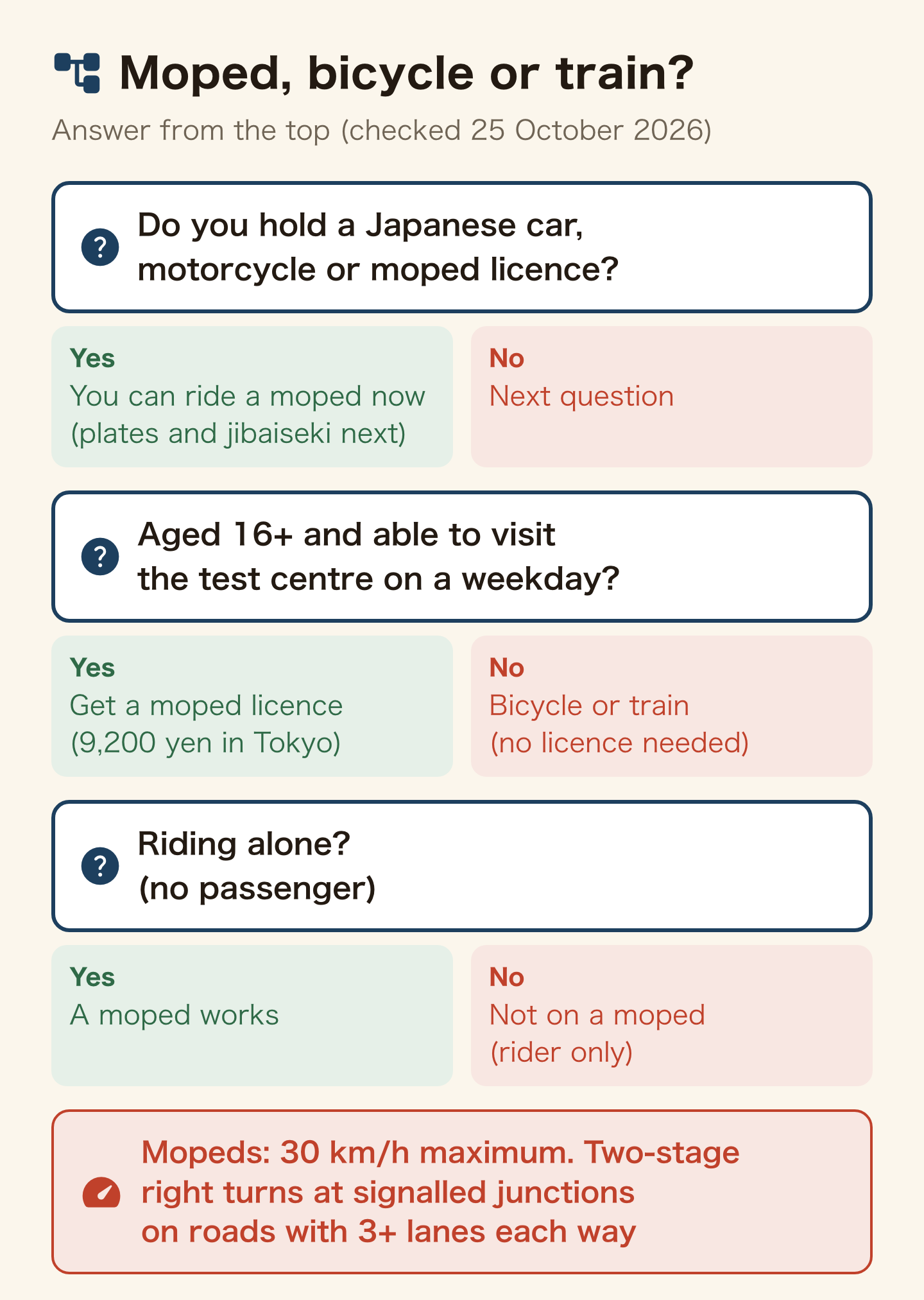
If you are not sure, answer three questions from the top.
- You hold a Japanese licence: with a car licence, you can ride a moped without a moped licence. All that is left is plates and jibaiseki.
- You have no licence: if you are 16 or over and can get to a test centre on a weekday, you can take the moped licence. In Tokyo, the moped test is held on weekdays only.
- You want to carry someone: you cannot on a moped. Article 23 of the Road Traffic Act Order says a moped carries no more than one person.
A bicycle needs no licence, no plates and no jibaiseki. From April 2026, however, bicycles also get blue tickets (fixed fines). The rules and fines for cycling to school or work are in Japan bicycle rules 2026: blue tickets and fines from April. If you commute by train as a student, whether you can buy a student commuter pass and how is covered in Suica and PASMO for foreigners, including commuter passes.
A moped suits someone who lives far from a station, rides alone and is fine at 30 km/h. If you will ride along main roads every day, also count how many junctions on your route need a two-stage right turn.
What is the 2025 new-standard moped? Up to 125cc and 4.0 kW on a moped licence
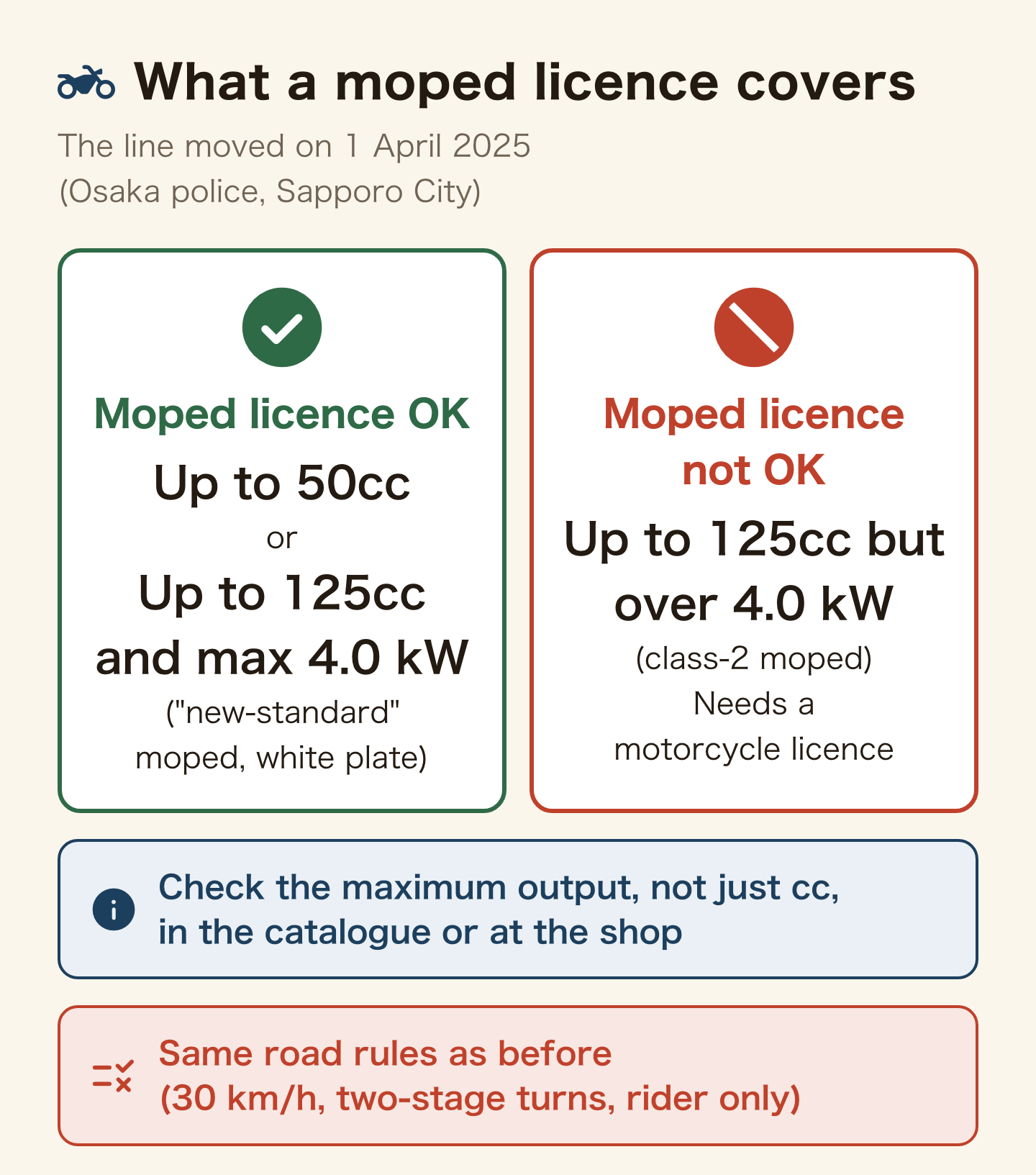
According to the Osaka police, new emission rules apply from November 2025, so production of the existing 50cc mopeds ended at the end of October 2025 (Osaka Prefectural Police, new moped category). The Road Traffic Act enforcement regulations were therefore changed from 1 April 2025.
- A moped licence now covers vehicles of up to 50cc, plus vehicles over 50cc and up to 125cc whose maximum output is 4.0 kW or less.
- A bike of 125cc or less whose output is over 4.0 kW is a “class-2 moped”. A moped licence does not cover it. Riding one on a moped licence is riding without a licence.
- New-standard mopeds follow the same road rules as the old mopeds.
New-standard mopeds get the same white plate as 50cc mopeds (Sapporo City, new-standard mopeds). In Sapporo, registering one also needs a document showing the maximum output is 4.0 kW or less, such as a sales certificate with the type-approval number. Before you buy, check the maximum output, not the engine size, in the catalogue or at the shop. A 50cc moped you already own can still be ridden on a moped licence.
How do you get a moped licence? Documents, test languages and the moped course
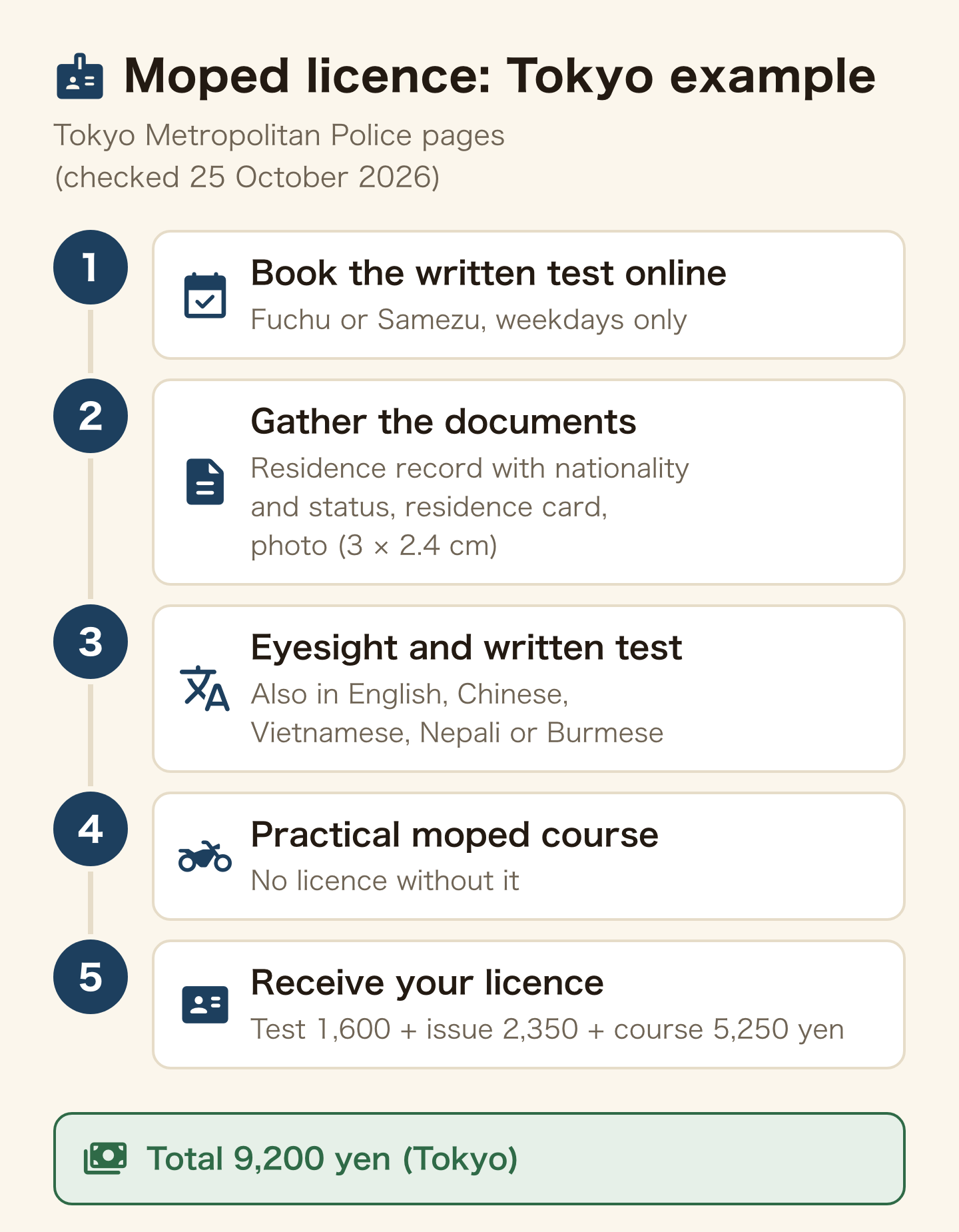
You take the moped licence at the test centre of the prefecture you live in, with no driving school. The steps below are for Tokyo (Tokyo Metropolitan Police). Fees, test days and languages differ by prefecture, so check your own prefectural police website.
- Book the written test. In Tokyo, written tests are by online reservation only (Tokyo Metropolitan Police, licence tests). Only people living in Tokyo can take them there.
- Gather the documents. A foreign national with a residence record must submit a copy of the residence record (juminhyo, issued within 6 months, no photocopies) showing the “specified items”: nationality, status of residence, period of stay and so on (Tokyo Metropolitan Police, October 2025 rule change). You also need ID such as your residence card and a photo 3 cm high by 2.4 cm wide.
- Check you are eligible: aged 16 or over, with eyesight of 0.5 or better with both eyes (Tokyo Metropolitan Police, moped licence test). The test centres are Fuchu and Samezu, on weekdays only.
- Take the eyesight test and the written test. In Tokyo, the moped written test is also available in English, Chinese, Vietnamese, Nepali and Burmese (Tokyo Metropolitan Police, written tests in foreign languages). Tell the staff you want a foreign-language test when you hand in the application.
- If you pass, take the moped course (riding a real moped). Without it, the licence is not issued. Wear long sleeves, long trousers and shoes. Helmets are provided.
The fee is 3,950 yen: 1,600 yen for the test and 2,350 yen to issue the licence. The moped course costs another 5,250 yen. 1,600 + 2,350 + 5,250 = 9,200 yen. If you fail and retake the test, you pay the test fee again each time.
If you are also thinking about a car licence, the driving-school cost and the Japanese-language hurdle are compared in getting a driving licence in Japan as a foreigner. A car licence also lets you ride a moped.
Can you ride a moped on a foreign or international licence? Some people can, some cannot
You have a motorbike licence from home, so you just ride. Where you come from, that may be normal. In Japan, a foreign licence card alone does not let you ride. With an international driving permit, you may drive only the vehicles it allows you to drive (Road Traffic Act, Article 107-2).
- An international driving permit is valid in Japan for one year from the day you landed, or until it expires, whichever is shorter (National Police Agency, foreign driving licences).
- If you have a residence record and come back to Japan within three months of leaving, that return does not restart the one-year count.
- There is also a procedure to get a Japanese licence for the vehicles your foreign licence covers, with part of the test waived (licence conversion). You must have spent a total of three months or more in that country after getting the licence.
Some countries’ international permits are not accepted at all. How your country’s licence is treated is in converting your foreign driving licence in Japan. Rather than riding on a licence you are not sure about, taking the moped licence is the safer route.
Where do you register a moped? At the city office, within 15 days (Sapporo example)
You get moped number plates from the tax counter of the city, ward or town where you live. Sapporo asks you to declare a moped within 15 days of getting it (Sapporo City, moped registration). For a moped bought from a shop, Sapporo asks for three things.
- The plate application form (available at the counter)
- A sales certificate (issued by the shop)
- ID for the person making the declaration
If a friend gives or sells you the moped, a transfer certificate and the previous owner’s deregistration certificate, among others, are added. Fees depend on the municipality. Sagamihara says there is no fee, except for some procedures (Sagamihara City, moped declarations). When you move to another municipality or get rid of the moped, you return the plates (deregistration). Sapporo’s deadline for that is 30 days.
Once the moped has plates, light vehicle tax applies. In Sapporo’s table, mopeds of 50cc or less and new-standard mopeds are 2,000 yen a year (Sapporo City, light vehicle tax). The tax is charged for the whole year to whoever owns the moped on 1 April, with no monthly proration. If you get rid of it on 2 April or later, you still pay that year’s tax.
How much is moped jibaiseki? 7,730 yen for 12 months from November 2026
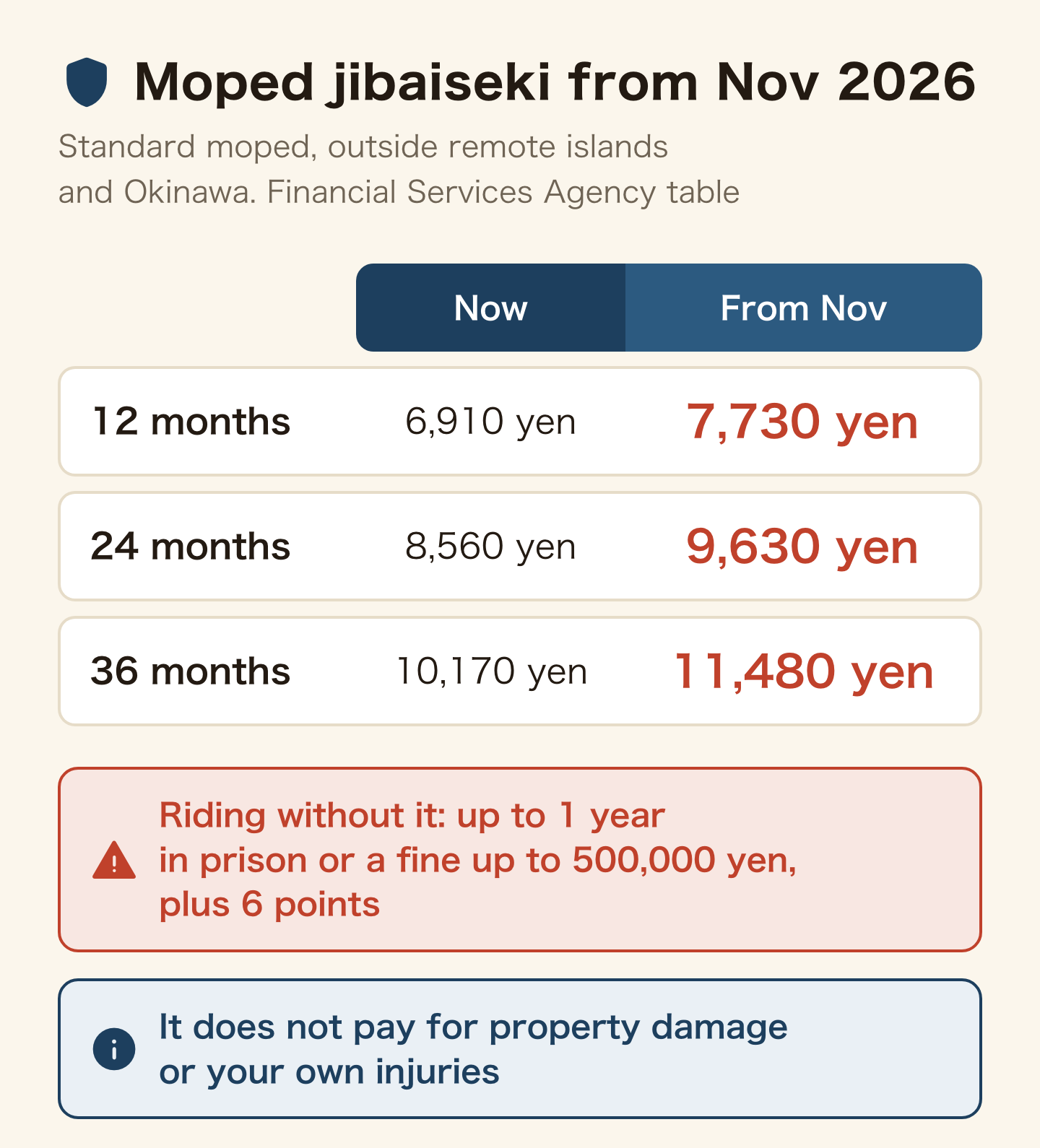
Jibaiseki premiums go up from November 2026. The Financial Services Agency’s council announced that the new standard rates apply from November 2026 (Financial Services Agency, 153rd jibaiseki council). For a standard moped outside remote islands and Okinawa, the amounts are as follows (FSA document 1, revised rate table).
| Period | Now | From November 2026 |
|---|---|---|
| 12 months | 6,910 yen | 7,730 yen |
| 24 months | 8,560 yen | 9,630 yen |
| 36 months | 10,170 yen | 11,480 yen |
If you will ride for a long time, a longer period costs less per year. From November, 36 months is 11,480 yen, and 11,480 ÷ 3 = about 3,827 yen a year.
Riding without jibaiseki carries up to one year’s imprisonment or a fine of up to 500,000 yen, plus six licence points (transport ministry, what jibaiseki covers). When you take it out, you receive an insurance sticker to put on the number plate. Renew it before the period ends.
How much does a moped cost in the first year? A worked example from licence to jibaiseki
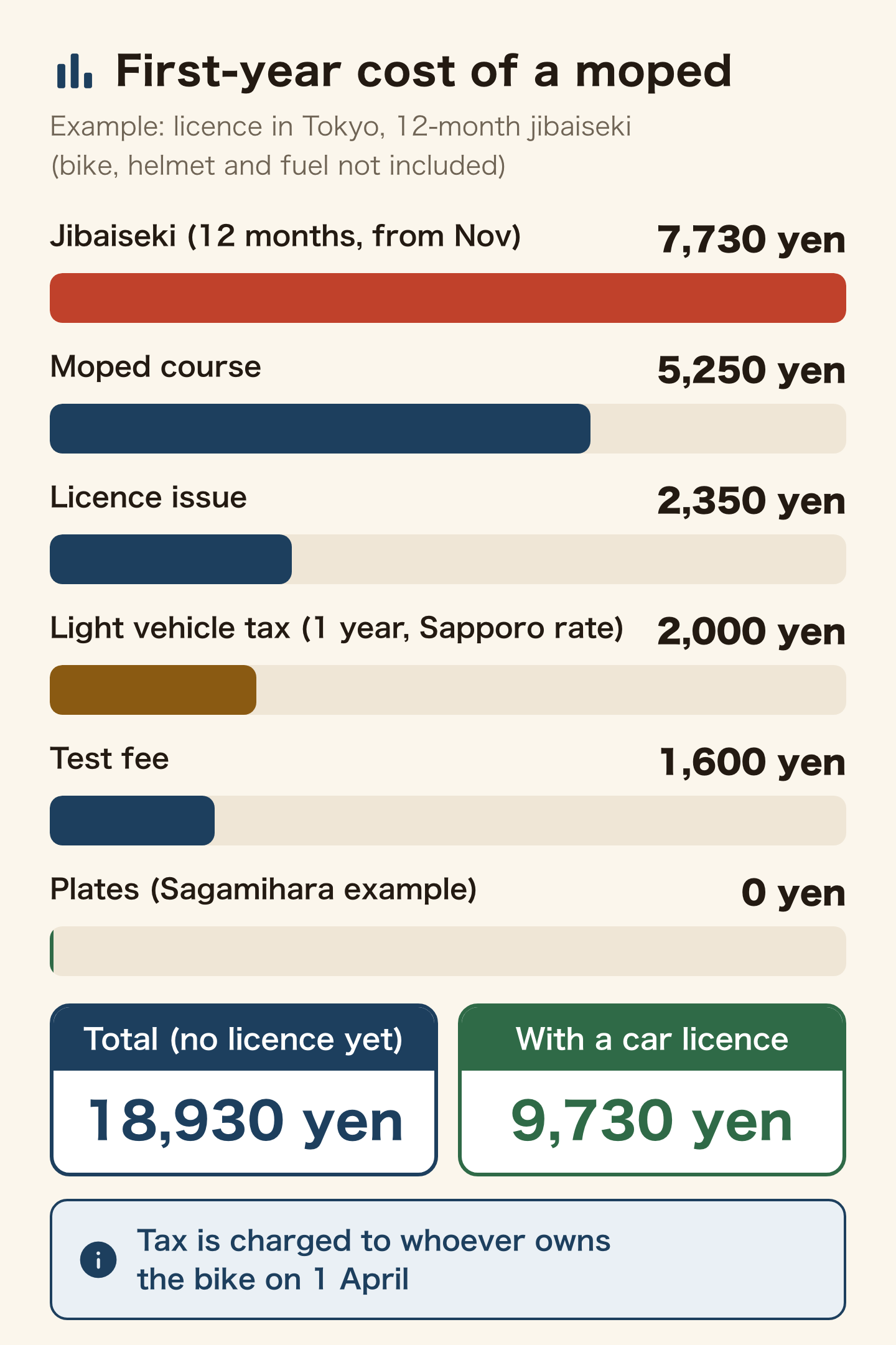
Take someone with no licence who gets a moped licence in Tokyo in November 2026, buys a moped and starts riding. The bike itself, the helmet and fuel are left out because they depend on the shop and the bike.
| Item | Amount | Source |
|---|---|---|
| Moped licence test fee | 1,600 yen | Tokyo police |
| Licence issue fee | 2,350 yen | Tokyo police |
| Moped course | 5,250 yen | Tokyo police |
| Plate registration | 0 yen | Sagamihara example |
| Light vehicle tax (for the next 1 April) | 2,000 yen | Sapporo table |
| Jibaiseki (12 months) | 7,730 yen | FSA |
The total is 1,600 + 2,350 + 5,250 + 0 + 2,000 + 7,730 = 18,930 yen. With a car licence you skip the 9,200 yen for the licence, so 2,000 + 7,730 = 9,730 yen. With 24-month jibaiseki at 9,630 yen instead, the total from no licence is 20,830 yen and there is no jibaiseki to pay in the second year. If you fail the written test, the 1,600 yen test fee is charged again.
Moped rules that trip foreigners up: 30 km/h, two-stage right turns, no passengers
Two people on a scooter, keeping up with the cars. Where you come from, that may be normal. In Japan, a moped can do neither.
- 30 km/h maximum: on ordinary roads a moped’s top speed is 30 km/h (Road Traffic Act Order, Article 11). A 40 or 50 km/h road sign does not apply to mopeds. A sign can set a moped’s maximum speed only when it is 30 km/h or lower (Order on Road Signs, Markings and Lines, Appended Table 1).
- Two-stage right turn: you must make a two-stage right turn at signalled (traffic-controlled) junctions, on roads with a “two-stage right turn” sign or where your side of the road (the whole road if one-way) has three or more lanes (Road Traffic Act, Article 34(5)). Keep to the left edge beforehand and go along the edge of the junction. In effect, you cross the junction in two goes to reach the road on your right. Where a “small turn” sign is posted, you turn right like a car.
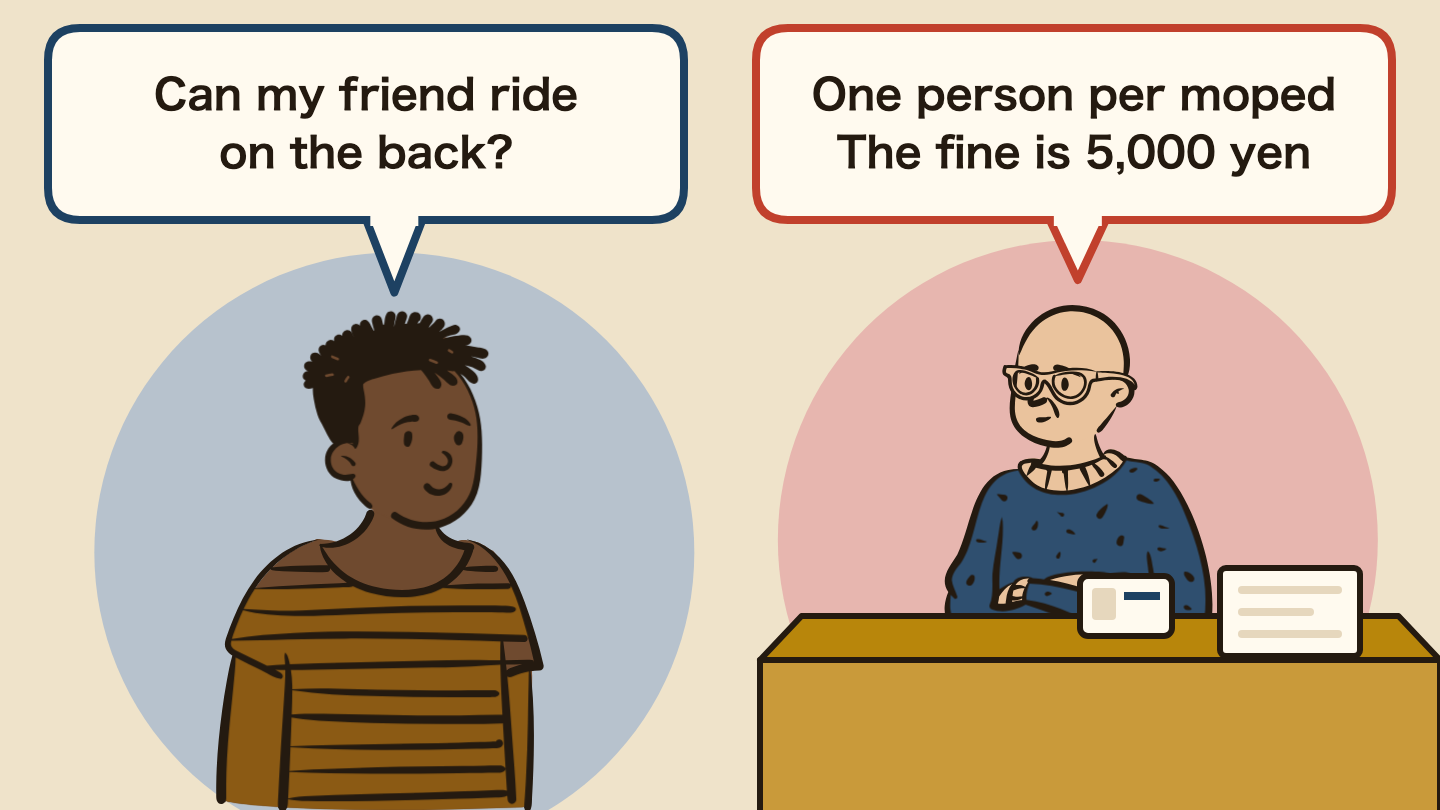
- No passengers: a moped carries one person only (Road Traffic Act Order, Article 23). This applies even if the moped has a rear seat.
- Helmet: you must not ride without one (Road Traffic Act, Article 71-4(2)).
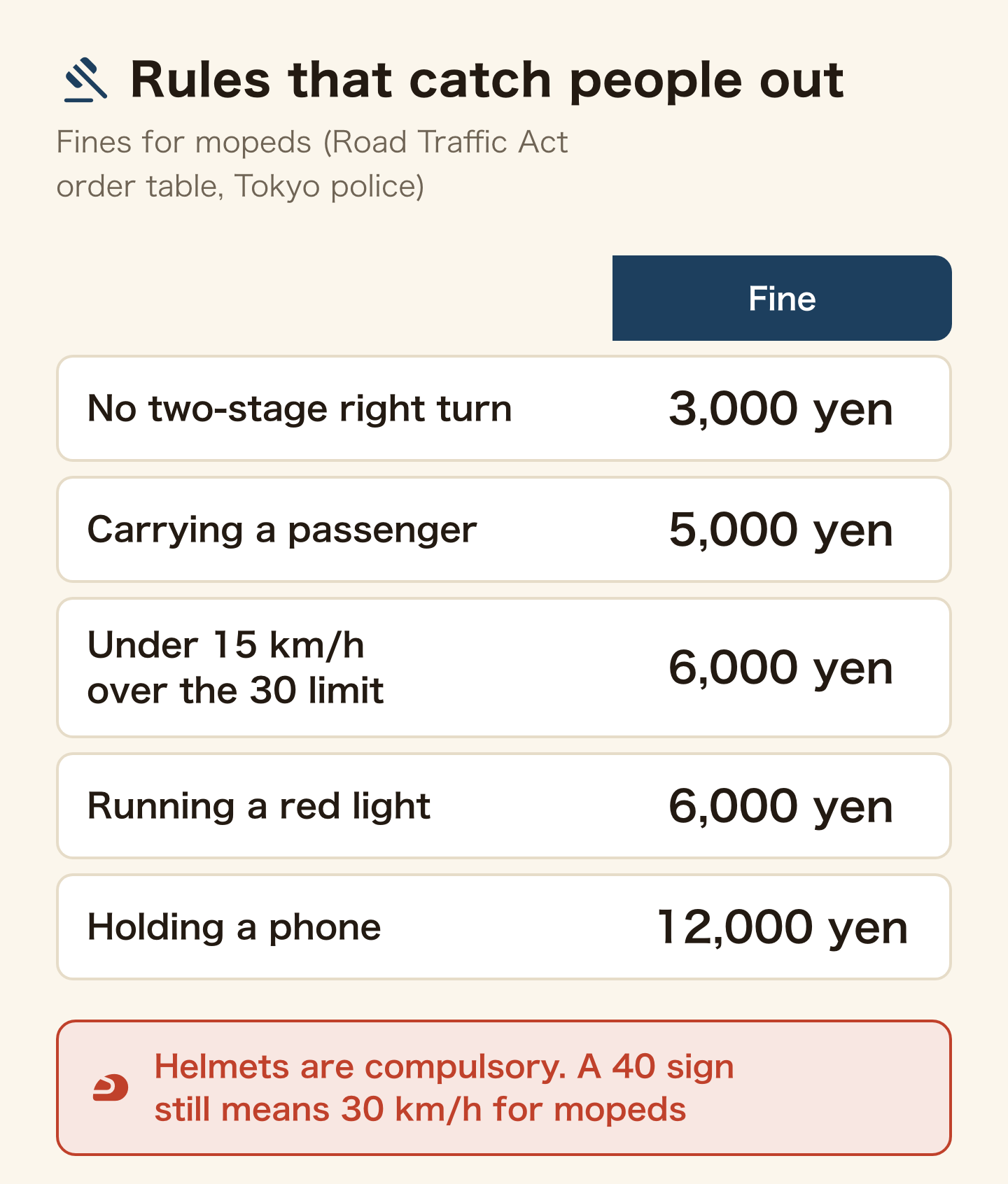
Break these rules and you pay a fixed fine. For mopeds, not making a two-stage right turn (improper turning at a junction) is 3,000 yen, carrying a passenger (exceeding capacity) is 5,000 yen, and going under 15 km/h over the 30 km/h limit is 6,000 yen (Tokyo Metropolitan Police, fines table). Going 25 to under 30 km/h over is 12,000 yen. Holding a phone while riding is 12,000 yen and running a red light is 6,000 yen. The table reproduces the Road Traffic Act Order, so the amounts are the same outside Tokyo.
What if you have an accident on a moped? What jibaiseki does not cover, and voluntary insurance
If you have an accident, first help anyone injured and report it to the police. What to do at the scene and which insurance pays for treatment are laid out step by step in traffic accidents in Japan: what to do, the police report and insurance.
Jibaiseki pays only for harm to other people (injury, lasting disability or death). Per victim, it pays up to 1.2 million yen for injury and up to 30 million yen for death (transport ministry, what jibaiseki covers). It does not pay for damage to things, such as the other car or a shop window, or for your own injuries. The transport ministry recommends that anyone who thinks jibaiseki is not enough takes out voluntary insurance as well.
Owing more than your savings can pay is exactly the situation insurance is for. Student insurance that covers bicycle accidents may exclude moped accidents. The JEES insurance for international students states that accidents involving automobiles or motorcycles, including motorised bicycles, are not covered (JEES inbound student insurance brochure 2026). What the insurance you joined through school actually pays is explained in Gakkensai student insurance: injuries and bike accidents. If you will ride a moped, decide before your first ride whether to take out voluntary insurance that covers moped accidents.
Which one are you?
- You hold a Japanese car licence: you do not need a moped licence. Today, open your city or ward’s moped registration page and check the documents.
- You have no licence, are 16 or over and free on weekdays: take the moped licence. Today, check your prefectural police page for how to book the written test and which languages are offered, and pick a day to get a residence record that shows your nationality and status.
- You only have an international or home-country licence: today, check on the National Police Agency page whether your licence can be used in Japan. If you cannot tell, take the moped licence route.
- You are buying a moped or being given one: today, ask the shop or the owner whether its maximum output is 4.0 kW or less. Set a date for registration and jibaiseki that comes before your first ride.
- You want to carry someone, or 30 km/h is not enough: look at a bicycle or the train, or at a motorcycle or car licence, instead of a moped. Today, ask your school office how much a commuter pass would cost.
Once you have the licence, the plates and the jibaiseki sticker, plus a helmet, this decision is done. All that is left is to check for two-stage right turn signs at the junctions on your route.
FAQ
Q. How old do you have to be to get a moped licence in Japan?
16. The Tokyo police require applicants to be 16 or over, with eyesight of 0.5 or better with both eyes.
Q. Can I ride a moped on a Japanese car licence?
Yes. A standard car licence covers standard cars, small special vehicles and mopeds. The new-standard mopeds from April 2025 are mopeds, so they are covered too.
Q. Can I take the moped licence test in English?
In Tokyo, yes. The Tokyo police offer it in English, Chinese, Vietnamese, Nepali and Burmese. For other prefectures, check that prefecture’s police website.
Q. What is a new-standard moped?
A two-wheeler over 50cc and up to 125cc with a maximum output of 4.0 kW or less. Since 1 April 2025 it can be ridden on a moped licence. It has a white plate and follows the same road rules as other mopeds.
Q. How much is moped jibaiseki?
From November 2026: 7,730 yen for 12 months, 9,630 yen for 24 months and 11,480 yen for 36 months (outside remote islands and Okinawa). Before that, 12 months was 6,910 yen.
Q. Can two people ride a moped?
No. A moped carries one person only. Carrying a passenger is exceeding capacity, with a fine of 5,000 yen.
Summary
To ride a moped you need a licence, plates and jibaiseki. With a car licence, you do not need a moped licence. In Tokyo a moped licence costs 9,200 yen, and the written test is offered in English and four other languages. From April 2025, new-standard mopeds of up to 125cc and 4.0 kW can be ridden on a moped licence, but anything over 4.0 kW cannot.
Jibaiseki rises to 7,730 yen for 12 months (outside remote islands and Okinawa) from November 2026, and the first year from no licence comes to 18,930 yen in our example (licence in Tokyo, plate fee from Sagamihara, tax from Sapporo; bike, helmet and fuel not included). Mopeds are limited to 30 km/h, carry one person, and make two-stage right turns at signalled junctions on roads with three or more lanes on your side. Jibaiseki alone may not cover what you owe for injuring someone, so think about voluntary insurance before you ride.
Sources (official): Tokyo Metropolitan Police moped licence test, licence tests, October 2025 rule change, foreign-language written tests, fines table; Osaka Prefectural Police new moped category, licence types; National Police Agency, foreign driving licences; Sapporo City new-standard mopeds, light vehicle tax, moped registration; Sagamihara City, moped declarations; Financial Services Agency 153rd jibaiseki council, document 1; transport ministry, what jibaiseki covers; e-Gov Road Traffic Act, Road Traffic Act Order, Order on Road Signs, Markings and Lines; JEES inbound student insurance brochure (all checked 25 October 2026, most in Japanese). Fees, premiums and taxes change, so check the official pages on the day you apply.
Related reading
Found this useful? Share it
Send it to a friend who lives in Japan.
WHO WROTE THIS

mori
Japanese. I read the ministries’ own notices, orders and Q&As in the original, and I start from what my Nepalese and Sri Lankan friends in Japan actually ran into. I do not write about what I have not checked or been told.
What this site can and cannot do →Looking for something else?
You may use the figures in this article, including commercially, if you credit this site with a link. How to use our figures