Last updated: August 2026 (covers the February 2026 guideline revision and the revocation system starting April 2027)
Summary
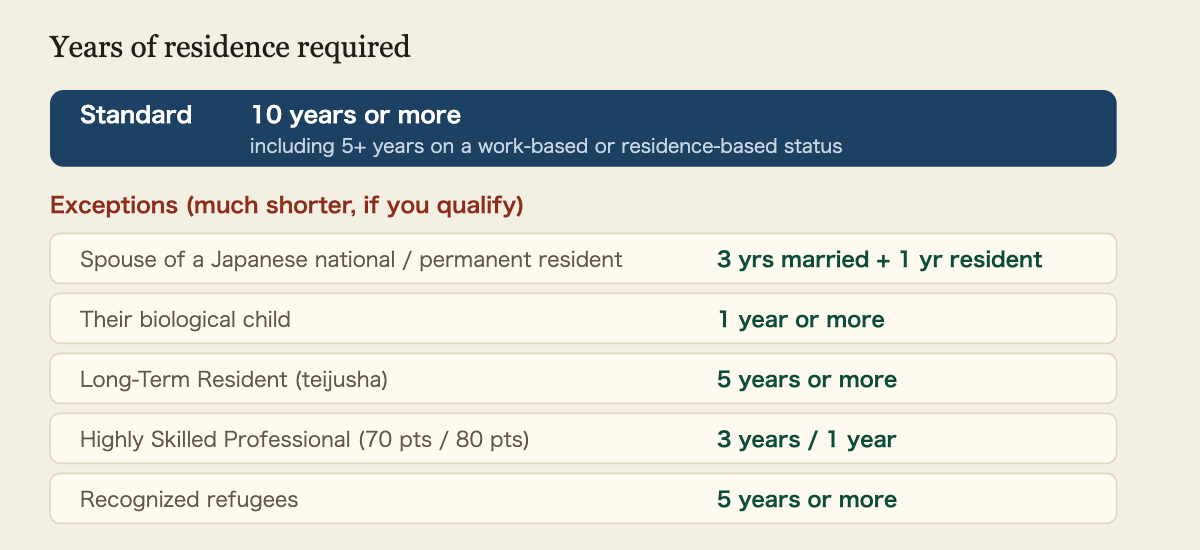
- You normally need 10 years in Japan. But there are big exceptions – 1 year of residence for spouses of Japanese nationals, and as little as 1 year for Highly Skilled Professionals.
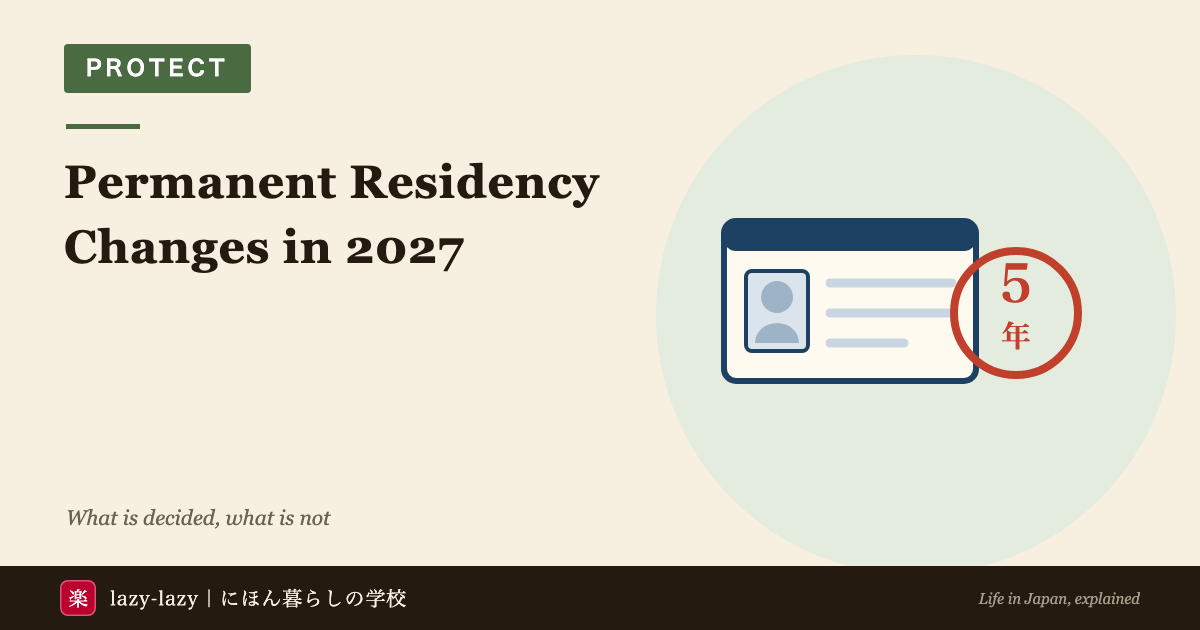
- From April 1, 2027, your residence card must show a 5-year period of stay. The current allowance for a 3-year card ends on March 31, 2027.
- The same day, a revocation system for permanent residence begins. It targets people who deliberately refuse to pay taxes and social insurance.
- But it requires intent and bad faith. Being unable to pay because of illness or job loss is not what this is aimed at. And revocation does not mean immediate deportation.
- Screening looks at 5 years of resident tax and 5 years of proven income, and 2 years of pension and health insurance. The only preparation that works starts today: keep paying.
Permanent Residence (永住 eijū) removes the limit on how long you can stay and the limit on what work you can do. It is not naturalization – you keep your original nationality.
This article reflects the February 2026 guideline revision and the revocation system starting April 2027. If you are reading guides written last year, part of what you know is now out of date.
- First: how many years do you need?
- You may not have to wait ten years (the points system)
- How much income do you need?
- February 2026 revision: your card must say 5 years
- April 2027: permanent residence can now be revoked
- There is only one thing you can do today
- August 2026: the draft revision is out – B1 Japanese, pension, income
- The revocation criteria were drafted too
- What has NOT been decided (don’t confuse this with the news)
- FAQ
- In short
- Related guides
First: how many years do you need?
The rule is 10 years, including at least 5 years on a work-based or residence-based status. Five years as a student plus five years working after graduation adds up to ten.
But the exceptions are large. Check whether one applies to you before assuming you have a decade to wait.
Besides the years, you need good conduct (no criminal record – repeated minor traffic violations over the past 5 years are also looked at) and a guarantor (a Japanese national or permanent resident with stable income).
You may not have to wait ten years (the points system)
Ten years is the general rule. But there is a route that shortens it, based on points. The Highly Skilled Professional points system scores your education, career, income, age and Japanese ability, and adds them up.
| Points | Years of residence needed |
|---|---|
| – (standard) | 10 years |
| 70 or more | 3 years |
| 80 or more | 1 year |
Hold 70 points or more as a highly skilled professional and stay three continuous years – or be recognised as having had 70 points three years before you apply – and three years is enough. At 80 points it drops to one year.
Honestly: this route is not open to everyone. The points are weighted heavily toward education and income, and someone fresh out of language school or newly in work will usually not reach the threshold.
It is still worth knowing. Points rise as your salary rises and as you pass Japanese language exams. People who cannot reach it now do reach it a few years later. Living as though ten years is the only road, versus watching your points, leads to different choices about which job to take.
How much income do you need?
You must be able to support yourself. There is no published fixed threshold, but there are working benchmarks.
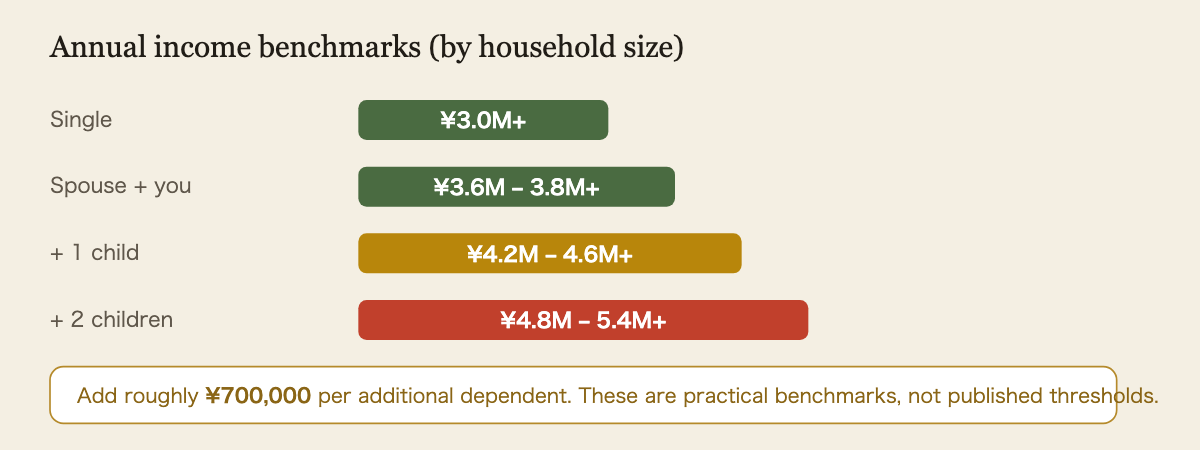
How much you can legally earn depends on your status. See How much can you earn on your visa?
February 2026 revision: your card must say 5 years
This is the part people get wrong. What changed is not “how many years you have lived here.” It is “the length of the period of stay printed on your residence card.”
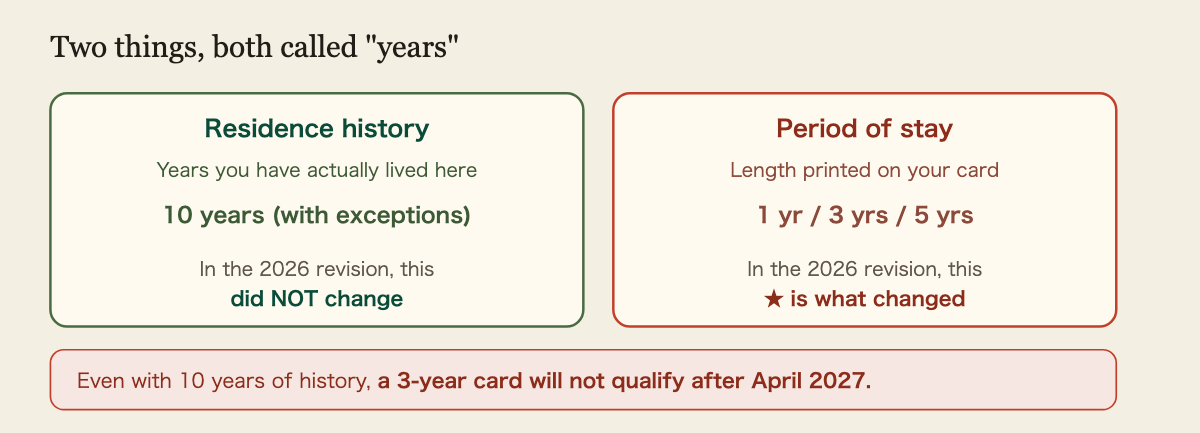
Until now, a 3-year period of stay was treated as if it were the “longest” one, as a special allowance. That allowance ends on March 31, 2027. From April 1, 2027, you generally need a 5-year period of stay (statuses based on family relationships are excluded).
There is a transitional rule. If you hold a 3-year period of stay on March 31, 2027, you can still be approved under the old treatment – but only for a first application made within that period of stay.
The risk to watch: if your renewal after April 2027 gives you 3 years again, you cannot apply for permanent residence until a later renewal gives you 5. Every renewal or status change should be treated as an attempt to reach 5 years.
April 2027: permanent residence can now be revoked
The 2024 amendment to the Immigration Control Act created a system for revoking permanent residence. It takes effect on April 1, 2027, and it applies to people who already hold permanent residence.
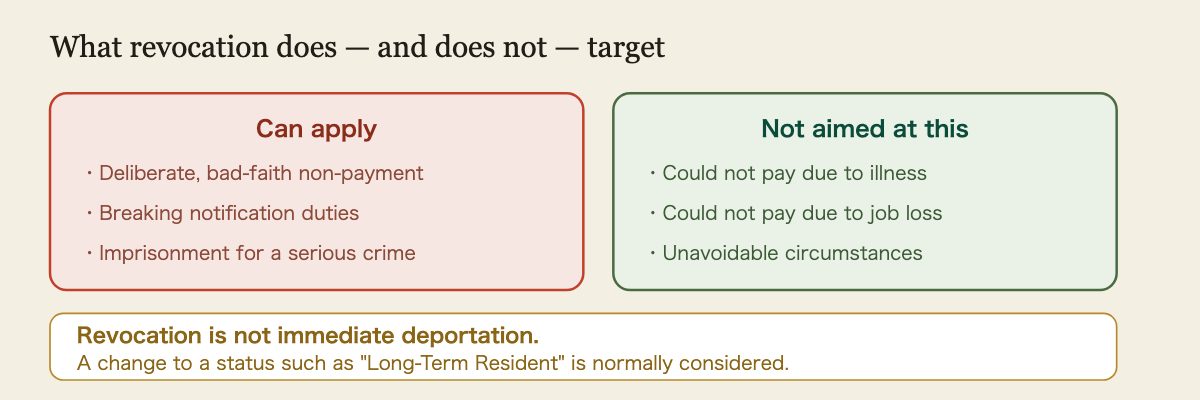
There are three grounds:
- Deliberately failing to pay taxes or social insurance premiums
- Violating notification duties under the Immigration Act (for example, not reporting a change of address)
- Being sentenced to imprisonment for a serious crime
Be precise here: it requires intent and bad faith
A lot of alarming coverage skips the condition attached to this. Revocation requires that the non-payment be deliberate and in bad faith.
Being unable to pay because of illness or unemployment is not what this system is aimed at. The fact that you had no money, on its own, does not get your status revoked.
And revocation does not mean immediate deportation. Taking into account your circumstances in Japan and your family situation, a change to a status such as “Long-Term Resident” is normally considered. Revocation and the change of status are two separate decisions.
There is only one thing you can do today
Keep paying. That is the whole preparation.
The screening periods are fixed:
- Resident tax and proof of income: the most recent 5 years
- Pension and health insurance: the most recent 2 years
Think about what those numbers mean. By the time you decide to apply, the last five years are already written. You cannot go back and fix them.
The thing most people miss is late payments. Even if you paid in the end, the delay stays in the record. For National Health Insurance and National Pension, set up automatic bank transfer and stop thinking about it. See National Health Insurance explained and Part-time work and taxes.
And from April 2027, this continues after you get permanent residence. That is the real change: it is no longer something you get and then forget about.
August 2026: the draft revision is out – B1 Japanese, pension, income
The three items this page used to describe as “under consideration” were published as a concrete draft revision on 4 August 2026. Public comment runs until 4 September, so nothing is final yet. But the contents are now known, and they differ from what the news reported.
Two different start dates
The revision applies from April 2027 – except that the income-related elements take effect in October 2026. That part is weeks away, not years.
Japanese ability: CEFR B1, not JLPT N2
The news reported “N2 level”. What the draft actually specifies is CEFR B1 on the Japanese language reference framework – the “independent user” level.
Alongside it, applicants with a poor understanding of Japanese systems and rules are assessed negatively.
Income: above the average Japanese household
Until now no fixed threshold had been published. The draft says income must “continuously reach a level exceeding the average income of a Japanese household of the same size”. That is a raise, not a clarification.
And a genuinely new requirement appears. Your projected future pension must reach the level of someone who paid into the employees’ pension for 30 years at that income. Where it falls short, financial assets that could make up the difference are also considered.
The rest
- Children’s schooling – not enrolling a school-age child in compulsory education is assessed negatively
- The spouse exception gets longer – spouses of Japanese nationals and permanent residents currently qualify after 3 years of marriage and 1 year of residence. The draft raises these to 5 years and 3 years
- For the first time the draft states plainly that permanent residence is “the most stable legal status, in which a person is expected to spend their entire life in Japan”, and therefore requires particularly careful screening
One more draft is moving separately. A five-year period of stay is to be added for Specified Skilled Worker (ii), expected to be promulgated in early 2027, explicitly so that the “longest period of stay” requirement for permanent residence lines up with other work statuses.
The revocation criteria were drafted too
Guidelines for how the April 2027 revocation system will be operated were published the same day. What matters to you is less what gets your status revoked than what does not.
The draft states that non-payment “does not fall under this provision where there are unavoidable circumstances and the person is not culpable”. Two examples are given explicitly.
Explicitly listed as NOT grounds for revocation
- Illness, disaster or unemployment – unavoidable circumstances
- Responding to demands, showing willingness to pay, and being granted instalments or a deferral
That is the most useful line on this page. Being unable to pay is not itself grounds for revocation. What counts against you is where it is “clear there is no intention to pay in future”, or where the amount and duration of arrears are socially unacceptable.
So the answer is the same whether it is health insurance you cannot pay or the National Pension. Do not ignore it – go to the counter and arrange instalments or a deferral. Having that on record is what protects your status.
There is also a route short of revocation. Where revocation is not warranted, the status can be changed ex officio to “Long-Term Resident” and reviewed at subsequent renewals. And reporting by national or local government is not mandatory.
What has NOT been decided (don’t confuse this with the news)
Everything above is a draft. Public comment closes on 4 September 2026 and the final text follows after that. Figures and conditions can still change.
If you see something stating flatly that “N2 will be required”, check the source. The draft specifies CEFR B1, which is not N2.
The only settled changes remain the two covered earlier on this page: the five-year period of stay, and the revocation system.
FAQ
Q. I’ve lived here 10 years. Can I apply now?
A. Years alone are not enough. You also need 5+ years on a work-based or residence-based status, sufficient income, a clean payment record for taxes and social insurance, and a guarantor. And from April 2027, a 5-year period of stay on your card.
Q. My card says 3 years. What should I do?
A. If you apply by March 31, 2027, the old treatment still applies (first application within that period of stay). If you cannot make that, aim to get 5 years at your next renewal.
Q. I was once late paying my taxes. Will my permanent residence be revoked?
A. Revocation requires deliberate, bad-faith non-payment. Falling behind because of illness or job loss is not what the system targets. But it does stay in the record, so pay on time from now on. If you are worried, consult an immigration lawyer (行政書士 / gyōsei shoshi).
Q. If my permanent residence is revoked, do I have to leave Japan?
A. Not immediately. Based on your circumstances and family situation, a change to a status such as “Long-Term Resident” is normally considered. Revocation and the change are separate decisions.
Q. What is the difference between permanent residence and naturalization?
A. Permanent residence is a residence status. Naturalization is taking Japanese citizenship. With permanent residence you keep your original nationality and you cannot vote. Naturalization normally means losing your original citizenship.
Q. Should I take the JLPT for permanent residence?
A. It is not a requirement right now. It is under discussion but not confirmed. That said, Japanese ability widens your job options, which makes the income requirement easier to meet. Learn kanji with elementary school drills covers a way to study that costs almost nothing.
Official source: Immigration Services Agency: Guidelines on Permission for Permanent Residence
In short
The baseline is 10 years – but the exceptions for spouses and Highly Skilled Professionals are large, so check which one applies to you first.
Two things change on April 1, 2027. Your card will generally need a 5-year period of stay, and permanent residence becomes revocable. Do not mix up “how long you have lived here” with “the number printed on your card” – only the second one changed.
Revocation is limited to deliberate, bad-faith cases, and it does not mean immediate deportation. This is not something to panic about.
But screening looks at 5 years of tax records and 2 years of pension and health insurance. By the time you decide to apply, your past is already fixed. The only preparation available today is paying on time.
Related guides
Found this useful? Share it
Send it to a friend who lives in Japan.
WHO WROTE THIS

mori
Japanese. I read the ministries’ own notices, orders and Q&As in the original, and I start from what my Nepalese and Sri Lankan friends in Japan actually ran into. I do not write about what I have not checked or been told.
What this site can and cannot do →Looking for something else?