Checked on 17 October 2026 against the Japan Pension Service pages on claiming a pension while living abroad, receiving it in a foreign bank, the yearly status report, time limits and social security agreements, the National Tax Agency’s Tax Answer No. 2884, and the National Pension Act (e-Gov).
The short answer
- You can receive your Japanese pension after you leave Japan. You need a qualifying period of 10 years or more, and payment normally starts at 65.
- If you live abroad, no claim form is mailed to you. From the day before your 65th birthday, you download it and claim yourself.
- The money can go to a bank in your country or a bank in Japan. For a foreign bank, you file a registration form with the SWIFT (BIC) code.
- Once payments start, you send a status report every year by the end of your birth month. Miss it and payments stop.
- Japanese income tax is waived if your country has a tax treaty with a pension clause and you file a form. Otherwise 20.42% is withheld (from 65, only on the part above 95,000 yen a month).
Knowing this, you can write down the two things you will need before you fly, and know exactly what to send when you turn 65, so the years you paid are not lost. If you are torn between the lump-sum refund and the pension, you will also see which side of the line you are on.
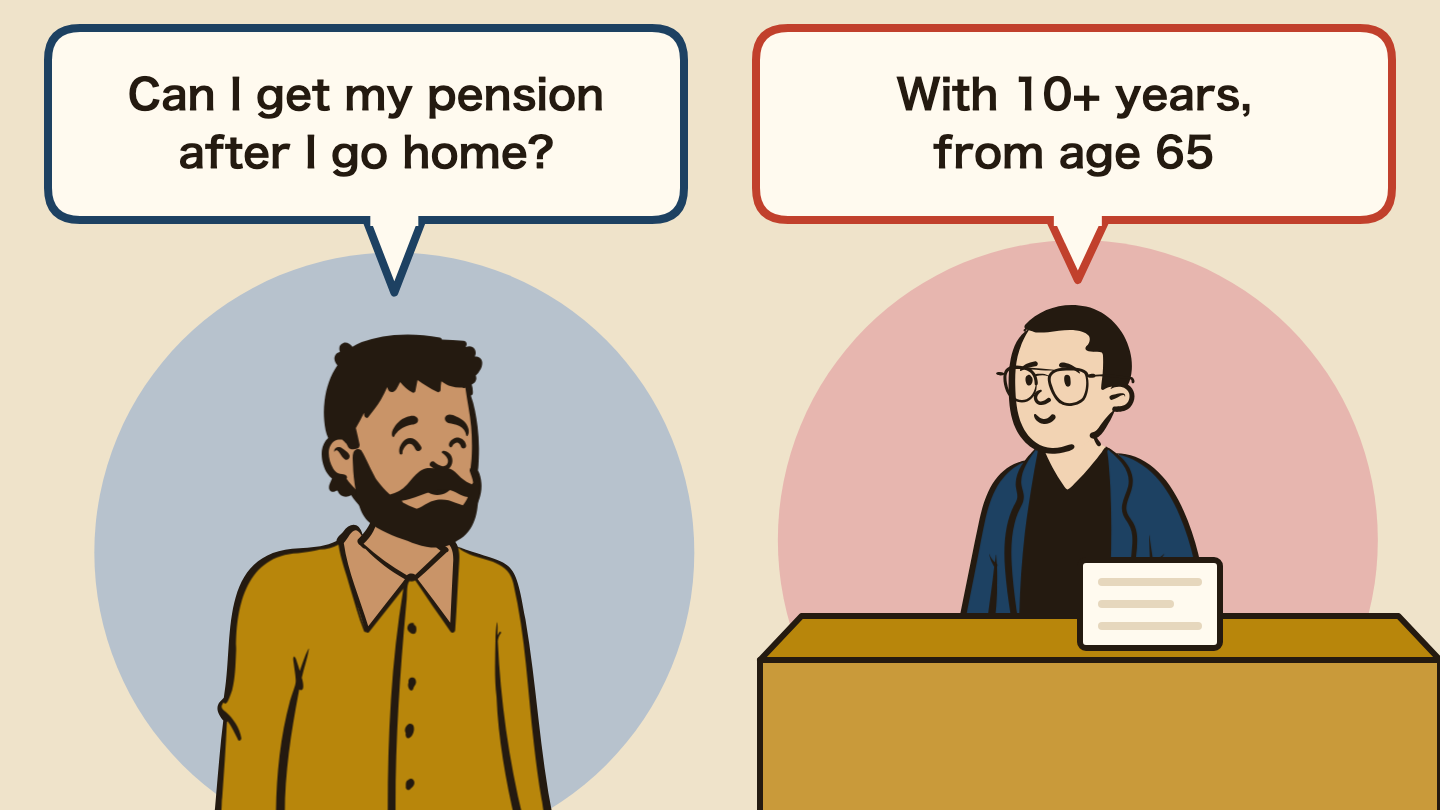
You have worked in Japan for eleven years, and next month you go home. You look up the lump-sum withdrawal payment and read that people with 10 years or more do not qualify. So what happens to your eleven years? A Japanese colleague says, “Won’t they just send you the forms when you turn 65?” If you live in Japan, they will. If you live abroad, they won’t.
- Can you get your Japanese pension after leaving Japan? Yes, with 10 years
- What should you do before leaving Japan? A moving-out notice and two things to write down
- How do you claim your Japanese pension from abroad? At 65, you send the form yourself
- Does your country have a social security agreement? Then you can claim through its office
- How is the pension paid into a foreign bank account? A registration form with the SWIFT code
- Do you need the yearly status report when living abroad? Yes, by the end of your birth month
- Is a Japanese pension paid abroad taxed? With a treaty and a form, Japanese tax is zero
- What if you forget to claim or claim late? The 5-year time limit
- Under 10 years? How the lump-sum refund differs
- How much will you get? Ten years of basic pension is about 211,800 yen a year
- Which one are you?
- Frequently asked questions
- Summary
- Related reading
Can you get your Japanese pension after leaving Japan? Yes, with 10 years
Yes. Japan’s old-age pension is paid, in principle from 65, to anyone with a qualifying period of 10 years or more (Japan Pension Service, Old-age Basic Pension). Where you live is not one of the conditions. The National Pension Act says the same: the pension is paid on reaching 65 if the periods add up to 10 years (National Pension Act, art. 26).
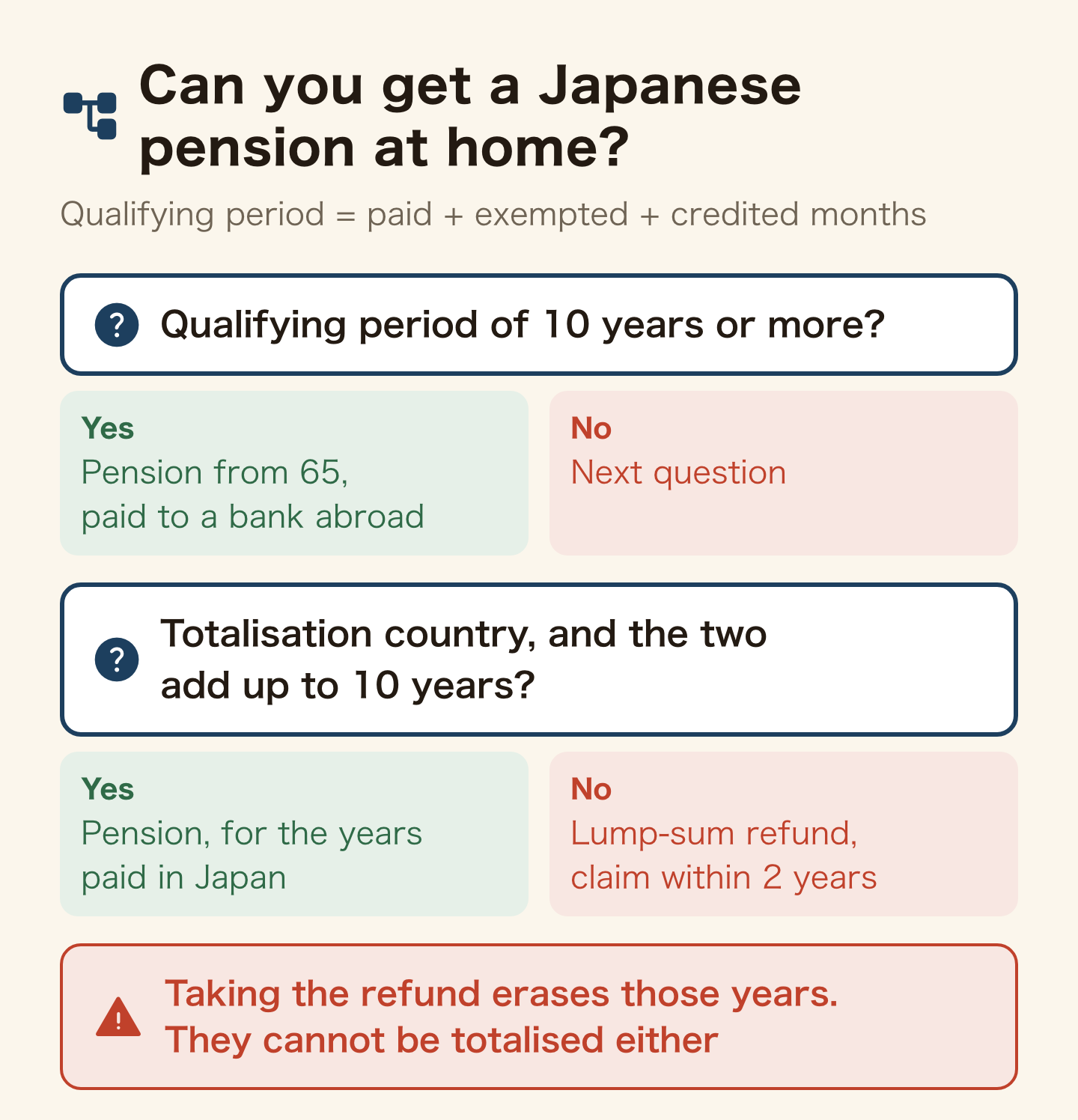
The qualifying period is the months you paid, the months you were exempted, and certain credited periods, added together. National Pension and Employees’ Pension months count together, so your years in a company scheme are in there.
How the 10 years are counted
- Counted: months you paid, months with an exemption or a payment postponement, and credited periods. Unpaid months are not counted. How exempted months work is in our guide to the National Pension exemption.
- Credited periods count towards the 10 years but add nothing to the amount. For example, if you received permanent residence, the time you lived abroad before that permission (between 20 and 60) is a credited period (Japan Pension Service, credited periods, in Japanese).
- If your country has a social security agreement with totalisation, years in its pension system can be added to reach 10. You are paid for the years in Japan. The agreements with the UK, Korea, China and Italy have no totalisation (Japan Pension Service, special rules under the agreements, in Japanese).
You may plan to keep paying in after you leave, to reach ten years. Where you come from, that may be normal. In Japan, voluntary National Pension membership for people living abroad is open only to Japanese nationals (Japan Pension Service, voluntary enrolment, in Japanese). If you leave at nine years, you cannot top up the last year from abroad. If you are close to ten, count your months before you set a leaving date.
What should you do before leaving Japan? A moving-out notice and two things to write down
There is little pension paperwork before you fly. What matters is keeping the information you will need at 65 while you are still here.
- File a moving-out notice at your city office. If you are in the National Pension, you lose membership when you go to live abroad, and you handle that at the same office (Japan Pension Service leaflet for people leaving or entering Japan, PDF in Japanese).
- Write down your basic pension number. A photo of your pension handbook or basic pension number notice is enough.
- Write down your last address in Japan. A claim from abroad goes to the pension office in charge of that address.
- Register for Nenkin Net to see your record from abroad. You can register after you leave, but the user ID is posted to your overseas address (Japan Pension Service, pension statements for people abroad, in Japanese).
If you are already receiving a pension in Japan and are moving abroad, there is a separate step. File the “Notification of Registration (Change) of Address/Pension-receiving Financial Institution of Pension Recipient Residing Outside Japan” by the end of the second month before a payment month (Japan Pension Service, when a pensioner moves abroad, in Japanese). The order of everything else, from resident tax to your residence card, is in our leaving-Japan checklist.
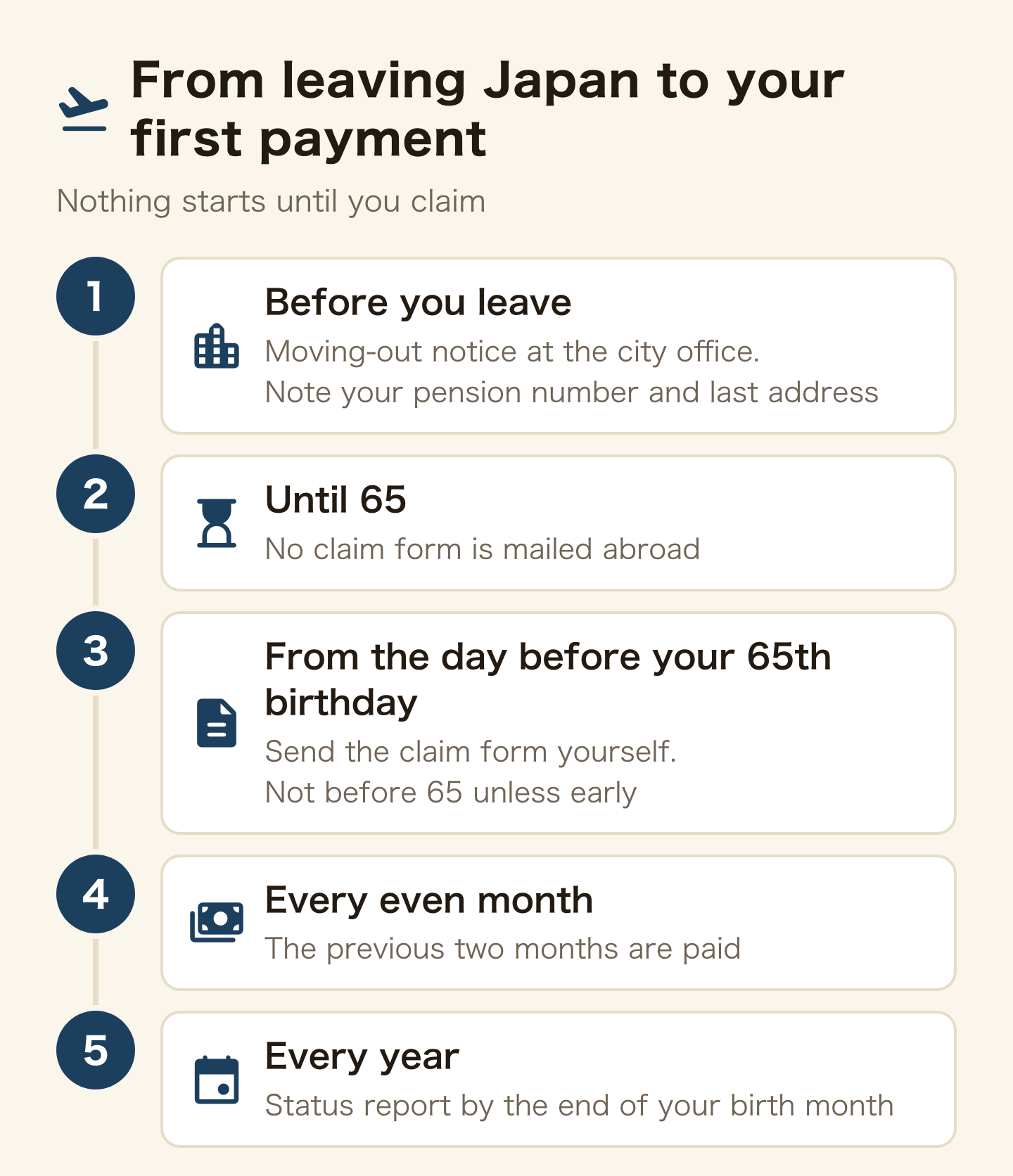
How do you claim your Japanese pension from abroad? At 65, you send the form yourself
You might expect the money simply to start arriving at 65. Where you come from, that may be normal. In Japan, the right to the pension arises at 65, but nothing is paid until you send a claim (Japan Pension Service, claiming while living abroad, in Japanese).
People living in Japan receive a pre-printed claim form three months before they turn 65. People living abroad are not sent one. The Japan Pension Service says overseas residents should download the form themselves (Japan Pension Service FAQ, in Japanese).
What to send
- The “Application for Pension: Old-age Benefits under National Pension / Employees’ Pension Insurance” (Form 101), downloadable from the Japan Pension Service claim form page (in Japanese).
- The Notification of Registration (Change) of Address/Pension-receiving Financial Institution. Everyone living abroad must attach it.
- If you are 65 or over, the form confirming how you will take the pension (whether you want to defer it).
- Documents that depend on your situation. Family or resident records must be issued on or after the date your right arose and within six months of sending the claim (Japan Pension Service, claiming at 65, in Japanese). What a non-Japanese claimant attaches varies, so ask the pension office before you send.
When and where
- When: from the day you reach pensionable age (the day before your birthday). Unless you choose early payment, a claim sent before 65 is not accepted.
- Where: by post to the pension office in charge of your last address in Japan, or to the Japan Pension Service Headquarters, 3-5-24 Takaido-Nishi, Suginami-ku, Tokyo 168-8505 (Japan Pension Service, Old-age Basic Pension).
- Earlier or later: you can start between 60 and 65 at a reduced amount, or between 66 and 75 at an increased amount (Japan Pension Service, old-age basic pension, in Japanese).
If you are unsure about your record, you can phone from abroad. The Nenkin Dial number from outside Japan is +81-3-6700-1165 (international call charges). Give your name, date of birth, basic pension number, and your address or last employer before you left, and they will tell you your record.
Does your country have a social security agreement? Then you can claim through its office
If your country has a social security agreement with Japan, you can hand your Japanese pension claim to your own country’s pension agency. It forwards the claim to the Japan Pension Service, which decides and pays (Japan Pension Service, claiming a Japanese pension under the agreements, in Japanese).
- This does not apply to the agreements with the UK, Korea and China. If you live there, send your claim to the Japanese pension office directly.
- The form for an old-age pension is the “Application for Determination: National Pension / Employees’ Pension Insurance (benefits payable on old age or disability)”.
- If you used your home years to reach 10, a claim filed in Japan needs a statement of those insured periods and supporting evidence.
Living in a country without an agreement does not stop you being paid. You simply post the claim to the pension office in Japan. The list of agreement countries, and how they stop you paying twice, is in our guide to the Japanese pension for foreigners.
How is the pension paid into a foreign bank account? A registration form with the SWIFT code
You can be paid into a bank in the country where you live or into a bank in Japan (Japan Pension Service, Report Changes).
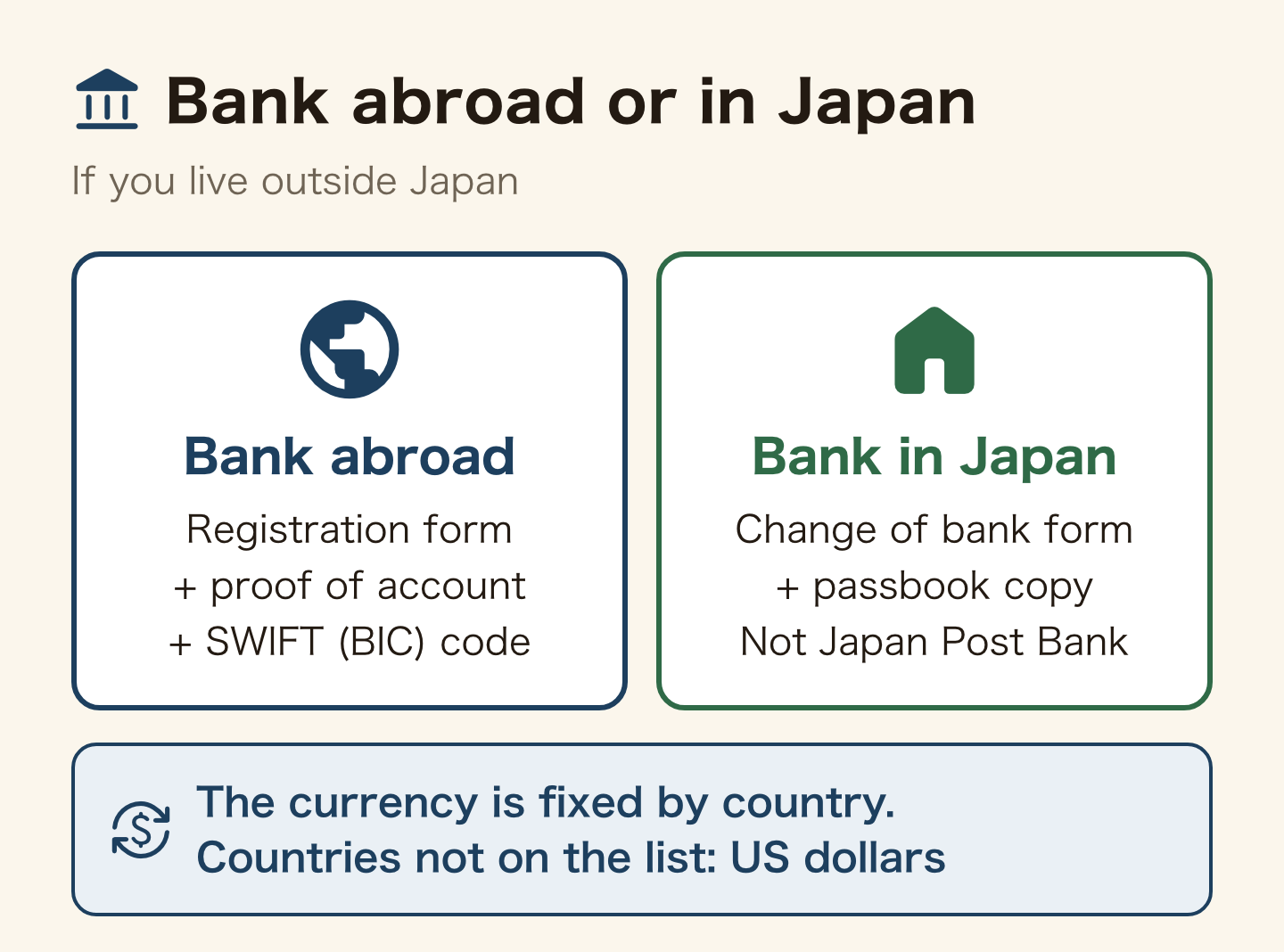
A bank abroad
- File the Notification of Registration (Change) of Address/Pension-receiving Financial Institution.
- Fill in the bank’s SWIFT (BIC) code, the city of the bank, and the state or province and city of your own address. In principle, choose a bank that has a SWIFT (BIC) code.
- Europe and other IBAN countries also need the IBAN, the US an ABA routing number, Australia a BSB number and Brazil an AGENCIA number (Japan Pension Service, in Japanese). For other countries, ask your bank what it needs for a transfer from Japan.
- Attach a bank certificate, or a copy of a cheque book or passbook.
A bank in Japan
- File the Report of Bank Change with a copy of your passbook.
- While you live outside Japan, Japan Post Bank (Yucho Ginko) cannot be used.
The currency is set by country, and you cannot choose it. The euro area is paid in euros, the UK in pounds, Australia in Australian dollars and so on, and any country not on the list is paid in US dollars (Japan Pension Service, currencies by country, PDF). Nepal, Vietnam and the Philippines are not on the list, so payments there arrive in US dollars. After a change of bank, the first payment can take three to four weeks.
Pensions are paid in the even months (February, April, June, August, October and December), each covering the months up to the one before (National Pension Act, art. 18(3)).
Do you need the yearly status report when living abroad? Yes, by the end of your birth month
Yes. If you receive a Japanese pension abroad, you send a status report once a year, due by the end of your birth month (Japan Pension Service, Annual Reporting in Your Birth Month).
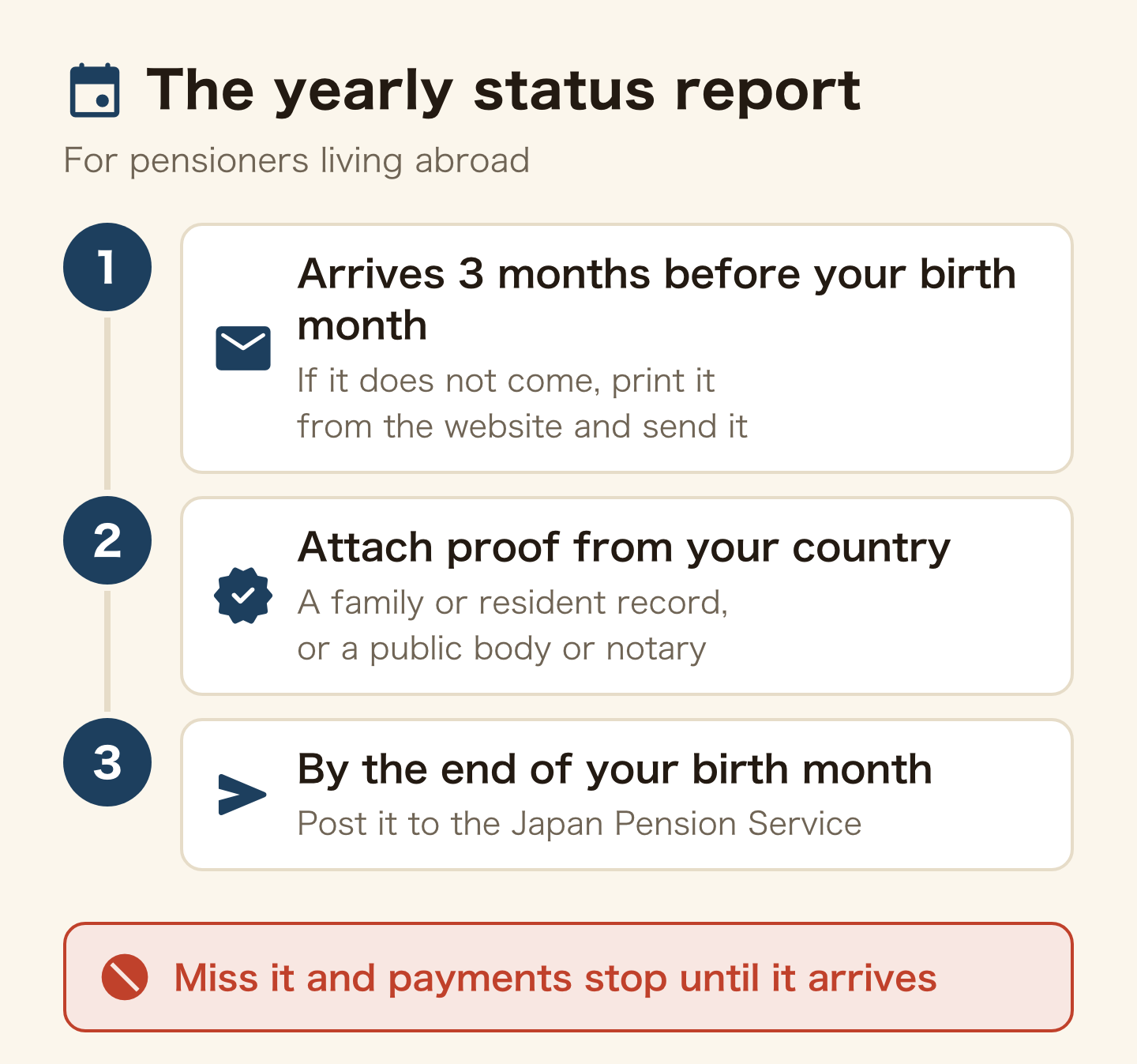
- The form is sent to you three months before your birth month.
- If you are not a Japanese national, attach your country’s equivalent of a family or resident record, or a certificate from a public body or a notary.
- If the form has not arrived by the middle of your birth month, do not wait. Print it from the Japan Pension Service website and send it with your proof (Japan Pension Service, in Japanese).
- Send it to: Japan Pension Service, Central Pension Center, Foreign Business Group, 3-5-24 Takaido-Nishi, Suginami-ku, Tokyo 168-8505, Japan.
If the report is not received by the deadline, your pension is suspended until it is. Payments resume once it arrives, so send it the day you notice.
Is a Japanese pension paid abroad taxed? With a treaty and a form, Japanese tax is zero
A Japanese public pension paid to someone who does not live in Japan has Japanese income tax withheld at 20.42%. It applies only to the amount left after deducting 95,000 yen (50,000 yen under 65) for each month the payment covers (National Tax Agency, Tax Answer No. 2884, in Japanese).
If your country has a tax treaty with Japan that covers pensions, you can have this tax waived by filing the “Application Form for Income Tax Convention” (Form 9) in two copies. If you live in the US, you also attach the Attachment Form for Limitation on Benefits Article (Form 17-US) and a certificate of residence (Form 6166) from the IRS (Japan Pension Service, in Japanese).
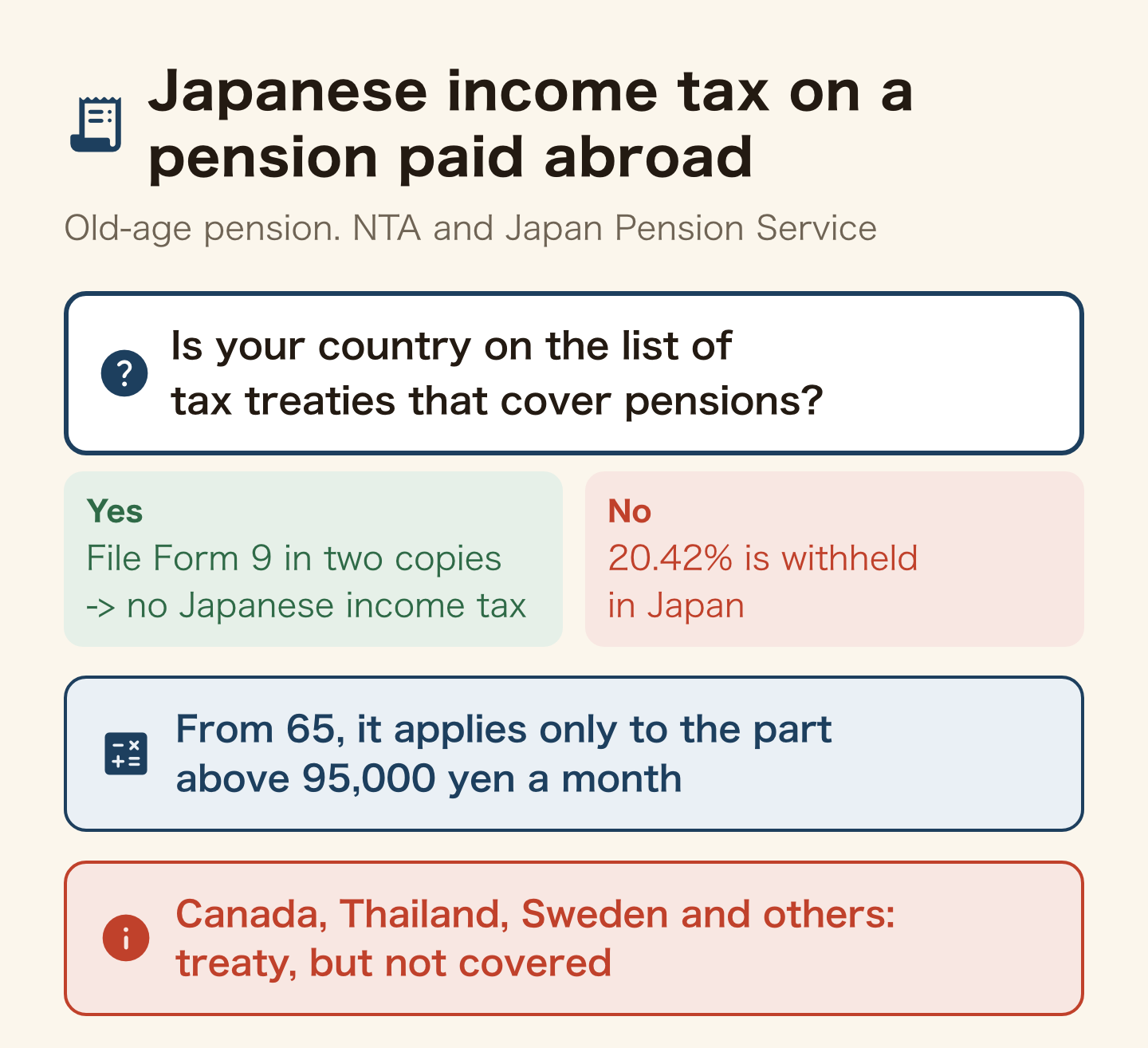
- The Japan Pension Service list (treaty countries as of January 2025, PDF) has 75 countries and territories. Vietnam, Sri Lanka, Bangladesh, Indonesia, the Philippines, India and China (excluding Macau) are on it. Nepal and Myanmar are not.
- Some places have a treaty that does not apply, for example because it has no pension clause: Canada, Thailand, Sweden, Macau, and Puerto Rico and Guam among US territories.
- Old-age pensioners abroad are sent a statement of the previous year’s payments and tax withheld at the end of every January, for your tax return where you live.
Even outside the treaty list, a small pension can mean zero Japanese tax. Ten years of basic pension alone is about 211,800 yen a year (847,300 yen full amount × 120 months ÷ 480 months). Two months is about 35,300 yen, and the deduction for two months is 190,000 yen (95,000 yen × 2), so nothing is left to tax. If you also have an employees’ pension, work it out with your own total. How your own country taxes the pension differs from country to country, so check with its tax office.
What if you forget to claim or claim late? The 5-year time limit
If you do not claim at 65, unpaid months pile up. Pension rights in Japan have a 5-year time limit (Japan Pension Service, time limits, in Japanese; National Pension Act, art. 102).
- The right to the pension itself expires 5 years after it arises. If unavoidable circumstances kept you from claiming, a written statement of the reason can stop it from expiring.
- Each payment expires 5 years from the first day of the month after its payment date. Payments older than that are lost, except in cases such as a corrected record or an error by the Japan Pension Service.
- If you claim after turning 65, you state on the attached confirmation form whether you want to defer and increase your pension (Japan Pension Service, in Japanese).
A late claim is still worth sending. Download the form the day you realise.
Under 10 years? How the lump-sum refund differs
Non-Japanese nationals who leave before reaching 10 years can claim the lump-sum withdrawal payment instead. You need 6 months or more of coverage, you claim within 2 years of no longer having an address in Japan, and the calculation is capped at 60 months (5 years) (Japan Pension Service, in Japanese). With 10 years you cannot claim it.
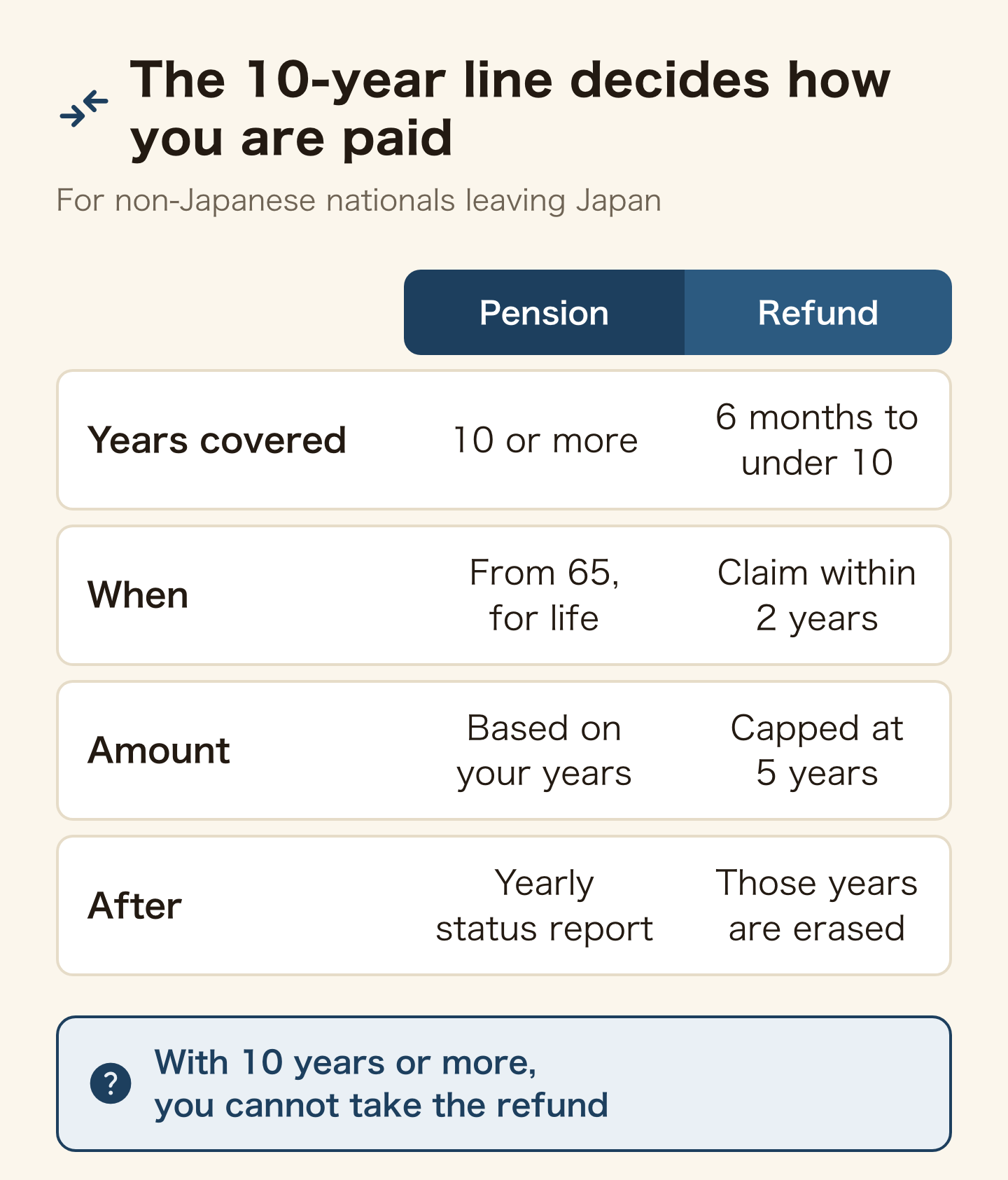
Taking the refund erases those years from your record, and they can no longer be totalised under an agreement (Japan Pension Service, in Japanese). If your country has totalisation, check whether your years add up to 10 before you take it. How much comes back and how to claim are in our lump-sum withdrawal guide, and how to reclaim the 20.42% tax on it is in our tax representative guide.
How much will you get? Ten years of basic pension is about 211,800 yen a year
The full old-age basic pension for 40 years of contributions is 847,300 yen a year in FY2026 (Japan Pension Service, Old-age Basic Pension). Ten years (120 months) is a quarter of that: about 211,800 yen a year, or about 17,650 yen a month. If you were in a company scheme, an old-age employees’ pension based on your pay and years is added on top.
Check your own figure on Nenkin Net or by phoning the Nenkin Dial. If you are weighing this against staying in Japan after you stop working, our guide to retiring in Japan explains which statuses let you stay and how the 10-year line fits in.
Transfer fees on a foreign bank account, and the cost of getting certificates in your own country, are not stated in the Japan Pension Service guidance. Ask your bank and the office that issues the certificate.
Which one are you?
- Still in Japan, past (or about to pass) 10 years. Your pension stays with you when you leave. Today: photograph your basic pension number and note your current address.
- Just over nine years and thinking of leaving. You cannot pay in from abroad to reach ten. Today: count your months on Nenkin Net or at a pension office.
- Already home, not yet 65. You claim from the day before your 65th birthday. Today: apply for a Nenkin Net user ID and put your 65th birthday in your calendar.
- 65 or older. No form will come. Today: download Form 101 and the registration form, and get them ready for the pension office for your last address.
- Already receiving a pension abroad. Check the yearly report and the tax form. Today: put the date three months before your birth month, and its last day, in your calendar, and check whether your country is on the treaty list.
- Leaving before 10 years. This is the lump-sum refund, not a pension. Today: write down the date you leave. The deadline is 2 years from then.
Frequently asked questions
Can I still get my Japanese pension after I leave Japan?
Yes, with a qualifying period of 10 years or more. Payment normally starts at 65 and can go to a bank account abroad. Where you live is not a condition.
Will the Japan Pension Service send me a claim form abroad?
No. People in Japan get one three months before 65, but people abroad do not. Download Form 101 from the Japan Pension Service website and send it yourself.
Where do I send my claim from abroad?
By post to the pension office in charge of your last address in Japan, or to the Japan Pension Service Headquarters. In agreement countries other than the UK, Korea and China, you can also hand it to your country’s pension agency.
Can I receive my Japanese pension in my home bank account?
Yes. File the registration form with your bank’s SWIFT (BIC) code and proof of the account. The currency is set by country, and countries not on the list are paid in US dollars.
Is my Japanese pension taxed if I live abroad?
Japan withholds 20.42%, and from 65 only on the part above 95,000 yen a month. If your country has a tax treaty that covers pensions, filing Form 9 in two copies waives it.
What happens if I miss the yearly status report?
Your pension is suspended until the report arrives, and resumes once it does. If the form never comes, print it from the website and send it with your proof of residence.
Summary
With 10 years, your Japanese pension follows you home. But no claim form is sent abroad, and nothing starts until you act. From the day before your 65th birthday, send Form 101 and the registration form to the pension office for your last address in Japan, or to Headquarters. In most agreement countries you can also claim through your own pension agency.
Once it is paid, send the status report every year by the end of your birth month. If your country has a treaty that covers pensions, a form waives Japanese income tax. Under 10 years, the lump-sum refund is the route, but it erases those years. Before you fly, keep your basic pension number and your last address.
Official sources: Japan Pension Service, Old-age Basic Pension / Annual Reporting in Your Birth Month / Report Changes / Claiming while living abroad (Japanese) / FAQ on claim forms abroad (Japanese) / Claim forms (Japanese) / When a pensioner moves abroad (Japanese) / Currencies by country (PDF) / Tax treaty countries (PDF) / Time limits (Japanese) / Claiming under agreements (Japanese) / Lump-sum withdrawal payment (Japanese) / National Tax Agency, Tax Answer No. 2884 (Japanese) / National Pension Act, arts. 18, 26, 102 (e-Gov). All checked on 17 October 2026.
Related reading
Found this useful? Share it
Send it to a friend who lives in Japan.
READ THIS NEXT
Leaving Japan for Good →Leaving Japan permanently? The moving-out notice unlocks your pension refund and stops your bills.WHO WROTE THIS

mori
Japanese. I read the ministries’ own notices, orders and Q&As in the original, and I start from what my Nepalese and Sri Lankan friends in Japan actually ran into. I do not write about what I have not checked or been told.
What this site can and cannot do →Looking for something else?
You may use the figures in this article, including commercially, if you credit this site with a link. How to use our figures