This article was checked on 16 October 2026 against the Immigration Services Agency, the Ministry of Justice notice on Designated Activities, e-Gov law search, the Japan Pension Service and the Statistics Bureau.
You have worked in Japan for twelve years. Your work visa is tied to your job. One evening a colleague asks, “So when you retire, do you go home?” You realise you do not know whether you are allowed to stay.
The short answer
- Japan has no retirement visa. To retire here, you need a status that does not depend on a job.
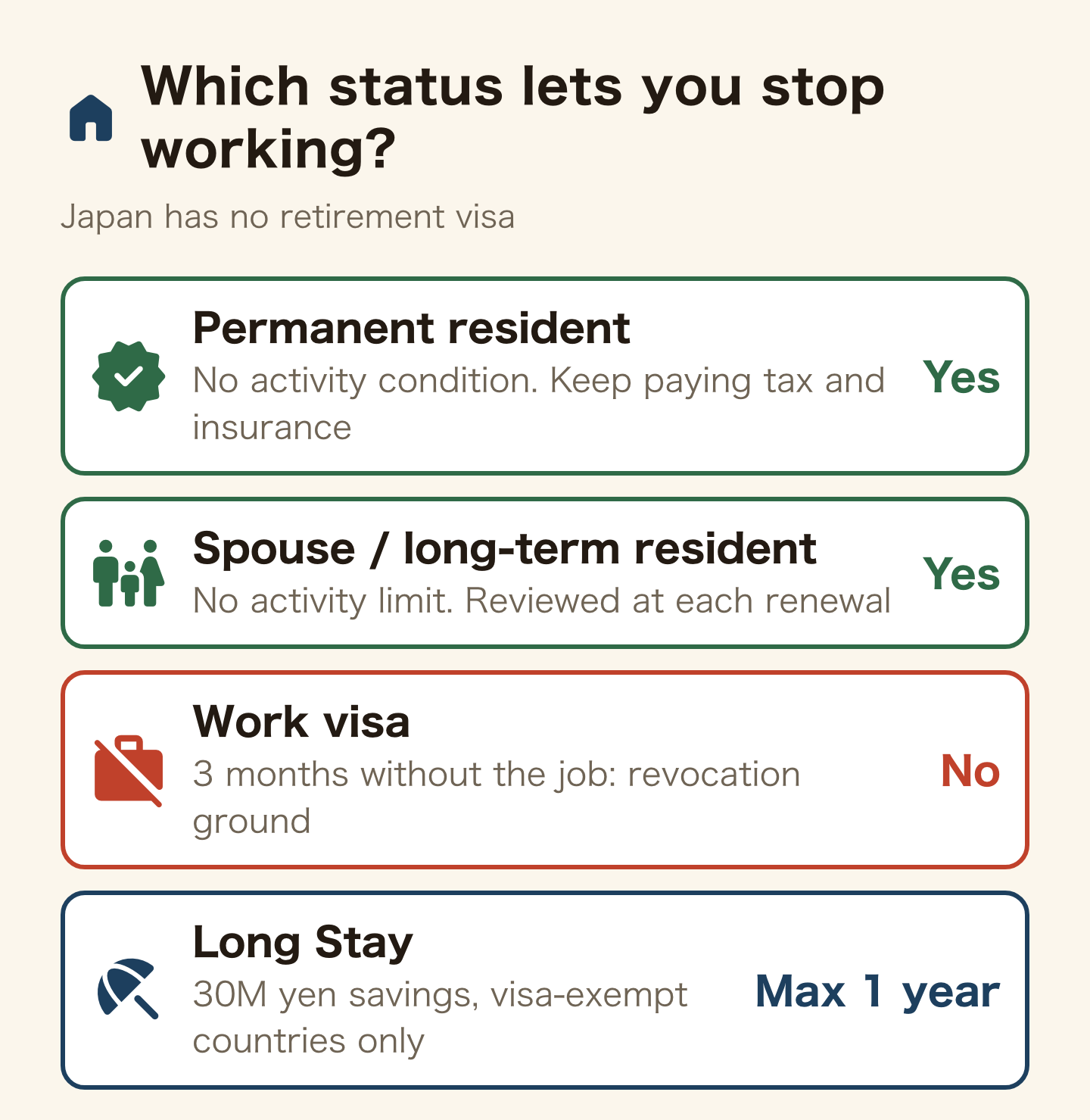
- For people already living here, the realistic route is permanent residence. A spouse or long-term resident status also has no work condition.
- The “Long Stay” status is for visitors with at least 30,000,000 yen in savings, from about 70 visa-exempt countries, for up to one year. Nepal, Sri Lanka, Vietnam, China, the Philippines and India are not on the list.
- A work visa does not continue after you stop working. Three months without the activity is a ground for revocation.
- Your Japanese pension needs 10 years of contributions. Under 10 years you can take a lump-sum refund instead; at 10 years or more you cannot.
Once this is clear, you can decide in your 40s or 50s which status to aim for and whether to keep paying into the Japanese pension, instead of finding out at 65.
- Is there a retirement visa in Japan?
- The Long Stay status: ¥30 million and a visa-free passport
- Can I stay on my work visa after I stop working?
- Permanent residence: the real retirement route
- Spouse or long-term resident: no work condition either
- Your Japanese pension: why 10 years decides everything
- How much does retirement in Japan cost?
- Which one are you?
- FAQ
- Summary
- Read next
Is there a retirement visa in Japan?
No. Every status of residence in Japan is tied either to an activity (work, study) or to a position (permanent resident, spouse, long-term resident). There is no status called “retiree”.
The closest thing is a Designated Activities status that lets a person stay for up to one year for sightseeing and recreation. English guides call it the “Long Stay visa”. It is not a way to live out your retirement in Japan, because it ends after a year.
You may see headlines about a “new retirement visa in 2026”. On 16 October 2026 we found no government document for it. If one is published, the Immigration Services Agency will list it on its status pages.
The Long Stay status: ¥30 million and a visa-free passport
The conditions are set in a Ministry of Justice notice, item 40. All of these must be met.
| Condition | What it means |
|---|---|
| Age | 18 or older |
| Nationality | A country or region that does not need a visa for short visits and is on the notice’s list (about 70, including the US, the UK, Australia, Korea, Thailand, Malaysia, Singapore, Indonesia, Brazil, Taiwan and Hong Kong) |
| Savings | 30,000,000 yen or more, you and your spouse combined. 60,000,000 yen if your spouse also applies for this status |
| Insurance | Private insurance covering death, injury and illness for the whole stay |
| Length | Up to one year. You cannot work |
Two points catch people out. First, the list of countries. Nepal, Sri Lanka, Vietnam, China, the Philippines and India are not on it, so citizens of those countries cannot use this status at all.
Second, health insurance. People on this status are excluded from National Health Insurance by regulation. That is why the application asks for private insurance. Every doctor’s bill would otherwise be paid in full.
The application needs your bank balance and six months of transactions. Source: Immigration Services Agency, Designated Activities (long-term stay for sightseeing and recreation) and the Ministry of Justice notice on Designated Activities (PDF, Japanese).
Can I stay on my work visa after I stop working?
No. A work visa such as Engineer/Specialist in Humanities/International Services exists for the job. When the job ends, the reason for the status ends too.
Two rules apply at that moment. You must notify the Immigration Services Agency within 14 days that your contract ended. And not doing the activity of your status for three months or more, without a legitimate reason, is a ground for revocation under the Immigration Control Act.
The notification is explained step by step in our guide to the 14-day notification. Retiring on a work visa is not an option. The question is which status you hold before you stop.
Permanent residence: the real retirement route
A permanent resident has no activity condition. You can stop working, and you can live on savings or a pension. This is why permanent residence is the route that matters for someone already working here.
The usual requirement is 10 years of continuous residence, including 5 years on a work or residence-based status, plus stable income and paid taxes, pension and health insurance. The full list, and what changes from April 2027, is in our permanent residency guide.
One warning for retirees. From 2027, permanent residence can be revoked for deliberately not paying taxes or social insurance. Living on a small pension, keep paying your resident tax and health insurance, or use the formal instalment and reduction routes. The rules are in our guide to permanent residency revocation.
Spouse or long-term resident: no work condition either
A spouse of a Japanese national or of a permanent resident, and a long-term resident, also have no limit on activities. You can stop working on these statuses too.
The difference from permanent residence is renewal. These statuses have a period, and at each renewal the immigration office looks at your situation again. Our long-term resident guide explains the renewal and what happens after a divorce.
Your Japanese pension: why 10 years decides everything
The old-age basic pension is paid from 65 to anyone with a qualifying period of 10 years or more. Before August 2017 the line was 25 years. Now it is 10.
How much does 10 years give you? The FY2026 full amount, for 40 years paid, is 847,300 yen a year. Ten years is a quarter of that: about 211,800 yen a year, or about 17,650 yen a month. Any company pension (employees’ pension) is paid on top.
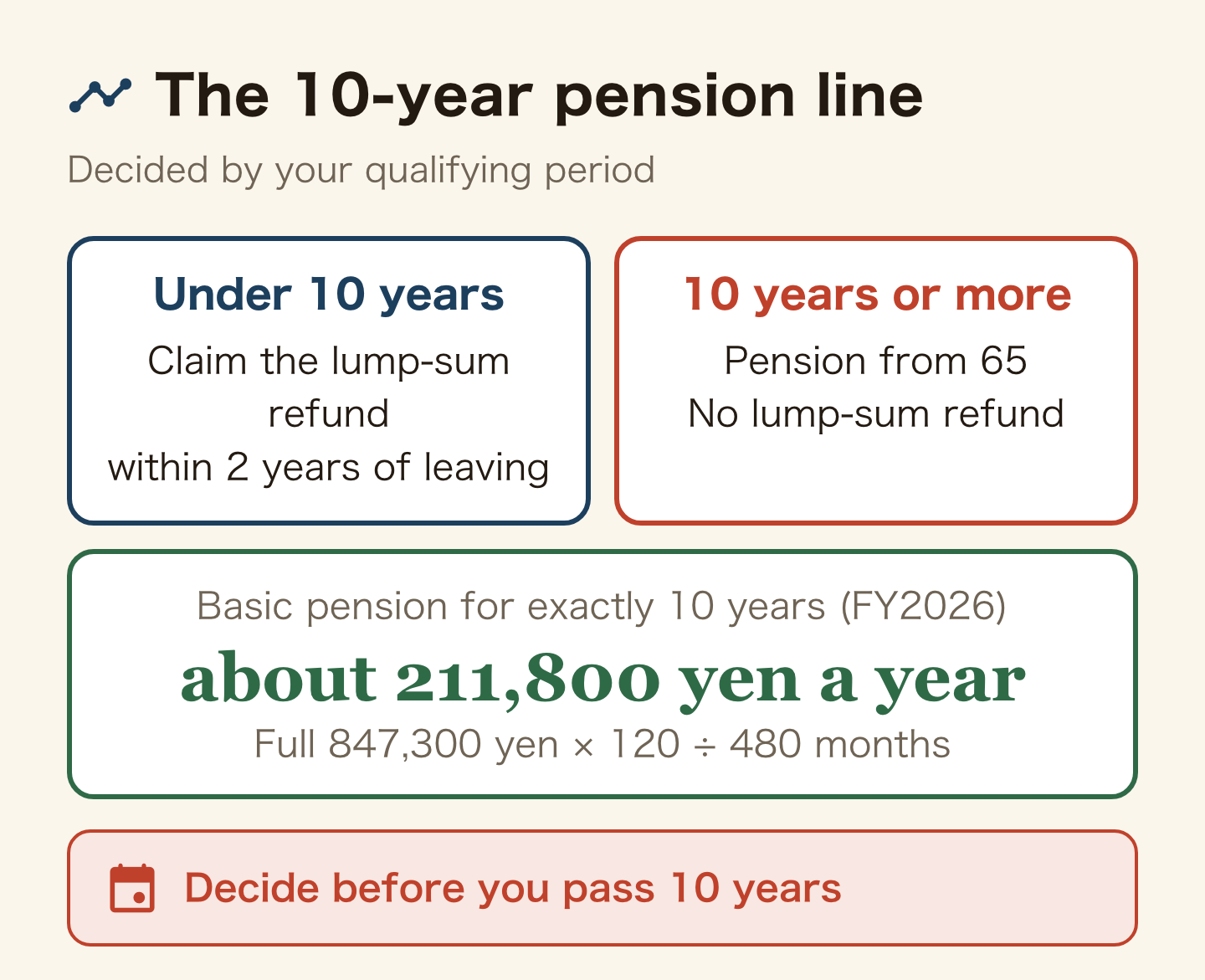
The 10-year line also decides whether you can take your money out. The lump-sum withdrawal payment is only for people who have not reached 10 years and who leave Japan. Once you pass 10 years, there is no refund. You wait for the pension instead. The conditions and the amount are in our lump-sum withdrawal guide.
Source: Japan Pension Service, old-age basic pension requirements and amount and who can claim the lump-sum withdrawal payment (Japanese).
How much does retirement in Japan cost?
The Statistics Bureau’s 2025 household survey gives a monthly figure for people aged 65 or older who no longer work.
| Household (65+, not working) | Spending a month | Income a month |
|---|---|---|
| One person | 148,445 yen | 131,456 yen |
| Couple | 263,979 yen | 254,395 yen |
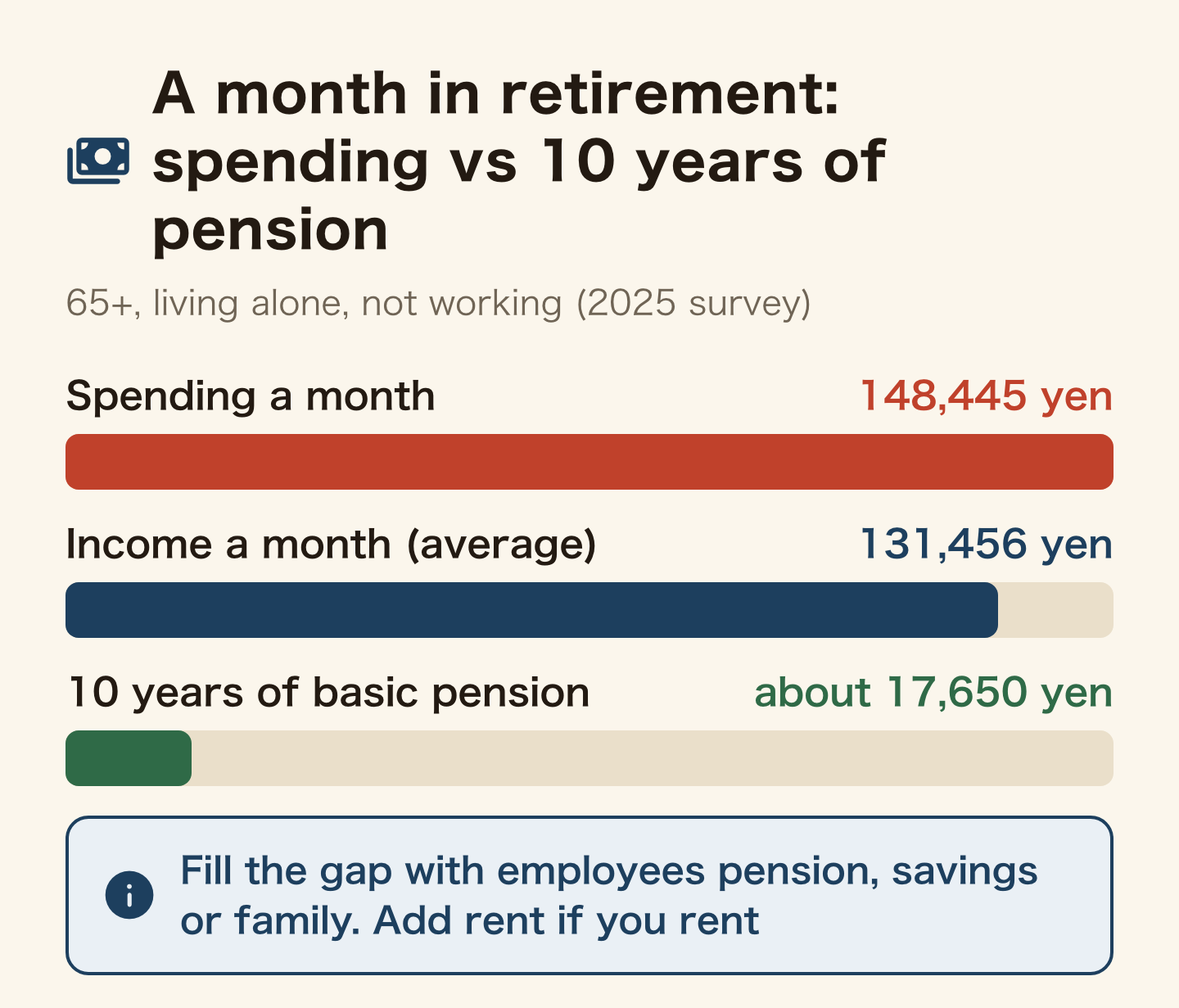
Compare the first line with 10 years of basic pension: about 17,650 yen a month against 148,445 yen of spending. The gap has to come from an employees’ pension, savings or family. Most of the people in this survey are Japanese and many own their homes. If you rent, add your rent.
Source: Statistics Bureau, Family Income and Expenditure Survey 2025, reference 4 (PDF, Japanese).
Which one are you?
- You work here and want to stay after retirement. Aim for permanent residence while you still have a job and income. Today, check how many years you have and what is missing.
- You have paid into the Japanese pension for under 10 years and plan to go home. You can claim the lump-sum refund within 2 years of leaving. Today, note the date you will leave.
- You are close to 10 years. Decide before you pass it. After 10 years the refund is gone and the pension is yours from 65. Today, check your record on the Nenkin Net or with your pension office.
- You live abroad with savings over 30,000,000 yen and a visa-free passport. The Long Stay status gives you up to one year, with private insurance. It is a long holiday, not a retirement.
FAQ
Q. Does Japan have a retirement visa?
No. The closest is the Designated Activities “Long Stay” status for up to one year, which needs 30,000,000 yen in savings and a passport from a visa-exempt country on the notice’s list.
Q. Can I retire in Japan on a work visa?
No. A work visa depends on the job. Not doing the activity for three months or more without a legitimate reason is a ground for revocation.
Q. Can a permanent resident retire in Japan?
Yes. Permanent residence has no activity condition. Keep paying taxes and social insurance, because deliberate non-payment can lead to revocation from 2027.
Q. How many years of pension do I need to get a Japanese pension?
10 years of qualifying period. With exactly 10 years paid, the basic pension is about 211,800 yen a year at the FY2026 rate.
Q. Can I join National Health Insurance on the Long Stay status?
No. Long Stay holders are excluded from National Health Insurance by regulation, so private insurance is required.
Summary
Japan has no retirement visa. If you already live here, the status that lets you stop working is permanent residence, or a spouse or long-term resident status. The Long Stay status is a one-year option for wealthy visitors from visa-exempt countries. Your Japanese pension starts at 10 years of contributions, and the same line ends your right to a lump-sum refund. Decide your route before you reach 10 years, not at 65.
Sources (official): Immigration Services Agency, Designated Activities (long-term stay for sightseeing and recreation) / Ministry of Justice notice on Designated Activities, items 40-41 and Appended Table 9 (PDF) / National Health Insurance Act Enforcement Regulation, Article 1 (e-Gov) / Japan Pension Service, old-age basic pension / Statistics Bureau, Family Income and Expenditure Survey 2025
Read next
Found this useful? Share it
Send it to a friend who lives in Japan.
WHO WROTE THIS

mori
Japanese. I read the ministries’ own notices, orders and Q&As in the original, and I start from what my Nepalese and Sri Lankan friends in Japan actually ran into. I do not write about what I have not checked or been told.
What this site can and cannot do →Looking for something else?
You may use the figures in this article, including commercially, if you credit this site with a link. How to use our figures