Checked on 9 October 2026 against the text of JASSO’s “Job Hunting Guide for International Students 2027”, the Ministry of Health, Labour and Welfare’s “Basics of fair hiring” and foreign-worker management guideline, a Tokyo Labour Bureau page, and a Careertasu company survey (December 2025).
The short answer
- The three standard ES questions are all built the same way: conclusion, specifics, then how it helps at work. They are motivation, self-promotion and what you put effort into as a student. Fill 90 to 100% of the character limit (JASSO).
- Two or more interviews is the norm, in three types. They are group discussion (4 to 6 people), group interview (2 to 6) and individual interview.
- Of the six expected questions the JASSO guide lists, the last three are why you came to Japan, how long you want to work here, and whether other companies are moving forward with you. They read as questions meant for international students. It gives no sample answers, so build yours from your own facts.
- Residence status is not among the 14 items employers are asked to be careful about. Before hiring, a company must confirm that the work is allowed under your status.
- The 14 items include registered domicile and birthplace, family, religion and political party. If you are asked, note it and tell your school or Hello Work. Official sources do not say how answering on the spot affects the result.
Knowing this, you can prepare your ES and interview answers within the lines set by official sources, and know what is normal to be asked. You can also decide when to stop preparing.
The ES is due next week. Your motivation section is written. Then a friend says you will be asked to show your residence card and questioned about your country, and you no longer know what is normal. In Japanese job hunting, both the order of an answer and the line between what may and may not be asked are fairly fixed.
An ES (entry sheet) is a form companies use to learn about applicants, usually a mix of basic details and short essays. The JASSO “Job Hunting Guide for International Students 2027” says the format and content differ by company. Honorifics and emails are in the job hunting honorifics article, and the fields of the resume are in the rirekisho article. This article covers only the content.
- What do you write in an ES? Conclusion, specifics, how it helps at work
- How much of the character limit should you fill? 90 to 100%
- How many interviews are there, and what types?
- What are international students asked? Three questions from JASSO
- Is it wrong to be asked about residence status? It is not among the 14 items
- What are the “14 items”, and what do you do if you are asked?
- How is a job-change interview different? Only the residence-status side is confirmed
- When do you stop? Which one are you?
- FAQ
- Summary
- Related reading
What do you write in an ES? Conclusion, specifics, how it helps at work
The JASSO guide names “motivation”, “self-promotion” and, for the ES, “what you put effort into as a student” as the usual items (guide pages 47 to 48).
In your country, a job application may have no section for “what you put effort into as a student”. In Japanese new-graduate hiring it is a standard question. It asks not about grades, but what you worked hard on, how, and what you gained.
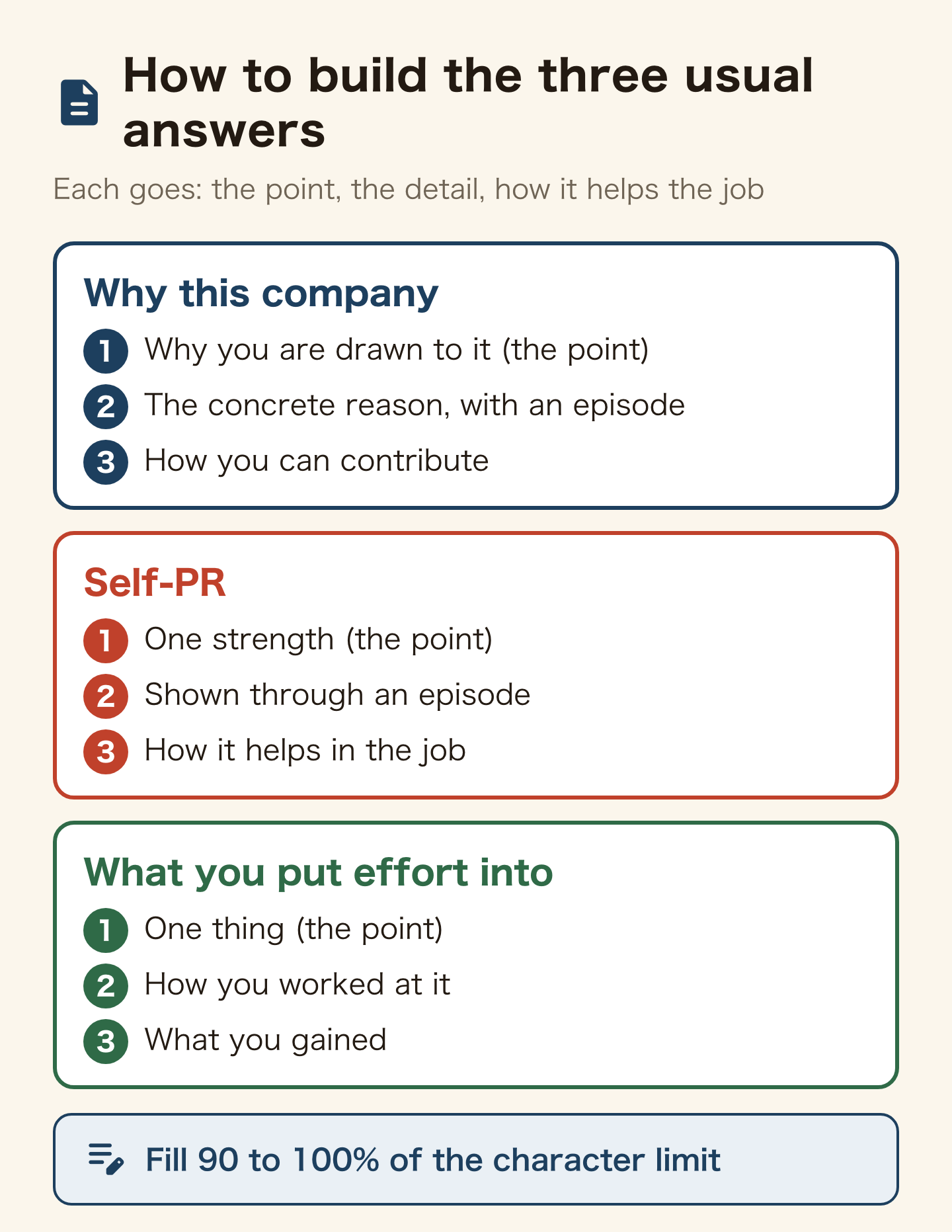
All three share one shape.
- Motivation: state why the company attracts you as the conclusion, then the specific reason (an episode if you have one), then how you can contribute. The guide asks you to show not only enthusiasm but the skills the job needs and the strengths you would contribute with.
- Self-promotion: pick one point and put it first. Then show it with an episode, and finish with how you would use it in the job.
- What you put effort into as a student: name one thing, describe how you tackled it with an episode, then say what you gained and how you grew. If a result can be shown in numbers, use numbers.
All three end on “the job” or “what you gained”. If you are unsure of your Japanese, write those three-line skeletons first, then turn them into sentences.
How much of the character limit should you fill? 90 to 100%
ES essays often have limits such as 200, 400 or 800 characters. The JASSO guide says filling 90 to 100% of the limit is expected (guide page 43). For 400 characters, that is 360 to 400.
The guide also says some companies now give a blank space to fill freely with drawings or photos, and guesses that these companies want people who can start working right away. If you meet such a format, check the company’s application page first for how to submit.
How many interviews are there, and what types?
Japanese interviews are held two or more times. The JASSO guide says this is so that people in different roles can see your character and way of thinking (guide page 54). Some companies hold them online.
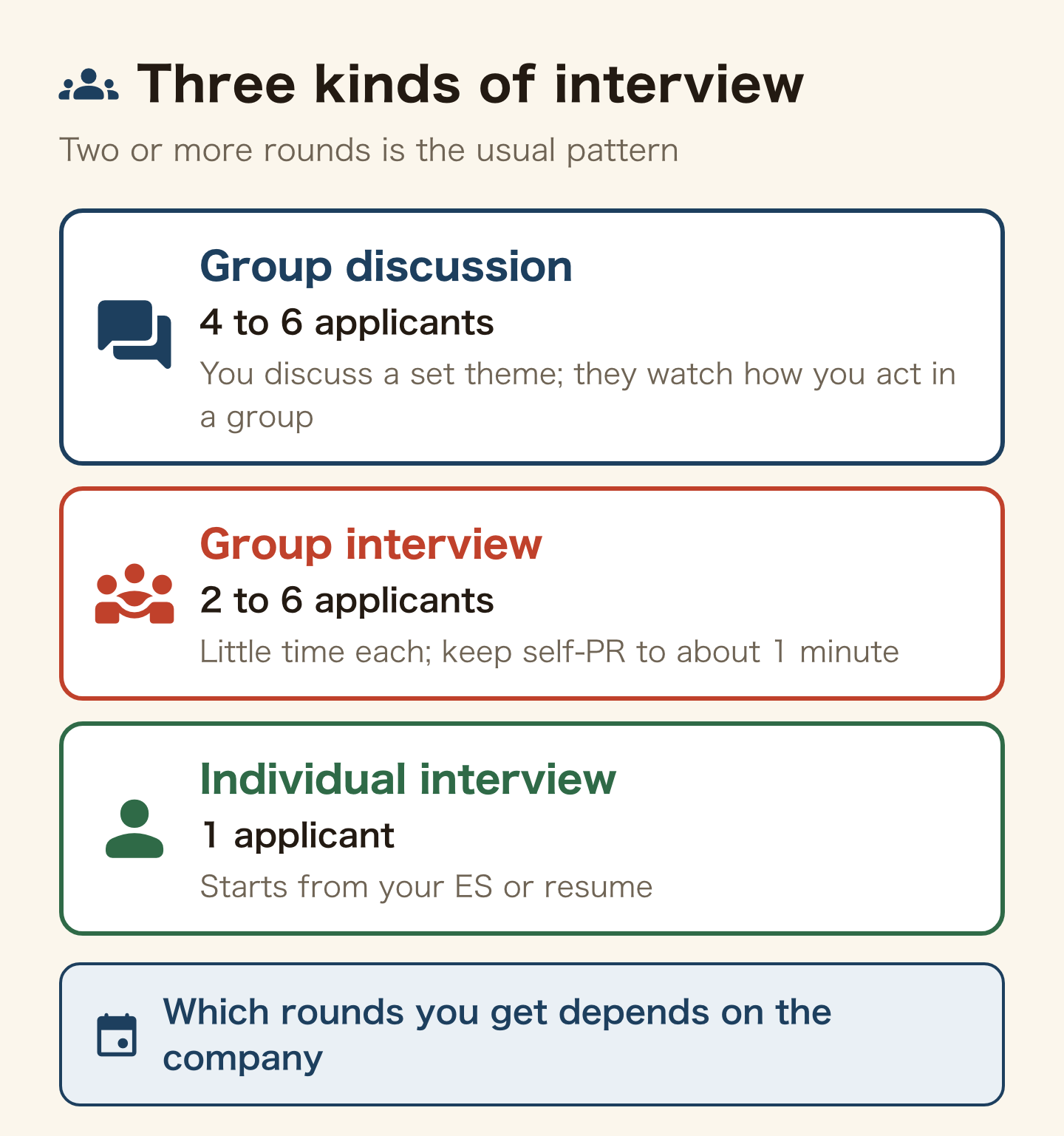
There are three common types.
- Group discussion: 4 to 6 people form a group and discuss a theme from the company. The interviewer watches how each person acts in the group. It is not a debate; the group works towards a conclusion together.
- Group interview: 2 to 6 applicants answer in turn to questions based on the ES and resume. Each person has little time, so the guide says to prepare a self-promotion you can give in about 1 minute.
- Individual interview: one person gets plenty of time. It starts from the ES and resume, then goes deeper into what you wrote.
Which types, and how many times, depends on the company. The guide also says they differ by company.
What are international students asked? Three questions from JASSO
The JASSO guide lists six expected interview questions (guide page 58). The last three ask about studying and working in Japan, so they read as questions meant for international students.
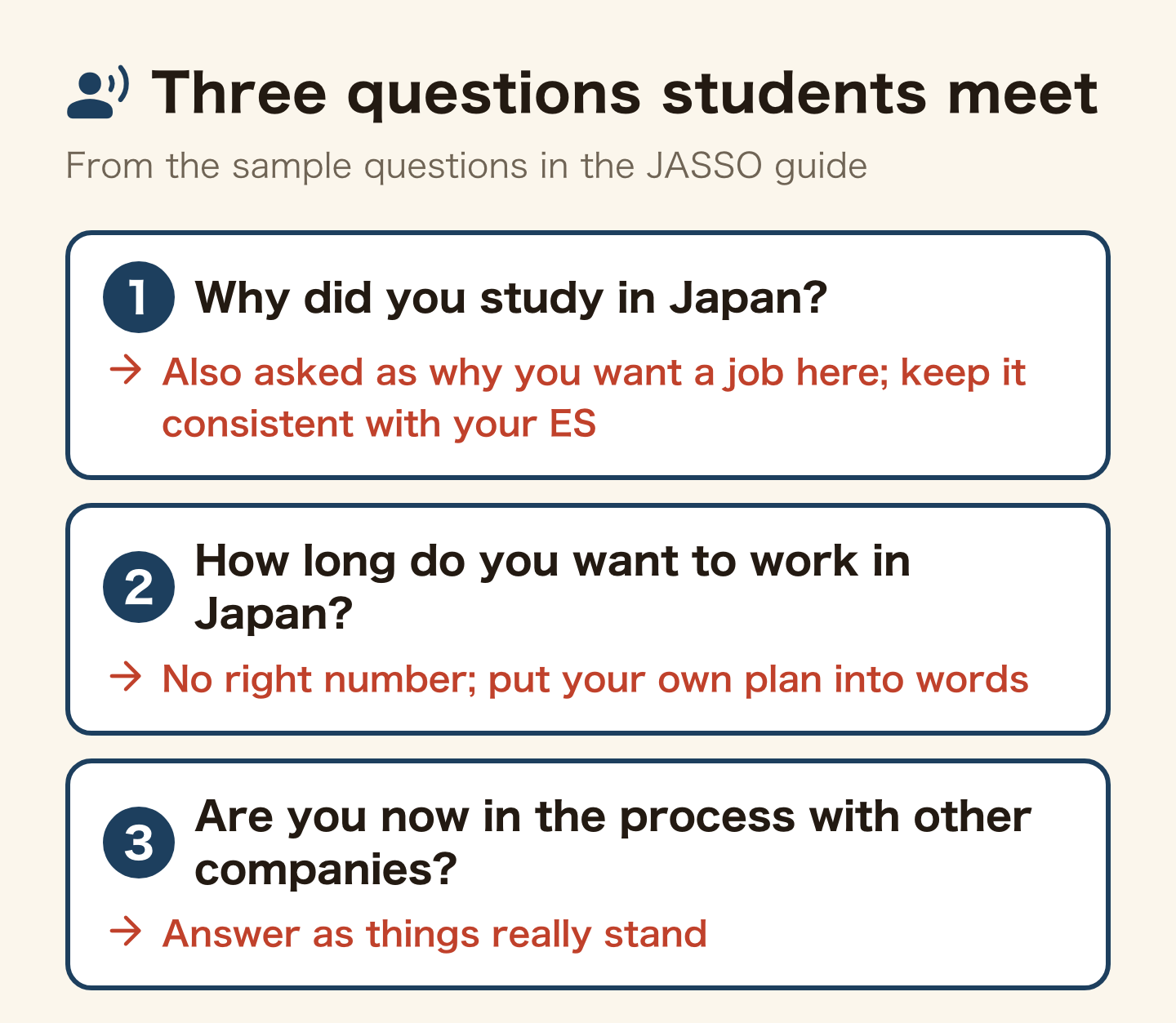
- Why did you study in Japan (why do you want to work at a Japanese company)?
- How long do you want to work in Japan?
- Are there companies where your selection is moving forward now?
The first three of the six (have you used the company’s products, what if you are assigned to a department you did not want, what do you expect from the company and the job) do not touch on studying abroad, so they apply to others as well.
The guide gives only the list of questions and the attitude to take; it has no sample answers. One thing it says clearly: interviewers read your ES and resume as they ask, so do not answer differently from what you wrote, and re-read them before the interview. The first question continues the same story as your ES motivation.
For the second question, there is no officially correct number of years. It is a question where you can only put your own plan into words. The third is a question to answer with the facts. Neither the guide nor other official sources say how mentioning other companies, or their results, affects the outcome.
The language of the interview also has a number. In a Careertasu survey (December 2025, 487 companies), 87.7% of companies said they interview international students “entirely in Japanese”. The top quality they look for in international students is also “Japanese ability”, at 55.6% for humanities and 51.5% for science (a question where up to three could be chosen). The JASSO guide also quotes an HR officer saying to understand the question properly and be able to answer in Japanese (guide page 58).
Is it wrong to be asked about residence status? It is not among the 14 items
In your country, you may rarely be asked to show an ID-like document in an interview. In Japan, a company hiring a foreigner has a duty to check.
The Ministry of Health, Labour and Welfare’s guideline (on how employers should handle the employment of foreign workers) says an employer should confirm in advance that the work the person will do is allowed under their residence status, and must not hire people for whom it is not (guideline, part 4, 1, 2). Part 5 of the same guideline names asking for the residence card as the way to confirm at hiring.
So residence status and the period of stay are checked for the sake of the work. They are not among the 14 items below. On the other hand, registered domicile, birthplace and family are among the 14, as matters unrelated to ability and aptitude.
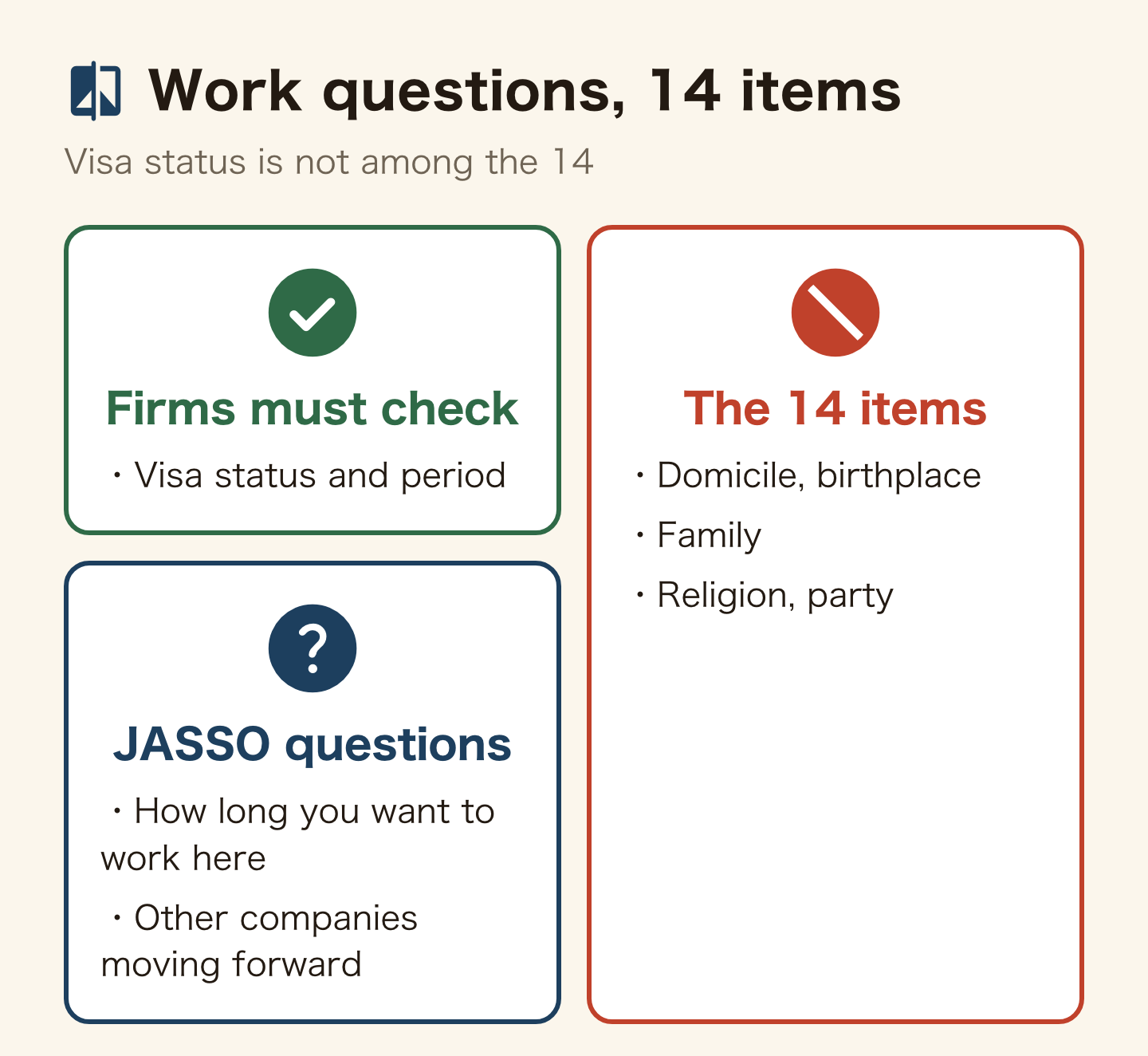
This only says whether something is among the 14 items. A question about residence status can drift towards your home country or family. Check each such question against the list in the next section.
What are the “14 items”, and what do you do if you are asked?
The Ministry of Health, Labour and Welfare’s “Basics of fair hiring” lists 14 matters that are unrelated to ability and aptitude, and says that learning them through an application form or interview can lead to discrimination in hiring. It is a call to companies, not a rule for applicants.
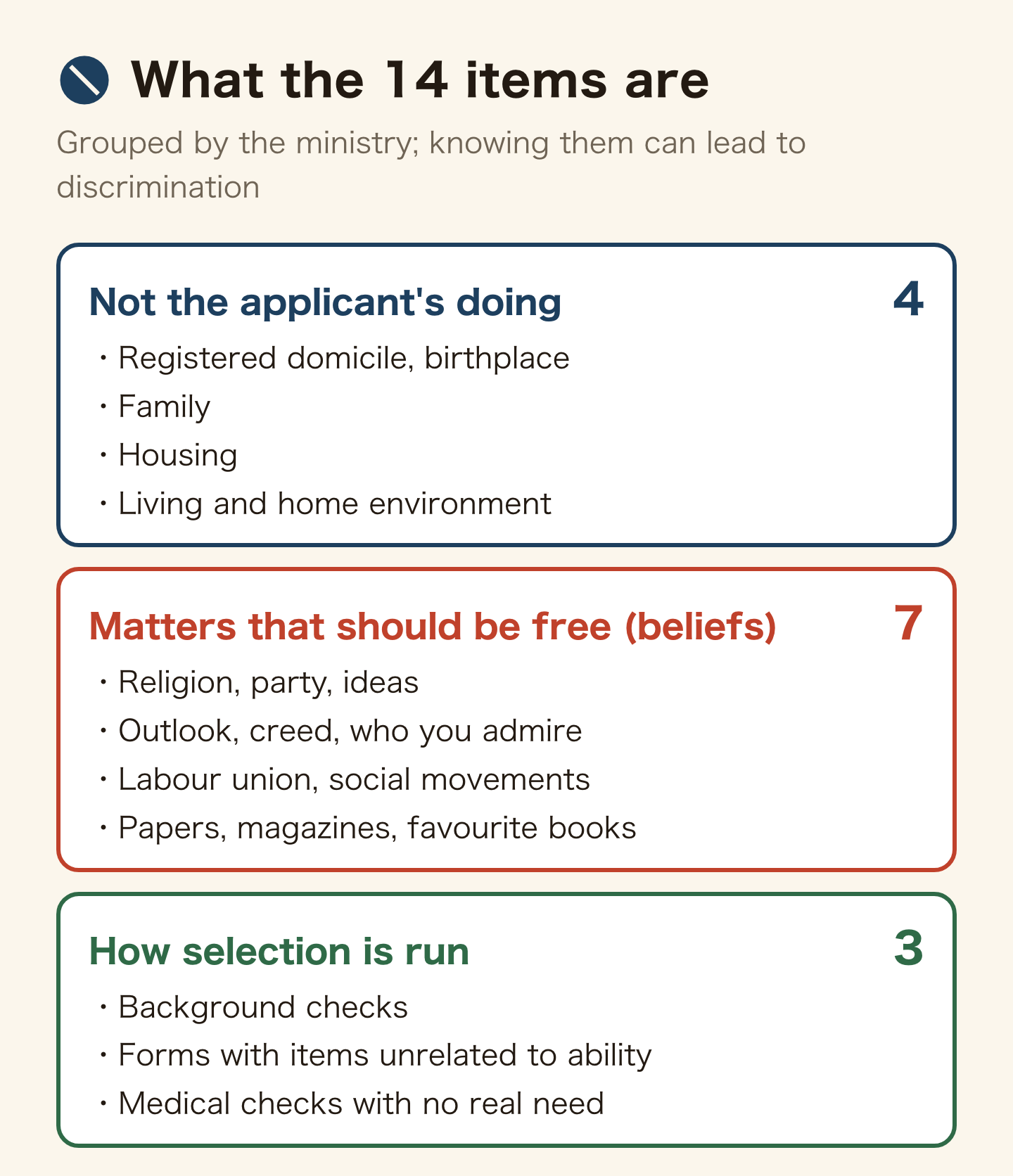
They split into four matters outside the person’s control, seven matters that should be free (those about thought and belief), and three about the method of selection. A note says that registered domicile and birthplace also covers asking for a family register copy or a residence certificate showing the domicile. Family covers occupation, relationship, health, illness, education, income and assets. The same view applies if an ES or resume has such fields. The fields of the resume are covered in the rirekisho article.
If you are asked about one of the 14 in an interview, take these steps.
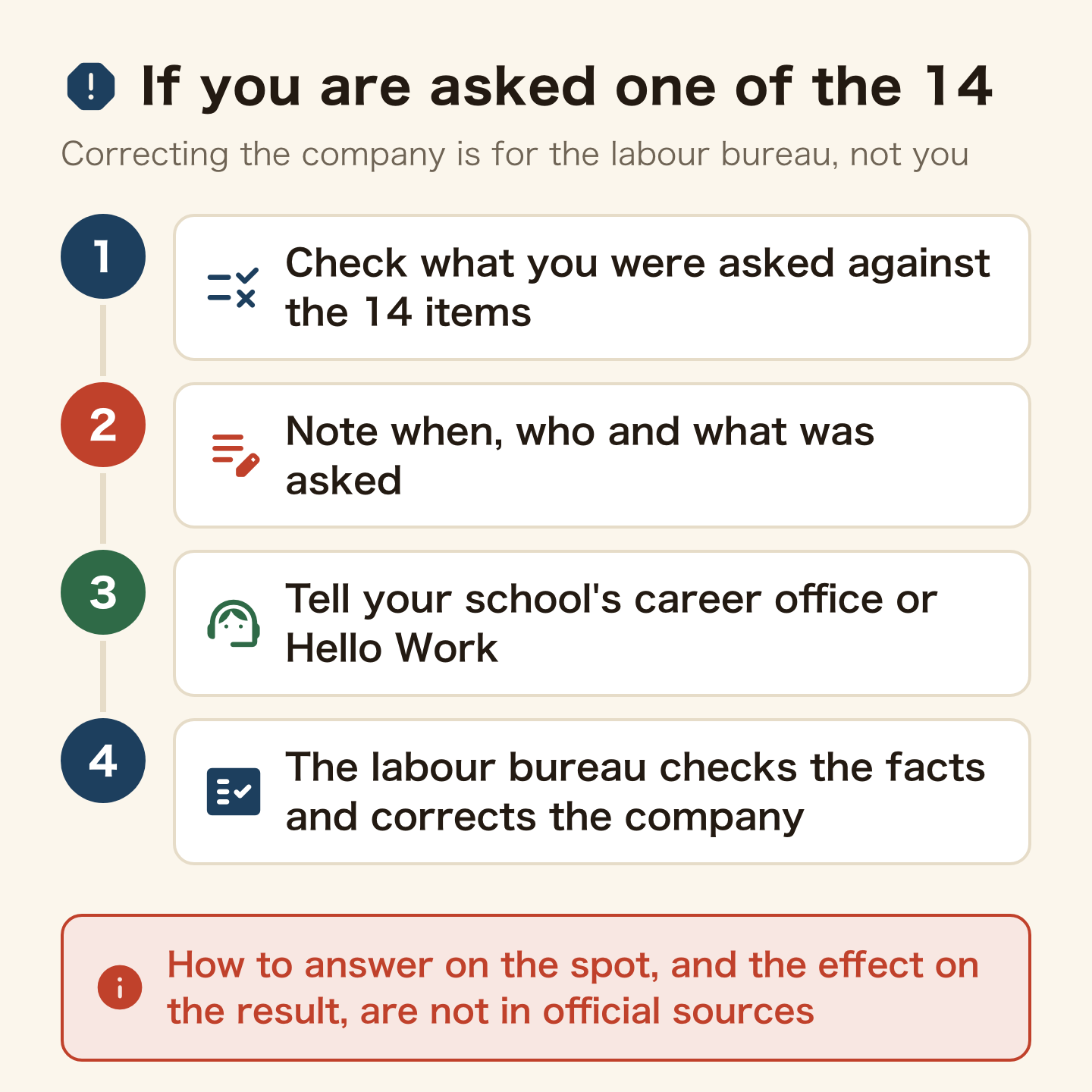
- Check what was asked against the list of 14.
- Note the same day when, who and what was asked.
- Tell your school’s career centre or Hello Work.
- The Labour Bureau, on receiving the report, checks the facts with the company and gives guidance to correct it.
The Tokyo Labour Bureau page says that when students or schools report items unrelated to ability and aptitude on an ES or in an interview, the special counselling desk at a Hello Work for new graduates takes it in, and the Tokyo Labour Bureau checks the facts with the workplace and gives guidance. Correcting the company is the Labour Bureau’s job, not yours. The same page also says that violating the Employment Security Act can bring an improvement order, with penalties for ignoring it.
Something I could not confirm: whether to answer or decline on the spot, and how answering affects the result. Neither the Ministry’s material nor the JASSO guide says. This article does not give a “correct” way to answer either. If you are unsure, describe the situation to your school’s career centre or a Hello Work for foreign nationals.
How is a job-change interview different? Only the residence-status side is confirmed
This is for people already working on an Engineer/Specialist in Humanities visa or similar who are changing jobs. The JASSO guide is for new-graduate international students, and I could not find an official source that sets out the questions asked in job-change interviews. What I can write is only what was confirmed on the residence-status side.
- The 14 items are not a list for new graduates only. The Ministry’s page is written as a basic rule for selecting on ability and aptitude, and its notes on application forms are included for “other job seekers” too.
- A company must confirm before hiring that the new work is allowed under your current status (see the guideline above). Even a move under the same status cannot be hired if the work is outside its range.
- A job change involves three separate things. Notifying Immigration of a contract ending or a new contract is due within 14 days (Immigration Control Act, article 19-16; Immigration Services Agency page on the notification). The Certificate of Authorized Employment is a document the Act says Immigration “may issue” (article 19-2), and the agency page says you apply when you want to receive one. The same article bars an employer, where the activity you may do is clear, from treating you unfavourably for not presenting it. Work outside your status’s range may not be done without permission (article 19), and article 20 provides that you may receive a change of status for such work (the Act).
How to get the certificate and make the notification, with documents and fees, is in the Certificate of Authorized Employment article. If an interviewer asks at the end “is your visa all right?”, that three-way distinction is your footing.
When do you stop? Which one are you?
- A new graduate about to write the ES: today, write only the one-sentence conclusion of your motivation. Stop revising when the length is within 90 to 100% of the limit and all three answers follow conclusion, specifics, how it helps. Then set the submission date.
- You have submitted and are waiting for interviews: today, re-read a copy of your ES and write one or two sentences each for “why I came to Japan”, “how long I want to work” and “companies that are moving forward”. Check only that they match the ES, and do not add more.
- You were asked about one of the 14 in an interview or on a form: the same day, note when, who and what, and tell your school’s career centre or Hello Work. Do not keep agonising over how to answer on the spot.
- You got an offer, or decided on a new job: new graduates check the change of status in the student visa to work visa article. If you are changing jobs, check that the new work is within your current status, and write the date 14 days from the contract in your diary for the notification.
FAQ
Q. How much of the character limit should I fill?
Aim for 90 to 100% of the limit. The JASSO guide says limits such as 200, 400 or 800 characters are common, and that filling 90 to 100% of the limit is expected.
Q. How many interviews are there?
Two or more is the norm. The three common types are group discussion, group interview and individual interview, and the number of each differs by company (JASSO).
Q. What do international students get asked in interviews?
Of the six expected questions in the JASSO guide, the last three are: why you studied in Japan (and want to work at a Japanese company), how long you want to work in Japan, and whether other companies are moving forward with you. Only the first two touch directly on studying or working in Japan, and they read as questions meant for international students. The guide gives no sample answers. It says to re-read your ES before the interview so that you do not answer differently from what you wrote.
Q. Is it a problem if an interviewer asks about my residence status?
Residence status is not among the Ministry of Health, Labour and Welfare’s 14 items. The ministry’s guideline asks companies to confirm, before hiring, that the work is allowed under the candidate’s status. Birthplace and family, however, are among the 14.
Q. What should I do if I am asked about my family or registered domicile?
Note when, who and what was asked, and tell your school’s career centre or Hello Work. The Labour Bureau then checks the facts with the company and gives guidance to correct it. Official sources do not say how answering on the spot affects the result.
Q. Are the 14 items the same in a job-change interview?
The 14 items are written as a basic rule for selecting on ability and aptitude, not only for new graduates. I could not find an official source that sets out the questions asked in job-change interviews.
Summary
In an ES, motivation, self-promotion and what you put effort into as a student all go conclusion, specifics, then how it helps at work (or what you gained), and the length fills 90 to 100% of the limit. Interviews are two or more, and international students are often asked why they came to Japan, how long they want to work here, and whether other companies are moving forward. There are no official sample answers, so build yours from your own facts and your ES.
Residence status is something a company checks for hiring, and it is not among the 14 items. If you are asked about registered domicile, birthplace, family, religion, political party or the rest of the 14, note it and tell your school or Hello Work. How answering on the spot affects the result is not in official sources, so I do not claim it. Submit the ES, prepare for the interview, record what you were asked. Then your preparation is done.
Sources (official): Immigration Services Agency, application for a certificate of authorized employment / Immigration Services Agency, notification about the organization you belong to / Immigration Control and Refugee Recognition Act (e-Gov) / JASSO, Job Hunting Guide for International Students 2027 (guide pages 43, 47, 48, 54, 55, 58) / Ministry of Health, Labour and Welfare, Basics of fair hiring / Tokyo Labour Bureau, Conducting fair hiring / Ministry of Health, Labour and Welfare, guideline on employment management of foreign workers / Careertasu, company survey on hiring international students and highly skilled foreign talent (December 2025). Checked on 9 October 2026. Rules and materials can change in the next revision.
Related reading
WHO WROTE THIS

mori
Japanese. I read the ministries’ own notices, orders and Q&As in the original, and I start from what my Nepalese and Sri Lankan friends in Japan actually ran into. I do not write about what I have not checked or been told.
What this site can and cannot do →Looking for something else?
You may use the figures in this article, including commercially, if you credit this site with a link. How to use our figures