This article contains affiliate links.
Last updated: November 2026
Figures, prices and terms were checked against the official cost pages of Oak House and X-House on 6 August 2026; move-in conditions and move-out rules were checked on 4 November 2026. They change — check the current terms yourself before you sign up or file anything.
In short
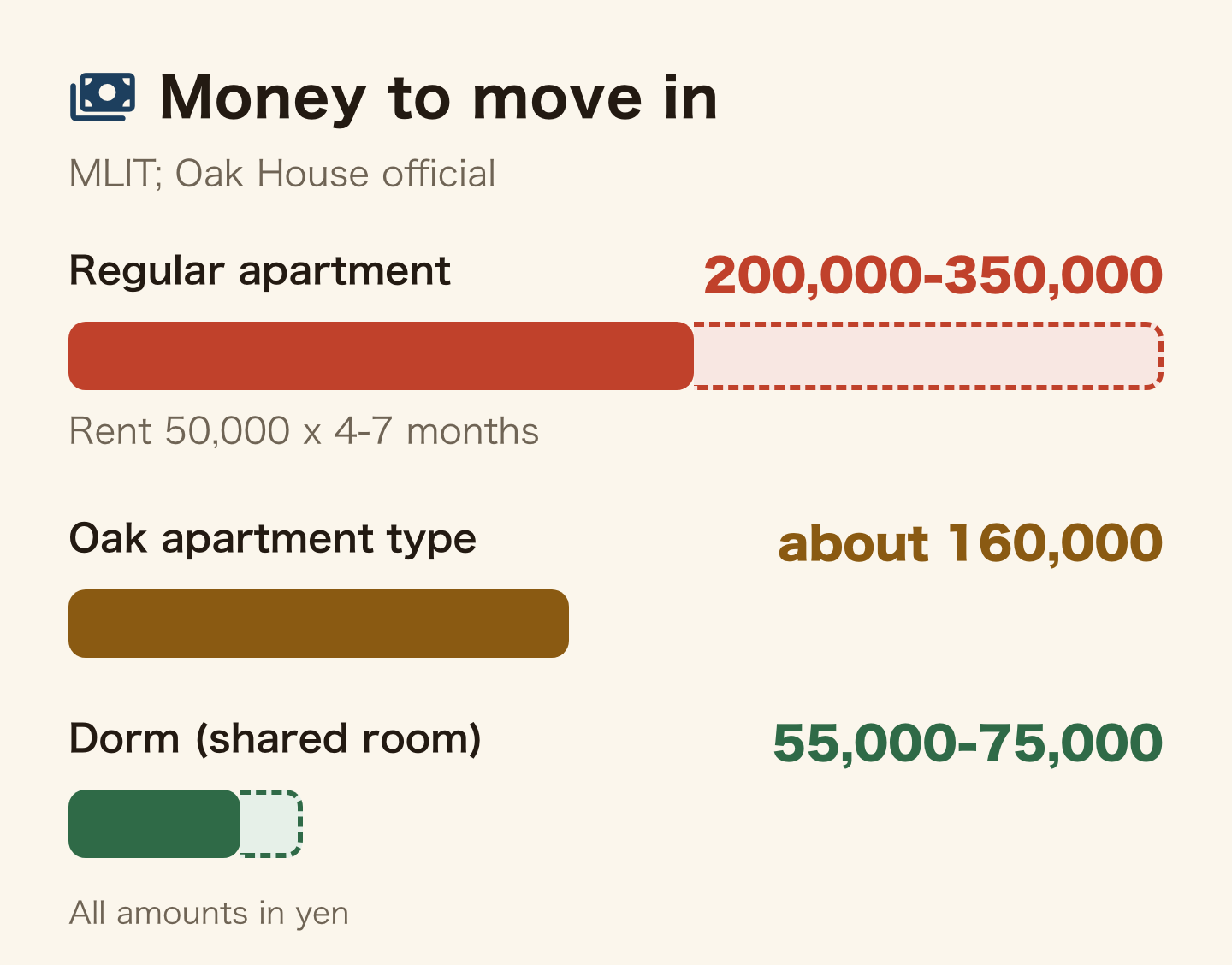
- A regular Japanese apartment charges 4 to 7 months of rent up front (at 50,000 yen rent, 200,000 to 350,000 yen: MLIT housing guidebook). For a new arrival, that is brutal.
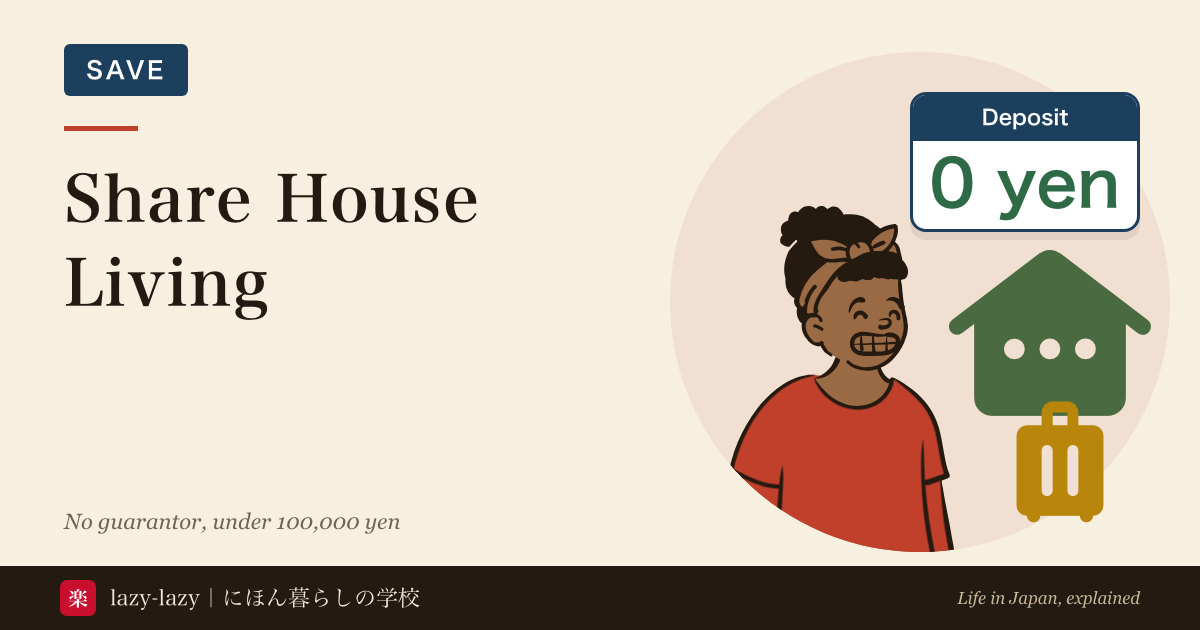
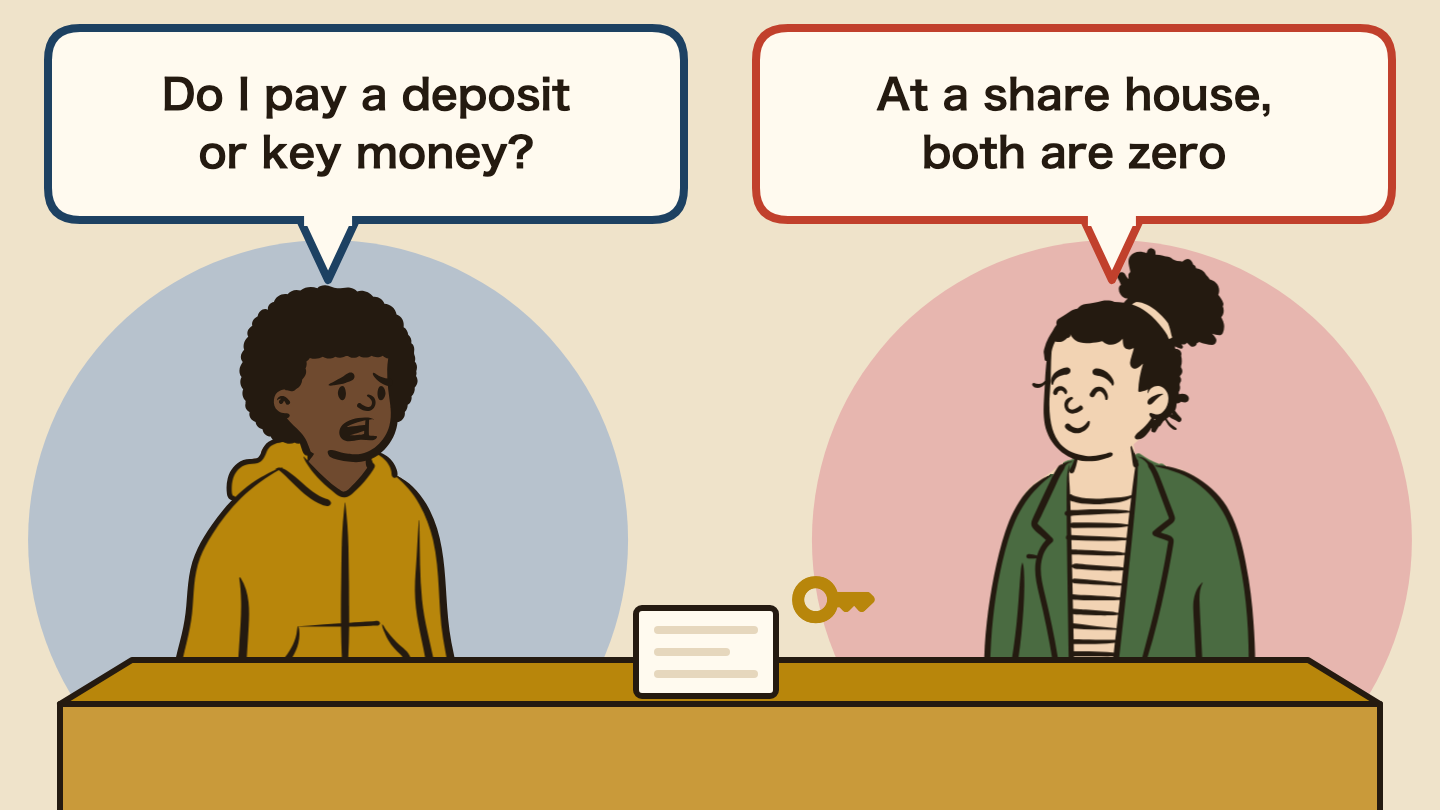
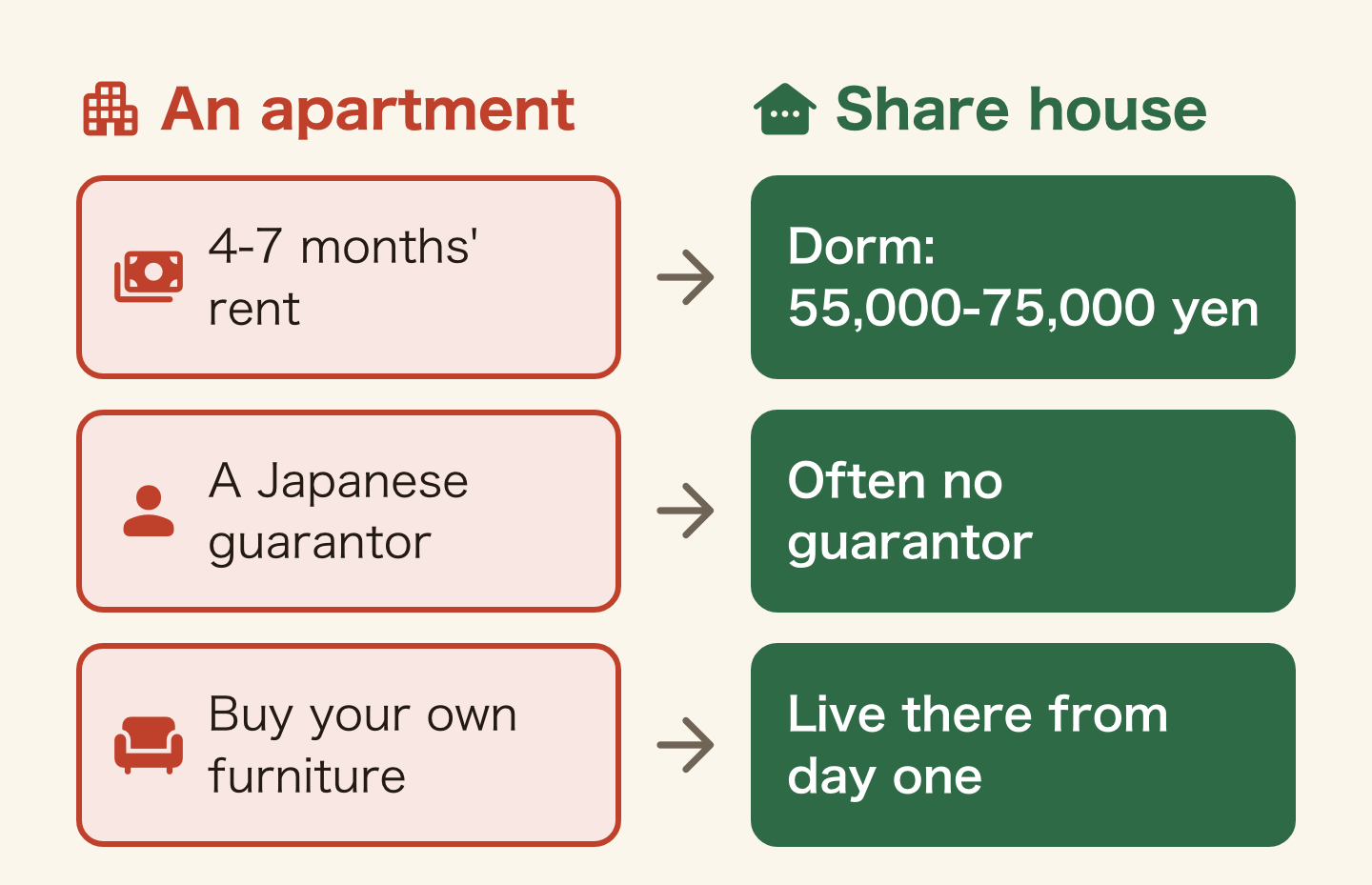
- A share house charges zero deposit, zero key money and zero agency fee, often needs no guarantor, and comes furnished with internet included. Oakhouse needs no guarantor, but you name a parent as emergency contact.
- What you do pay is the contract fee + first month’s shared-cost fee + first month’s rent. A dormitory comes to about 55,000 to 75,000 yen (contract fee 10,000-30,000 + shared-cost fee 10,000 + average rent 35,000); Oak House’s own example for an apartment type is 160,000 yen (Oak House official cost page, in Japanese, checked 2 October 2026).
- The largest operator is Oakhouse – over 20 years running, with strong support for foreign residents.
- You end up living alongside both foreign and Japanese residents, which makes friends and Japanese practice happen naturally.
- It is not for everyone: if you want total quiet and privacy, look for a private-room plan first.
Once this is clear, “I cannot rent because I do not have 300,000 yen” becomes “I can move in this week for 100,000” – and you know in advance whether a share house suits you.
- Finding a room in Japan is expensive before you even move in
- The fix: a share house, with move-in costs on a different scale
- Oakhouse: the operator most students end up choosing
- How does Oakhouse screening work? No guarantor, but you need an emergency contact
- Can you register your address at a share house? Do it within 14 days
- How do you leave an Oakhouse share house early? Two weeks for a dormitory, one month for other rooms
- Who it fits, and who should think twice
- Frequently asked questions
- Summary
- Related guides
Finding a room in Japan is expensive before you even move in
You arrive with enough saved for a month’s rent and a deposit, which is what renting a room usually takes. Where you come from, that may be plenty. In Japan, that money can run out before you are even handed the key.
Housing is usually the first wall a new arrival hits. A standard Japanese apartment charges move-in costs (deposit, key money, agency fee) worth 4 to 7 months of rent, according to the housing guidebook from Japan’s Ministry of Land, Infrastructure, Transport and Tourism. On top of that, most landlords want a Japanese guarantor, and you still have to buy your own furniture and appliances. For someone who just landed in the country, this is a genuinely heavy burden.
The fix: a share house, with move-in costs on a different scale
A share house is a building where residents share the kitchen, living room, and bathroom, while each person has their own bedroom (private or shared). The single biggest advantage is the move-in cost.
Beyond the move-in cost, a share house solves several problems new arrivals commonly run into all at once.
Oakhouse: the operator most students end up choosing
Oakhouse is one of the largest share house operators in Japan, running for over 20 years, with a strong track record hosting foreign residents. Here is what stands out:
- No deposit, no key money, no agency fee: a standard one-room charges three months’ rent for those three alone
- Furniture, appliances, and internet included: you can start living, and job hunting, the day you arrive
- Social residences: some larger buildings include a gym, lounge, or theater room – amenities you would never get living alone
- International events: foreign and Japanese residents mix naturally, which is where friendships and Japanese language practice tend to start
How does Oakhouse screening work? No guarantor, but you need an emergency contact
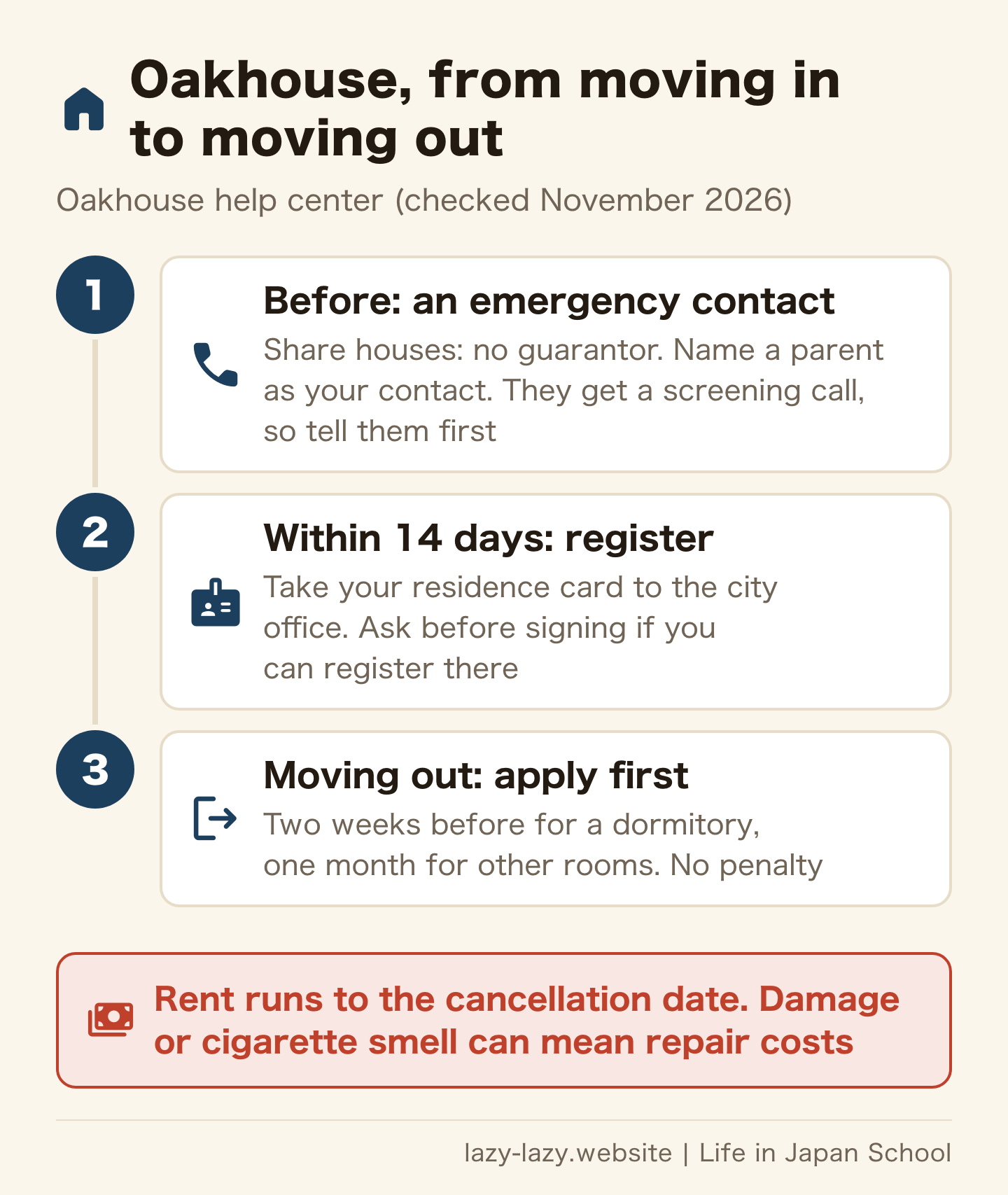
You apply, and your parent’s phone rings with a call from Japan. That can happen at screening. Oakhouse share houses need no guarantor and no guarantor company, but they do need an emergency contact, and Oakhouse calls that person during screening (Oakhouse help center: requirements to move in).
The contact must be a parent, whether in Japan or overseas. If you have no parent, name a sibling or another relative. Tell them about the call first. Some Oakhouse apartment listings do require a guarantor company, so check the listing.
The other conditions on the same page:
- Everyone who moves in is screened
- You must be at least 18. Under 20, you need a parental consent form
- There is no nationality limit. Any visa type is fine as long as it is valid
- You show a passport, residence card or similar document
- Your work or study status is not limited. Most properties set no income or bank balance condition (some may ask to see them)
On moving day, bring a copy of a photo ID, plus a personal seal and slippers if you have them. Bedding is not included at first. Bring your own, or order a bedding set for 17,600 yen including tax before you move in. Every resident buys a 2,200 yen bed pad (Oakhouse help center: bedding, Q&A).
Can you register your address at a share house? Do it within 14 days
If you hold a residence card and live in a share house, that is your address. As with a normal apartment, you report it at the city or ward office within 14 days of moving in. If you are a newly arrived mid-to-long-term resident and, without a good reason, do not report an address within 90 days of landing, your status of residence can be revoked (Immigration Act, Art. 22-4). The steps are in the residence registration guide.
How the room number is written depends on the room type and the municipality. A private room usually includes it. For a dormitory, some municipalities register only the building address (X-House explanation).
We could not find anything about resident registration in the Oakhouse help center. Some share houses do not allow it (X-House explanation), so before you sign, ask whether you can register at that property. National Health Insurance is for people registered as residents (Toshima City). Banks can also ask for your registered address when you open an account.
How do you leave an Oakhouse share house early? Two weeks for a dormitory, one month for other rooms
Oakhouse’s standard contract is a fixed-term lease of 1 to 6 months, some properties excluded (Oakhouse Q&A, Japanese). It does not renew. If you can stay on, Oakhouse emails you first, then you sign a new contract (Oakhouse help center: contract length, contract renewal). A move-out application is always required, even when you leave on the day your contract ends (help center).
The deadline is one month before the date you want to cancel, or two weeks for a dormitory (Oakhouse help center: move-out deadline). To cancel on 31 October in a room that is not a dormitory, apply on My Page by 1 October.
There is no penalty fee. Rent still runs to the cancellation date, even if you leave earlier. Damage or cigarette smell in the room can mean charges for repairs, new wallpaper, cleaning (Oakhouse help center: move-out fees). Once you know your flight home, count back from the cancellation date first.
Who it fits, and who should think twice
A share house is not the right fit for everyone. Check yourself honestly against this table before you commit.
| Good fit | Think twice if you… |
|---|---|
| Want to keep move-in costs low | Want total silence and full privacy |
| Do not have a guarantor | Dislike sharing a kitchen or bathroom |
| Just arrived with no furniture | Keep unusual hours (late-night work, for example) |
| Want to meet people and make friends | Find shared cleaning and trash rules annoying |
If you like the idea of community but still want your own space, look for a private, lockable room plan – you get the shared common areas without giving up a quiet room to retreat to. Popular properties fill up quickly, so if a listing catches your eye, check it sooner rather than later.
In Tokyo, X-House is another strong option
Oakhouse covers all of Japan and leans toward community living in larger houses. X-House is mostly in the Tokyo area, with some houses in Osaka, Fukuoka and other cities. Its share houses have three room types: a private room with a lock, a semi-private room, and a dormitory bed (X-House, fees and move-in steps (Japanese)).
- Zero deposit, key money and agency fee. The move-in cost is a flat 30,000 yen, but the first month’s rent and service fee come on top of that
- Rent from 24,800 yen for a dormitory bed, 34,800 yen for a semi-private room and 40,000 yen for a private room. On top of that is a flat 15,000 yen shared-cost fee that covers water, electricity and gas, and Wi-Fi is free (X-House official fees)
- No guarantor needed, from one month, apply online. Support in 11 languages (English, Nepali, Sinhala, Hindi, Vietnamese and more)
- Phone support in Nepali and Sinhala – built for exactly the readers of this site
Want community and events? Go with Oakhouse. Want your own locked room and quiet? Go with X-House.
See Tokyo rooms from 24,800 yen (X-House)
Looking in Osaka instead: furnished studios from 50,000 yen ->
Official sources: Oakhouse, cost of living in a share house (Japanese) / Oakhouse company information, founded 1992 (Japanese) / MLIT, apartment search guidebook (English) / X-House, fees and move-in steps (Japanese) (checked 26 September 2026) / Oakhouse help: requirements, move-out deadline, move-out fees , contract length, bedding (checked 4 November 2026)
Frequently asked questions
Q. Can I really move in without a guarantor?
Yes. Oakhouse share houses need no guarantor and no guarantor company. You do need an emergency contact, one of your parents. A call goes to them during screening, so tell them first. Some apartment listings do require a guarantor company.
Q. Is the move-in cost really under 100,000 yen?
It depends on the room type. On Oak House’s official cost page (August 2026) the contract fee is 10,000-30,000 yen for a dormitory and from 50,000 for an apartment type, plus 10,000-27,000 for the first month’s shared-cost fee and the first month’s rent. A dormitory (average rent about 35,000, shared-cost fee 10,000) comes to about 55,000-75,000 in total, under 100,000; an apartment type (average rent about 90,000) comes to about 160,000 in Oak House’s own example (Oak House official cost page, in Japanese). Either way, because there is no deposit or key money and the room comes furnished, share houses are far cheaper to move into than a standard apartment (4 to 7 months of rent). Check the current price on the official site before you commit.
Q. Are there private rooms, or only shared rooms?
Both exist. There are lockable private rooms and cheaper shared dormitory-style rooms. If privacy matters to you, choose a private room plan.
Q. Is it okay if my Japanese is not strong?
Many properties have a large foreign resident base and English-language support, and some, like X-House, offer phone support in Nepali and Sinhala. Living alongside other residents also becomes informal language practice.
Q. What about contract length and moving out early?
Oakhouse’s standard contract is a fixed-term lease of 1 to 6 months (some properties excluded). It does not renew; if you can stay on, you sign a new contract. Apply to move out one month before the cancellation date, or two weeks for a dormitory. There is no penalty fee, but rent runs to the cancellation date.
Summary
- A standard Japanese apartment is expensive to move into (4 to 7 months of rent, plus a guarantor)
- Oakhouse needs no guarantor. Name a parent as emergency contact, tell them about the screening call
- Report your address within 14 days of moving in. Ask before signing if you can register there
- At Oakhouse, apply to move out two weeks before for a dormitory, one month for other rooms
- A share house charges zero deposit, key money and agency fee, often needs no guarantor, and comes furnished. A dormitory comes to about 55,000 to 75,000 yen in total; an apartment type about 160,000 (Oak House official cost page, in Japanese)
- Oakhouse is the largest, most established option for foreign residents
- You get community and language practice built in – but choose a private room plan if you value quiet
- Popular listings fill fast, so start looking early
Related guides
Found this useful? Share it
Send it to a friend who lives in Japan.
WHO WROTE THIS

mori
Japanese. I read the ministries’ own notices, orders and Q&As in the original, and I start from what my Nepalese and Sri Lankan friends in Japan actually ran into. I do not write about what I have not checked or been told.
What this site can and cannot do →Looking for something else?
You may use the figures in this article, including commercially, if you credit this site with a link. How to use our figures