Checked on 23 September 2026 against official pages from the Agency for Natural Resources and Energy, METI (the retail guidelines for electricity and gas, and the LPG rule changes), the Electricity and Gas Market Surveillance Commission, the Consumer Affairs Agency, the National Consumer Affairs Center, the Statistics Bureau, and the Tokyo and Osaka waterworks bureaus, Sendai City Gas Bureau and Otsu City.
The short answer
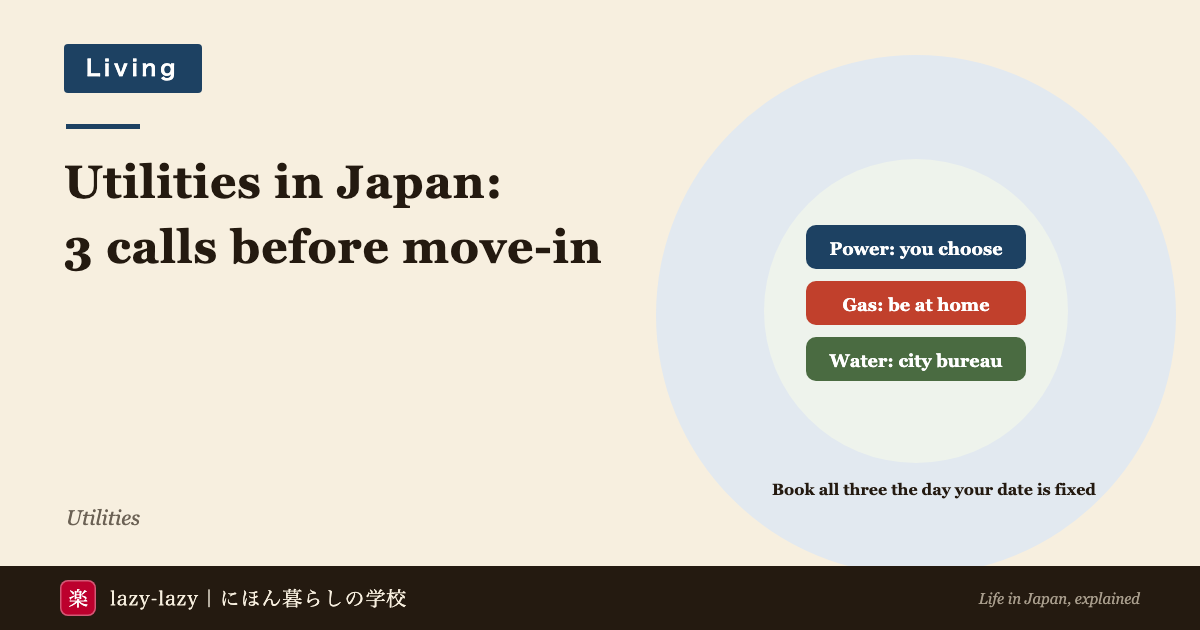
- Three calls. Electricity goes to a company you choose, gas to the gas company, water to your city’s waterworks bureau. Once you have a move-in date, make all three calls at least a week ahead (gas asks for five working days, Tokyo water for three to four days).
- Someone has to be home when the gas is switched on. A technician comes in to check for leaks and test your appliances. If you cannot be there, your landlord or building manager can stand in.
- In a rented flat on propane (LPG), you cannot change the gas company after you move in. Ask the agent for the gas price list before you sign.
- An unpaid bill does not cut you off overnight. Electricity and gas send notices about 15 days and about 5 days before the cut-off, and water sends reminders first. Call the company before the first notice comes.
- If someone at your door says “the whole building is switching electricity company”, it is a lie. Do not show them your meter-reading slip.
Knowing this, you will not spend your first night with no hot water or no power, and you can spot a propane flat before you sign for it. In a month when money is short, you also know how long you have before anything is cut off.
The night you get the keys. The lights work, but the shower only runs cold. Gas, it turns out, stays off until a technician comes to open it. The next day you ask a Japanese friend what you were supposed to do. “My parents sorted all that when I moved out,” they say. The instructions exist, but in Japanese, and split across a power company, a gas company and a city office.
Setting up utilities in Japan means applying, before you move in, to three separate organisations with your name, your new address and the start date. None of it is linked to the move-in notice you file at the city office. If you do not call, nothing starts.
- How do I set up utilities in Japan, and how many days ahead?
- Which electricity company should I choose?
- Do I need to be home when the gas is switched on?
- Propane vs city gas in Japan: what changes for renters?
- How do I set up water?
- What is the average utility bill in Japan?
- How do I cancel utilities when I move or leave Japan?
- What happens if I cannot pay my electricity, gas or water bill?
- Someone at my door is selling electricity. What do I do?
- Which one are you?
- FAQ
- Summary
- Related reading
How do I set up utilities in Japan, and how many days ahead?
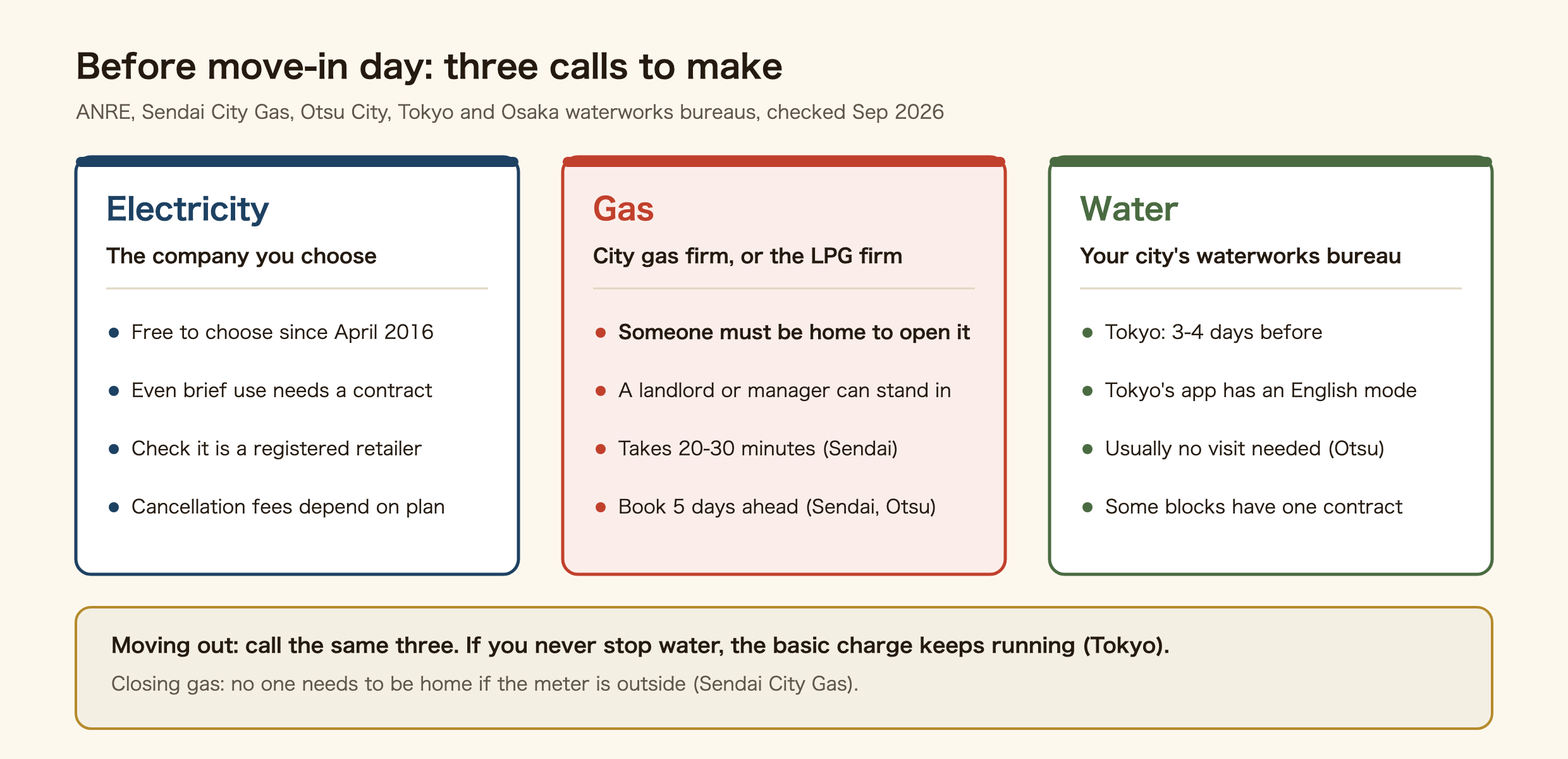
Each company and city sets its own lead time. These are the ones confirmed on official pages.
| Who you call | How far ahead | Visit | |
|---|---|---|---|
| Electricity | The company you choose | Depends on the company (call in advance) | — |
| Gas | City gas company, or the building’s LPG company | Sendai City Gas: 5 working days; Otsu: 5 days | Needed to open |
| Water | Your city’s waterworks bureau | Tokyo: 3-4 days; Otsu: 5 days | Usually not |
Gas takes longest, because you are booking a technician’s visit. The Tokyo waterworks bureau warns that its phone lines are hard to get through in March and April, the peak moving season. Make all three calls on the day your move-in date is fixed.
They all ask for much the same things: your name, the full new address including building name and room number, a phone number and the start date. Keep your lease to hand. If you also need home internet, fibre can take one to two months to install, so look at routers that need no installation before you are left offline.
Which electricity company should I choose?
Since April 2016, households in Japan have been free to choose their electricity company and plan (ANRE). That includes renters, as long as the contract is in your name. If your building buys electricity in bulk for every flat, ask the management first.
Every company delivers over the same power lines, and ANRE says quality and the chance of a power cut are the same whoever you buy from. Its checklist has three points:
- Is it a registered electricity retailer? ANRE publishes the list
- What is the price, how is it calculated, and how long does any discount last? Retailers must explain this in writing before you sign
- How long is the contract, and is there a cancellation fee? Some plans have one
If you cannot decide, one option is the big regional company for your area (TEPCO Energy Partner in Tokyo, Kansai Electric in Osaka, ten across Japan). These ten still offer the government-approved regulated rate.
People forget the short jobs. Even a few hours of power to clean the flat before moving in needs a contract (ANRE). The lights may come on, but without an application you have no contract. Apply in advance for supply from your move-in day.
Do I need to be home when the gas is switched on?
Yes. Sendai City Gas Bureau explains that on the opening day a technician comes inside, tests the appliances and checks for leaks, then shows you how to use gas safely, so someone has to be there. Otsu City says the same: gas cannot be started without someone present.
- It should be you. If you cannot, a person who can pass on the explanation, such as your landlord or building manager, can stand in (Sendai)
- It takes about 20 to 30 minutes in a normal home. In Sendai you pick a slot: 10-12, 13-15 or 15-17
- They check the hot water too, so have electricity and water running first
- Your stove must match the type of gas in the building. Using an appliance made for the wrong gas is very dangerous, Sendai warns
Whether they will open without a stove in place, and whether there is a fee, differ by company, so ask when you book. When you move out, closing the gas needs no one at home if the meter is outside. For an indoor meter or an auto-lock building, they will ask someone to be there (Sendai).
Propane vs city gas in Japan: what changes for renters?
City gas comes through gas mains. Propane, or LPG, is delivered to each building in cylinders. About 40% of households in Japan use LPG (ANRE).
The catch for renters is that you do not choose the LPG company. METI itself notes that in rented apartment buildings, tenants in practice cannot switch LPG company after moving in. On top of that, a long-running practice had LPG companies lending air conditioners and other equipment free to building owners, then recovering the cost through the tenants’ gas bills.
The rules changed under the LPG Act’s enforcement regulation:
- From 2 July 2024: LPG companies must try to show prospective tenants the price list before they sign the lease. If a prospective tenant asks the company directly, it must answer
- From 2 April 2025: bills must be split into a basic charge, a usage charge and an equipment charge. Costs unrelated to gas, such as air conditioners or Wi-Fi equipment, may not be put into the gas price. In rented homes, the cost of gas appliances like water heaters and stoves is also, in principle, off the bill (for contracts made from that date)
A separate government guideline also expects LPG companies to publish their standard prices and a monthly example on their website or at their shop.
So before you choose a flat, do one thing. Ask the agent: “Is the gas city gas or propane? If it is propane, can I have the price list?” The Consumer Affairs Agency gives the same advice. If a later bill shows an amount under “equipment charge”, query it: in rented homes you normally pay nothing there unless you agreed to it in advance (contracts from 2 April 2025). The steps and costs of renting are in how renting works in Japan, so you can fit this question in before the screening.
For LPG billing problems, call the consumer hotline 188. ANRE also runs an online form for reporting LPG trade practices. The electricity and gas commission’s desk does not take LPG cases.
How do I set up water?
Water is the one utility you cannot choose. You deal with your city’s waterworks bureau.
- Tokyo (the 23 wards and 26 Tama municipalities): three to four days ahead, through the Tokyo Waterworks app or the customer centre (0570-091-100). The app has an English mode for starting and stopping water. For a move inside this area, one call handles both the old and new address
- Osaka City: apply online through the city’s online system or call the customer centre (06-6458-1132). Some private apartment buildings hold one contract with the bureau for every flat, and then you do not need to call
Starting water usually needs no visit (Otsu). If you have applied and still get no water, the stop valve before the meter may be closed. Tokyo and Osaka both say to turn it anticlockwise.
What is the average utility bill in Japan?
In the government’s Family Income and Expenditure Survey for 2025, single-person households aged 34 or under paid an average of ¥8,291 a month for utilities.
| Item | Monthly average (single, 34 or under) |
|---|---|
| Electricity | ¥4,569 |
| Gas | ¥2,323 |
| Water and sewerage | ¥1,341 |
| Other fuel (kerosene etc.) | ¥58 |
| Total | ¥8,291 |
That is a yearly average, so months with air conditioning or heating run higher. In Tokyo, water is read and billed every two months, so each water bill covers two months.
Electricity and city gas used in July, August and September 2026 are discounted automatically under a government support scheme: ¥3.5 per kWh of electricity (¥4.5 in August) and ¥14.0 per cubic metre of city gas (¥18.0 in August), taken straight off the bill. You do not apply. LPG is outside this national discount; some local governments run their own support.
How to pay utility bills in Japan: at the Tokyo waterworks bureau and Sendai City Gas, you can pay by a bill you take to a convenience store or bank, by direct debit, or by credit card (Tokyo water also takes smartphone payment apps). If going to the shop every month is a pain, set up automatic payment from a bank account or credit card, so a forgotten bill does not turn into a cut-off.
How do I cancel utilities when I move or leave Japan?
Call the same three and give the date to stop. If you do not, the basic charge keeps running even with nobody living there (Tokyo waterworks, Otsu). Sendai City Gas and Tokyo water charge the last part-month by the day.
Settle how you will pay the last bill when you call. Sendai City Gas offers four ways:
- Direct debit, if that is how you already pay
- Credit card, if that is how you already pay
- A bill posted to your new address, paid at a convenience store or bank
- Cash on the day they close the gas (you must be there)
If you are leaving Japan, there will be no Japanese address for the last bill. Arrange to finish on direct debit or card, or ask whether you can settle on the day. The order against closing your bank account is in the leaving-Japan checklist. For a move inside Japan, line up the stop and start dates with your move-out and move-in days, using the order of paperwork for moving. Some electricity plans charge a fee if you leave early.
What happens if I cannot pay my electricity, gas or water bill?
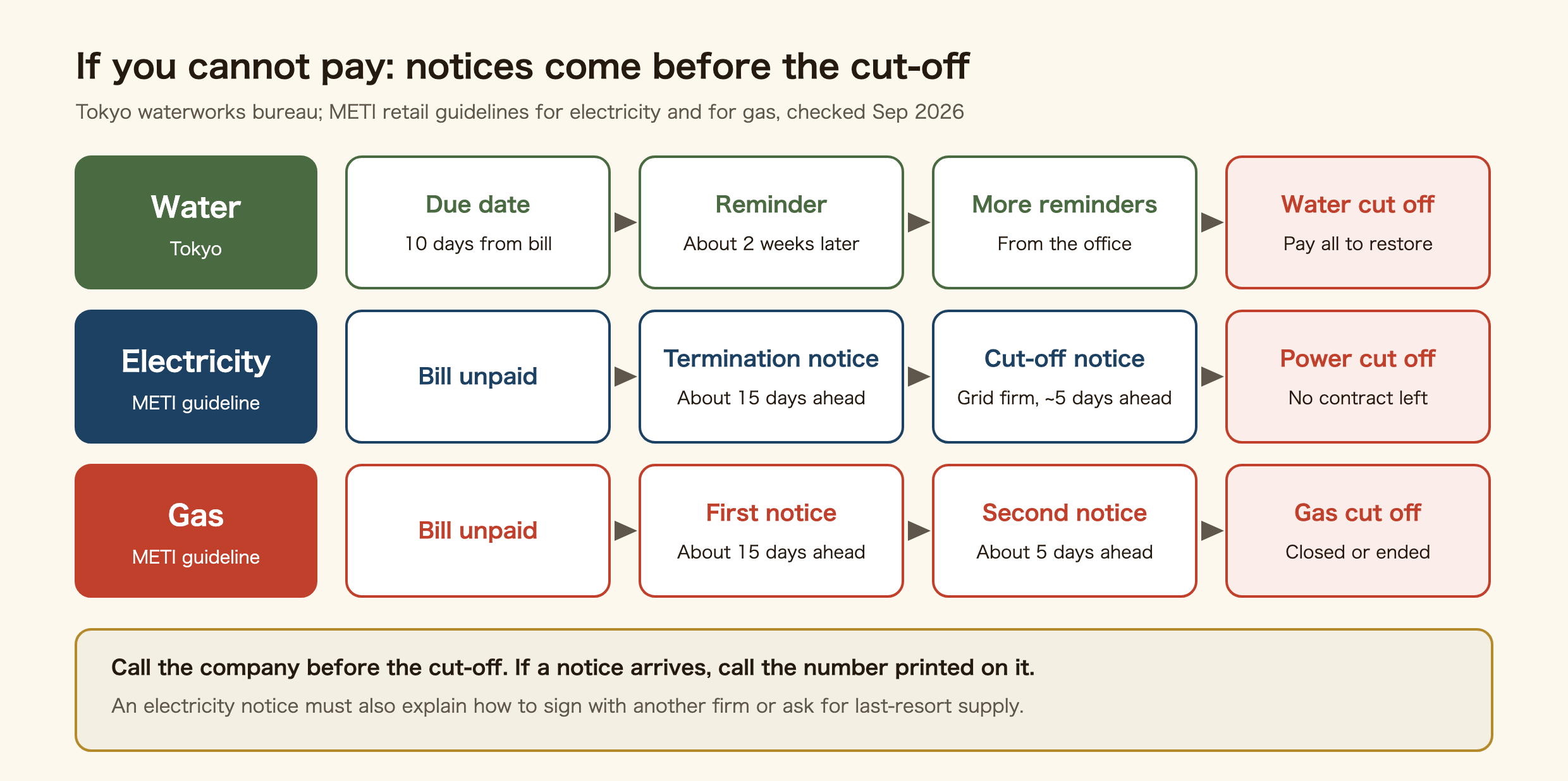
Missing a payment does not mean a cut-off the next day. Several written notices come first.
Tokyo water bills are due 10 days after the bill is sent. About two weeks after that, a payment reminder arrives. If you still do not pay after repeated reminders, the water is, as a rule, cut off. To restore it you must pay everything owed. If you still do not pay, the supply contract itself is ended.
For electricity, METI’s retail guideline sets the steps. When a bill goes unpaid, the retailer must give notice about 15 days before ending the contract, stating the date and the reason. Once the contract ends, the grid company must give notice of the cut-off date about 5 days ahead. The notice must explain that supply stops without a contract, and how to apply for last-resort supply. Gas follows its own METI guideline, with notices about 15 days and about 5 days before the cut-off.
The best move is to call the company that sent the bill before any notice arrives, and tell them when you can pay. If a cut-off notice has already come, call the number printed on it. Sendai City Gas says that once you have paid, you call with the receipt ready and they arrange to restore the gas.
Someone at my door is selling electricity. What do I do?
The National Consumer Affairs Center names this exact trick in its leaflet for foreign residents (February 2025, in Japanese and nine other languages including English):
- “The whole apartment building is switching electricity contract”, “the management company sent me” and “you will pay less” are all given as lies
- Do not show your meter-reading slip. It holds the details needed to switch your contract
- It often happens right after people move in, and some callers claim to be from gas, water-heater or battery companies
The Electricity and Gas Market Surveillance Commission lists more false claims: that changing company means new power lines, that your power stops immediately if your company goes bust, and that a smart meter costs you money.
An electricity or gas contract signed at your door or over the phone can be cancelled under cooling-off within 8 days of receiving the paperwork (a few, such as the big regional companies’ regulated-rate contracts, are excluded). But cancelling does not bring back your old contract. You can be left with no contract, and supply can be stopped (METI guidelines). After you send the cooling-off notice, apply straight away to your old company or another one.
For electricity and city gas contracts, the commission’s consultation desk is on 03-3501-5725 (weekdays 9:30-18:15). For LPG, or if you are not sure where to go, call the consumer hotline 188. Phone and social-media scams aimed at foreign residents are covered in scams in Japan.
Which one are you?
- Still choosing a flat — ask the agent whether it is city gas or propane, and get the price list if it is propane. Today, email the agent for the flats on your list.
- Move-in date fixed — apply to the electricity company, the gas company and the waterworks bureau for supply from that day. Today, book the gas opening and keep that time free.
- Moving out or leaving Japan — give all three a stop date and decide how to pay the last bills. Today, write your move-out date in your calendar and add “call electricity, gas, water” a week before it.
- Cannot pay this month — call the company before any notice and tell them when you can pay. Today, ring the number on the bill in front of you.
FAQ
Q. How many days ahead should I set up utilities in Japan?
Call all three as soon as your move-in date is fixed, and at least a week ahead. Sendai City Gas asks for five working days and Otsu for five days; Tokyo water asks for three to four days. Electricity varies by company, so apply the same day.
Q. Do I have to be home when the gas is turned on in Japan?
Yes, but a landlord or building manager can stand in if you cannot. A technician tests for leaks and checks your appliances inside the flat, then explains safe use. It takes about 20 to 30 minutes (Sendai City Gas).
Q. What is the difference between propane and city gas for renters?
In a rented building on propane (LPG), you in practice cannot change the gas company after you move in. Get the price list from the agent before you sign. Since July 2024, an LPG company must answer if a prospective tenant asks it directly about prices.
Q. Can foreigners choose their electricity company in Japan?
Yes. Since April 2016, every household can choose its electricity company and plan. Before signing, check that it is a registered retailer and read the written terms on contract length and cancellation fees.
Q. When will my electricity or water be cut off if I cannot pay?
Not straight away. For electricity and gas, notices come about 15 days and about 5 days before a cut-off (METI guidelines). Tokyo water sends a reminder after the due date (10 days from the bill) and further reminders, and cuts off only if you still do not pay. Call the company before the notices start.
Q. How do I cancel utilities when I move out or leave Japan?
Give all three a stop date and settle how to pay the final bills. If you do not, the basic charge keeps running. If you are leaving Japan, finish on direct debit or card, or check whether you can pay on the closing day.
Summary
None of your utilities start on their own. Electricity goes to a company you choose, gas to the gas company, water to your city’s bureau. Booking the gas opening takes longest, so make all three calls the day your move-in date is fixed.
On propane, you cannot change the gas company once you live there, so get the price list before you sign. If a month goes badly, notices come before anything is cut off, and a call before them buys you time to talk. And you never need to show your meter slip to a stranger at the door.
Official sources: ANRE, electricity retail liberalisation FAQ (Japanese) / METI guideline on electricity retail (Japanese) / METI guideline on gas retail (Japanese) / METI, LPG rule changes (Japanese) / Consumer Affairs Agency, LPG prices for rented homes (Japanese) / Electricity and Gas Market Surveillance Commission, consultation desk (Japanese) / National Consumer Affairs Center, leaflets for foreign residents / Tokyo waterworks bureau, starting and stopping water (Japanese) / Osaka waterworks bureau FAQ (Japanese) / Sendai City Gas Bureau FAQ (Japanese) / Otsu City, water and gas start and stop (Japanese) / METI, July-September 2026 bill support (Japanese) / Statistics Bureau, Family Income and Expenditure Survey 2025. Checked on 23 September 2026. Lead times and methods vary by area, so confirm with your own companies and waterworks bureau.
Related reading
Found this useful? Share it
Send it to a friend who lives in Japan.
WHO WROTE THIS

mori
Japanese. I read the ministries’ own notices, orders and Q&As in the original, and I start from what my Nepalese and Sri Lankan friends in Japan actually ran into. I do not write about what I have not checked or been told.
What this site can and cannot do →Looking for something else?