Checked on 23 September 2026 against the Labor Standards Act (Art. 15) and its Enforcement Regulations (Art. 5), the Part-Time and Fixed-Term Employment Act on e-Gov, the Ministry of Health, Labour and Welfare’s leaflets and Q&A on stating working conditions, its model notices for foreign workers, its guideline on employing foreign workers, and its consultation lines.
The short answer
- In Japan, the document your employer must give you is the written statement of working conditions (rodo joken tsuchisho). A signed employment contract is not required by law; the written statement is.
- Six terms must be in writing: contract period, place and duties, working hours, days off, wages, and leaving the job. Since April 2024, the “scope of change” of place and duties and any renewal limit on a fixed-term contract are added.
- Part-time international students get one too. Part-time and fixed-term workers must also be told in writing whether there are raises, retirement pay and bonuses, and who to ask.
- If the job is not what was written, you may end the contract at once (Labor Standards Act Art. 15(2)). If you moved for the job and go home within 14 days, the employer pays the travel costs.
- The ministry’s model notice comes in 13 languages, including English, Vietnamese and Nepali. A free hotline answers in English on 0120-531-401.
Knowing this, you can spot “there is no paper” or “this is not what we agreed” before your first shift, not after the pay rate or hours have quietly changed. If the terms are wrong, you will also know whether you can leave and whom to call.
You passed the interview. The manager says, “Start next Monday. It’s 1,200 yen an hour.” Nothing is written down. You ask a Japanese friend whether you should get something on paper, and they shrug: “It’s just a part-time job.” They have never seen their own statement of working conditions either. A Japanese worker can argue their way out of a broken promise. You have a visa and a weekly hours limit to think about, and without paper you have nothing to point to when something goes wrong.
- What is an employment contract in Japan, and what must the employer give you?
- Written statement vs employment contract: what is the difference?
- What must a Japanese employment contract include? The six terms in writing
- Do part-time jobs and international students get written terms too?
- Is there an employment contract in English? The ministry’s model in 13 languages
- What should I check in my employment contract? Wages, hours, days off, insurance
- What if my employer never gave me a written contract?
- Can I quit immediately if the working conditions are different?
- Where can I get help, and does it cost anything?
- Which one are you?
- FAQ
- Q. Is an employment contract required in Japan?
- Q. What must a Japanese employment contract include?
- Q. Do part-time workers and international students get written terms?
- Q. Is there an English version of the employment contract in Japan?
- Q. Can I quit immediately if the working conditions are different from what I was told in writing?
- Q. Where can I get help in English with my working conditions?
- Summary
- Related reading
What is an employment contract in Japan, and what must the employer give you?
What Japanese law requires is not a contract you both sign. It is a document the employer hands you, stating your working conditions. Article 15 of the Labor Standards Act says that when an employer concludes an employment contract, it must state wages, working hours and other conditions to the worker. The most important of these must be given in writing.
The timing is “when the contract is concluded” — when you agree to the job — not some time after you start working.
Nationality makes no difference. Article 3 of the same Act bans discrimination in working conditions based on nationality. The ministry’s guideline for employers of foreign workers also tells them to give the main working conditions in writing.
Written statement vs employment contract: what is the difference?
| Written statement of working conditions | Employment contract | |
|---|---|---|
| Who makes it | The employer gives it to you | You and the employer both sign |
| Required by law? | Yes (Labor Standards Act Art. 15) | No |
| If missing | Fine of up to 300,000 yen (Art. 120) | No penalty |
A contract of employment exists once both sides agree that you will work and be paid (Labor Contract Act Art. 6). The Hyogo Labour Bureau explains that a spoken agreement is still a valid contract. So “no paper” does not mean “no contract”. It means that proving what was promised becomes hard.
The Labor Contract Act also says both sides should confirm the terms in writing as far as possible (Art. 4(2)). Some employers use a single sheet that is both: a “written statement of working conditions and employment contract”. Whatever it is called, it satisfies the legal duty if the required terms are in it. Look for the six terms, not the title.
What must a Japanese employment contract include? The six terms in writing
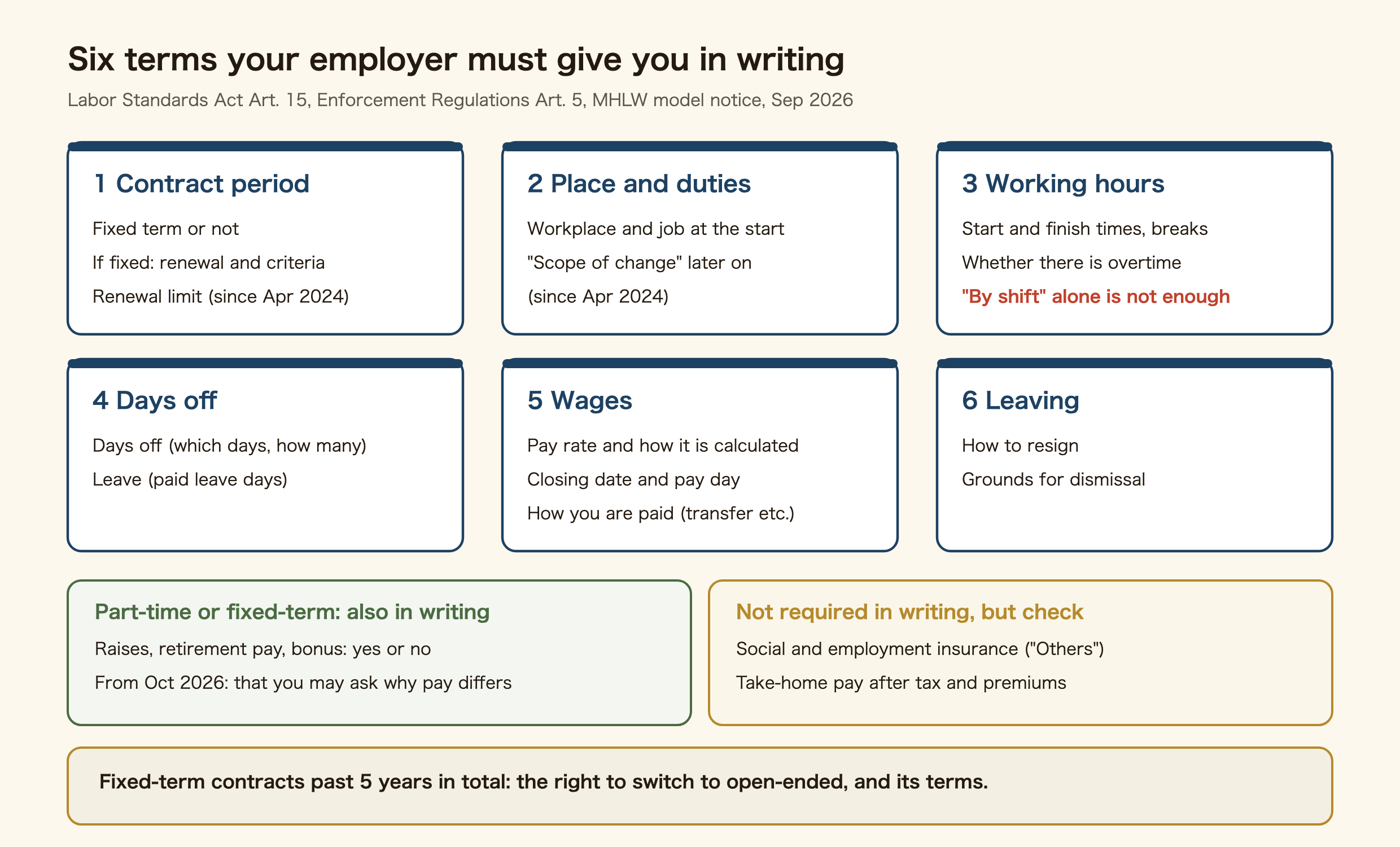
The terms that must be in writing are set by Article 5 of the Enforcement Regulations. Grouped into six, they are:
- Contract period — open-ended or fixed. If fixed, whether it is renewed and on what criteria
- Place of work and duties
- Working hours — start and finish times, breaks, whether there is overtime, and how shifts rotate
- Days off and leave
- Wages — how they are set, calculated and paid, the closing date and the pay day
- Leaving — how to resign, and the grounds for dismissal
Pay raises must be stated, but not necessarily in writing. Retirement pay, bonuses, leave of absence and similar schemes must be stated if the company has them, and that can be done verbally.
Four items were added from 1 April 2024 (MHLW):
- Every contract: the “scope of change” for place and duties — how far they might change later, for example through a transfer
- Fixed-term contracts: whether there is a limit on renewals (total years or number of renewals), and what it is
- At the renewal where you gain the right to switch to an open-ended contract after more than five years in total: that you can apply
- At the same renewal: the working conditions after the switch
The new rules apply to contracts concluded on or after 1 April 2024. Employers do not have to reissue terms to people already working. But renewing a fixed-term contract counts as concluding a new one, so each renewal must follow the new rules.
Do part-time jobs and international students get written terms too?
Yes. The Labor Standards Act applies to part-timers exactly as to full-time staff. Students working on a permission to engage in activity outside their status are covered too.
Part-time and fixed-term workers get four more items under Article 6 of the Part-Time and Fixed-Term Employment Act: whether there are raises, whether there is retirement pay, whether there are bonuses, and a contact for consultation. These must also be given in writing (or by email if you ask), and an employer who fails can be fined up to 100,000 yen as an administrative penalty. From 1 October 2026 a fifth item is added: that you may ask for the content of, and reasons for, any difference in treatment compared with regular staff (the rules have already been amended).
If you work shifts, look at the hours section. The ministry’s guidance on shift work says writing only “according to the shift” is not enough. The employer must give the start and finish times for days already decided, or state standard times and hand over the first shift schedule with the contract.
The same guidance suggests agreeing in advance on the maximum days and hours you might be scheduled in a period, and a rough target. On a student status, that line is useful. If a shift pushes you past the 28-hour weekly limit, it is your status at risk, not the shop’s. A maximum set inside 28 hours, on paper, gives you something to point to when you say no.
Is there an employment contract in English? The ministry’s model in 13 languages
Yes. The Ministry of Health, Labour and Welfare publishes a model written statement for foreign workers in 13 languages: English, Chinese, Korean, Portuguese, Spanish, Tagalog, Indonesian, Vietnamese, Khmer, Mongolian, Burmese, Nepali and Thai.
The English version, titled “Notice of Employment”, sets English and Japanese side by side in each field. It already has the April 2024 fields, “Scope of change” and “Renewal limit”. If you receive a statement in Japanese only, download the version in your language and match the fields in order. That tells you what each line of your own document means.
Your employer is not required to give you the statement in your language. The ministry’s guideline asks employers to make an effort to state conditions in a way you understand, such as using the model notice or explaining in your native language or plain Japanese. You can ask, “Could you explain this using the English version?”
What should I check in my employment contract? Wages, hours, days off, insurance
Six terms on paper mean nothing unless you read them. Before your first day, check at least these four.
- Wages — the hourly or monthly rate, the closing date and the pay day. If the rate is below your prefecture’s minimum wage, that part is void and you are treated as hired at the minimum wage
- Hours — start and finish, breaks, overtime. On a student status, whether the weekly total stays within 28 hours
- Days off and leave — which days or how many, and how many days of paid leave you get
- Social and employment insurance — whether you will be enrolled. The model notice has this under “Others”
Insurance is not one of the terms that must be in writing, but it changes your take-home pay. The ministry’s guideline asks employers explaining wages to cover tax, insurance premiums and other deductions too, so that you know what you will actually receive. It is fair to ask, “How much is deducted each month, and how much will I get?” Whether a student’s part-time job comes with social insurance is explained in student part-time work and social insurance.
Some lines should worry you. A promise like “if you quit early you pay a penalty of X yen” is banned by Article 16 of the Labor Standards Act. Any term worse than the law’s minimum is void for that part, even if it is written down (Art. 13).
What if my employer never gave me a written contract?
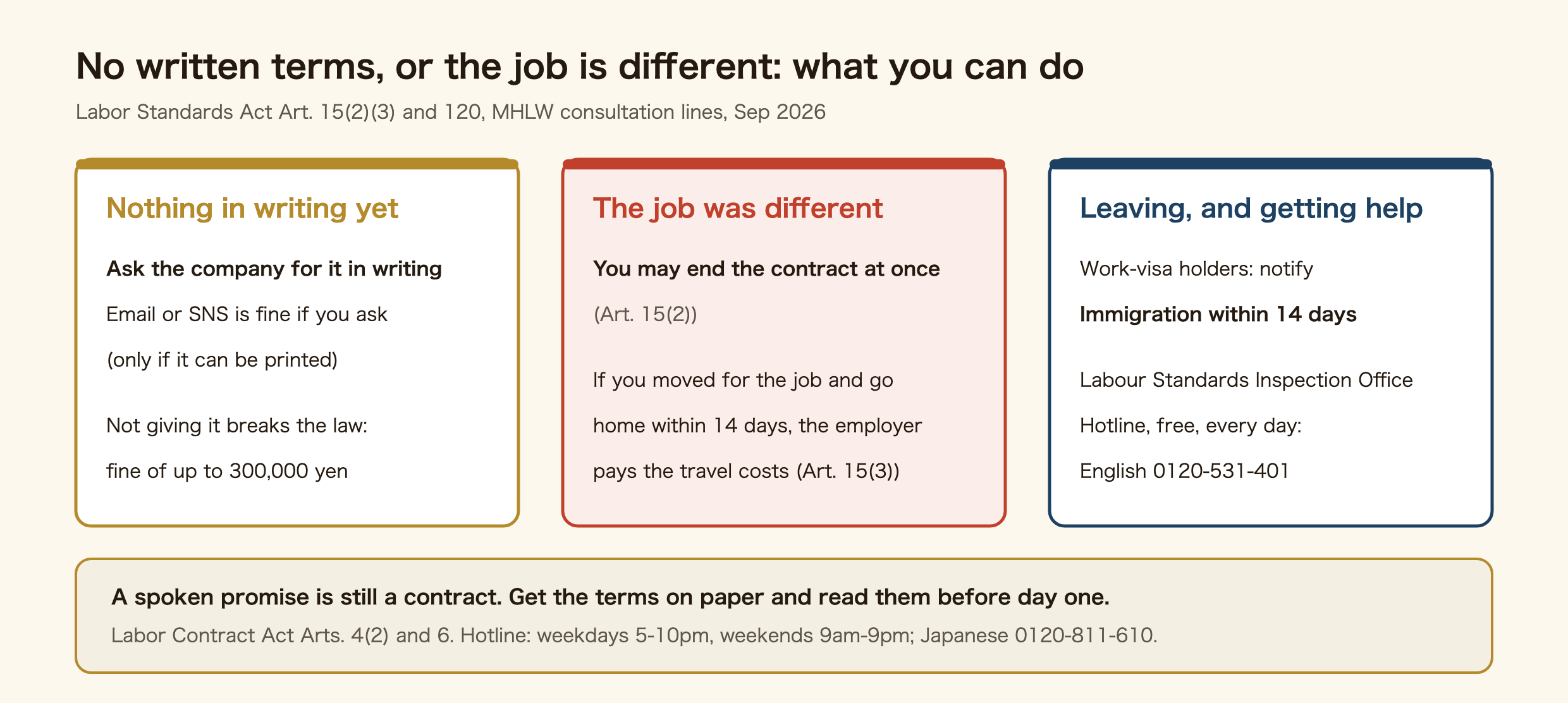
Not giving you the required terms in writing breaks Article 15(1) of the Labor Standards Act. The penalty is a fine of up to 300,000 yen (Art. 120). Part-time, full-time, it does not matter: ask the company, “Please give me my working conditions in writing.” You can ask as soon as you receive a job offer.
It does not have to be on paper. If you ask for it, the employer can send it by fax, email or an SNS message, as long as you can print it out. Being shown a screen that never reaches you does not count.
If nothing comes, you can go to the Labour Standards Inspection Office for the area where the company is. To talk in English, use the lines further down.
Can I quit immediately if the working conditions are different?
Yes. Article 15(2) of the Labor Standards Act says that if the stated conditions turn out to be different from the facts, you may terminate the contract immediately. For example, the paper said 1,200 yen an hour and you are paid 1,000, or it said three days a week and you are rostered every day.
There is a rule on travel costs too (Art. 15(3)). If you moved home for the job and return home within 14 days of the day you end the contract, the employer must pay the necessary travel costs. The 14 days count from the day you end the contract. What counts as “necessary travel costs” in your case is a question for the Labour Standards Inspection Office.
Your residence status is a separate matter. If you work on a status such as Engineer/Specialist in Humanities/International Services or Specified Skilled Worker, you must notify Immigration within 14 days of leaving. The steps are in leaving a job in Japan as a foreigner. If you are a student leaving a part-time job, start the paper check again from the beginning at the next one.
You do not have to leave. You can also ask for the conditions to be corrected. If you are owed the difference in pay, start with one of the consultation lines.
Where can I get help, and does it cost anything?
- Working Conditions Consultation Hotline — run for the ministry, free to call. Weekdays 5pm to 10pm, weekends and holidays 9am to 9pm. English 0120-531-401, Chinese 0120-531-402 and Japanese 0120-811-610 every day. Other languages are answered on set days (13 foreign languages in all)
- Labour Standards Inspection Offices and the Foreign Workers’ Consultation Corners at prefectural labour bureaus — for help in person. The ministry’s “Check your working conditions” site lists where foreign-language help is available, by prefecture
- Foreign Workers’ Consultation Dial — weekdays 10am to 3pm (not 12 to 1). English 0570-001-701 and others. Call charges apply: 9.35 yen per 180 seconds from a landline, 11 yen per 20 seconds from a mobile
Have three things ready when you call: the statement you were given (or the fact that you were not given one), your payslips, and a record of your shifts or hours. If the terms were sent by LINE or email, those screens are records too.
Which one are you?
- About to start a job — before your first day, ask for the written statement of working conditions. When you get it, read the six terms and the four checks: wages, hours, days off, insurance.
- Already working, with nothing in writing — today, ask the company for the terms in writing or by email. If nothing comes, call the hotline on 0120-531-401.
- The job is not what was written — write down the differences and keep your payslips next to the statement. Talk to the Labour Standards Inspection Office or the hotline before deciding whether to stay or leave.
- A student whose shifts may go over 28 hours — ask for a weekly maximum inside 28 hours, and keep that promise on paper or in a message.
FAQ
Q. Is an employment contract required in Japan?
A signed contract is not required by law. What is required is a written statement of working conditions from the employer (Labor Standards Act Art. 15), and not giving one can mean a fine of up to 300,000 yen. Some employers combine the two in one document.
Q. What must a Japanese employment contract include?
The written statement must cover the contract period and renewal criteria, place of work and duties, working hours and overtime, days off and leave, wages and pay day, and leaving the job. Since April 2024 it must also state the scope of change of place and duties and any renewal limit on a fixed-term contract.
Q. Do part-time workers and international students get written terms?
Yes. Part-time and fixed-term workers must also be told in writing whether there are raises, retirement pay and bonuses, and who to consult. For shift work, writing only “according to the shift” is not enough.
Q. Is there an English version of the employment contract in Japan?
The Ministry of Health, Labour and Welfare publishes a model written statement for foreign workers in 13 languages, and the English version shows English and Japanese side by side. Employers are not required to use your language, but the ministry’s guideline asks them to make an effort to explain in a way you understand.
Q. Can I quit immediately if the working conditions are different from what I was told in writing?
Yes. Under Article 15(2) of the Labor Standards Act, you may end the contract immediately if the stated conditions differ from the facts. If you moved for the job and go home within 14 days, the employer must pay the necessary travel costs.
Q. Where can I get help in English with my working conditions?
The free Working Conditions Consultation Hotline answers in English on 0120-531-401 every day, on weekdays from 5pm to 10pm and on weekends and holidays from 9am to 9pm. You can also go to the Labour Standards Inspection Office.
Summary
In Japan, the document your employer must give you is a written statement of working conditions. A signed contract is optional, and the title matters less than what is inside: contract period, place and duties, hours, days off, wages and leaving the job, all in writing.
Part-time students are covered too, and part-timers get extra items. If you have nothing in writing, ask for it. If the job is not what was written, you can end the contract at once. When in doubt, a free hotline answers in English. Get the paper first, then start work.
Official sources: Labor Standards Act, Arts. 3, 13, 15, 16, 120 (e-Gov, Japanese) / Enforcement Regulations of the Labor Standards Act, Art. 5 (e-Gov, Japanese) / Part-Time and Fixed-Term Employment Act, Arts. 6, 31 (e-Gov, Japanese) / Labor Contract Act, Arts. 4, 6 (e-Gov, Japanese) / MHLW, changes to stating working conditions from April 2024 (Japanese) / MHLW, part-time and fixed-term rules from 1 October 2026 (Japanese) / MHLW, model Notice of Employment for foreign workers (English) / MHLW, guideline on employing foreign workers (Japanese) / MHLW, shift work (Japanese) / MHLW, consultation for foreign workers / Hyogo Labour Bureau, employment contracts and stating conditions (Japanese). All checked on 23 September 2026.
Related reading
Found this useful? Share it
Send it to a friend who lives in Japan.
READ THIS NEXT
After Japanese Language School →A language school has no job pipeline, and that is not because you are behind.WHO WROTE THIS

mori
Japanese. I read the ministries’ own notices, orders and Q&As in the original, and I start from what my Nepalese and Sri Lankan friends in Japan actually ran into. I do not write about what I have not checked or been told.
What this site can and cannot do →Looking for something else?