Checked on 23 September 2026 against the National Police Agency’s bicycle portal and Bicycle Rulebook (September 2025), Government of Japan PR Online, and the Tokyo Metropolitan Police bicycle pages.
The short answer
- Since 1 April 2026, cyclists in Japan can get a “blue ticket” for traffic violations. It applies to anyone aged 16 or over, foreign or Japanese.
- The rules themselves did not change. What changed is what happens after you are caught: pay the fine and there is no court case and no criminal record.
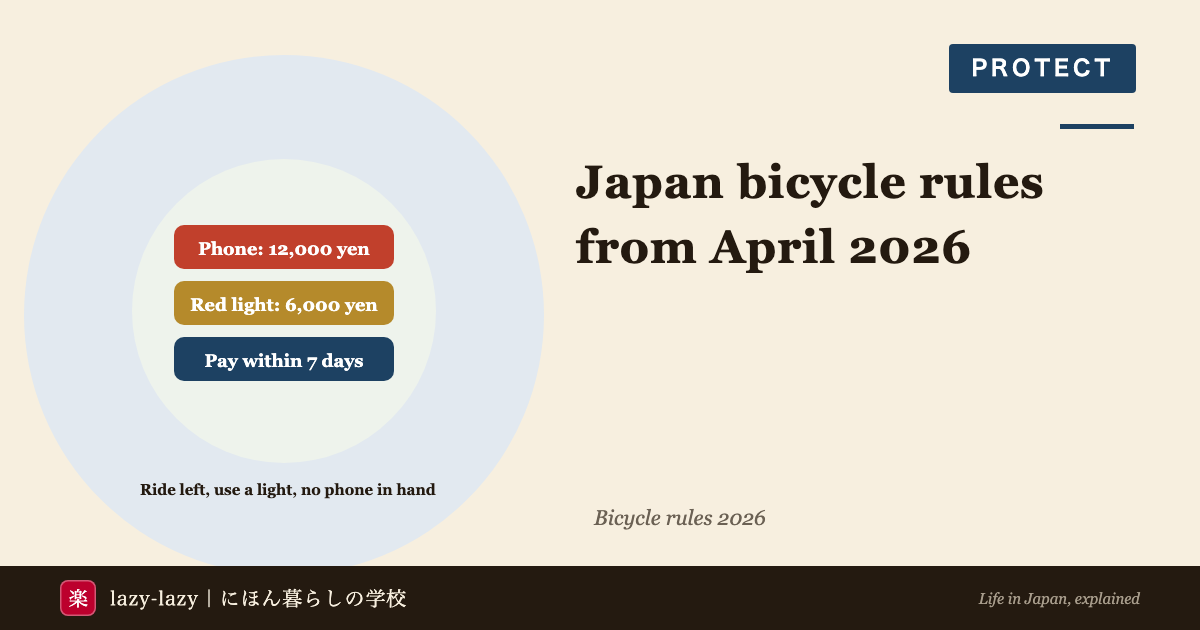
- Fines include 12,000 yen for holding a phone while riding, 6,000 yen for running a red light or riding on the right, 5,000 yen for not stopping at a stop sign or riding without a light, and 3,000 yen for carrying a passenger or riding side by side.
- Drink-cycling gets a red ticket, not a blue one — criminal proceedings, up to three years in prison or a 500,000 yen fine.
- Police start with a warning. Tickets are for dangerous riding, or for carrying on after being warned.
Knowing this, you can see exactly where your daily ride to school, work or deliveries could cost you, and fix three things today: ride on the left of the road, use a proper light, and keep the phone in your pocket. If you do get a ticket, you will know what to do within seven days.
Late at night after your shift. You ride on the pavement, then turn at a red light while checking the map on your phone. Back home, nobody would look twice. Here a police officer waves you down. Your Japanese friend says, “They don’t stop bicycles.” Until March 2026, plenty of people thought so.
- What changed for bicycles in Japan in April 2026?
- How much are the bicycle fines?
- When do police actually give a ticket?
- Which offences get a red ticket?
- Can I ride on the pavement?
- Lights, umbrellas, earphones and helmets
- I got a blue ticket. What now?
- Does a bicycle ticket affect my visa?
- What does it cost?
- Which one are you?
- FAQ
- Summary
- Related reading
What changed for bicycles in Japan in April 2026?
A blue ticket is the notice you are given under Japan’s traffic infraction system: pay the fine and the case ends without a trial. Cars and motorbikes have had it for years. From 1 April 2026, it applies to bicycles too (National Police Agency).
Before that, a cyclist caught for a violation went through criminal procedure, the so-called red ticket: questioning, appearing in person, and a criminal record if convicted. With a blue ticket, paying the fine is the end of it. The procedure is lighter, which also makes it easier for police to process violations.
It applies to riders aged 16 and over. Under-16s mostly still get warnings. The Tokyo Metropolitan Police stress that the bicycle rules themselves have not changed. Things that were already illegal now come with a price.
The same Road Traffic Act applies to everyone on Japanese roads, whatever their nationality. The Tokyo police publish their guidance on the new system in English, Chinese and Korean as well.
How much are the bicycle fines?
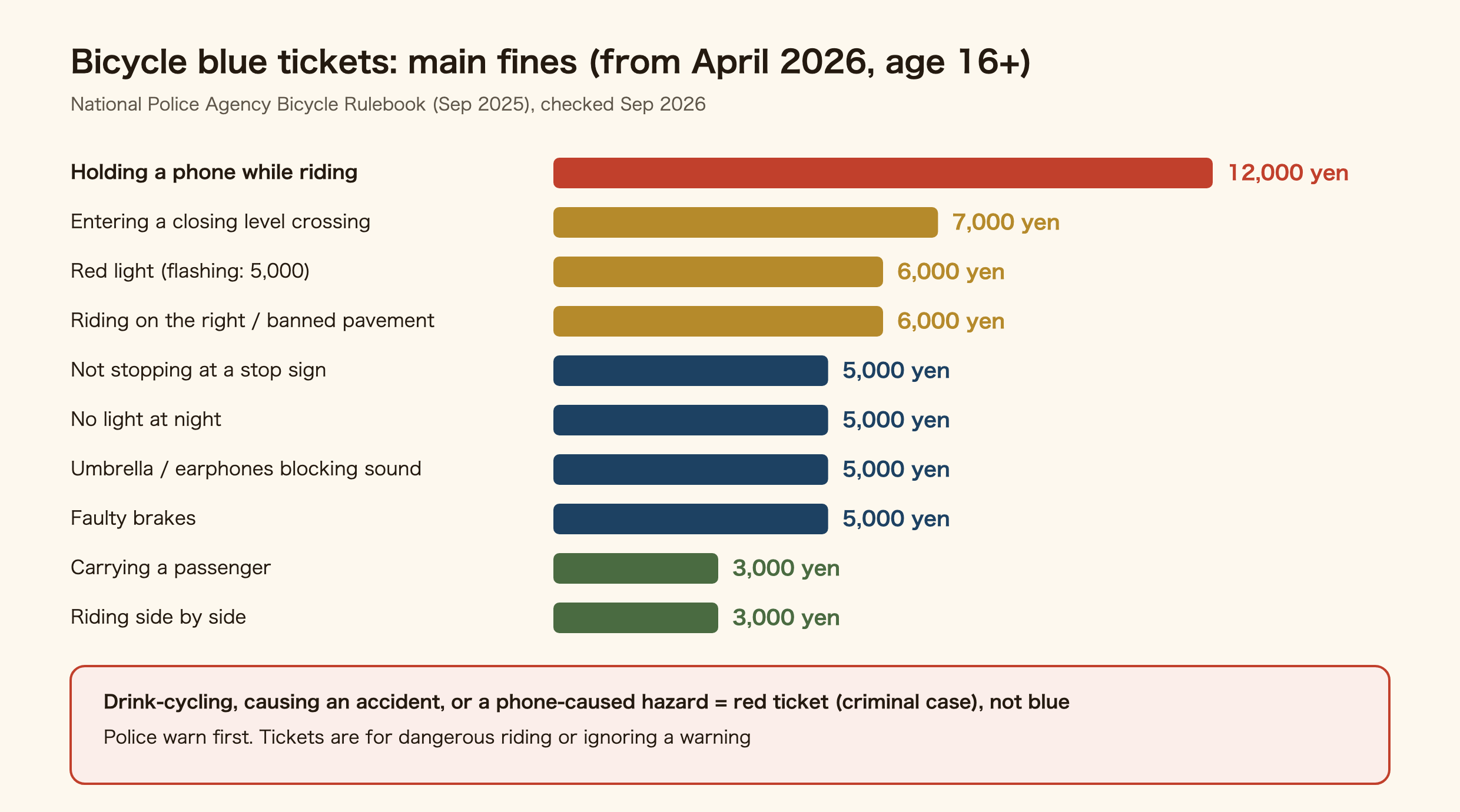
These are the fines for common violations as set out in the National Police Agency’s Bicycle Rulebook.
| Violation | What it means | Fine |
|---|---|---|
| Phone use (holding) | Talking on or looking at a phone held in your hand while riding | 12,000 yen |
| Entering a closed level crossing | Going onto a railway crossing when the barrier is coming down or the alarm is ringing | 7,000 yen |
| Signal violation | Going through a red light (flashing signal: 5,000 yen) | 6,000 yen |
| Wrong part of the road | Riding on the right (against traffic), or on a pavement where cycling is not allowed | 6,000 yen |
| Obstructing pedestrians crossing | Getting in the way of people on a pedestrian crossing | 6,000 yen |
| Not stopping at a stop sign | Rolling through a 止まれ (tomare) sign | 5,000 yen |
| No light | Riding without a light at night | 5,000 yen |
| Prefectural safety rules | Holding an umbrella, or wearing earphones so you cannot hear what is around you | 5,000 yen |
| Faulty brakes | Riding a bicycle with no brakes or broken brakes | 5,000 yen |
| Passenger limit | Carrying someone on your bicycle | 3,000 yen |
| Riding side by side | Two or more cyclists riding abreast | 3,000 yen |
| Pavement riding rules | Not slowing down on the road side of a pavement, or not stopping for pedestrians | 3,000 yen |
The highest in this table is the 12,000 yen for riding with a phone in your hand. Using it while stopped is fine. If you need the map, pull over first.
When do police actually give a ticket?
The police approach has not changed with the blue ticket. When officers see a violation, they first give a warning on the spot. They make an arrest for violations that are dangerous enough to cause accidents. The National Police Agency gives examples like these.
- Your violation made a pedestrian stop or a car brake suddenly
- You are doing two violations at once (an umbrella and a missed stop sign, a passenger and a red light)
- You kept riding on the right after an officer warned you
- You ran a red light even though you could see an officer there
- Phone use while riding, entering a closed level crossing, faulty brakes (dangerous in themselves)
Enforcement focuses on the morning commute and on dusk, when accidents are most common.
Which offences get a red ticket?
Serious violations are not covered by the blue ticket. They still go through criminal procedure.
- Riding with alcohol in your system — up to three years’ imprisonment or a fine of up to 500,000 yen. Riding while drunk: up to five years or up to 1,000,000 yen (Tokyo Metropolitan Police). People who serve the alcohol or lend the bicycle are punished too
- Phone use that actually creates a traffic hazard — up to one year’s imprisonment or a fine of up to 300,000 yen
- A violation that actually causes an accident — for example riding no-hands and hitting a pedestrian
- Obstructive (road-rage) riding
A red ticket is a criminal case. A fine at that stage is a criminal record.
Can I ride on the pavement?
A bicycle is a vehicle. The rule is the left side of the road. Riding on the right is riding against traffic: 6,000 yen.
You may ride on the pavement only when:
- a sign or road marking says bicycles may use the pavement (普通自転車歩道通行可)
- the rider is under 13, 70 or over, or has certain physical disabilities
- it cannot be helped — road works or parked cars block the left of the road, or traffic is very heavy on a narrow road
On the pavement, ride on the road side at a speed where you can stop at once, and stop if you would get in a pedestrian’s way. On the road, follow the traffic lights for vehicles; on the pavement, follow the pedestrian lights. If there is a “pedestrians and bicycles” signal, follow that (Tokyo Metropolitan Police).
Lights, umbrellas, earphones and helmets
- Lights — always on at night (5,000 yen if not). The Tokyo police point out that a flashing light alone does not count as a headlight. Use one bright enough to show an obstacle 10 metres ahead
- Umbrellas and earphones — riding with an umbrella, or with earphones so you cannot hear around you, is banned in every prefecture (5,000 yen). Wear a raincoat instead
- Helmets — you are required to make an effort to wear one. There is no fine. But among cyclists with head injuries, those without a helmet died at about 1.4 times the rate of those wearing one (Government PR Online)
A “pedal e-bike” (moped) that looks like a power-assisted bicycle is legally a moped, not a bicycle. It needs a licence, a number plate and a helmet. Before you buy an electric bicycle, check it has a TS or BAA mark as a power-assisted bicycle.
I got a blue ticket. What now?
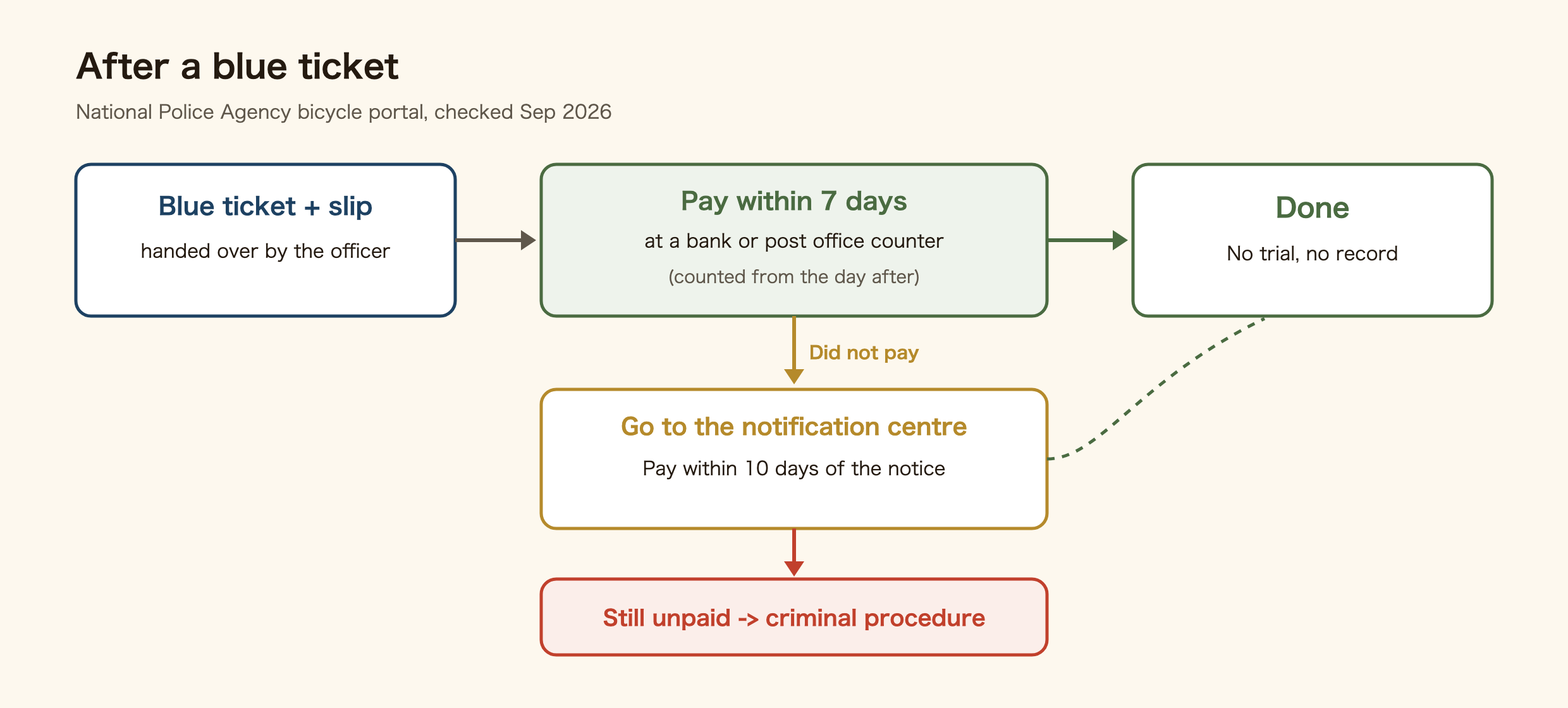
- The officer gives you the blue ticket and a payment slip
- If you accept the violation, take the slip to a bank or post office counter and pay within seven days, counted from the day after you were stopped (provisional payment). That is the end of it: no trial, no criminal record
- If you do not pay in time, go to the traffic infraction notification centre on the date written on the ticket to receive a notice and a new slip. Pay within ten days of the notice and the case ends the same way
- If you still do not pay, the case moves to criminal procedure
Ignoring the ticket is a costly choice. Something that could have ended with a fine turns into a criminal case.
Does a bicycle ticket affect my visa?
If you pay the blue-ticket fine, there are no criminal proceedings and no criminal record (National Police Agency). If you hold a driving licence, bicycle violations do not add points to it, although serious violations or accidents can lead to a licence suspension.
Immigration reviews look at more than a criminal record, though. For permanent residency, good conduct is a requirement, and repeated minor traffic violations over the past five years are looked at. A red ticket that ends in a fine, such as for drink-cycling, is a criminal punishment, and the Immigration Services Agency’s published renewal refusal cases include refusals after a fine. How blue tickets are weighed in a review has not been published.
Repeat offenders face one more step. Riders aged 14 or over caught twice within three years for any of 16 violation types, such as signal violations or riding on the right, are ordered to take a cyclist safety course. Skipping it can mean a fine of up to 50,000 yen.
What does it cost?
Fines run from 3,000 to 12,000 yen, as in the table. The bigger risk is an accident. Courts have ordered cyclists who injured someone to pay damages in the tens of millions of yen (Government PR Online). Some prefectures make bicycle liability insurance compulsory by ordinance (National Police Agency). Check the rule where you live, and get cover if you do not have it.
If you are hurt on the way to or from work, or while working, your treatment can be covered by work injury insurance (rosai).
Which one are you?
- You ride every day — from today, ride on the left of the road, use a steady light at night, and look at your phone only when stopped.
- You deliver or commute by bicycle for work — the costly ones are phone use (12,000 yen) and red lights (6,000 yen). Stop to check the map. Check you have bicycle insurance.
- You got a blue ticket — take the slip to a bank or post office within seven days. Do not ignore it.
- You are buying an electric bicycle — look for a TS or BAA mark. A pedal e-bike needs a licence and a number plate.
FAQ
Q. When did blue tickets for bicycles start in Japan, and who do they apply to?
From 1 April 2026, for cyclists aged 16 and over. Foreign residents and Japanese nationals alike. Under-16s mostly still get warnings.
Q. How much are bicycle fines in Japan?
12,000 yen for holding a phone, 7,000 yen for entering a closed level crossing, 6,000 yen for a red light or riding on the right, 5,000 yen for a missed stop sign, no light, an umbrella or earphones, and 3,000 yen for a passenger or riding side by side, among others.
Q. Will I get a ticket for any violation?
Police start with a warning. Tickets are for dangerous cases, such as making a pedestrian stop, making a car brake, or carrying on after a warning.
Q. How do I pay a bicycle blue ticket?
Take the payment slip to a bank or post office counter within seven days from the day after you were stopped. Paying ends the case with no trial and no criminal record. If you never pay, it moves to criminal procedure.
Q. What happens if I cycle after drinking?
It is a red ticket, not a blue one: criminal proceedings. Riding with alcohol in your system can mean up to three years in prison or a 500,000 yen fine; riding drunk, up to five years or 1,000,000 yen.
Q. Can I ride my bicycle on the pavement in Japan?
Normally no; ride on the left of the road. You may use the pavement where a sign allows it, if you are under 13 or 70 or over, or when the road is unsafe — and then only slowly, on the road side.
Summary
Since April 2026, cyclists in Japan can be given blue tickets. The rules are the same as before; what changed is what happens after you are stopped. Ride on the left, use a steady light at night, and keep the phone out of your hand. That covers most of the table.
Pay a ticket within seven days and it is over, with no criminal record. Drink-cycling is a red-ticket criminal case. Accident damages can dwarf any fine, so check your bicycle insurance too.
Official sources: National Police Agency, the new bicycle system (Japanese) / NPA, enforcement (Japanese) / NPA Bicycle Rulebook (PDF, Japanese) / Government of Japan PR Online on bicycle blue tickets (Japanese) / Tokyo Metropolitan Police, traffic rules (English). Checked on 23 September 2026.
Related reading
Found this useful? Share it
Send it to a friend who lives in Japan.
WHO WROTE THIS

mori
Japanese. I read the ministries’ own notices, orders and Q&As in the original, and I start from what my Nepalese and Sri Lankan friends in Japan actually ran into. I do not write about what I have not checked or been told.
What this site can and cannot do →Looking for something else?