Figures, prices and terms were checked against the draft guidelines published on e-Gov (case 315000141, still a draft at the time; public comment ran until 3 September 2026, and the guidelines were adopted without changes on 1 October 2026) on 25 August 2026. They change — check the current terms yourself before you sign up or file anything.
Last updated: 25 August 2026
Summary
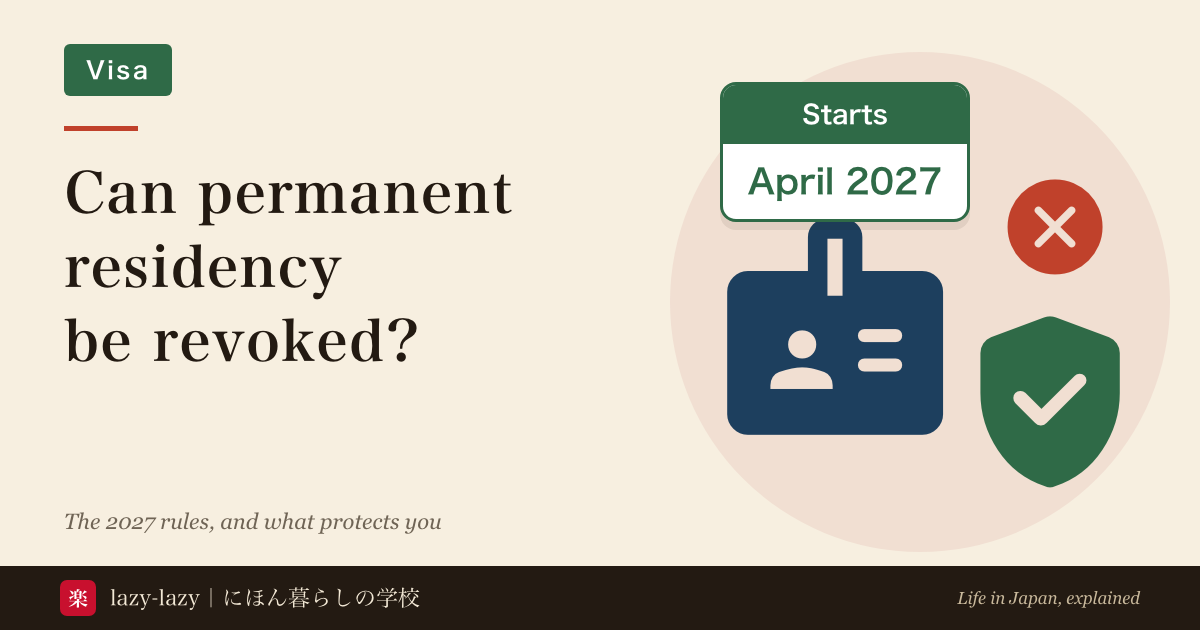
- From April 2027, permanent residence in Japan can be revoked. Draft guidelines on how that will work were published on 4 August 2026 and adopted without changes on 1 October 2026.
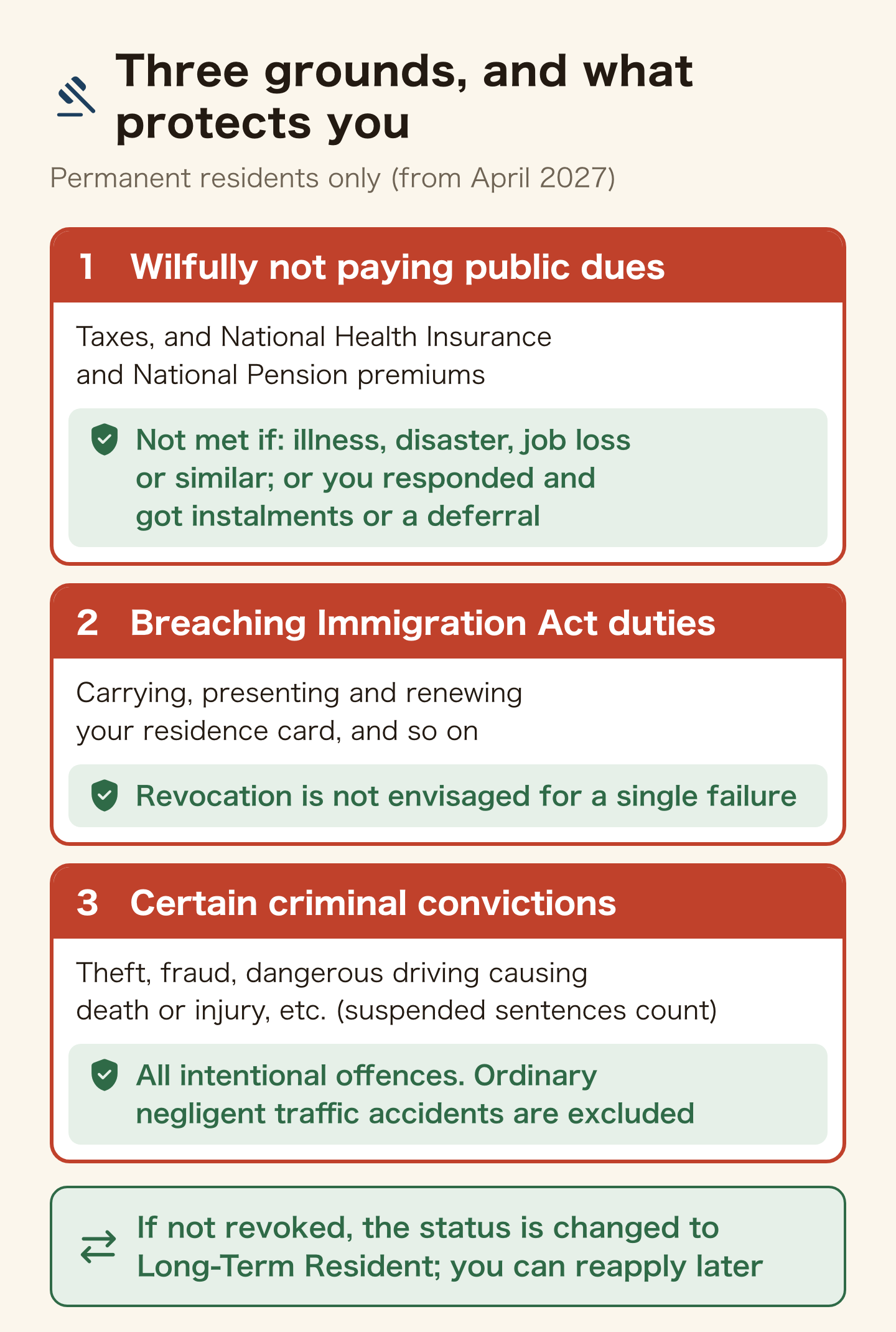
- Three grounds: unpaid taxes and social insurance premiums, breaches of Immigration Act duties, and certain criminal convictions. The premiums include National Health Insurance and the National Pension.
- Being unable to pay is not itself a ground. The draft lists four situations that explicitly do not qualify, one being “granted instalments or a deferral”.
- Forgetting your residence card once will not cost you your status. The draft states plainly that revocation “is not envisaged on the basis of a single failure to fulfil a duty”.
- Short of revocation, your status is changed ex officio to “Long-Term Resident”, and you can apply for permanent residence again once you meet the requirements.
What changes: you know that being on an instalment or deferral plan is not a ground for revocation – so you never take the one dangerous route: silence.
Revocation of status of residence means the state withdrawing the residence status you hold. The 2024 amendment to the Immigration Act added three grounds that apply to permanent residents only (Immigration Services Agency, draft guidelines on revoking permanent resident status, full text (e-Gov, PDF, Japanese)), taking effect in April 2027. Getting permanent residence in the first place is covered separately.
- What can get permanent residency revoked?
- Will I lose it if I cannot pay?
- How much do I have to owe before it is a problem?
- Some things are not “public dues” at all
- What if I just forget my residence card?
- Does a suspended sentence count?
- If it is revoked, do I have to leave Japan?
- Will someone report me?
- Frequently asked questions
- Q. When can permanent residency start being revoked in Japan?
- Q. Can I lose permanent residency for not paying pension contributions?
- Q. How much do I need to owe before permanent residency is at risk?
- Q. Can I lose my status for forgetting my residence card?
- Q. Does a suspended sentence count?
- Q. If my permanent residency is revoked, must I leave Japan?
- Q. Do unpaid traffic fines count?
- In short
- Related guides
What can get permanent residency revoked?
Three grounds were added. All of them apply to permanent residents alone and not to other statuses.
| Ground | What it covers |
|---|---|
| Wilfully failing to pay public dues | Taxes and premiums, including National Health Insurance and the National Pension |
| Breaching Immigration Act duties | Carrying and presenting your residence card, renewing its validity, not forging it |
| Certain criminal convictions | Theft, fraud, extortion, homicide, injury, dangerous driving causing death or injury. Suspended sentences count |
Will I lose it if I cannot pay?
The months you cannot pay pile up, and you tell no one, waiting for the day you can. Where you are from, that may be the most tactful way to handle it. In Japan, when it comes to keeping permanent residence, the silent waiting is the dangerous part.
This is the part worth reading twice. Being unable to pay is not itself a ground for revocation. (Immigration Services Agency, Q&A on the permanent residence reform (Japanese))
The draft lists four situations that explicitly do not qualify.
Four situations the draft says do NOT qualify
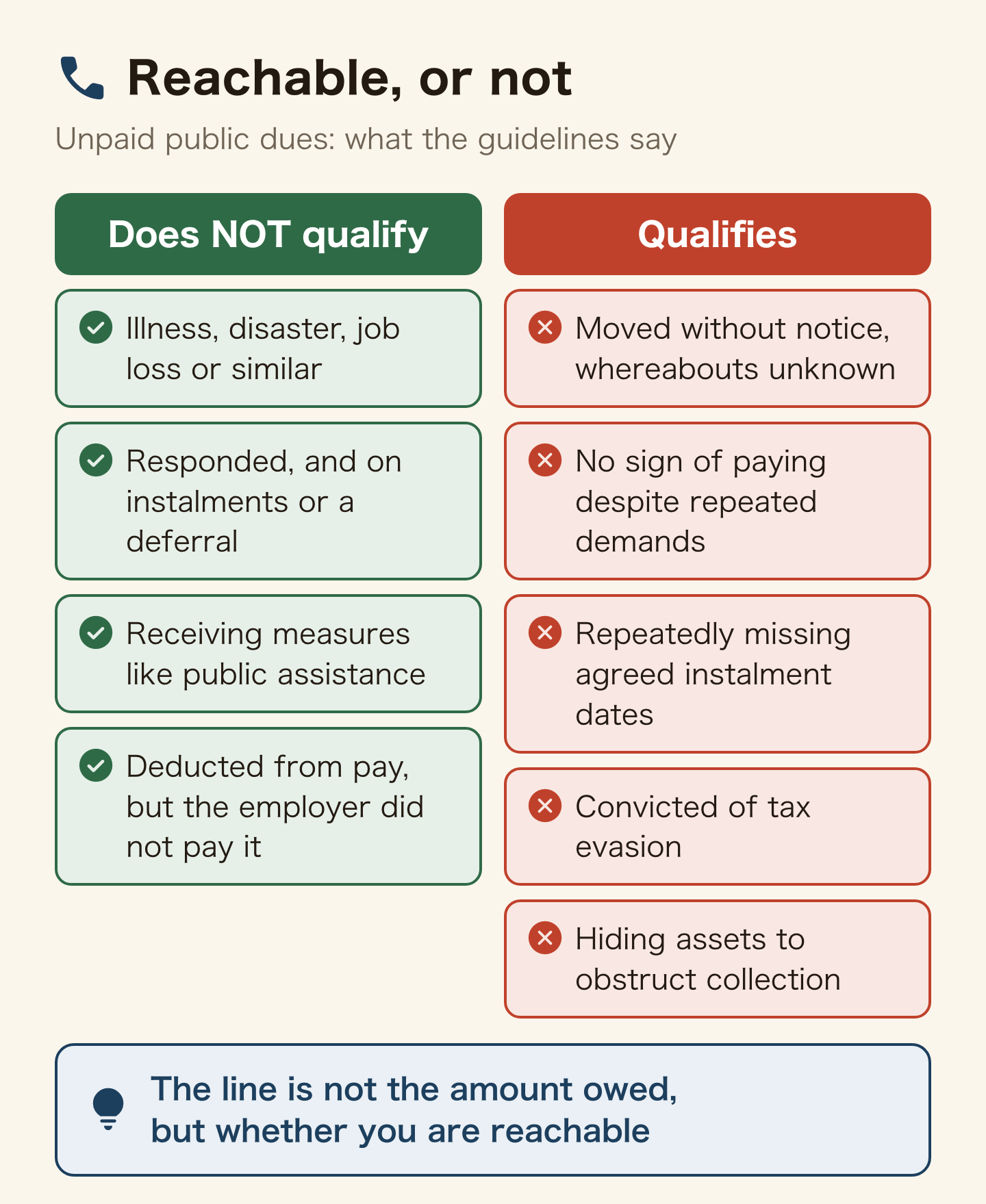
- Unable to pay because of illness, disaster, unemployment or similar unavoidable circumstances.
The examples given are business downturn, income loss from an epidemic or disaster, hardship caused by domestic violence, and leaving a job because of workplace harassment - Having responded to demands, shown willingness to pay, and been granted instalments or a deferral
- Receiving measures equivalent to public assistance
- Where the money was deducted from your salary but your employer failed to pay it on
The draft also lists what does qualify: moving without notifying the municipality so your whereabouts are unknown, repeated demands and enforcement without ever indicating you will pay, repeatedly missing the dates on an instalment plan you agreed to, a conviction for tax evasion, hiding assets to obstruct collection.
Set the two lists side by side and the line becomes obvious. What separates them is not the amount owed. It is whether you are reachable. The draft says as much: the word “wilfully” is there to limit the ground to cases where non-payment is culpable.
So there is one answer. If you cannot pay your health insurance or your pension, go to the counter and arrange instalments or a deferral. Having that on record protects your status. For the pension, people on low income or out of work can apply for a National Pension exemption or deferral, going back two years and one month (Japan Pension Service, how far back you can apply for an exemption or deferral (Japanese)). Silence is the only genuinely dangerous option. For residence tax, seizure can start ten days after a demand letter is sent, so know how to ask for a deferral or instalments before then.
How much do I have to owe before it is a problem?
There is no figure. The draft says arrears, duration and frequency are all considered, but that judgements are “not necessarily made by setting a uniform standard for the amount owed”.
What gets weighed instead: your income, funds and assets, how many times and how long you have been in arrears, your payment record, how the arrears arose, your business and living situation afterwards, and your own words and conduct.
If you find a page stating a safe threshold in yen, treat it with suspicion. No such line exists in the official text.
Some things are not “public dues” at all
A small distinction that removes some unnecessary worry. Public dues means money collected compulsorily for public purposes.
- Included – income tax, resident tax, corporate tax, fixed asset tax, National Health Insurance and health insurance premiums, National Pension and employees’ pension premiums
- Not included – fees and charges, fines and civil penalties. The draft names the Mount Fuji trail fee and traffic fines and penalty payments as examples
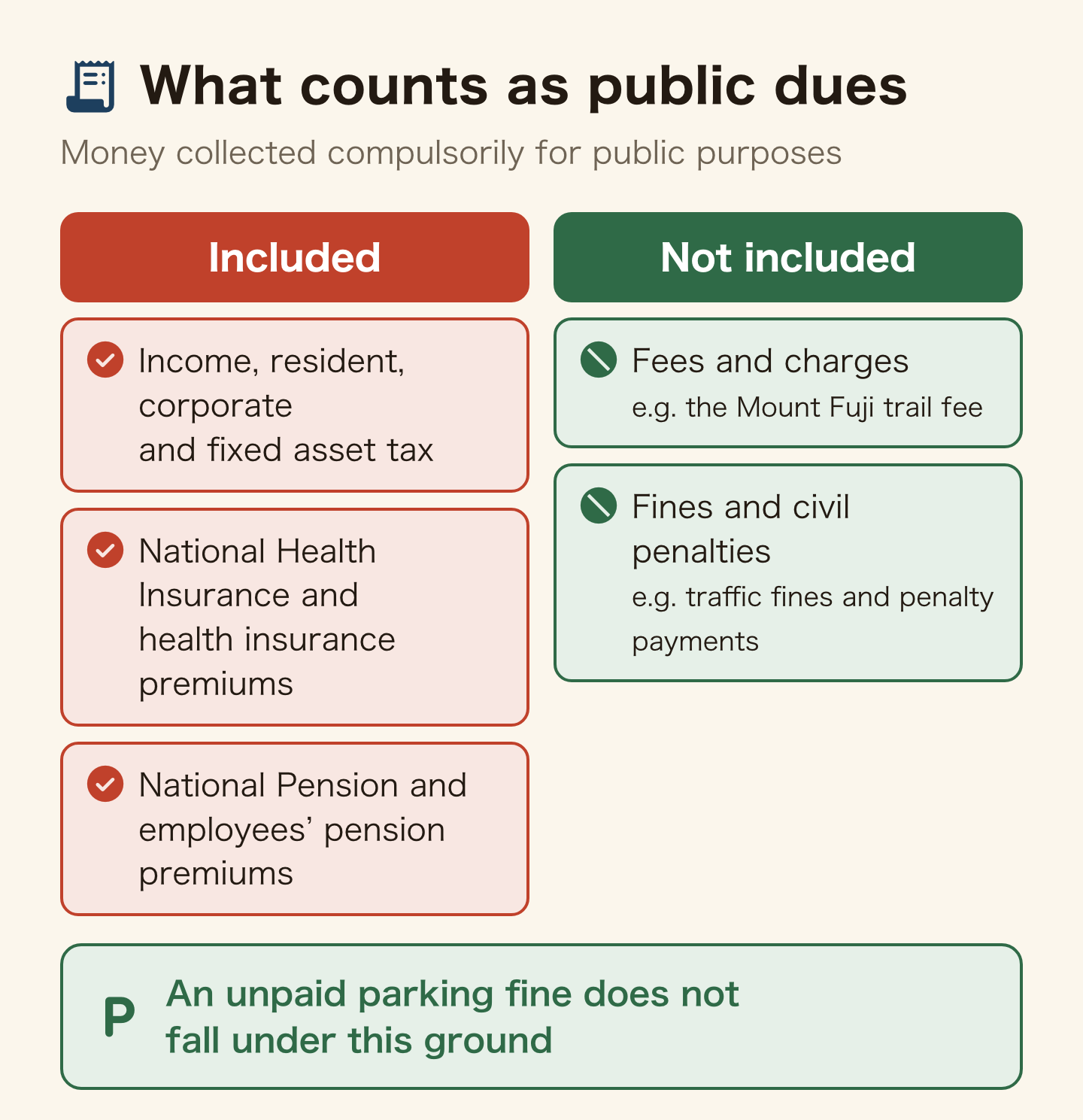
So an unpaid parking fine does not fall under this ground. It may be a problem in other ways, but it is not a public due.
What if I just forget my residence card?
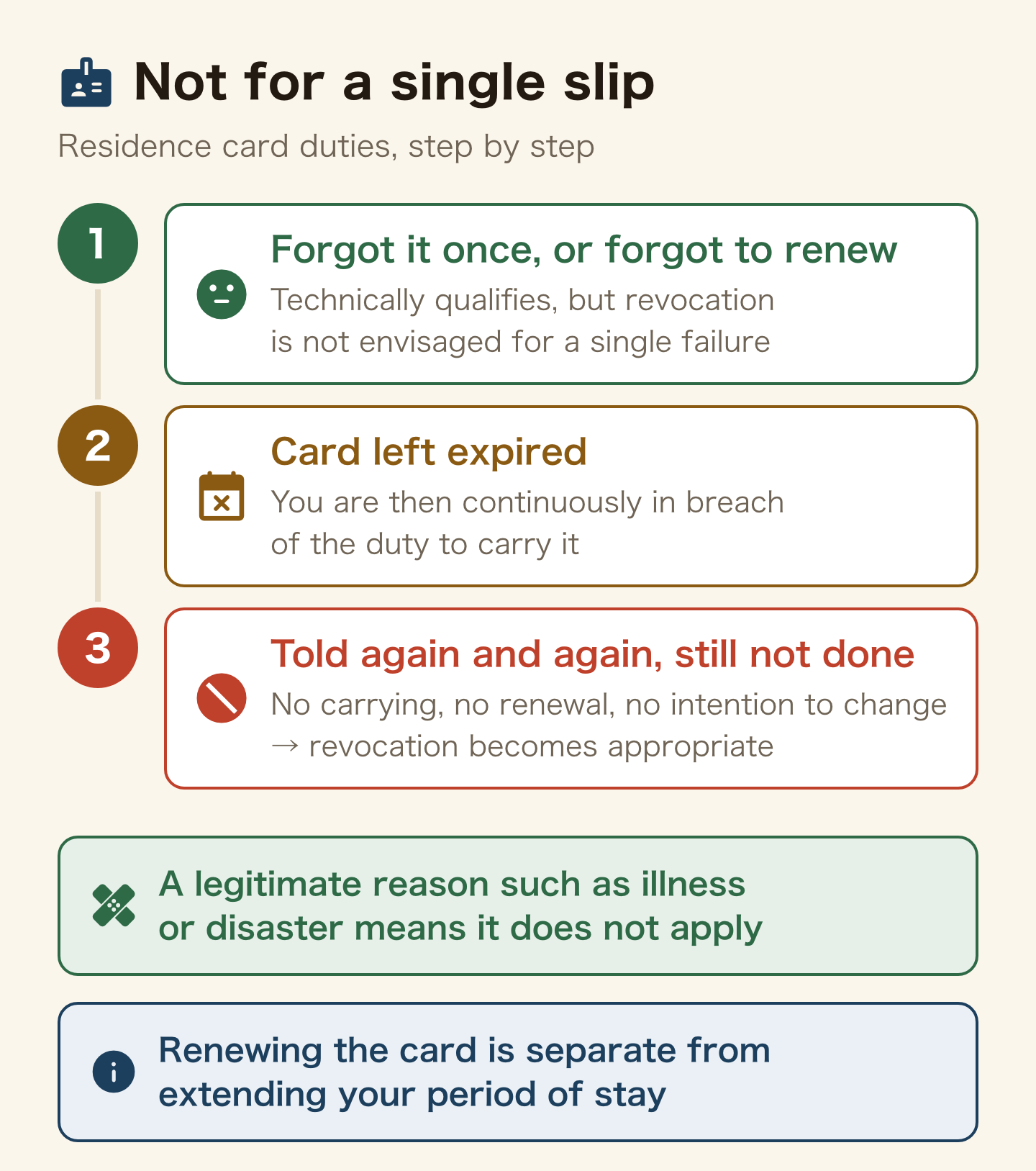
You will not lose your status over it. That said, the ground can technically be met even by accident.
The draft states that breaching a duty counts even where it was negligent – forgetting to renew the validity of your residence card, or leaving it at home by mistake, both technically qualify.
And then it says this.
“Revocation is not envisaged on the basis of a single failure to fulfil a duty.”
Revocation becomes appropriate where “it is clear there is no intention to fulfil the duty in future”, or where the breach is unacceptable by ordinary social standards. The example given is repeatedly being instructed to carry and present the card, still not doing so, still not renewing it, and showing no intention to change. That is a long way from forgetting it once.
There is also a “legitimate reason” exemption – illness, disaster or similar circumstances preventing you from fulfilling the duty.
One thing to be careful about, though: do not forget to renew the validity of the card itself. The draft points out that once it expires you are then continuously in breach of the duty to carry a valid card. That is a different procedure from extending your period of stay, and the two get confused.
Does a suspended sentence count?
Yes. The draft states that a custodial sentence counts “regardless of its length, including where execution of the sentence is suspended”.
The offences are a closed list and all of them are intentional: theft and robbery, fraud and extortion, homicide, injury, trespass, currency and document forgery, unlawful confinement, kidnapping, gambling – plus dangerous driving causing death or injury.
Ordinary negligent traffic accidents are not on the list. Dangerous driving is listed separately as an intentional offence, which is a different thing.
If it is revoked, do I have to leave Japan?
No, and this is widely misunderstood. Meeting a ground does not mean immediate revocation and departure.
The draft explains that unless it is judged inappropriate for the person to remain in Japan, the Minister of Justice changes the status ex officio to something other than permanent resident. This is called ex officio change, and the draft states that “Long-Term Resident” is envisaged in most cases.
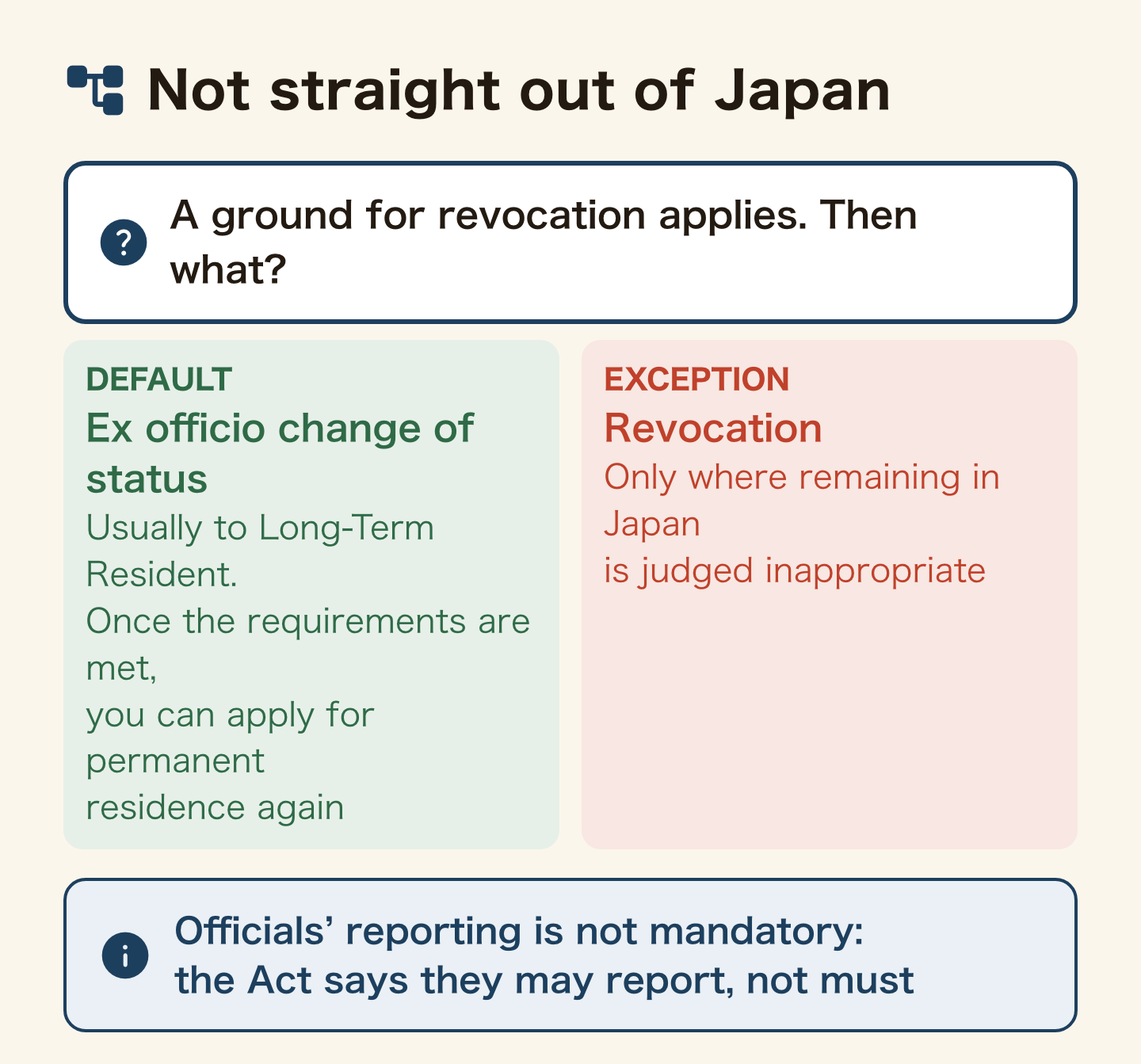
Then comes the sentence worth holding on to. “After an ex officio change, it is also possible to obtain permanent residence again if the requirements are met.”
Losing permanent residence is not the same as losing Japan. You stay as a long-term resident, rebuild the requirements, and apply again.
Will someone report me?
There is a mechanism for national and local government staff to report cases to immigration. Reporting is not mandatory. The Act says they “may” report, not that they must.
What the draft envisages is reporting where, in the course of collection – repeated demands, seizure of assets – it becomes clear the person has no intention of paying. Nothing describes someone paying by instalments after speaking to the counter as a candidate for reporting.
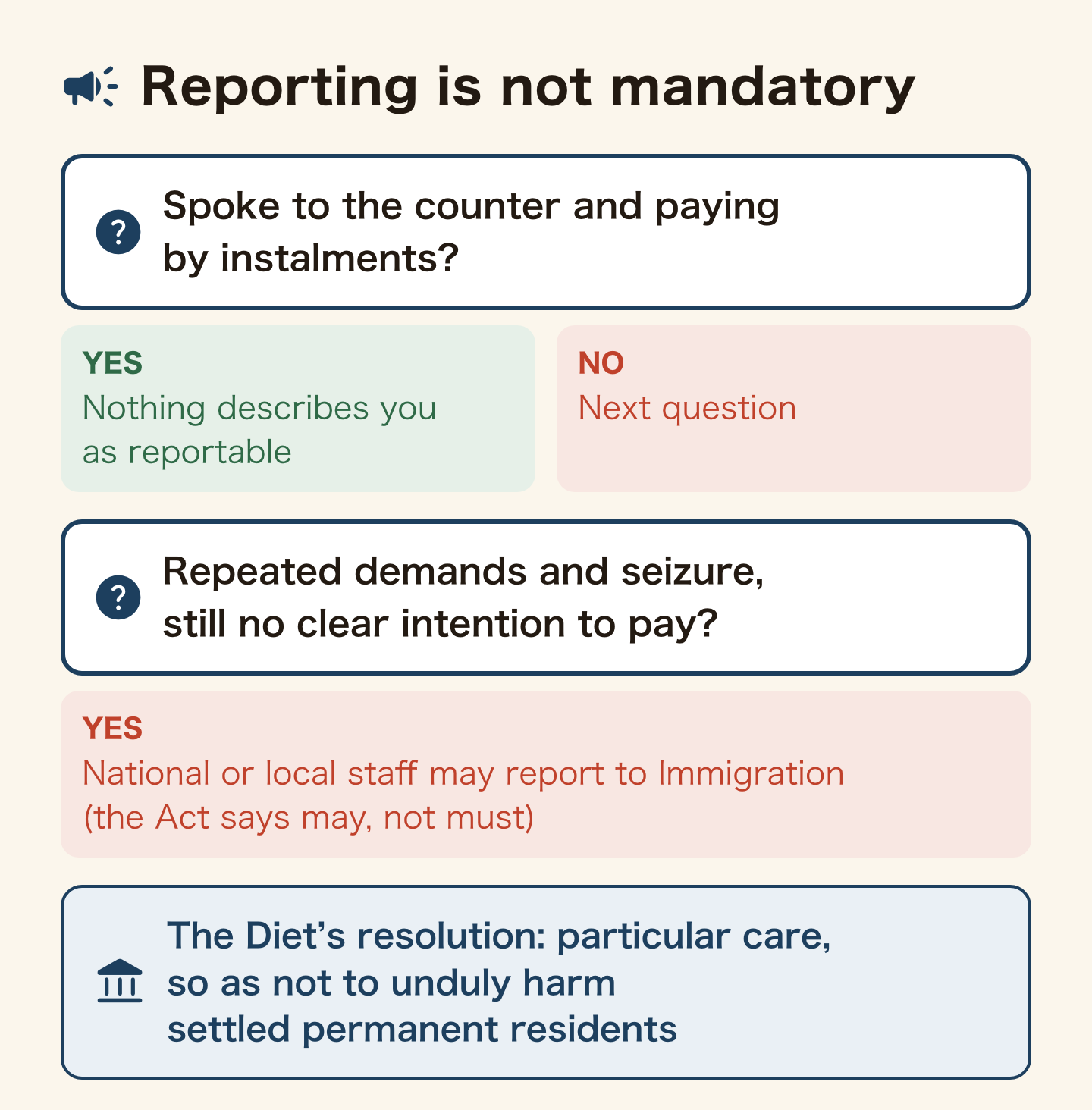
The draft also quotes the Diet’s supplementary resolution: “so as not to unduly harm the interests of permanent residents already settled in Japan”, and “exercise particular care in operating the system”. (Immigration Services Agency, public comment on the permanent residence guidelines (Japanese))
This page is based on the draft guidelines published on 4 August 2026. Public comment ran until 3 September 2026, and the guidelines were adopted without changes on 1 October 2026 (Immigration Services Agency, result of the public comment (e-Gov, PDF, Japanese)). The draft was read on 25 August 2026. Official source: e-Gov, public comment on the draft guidelines for revoking permanent resident status (case 315000141) / Immigration Services Agency, draft guidelines on revoking permanent resident status, full text (e-Gov, PDF, Japanese) / Immigration Services Agency, Q&A on the permanent residence reform (Japanese) / Immigration Services Agency, public comment on the permanent residence guidelines (Japanese) / Japan Pension Service, how far back you can apply for an exemption or deferral (Japanese) (checked 26 September 2026)
Frequently asked questions
Q. When can permanent residency start being revoked in Japan?
April 2027. Draft operational guidelines were published on 4 August 2026 and, after public comment until 3 September, adopted without changes on 1 October 2026.
Q. Can I lose permanent residency for not paying pension contributions?
Not merely for not paying. The ground is failing to pay wilfully, limited to cases where it is clear there is no intention to pay. The draft explicitly excludes unavoidable circumstances such as illness, disaster and unemployment, and excludes those who responded to demands and were granted instalments or a deferral.
Q. How much do I need to owe before permanent residency is at risk?
There is no set figure. The draft states judgements are not made by setting a uniform standard for the amount owed. Income, assets, how the arrears arose, later circumstances and the person’s own conduct are all weighed together.
Q. Can I lose my status for forgetting my residence card?
No. The draft states revocation is not envisaged on the basis of a single failure to fulfil a duty. It becomes appropriate only where repeated instruction is ignored and there is clearly no intention to comply.
Q. Does a suspended sentence count?
Yes. The draft says a custodial sentence counts regardless of length, including where execution is suspended. The offences are a closed list of intentional crimes such as theft, fraud, extortion, injury and dangerous driving causing death or injury.
Q. If my permanent residency is revoked, must I leave Japan?
Not necessarily. Unless remaining is judged inappropriate, the Minister of Justice changes your status ex officio, and Long-Term Resident is envisaged in most cases. You can apply for permanent residence again once you meet the requirements.
Q. Do unpaid traffic fines count?
No. Public dues means money collected compulsorily for public purposes, and fines, civil penalties, fees and charges are excluded. The draft names traffic fines and the Mount Fuji trail fee as examples of what is not covered.
In short
- Effective April 2027, permanent residents only. The guidelines were adopted without changes on 1 October 2026
- Three grounds: unpaid public dues, Immigration Act breaches, certain convictions
- Public dues include National Health Insurance and National Pension premiums
- Inability to pay is not a ground. Instalments and deferrals are explicitly excluded
- No yen threshold exists. What matters is whether you are reachable
- A single forgotten residence card is not enough – but do renew the card’s validity
- Ex officio change to Long-Term Resident is the norm, and you can reapply for permanent residence
Related guides
Found this useful? Share it
Send it to a friend who lives in Japan.
WHO WROTE THIS

mori
Japanese. I read the ministries’ own notices, orders and Q&As in the original, and I start from what my Nepalese and Sri Lankan friends in Japan actually ran into. I do not write about what I have not checked or been told.
What this site can and cannot do →Looking for something else?
You may use the figures in this article, including commercially, if you credit this site with a link. How to use our figures