Checked on 24 November 2026 against official pages. Sources: the Japan Student Services Organization (JASSO) housing guide, plus its 2023 survey of self-funded international students. Dorm examples come from official pages. They are JASSO’s Tokyo Japanese Language Education Center, Kyoto University, Ritsumeikan Asia Pacific University (APU), Nagano Prefectural University, plus one private student residence. Prices and rules differ by dorm. These are examples only.
The short answer
- A student dormitory is housing that a school, a city or a company provides for students. About 1 in 5 international students live in one. 7 in 10 rent an apartment.
- What the “dorm fee” covers differs by dorm. Some include utilities, meals or Wi-Fi. Others charge them separately.
- Some move-in money never comes back. In our example, the entry fee is not returned, as a rule.
- Some dorms have rules on curfews, nights away, overnight guests. Some charge rent even while you are home for the holidays.
- Some dorms only let you stay for a set time. Before you sign, send the dorm 5 questions in writing.
Knowing this, you can compare what you really pay each month, plus what comes back when you leave, before you sign. You will also know your move-out date early, so you have time to find your next room.
You have been at a Japanese language school for six months. One friend says, “The dorm is cheap.” Another says, “The curfew is strict.” Your Japanese friends cannot answer. Each dorm has its own rules, written on its own paper.
- Do Japanese schools have dorms? 4 types of student dormitory in Japan
- How much is a student dorm in Japan? What the fee covers, what it does not
- Do student dorms in Japan have curfews? Rules on guests, nights away, kitchens
- How long can you stay in a Japanese dorm? End dates, notice to leave
- Do you get money back when you leave a dorm? The entry fee stays; the deposit is settled
- What if you break the dorm rules? You can be told to leave
- Can’t get a dorm, or can’t pay? Ask your school office first
- Dorm vs. apartment in Japan: when moving out is better
- 5 questions to ask a dorm before you sign
- Which one are you?
- FAQ
- Summary
- Read next
Do Japanese schools have dorms? 4 types of student dormitory in Japan
Yes. Schools, cities and others run dorms for students. JASSO’s housing guide says local governments and universities run dorms. It also says about 70% of international students live in private housing.
Here is where students live, from JASSO’s 2023 living survey (Table 10-1, in Japanese). It covers 7,867 self-funded international students.
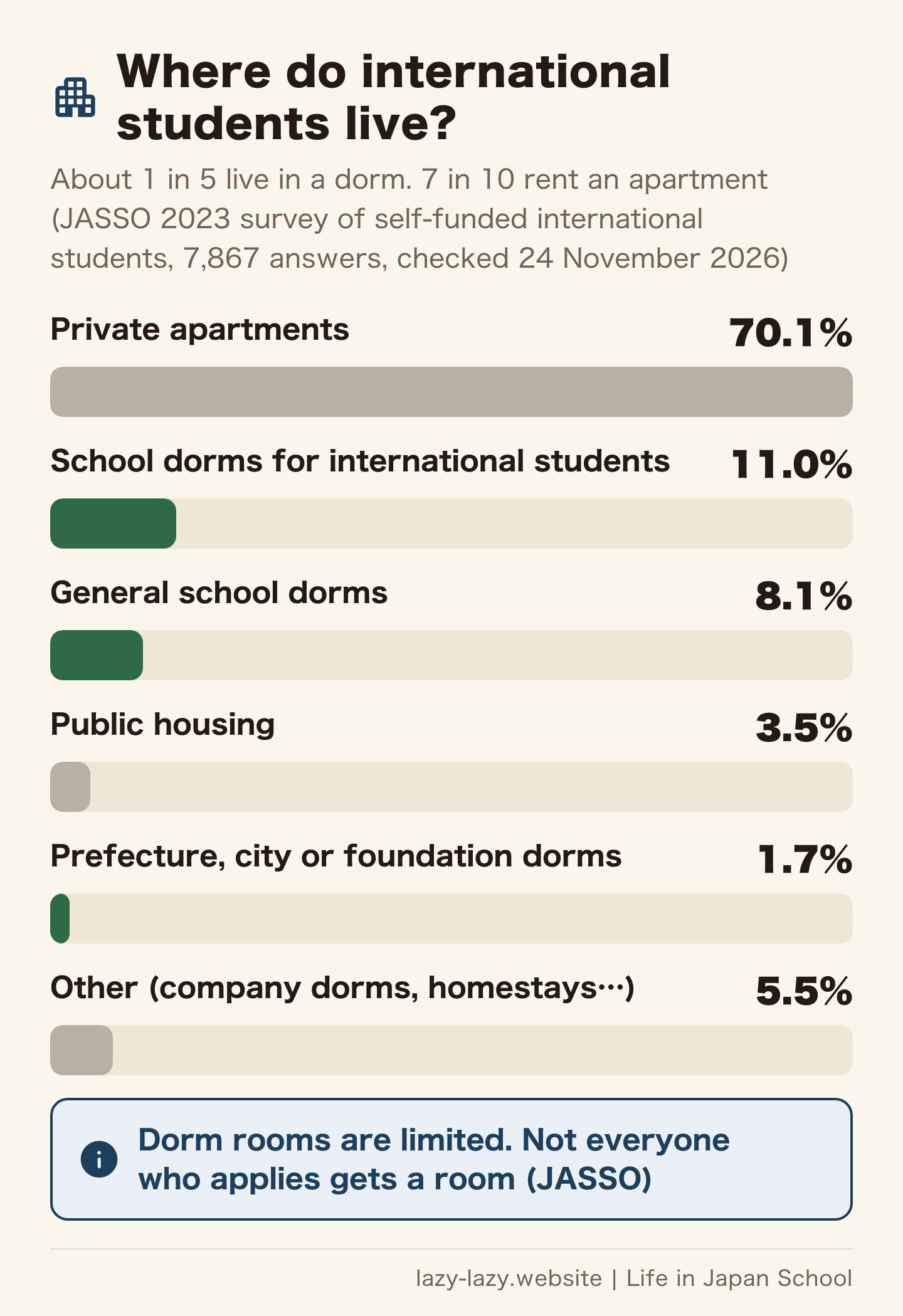
About 1 in 5 (20.8%) live in a dorm. It helps to think of 4 types.
- School dorms: run by a language school or vocational school. At the JASSO Tokyo language center, only its own students can apply.
- University international houses and dorms: some are for international students, some are shared with Japanese students.
- City, prefecture, foundation dorms: rare. Only 1.7% in the survey.
- Private student residences: run by companies. Some include meals.
JASSO also runs the Tokyo International Exchange Center. But it is for graduate students and similar. You apply through your university. A language school student cannot apply on their own.
How much is a student dorm in Japan? What the fee covers, what it does not
In the survey, the most common housing cost in school dorms for international students was 20,000 to under 30,000 yen. That was 28.9% (Table 10-5). For private apartments, the most common was 30,000 to under 40,000 yen. But the same “monthly fee” can mean very different things.
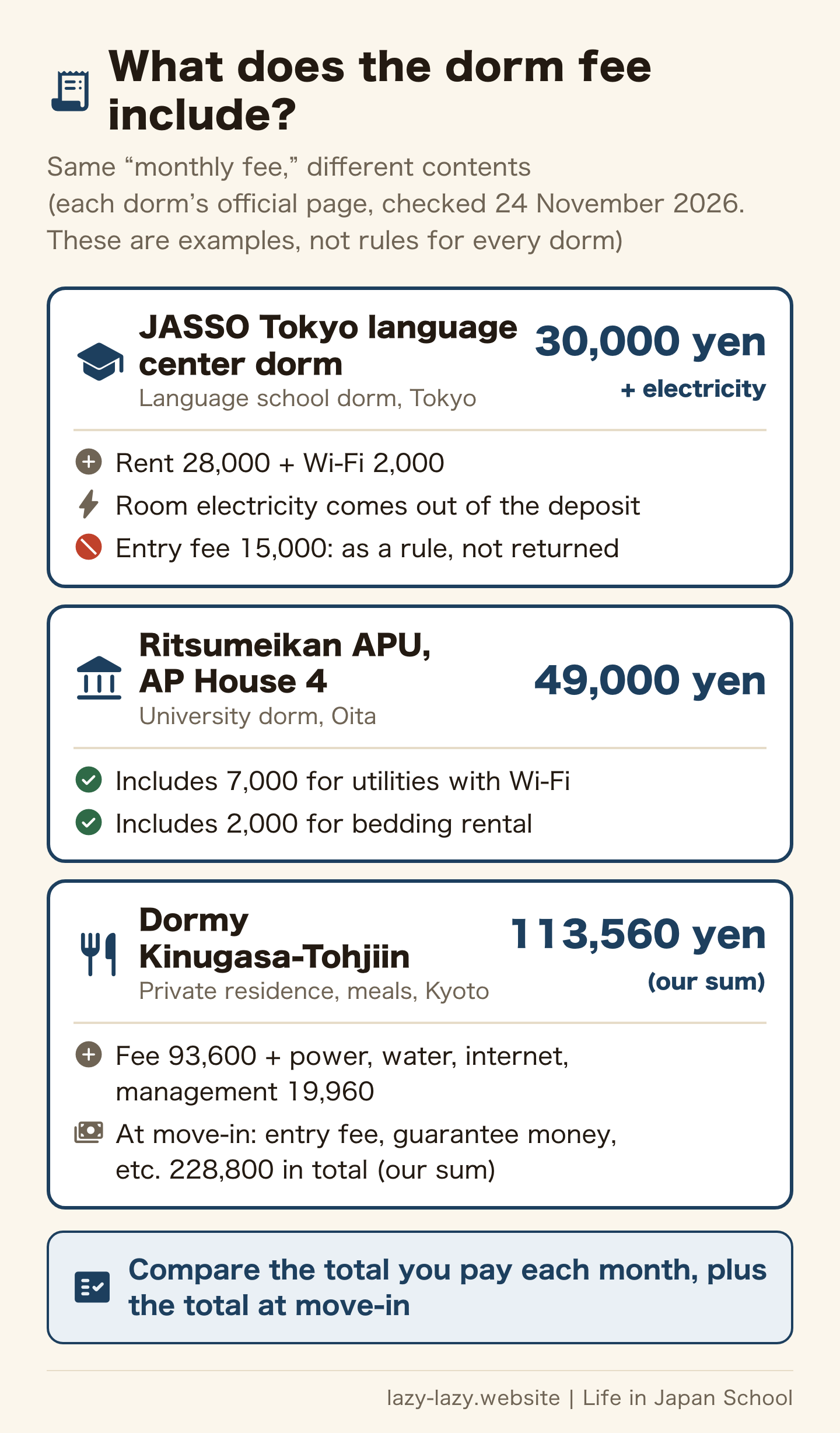
Here are 3 examples. All numbers come from official pages. They do not apply to other dorms.
- Language school dorm: JASSO’s Tokyo Japanese Language Education Center dorm charges 28,000 yen rent plus 2,000 yen for Wi-Fi. Room electricity comes out of a 30,000-yen deposit, paid every half year.
- University dorm: APU’s AP House 4 is 49,000 yen a month. It includes utilities with Wi-Fi (7,000 yen). It also includes bedding rental (2,000 yen).
- Private residence: Dormy Kinugasa-Tohjiin has a long-term plan for international students from 93,600 yen a month. Breakfast plus dinner are included. Meal times are listed for weekdays, Saturdays. On top: power 7,150 yen, water 1,650 yen, internet 3,960 yen, management 7,200 yen, so 19,960 yen in all. The monthly total is 113,560 yen (our sum).
A dorm with meals looks expensive, because food is inside the price. Compare the total you pay each month, plus the total at move-in. For students living in Tokyo, the average housing cost was 57,000 yen, for any type of housing (Table 10-4). To see your whole budget, read our guide to living costs for international students.
Move-in money, plus how part months are counted
JASSO says dorms cost less, because there is no deposit, key money or renewal fee. You still pay something at move-in. The Tokyo language center charges a 15,000-yen entry fee. The private example charges a 115,000-yen entry fee, 50,000 yen in guarantee money, 47,300 yen for cleaning, 16,500 yen in admin fees. At move-in, that is 228,800 yen in total (our sum).
In a part month, divide the rent by 30, then multiply by your days there. The move-in day counts, so does the move-out day (Tokyo language center rules). For example, 10 days at 28,000 yen is 28,000 ÷ 30 × 10 = about 9,333 yen.
Do student dorms in Japan have curfews? Rules on guests, nights away, kitchens
A friend from home visits. It gets late, so they sleep in your room. Where you come from, that may be normal. In Japan, some dorms ban overnight guests in your room.
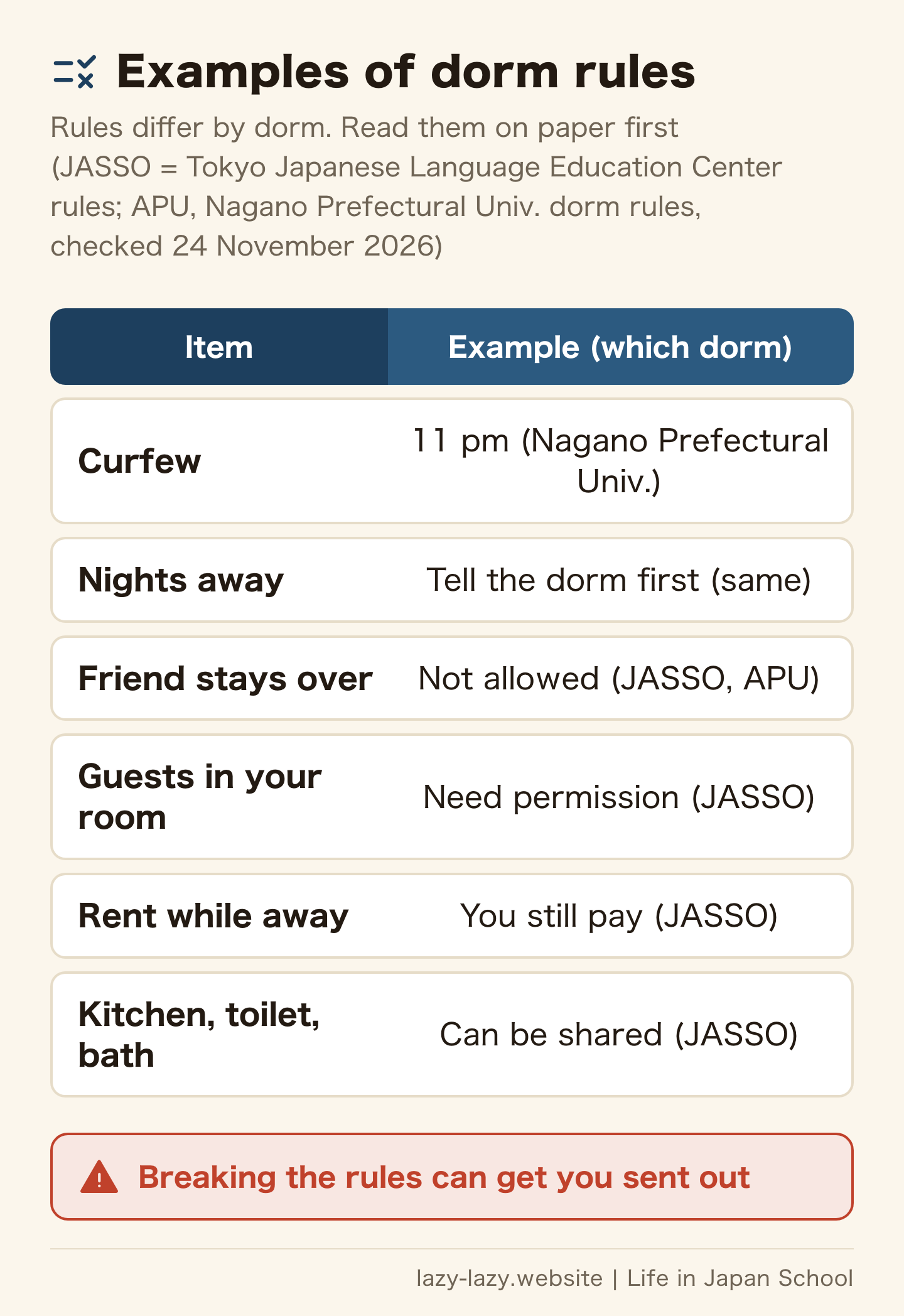
JASSO’s guide says dorms have rules such as curfews and wake-up times. It also lists a shared kitchen, toilet and bath. Here are real examples.
- Curfew: Nagano Prefectural University’s Zozan dorm has an 11 pm curfew. Part-time work must let you return by then.
- Nights away: at Zozan, you can stay out if you tell the dorm first.
- Overnight guests: the Tokyo language center dorm bans them. So does AP House 4.
- Guests in your room: the Tokyo language center needs the manager’s permission.
A curfew plus a late part-time shift is a bad mix. You find out only after you move in. If you work at night, ask about the curfew first. Cleaning duty, plus kitchen hours, also differ by dorm.
Long holidays matter too. The Tokyo language center rules say rent is charged while you are away. That includes trips home. So some dorms keep charging, even if you fly home for the summer.
How long can you stay in a Japanese dorm? End dates, notice to leave
A dorm is not always a place to stay for years. All 4 example dorms set a time limit, or a time to leave.
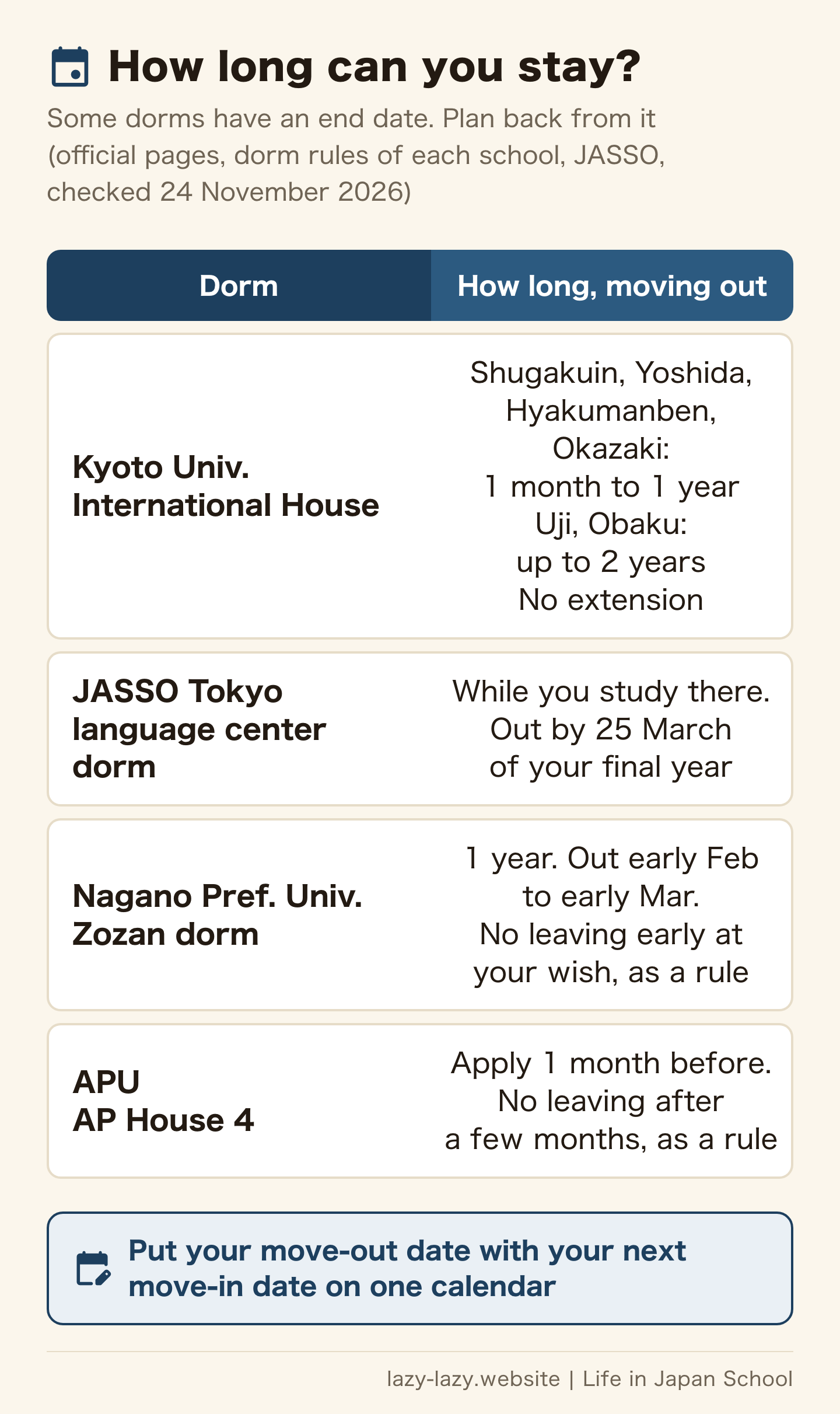
- Kyoto University International House: for international students who enter within 1 year of arriving in Japan. At Shugakuin, Yoshida, Hyakumanben, Okazaki, you stay 1 month to 1 year. At Uji, Obaku, up to 2 years. There is no extension.
- Tokyo language center dorm: you stay while you study there. As a rule, you leave by 25 March of the year your course ends.
- Zozan dorm: 1 year. You move out from early February to early March of the next year.
- AP House 4: apply 1 month before the day you leave.
Kyoto University says it plainly. When your time ends, you must find a private apartment. Moving from a language school to a university in April? Check the gap. Your dorm has a move-out deadline. At the Tokyo language center, it is 25 March. Your new room may start later.
Leaving early has rules too. As a rule, AP House 4 does not let you leave after only a few months. The Zozan dorm does not allow early leaving at your own wish, as a rule. “I can just leave if I don’t like it” may not work.
Do you get money back when you leave a dorm? The entry fee stays; the deposit is settled
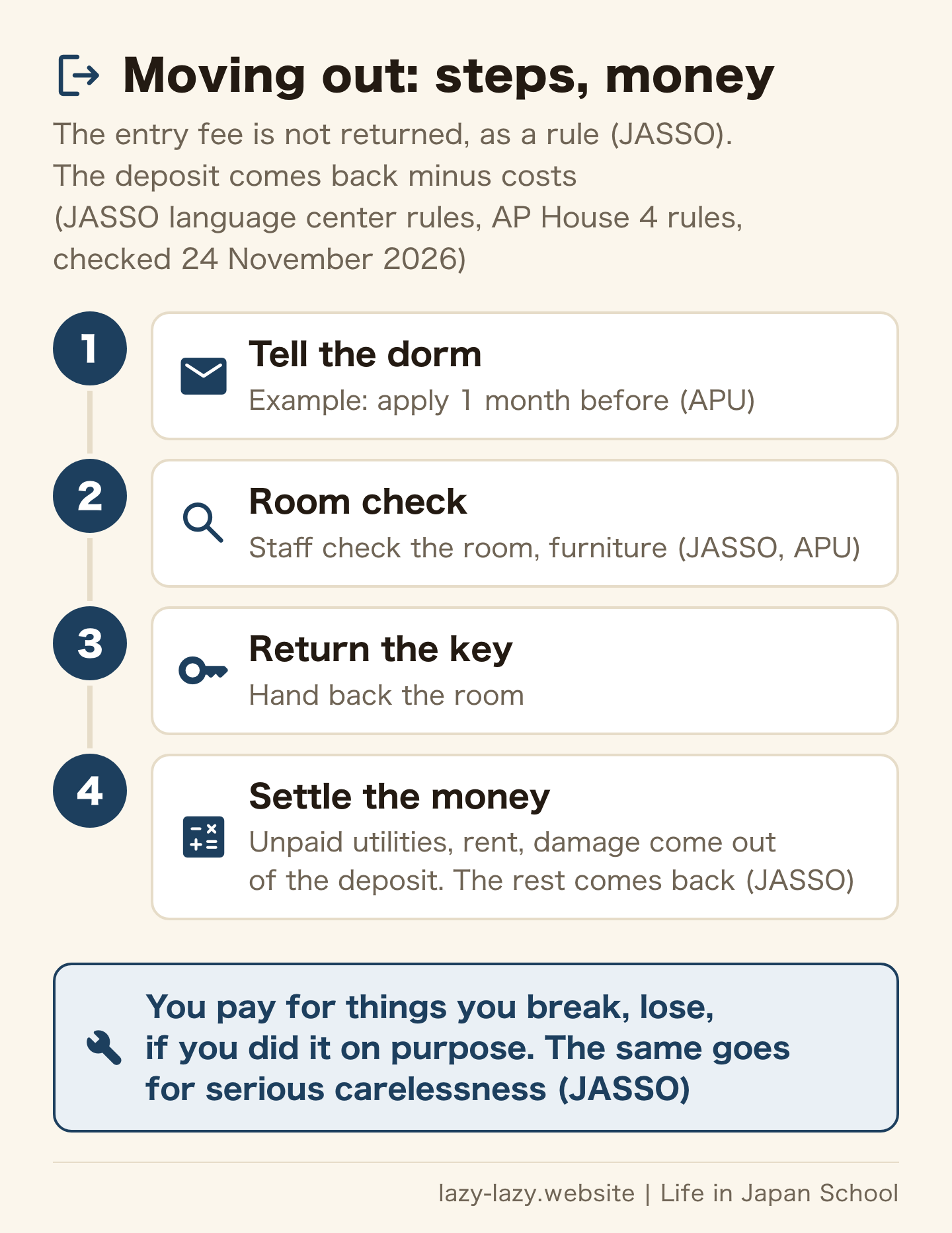
Here are the money words in the example dorms, sorted by what comes back.
- Entry fee: paid when you move in. At the Tokyo language center it is 15,000 yen. As a rule, it is not returned (dorm rules, Article 10, in Japanese).
- Entry fee at the private example (115,000 yen): the page does not say if any comes back. Ask before you sign.
- Deposit: money you leave with the dorm first. Unpaid utilities, rent, damage come out. The rest comes back (Tokyo language center).
- Guarantee money: 50,000 yen at the private example. Ask when, how much comes back, before you sign.
- Settling up: when you leave, the dorm works out what you owe, what you get back. At the Tokyo language center, the room check and settling up both happen when you move out.
- Restoring the room: for an apartment, repairing damage you caused. Normal wear is not included (MLIT guideline, in Japanese). The rules differ from a dorm. Our guide to move-out costs explains them.
You pay if you break or lose something on purpose, or through serious carelessness (Article 13).
What if you break the dorm rules? You can be told to leave
Breaking the rules can get you sent out. In the example dorms, these are reasons to make you leave.
- Tokyo language center: no rent paid 2 months after moving in, 3 months or more unpaid, expulsion from school, breaking the rules, etc.
- AP House 4: 2 months or more unpaid, breaking a banned-acts rule, losing student status through leave or withdrawal, etc.
- Zozan dorm: if you are sent out, none of the fees you paid come back.
In the example dorms, if you leave your school, you lose your dorm too. At the Tokyo language center, you must move out within 1 week.
Can’t get a dorm, or can’t pay? Ask your school office first
Dorm rooms are limited. JASSO says not everyone who applies gets one. Starting in April? As soon as you pass, ask your school’s international office if it has a dorm. If not, ask where it can refer you. JASSO also says to start looking as soon as you get your acceptance letter.
- Ask your school’s international student office. JASSO lists this first. The Tokyo language center tells students to ask its dorm office for other options.
- No guarantor for an apartment? There are 3 routes to rent without a guarantor.
- Want low move-in costs? A furnished share house with no deposit, no key money is worth comparing.
If you may fall behind on rent, talk to the dorm office early. In the example dorms, 2 to 3 months unpaid is a reason to make you leave. We do not suggest borrowing money to pay rent.
Dorm vs. apartment in Japan: when moving out is better
JASSO compares them like this. A dorm costs less and makes friends easy. An apartment lets you live on your own schedule. For an apartment, you pay a deposit, key money and an agent fee first. You also buy your own furniture. For the steps, read our guide to renting an apartment in Japan.
Moving out may be better when:
- your dorm time ends (Kyoto University International House: up to 1 year, 2 years at Uji, Obaku)
- a night shift clashes with the curfew
- you want to cook, but the kitchen is hard to use
- you want family or friends to visit your room
When your address changes, report it to your city office within 14 days. Moving to a different city? First file a moving-out notice at your old city office. Our residence registration guide shows how. For mail, file a Japan Post change of address. Your mail is then forwarded for 1 year.
5 questions to ask a dorm before you sign
Every dorm has its own rules. Don’t rely on what friends say. Get your own dorm’s answers, by email or on paper, then keep them.
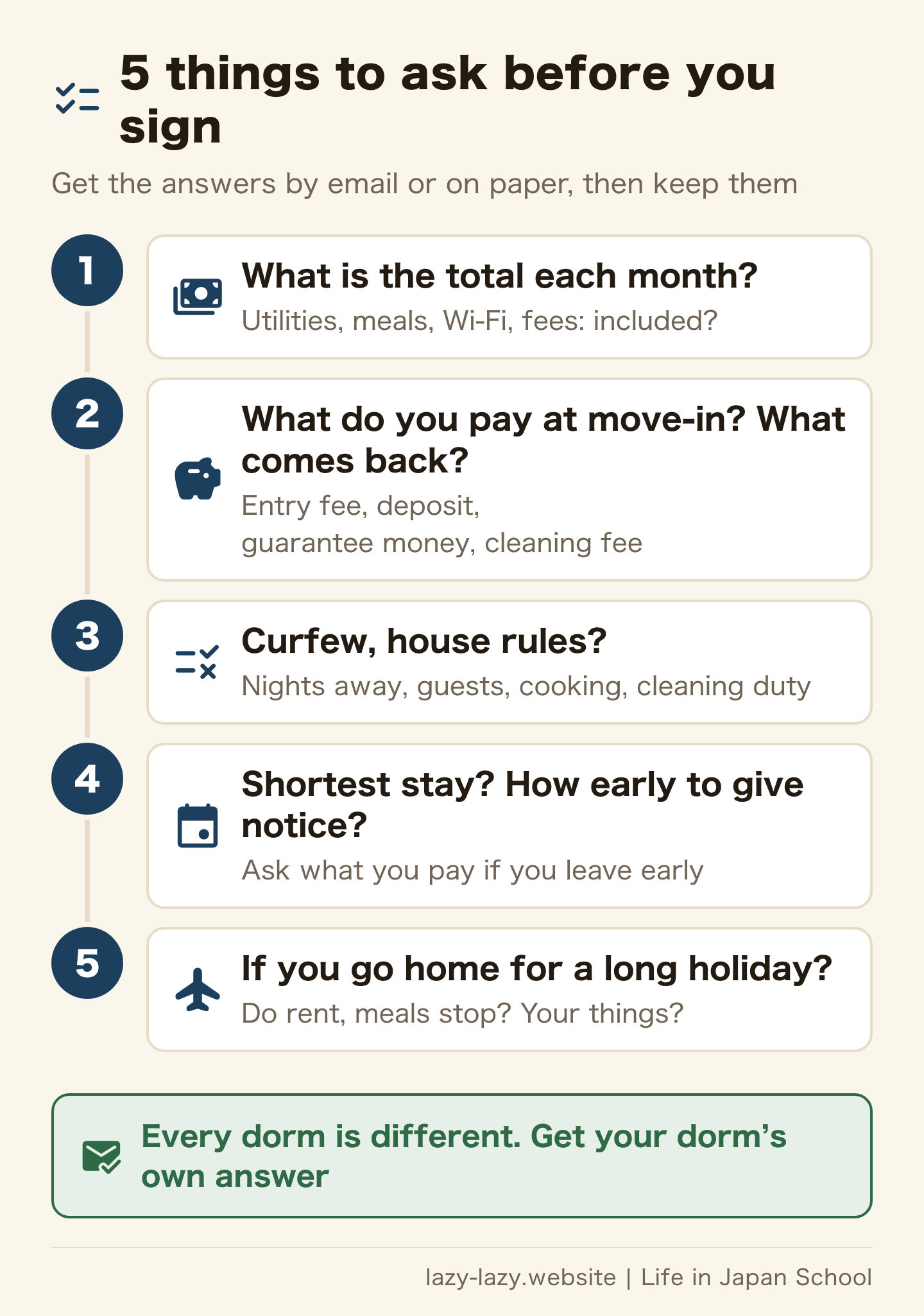
- What is the total each month? Are utilities, meals, Wi-Fi, management fees included?
- What do I pay at move-in? Which parts come back when I leave: entry fee, deposit, guarantee money?
- Is there a curfew? What are the rules on nights away, visitors, cooking, cleaning duty?
- What is the shortest stay? How many days before leaving must I tell you?
- If I go home in the summer or winter break, what happens to rent? What about meals?
You can paste these 5 lines into an email as they are.
Which one are you?
- At a language school, with your dorm time ending soon. Ask your school for the move-out date, then mark it on your calendar. Set your next move-in date before it.
- About to enter a dorm (from April). Once you pass, ask your school’s international office if there is a dorm, or a referral. Today, send that email.
- Working night shifts. Ask the dorm about its curfew today. If it does not fit, compare apartments with share houses.
- Moving from a dorm to an apartment. Report your address to the city office within 14 days. Today, pick the day you will file your Japan Post change of address.
FAQ
Q. How much is a student dorm in Japan?
In JASSO’s survey, the most common cost in school dorms for international students was 20,000 to under 30,000 yen a month (28.9%). Some private residences with meals cost over 100,000 yen a month.
Q. Does the dorm fee include utilities?
APU’s AP House 4 includes utilities in its 49,000 yen. The JASSO Tokyo language center dorm takes room electricity out of your deposit.
Q. Do student dorms in Japan have curfews?
JASSO’s guide says dorms have rules such as curfews. For example, Nagano Prefectural University’s Zozan dorm has an 11 pm curfew.
Q. Can a friend stay overnight in my dorm room?
The JASSO Tokyo language center dorm bans overnight guests in your room. So does APU’s AP House 4. Check your own dorm’s rules.
Q. Do I get money back when I leave a dorm?
You may get part of your deposit back, after unpaid costs come out (JASSO Tokyo language center example).
Q. How long can I live in a dorm?
Kyoto University International House allows up to 1 year (2 years at Uji, Obaku), with no extension. Ask for the move-out deadline before you enter.
Summary
A student dorm needs no deposit or key money, says JASSO. Rooms may come furnished. But the fee, plus the rules, differ by dorm, and rooms are limited.
So don’t decide by the monthly number alone. Ask in writing before you sign. Start today with one email to the dorm you want.
Sources (official): JASSO “Accommodation” | JASSO 2023 survey of self-funded international students (Japanese) | JASSO “Student Guide to Japan 2026-2027” | JASSO Tokyo Japanese Language Education Center dorm | JASSO language center dorm rules (Japanese) | JASSO Tokyo International Exchange Center, applications | Kyoto University, housing | APU, AP House 4 rules (Japanese) | Nagano Prefectural University, Zozan dorm rules (Japanese) | Dormy Kinugasa-Tohjiin, international student rates | Basic Resident Registration Act | MLIT guideline on restoring rented rooms (Japanese) | Japan Post mail forwarding (Japanese) (all checked 24 November 2026). Our sums: dorm residents 20.8% = 11.0 + 8.1 + 1.7 (Table 10-1). Dormy Kinugasa-Tohjiin monthly total 113,560 yen = 93,600 + 7,150 + 1,650 + 3,960 + 7,200; move-in total 228,800 yen = 115,000 + 50,000 + 47,300 + 16,500. Address rules: Basic Resident Registration Act, Articles 22, 23 (14 days), Article 24 (moving-out notice). Prices and rules can change. Always check with your own dorm before you sign.
Read next
Found this useful? Share it
Send it to a friend who lives in Japan.
WHO WROTE THIS

mori
Japanese. I read the ministries’ own notices, orders and Q&As in the original, and I start from what my Nepalese and Sri Lankan friends in Japan actually ran into. I do not write about what I have not checked or been told.
What this site can and cannot do →Looking for something else?
You may use the figures in this article, including commercially, if you credit this site with a link. How to use our figures