This article was checked on 27 October 2026 against the Japan Student Services Organization (JASSO) pages on loan and grant scholarships, repayment examples, arrears, credit bureau reporting, reduced repayment and deferral, and the Honors Scholarship; the Instalment Sales Act and the Interest Rate Restriction Act (e-Gov); the Financial Services Agency’s guide to the money lending rules; the National Consumer Affairs Center’s warning on pay-later services; docomo’s, au’s and Paidy’s official instalment pages; and Rakuten Card’s official revolving and cash advance pages. Rates and conditions change, so check the official pages on the day you apply.
The short answer
- Good debt is borrowing that earns more than the interest it costs. Bad debt is borrowing spent on things that are gone once used, so only interest goes out. Paying interest or fees to cover living costs, shopping or fun is almost always bad debt.
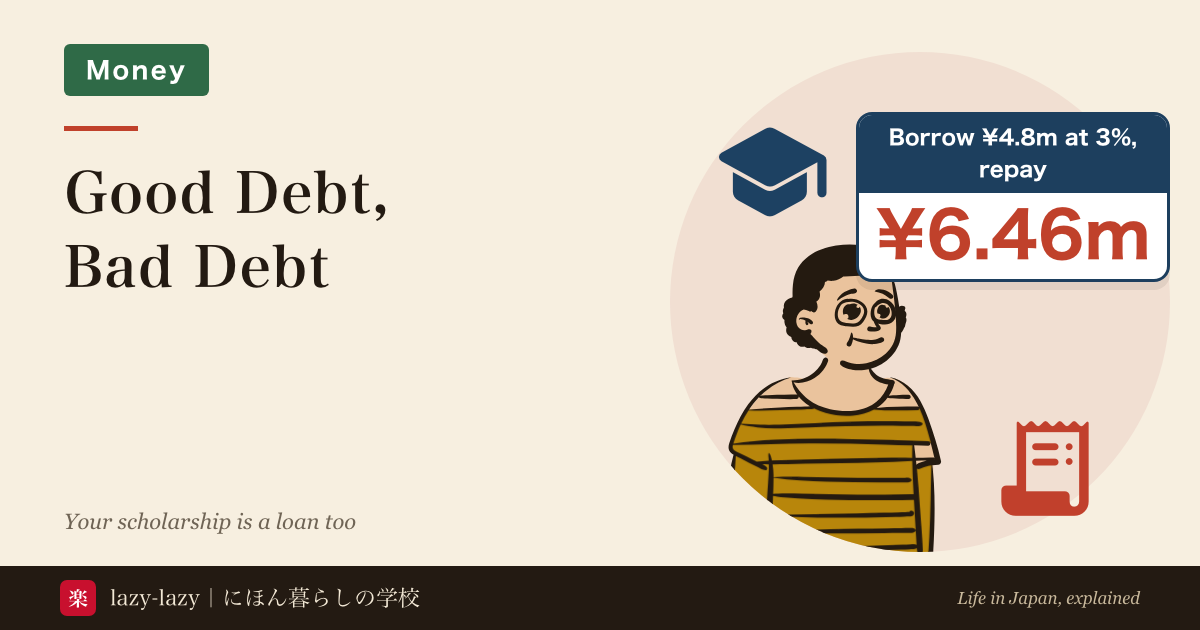
- A scholarship can be debt too. JASSO’s loan-type scholarships must be repaid: Type 1 is interest-free, Type 2 charges interest. Borrow 100,000 yen a month for 4 years at 3.0% and you repay 6,459,510 yen over 20 years.
- Fall 3 months or more behind and you are reported to a credit bureau. The record stays until 5 years after you finish repaying. If you cannot repay, apply for reduced repayment or a deferral before you fall behind.
- Among foreign nationals, only certain statuses can apply for JASSO’s grant, Type 1 or Type 2, such as permanent residents, spouses of Japanese nationals and long-term residents. “Student” (ryugaku) status is not eligible; there is the Honors Scholarship instead, which you do not repay (48,000 yen a month at university).
- Revolving, cash advances and instalments with fees are bad debt. 0% instalments are fine if you can pay every one, but they go on your credit file. When money is short, do not borrow: cut fixed costs and look for grants and fee cuts.
Knowing this, you can compare the total you would repay with the ways to avoid borrowing, before you sign up for a scholarship or switch to revolving thinking it is not debt.
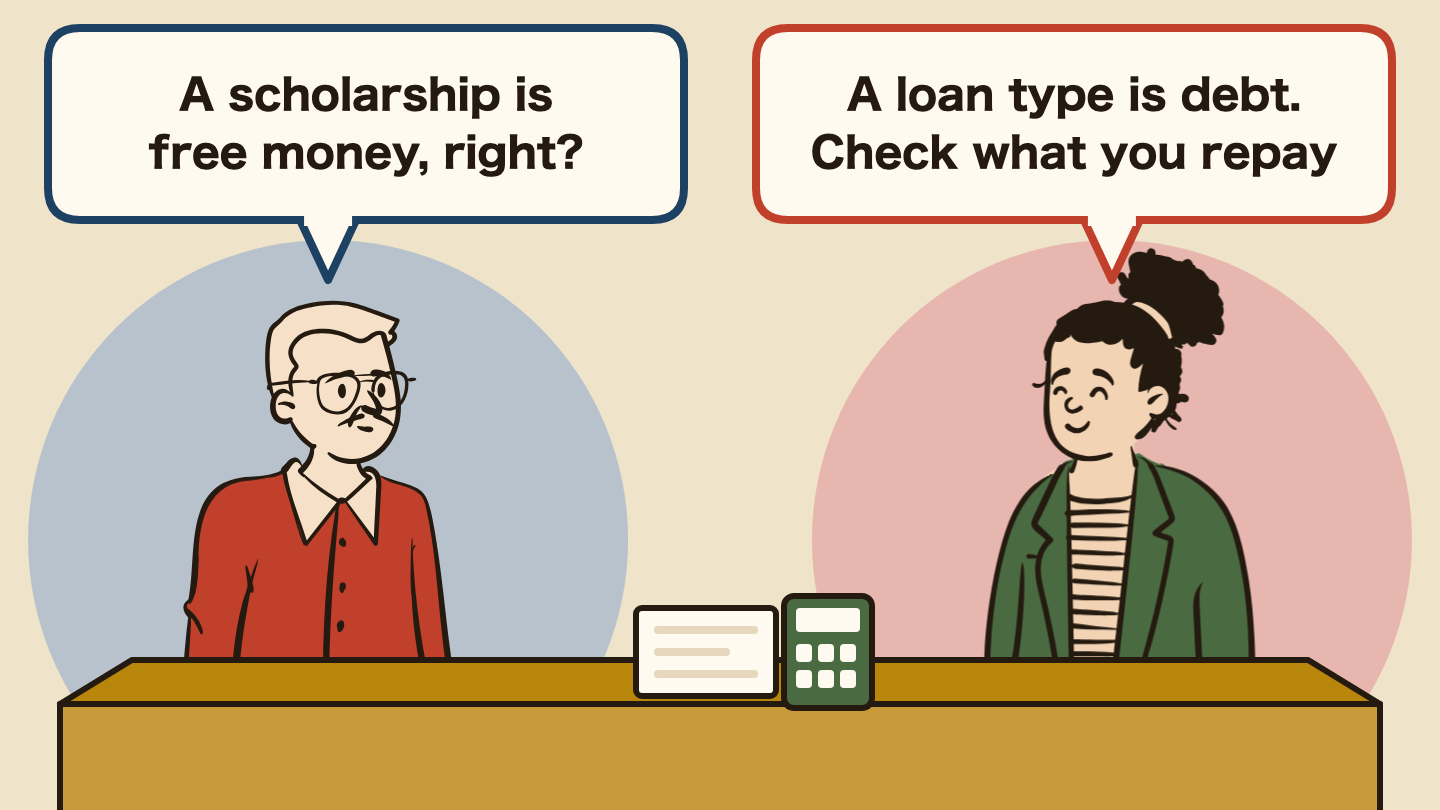
Spring of your second year at university. A Japanese classmate says, “I get a scholarship, so my fees are covered.” You go to the student office to apply too, and the form says “loan”, “repayment” and “interest rate”. Is this money you are given, or money you borrow? Your classmate just laughs: “Think about that after graduation.” The “repayment” on that form is a monthly bill that can run for 20 years after you graduate.
- What is good debt and bad debt? Almost all personal debt is bad debt
- Is a scholarship a loan? Loan-type you repay, grant-type you keep
- How much do you repay on a JASSO loan? Borrow 4.8 million yen at 3%, repay about 6.46 million over 20 years
- What happens if you do not repay a JASSO scholarship? Credit bureau after 3 months
- Cannot repay your scholarship? Apply for reduced repayment or a deferral before you fall behind
- Can foreigners get a student loan in Japan? “Student” status is not eligible
- Which debts do not look like debt? Revolving, instalments, buy now pay later, “effectively 0 yen”
- Is this good debt? Three questions
- Which one are you?
- FAQ
- Summary
- Related reading
What is good debt and bad debt? Almost all personal debt is bad debt
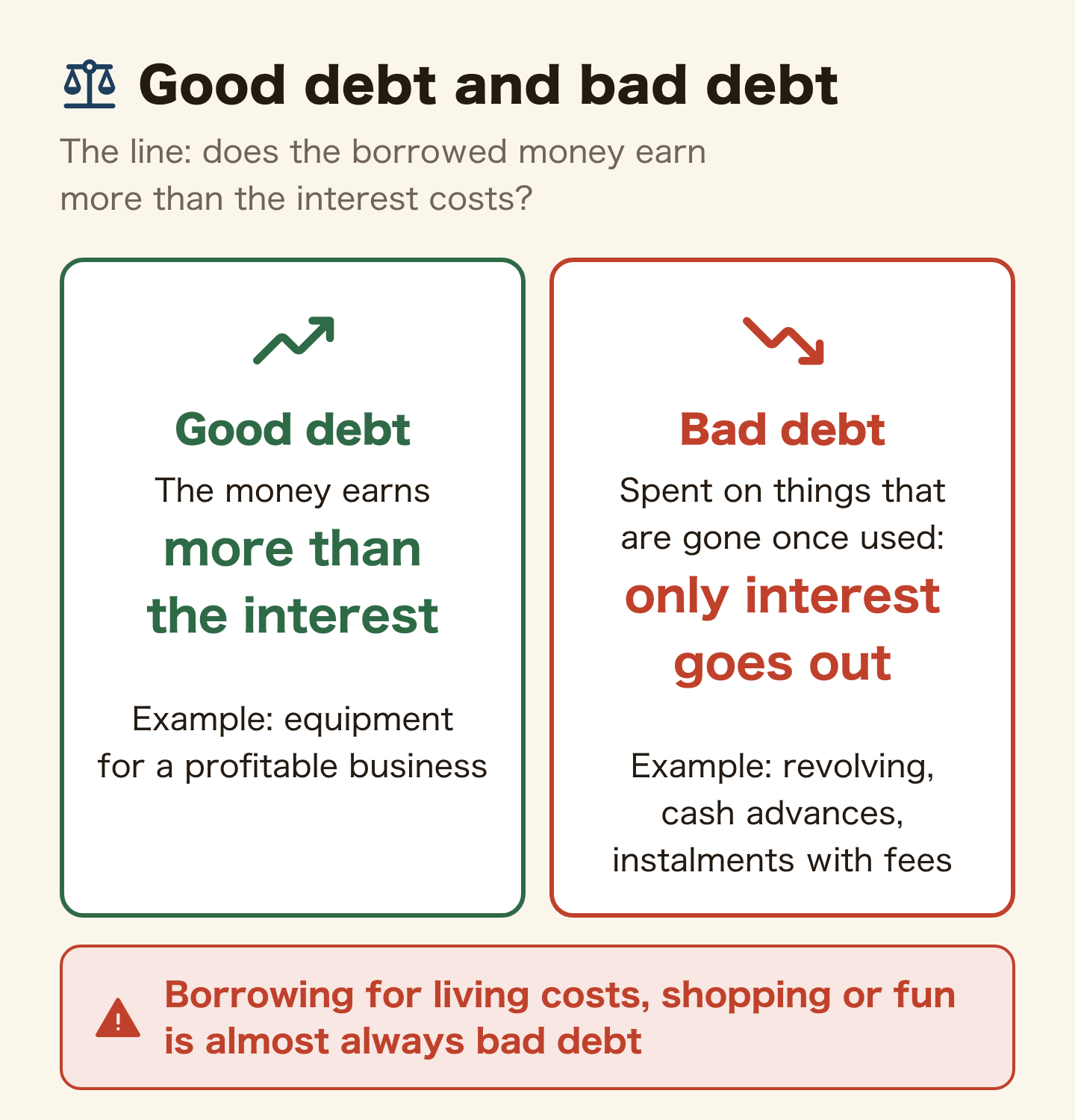
Good debt is borrowing that earns more than the interest you pay on it. Think of buying equipment for a profitable business, where the sales from that equipment pay back the interest and the loan. Bad debt is borrowing spent on things that are gone once used, so only the interest goes out. Paying interest or fees to buy clothes, trips or the month’s living costs falls here. So does any debt you cannot repay on schedule, because late charges are added on top.
The line is not whether your reason for borrowing is good or bad. It is whether the money comes back bringing more than the interest with it. A 100,000 yen loan to cover living costs produces nothing and disappears. What remains is 100,000 yen to repay, plus interest.
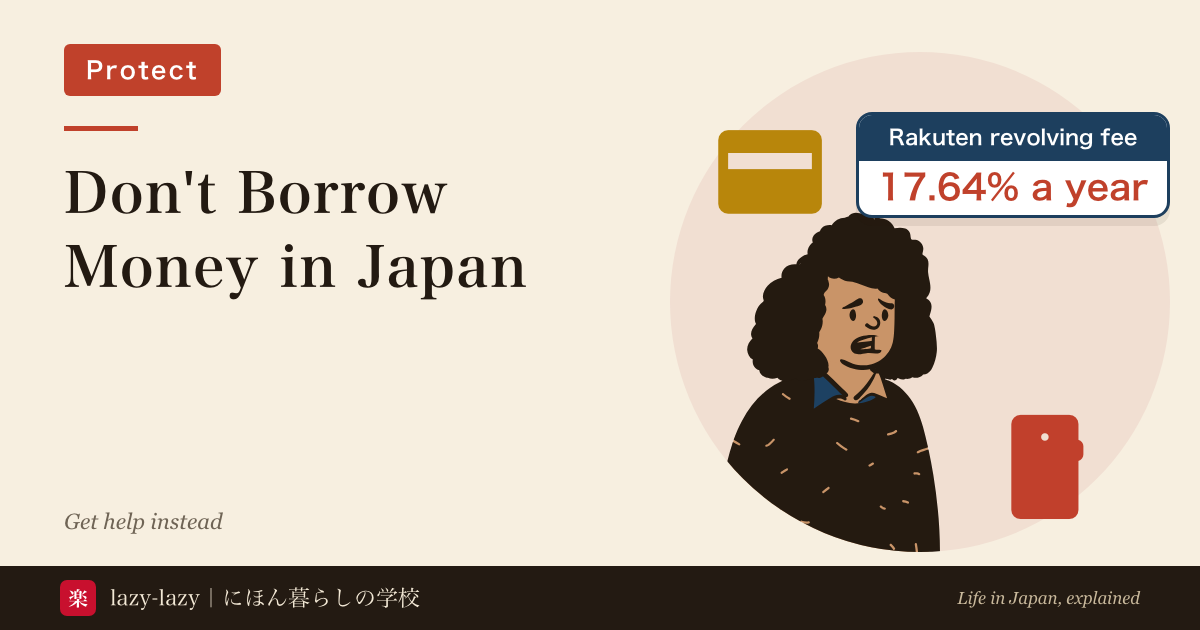
Interest is easier to judge as a number. Rakuten Card charges a revolving fee of 17.64% a year (Rakuten Card, revolving payments (Japanese)). That is close to what Warren Buffett’s company, Berkshire Hathaway, earned per year from 1965 to 2025 (19.7%, Berkshire Hathaway 2025 shareholder letter). The comparison, and the fees on 100,000 yen repaid by revolving, are worked out in Don’t borrow money in Japan (revolving fees of 25,224 yen, step by step). Ordinary daily life offers almost nothing that earns more than that interest.
Is a scholarship a loan? Loan-type you repay, grant-type you keep
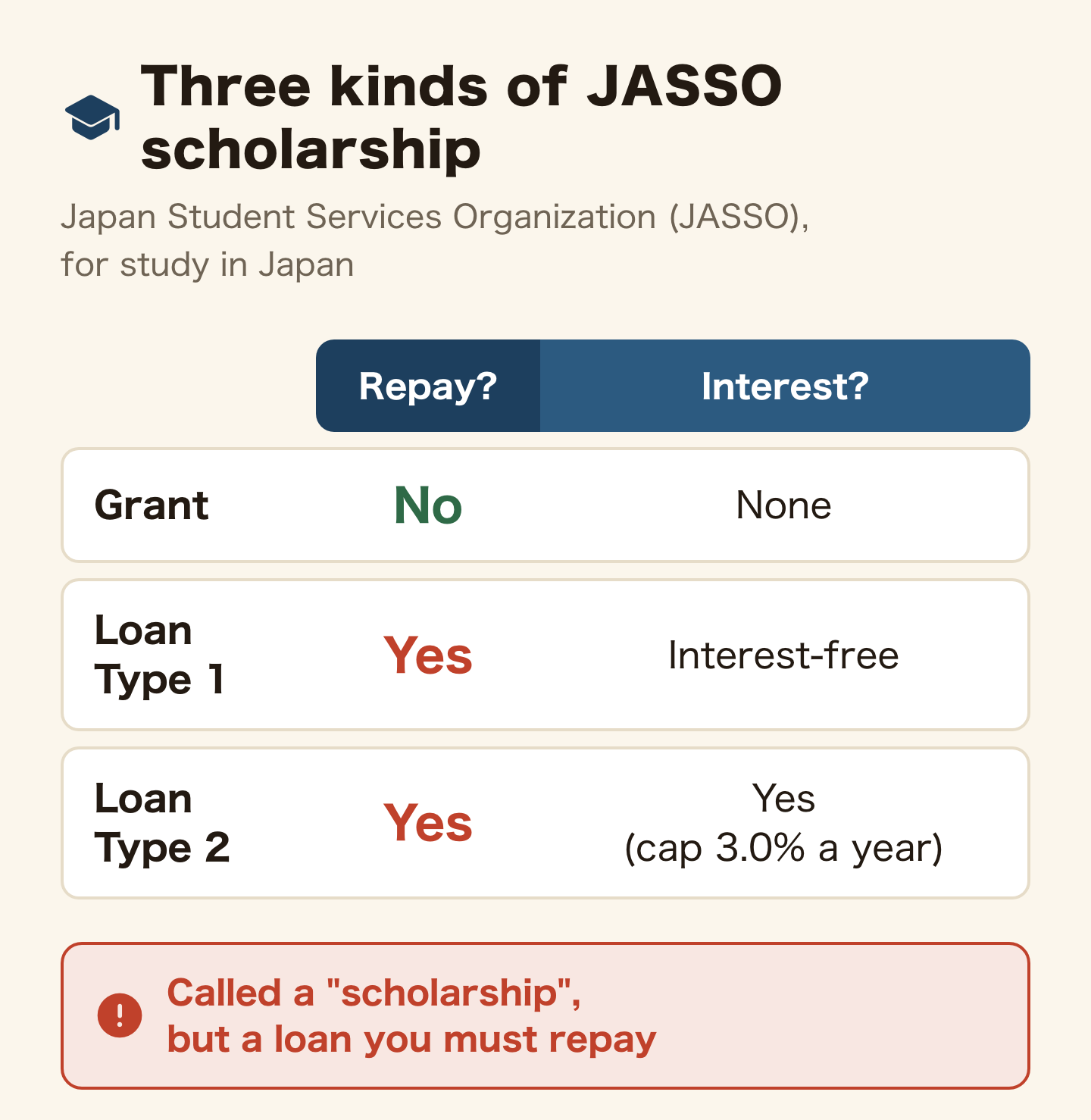
You hear “scholarship” and assume it is money you never pay back. Where you come from, that may be normal. In Japan, a loan-type scholarship is debt you repay, whatever it is called. JASSO’s scholarships come in two forms, loans and grants (JASSO, types of scholarship (Japanese)).
- Grant: you do not repay it. It is part of the “new higher education support system”, which combines the grant with tuition and admission fee exemptions or cuts (JASSO, grant scholarships (Japanese)).
- Loan, Type 1: borrowed and repaid, with no interest.
- Loan, Type 2: borrowed and repaid, with interest (JASSO, loan scholarships (Japanese)).
With a loan, you receive money while you study and repay it every month after you graduate. Even interest-free Type 1 is repaid in full. If the form says “loan” (taiyo) and “repayment” (henkan), you are signing a debt contract.
How much do you repay on a JASSO loan? Borrow 4.8 million yen at 3%, repay about 6.46 million over 20 years
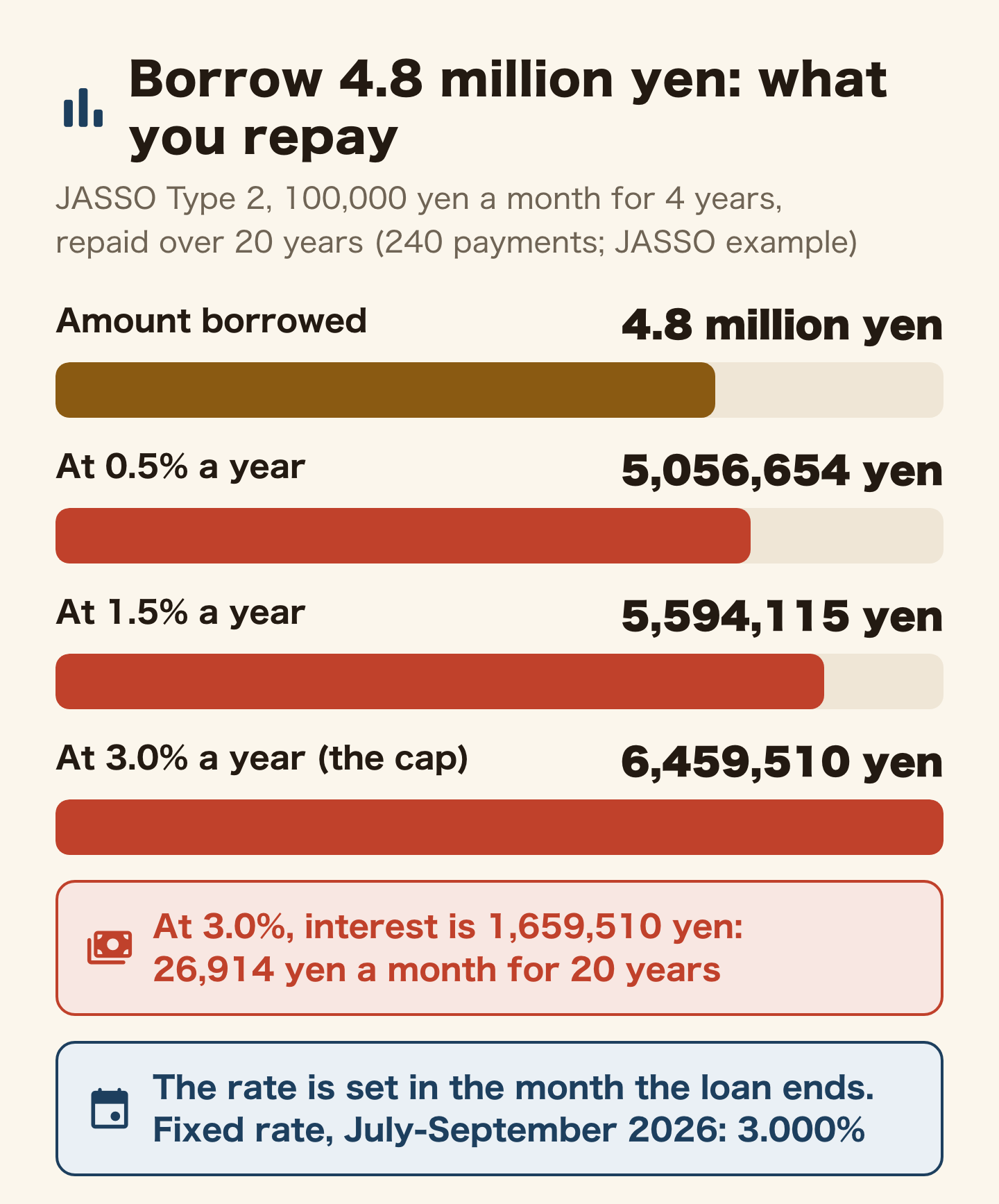
JASSO gives an example for Type 2: borrow 100,000 yen a month for 4 years (4.8 million yen in total) and repay it over 20 years in 240 payments (JASSO, Type 2 interest and how the rate is set (Japanese)).
| Rate | Monthly payment | Total repaid | Of which interest |
|---|---|---|---|
| 0.5% a year | 21,069 yen | 5,056,654 yen | 256,654 yen |
| 1.5% a year | 23,309 yen | 5,594,115 yen | 794,115 yen |
| 3.0% a year | 26,914 yen | 6,459,510 yen | 1,659,510 yen |
The rate is not fixed when you start borrowing. It is set in the month your loan ends, so while you are borrowing you do not know what it will be. On the same page, the “fixed rate” for loans that ended between July and September 2026 was 3.000% a year. The basic Type 2 rate is capped at 3.0% a year. No interest is charged while you are still studying.
Interest-free Type 1 still takes a long time to repay. In JASSO’s university example, a student at a private university living away from home borrows 64,000 yen a month for 4 years: 3,072,000 yen in total. That is repaid at 14,222 yen a month over 216 payments, or 18 years (JASSO, university repayment examples (Japanese)). Graduate at 22 and you finish at around 40.
What you learn with a scholarship may raise your income after graduation. If it does, the loan moves closer to good debt. But nobody can promise you that income on the day you borrow. So look for grants and tuition fee cuts first, and think only about what is still missing.
What happens if you do not repay a JASSO scholarship? Credit bureau after 3 months
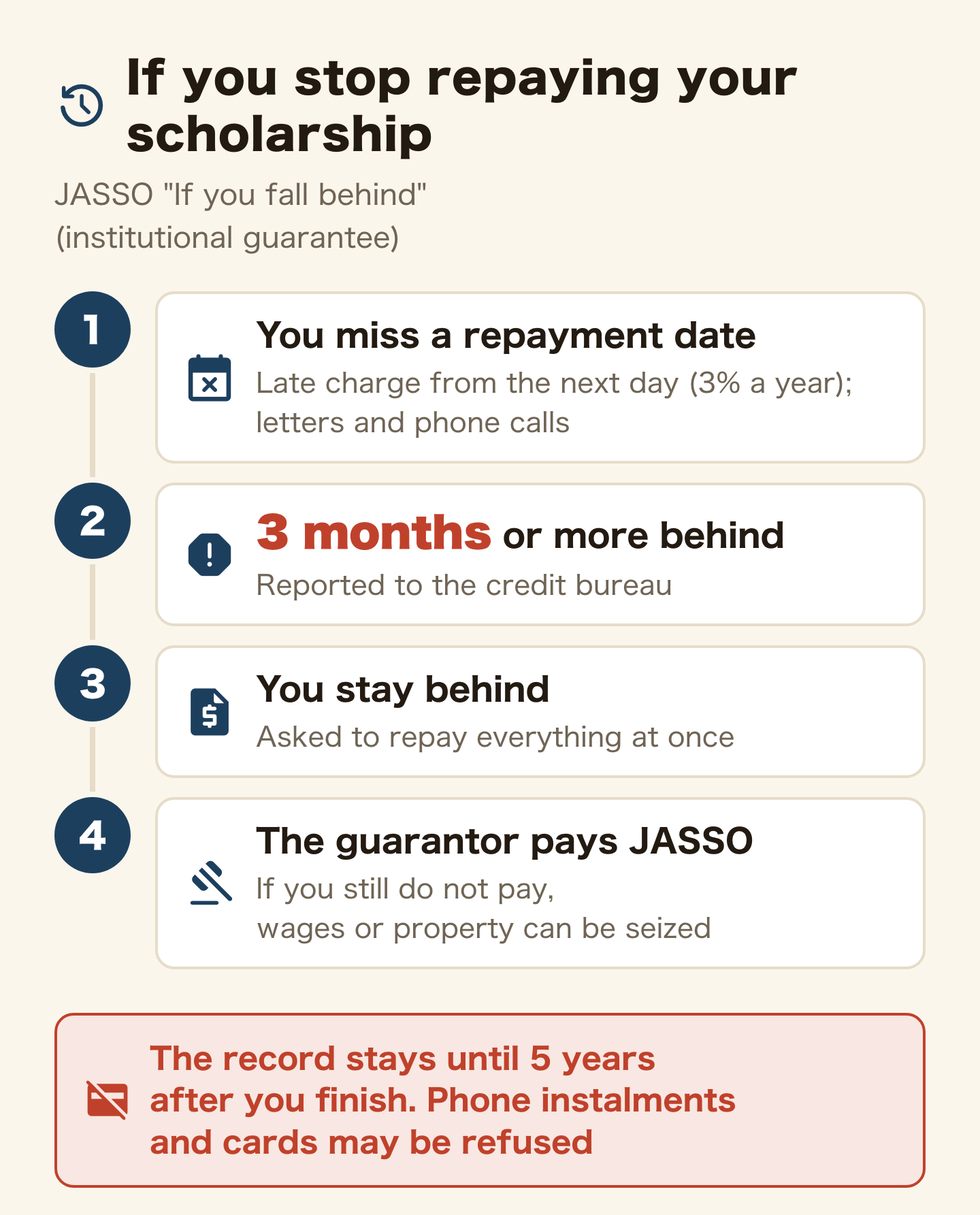
Miss a repayment date and a late charge starts the next day. Since 28 March 2020, the late charge has been 3% a year (JASSO, late charges (Japanese)). JASSO chases you and any guarantors by letter and by phone (JASSO, reminders (Japanese)).
Once you are 3 months or more behind, you are reported to a credit bureau. If you have only just started repaying, the check is made 6 months after repayment begins: 3 months or more behind at that point, and you are reported. The record is deleted 5 years after you finish repaying. JASSO warns that while you are listed, you may be refused phone instalments or credit cards (JASSO, credit bureau reporting (Japanese)). You agreed to this reporting in the consent form you signed when you applied.
If the arrears continue, you are asked to repay the whole remaining balance at once, including amounts not yet due. With an institutional guarantee, the guarantor pays JASSO, then demands the full amount from you. If you still do not pay, it can go as far as seizing your wages or property (JASSO, institutional guarantee (Japanese)).
Cannot repay your scholarship? Apply for reduced repayment or a deferral before you fall behind
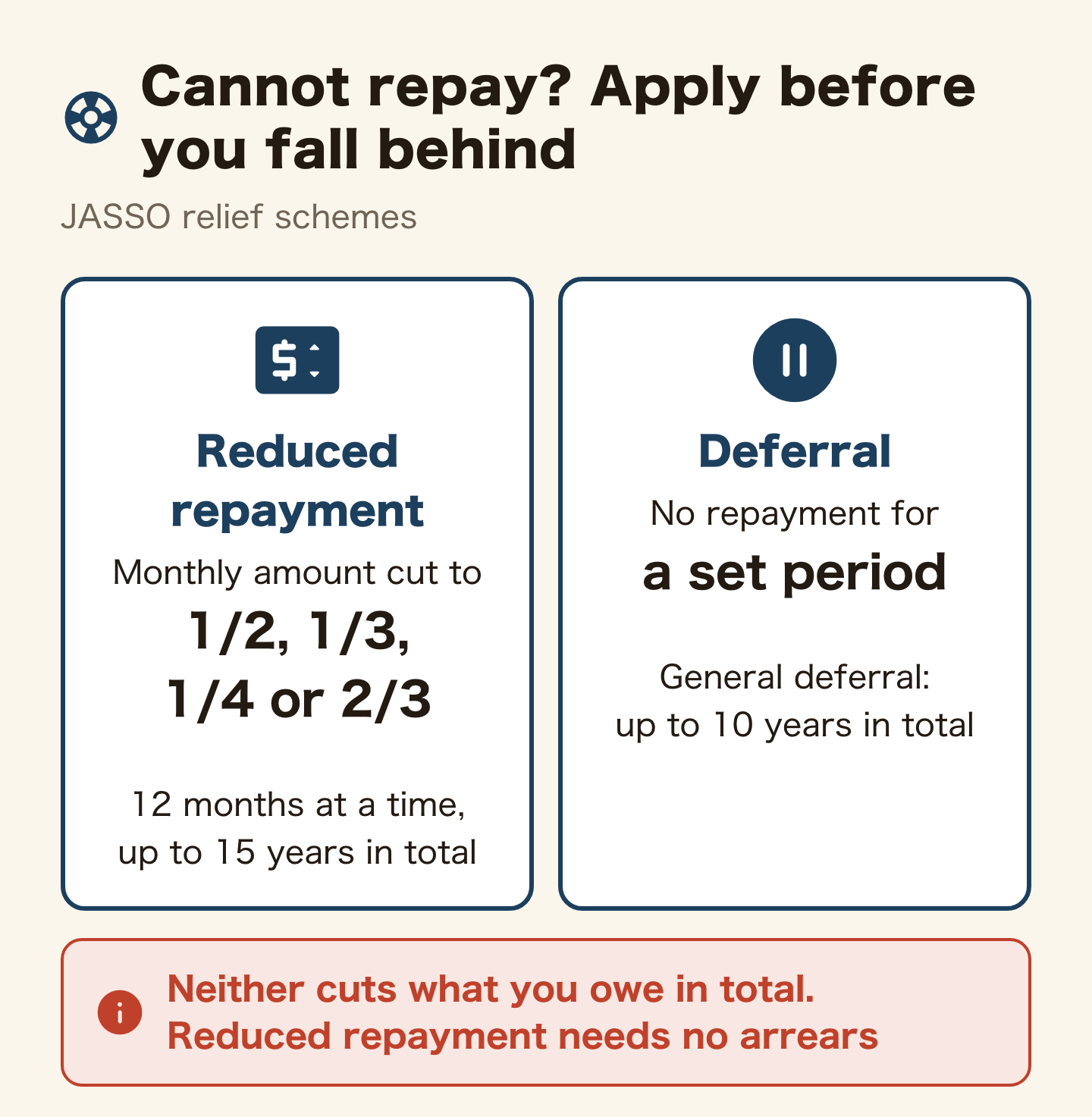
As soon as you know you cannot keep up, apply to JASSO before a payment is missed. Falling behind silently starts the late charge and the credit bureau clock.
- Reduced repayment: your monthly amount is cut to 1/2, 1/3, 1/4 or 2/3, and the repayment period is extended to match. Each application covers 12 months, up to 15 years in total. For salaried workers, the guide is an annual income of 4 million yen or less. You must not be in arrears when you apply (JASSO, reduced repayment (Japanese)).
- Deferral: while illness, unemployment or low income makes repayment impossible, repayment is pushed back. A general deferral can be used for up to 10 years in total (JASSO, deferral (Japanese)).
Neither scheme reduces the total you owe. JASSO itself says a deferral does not waive the principal or the interest. Whatever you push back, you finish repaying that much later.
Can foreigners get a student loan in Japan? “Student” status is not eligible
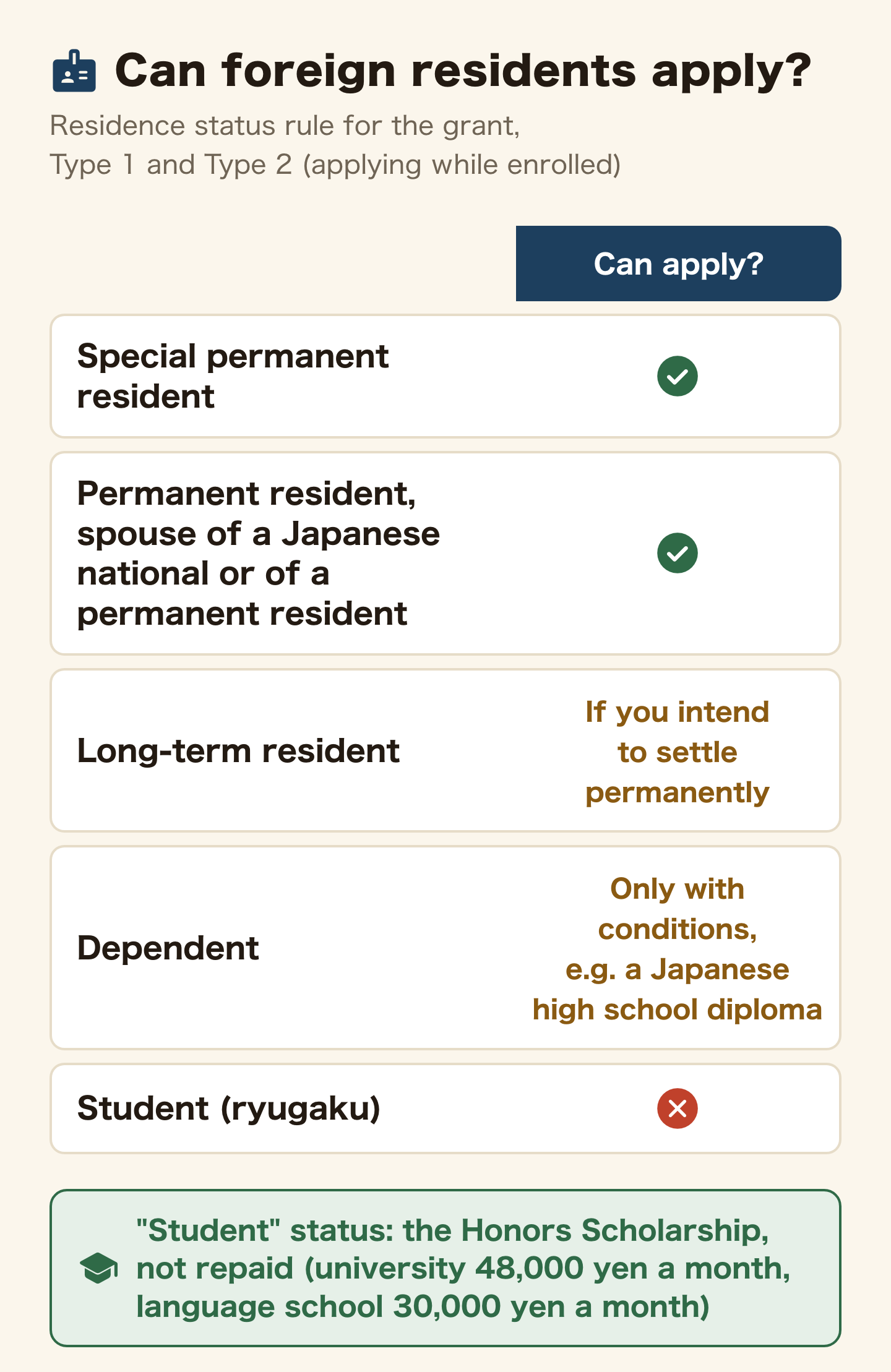
If you apply for JASSO’s grant after starting your course, only these residence statuses are eligible for foreign nationals (JASSO, grant eligibility while enrolled (Japanese)):
- Special permanent resident
- Permanent resident, spouse or child of a Japanese national, or spouse or child of a permanent resident
- Long-term resident who intends to settle permanently
- Dependent who meets conditions such as graduating from a Japanese elementary, junior high and high school, and who intends to settle and work in Japan
The residence status rule for Type 1 is the same as for the grant, and Type 2 follows Type 1 (JASSO, Type 1 eligibility while enrolled (Japanese); Type 2 eligibility while enrolled (Japanese)). “Student” (ryugaku) status is not on the list.
With student status, there is the Honors Scholarship, which you do not repay. It pays 48,000 yen a month at university or graduate school, and 30,000 yen a month at a Japanese language school. You apply through your school, and each school has a fixed number of places it can recommend (JASSO, Honors Scholarship (Japanese)). The grade and allowance conditions are in the JASSO Honors Scholarship: conditions and how to apply. To lower the tuition itself, check your school’s deadline first in tuition fee exemption in Japan.
Which debts do not look like debt? Revolving, instalments, buy now pay later, “effectively 0 yen”
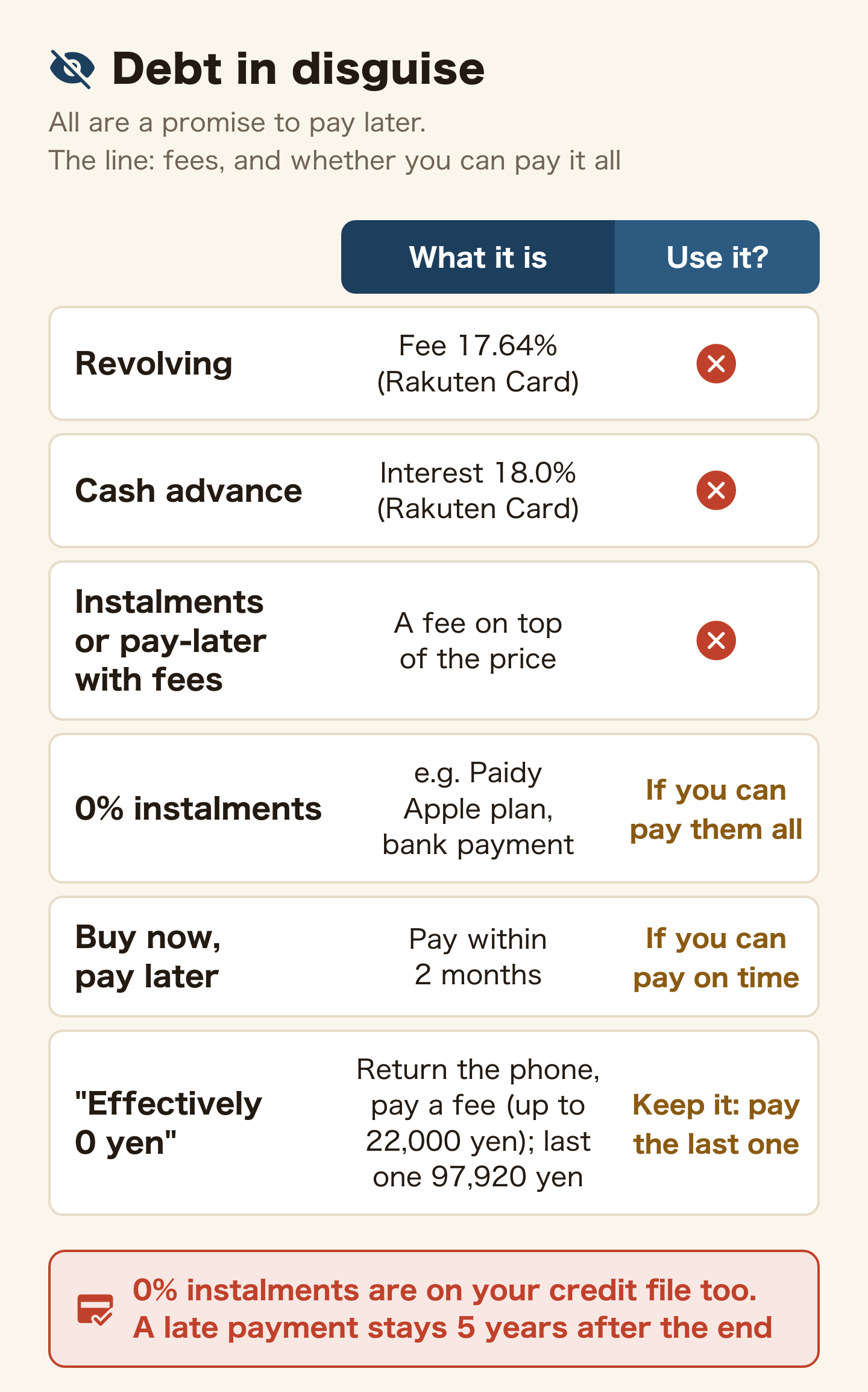
Payment methods that never use the word “debt” still contain a promise to pay later. Two things decide whether they hurt you. Is there interest or a fee? And can you pay every instalment on schedule?
- Revolving and cash advances: Rakuten Card’s revolving fee is 17.64% a year and its cash advance interest is 18.0% a year (Rakuten Card, cash advances (Japanese)). You pay a fee to consume, so this is bad debt.
- Instalments or pay-later with fees: the Instalment Sales Act defines paying for card purchases later, over more than 2 months, as “comprehensive credit purchase intermediation” (e-Gov, Instalment Sales Act (Japanese)). If the instalments carry a fee, you pay the price of the item plus that fee.
- 0% instalments: Paidy’s Apple plan has no instalment fee for up to 36 payments, as long as you pay by bank debit or bank transfer (Paidy, Apple plan (Japanese)). If you pay every instalment, no interest goes out.
- Buy now, pay later: services that let you pay within 2 months without a card. Complaints connected with them keep rising at the National Consumer Affairs Center (National Consumer Affairs Center, pay-later service problems (Japanese)).
- “Effectively 0 yen”: in au’s example, a 120,000 yen phone is paid as 960 yen x 23 plus a final payment of 97,920 yen. Return the phone between month 13 and month 25 and pay a program fee (up to 22,000 yen), and the final payment is waived (au, Smartphone Tokusuru Program+ (Japanese)). Keep it and you pay the final one too.
Even at 0%, an instalment plan is a credit contract. Paidy reports the contract to CIC, and a late payment stays on record until 5 years after the contract ends (Paidy, consent to the handling of personal information (Japanese)). docomo’s phone instalments are the same: miss a due date and the late payment is reported to a credit bureau (docomo, buying a phone in instalments (Japanese)). Use 0% instalments only when you can afford every monthly payment, right to the last one.
For a phone, paying in full comes first. Next is a used or cheaper model paid in full; if you split it, use Paidy’s Apple plan by bank debit at 0%. That order is explained in installment phones in Japan (why we do not recommend carrier plans). Use a credit card in one payment only, as in credit cards for foreigners in Japan.
The legal interest cap is 15-20% a year (Financial Services Agency, money lending rules (Japanese)). Staying inside those limits does not make it safe. The 20% cap is higher than Rakuten Card’s revolving fee.
Is this good debt? Three questions
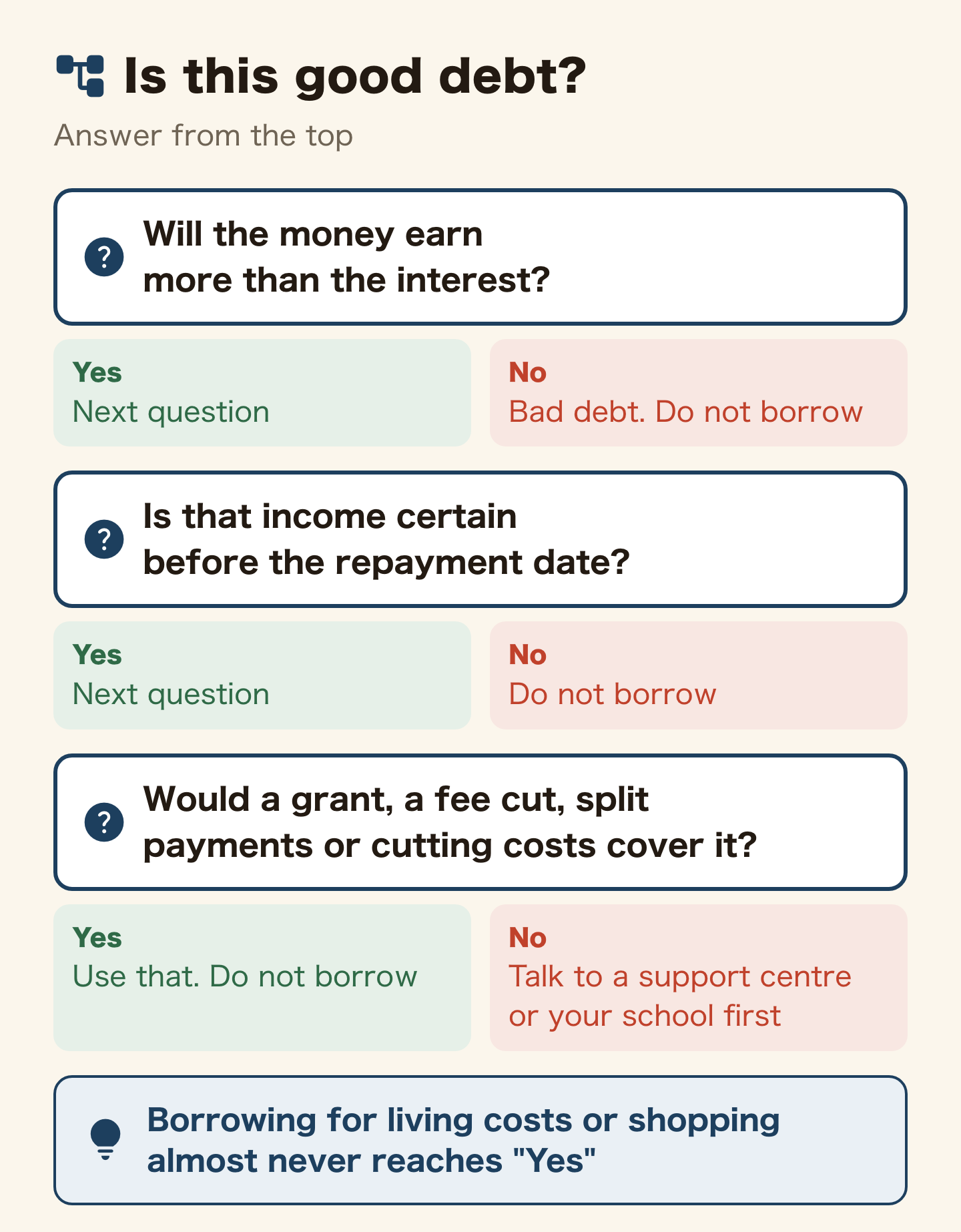
When you are thinking about debt with interest or fees, answer three questions from the top. If any answer is “no”, do not borrow. For 0% instalments, only one thing matters: whether you can pay every month, right to the last payment.
- Will the money earn more than the interest? Clothes, trips and living costs stop here.
- Is that income certain before the repayment date? “Probably” and “after I graduate” are not certain.
- Would a grant, a fee cut, split payments of the bill, or cutting costs cover it? If so, use that instead of borrowing.
When money is short, the answer is not debt but less money going out. How to lower fixed monthly costs such as rent, phone and insurance first is set out in Save: cut your costs in Japan. If daily life itself is not working, talk to a self-reliance support centre before you borrow. The centres and the support you can use are in welfare in Japan for foreigners (help for those not eligible).
Which one are you?
- You are about to apply for a scholarship. Look for money you do not repay first. Today, check your residence status on your residence card: with student status, ask the student office about a recommendation for the Honors Scholarship; with permanent resident, long-term resident or similar status, ask about JASSO grant eligibility.
- You already have a JASSO loan. Find out the total. Today, check the amount borrowed, the rate and the monthly repayment on Scholar-Net Personal or your school’s papers.
- Repayments are hard to keep up. Apply before you fall behind. Today, read JASSO’s conditions for reduced repayment or deferral and gather your income certificate.
- You have a balance on revolving or instalments with fees. Stop adding to it. Today, write down the balance and the fees from your card’s page, and pay in one go from your next purchase.
- You are about to buy something on 0% instalments. Check you can pay to the end. Today, add the monthly payment to your budget and work out whether what is left covers your living costs.
- You are short of money and thinking of borrowing. Cut fixed costs instead. Today, list your monthly spending and choose one of rent, phone or insurance to lower.
Once you know the total you would repay, or have found one way to avoid borrowing, this decision is done. Then rebuild your monthly spending so it works without debt.
FAQ
Q. What is the difference between good debt and bad debt?
Good debt is borrowing that earns more than the interest it costs. Bad debt is borrowing spent on things that are gone once used, so only interest goes out. Paying interest or fees to cover living costs, shopping or fun is almost always bad debt.
Q. Is a scholarship a loan in Japan?
JASSO’s loan-type scholarships are debt. Type 1 is interest-free and Type 2 charges interest; both are repaid after graduation. The grant does not have to be repaid.
Q. How much do you repay on a JASSO loan?
In JASSO’s example, borrowing 100,000 yen a month for 4 years (4.8 million yen) under Type 2 and repaying over 20 years costs 5,056,654 yen at 0.5% a year and 6,459,510 yen at 3.0%. The rate is set in the month the loan ends and is capped at 3.0%.
Q. Does a late JASSO repayment go on your credit record?
Yes, once you are 3 months or more behind you are reported to a credit bureau. The record is deleted 5 years after you finish repaying. While it is there, you may be refused phone instalments or credit cards.
Q. Can foreigners or international students get a JASSO student loan?
Among foreign nationals, special permanent residents, permanent residents, spouses or children of Japanese nationals or of permanent residents, long-term residents who intend to settle permanently, and dependents who meet the conditions can apply. “Student” (ryugaku) status is not eligible. Students can apply instead for the Honors Scholarship, which is not repaid (48,000 yen a month at university).
Q. Are buy now pay later and phone instalments debt?
They are a promise to pay later, so they work like debt. Instalments with a fee are bad debt. With 0% instalments such as Paidy’s Apple plan, no interest goes out if you pay every instalment. They are still credit contracts, so a late payment is recorded with a credit bureau.
Summary
Good debt is borrowing that earns more than its interest. Borrowing for living costs or shopping is almost always bad debt. A scholarship can be debt too: JASSO’s loan type must be repaid. Borrow 4.8 million yen under Type 2 at 3.0% and you repay 6,459,510 yen over 20 years. Fall 3 months or more behind and you are reported to a credit bureau, and the record stays until 5 years after you finish.
Among foreign nationals, JASSO’s grant, Type 1 and Type 2 are open only to statuses such as permanent resident, spouse of a Japanese national and long-term resident; “student” status is not eligible. With student status, look first for the Honors Scholarship, which is not repaid, and tuition fee cuts. Revolving, cash advances and instalments with fees are bad debt. Use 0% instalments only when you can pay to the last one. When money is short, do not borrow: cut fixed costs and use grants and fee cuts.
Official sources: Japan Student Services Organization (JASSO) types of scholarship, grant scholarships, loan scholarships, Type 2 interest and rates, university repayment examples, late charges, reminders, institutional guarantee, credit bureau reporting, reduced repayment, deferral, grant eligibility while enrolled, Type 1 eligibility while enrolled, Type 2 eligibility while enrolled, Honors Scholarship; e-Gov Instalment Sales Act; Financial Services Agency, money lending rules; National Consumer Affairs Center, pay-later services; Paidy Apple plan and consent to the handling of personal information; docomo, phone instalments; au, Smartphone Tokusuru Program+; Rakuten Card revolving and cash advances (all in Japanese, all checked 27 October 2026). Rates and conditions change, so check the official pages on the day you apply.
Related reading
Found this useful? Share it
Send it to a friend who lives in Japan.
WHO WROTE THIS

mori
Japanese. I read the ministries’ own notices, orders and Q&As in the original, and I start from what my Nepalese and Sri Lankan friends in Japan actually ran into. I do not write about what I have not checked or been told.
What this site can and cannot do →Looking for something else?
You may use the figures in this article, including commercially, if you credit this site with a link. How to use our figures