Checked on 18 October 2026 against the Ministry of Health, Labour and Welfare’s defined contribution pages and official Q&A, the iDeCo official site (National Pension Fund Association) on auto-transfer and lump-sum withdrawals, the Defined Contribution Pension Act and its Enforcement Order on e-Gov, and the National Tax Agency’s Tax Answer.
The short answer
- A corporate DC plan (kigyo-gata defined contribution pension, Japan’s closest thing to a 401k) is a company pension your employer pays into, you invest, and what you get depends on the results. It is separate from the Employees’ Pension and from iDeCo.
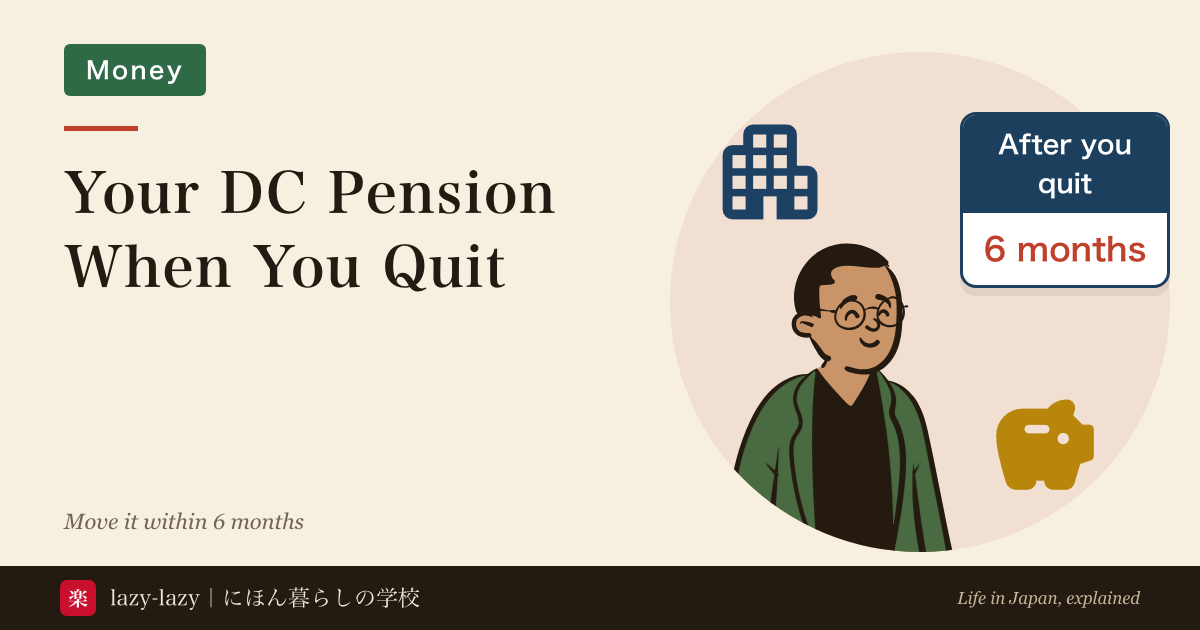
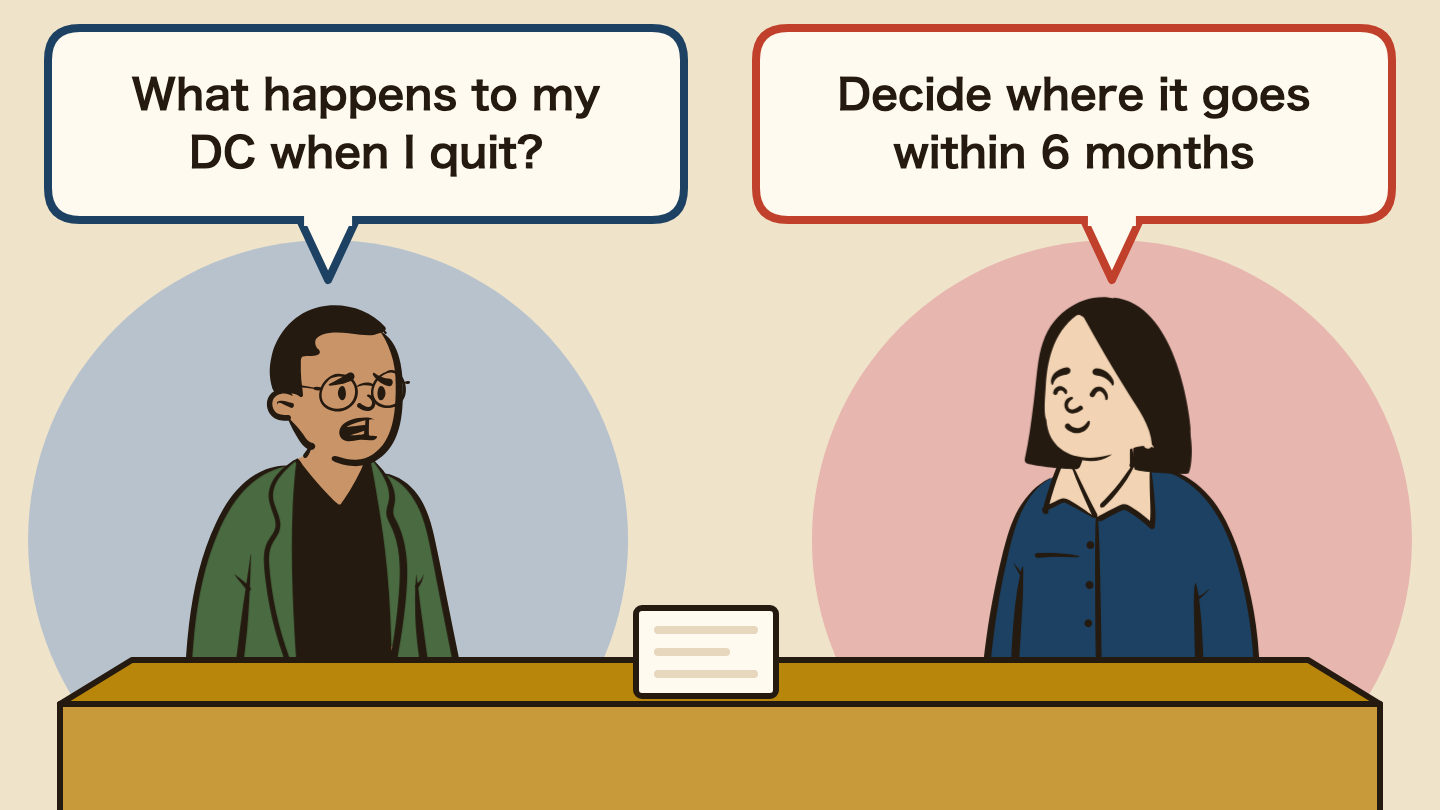
- When you leave the job, you have six months, counted from the month after you lose membership, to decide where the money goes: the new employer’s DC plan, iDeCo, or a lump-sum withdrawal if you qualify.
- Do nothing and it is “auto-transferred”. Investing stops, 4,348 yen comes off when it moves, and 98 yen a month after that.
- Non-Japanese leaving Japan can take the lump sum if they contributed for 5 years or less, or the balance is 250,000 yen or less. Within the six months, claim from your company plan; after that, through iDeCo within two years of losing membership.
- Leave within three years of service and the employer’s money may go back to the employer — only if your plan rules say so.
Knowing this, you can decide before your last day where the money goes and whether you can take it home, instead of finding out six months later that it has been frozen and charged fees.
Your last day is set. HR hands you a stack of papers, and one of them is about your defined contribution pension: “loss of membership”. You ask a Japanese colleague what to do. “Just move it to iDeCo,” they say. But you might be going home next year. Should you move it, or can you take it with you? Your colleague has never had to ask that question.
- What is a corporate DC pension in Japan?
- What happens to my DC plan when I leave the job?
- What if I leave my DC alone? Auto-transfer and its costs
- Changing jobs in Japan: move it to the new plan or to iDeCo
- Leaving Japan: can foreigners withdraw a corporate DC?
- How much is the lump sum, how do I claim, and is it taxed?
- Leaving within three years: the employer refund rule
- Missed the six months? You can still claim within two years
- Corporate DC on one page: numbers, deadlines, sources
- Which one are you?
- FAQ
- Summary
- Related reading
What is a corporate DC pension in Japan?
A defined contribution pension is one where your future payout is the contributions plus whatever they earn (Ministry of Health, Labour and Welfare, DC overview). In the corporate type, the employer pays in. In iDeCo, you pay in yourself.
Members are, as a rule, employees covered by the Employees’ Pension at a company that runs a plan. If the plan rules allow it, you can add your own money on top (matching contributions). The plan’s provider offers between 3 and 35 investment products, and you choose.
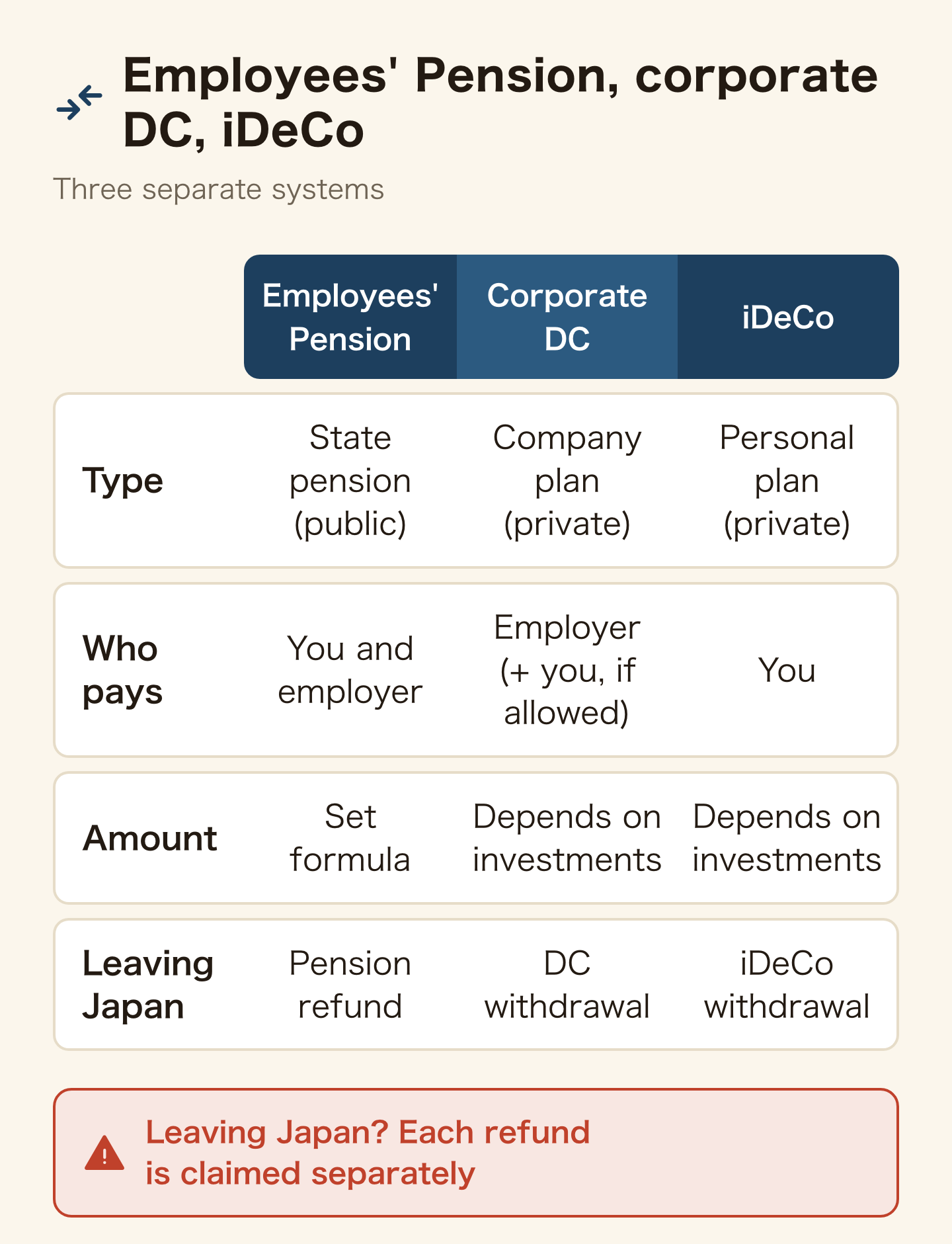
The Employees’ Pension deducted from your salary is the state pension. The corporate DC sits on top of it as a private company plan. The refunds when you leave Japan are separate too: the pension refund goes to the Japan Pension Service, the DC withdrawal goes to the DC plan. Do not file one and forget the other.
What happens to my DC plan when I leave the job?
When you leave, you lose membership. In law, that is the day after you stop being employed (Defined Contribution Pension Act, Article 11). Check your exact date on the papers from your employer or on your plan’s record-keeper website.
The clock starts there. Within six months, counted from the month after the month you lost membership, you do one of these (MHLW, portability; DC Act, Article 83):
- move it to the new employer’s corporate DC plan
- move it to iDeCo
- move it to a defined benefit plan (DB) or the Pension Fund Association’s plan
- claim the lump-sum withdrawal, if you qualify
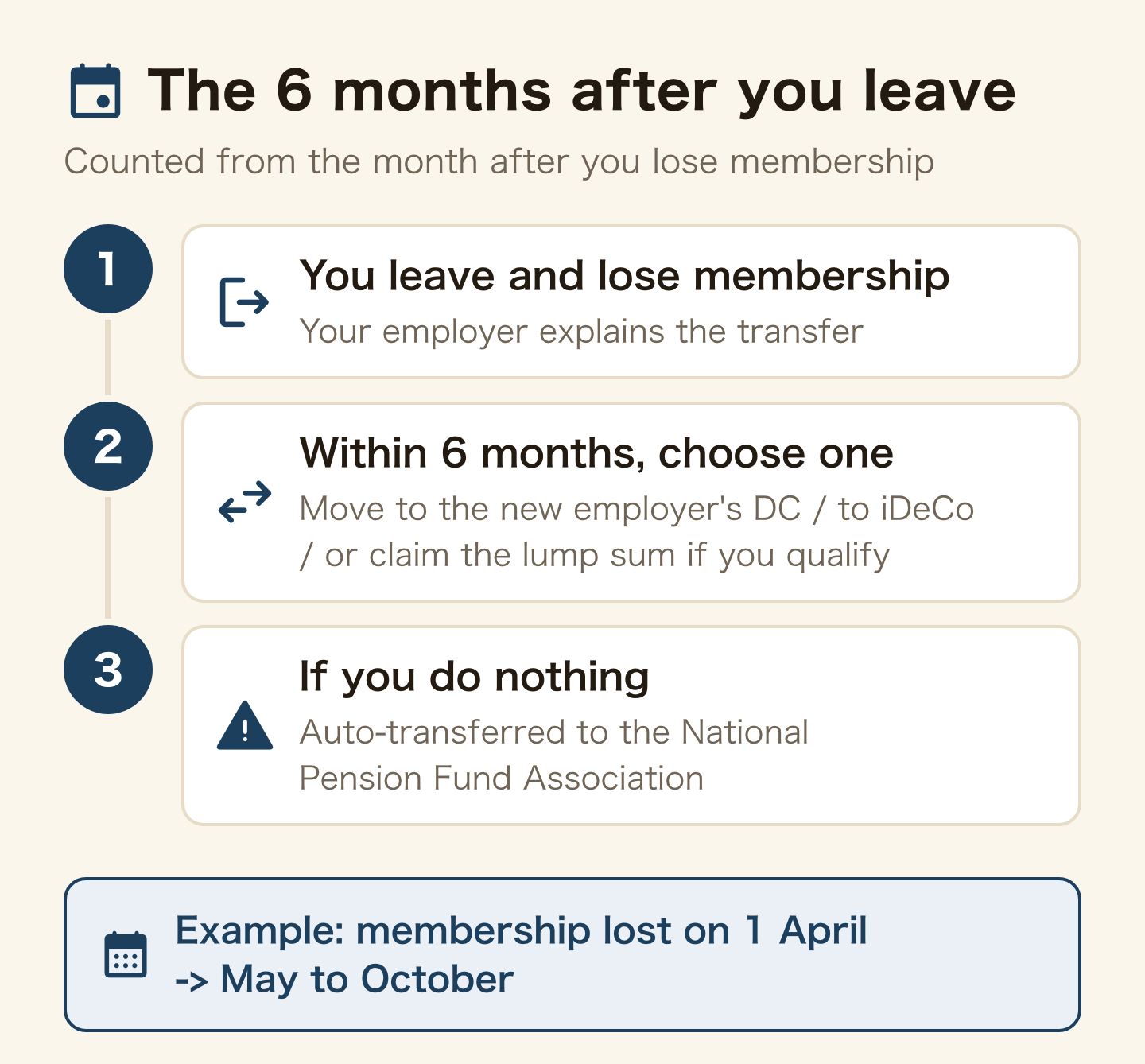
An example: if you lost membership on 1 April, you count six months from May, to the end of October. The official Japanese word for this transfer is 移換 (ikan). People often write 移管, which sounds the same, and either is understood at the counter.
From 1 April 2026, employers must explain this when they expect an employee to lose membership, not after (MHLW, 2025 reform). If HR has not explained it before your last day, ask.
What if I leave my DC alone? Auto-transfer and its costs
You quit, and the company settles your retirement savings with your final pay. Where you come from, that may be normal. In Japan, a corporate DC does not turn into cash just because you quit. If you do nothing for six months, the money is moved to the National Pension Fund Association. This is called auto-transfer.
The ministry lists three costs:
- the money is not invested
- management fees are charged
- the time does not count toward the membership period needed to draw from age 60, so your payout age can move later
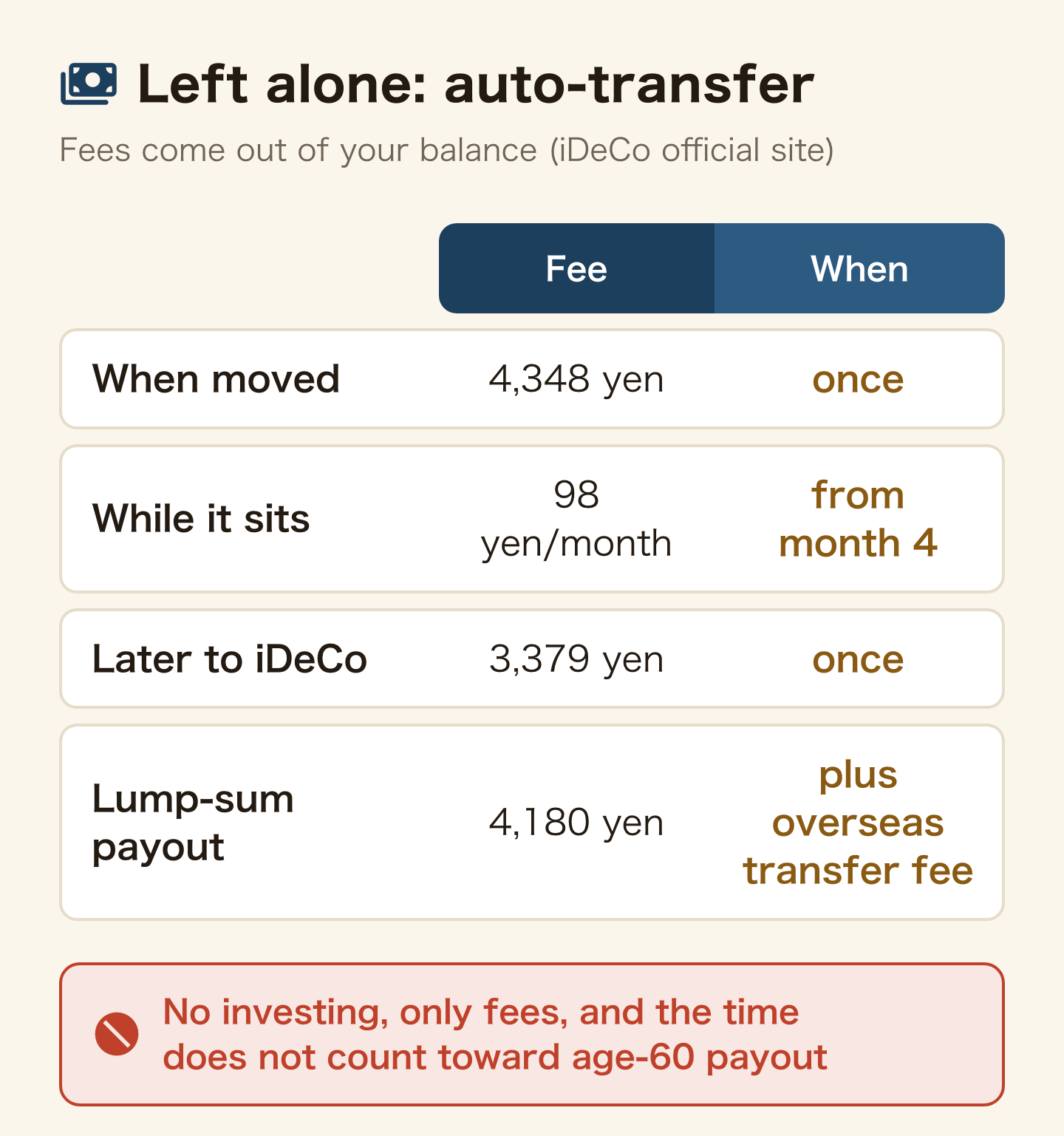
The fee table is on the iDeCo official site, for people who were auto-transferred. The move costs 3,300 yen (the designated record-keeping body) plus 1,048 yen (the Association): 4,348 yen. Holding it costs 58 plus 40 yen: 98 yen a month. The monthly fee starts four months after the move and is taken from your balance each April for the year. With a zero balance, nothing is charged.
The payout age moves too. DC old-age benefits start at 60 as a rule, but with under 10 years of counted membership at 60, the start moves step by step to 61 and up to 65. Auto-transferred time does not count.
One exception: if within the six months you are confirmed as joining iDeCo or another employer’s DC plan, the money is moved there without you filing a request.
Changing jobs in Japan: move it to the new plan or to iDeCo
Staying in Japan for a new job? Ask HR at the new company whether they have a corporate DC plan. If they do, ask their pension team to take your assets in.
If they do not, or you become self-employed, move it to iDeCo. According to the iDeCo official site, you choose an iDeCo provider yourself and send the transfer form (K-003). To keep contributing, add the enrolment form (K-001). If you only keep it invested without contributing, you are an “investment instructor” (unyo shizusha).
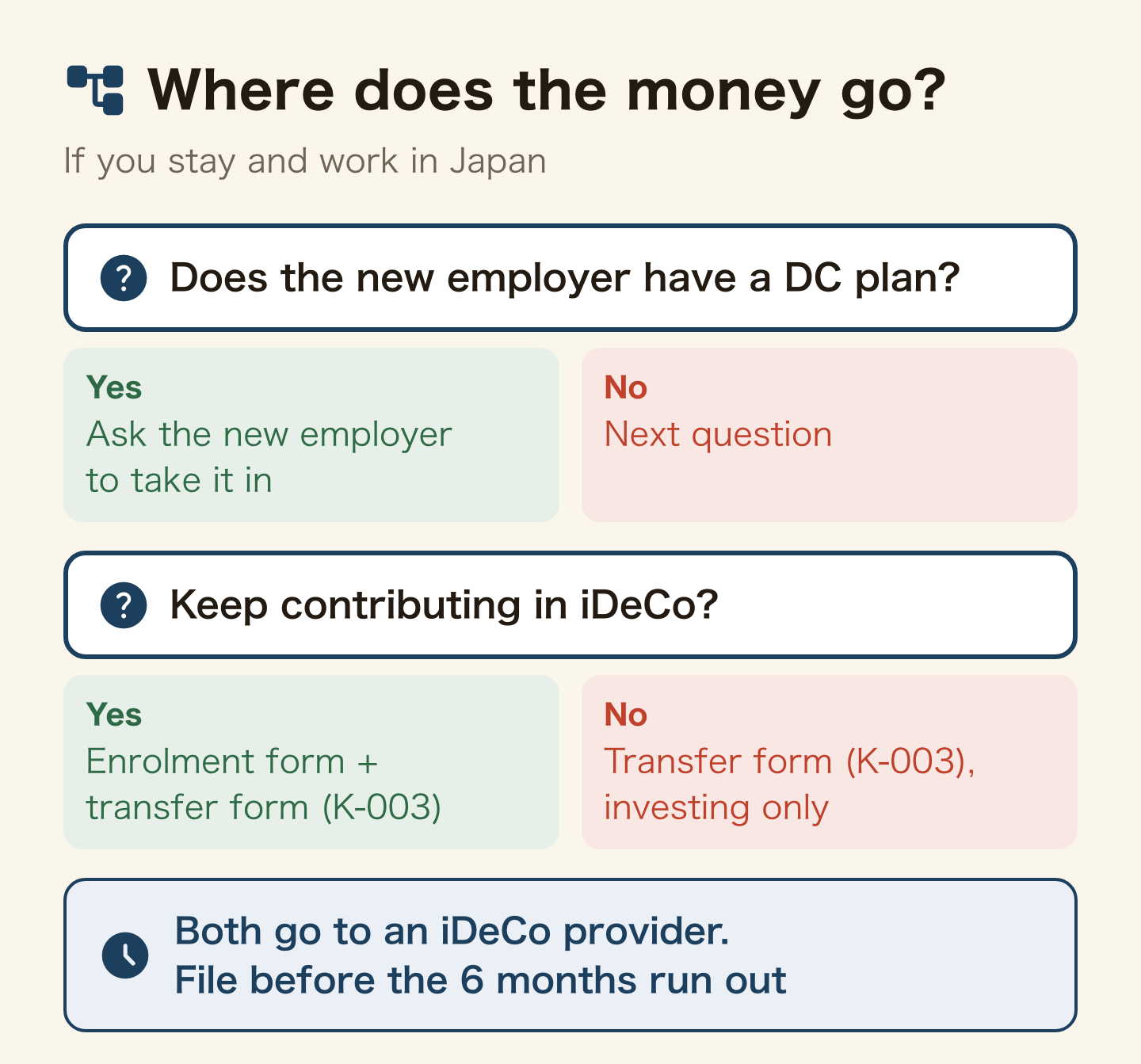
Moving to iDeCo costs 2,829 yen to the Association (iDeCo official site, joining). Provider fees vary, so compare before you sign up. Which products to invest in is outside this guide. The residence-status filing and National Pension steps when you quit are in leaving a job in Japan as a foreigner.
Leaving Japan: can foreigners withdraw a corporate DC?
A corporate DC is locked until 60 as a rule. The exception is the lump-sum withdrawal. Since May 2022, even with more than 15,000 yen, you can take it straight from the corporate plan without moving it to iDeCo first, if you meet the conditions (MHLW, 2020 reform).
The conditions that matter for a non-Japanese national going home (MHLW, DC overview):
- under 60
- not a member or investment instructor of a corporate DC or iDeCo
- not able to join iDeCo (“a non-Japanese national living abroad” counts)
- no right to a DC disability benefit
- contributions for 5 years or less, or a balance of 250,000 yen or less
- to claim from the corporate plan: within six months from the month after you lost membership (DC Act, Supplementary Provisions Art. 2-2(1)(iii))
Because of the third condition, you claim after you have left Japan and live abroad. While you live in Japan and are in the public pension, you are usually someone who can join iDeCo. Japanese nationals abroad can still join the National Pension voluntarily, so this route is closed to them.
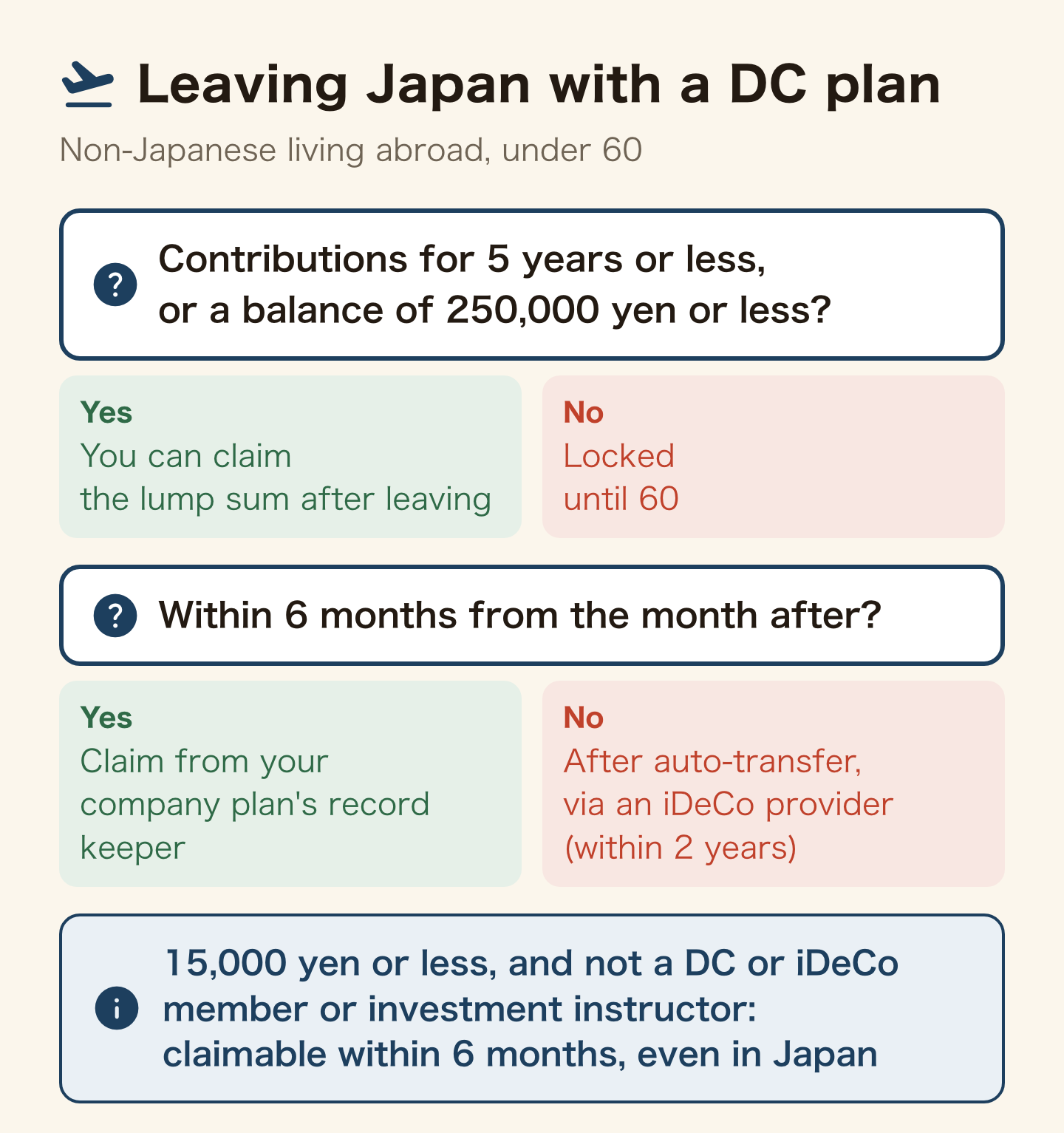
Missing the six months does not close the door. Auto-transferred money can be claimed under the iDeCo withdrawal rules, within two years of the day you last lost membership. The ministry’s Q&A (No. 293) confirms that a former member of foreign nationality who has gone home can use either route, unless they have become an iDeCo investment instructor.
Over both lines — more than five years of contributions and more than 250,000 yen — there is no lump sum. The money stays in Japan’s system until 60 or later. For the state pension after you leave, see receiving your Japanese pension abroad.
With 15,000 yen or less, a simpler rule applies: not a member or investment instructor of a corporate DC or iDeCo, and within six months. You can be living in Japan.
How much is the lump sum, how do I claim, and is it taxed?
The amount is your balance — precisely, the balance on a date set by the plan rules within three months of your claim (DC Act Enforcement Order, Article 59). If it was auto-transferred first, the 4,180-yen payout fee comes off, and an overseas transfer adds its own fee.
Where to claim depends on timing:
- within six months: your company plan’s record keeper (contact details are on the plan’s website and notices)
- after auto-transfer: send the combined claim and transfer form (K-016) to an iDeCo provider; the payment is made by the designated record-keeping body (iDeCo official site, benefits)
The claim normally asks for a Japanese family-register extract or similar proof of birth date, which you will not have abroad. The ministry’s Q&A (No. 290) allows a copy of your passport instead, showing your last departure date from Japan, name, birth date, nationality, signature and residence status. Before you fly, check that the departure stamp page will be easy to copy.
Tax: if you receive it while living in Japan, the lump sum is “occasional income” (Income Tax Act Enforcement Order, Article 183). For occasional income, a special deduction of up to 500,000 yen comes off, and half of what remains is added to your other income (NTA Tax Answer No. 1490). A withdrawal of 15,000 yen or less, with no other occasional income that year, stays inside the deduction.
How Japan taxes the lump sum once you have left could not be confirmed from National Tax Agency guidance. When you claim, ask the record keeper whether tax is withheld and how much. If you leave tax matters behind in Japan, appointing a tax representative before you go means someone can receive the papers.
Leaving within three years: the employer refund rule
Leaving after two years? Check one more thing. A corporate DC plan’s rules may say that if you leave with under three years of service, all or part of what the employer paid in goes back to the employer (DC Act, Article 3(3)(x)). This is the employer refund (jigyonushi henkan).
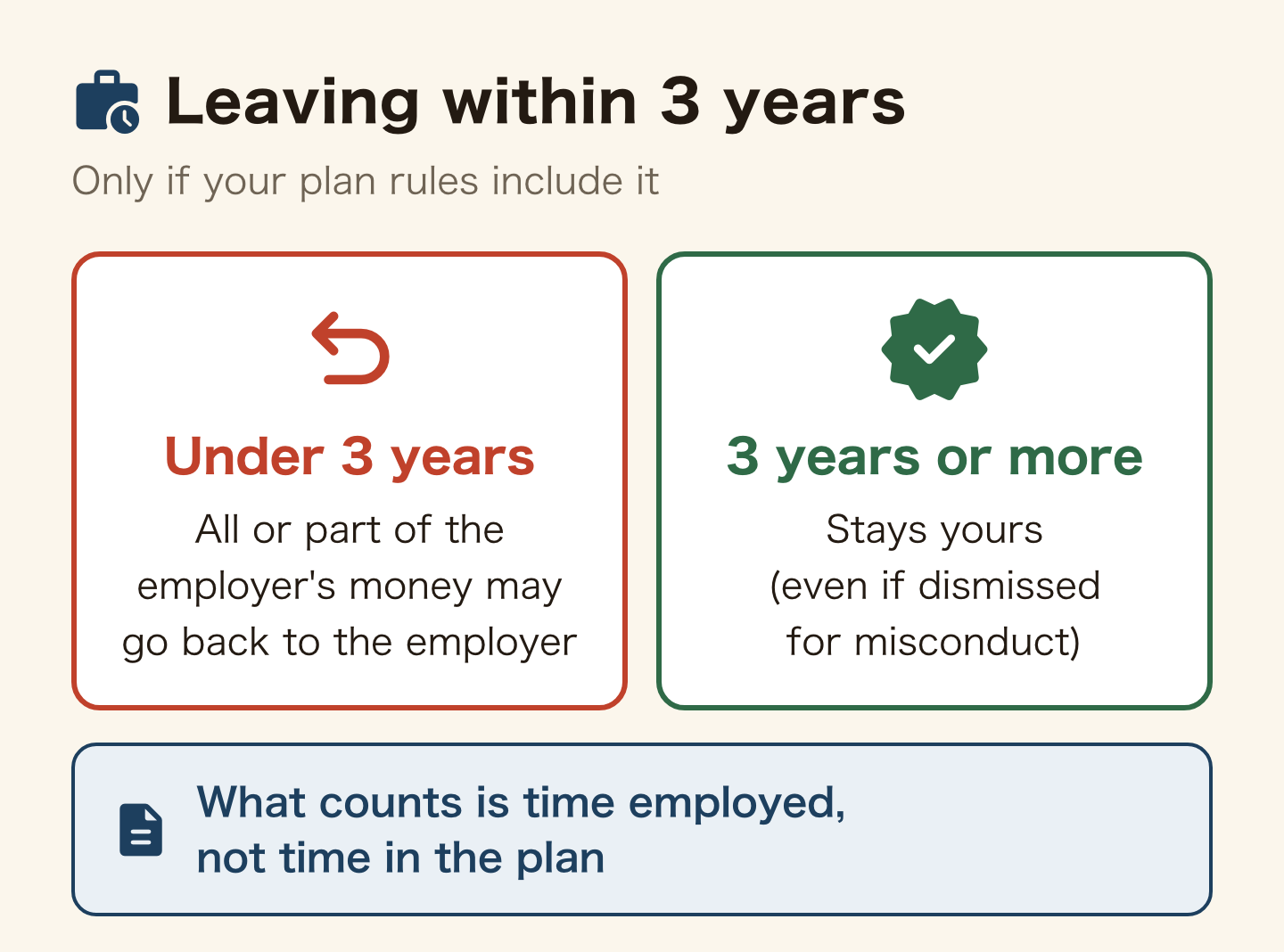
The three years are counted as time employed, not time in the plan (ministry Q&A No. 76). With three years or more, the employer cannot take it back even after a dismissal for misconduct (No. 77). Where the rule applies, what you can move or withdraw is what remains after the refund. Each company decides whether to have it, so check your plan rules or ask HR.
Missed the six months? You can still claim within two years
Past the six months already? Do not give up. The auto-transfer call centre (03-5958-3736, weekdays 9:00–17:30) can tell you whether your money was moved.
- Still working in Japan: you can still move it to iDeCo or a new employer’s DC plan. Once you are confirmed as a new iDeCo or DC member, it is moved without a request.
- Gone home: within two years of losing membership, claim the lump sum through an iDeCo provider with form K-016.
- Past two years: no lump sum; you draw it as an old-age benefit from 60 or later.
The longer it sits, the more fees pile up and the more months go uncounted toward age 60. The day you notice is the earliest day you can act.
Corporate DC on one page: numbers, deadlines, sources
Everything below was checked on official pages on 18 October 2026.
| Question | What the official source says | Source |
|---|---|---|
| Deadline to move it | Within six months from the month after the month you lost membership | MHLW, portability; DC Act, Article 83 |
| If you do nothing | Auto-transfer to the National Pension Fund Association: no investing, fees, time not counted | Same |
| Auto-transfer fees | 4,348 yen when moved; 98 yen a month (from month 4); 3,379 yen to move to iDeCo; 4,180 yen for a lump-sum payout | iDeCo official site |
| Withdrawal, 15,000 yen or less | Not a member or investment instructor; within six months | MHLW, DC overview; DC Act, Suppl. Provisions Art. 2-2 |
| Withdrawal, over 15,000 yen | Under 60; cannot join iDeCo (e.g. non-Japanese living abroad); 5 years or less or 250,000 yen or less; within six months | MHLW, DC overview; MHLW, 2020 reform |
| After six months | iDeCo withdrawal rules; within two years of losing membership | Same |
| Passport instead of a register | Allowed if you live abroad and cannot get a family-register extract | MHLW DC Q&A No. 290 |
| Employer refund | Plan rules may return all or part of employer money if service is under three years | DC Act, Art. 3(3)(x) |
| Tax while living in Japan | Occasional income; up to 500,000 yen deduction, then half is added | NTA No. 1490 |
Read down the table and there are two clocks: six months to claim from the company plan, two years to claim through iDeCo. If you are going home, whether you are under 5 years or under 250,000 yen decides your route.
Which one are you?
- Changing jobs in Japan, and the new employer has a DC plan — ask their HR to take your assets in when you join. Today, find your loss-of-membership date on the papers from your old employer.
- Staying in Japan, but no DC plan at the next job or going self-employed — choose an iDeCo provider and file K-003 (plus K-001 to keep contributing) within six months. Today, start comparing provider fees.
- Going home with 5 years or less, or 250,000 yen or less — prepare a copy of your passport with the departure stamp, and claim from the company plan within six months. Today, write down your plan’s record-keeper contact.
- Going home with more than 5 years and more than 250,000 yen — there is no lump sum. Plan to draw it from 60. Today, ask the record keeper whether you can register an address abroad.
FAQ
Q. What happens to my corporate DC when I leave my job in Japan?
You lose membership. Within six months, counted from the month after, move it to the new employer’s DC plan or to iDeCo, or claim the lump sum if you qualify. If you do nothing, it is auto-transferred to the National Pension Fund Association.
Q. What if I just leave my DC plan alone after quitting?
It is auto-transferred. It is not invested, 4,348 yen comes off when it moves and 98 yen a month after that, and the time does not count toward the membership needed to draw from age 60.
Q. Can a foreigner leaving Japan withdraw a corporate DC?
Yes, if you are under 60 and contributed for 5 years or less, or have 250,000 yen or less, you can claim after you start living abroad. Within six months from the month after you lost membership, claim from the company plan; after that, through an iDeCo provider within two years of losing membership.
Q. Is the DC lump-sum withdrawal taxed?
If you receive it while living in Japan, it is occasional income: up to 500,000 yen is deducted and half of the rest is added to your other income. For a payment after you have left Japan, ask the record keeper how it is taxed.
Q. How do I move a corporate DC to iDeCo?
Choose an iDeCo provider and send the transfer form (K-003). To keep contributing, also send the enrolment form (K-001). Do it within six months from the month after you lost membership.
Q. Do I lose money if I leave within three years?
If your plan rules include an employer refund, all or part of what the employer paid in can go back to the employer. The three years are counted as time employed, not time in the plan. Ask HR whether your plan has the rule.
Summary
A corporate DC does not turn into cash when you quit. Within six months from the month after you lose membership, move it to a new DC plan or iDeCo, or claim the lump sum if you qualify. Left alone, it is auto-transferred: no investing, fees only, and the time does not count toward age 60.
Non-Japanese going home have a way out. With 5 years of contributions or less, or 250,000 yen or less, you can claim the lump sum once you live abroad: from the company plan within six months, or through iDeCo within two years. It is a separate claim from the Employees’ Pension refund, so file both.
Official sources: MHLW, overview of the defined contribution pension / MHLW, portability when changing jobs / MHLW, 2020 reform / MHLW, 2025 reform / MHLW, DC Q&A (as of 1 October 2026) / iDeCo official site, after changing jobs or leaving / iDeCo official site, benefits / iDeCo official site, joining and transfer fees / e-Gov, Defined Contribution Pension Act / e-Gov, its Enforcement Order / e-Gov, Income Tax Act Enforcement Order / NTA, Tax Answer No. 1490 (all checked 18 October 2026). Always confirm fees and steps with your own plan’s record keeper.
Related reading
Found this useful? Share it
Send it to a friend who lives in Japan.
WHO WROTE THIS

mori
Japanese. I read the ministries’ own notices, orders and Q&As in the original, and I start from what my Nepalese and Sri Lankan friends in Japan actually ran into. I do not write about what I have not checked or been told.
What this site can and cannot do →Looking for something else?
You may use the figures in this article, including commercially, if you credit this site with a link. How to use our figures