This article contains affiliate links.
Last updated: July 2026
In short
- Leaving Japan is not one task – it is a chain of tasks that must happen in the right order. Get the order wrong and you lose money.
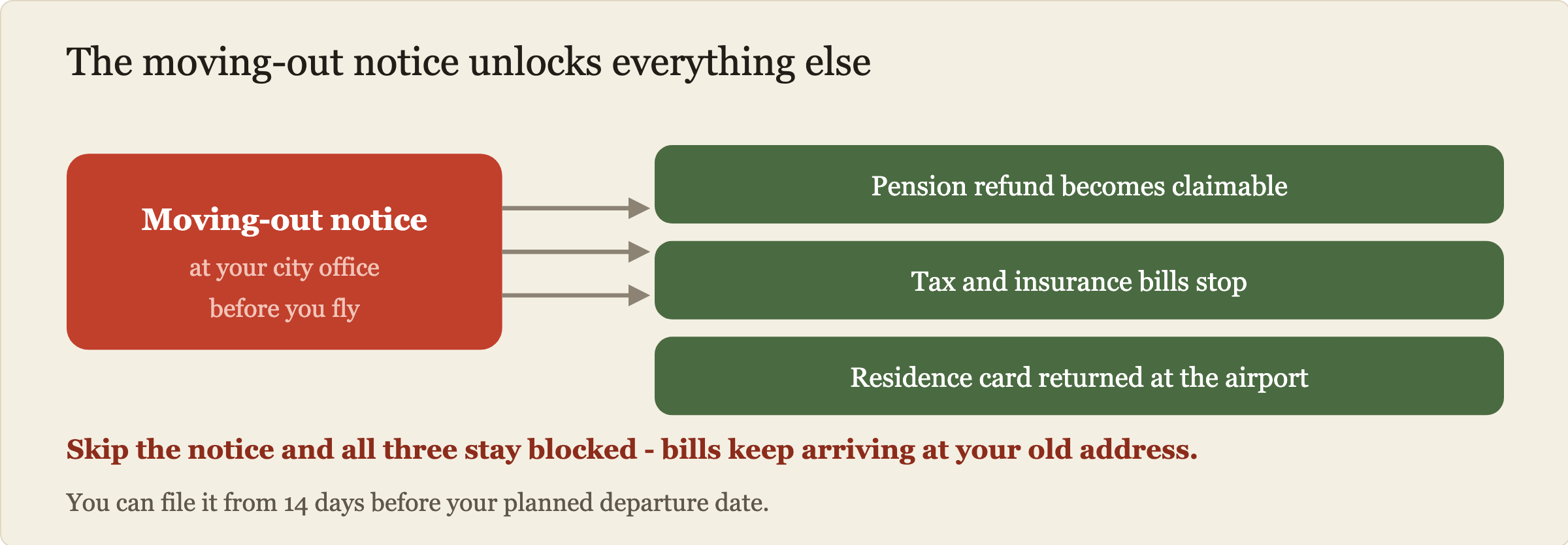
- The single most important step: file your moving-out notice (転出届 / tenshutsu todoke) at your city office before you fly. Skip it and Japan still treats you as a resident – bills keep coming.
- No moving-out notice means no pension refund (and the income-tax refund needs a tax agent appointed before you go). The lump-sum withdrawal payment requires that you no longer have an address in Japan.
- Residence tax follows you home. If you were in Japan on 1 January, you owe that year’s tax even after you leave – and unpaid tax can block a future visa or re-entry (if you are only going home for a while, read the one-year re-entry rule first).
- Close your bank account. An abandoned account misused by criminals can cost you entry to Japan later.
Most guides give you a list of things to do before leaving Japan. The problem is that a list does not tell you what breaks if you do things in the wrong order – and in Japan, the order genuinely matters. This guide walks through it as a timeline, from three months before your flight to after you land at home.
- Why does the order matter so much?
- The timeline: what to do and when
- Three months before: housing and work
- Two weeks before: the city office visit
- The resident tax trap that follows you home
- Your bank account: close it, do not abandon it
- Departure day and after
- Frequently asked questions
- Summary
- Related guides
Why does the order matter so much?
Because several steps depend on each other. The clearest example: you cannot claim your pension refund until you have filed your moving-out notice, because that refund requires you to no longer have a registered address in Japan.
The timeline: what to do and when
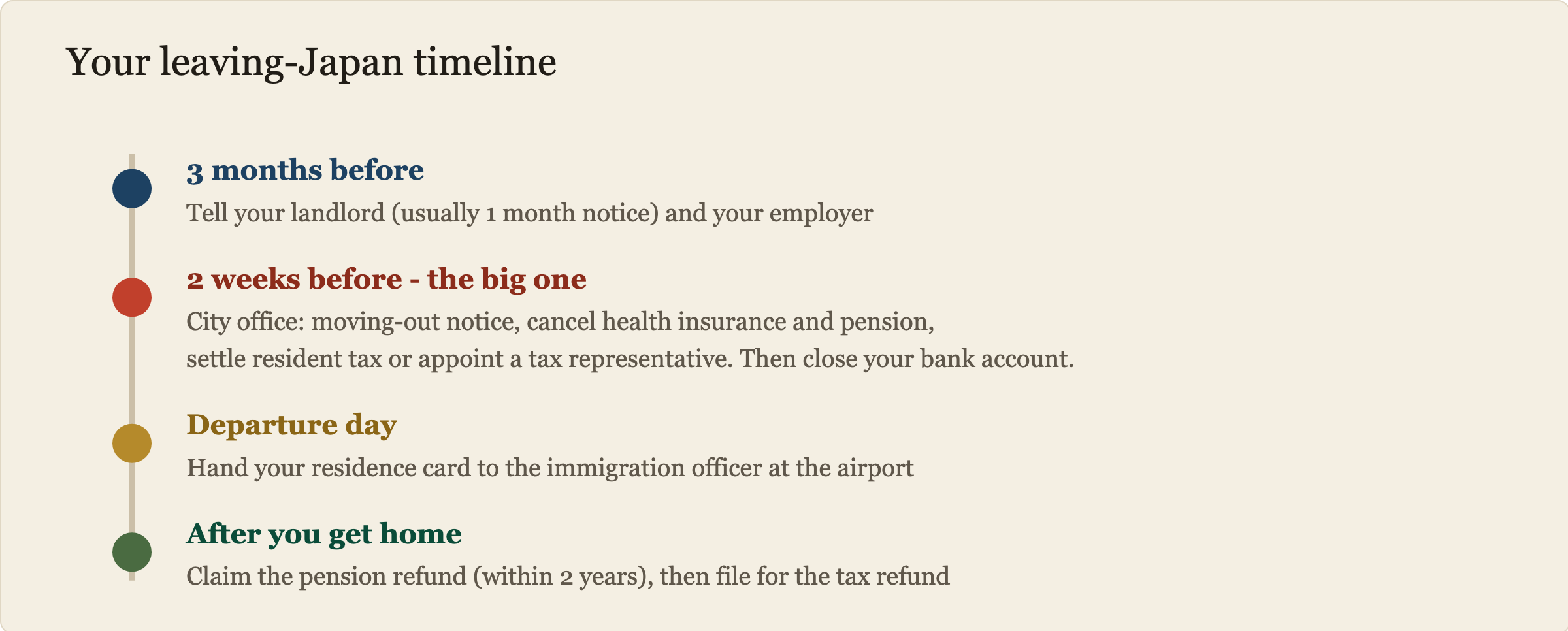
Work backwards from your flight. Three months out, sort your housing and job. Two weeks out, go to the city office. On the day, hand back your residence card at the airport. After you land, claim your pension refund.
Three months before: housing and work
Give your landlord notice as early as you can – most contracts require one month, and late notice means paying rent for a month you do not live there.
- Your rental contract: check the notice period in writing. Take photos of the room’s condition on the day you leave – this protects you from unfair charges. See our guide on move-out costs.
- Your job: your employer handles the social insurance paperwork on their side, but only if they know your last day. Tell them early.
- Utilities and phone: schedule cancellations for the day after you move out, not before – you need power and internet until the end.
Two weeks before: the city office visit
This is the visit that decides whether the rest goes smoothly. You can file the moving-out notice from 14 days before your planned departure date, and everything else at the city office can usually be done the same day.
- Moving-out notice (転出届): bring your residence card and passport. This is what tells Japan you no longer live here.
- National Health Insurance: cancel it and return your insurance card, or premiums keep accruing. See the health insurance guide.
- Pension: complete the withdrawal paperwork. You claim the actual refund later, from your home country.
- My Number card: hand it back at the same counter.
- Resident tax: settle what you owe, or appoint a tax representative (see below).
Bring proof of your departure date, such as your flight booking. If you have family members registered as dependents, their notices need filing too.
The resident tax trap that follows you home
Resident tax is charged based on last year’s income, to whoever lived in the city on 1 January. So if you were in Japan on 1 January and leave in March, you still owe the full year’s tax – and the bill arrives after you have gone.
You have two ways to handle it:
- Pay in advance before you leave: ask the city office to calculate your estimated amount and settle it at the counter. Simplest option if you can afford it.
- Appoint a tax representative (納税管理人 / nozei kanrinin): a person or company with an address in Japan who receives your tax notices and pays on your behalf. A friend, your former employer, or a paid service can do this.
Do not simply leave without doing either. Unpaid resident tax can cause problems with a future visa application or re-entry to Japan. If you ever plan to come back – to work, to study, or even to visit – this matters. The same tax representative can also handle your pension refund tax reclaim, so appointing one often solves two problems at once.
Your bank account: close it, do not abandon it
Close your Japanese bank account before you leave. An account left open and forgotten can be sold or stolen and used for fraud – and if that happens, you can be refused entry to Japan or deported in the future.
- Bring your passbook, cash card, residence card and personal seal if you registered one
- Move any remaining money out first – sending it home is usually cheaper before you leave than after
- If you genuinely need to keep the account open (for a Japanese salary, for example), confirm the conditions with the bank directly – see our bank account guide
Move the money out before you close the account
Once it is closed, you cannot send from it. And your last transfer home is usually the biggest one. A bank counter charges 5,500-12,500 yen per 100,000 yen in published fees, with a mark-up on the exchange rate on top (MUFG Bank’s official fee schedule, checked August 2026). With Wise you see the arriving amount before you send. Full comparison in sending money home from Japan.
Departure day and after
At the airport, hand your residence card to the immigration officer during exit inspection – that is the official return. Then, once you are home, claim your pension refund within 2 years.
- Residence card: returned at exit inspection if you have no re-entry permit. If it stays with you by mistake, it must be returned within 14 days of expiry.
- Pension refund: file from your home country. It cannot be claimed while you are still in Japan, and the deadline is 2 years from losing your Japan address. The full process, the 5-year cap and the 20.42% tax reclaim are in the lump-sum withdrawal payment guide.
- Tax refund on that payment: file through your tax representative afterwards – most people get most of the withheld tax back.
Official source: National Tax Agency – leaving Japan
Frequently asked questions
What happens if I leave Japan without filing the moving-out notice?
Japan continues to treat you as a resident, so resident tax, pension and health insurance bills keep being issued to your old address. You also cannot claim your pension refund, because that requires no longer having an address in Japan.
Do I still owe resident tax after I leave Japan?
Yes, if you were living in your city on 1 January. Resident tax is charged on the previous year’s income to whoever was resident on that date, so leaving mid-year does not cancel it. Pay in advance or appoint a tax representative before you go.
Can I claim my pension refund before I leave Japan?
No. The lump-sum withdrawal payment requires that you no longer have a registered address in Japan, so you file it from your home country after departure – within 2 years.
When do I return my residence card?
At the airport during exit inspection, you hand it to the immigration officer. This applies when you are leaving for good without a re-entry permit.
Is it really a problem to leave my bank account open?
Yes. An abandoned account can be misused for fraud, and that can lead to being refused entry or deported from Japan in the future. Close it properly before you leave.
Summary
- The moving-out notice unlocks everything – the pension refund, the end of your bills, and a clean exit
- Resident tax follows you home if you were here on 1 January – pay in advance or appoint a representative
- Close your bank account – an abandoned one is a real risk to your future entry
- Return your residence card at the airport, then claim your pension refund within 2 years
Related guides
Found this useful? Share it
Send it to a friend who lives in Japan.
Sending what is left before you fly: the fee difference is thousands of yen in one transfer.
Sending Money Home from Japan →WHO WROTE THIS

mori
Japanese. I read the ministries’ own notices, orders and Q&As in the original, and I start from what my Nepalese and Sri Lankan friends in Japan actually ran into. I do not write about what I have not checked or been told.
What this site can and cannot do →Looking for something else?