This article contains affiliate links.
Last updated: October 2026
Checked on 10 October 2026 against the Japan Pension Service page on lump-sum withdrawal payments, the Ministry of Health, Labour and Welfare materials on the pension reform law (passage, promulgation, outline, main changes) and the National Tax Agency answers No. 1420, 1923 and 2030.
In short
- If you paid into Japan’s pension for 6 months or more and are not Japanese, you can get some of it back after you leave Japan for good. This is the lump-sum withdrawal payment (脱退一時金 / dattai ichijikin).
- Right now the payout is capped at 5 years (60 months) of contributions, even if you paid in for longer.
- Important correction: many blogs and AI answers claim the cap rose to 8 years in April 2026. That is not true yet. The 8-year cap is only planned, to be set by cabinet order rather than written into the law, and no start date has been set (as of October 2026) – it could take effect any time up to June 2029.
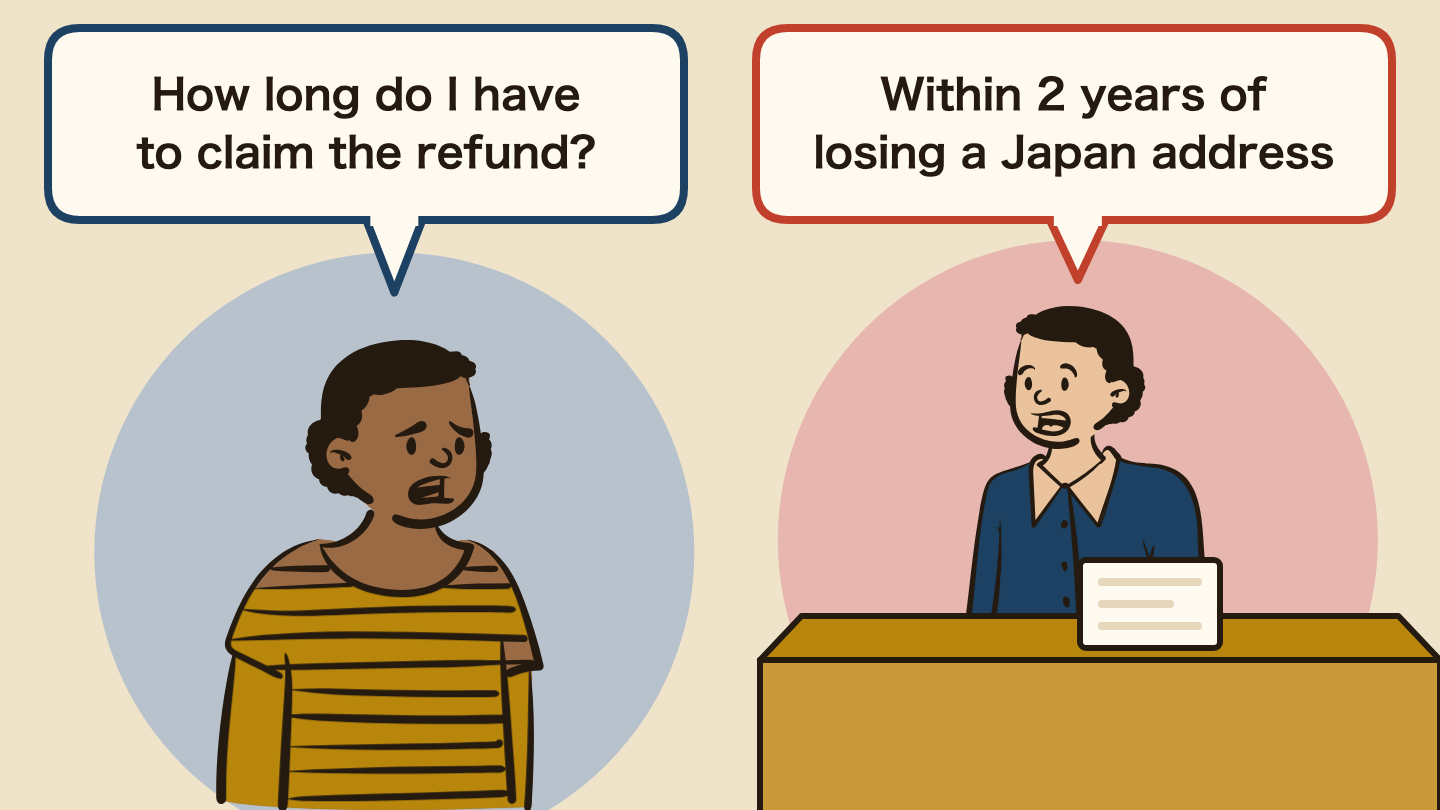
- You must apply within 2 years of losing your Japan address, and only after you leave – not while still living here.
- Japan withholds 20.42% tax from the payment automatically. Most of that can be claimed back if you file a return through a tax representative.
What changes: you know how much of your pension comes back (up to 5 years’ worth), and you claim it inside the 2-year window instead of leaving it in Japan.
What is the lump-sum withdrawal payment?
The lump-sum withdrawal payment (脱退一時金, “dattai ichijikin” in Japanese) refunds part of the pension contributions a non-Japanese worker paid while living in Japan, once they leave the country for good without qualifying for a Japanese pension. Japan’s public pension is built for a 10-year minimum to receive an actual pension later. Most foreign workers never reach that, so this payment exists to return some of what was paid in.
Who qualifies?
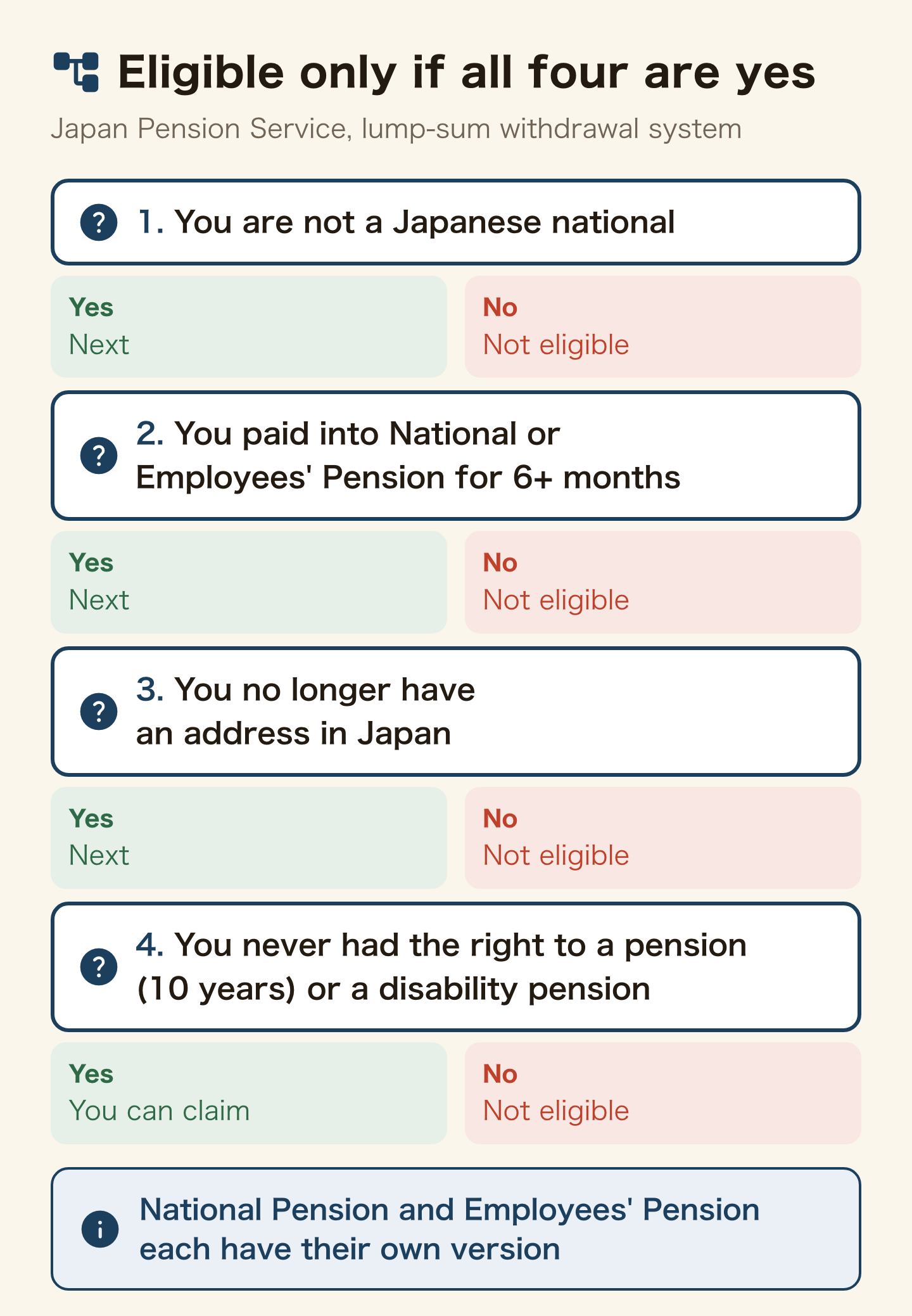
You qualify if all of these are true: you are not a Japanese national, you paid into National Pension or Employees’ Pension for 6 months or more, you no longer have an address in Japan, and you have never had the right to a Japanese old-age pension (10 years of coverage) or a disability pension.
- If you already have 10 years (120 months) or more of pension contributions, you do not qualify for this payment – you qualify for an actual pension instead, which is usually worth far more. Check your total months before assuming this applies to you. How to claim that pension from your home country, and have it paid into your own bank, is in our guide to receiving your Japanese pension abroad.
- Both National Pension (kokumin nenkin – typically students and the self-employed) and Employees’ Pension (kosei nenkin – typically company employees) have their own version of this payment. The long-term care premium taken from age 40 is not covered and is not refunded.
How much do you get back?
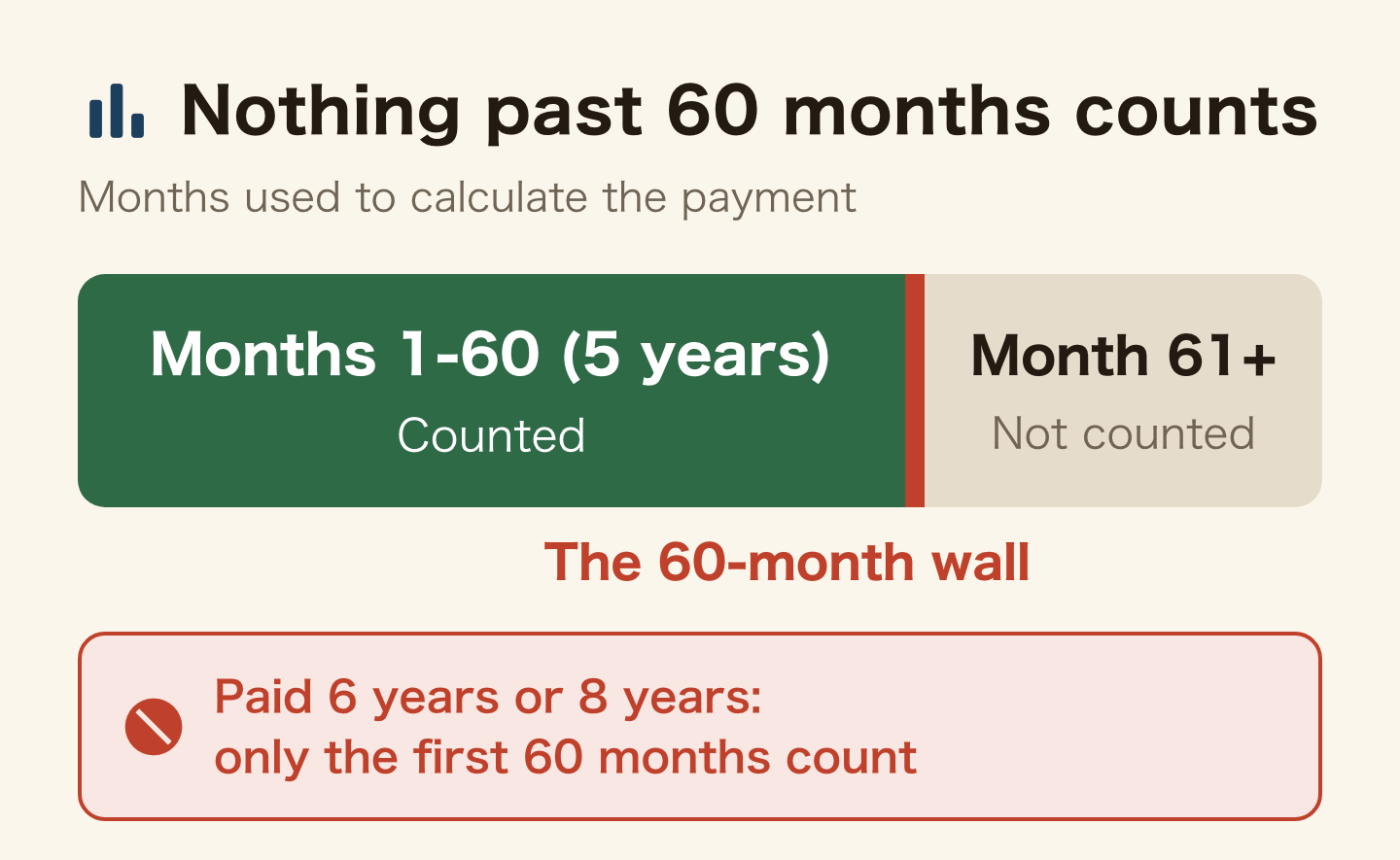
The payout is based on how much you contributed, capped at 5 years (60 months) of contributions – even if you paid in for 6, 8 or 10 years, only the first 60 months count.
Quick table: payout by months of contributions
These are the Japan Pension Service figures as published. Anything from 60 months up falls in the same row.
| Months of contributions | Number used in the calculation | National Pension (FY2026 amount) | Employees’ Pension rate |
|---|---|---|---|
| 6-11 months | 6 | 53,760 yen | 0.5 |
| 12-17 months | 12 | 107,520 yen | 1.1 |
| 18-23 months | 18 | 161,280 yen | 1.6 |
| 24-29 months | 24 | 215,040 yen | 2.2 |
| 30-35 months | 30 | 268,800 yen | 2.7 |
| 36-41 months | 36 | 322,560 yen | 3.3 |
| 42-47 months | 42 | 376,320 yen | 3.8 |
| 48-53 months | 48 | 430,080 yen | 4.4 |
| 54-59 months | 54 | 483,840 yen | 4.9 |
| 60+ months | 60 | 537,600 yen | 5.5 |
The National Pension amounts apply if your last paid month falls between April 2026 and March 2027 (months with partial exemption are converted by exemption type and added up). The Employees’ Pension payout is your average standard remuneration x this rate. Source: Japan Pension Service, lump-sum withdrawal payment (updated 1 April 2026, checked 10 October 2026).
Because of this cap, paying into the pension for more than 5 years without becoming eligible for a real pension is, in a sense, money you will never see again through this route. Read this together with the 10-year rule for a real pension and our guide to visas and ways to earn, and think about how long you plan to stay in Japan. If the refund will not cover your old age, why people who leave Japan still need their own assets explains the order to think in.
[Important] The “8-year cap” rumor – what’s actually true
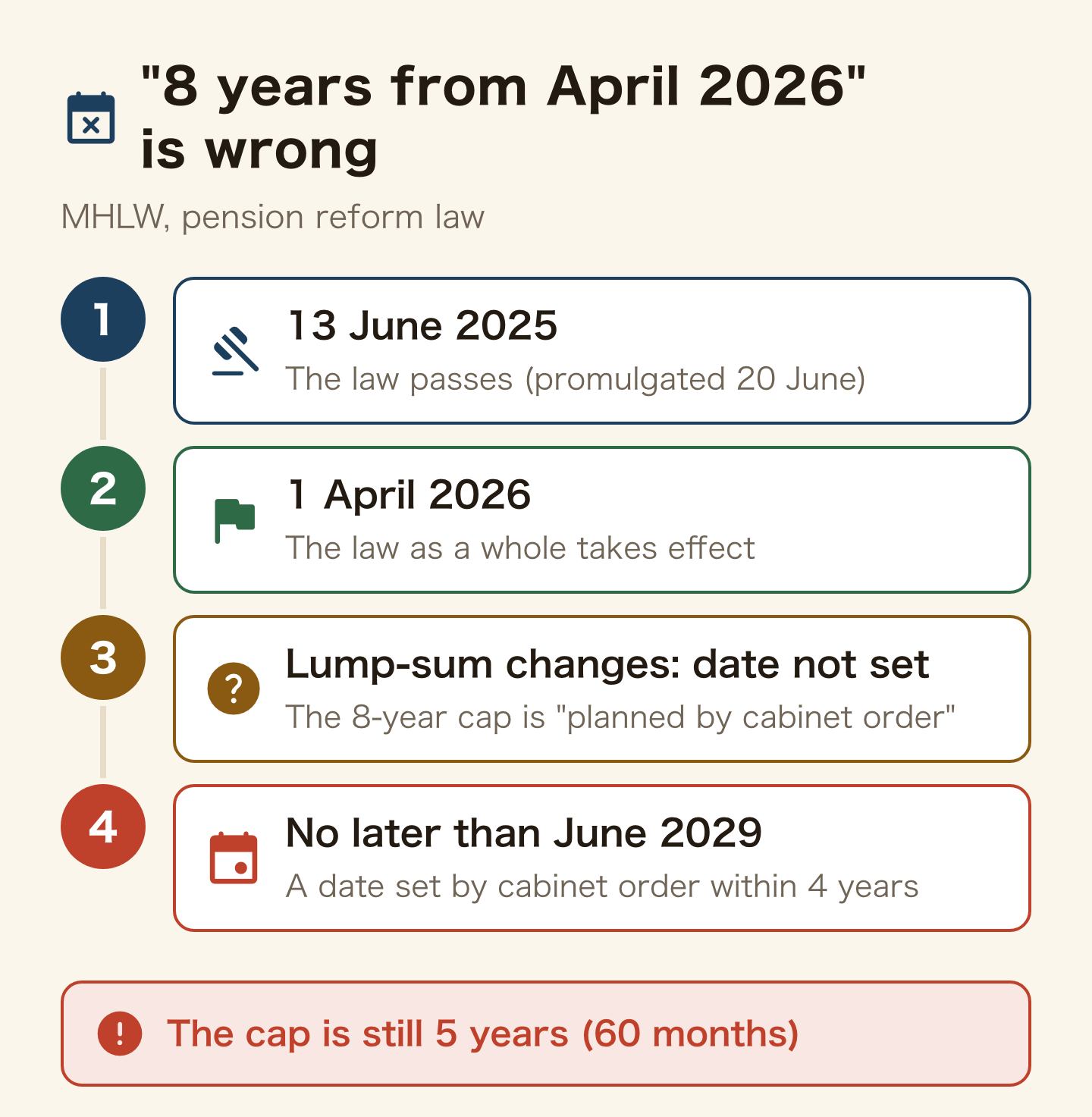
Raising the cap from 5 years to 8 years is still only a plan, to be done by cabinet order rather than by the law itself. As of October 2026, no start date has been set. The re-entry permit change is written into the pension reform law, which was passed on 13 June 2025 and promulgated on 20 June 2025 (Ministry of Health, Labour and Welfare). The ministry’s outline of the law describes the 8-year cap as “planned to be done by cabinet order”. The same document gives the reason: more people are expected to stay 8 years in total, moving from the new employment-for-skill-development system (3 years) to Specified Skilled Worker (i) (5 years). The lump-sum changes start on a date set by cabinet order within 4 years of promulgation – meaning it could start any time before June 2029.
Many company blogs and even AI-generated answers state flatly that “the cap became 8 years in April 2026.” This mixes up two different things: the broader pension reform law did take effect on 1 April 2026, but the lump-sum changes have their own, still-undecided start date, and the 8-year cap itself is still to be set by cabinet order.
What is confirmed to be changing: once this reform takes effect, if you leave Japan while holding a re-entry permit (meaning you still plan to come back), you will not be able to claim the payment during that permit’s validity (if the permit expires without you coming back, you can claim). Check the official Japan Pension Service site for the current start date before assuming either the 8-year cap or this new restriction applies to your case.
When and how do you claim it?
You cannot claim while living in Japan. File within 2 years of the date you lose your address in Japan, from the country you return to.
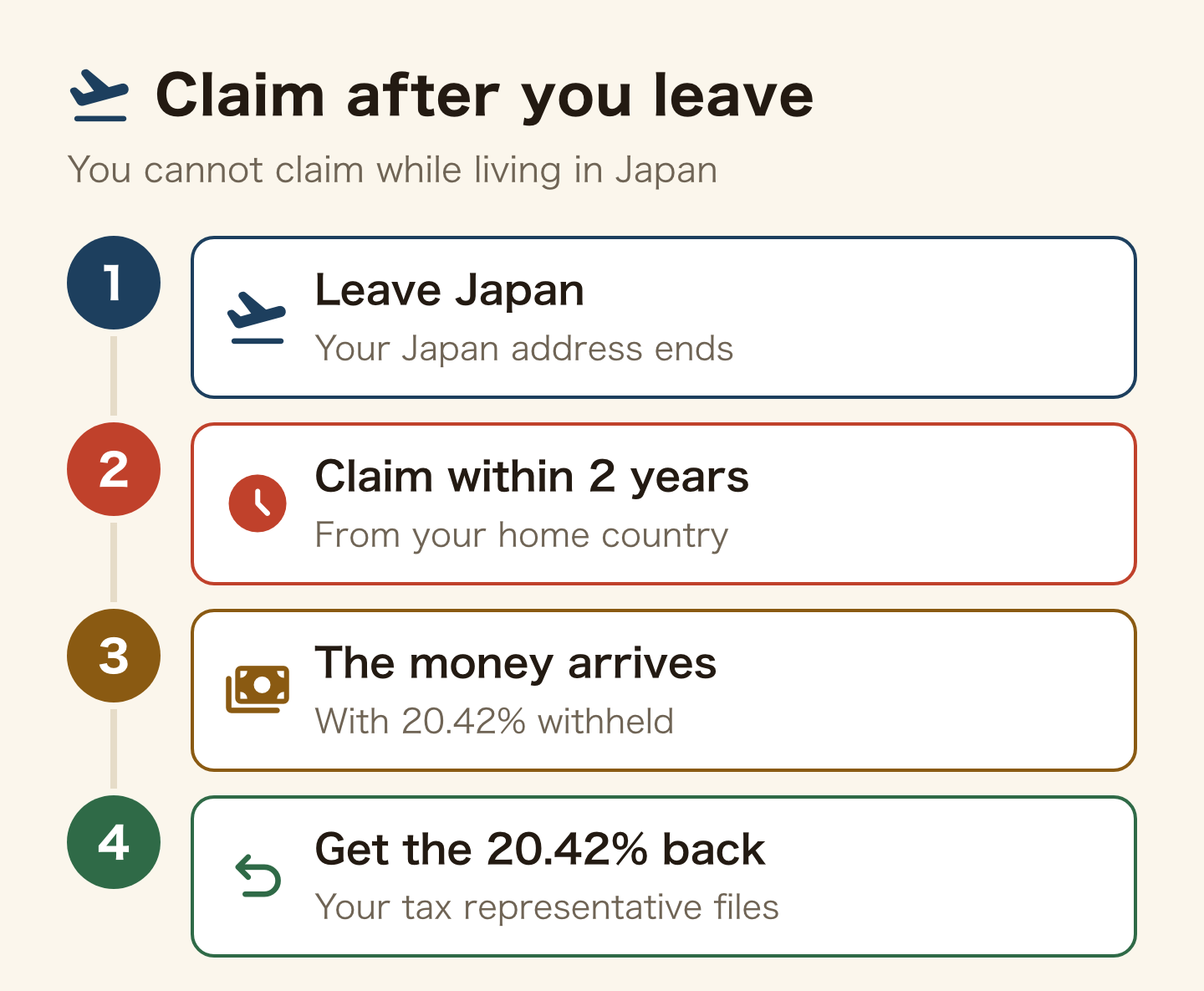
You will need: the claim form, a copy of your passport, a document showing your basic pension number (basic pension number notice or pension handbook), and a document showing the receiving bank account is in your name (Japanese). The claim form is printed in Japanese side by side with one of 14 languages, including English, Chinese, Vietnamese and Nepali. If you filed the moving-out notice before leaving, you usually do not need a document showing you have no Japan address (people insured since July 2012 or earlier may still need one). Japan Post Bank and some online-only banks cannot receive the payment. After you apply, the Japan Pension Service mails a “payment notice” (支給決定通知書) – keep this, you need it for the tax refund step below.
Getting the money home is part of the process
The lump sum arrives after you have left Japan. Choose a bank transfer at that point and part of what you just recovered goes back out in fees — 5,500-12,500 yen per 100,000 yen at a bank counter (MUFG Bank, checked August 2026). Decide how you will move it before it arrives. Comparison in sending money home from Japan.
Don’t lose 20.42% – claim your tax back
The payment lands in your account about a fifth smaller than you expected, and you assume the tax taken out is simply gone. Where you come from, tax withheld at source may well be final. In Japan, most people can get this 20.42% back, but it does not come back by itself: you have to file for it.
Japan automatically withholds 20.42% income tax from the payment. Most people can get this back, but it does not happen automatically – you have to file a separate tax return.
Here is why: the flat 20.42% withholding treats your payment like ordinary non-resident income. But if you calculate it the way Japan calculates retirement income for residents, you get a large deduction – roughly 400,000 yen for every year you contributed (minimum 800,000 yen). For most foreign workers, this deduction wipes out most or all of the taxable amount, meaning most or all of the withheld 20.42% comes back.
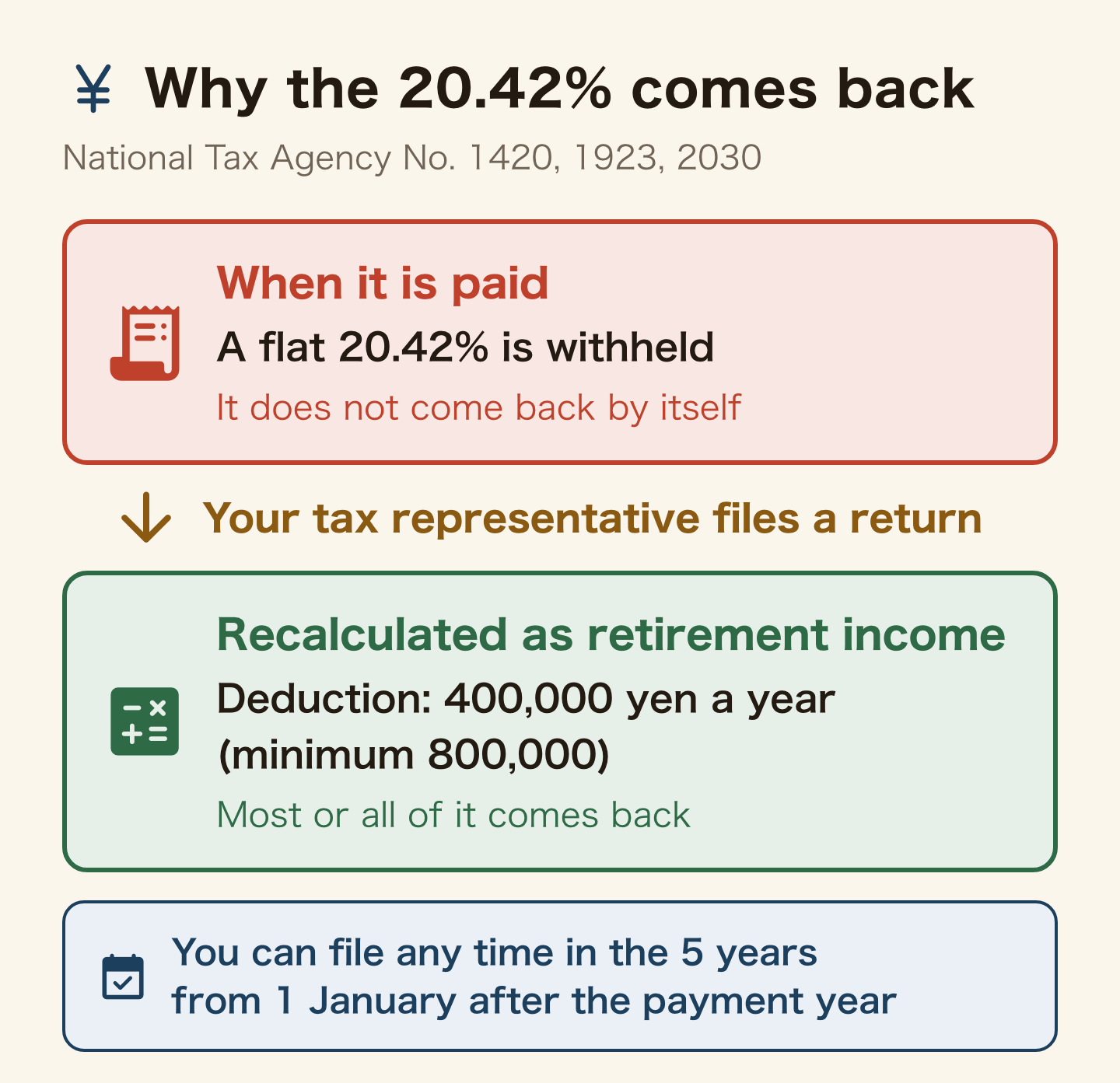
- Since you will not be in Japan to file, you must appoint a tax representative (nozei kanrinin) – any person or company with an address in Japan, such as a friend or a tax accountant (National Tax Agency No. 1923, Japanese) – to file the return on your behalf. The steps, from the tax office notification to sending on the payment notice, are laid out in how a tax representative gets the 20.42% back. It is safest to decide who that will be before you leave
- You can file this return any time in the 5 years after 1 January of the year following your payment
- Skipping this step means leaving real money on the table – for many people it is a larger amount than the effort of filing
Official sources: Japan Pension Service, Lump-sum Withdrawal Payments / Japan Pension Service, the lump-sum withdrawal system (Japanese) / Japan Pension Service, how to claim the lump-sum withdrawal payment (Japanese, checked 18 October 2026) / Ministry of Health, Labour and Welfare, main points of the pension reform law (Japanese) / MHLW, the pension reform law has passed (Japanese) / MHLW, the pension reform law was promulgated on 20 June (Japanese) / MHLW, outline of the pension reform law (Japanese) / National Tax Agency No. 1420, retirement income (Japanese) / NTA No. 1923, tax agent when working abroad (Japanese) / NTA No. 2030, refund returns (Japanese) (checked 26 September 2026)
If you paid into iDeCo, its lump-sum withdrawal is a separate claim from the National and Employees’ Pension refund.
Frequently asked questions
Is the payout cap really 8 years now?
Not yet, as of October 2026. Raising the cap from 5 to 8 years is planned by cabinet order and has no confirmed start date – it can begin any time up to June 2029. The current cap remains 5 years (60 months) until the government announces otherwise. Check the official Japan Pension Service site before relying on the 8-year figure.
Can I apply for this while I am still in Japan?
No. You can only apply after you have left Japan and no longer have a registered address here, and you must apply within 2 years of that date.
I paid into the pension for 12 years. Do I get more money back?
If you have 10 years (120 months) or more of contributions, you likely qualify for an actual pension instead of this lump-sum payment, which is usually worth significantly more over time. If you have between 6 months and under 10 years, your lump-sum payment is still capped at 60 months of contributions even if you paid in longer.
Passing 10 years is a decision point: stay and wait for the pension, or leave before you reach it. Which status lets you stay after you stop working is in our guide to retiring in Japan as a foreigner.
Why was 20.42% taken from my payment, and can I get it back?
Japan withholds a flat 20.42% tax automatically. Most of it can be refunded if you appoint a tax representative in Japan and file a tax return applying the retirement income deduction. For most people, that deduction brings the taxable amount close to zero.
Can I claim this if I still plan to come back to Japan later?
Under current rules this is possible, but a pending reform will restrict claims while you hold a valid re-entry permit once it takes effect. The start date is not set, so check the official site for the current rules before you leave.
Summary
- Non-Japanese with 6+ months of pension contributions and no plan to reach 10 years can claim a refund after leaving Japan
- The payout is capped at 5 years (60 months) of contributions right now – the 8-year cap is only planned and not yet in effect as of October 2026
- File within 2 years of losing your Japan address, only after you leave
- 20.42% tax is withheld automatically – file a return through a tax representative to get most of it back
Related guides
Found this useful? Share it
Send it to a friend who lives in Japan.
You receive it as an overseas transfer. Which service you use changes what actually arrives.
Sending Money Home from Japan →WHO WROTE THIS

mori
Japanese. I read the ministries’ own notices, orders and Q&As in the original, and I start from what my Nepalese and Sri Lankan friends in Japan actually ran into. I do not write about what I have not checked or been told.
What this site can and cannot do →Looking for something else?
You may use the figures in this article, including commercially, if you credit this site with a link. How to use our figures