Checked on 23 September 2026 against the full text of the Labor Standards Act (Arts. 32, 36, 37, 38, 114, 115 and Suppl. Art. 143), the Cabinet Order on premium rates and the Enforcement Regulations (Arts. 19-21) on e-Gov, the Ministry of Health, Labour and Welfare (MHLW) guidance and Q&A on overtime pay, its leaflets on the overtime cap, the 60-hour rate, the time limit on wage claims, fixed overtime pay and rounding of working hours, and its consultation pages for foreign workers.
The short answer
- Overtime pay (warimashi chingin) is the extra your employer must add to your normal pay for hours beyond 8 a day or 40 a week, for late-night hours, and for work on your statutory day off. Nationality does not matter, and part-timers are covered.
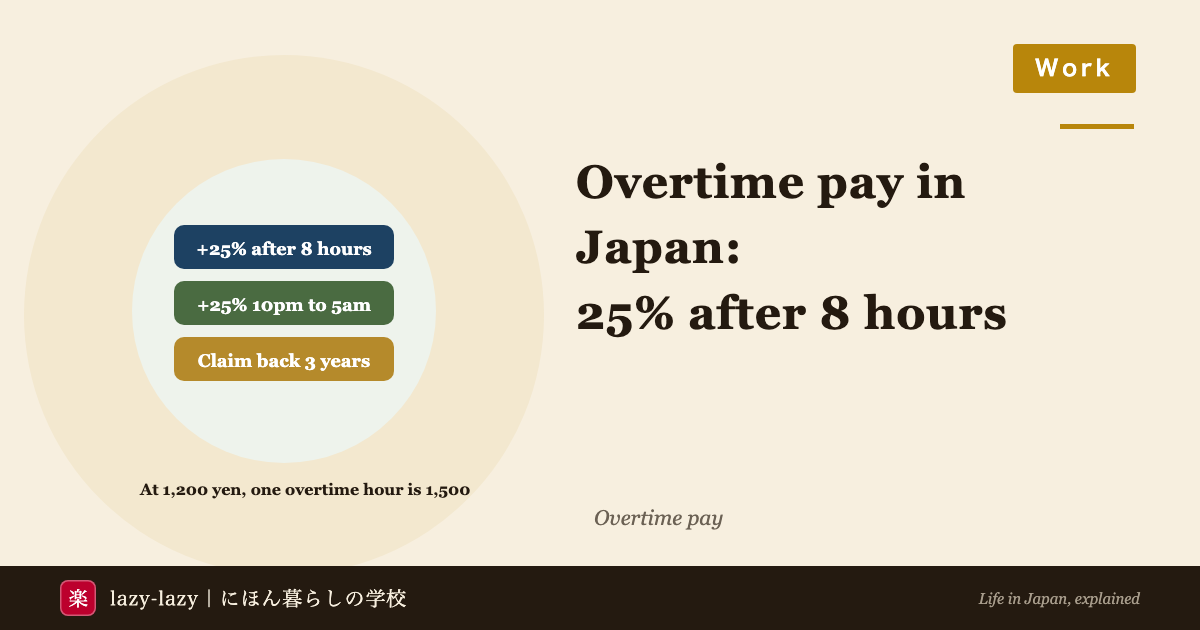
- The rates: 25% for overtime, 50% for overtime beyond 60 hours a month, 25% for 10pm-5am, 35% for the statutory day off. At 1,200 yen an hour, an overtime hour pays 1,500 yen, and 1,800 yen after 10pm.
- No overtime is allowed without a “36 Agreement”, and the normal cap is 45 hours a month and 360 a year. Even with the special clause, the ceiling is 720 hours a year and under 100 hours in any month.
- Hours are counted by the minute. Cutting off “anything under 15 minutes” every day is a breach. Fixed overtime pay covers a set number of hours; anything beyond that is paid on top.
- You can claim unpaid overtime going back three years from each payday. Help is free: the Labour Standards Inspection Office, or the hotline in English on 0120-531-401.
Knowing this, you can check your own payslip line by line. If it comes up short, you can put a number on the gap and claim it back for up to three years.
Saturday: you start at the izakaya at 2pm and finish cleaning up at midnight, with one hour’s break. The payslip says “9 hours x 1,200 yen = 10,800 yen”. You ask a Japanese friend whether long shifts get overtime pay. “It’s a part-time job, that’s just how it is. Mine rounds down to 15 minutes.” Your friend has never checked a payslip either. Was that day worth 10,800 yen or 11,700 yen? The answer is not up to the manager. It is written in the Labor Standards Act.
- Is overtime paid in Japan for foreigners and part-timers? Yes, 25% extra after 8 hours
- What is the overtime pay rate in Japan? 25%, 50% over 60 hours, 25% at night, 35% on days off
- How is overtime pay calculated in Japan? Worked examples at 1,200 yen an hour and 240,000 yen a month
- Night shift allowance in Japan: 25% extra from 10pm to 5am
- Does overtime count toward a student’s 28-hour limit? And with two jobs, hours add up
- What is the maximum overtime in Japan? The 36 Agreement, 45 hours a month and 360 a year
- Is overtime paid by the minute in Japan? Daily rounding down is a breach
- What is fixed overtime pay in Japan? Three things to find in the job ad
- Unpaid overtime in Japan: a 3-year limit, and free help
- Which one are you?
- FAQ
- Q. Is overtime paid in Japan for foreigners and part-timers?
- Q. How is overtime pay calculated in Japan?
- Q. What time does the night shift allowance start in Japan?
- Q. What is the maximum overtime allowed in Japan?
- Q. With fixed overtime pay, is extra overtime ever paid?
- Q. How far back can I claim unpaid overtime in Japan?
- Summary
- Related reading
Is overtime paid in Japan for foreigners and part-timers? Yes, 25% extra after 8 hours
Yes. Article 32 of the Labor Standards Act says an employer must not make you work more than 8 hours a day or 40 hours a week, not counting breaks. These are the statutory working hours. For any time beyond them, the employer must pay a premium (Art. 37).
The MHLW states plainly that the premium applies to every employment type, including part-time workers and “arubaito” student jobs. Nationality is irrelevant: Article 3 bans discrimination in wages or working hours on the grounds of nationality.
One distinction matters. Going past your scheduled shift is not the same as going past 8 hours. If a 5-hour shift runs 2 hours long and you work 7 hours, those 2 hours must be paid at your normal rate, but the law requires no premium for them. The MHLW says there is no legal duty to pay a premium until you pass 8 hours a day or 40 a week. If your company’s work rules are more generous, the work rules win.
There are two exceptions to the 40-hour week. Your employment contract or work rules will say whether either applies to you.
- Workplaces with fewer than 10 regular staff in commerce, film and theatre (not film production), health and hygiene, and hospitality and entertainment have a 44-hour week (MHLW FAQ).
- Employers using a variable working-hours system can schedule days over 8 hours or weeks over 40, as long as the average over the set period stays within 40 a week.
What is the overtime pay rate in Japan? 25%, 50% over 60 hours, 25% at night, 35% on days off
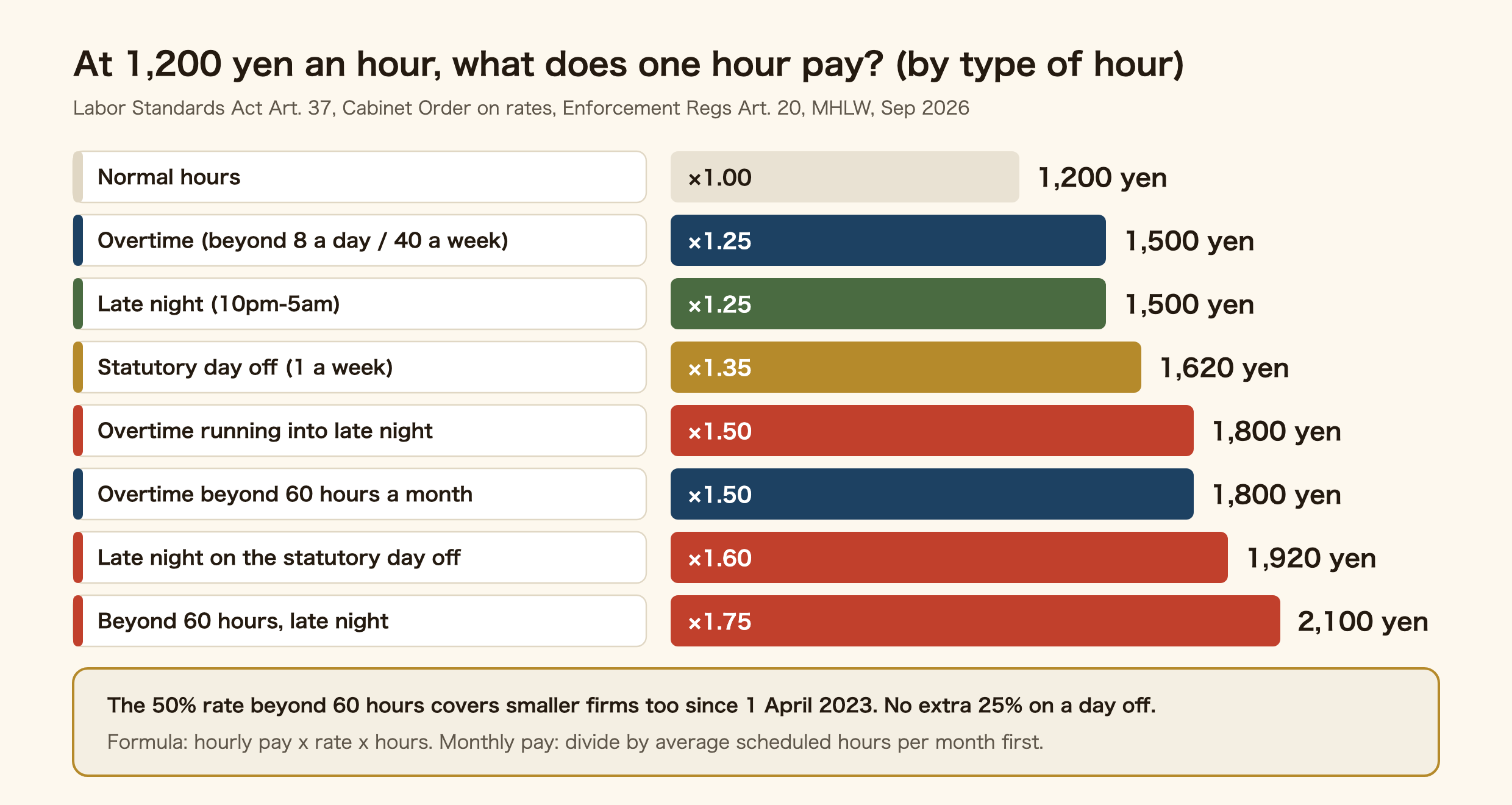
The law and a Cabinet Order set the minimum rates (Art. 37 and the Order on premium rates).
| Hours worked | Premium | One hour at 1,200 yen |
|---|---|---|
| Overtime (beyond 8 a day or 40 a week) | 25% or more | 1,500 yen |
| Overtime beyond 60 hours in a month | 50% or more | 1,800 yen |
| Late night (10pm to 5am) | 25% or more | 1,500 yen |
| Statutory day off | 35% or more | 1,620 yen |
| Overtime running into late night | 50% or more | 1,800 yen |
| Statutory day off running into late night | 60% or more | 1,920 yen |
| Overtime beyond 60 hours, late night | 75% or more | 2,100 yen |
The 50% rate beyond 60 hours has applied to large companies since April 2010 and to small and medium-sized companies since 1 April 2023 (MHLW leaflet). You add up overtime from the first day of the monthly period, and the 50% rate starts from the moment the total passes 60 hours.
“Day off” means two different things. The statutory day off is the one day a week (or four days in four weeks) the law requires (Art. 35), and only that day gets 35%. If your company gives two days off a week, work on the other one counts toward the 40-hour week and earns 25% for the hours beyond 40. Working more than 8 hours on the statutory day off does not stack the 25% overtime rate on top (MHLW FAQ).
How is overtime pay calculated in Japan? Worked examples at 1,200 yen an hour and 240,000 yen a month
There is one formula (Enforcement Regulations, Art. 19).
hourly pay x premium rate x hours
If you are paid by the hour, your hourly rate is the “hourly pay”. Here is the Saturday from the start.
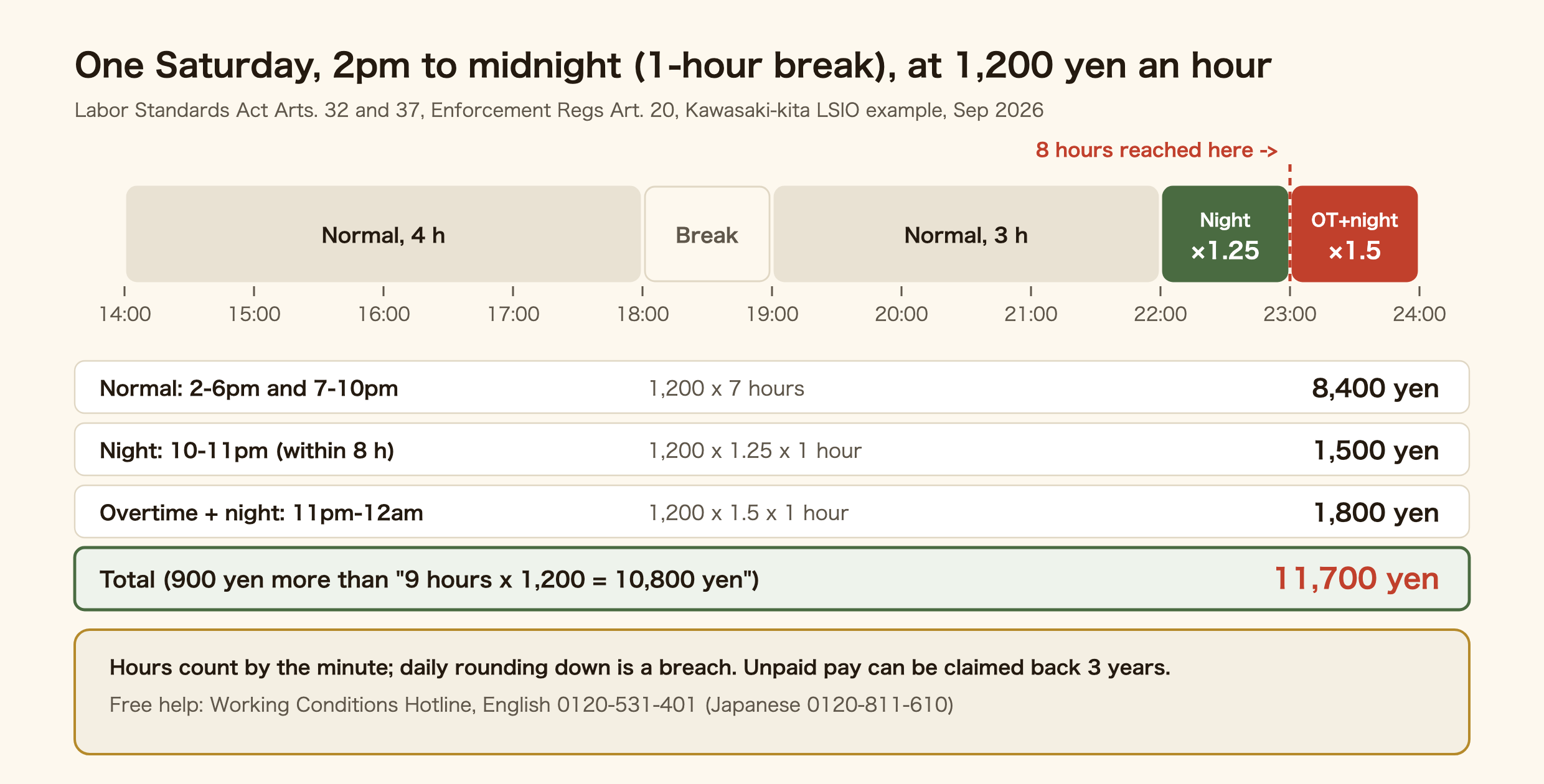
- 2pm-6pm and 7pm-10pm, 7 hours at the normal rate: 1,200 x 7 = 8,400 yen.
- 10pm-11pm: still within 8 hours, but late night, so 25% extra: 1,500 yen.
- 11pm-midnight: beyond 8 hours and late night, so 50% extra: 1,800 yen.
That is 11,700 yen. The payslip’s 10,800 yen is 900 yen short. A worked example from the Kawasaki-kita Labour Standards Inspection Office treats the same pattern the same way: someone working 1pm to 11pm with an hour’s break gets 1.5 times for 10pm-11pm.
On a monthly salary, you first convert it to an hourly figure: monthly pay divided by the average scheduled hours per month. In the same office’s example, a company with 125 days off a year and 8-hour days has (365 – 125) x 8 / 12 = 160 hours a month. A 240,000 yen salary is 1,500 yen an hour, so 20 hours of overtime is 1,500 x 1.25 x 20 = 37,500 yen.
Only seven kinds of pay can be left out of that monthly figure: family allowance, commuting allowance, separate-living allowance, children’s education allowance, housing allowance, one-off payments, and pay made at intervals longer than a month such as bonuses (Art. 37(5), Enforcement Regulations Art. 21). The MHLW says this list is closed and that the substance counts, not the name. A “housing allowance” paid at the same flat amount to everyone has to be included.
Check that your base rate is not below your prefecture’s minimum wage, too. A premium is only right if it is calculated on the right hourly rate (Japan’s minimum wage by prefecture for 2026).
Night shift allowance in Japan: 25% extra from 10pm to 5am
Any hour worked between 10pm and 5am earns at least 25% extra, whether or not it is overtime (Art. 37(4)). A shift that is late-night from the start is covered in full.
Take a convenience-store night shift from 10pm to 6am, with a one-hour break from 2am to 3am. Of the 7 hours worked, 6 fall between 10pm and 5am.
- 6 late-night hours: 1,200 x 1.25 x 6 = 9,000 yen
- 5am-6am: 1,200 yen
That comes to 10,200 yen, or 1,800 yen more than 7 x 1,200 = 8,400 yen. Check that your payslip shows the extra 25% on those hours.
You may hear “you’re a manager, so no night allowance”. People in management and supervisory positions are exempt from the rules on working hours (Art. 41), but the MHLW says the late-night premium still applies to them. And whether you really are in such a position depends on your actual authority, working pattern and pay, not on a “store manager” title.
Does overtime count toward a student’s 28-hour limit? And with two jobs, hours add up
International students may work up to 28 hours a week under their work permission, or up to 8 hours a day during the school’s long holidays. The Immigration Services Agency says only “28 hours per week” and does not exclude overtime. Overtime is time worked, so leave enough room in your shifts that overtime cannot push you past 28. How the 28 hours are counted is explained in our guide to part-time jobs for students.
Two jobs also change how overtime works. Article 38 says working hours are added together even across different workplaces. According to the MHLW, scheduled hours are added in the order the contracts were signed, and the part beyond 8 hours becomes overtime at the job you signed later.
Say you work 5 hours on Saturday at shop A, which hired you first, and 4 hours at shop B. That is 9 hours, so shop B’s last hour is overtime and shop B owes the 25%. Neither shop sees the other’s rota. The MHLW asks workers to keep track of their hours at each job and tell each employer.
What is the maximum overtime in Japan? The 36 Agreement, 45 hours a month and 360 a year
A 36 Agreement (“saburoku kyotei”) is a written agreement the employer signs with a union representing the majority of staff, or with a representative of the majority, and files with the Labour Standards Inspection Office before making anyone work overtime or on the statutory day off (Art. 36). Without it, the employer cannot make you work beyond 8 hours a day or 40 a week.
Even with a 36 Agreement, overtime is capped.
- Normal cap: 45 hours a month and 360 a year (Art. 36(4))
- With a special clause for temporary, exceptional circumstances: up to 720 hours a year; under 100 hours in a month and no more than 80 hours a month on average over any 2 to 6 months, both counting day-off work; and more than 45 hours in no more than six months a year (Art. 36(5), (6))
The MHLW notes that 80 hours a month is roughly 4 hours of overtime a day. Making someone work 100 hours or more in a month, or over 80 on average, can mean up to six months’ imprisonment or a fine of up to 300,000 yen (Art. 119). Driving, construction and doctors have separate rules (Suppl. Arts. 139-141).
The employer must make the 36 Agreement known to staff, for example by posting it or handing out copies (MHLW guidance), so you can ask to see your workplace’s cap. The workers’ representative must be chosen by a vote, a show of hands or similar, and part-timers must be able to take part. An agreement signed with someone the employer simply appointed is invalid.
Is overtime paid by the minute in Japan? Daily rounding down is a breach
Yes, by the minute. The MHLW puts it directly: daily working hours must be counted in one-minute units; rounding up is fine, rounding down is not.
A 2024 leaflet from the labour bureaus and inspection offices lists three breaches.
- Setting the attendance system to cut any daily overtime under 15 minutes
- Only accepting overtime requests in 30-minute blocks, so shorter overtime goes unclaimed
- Requiring changing into uniform, cleaning or a morning meeting before clocking in, without counting it as working time
The only rounding allowed is on monthly totals: within each of the month’s overtime, day-off and late-night totals, under 30 minutes may be dropped and 30 minutes or more rounded up to an hour. This cannot be done day by day.
Small cuts add up. At 1,200 yen an hour, losing 15 minutes a day over 20 days a month is 5 hours, or 6,000 yen a month. Over three years, that is 216,000 yen.
What is fixed overtime pay in Japan? Three things to find in the job ad
Fixed overtime pay (“kotei zangyo-dai”, also called “minashi zangyo”) is a flat amount paid for a set number of overtime, day-off and late-night hours, whatever it is called (MHLW).
It is not illegal. But hours beyond the set number must be paid on top. In the Kawasaki-kita office’s example, a company paying fixed overtime for 20 hours must add 5 hours of premium pay for someone who works 25. Where it is folded into base pay, the Supreme Court has held that the overtime part must be distinguishable from the rest, and any shortfall paid (the Koshinkai case).
The MHLW asks companies using fixed overtime pay to state all three of these in job ads (under the guidelines of the Youth Employment Promotion Act).
- Base pay, excluding the fixed overtime amount
- How many hours the fixed overtime covers, and how much it is
- That overtime, day-off and late-night work beyond those hours is paid on top
Suppose an ad says “222,000 yen a month, including 30,000 yen fixed overtime for 20 hours”. Base pay is 192,000 yen. With 160 scheduled hours a month, that is 1,200 yen an hour and 1,500 yen per overtime hour, so 30,000 yen for 20 hours adds up. In a month with 25 hours of overtime, you should see another 7,500 yen for the extra 5.
If any of the three is missing, ask before you accept. Fixed overtime for 45 hours means the salary assumes you work up to the normal legal cap every month. When comparing job offers, remember that the average salaries by visa type are scheduled pay, which leaves out overtime.
Unpaid overtime in Japan: a 3-year limit, and free help
Not paying overtime breaches Article 37 of the Labor Standards Act, punishable by up to six months’ imprisonment or a fine of up to 300,000 yen (Art. 119). The MHLW calls so-called “service overtime” what it is, unpaid-wage overtime, and says it is illegal.
You can claim unpaid overtime going back three years from each payday. The law’s full period is five years, but for the time being it is three (Art. 115, Suppl. Art. 143), for wages with a payday on or after 1 April 2020. Leaving the job does not stop you claiming anything within those three years. A court can also order the employer to pay an “additional payment” of up to the same amount again (Art. 114).
Here is what employers sometimes say, and where the law stands.
- “Part-timers don’t get overtime pay.” Premiums must be paid to part-timers too.
- “We round down to 15 minutes.” Daily rounding down is a breach.
- “It’s included in your fixed overtime.” Hours beyond the set number are paid on top.
- “You’re a manager, so there’s none.” It depends on the reality, not the title, and the late-night premium applies to managers anyway.
Before you act, gather records.
- Photos of your time card or attendance screen, your rota, and your payslips. Timestamps on work messages in LINE also show when you were working.
- Your own daily note of start and finish times. The MHLW recommends keeping your overtime hours in a notebook.
- Your own calculation, month by month, using hourly pay x premium rate x hours.
The employer, for its part, must record overtime, day-off and late-night hours in the wage ledger (Art. 108, Enforcement Regulations Art. 54) and keep records for three years (Art. 109, Suppl. Art. 143).
There are three places to go.
- Labour Standards Inspection Office (roudou kijun kantokusho): the office that orders employers to comply. You can report a breach, and the employer may not dismiss you or treat you worse for doing so (Art. 104).
- General Labour Consultation Corners: 378 locations in prefectural labour bureaus and inspection offices. Free, no appointment, in person or by phone. They take questions from students and in several languages, and pass suspected breaches to the inspection office.
- Working Conditions Hotline (roudou jouken soudan hotto rain): a free phone line run for the MHLW. Weekdays 5pm-10pm, weekends and holidays 9am-9pm. English 0120-531-401, Chinese 0120-531-402 and Japanese 0120-811-610 every day; Vietnamese 0120-531-406 on Tuesday, Wednesday and Friday to Sunday; Nepali 0120-531-408 on Wednesday and Sunday.
To talk in English on a weekday daytime, there is also the Telephone Consultation Service for Foreign Workers (English 0570-001-701, Monday to Friday 10am-3pm, closed noon-1pm). Call charges apply.
If you have decided to leave, check that overtime will be settled in your final pay before you fix your last day. Any paid leave you have left can be used before you quit, and the employer cannot move those days.
Which one are you?
- You have days over 8 hours, or hours after 10pm: take this month’s payslip, split those days into normal, late-night and overtime hours, and check them with the formula above.
- Your hours are cut to 15- or 30-minute blocks: from today, note your start and finish times to the minute, and work out the gap after one month.
- You are on fixed overtime and go past the set hours most months: find the number of hours in your employment contract, then match the extra hours and extra pay against your payslip.
- Overtime has gone unpaid for months: gather your records, and because the oldest months drop off after three years, call the Working Conditions Hotline or a General Labour Consultation Corner this week.
FAQ
Q. Is overtime paid in Japan for foreigners and part-timers?
Yes. Hours beyond 8 a day or 40 a week must be paid at least 25% extra, whatever your nationality and whether you are full-time or part-time.
Q. How is overtime pay calculated in Japan?
Hourly pay x premium rate x hours. At 1,200 yen an hour, an overtime hour is 1,500 yen, and 1,800 yen once it runs past 10pm. On a monthly salary, divide by the average scheduled hours per month to get the hourly figure first.
Q. What time does the night shift allowance start in Japan?
At 10pm, and it runs until 5am. Hours worked in that window are paid at least 25% extra, whether or not they are overtime.
Q. What is the maximum overtime allowed in Japan?
With a 36 Agreement in place, normally 45 hours a month and 360 a year. Even with the special clause, it is up to 720 hours a year, under 100 hours in any month including day-off work, and no more than 80 hours a month on average over 2 to 6 months.
Q. With fixed overtime pay, is extra overtime ever paid?
Yes, for hours beyond the set number. If fixed overtime covers 20 hours and you work 25, the premium for the extra 5 hours is added.
Q. How far back can I claim unpaid overtime in Japan?
Three years from each payday, for wages with a payday on or after 1 April 2020. You can still claim after you leave the job.
Summary
Overtime pay is the premium for hours beyond 8 a day or 40 a week, for 10pm to 5am, and for the statutory day off. The rates are 25%, 50% beyond 60 hours a month, 25% and 35%, and they add up when they overlap. Nationality and part-time status make no difference, and hours are counted by the minute.
Overtime needs a 36 Agreement and is normally capped at 45 hours a month and 360 a year. Fixed overtime pay covers only the hours it names. Anything short can be claimed back for three years from each payday, and advice is free.
Official sources: Labor Standards Act, Arts. 3, 32, 35, 36, 37, 38, 41, 104, 108, 109, 114, 115, 119 and Suppl. Art. 143 (e-Gov) / Cabinet Order on the minimum premium rates under Art. 37(1) (e-Gov) / Enforcement Regulations of the Labor Standards Act, Arts. 19-21 and 54 (e-Gov) / MHLW, overtime and premium pay (Japanese) / MHLW, recording working time and paying wages correctly (Japanese) / MHLW, 50% rate beyond 60 hours for smaller companies (Japanese) / MHLW, longer period for claiming unpaid wages (Japanese) / MHLW, showing fixed overtime pay in job ads (Japanese) / MHLW, adding up hours across two jobs (Japanese) / MHLW, consultation services for foreign workers / Immigration Services Agency, work permission for students (Japanese). All checked on 23 September 2026.
Related reading
Found this useful? Share it
Send it to a friend who lives in Japan.
WHO WROTE THIS

mori
Japanese. I read the ministries’ own notices, orders and Q&As in the original, and I start from what my Nepalese and Sri Lankan friends in Japan actually ran into. I do not write about what I have not checked or been told.
What this site can and cannot do →Looking for something else?