Checked on 23 September 2026 against the Ministry of Health, Labour and Welfare’s page on the high-cost medical expense benefit and its revision notice for treatment from August 2026, the Health Insurance Act, the National Health Insurance Act and their enforcement orders on e-Gov, Japan Health Insurance Association (Kyokai Kenpo), and the National Health Insurance pages of Tokyo Metropolitan Government, Osaka City and Minato City.
The short answer
- The high-cost medical expense benefit (kogaku ryoyohi) refunds whatever you pay above a monthly cap at hospitals and pharmacies. Foreign residents use the same table as Japanese citizens, on National Health Insurance or a company plan.
- For under-70s the cap depends on income, in five bands. From treatment in August 2026 it is 36,900 yen a month if you are exempt from resident tax, and 61,500 yen up to an annual income of about 3.7 million yen.
- Use your My Number card as your health card and the bill stops at the cap with no paperwork in advance. If you use a paper eligibility certificate instead, get a “limit certificate” before you are admitted.
- On National Health Insurance, if your income has not been declared you are put in band A, the one with the highest cap. You must declare even zero income.
- Claim from your city office (National Health Insurance) or from Kyokai Kenpo or your company’s health insurance society, within two years from the 1st of the month after treatment. Hospital meals and private-room charges are not covered.
Knowing this, you know the most you can be charged this month before the bill arrives, and you do not have to front 300,000 yen at the counter. If you have already paid, you know where to send the claim to get money back.
You had an operation and a week in hospital. On the day you leave, the cashier says 300,000 yen. A Japanese friend tells you not to worry, “the high-cost thing” will give most of it back. How much, where you apply, and whether it works the same for a foreigner, your friend cannot say. They have never had to claim it themselves.
- What is the high cost medical expense benefit in Japan, and can foreigners use it?
- How much is the monthly cap? The five bands for under-70s (from August 2026)
- If the bill is 1 million yen, how much do I get back?
- Why undeclared income puts you in the top band
- Do I need a limit certificate? Not with a My Number health card
- How the cap is counted: calendar month, per hospital, 21,000 yen for household totals
- What if treatment goes on for months? The 4th-time rate and the annual cap
- Are hospital meals and private rooms covered? No
- Where do I claim? City office for National Health Insurance, Kyokai Kenpo or your society for company plans
- What is the deadline? Two years from the 1st of the following month
- What if I owe premiums, or cannot pay the bill?
- What changes in August 2027? More income bands (already promulgated)
- Which one are you?
- FAQ
- Summary
- Related reading
What is the high cost medical expense benefit in Japan, and can foreigners use it?
Yes. The benefit is set out in the Health Insurance Act (Article 115) and the National Health Insurance Act (Article 57-2), and neither article mentions nationality. An international student on National Health Insurance and an employee on a company plan both use the same cap table as Japanese people.
It covers what you pay at the counter for insured treatment — normally 30% of the cost. When the month’s total goes over your cap, the excess comes back. If you are not insured yet, sort out which health insurance you belong in first. Treatment in a month when you were not insured is not covered.
Injuries at work or on the way to work are a different system. For those you use work injury insurance, and the treatment costs you nothing.
How much is the monthly cap? The five bands for under-70s (from August 2026)
The caps went up for treatment from August 2026. The government order (Cabinet Order No. 240 of 2026) was promulgated on 29 July 2026 and took effect on 1 August. The table for people under 70:
| Band | Approx. annual income | Monthly cap | From the 4th time | Annual cap |
|---|---|---|---|---|
| A (ア) | 11.6 million yen + | 270,300 + (cost − 901,000) × 1% | 140,100 | 1.68 million |
| B (イ) | 7.7–11.6 million | 179,100 + (cost − 597,000) × 1% | 93,000 | 1.11 million |
| C (ウ) | 3.7–7.7 million | 85,800 + (cost − 286,000) × 1% | 44,400 | 530,000 |
| D (エ) | up to 3.7 million | 61,500 | 44,400 | 530,000 |
| E (オ) | resident-tax exempt | 36,900 | 24,600 | 290,000 |
The band is not set by salary as such. Company plans use your “standard monthly remuneration” (band C is 280,000–500,000 yen, band D is 260,000 or less). National Health Insurance uses income after the basic deduction (band C is 2.1–6 million yen, band D is 2.1 million or less).
“Cost” in the formula means the full price of the insured treatment, not your 30%. Until July 2026 the caps were 80,100 yen for band C, 57,600 for band D and 35,400 for band E.
On National Health Insurance, band E is a household test. Tokyo defines it as a household where the head of household and every member on National Health Insurance are exempt from resident tax. If you are exempt but a family member on the same policy is not, you are not in band E. The residence tax guide explains when resident tax starts.
If the bill is 1 million yen, how much do I get back?
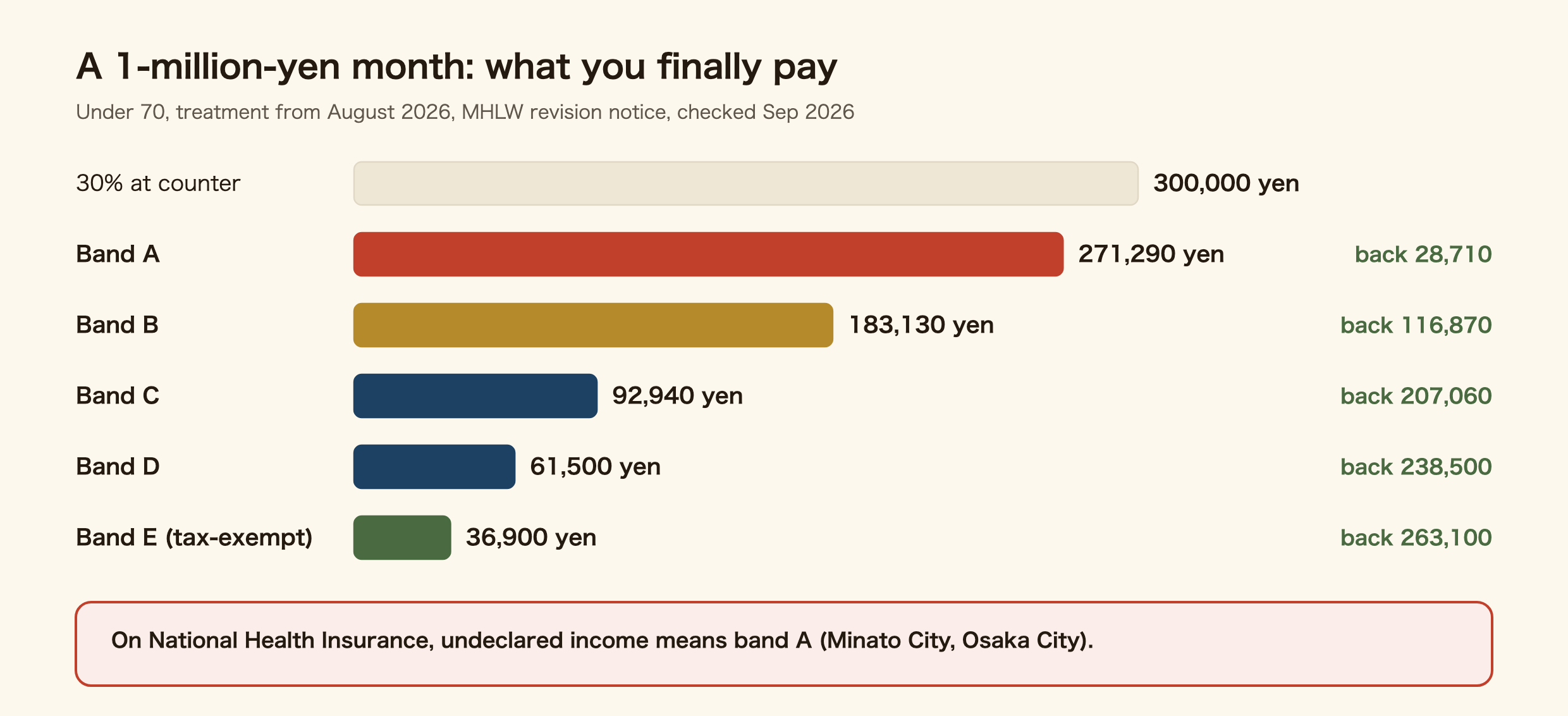
Say surgery and a hospital stay cost 1 million yen of insured treatment in one month. Your 30% at the counter is 300,000 yen. What you end up paying, and what comes back, depends on your band.
| Band | You pay (cap) | Refunded |
|---|---|---|
| A | 271,290 yen | 28,710 yen |
| B | 183,130 yen | 116,870 yen |
| C | 92,940 yen | 207,060 yen |
| D | 61,500 yen | 238,500 yen |
| E | 36,900 yen | 263,100 yen |
For band C: 85,800 + (1,000,000 − 286,000) × 1% = 92,940 yen, the same figure as the ministry’s own worked example. Bands D and E are flat, however big the bill.
A student living on 28 hours a week of part-time work earns well under the band D line (2.1 million yen after the basic deduction). As long as the income has been declared, you are in band D or E, and a 300,000 yen bill ends up costing you 61,500 or 36,900 yen.
Why undeclared income puts you in the top band
This is where foreign residents get caught. On National Health Insurance, the city sets your band from last year’s income. If the city does not know your income, you cannot be placed in a low band.
Minato City says that if resident tax has not been declared, you are treated as band A, and the benefit may not be paid at all. Osaka City also puts any household with a member whose income cannot be confirmed into band A. In the table above, that turns a refund of about 238,000 yen into less than 30,000.
Declare your income for resident tax even if it was zero. The declaration goes to the tax section of your city office, not the health insurance desk. The same declaration can also cut your premium. The steps are in the guide to the National Health Insurance reduction you have to ask for.
If you arrived this year, there is one more rule. Osaka City says a household with anyone who had no address in Japan on 1 January is treated as a taxed household (band D or higher). If you are not sure which band you are in during your first year, ask the National Health Insurance desk: “What is my high-cost medical expense band?” Bands are reset every August using the previous year’s income.
Do I need a limit certificate? Not with a My Number health card
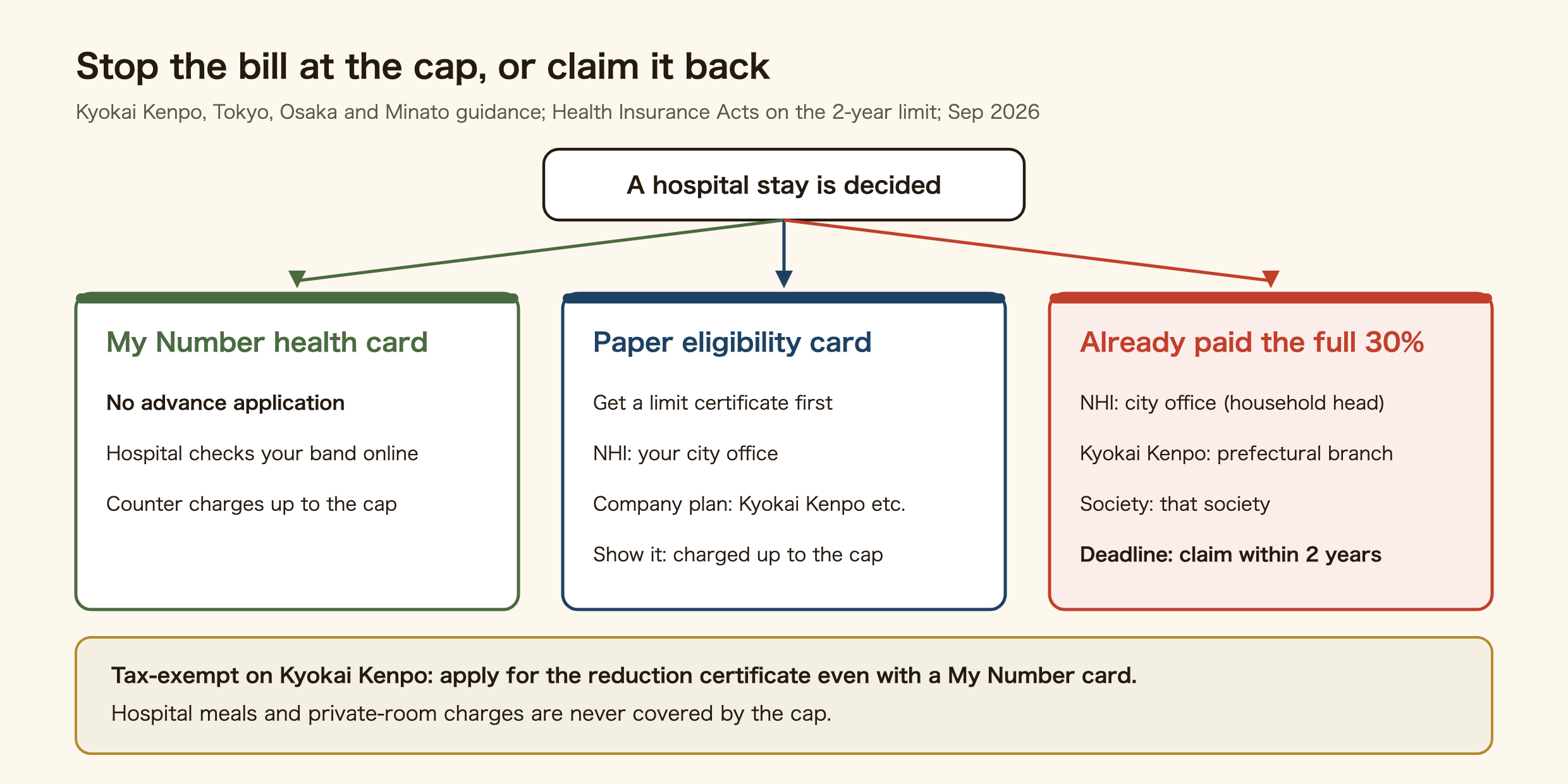
There are two ways to receive the benefit. Either the bill stops at the cap at the counter, or you pay the full 30% and get the excess refunded later.
The easy way to stop it at the counter is the My Number health card. Kyokai Kenpo and Tokyo both say that if you see the doctor with your My Number card, you do not need to apply for a limit certificate. The hospital checks your band online and charges you only up to the cap. If you have not registered your card as a health card yet, check the My Number card guide, including when the card expires.
If you use a paper eligibility certificate, or the hospital cannot check online, apply for a limit certificate (gendogaku tekiyo ninteisho) before you are admitted. On National Health Insurance, apply at your city office; on a company plan, at Kyokai Kenpo or your health insurance society. Kyokai Kenpo cannot issue one for a month before the month you apply, so apply in the same month your admission is decided.
If you are exempt from resident tax, the rules differ by insurer. Kyokai Kenpo asks you to apply for the “limit and standard meal-cost reduction certificate” even if you use a My Number card. Osaka City’s National Health Insurance says that at hospitals with online checking, your hospital meal charge is reduced too without the certificate. Ask your own insurer once.
Stopping at the cap at one hospital is not the end of it. If you also paid at another hospital in the same month and the total goes over the cap, you can claim the difference (Osaka City).
How the cap is counted: calendar month, per hospital, 21,000 yen for household totals
The cap is monthly, and the counting has rules.
- A month runs from the 1st to the last day. A stay across two months is counted as two separate months
- Each hospital is counted separately, and within one hospital, inpatient and outpatient, medical and dental are separate too
- What you pay at a pharmacy for a prescription is added to the hospital that wrote it
- Under 70, only amounts of 21,000 yen or more (per hospital and type above) can be added together
- The “household” you can add up is everyone in the same household on National Health Insurance, or on Kyokai Kenpo, you and your dependants
Admitted on 28 September and discharged on 5 October, you use one cap for September and another for October. If the stay fits inside one month, you only pay up to one cap. If the date of an operation is flexible, it is worth raising with the hospital.
A couple both on National Health Insurance: in the same month one pays 50,000 yen for a hospital stay and the other 30,000 yen at a different clinic. Both are over 21,000 yen, so the total of 80,000 yen counts. In band D the cap is 61,500 yen, and 18,500 yen comes back.
What if treatment goes on for months? The 4th-time rate and the annual cap
When high bills keep coming, for cancer treatment for example, the cap drops further. If you received the benefit in three of the last 12 months, the cap from the fourth month is the lower “multiple-time” rate: 44,400 yen for bands C and D, and 24,600 for band E.
The count can start over. Kyokai Kenpo counts within the same insurer, so if you move from National Health Insurance as a student to a company plan when you start work, the months do not carry over. If you stay on National Health Insurance and move within the same prefecture, the count carries over as long as the household continues (Osaka City).
An annual cap was also added from August 2026. If your share from August to the following July goes over 530,000 yen in bands C and D, or 290,000 yen in band E, the rest comes back. Claims for this annual cap open in August 2027 (Kyokai Kenpo, Osaka City). Keep your receipts.
Are hospital meals and private rooms covered? No
The benefit only covers your share of insured treatment. Both the Health Insurance Act and the National Health Insurance Act exclude meals and living costs in hospital.
- Meals during your stay
- Extra charges for a private or semi-private room you chose
- Treatment not covered by insurance, and the extra cost of dental materials
You pay these on top of the cap. If you are told only a private room is free, ask what the room charge is before you sign the consent form.
Where do I claim? City office for National Health Insurance, Kyokai Kenpo or your society for company plans
Your insurer decides where the claim goes. The ministry tells you to check your insurer’s name on your eligibility certificate or on Mynaportal.
| Name shown | Where to claim |
|---|---|
| A city or ward (National Health Insurance) | That city’s National Health Insurance desk |
| Japan Health Insurance Association (全国健康保険協会) | The Kyokai Kenpo prefectural branch (by post or online) |
| … Health Insurance Society (健康保険組合) | That society |
On National Health Insurance, the benefit is paid to the head of household. Minato City posts a claim form to the head of household three to four months after the month of treatment. Osaka City also sends a notice to households that have not claimed. In Osaka you need:
- Something that shows you are insured, such as your eligibility certificate or insurance information notice
- Your My Number card or other proof of your My Number and identity
- Details of a bank account in the head of household’s name
How long payment takes depends on the office. Minato says one to one and a half months after it receives the form, Osaka about four to six months after you apply. If Japanese is hard, some wards, such as Minato, offer phone calls with an interpreter on the line.
What is the deadline? Two years from the 1st of the following month
The right to the benefit expires after two years (Health Insurance Act Article 193, National Health Insurance Act Article 110). The clock starts on the 1st of the month after you were treated. For a stay in September 2026, that is two years from 1 October 2026.
After two years, whatever you paid over the cap is gone. If no form has arrived three or four months after treatment, phone the office. Minato asks people to do exactly that.
If you may leave Japan, claim first. National Health Insurance refunds go to a Japanese bank account in the head of household’s name (Osaka City). The order for closing your account is in the leaving-Japan checklist.
What if I owe premiums, or cannot pay the bill?
If you have not paid National Health Insurance premiums, the cap may not work at the counter. Osaka City says that without special circumstances, arrears can mean your band cannot be checked or a certificate cannot be issued. Then you pay the full 30% first and claim at the ward office afterwards.
If the money is not there, you have three moves.
- Before admission, bring the counter charge down to the cap with a My Number health card or a limit certificate
- On Kyokai Kenpo, use the high-cost medical expense loan: 80% of the refund you expect, lent interest-free in advance
- Ask the hospital cashier about paying in instalments. The free or low-cost medical care scheme for people in hardship is in the guide to seeing a doctor in Japan
Whether National Health Insurance has a similar loan depends on your city. Tell the desk you cannot wait for the refund and ask what is available.
What changes in August 2027? More income bands (already promulgated)
A second step is already law. The same Cabinet Order, promulgated on 29 July 2026, splits the income bands further from 1 August 2027. e-Gov lists it as an amendment taking effect on that date.
- Band C (about 3.7–7.7 million yen) splits into three, with monthly caps of 85,800, 98,100 and 110,400 yen (each plus 1% of the cost above a threshold)
- Band D (up to about 3.7 million yen) splits into three: 69,600, 65,400 and 61,500 yen
- Resident-tax exempt stays at 36,900 yen
- For incomes under about 2 million yen, the multiple-time rate falls from 44,400 to 34,500 yen
Kyokai Kenpo says limit certificates issued from August 2026 are valid until 31 July 2027 at the latest. If you rely on one, apply again from August 2027.
Which one are you?
- You have a hospital stay or operation coming up — check whether you can use your My Number card as a health card. If not, apply for a limit certificate at your insurer this month.
- You have already paid the full 30% — find your insurer’s name on your eligibility certificate or Mynaportal, and phone them if no claim form has arrived. Keep the receipts together and put the two-year deadline in your calendar.
- You are on National Health Insurance and have never declared your income — file a resident tax declaration at the city tax section. Then ask the National Health Insurance desk which band you are in.
- You were hurt at work or on the way there — tell your employer you are using work injury insurance, not health insurance, and say “rosai” at the hospital desk.
- You may leave Japan before treatment ends — send the claim before you close your Japanese bank account.
FAQ
Q. Can foreigners use the high-cost medical expense benefit in Japan?
Yes. It is set by the Health Insurance Act and the National Health Insurance Act, with no nationality condition. On National Health Insurance or a company plan, foreign residents use the same cap table as Japanese people.
Q. What is the monthly cap?
For under-70s there are five income bands. From treatment in August 2026 the cap is 36,900 yen if you are exempt from resident tax, 61,500 yen up to an annual income of about 3.7 million yen, and 85,800 yen + (cost − 286,000) × 1% for about 3.7–7.7 million yen.
Q. Do I need a limit certificate if I have a My Number health card?
No. Kyokai Kenpo and Tokyo both say no application is needed if you use a My Number health card. Kyokai Kenpo does ask people exempt from resident tax to apply for the limit and meal-cost reduction certificate even so.
Q. Where do I apply for the refund?
On National Health Insurance, at the National Health Insurance desk of your city or ward. On a company plan, at the Kyokai Kenpo prefectural branch or your health insurance society.
Q. What is the deadline to claim?
Two years from the 1st of the month after the month of treatment. After that the right expires.
Q. Are hospital meals and private-room charges refunded?
No. The benefit only covers your share of insured treatment. Meals in hospital, private-room charges and uninsured treatment are outside it.
Summary
The high-cost medical expense benefit works the same for foreign residents as for Japanese citizens. Under 70, the cap has five income bands; from August 2026 it is 36,900 yen a month if you are exempt from resident tax and 61,500 yen up to about 3.7 million yen a year. On National Health Insurance, undeclared income puts you in band A, the highest cap.
When a hospital stay is decided, stop the bill at the cap with a My Number health card or a limit certificate. For anything already paid, claim from your city office, Kyokai Kenpo or your health insurance society within two years from the 1st of the following month. Meals and private-room charges are paid separately, so check them before you are admitted.
Official sources: MHLW, high-cost medical expense benefit (Japanese) / MHLW, revision from August 2026 treatment (PDF, Japanese) / Kyokai Kenpo, high-cost medical expenses (Japanese) / Kyokai Kenpo, limit certificate (Japanese) / Tokyo Metropolitan Government, high-cost medical expenses (Japanese) / Osaka City (Japanese) / Minato City (Japanese). Checked on 23 September 2026. Always confirm with your own insurer before you claim.
Related reading
Found this useful? Share it
Send it to a friend who lives in Japan.
WHO WROTE THIS

mori
Japanese. I read the ministries’ own notices, orders and Q&As in the original, and I start from what my Nepalese and Sri Lankan friends in Japan actually ran into. I do not write about what I have not checked or been told.
What this site can and cannot do →Looking for something else?