Checked on 20 September 2026 against the Japan Pension Service pages on covered workers, the qualifying period, credited periods and claiming from abroad, the Employees’ Pension Insurance Act (e-Gov), and the Ministry of Health, Labour and Welfare’s list of social security agreements (as of 2 June 2026).
In short
- The Employees’ Pension (kosei nenkin) is the state pension for people employed by a company, and foreigners are enrolled “regardless of nationality”. Part-time counts too at 20+ hours a week and 88,000 yen+ a month (students excepted).
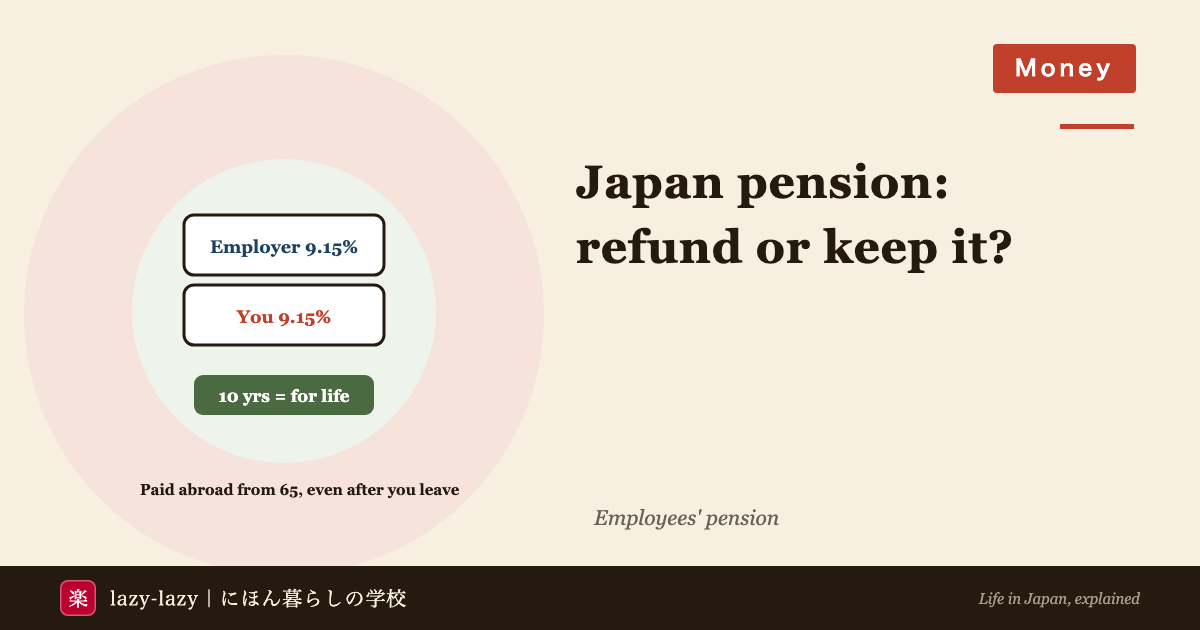
- The premium is 18.3% of pay, split half and half with the employer. You pay 9.15%; your employer adds the same amount on top.
- Pay in for 10 years and you get a pension for life from 65, even after leaving Japan. It can be paid to a bank abroad, and if your country has an agreement (24 countries), years at home can be added.
- Leaving before 10 years? The lump-sum withdrawal. Within 2 years of leaving, capped at 5 years – and claiming it erases those years.
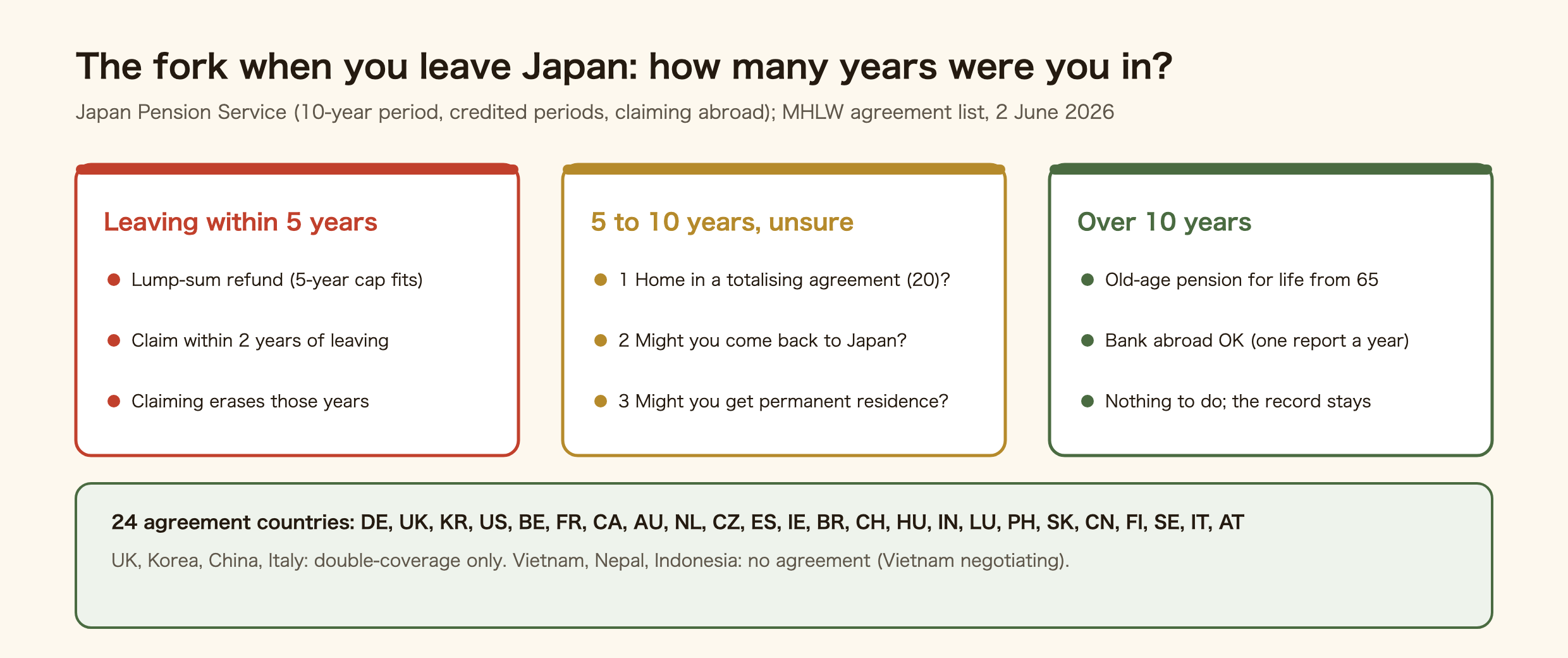
- The fork is how long you will be in Japan. Under 5 years: the refund. Over 10: the pension. The 5-to-10 group is where people get stuck, so that is what this article is for.
Once this is clear, the pension line on your payslip stops looking like money taken and starts looking like savings your employer matches yen for yen – and when you leave, you choose between refund and pension yourself.
Your first Japanese payslip. Nearly 20,000 yen gone under “Employees’ Pension”. Why pay, if you are going home one day? Does it come back? Ask a Japanese colleague and you hear “well, everyone pays it”. They have never had leaving the country as an option, so they have never had to think about it. Here are the enrolment rules, the cost, when you get it and what happens when you leave – from the Japan Pension Service and the Act, nothing else.
- What is the Employees’ Pension? The company pension, and foreigners are in “regardless of nationality”
- How much comes out? 18.3%, halved with the employer: 9.15% from you
- When do you get it? Ten years in, and it is yours for life from 65
- Can home-country years be added? Yes, in 24 agreement countries
- Leaving before ten years? The lump-sum withdrawal, once you know what it erases
- The decision: it comes down to how long you will be in Japan
- FAQ
- Summary
What is the Employees’ Pension? The company pension, and foreigners are in “regardless of nationality”
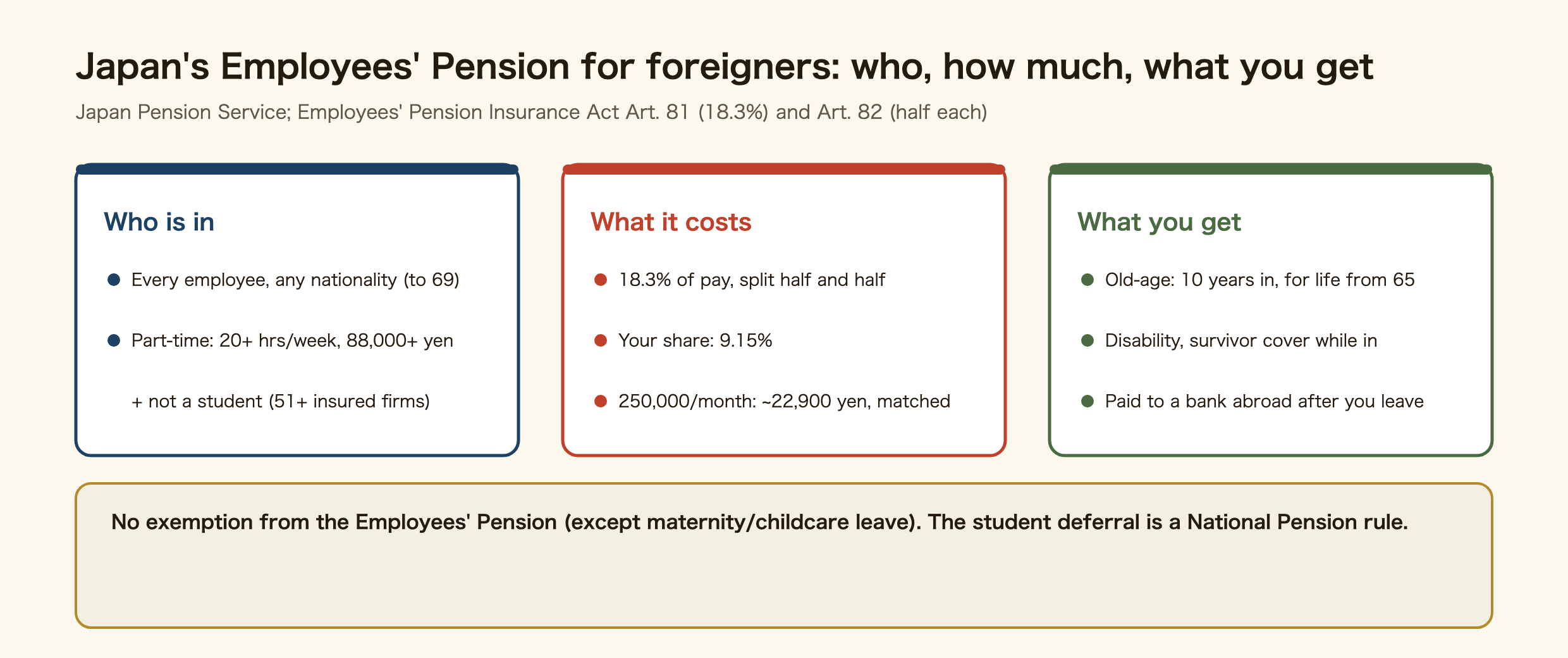
The Employees’ Pension is the public pension for people who work at a company (a “covered workplace”), the second tier that sits on top of the National Pension. The Japan Pension Service describes who is in like this: “anyone regularly employed at the workplace becomes an insured person, regardless of nationality, sex, wage level, etc.” There is no option of being foreign and therefore out (over-70s are in health insurance only).
It is not only full-time staff. Part-time and casual workers are enrolled if all three hold:
- 20 or more scheduled hours a week
- Regular pay of 88,000 yen or more a month
- Not a student – a student’s part-time job is outside, as in the student social-insurance article
This part-time rule applies at “specified” employers (companies with 51 or more insured workers), and from October 2027 it extends to 36 or more. Under 20 hours a week, you are not enrolled.
How much comes out? 18.3%, halved with the employer: 9.15% from you
The rate is 18.3%, fixed since September 2017 (Employees’ Pension Insurance Act, Art. 81). The insured person and the employer “each bear half of the premium” (Art. 82), so 9.15% leaves your pay and the employer pays the same amount.
On a monthly salary of 250,000 yen, that is roughly 22,900 yen from you and 22,900 from the employer: about 550,000 yen a year going in under your name (the exact figure uses “standard monthly remuneration” bands, so it differs slightly).
That is the big difference from the National Pension. A student’s National Pension is 17,920 yen a month paid entirely by the student; the Employees’ Pension is half-paid by the employer and includes the National Pension inside it. There is no exemption from the Employees’ Pension (apart from maternity and childcare leave). As long as you are paid, it is deducted.
When do you get it? Ten years in, and it is yours for life from 65
The old-age pension is paid from 65 once your “qualifying period” reaches 10 years (Japan Pension Service). The qualifying period adds together the months you paid, the months you were exempted, and some credited periods; National and Employees’ Pension months count together. It was cut from 25 years to 10 in August 2017, so ten working years in Japan after university is enough for a pension for life.
Leaving Japan does not cancel it. It can be paid into a bank account abroad (you file a registration of address and receiving bank with the SWIFT code). The one condition is a “status report” once a year, by the end of your birth month. If you live in a country with a tax treaty with Japan, a filing waives the non-resident withholding tax.
While enrolled you are also covered by the disability and survivors’ pensions, on the same terms as anyone else.
Can home-country years be added? Yes, in 24 agreement countries
Japan has social security agreements in force with 24 countries (as of 2 June 2026, MHLW). An agreement does two things.
- Prevents double coverage – someone posted to Japan by a home employer does not pay into both systems
- Totalises periods – seven years in Japan plus three at home count as ten for Japan’s qualifying period (the amount reflects the seven years paid in Japan)
The 24: Germany, the UK, Korea, the USA, Belgium, France, Canada, Australia, the Netherlands, Czechia, Spain, Ireland, Brazil, Switzerland, Hungary, India, Luxembourg, the Philippines, Slovakia, China, Finland, Sweden, Italy and Austria. But for the UK, Korea, China and Italy the agreement covers double coverage only; there is no totalisation. Poland is signed (April 2026); Turkey, Norway and Vietnam are negotiating; Thailand is in preliminary talks.
Vietnam, Nepal, Indonesia, Myanmar, Sri Lanka and Bangladesh are not on the list (Vietnam is negotiating). If you are from one of those, the question is simply whether Japan alone gets you to ten years.
Leaving before ten years? The lump-sum withdrawal, once you know what it erases
With six months or more in the National or Employees’ Pension, a claim within two years of losing your Japanese address returns part of what you paid as a “lump-sum withdrawal payment”, capped at five years’ worth. The calculation and the steps are in the lump-sum article.
One thing before you claim. Taking the lump sum erases those years from your record. Work seven years, take the refund (five years’ worth), come back later and work three more: that is not ten. The refund is the tool for people who have decided they will not return; for anyone who might, it can cost more than it pays.
The decision: it comes down to how long you will be in Japan
- Leaving within five years: the lump sum. The five-year cap means you use it fully. Moving-out notice before you go, claim within two years after.
- Likely to pass ten years: take the pension. Nothing to do now. When you leave, register a bank abroad and collect from 65.
- Five to ten and unsure: check three things. (1) Is your country an agreement country with totalisation (USA, Canada, Germany, France, Australia, Brazil, the Philippines, India and others – 20 of the 24)? Then home years can carry you to ten. (2) Might you come back to Japan? Then do not take the refund; the years stay and add up. (3) Might you obtain permanent residence? Once granted, your years abroad before the grant (ages 20-59) count as “credited periods” toward the ten (not toward the amount).
If none of those applies – no realistic path to ten years, no plan to return – take the refund. Otherwise, keeping the record leaves more doors open. The refund can be claimed any time within two years of leaving, so if you are unsure, do not rush to erase it.
FAQ
Q. Do foreigners have to join the Employees’ Pension?
Yes. Anyone regularly employed at a covered workplace is insured “regardless of nationality, sex, wage level, etc.” Part-timers at 20+ hours and 88,000 yen+ a month are in too, students excepted.
Q. How much is the premium?
18.3% of pay, halved with the employer, so 9.15% from you. On 250,000 yen a month, roughly 22,900 yen, matched by the employer.
Q. Can I receive the pension after leaving Japan?
Yes, with a qualifying period of 10 years or more: from 65, into a bank account abroad. One status report a year is required.
Q. Can years paid in my home country be added?
In 20 of the 24 agreement countries, yes, to reach the 10 years. The UK, Korea, China and Italy have double-coverage agreements only. Vietnam, Nepal, Indonesia and others have no agreement (Vietnam is negotiating).
Q. Refund or pension – which is better?
No path to 10 years and no return to Japan: the refund. Anything else: keep the record. Claiming the refund erases those years.
Q. Is there an exemption from the Employees’ Pension?
No (other than maternity and childcare leave). It is deducted as long as you are paid. The student deferral belongs to the National Pension.
Summary
Foreigners are enrolled in the Employees’ Pension regardless of nationality. The premium is 18.3% split with the employer, 9.15% from you. Ten years in, and it pays for life from 65, to a bank abroad if you leave. Agreement countries with totalisation (20) let you add home years.
Leaving before ten years: the lump-sum withdrawal (within 2 years, up to 5 years’ worth), which erases those years. The fork is how long you stay. If unsure, keep the record – it leaves more open.
Sources (official): Japan Pension Service, covered workplaces and insured persons / JPS, expansion of coverage to short-time workers / Employees’ Pension Insurance Act, Arts. 81 and 82 (e-Gov) / JPS, old-age basic pension requirements / JPS, credited periods / JPS, claiming a pension from outside Japan / MHLW, status of social security agreements (as of 2 June 2026) (all checked 20 September 2026)
Found this useful? Share it
Send it to a friend who lives in Japan.
WHO WROTE THIS

mori
Japanese. I read the ministries’ own notices, orders and Q&As in the original, and I start from what my Nepalese and Sri Lankan friends in Japan actually ran into. I do not write about what I have not checked or been told.
What this site can and cannot do →Looking for something else?