Checked on 18 September 2026 against the Immigration Services Agency’s guidelines for extensions and changes of status, its published denial cases, its page on the special period, and Articles 20 and 21 of the Immigration Control Act (e-Gov). How long you may stay to prepare for departure after a denial is not on the Agency’s public pages, so this article does not assert it and tells you to ask at the counter.
In short
- A denied renewal means the Minister found no “reasonable grounds” to extend. The review rests on eight factors: activity, conduct, livelihood, tax and notifications are the pillars.
- Of the nine denial cases the Agency publishes, six are criminal punishment or a false statement. The rest are “not carrying out the status’s activity” or “no circumstances to justify”. If you work, pay tax and file your notifications, none of them fits you.
- No decision by your expiry date? You may stay on your current status for up to two months after it (the special period). Check that the back of your residence card says an application is pending.
- When a denial arrives: (1) ask the counter why, (2) if still within your period of stay, fix the reason and re-apply or apply to change status, (3) if neither works, prepare to leave. The worst move is doing nothing until the date passes.
- Nothing is charged on a denial. The fee is paid when permission is granted (and it rises sharply from 1 October).
The postcard arrives. It says “not permitted”. Why? How many days do I have? Can I apply again? Ask a Japanese colleague and you get “Wait, that can happen?” They have never held a status of residence. This article lines up the yardstick the Agency itself publishes and its own denial cases, and then gives the order of what to do.
- What is a denial? A finding that there are no “reasonable grounds”
- What actually gets people denied? The nine published cases
- No decision by the expiry date? The two-month “special period”
- A denial arrived. What now? Reason, then re-apply or change, then departure
- What you can do today so it never happens
- The decision: which case are you?
- FAQ
- Summary
What is a denial? A finding that there are no “reasonable grounds”
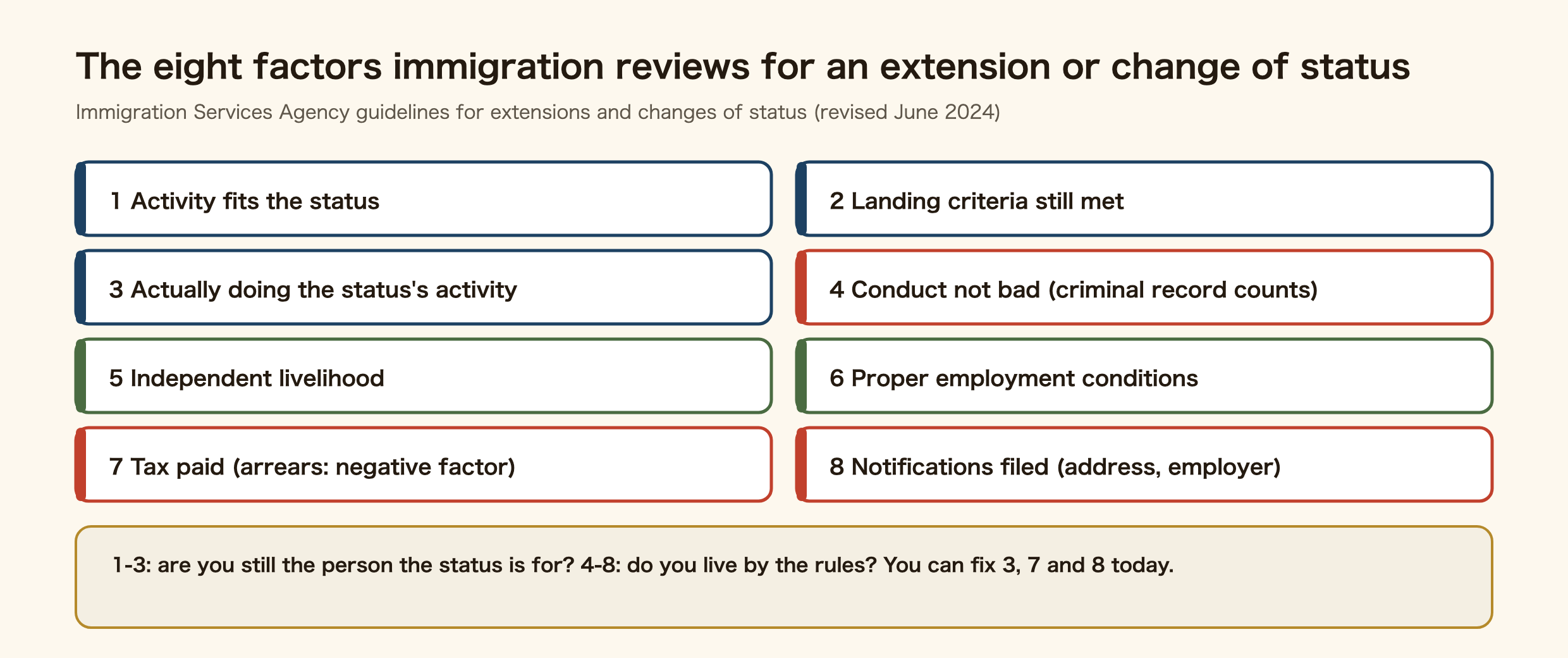
An extension of stay is granted by the Minister of Justice “only where there are reasonable grounds sufficient to find the extension appropriate”: it is discretion, not a right (Immigration Control Act, Art. 21(3)). A change of status works the same way (Art. 20(3)). How “reasonable grounds” are judged is set out in the Agency’s published guidelines. Eight things are looked at.
- The activity you intend fits the status – degree-level work for Engineer/Humanities, attending school for Student
- The landing criteria are still met – the conditions you satisfied on entry still hold
- You are actually doing the activity of your current status – a technical intern who disappeared, a student who withdrew but stayed: “a negative factor unless there is good reason”
- Your conduct is not bad – criminal punishment comparable to deportation grounds, brokering illegal work: bad conduct even on a first offence
- You have the assets or skills for an independent living
- Employment and working conditions are proper – not below the minimum wage or outside labour law
- You have met your tax obligations – unpaid resident or income tax is “a negative factor”
- You have filed the notifications the Act requires – your address, and your organization (within 14 days of leaving or changing a job)
Factors 1-3 ask “are you still the person that status is for”; 4-8 ask “are you living by Japan’s rules”. Most denials have a concrete snag on one of the eight. Put the other way: a person with no snag on any of them is rarely denied.
What actually gets people denied? The nine published cases
The Agency publishes nine denial cases. Laid side by side, the pattern shows.
- Criminal punishment (5) – a fine of 300,000 yen for abetting illegal work (Business Manager); a fine of 500,000 yen under the child pornography law (Engineer/Humanities); two years’ imprisonment suspended for four for fraud and theft (Long-Term Resident); ten months suspended for three for cannabis (Spouse of Japanese National); long-term work at an adult-entertainment business without permission (Student). Suspended sentences and fines both led to denial.
- A false statement (1) – the address on the withholding slip differed from the address notified to immigration (Long-Term Resident). Move house without notifying your new address, and this is what it looks like.
- Not carrying out the status’s activity, or no rational reason (2) – after moving from a language school to a vocational school, applying to take the same course at the same school again (Student); resigning and then asking to change to Long-Term Resident (Engineer/Humanities).
- No settledness (1) – one year and three months in Japan, divorced, asking to change to Long-Term Resident.
None of the nine is “one document was missing” or “my Japanese was poor”. Missing documents normally bring a request for more, not a denial; what denies is substance. Substance can also lie outside your own hands: the school’s attendance record, the employer’s finances. A student with low attendance, a company in tax arrears, are the typical cases.
No decision by the expiry date? The two-month “special period”
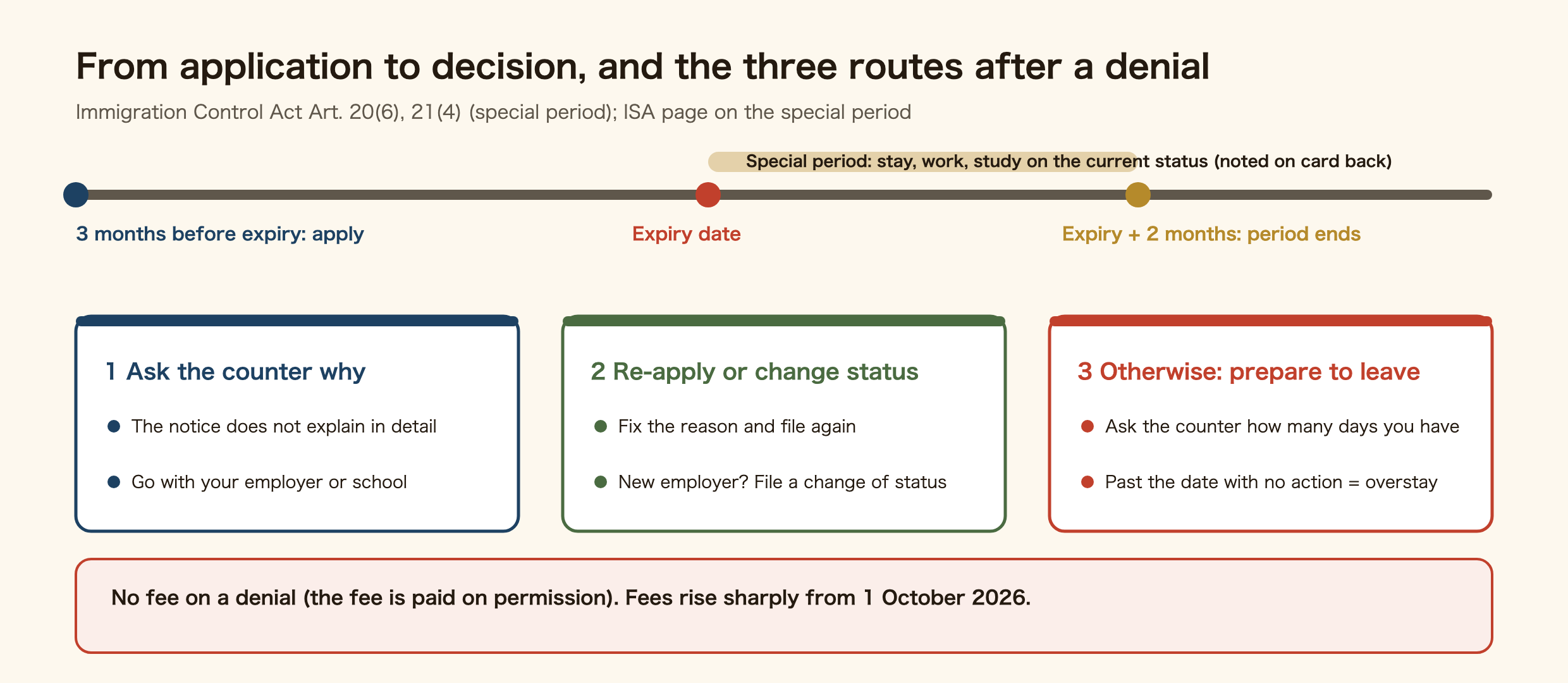
You can apply from about three months before expiry. It is common for the decision not to arrive by the expiry date. In that case you may stay on your current status until the decision, or until two months after the expiry date, whichever comes first (Act, Art. 20(6) and 21(4)). This is the special period.
During it you keep working or studying as before. The date on the front of your residence card may have passed, but the entry on the back under “application for extension etc.” keeps it valid (online applications get no entry, so keep the receipt e-mail). If a bank or a city office says “expired”, show them the back.
One warning: the special period ends two months after expiry. Decisions rarely take longer, but if immigration asks for more documents before then, send them at once. Let the two months pass without responding and you have no basis to stay.
A denial arrived. What now? Reason, then re-apply or change, then departure
- Ask the counter for the reason. The notice does not explain in detail. Take it to the regional immigration office and ask. Without knowing what was lacking you cannot plan the next move. Going with someone from your employer or school lets you check the employer’s side too (finances, employment terms).
- If you are still within your period of stay, fix the reason and re-apply, or apply to change to another status. Told the job does not fit Engineer/Humanities? Change to work that does, and file again. Left the company and found another? File a change with the new employer. If little of the special period is left, file without delay.
- If neither is possible, prepare to leave. It is commonly said that a short stay to prepare for departure may be granted after a denial, but the Agency’s public pages do not state the conditions, so ask at the counter exactly how many days you have. Leave by that date. Staying past it is overstaying and makes any future entry to Japan hard.
Nothing is charged on a denial. The fee is paid when permission is granted. Note that fees rise sharply from 1 October 2026, so for a re-application the amount depends on whether you can file by 30 September.
What you can do today so it never happens
Of the eight factors, three are entirely in your own hands.
- File your notifications. Within 14 days of moving, notify your new address; within 14 days of leaving or changing a job, notify your organization. The “address mismatch” denial case is what forgetting this looks like.
- Pay your tax. Do not leave resident-tax slips unpaid. If you cannot pay, ask the city office about instalments. “Arrears” are written into the guidelines as a negative factor.
- Keep doing the activity of your status. Students attend; workers do work that fits the status. If you leave a job, the three-month clock starts, so keep records of your job search.
Criminal punishment led to denial even at the level of a fine. Cycling drunk, shoplifting, cannabis – “small things” are not small in an immigration review.
The decision: which case are you?
Still waiting, expiry close: the special period covers you for two months after the date. Check the back of your card and do not miss a request for documents.
Denial in hand: go to the counter today and ask why. If the reason can be fixed, re-apply or change; if not, confirm your departure date. Decide after hearing the reason; just do not sit on it.
Worried about the next renewal: get notifications, tax and activity in order today. With those three in place and no criminal record, none of the published cases applies to you.
FAQ
Q. Why do visa renewals get denied in Japan?
In the Agency’s nine published cases: criminal punishment (5), a false statement (1), not carrying out the status’s activity or no rational reason (2), no settledness (1). The review uses eight factors including activity, conduct, livelihood, tax and notifications.
Q. My period of stay expires before the decision. Am I overstaying?
No. You may stay on your current status until the decision or two months after expiry, whichever is earlier (the special period). The back of your residence card shows the application is pending.
Q. Can I apply again after a denial?
If you are still within your period of stay, you can fix the reason and re-apply, or apply to change to another status. Ask the counter for the reason first.
Q. Do I have to leave Japan immediately after a denial?
The number of days you have is not stated on the Agency’s public pages, so ask at the counter. Leave by the date you are given. Staying past it is overstaying.
Q. Is the fee charged if I am denied?
No. The fee is paid on permission. Fees rise sharply from 1 October 2026.
Q. Will unpaid tax get my renewal denied?
Meeting tax obligations is a review factor, and arrears are written in as a negative factor. It is not an automatic denial, but pay before renewing or arrange instalments with the city office.
Summary
A denied renewal happens when one of the eight review factors has a concrete snag. The published pattern: criminal punishment, a false statement, not doing the status’s activity, no settledness. No decision by expiry? You stay on your current status for up to two months.
When a denial arrives: reason, then re-apply or change, then departure if nothing else. Never just wait. No fee on a denial. Notifications, tax and activity in order today, and the next renewal stops being a worry.
Sources (official): Immigration Services Agency, guidelines for permission to change status of residence and extend period of stay / ISA, denial cases for extension and change applications / ISA, what is the special period? / Immigration Control and Refugee Recognition Act, Art. 20(3), 20(6), 21(3), 21(4) (e-Gov) (all checked 18 September 2026)
Found this useful? Share it
Send it to a friend who lives in Japan.
WHO WROTE THIS

mori
Japanese. I read the ministries’ own notices, orders and Q&As in the original, and I start from what my Nepalese and Sri Lankan friends in Japan actually ran into. I do not write about what I have not checked or been told.
What this site can and cannot do →Looking for something else?