This article contains affiliate links.
Last updated: 22 August 2026
Summary
- Two different things are called a guarantor in Japan. The one on a visa application and the one on a lease are unrelated, and mixing them up wastes weeks.
- A guarantor person and a guarantor company are also different. Japanese renters mostly skip the person now and pay a company instead.
- You do not get to choose the guarantor company – the estate agent does. Which means a different agent can mean different terms: ask a second agency about the same flat before giving up on it.
- There are up to three screenings, and foreign applicants usually stop at the last one – the landlord’s approval. Passing the guarantor company and still being refused means nothing was wrong with your paperwork.
- Three routes work without a personal guarantor: use a guarantor company, choose a property that never asks for one, or apply to UR housing.
- UR housing asks for a monthly income of four times the rent. On a student’s 28 hours a week that is out of reach. But university and vocational school students can apply if a parent’s income or savings meets the standard. For full-time workers it is one of the best deals in Japan.
What changes: you know a refusal is usually the landlord, not your paperwork – so you go to another agent and ask again.
A guarantor (連帯保証人, rentai hoshounin) on a Japanese lease is a person who takes on the legal duty to pay your rent if you cannot. Traditionally this was a parent or relative living in Japan. If your family is not here, you cannot produce one – which is where most people get stuck. The wider contract and what it costs is covered in how renting works in Japan.
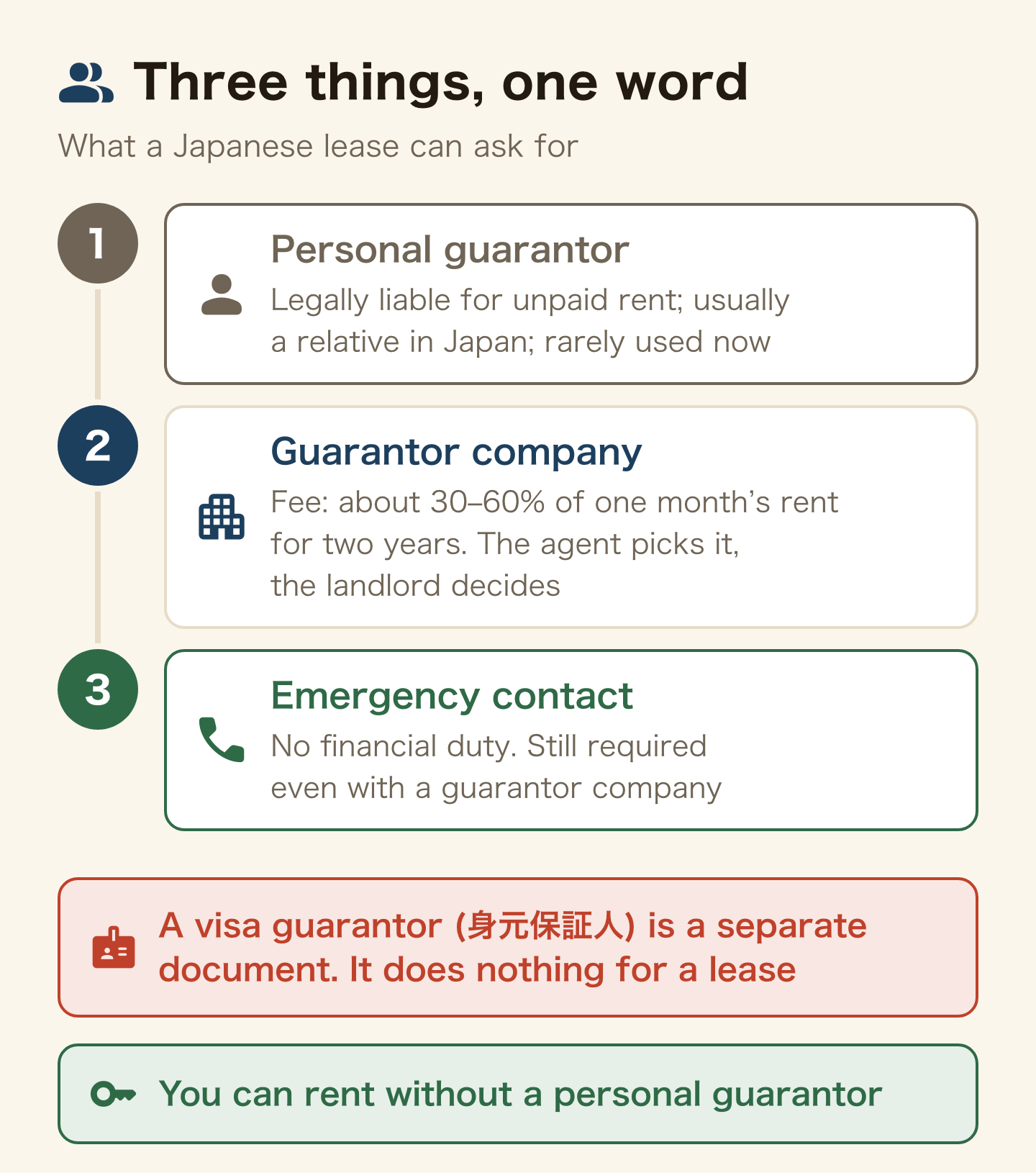
- First: the guarantor on your visa is not this guarantor
- A guarantor company does the job for money
- You do not choose the company – and that can work for you
- Three routes that work without a personal guarantor
- UR says no guarantor. Students qualify through a parent’s income
- There is more than one screening, and the last is where foreigners stop
- You can check the company yourself
- Frequently asked questions
- Q. Can I rent in Japan without a guarantor?
- Q. Which guarantor company should I choose?
- Q. The guarantor company approved me but I was still refused. Why?
- Q. One agency turned me down. Is that flat gone?
- Q. How much does a guarantor company cost?
- Q. Is the guarantor on my visa the same as the one on my lease?
- Q. Do I still need an emergency contact if I use a guarantor company?
- Q. Can students apply for UR housing?
- In short
- Related guides
First: the guarantor on your visa is not this guarantor
Search in English for “guarantor Japan” and most of what comes back is about visas – a Japanese resident who signs for a visitor, a sponsor for a student visa. That is 身元保証人 (mimoto hoshounin), and it is a different document, a different form, and a different legal weight.
The visa version vouches for your conduct and your ability to support yourself. The lease version signs up to pay a specific debt: your rent. Having one does nothing for the other. People arrive holding a visa guarantor letter and are surprised when the estate agent shrugs at it. Nothing has gone wrong – they are simply two unrelated things wearing the same English word.
A guarantor company does the job for money
You bring proof of income and the money for move-in, and apply for the room. Back home, that may be all a landlord needs to feel safe. In Japan you are also asked for someone, a person or a company, who will cover the rent if it stops. Walk in without knowing that, and the conversation ends at the first question.
What a landlord actually fears is rent that stops arriving. For decades that fear was passed to the tenant’s relatives. Now there are companies that absorb it for a fee – 家賃債務保証会社, rent guarantee companies.
They charge a fee. According to the housing guidebook from Japan’s Ministry of Land, Infrastructure, Transport and Tourism, the most common arrangement is to pay about 30 to 60 percent of one month’s rent up front to cover two years. It is real money on top of an already expensive move-in. But from the landlord’s side, a company that runs checks and keeps records beats an unknown relative, so Japanese tenants now use them too.
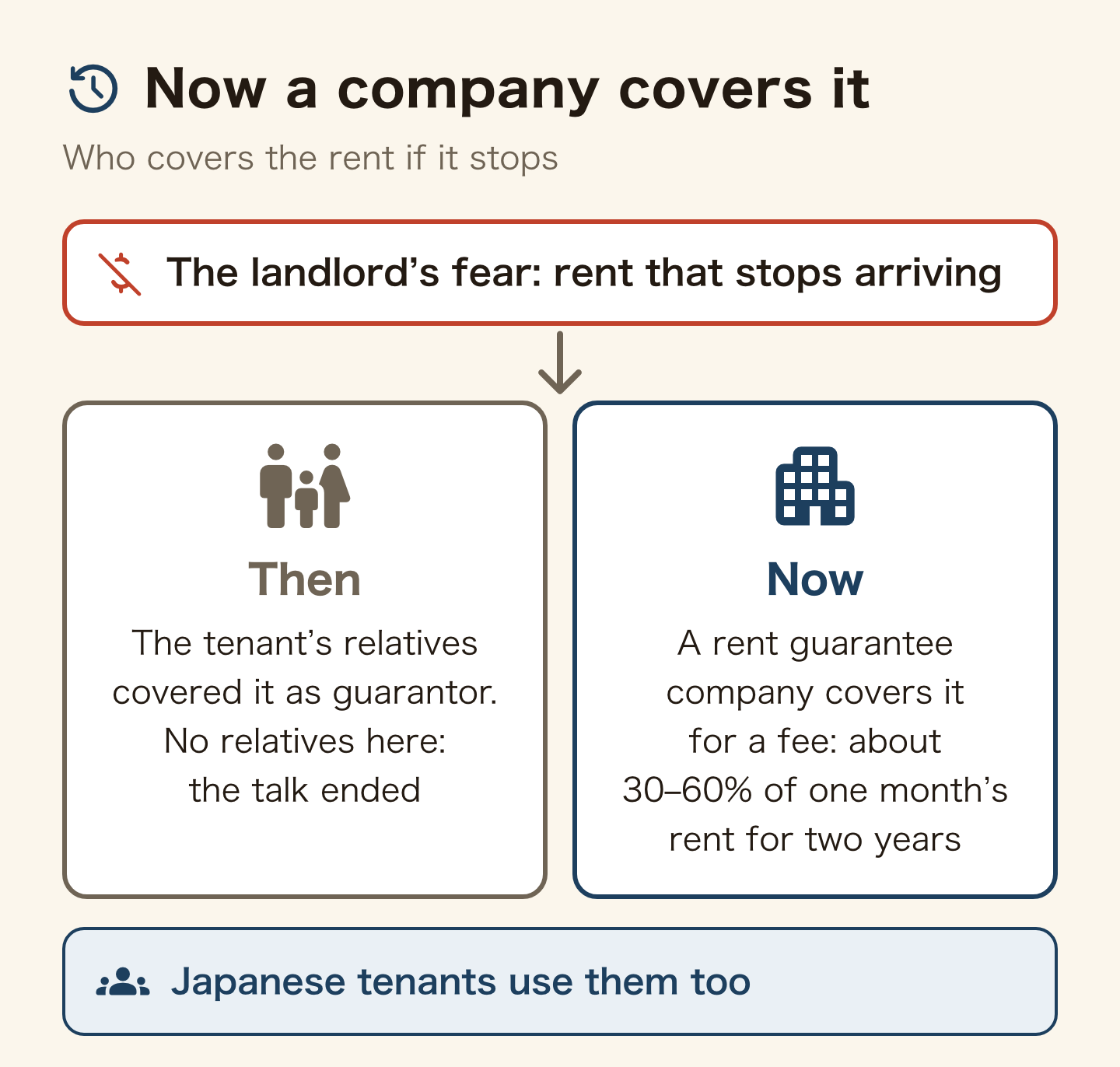
Read that as good news. The thing you could never produce has been turned into something you can buy.
You do not choose the company – and that can work for you
There are plenty of English pages comparing guarantor companies. They will not help you. You are not the one choosing.
In practice the estate agent handling the flat picks from the firms their office works with, and the landlord holds the final say. You still have something to work with. The ministry’s Q&A on its registration scheme says that both landlords and tenants can use the register when deciding on a contract or a property. Whether the firm you are offered is registered can be part of how you choose the flat.
There is a use for this, though. Change the agency and the partner firms change with it. One office will say a flat needs both a personal guarantor and a company; another office, same flat, will say the company alone is enough. Before you write off a place that turned you down, ask a second agency about it. That often moves faster than arguing with the first.
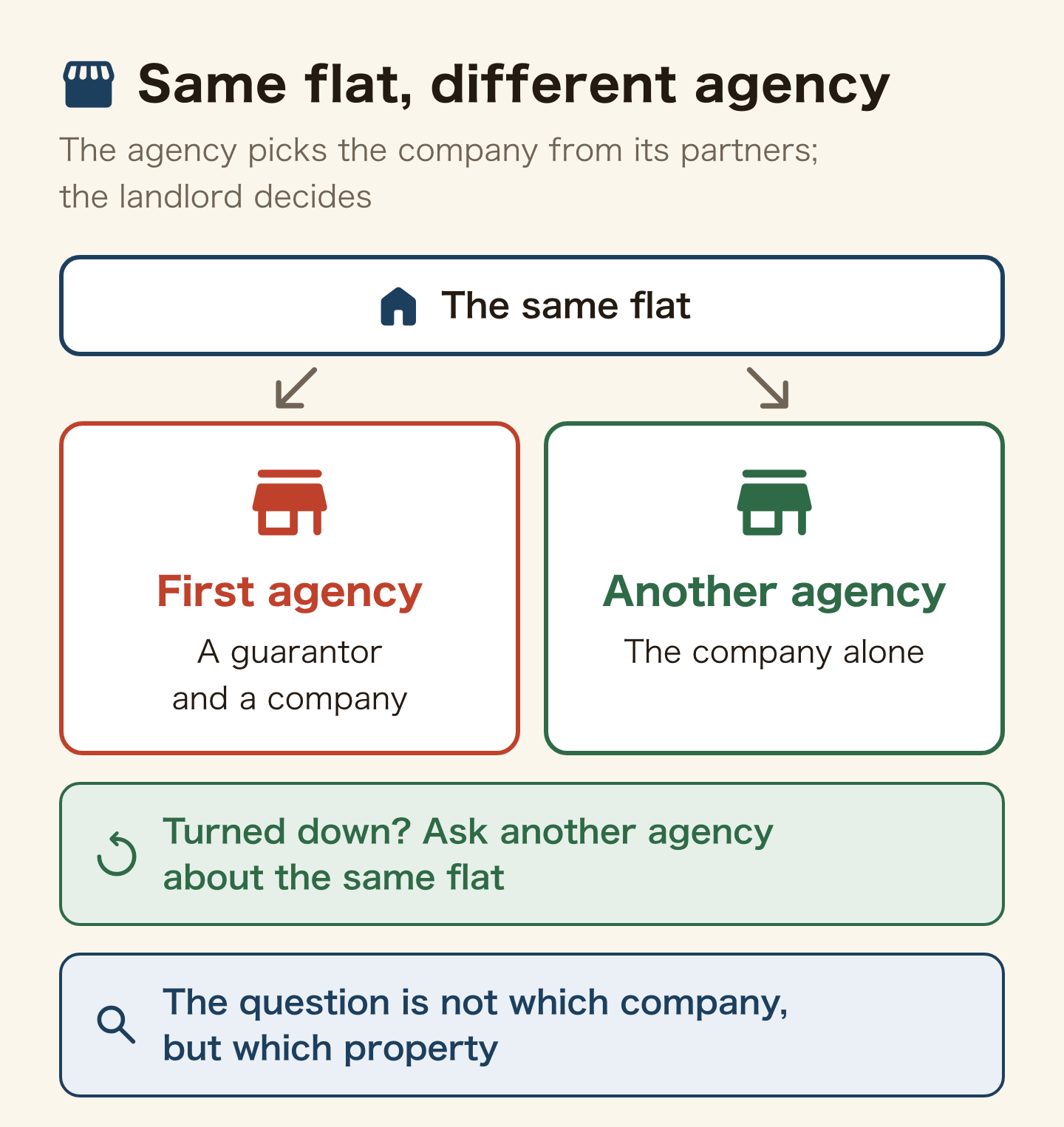
So point your effort somewhere else. The question is not which company, it is which property – and through which agent.
Three routes that work without a personal guarantor
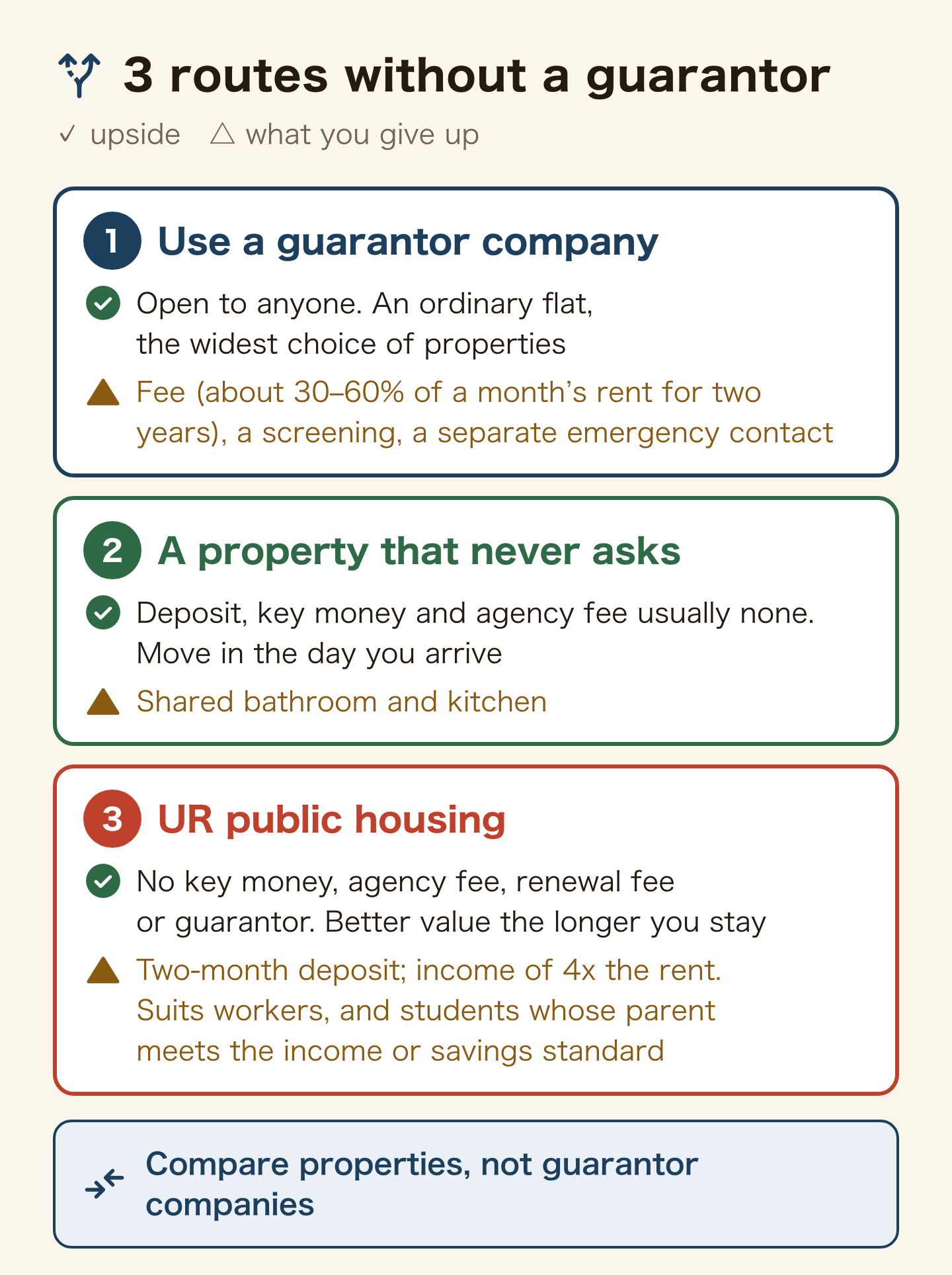
1. Use a guarantor company
The normal route, and the one with the widest choice of properties. You live in an ordinary flat. The cost is the guarantee fee. The ministry’s guidebook says about 30 to 60 percent of a month’s rent for two years is common. It comes on top of a move-in that is usually four to seven months’ rent. As finding a flat in Japan explains, ask for that total before you view anything, not after.
2. Choose a property that never asks for one
Share houses and furnished short-term flats are built without the guarantor step. Deposit, key money and agency fee are usually zero as well, and you can move in the day you arrive. What you trade away is a private bathroom and kitchen. Share houses and monthly apartments cover who these suit and who they do not.
3. UR public housing
Public rental housing that states plainly on its own homepage: no key money, no agency fee, no renewal fee, no guarantor. (UR, why UR: no key money, agency fee, renewal fee or guarantor (Japanese)) Foreign nationals can apply if they hold permanent residence, special permanent residence, or a mid-to-long-term residence status – which covers most student and work visas. Whether it reaches you is the next section.
UR says no guarantor. Students qualify through a parent’s income
UR replaces the guarantor with an income test. For a flat under 82,500 yen a month (under 62,500 yen if you apply alone), you need a monthly income of four times the rent. A 60,000 yen flat needs 240,000 yen a month, measured as last year’s income divided by twelve (UR, application requirements (Japanese)).
A student working the permitted 28 hours a week (Immigration Services Agency, permission for part-time work on a Student status (Japanese)) will not reach 240,000 yen a month on their own income.
Students have a special rule, though. UR’s application requirements (Japanese) let students aged 18 or over at a university, college of technology or specialised training school apply even when their own income falls short. There are two conditions. The relative who supports you, usually a parent, must have an average monthly income at or above the standard, or savings at or above the savings standard. And that relative must promise to share responsibility with you for paying the rent. If a parent can meet the standard, UR is open to students too. A Japanese language school is covered only if it is licensed as a specialised training school.
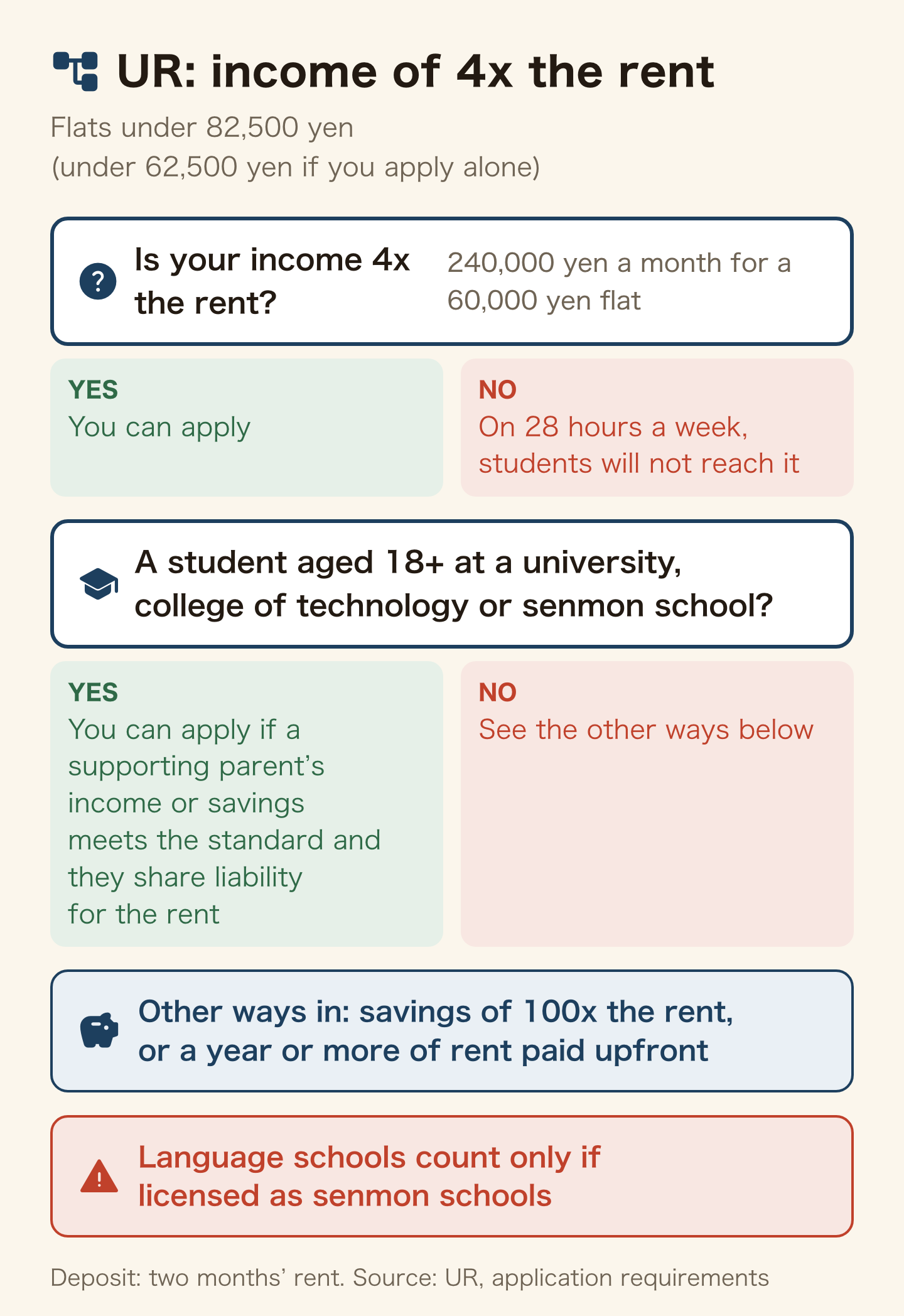
The two-month deposit is a second obstacle on top. There are two ways round the income test, though: savings of 100 times the rent, or paying a year or more of rent upfront.
For anyone working full time on a work visa, the arithmetic flips completely. No guarantor fee, no renewal fee, ever – and the gap widens the longer you stay. If you are working toward permanent residence, lower housing costs also show up in the savings record you will eventually be asked about.
There is more than one screening, and the last is where foreigners stop
People talk about “the screening” as one thing. There are up to three: the guarantor company’s check, the management company’s check, and the landlord’s approval.
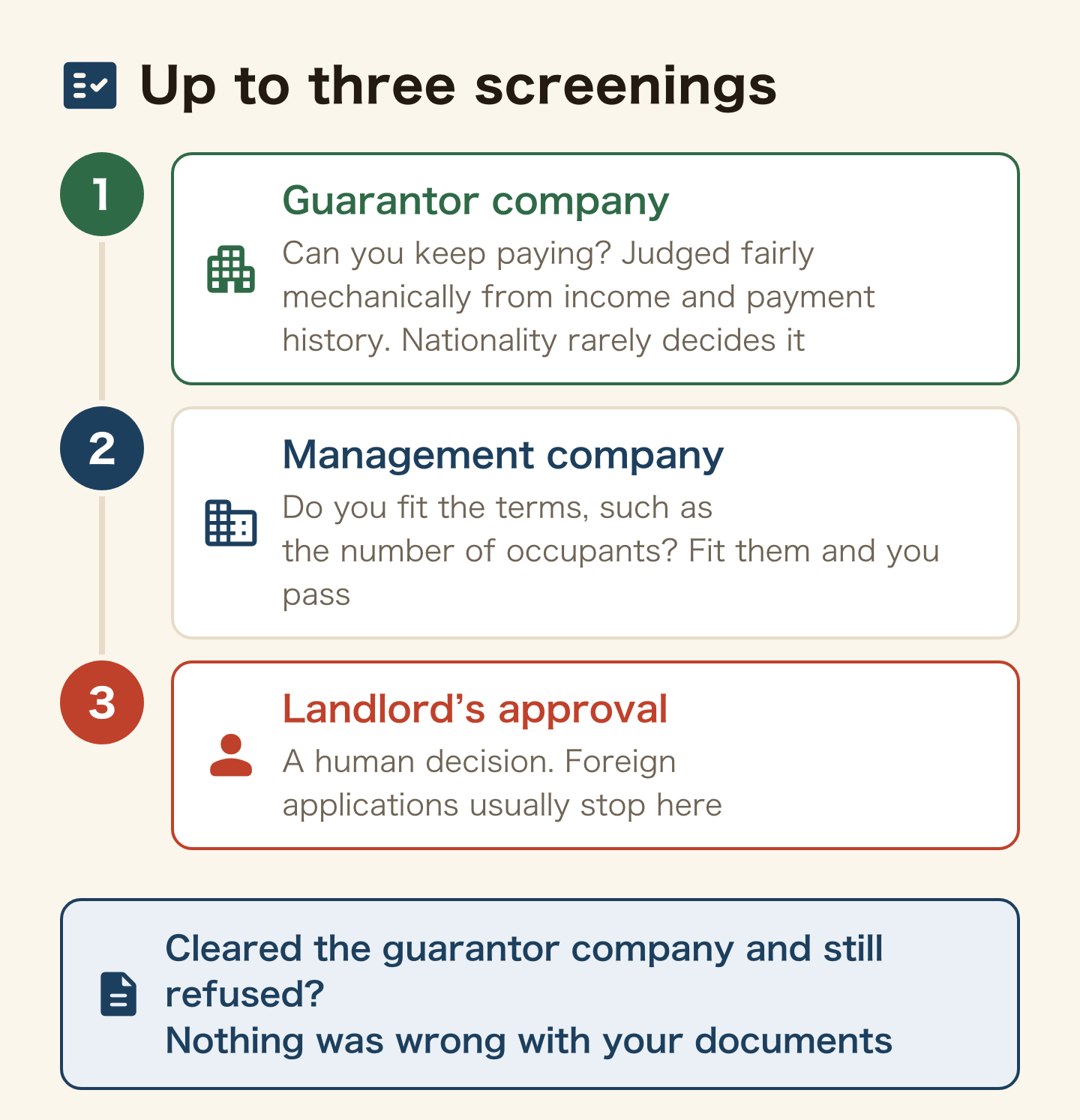
The guarantor company is looking at one question – can you keep paying the rent – and answers it fairly mechanically from income and payment history. Nationality by itself rarely decides anything here. Neither does how well you speak Japanese. Residence period does get checked, so if the lease runs two years and your card expires in one, be ready to say what happens next; stating that you intend to renew is often enough.
The last gate is the problem. You can clear the guarantor company and still be stopped by the landlord. That decision is a human one, and among the reasons landlords actually give is having had trouble with a foreign tenant before and never getting over it. That is somebody else entirely, whom you have never met.
It is an unfair thing to be told, but knowing it is worth something. If the guarantor company approved you and the answer was still no, there was nothing wrong with your income or your documents. Rather than hunting for something to fix, move – to another flat, or another agency. Starting from properties that welcome foreign tenants is usually the shorter road.
One more trap. Even with a guarantor company, you will still be asked for an emergency contact. That person owes nothing financially – they just have to answer the phone. A teacher, a manager at work, a friend living in Japan. You cannot invent a name at the counter, so ask someone before you start viewing.
You can check the company yourself
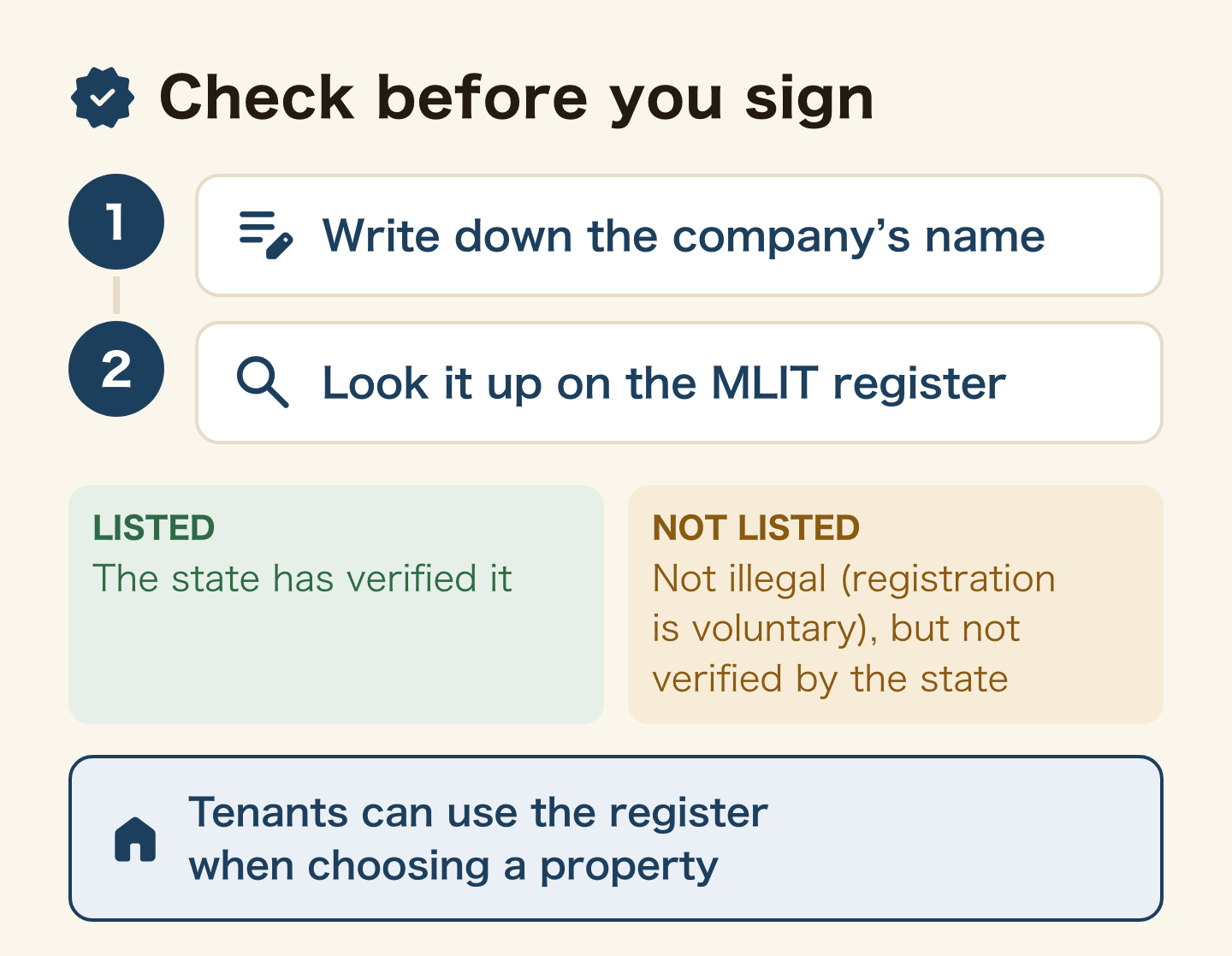
Japan’s Ministry of Land, Infrastructure, Transport and Tourism runs a registration scheme for rent guarantee companies and publishes the register of firms that meet its requirements.
One caveat worth knowing: registration is voluntary. A company can operate without it (Ministry of Land, Infrastructure, Transport and Tourism, rent guarantee company registration scheme (Japanese)), so an absence from the register does not mean anything illegal. It only tells you whether the state has verified that firm (MLIT, list of registered rent guarantee companies (Japanese)). Write down the name you are given and look it up before you sign.
Skip the guarantor question entirely: CrossHouse
Share houses and furnished flats, mainly around Tokyo. Their own FAQ answers it directly: “Is a guarantor required? No, a guarantor is not required.” (checked 21 August 2026)
- No guarantor, no deposit, no key money, no agency fee – and no guarantor company fee on top
- Support is offered in eight languages including Nepali and Sinhala, and the site itself switches to Nepali, Vietnamese and others
- Contracts are signed online, and stays start from one month
- Honestly: the advertised “30,000 yen to move in” is not the full amount – your first month’s rent comes on top. Bathroom and kitchen are shared, so this is wrong for anyone who needs privacy and quiet
Costs and conditions were checked on official company sites on 21 August 2026. Always confirm the full amount before signing. Official sources: Ministry of Land, Infrastructure, Transport and Tourism, rent guarantee company registration scheme (Japanese) / MLIT, list of registered rent guarantee companies (Japanese) / UR – application requirements / UR, why UR: no key money, agency fee, renewal fee or guarantor (Japanese) / Immigration Services Agency, permission for part-time work on a Student status (Japanese) / MLIT, housing guidebook for foreign residents (Japanese) / MLIT, Q&A on the rent guarantee registration scheme (Japanese) (checked 26 September 2026)
Frequently asked questions
Q. Can I rent in Japan without a guarantor?
Yes. Japanese tenants mostly skip the personal guarantor now and pay a guarantor company instead, and some properties never ask for either. Not having a guarantor is not a reason you cannot rent.
Q. Which guarantor company should I choose?
You do not choose. In practice the estate agent picks from the firms their office works with, and the landlord has the final say. Compare properties, not companies.
Q. The guarantor company approved me but I was still refused. Why?
There are up to three screenings, and the guarantor company is only the first. After it come the management company and the landlord’s approval, and that last decision is a human one – landlords sometimes cite trouble with a foreign tenant years ago. Nothing was wrong with your income or documents, so move to another flat or another agency rather than looking for something to fix.
Q. One agency turned me down. Is that flat gone?
Not necessarily. Ask a second agency about the same flat. Partner guarantor firms differ from office to office, so a place that needed “a guarantor and a company” at the first agency can need only the company at the next.
Q. How much does a guarantor company cost?
The ministry’s guidebook says the most common arrangement is about 30 to 60 percent of one month’s rent, paid up front for two years. It is added on top of the deposit, key money and agency fee, so ask for the full move-in total early.
Q. Is the guarantor on my visa the same as the one on my lease?
No. The visa version vouches for your conduct and support; the lease version takes on liability for your rent. They are separate documents and one does not substitute for the other.
Q. Do I still need an emergency contact if I use a guarantor company?
Yes, separately. An emergency contact has no financial duty – they only need to be reachable. A teacher, someone at work, or a friend in Japan is fine. Arrange this before you start viewing.
Q. Can students apply for UR housing?
Sometimes. The usual test is a monthly income of four times the rent – 240,000 yen for a 60,000 yen flat – which 28 hours a week cannot produce. But students aged 18 or over at a university, college of technology or specialised training school can apply if the relative who supports them has enough income or savings and promises to share responsibility for the rent.
In short
- Visa guarantor and lease guarantor are different things sharing one English word
- A guarantor company replaces the person for a fee – the agent picks it, so a different agency can mean different terms
- Up to three screenings; the one that stops foreigners is the landlord’s – not your paperwork
- Three routes: guarantor company, guarantor-free property, or UR
- UR needs four times the rent in monthly income – students can apply through a parent who meets the standard
- An emergency contact is required either way. Ask someone before you start looking
Related guides
Found this useful? Share it
Send it to a friend who lives in Japan.
One company holds a lot of rooms that need neither a guarantor nor a guarantee company.
Share House in Japan →WHO WROTE THIS

mori
Japanese. I read the ministries’ own notices, orders and Q&As in the original, and I start from what my Nepalese and Sri Lankan friends in Japan actually ran into. I do not write about what I have not checked or been told.
What this site can and cannot do →Looking for something else?
You may use the figures in this article, including commercially, if you credit this site with a link. How to use our figures