Checked on 23 November 2026 against official sources: three Supreme Court rulings (27 November and 22 December 2006), the Consumer Contract Act, a MEXT notice (26 June 2025) with its survey results (December 2025), the national university fee ordinance, a Tohoku University notice, and the 2027 admission guides of the University of Human Environments and 21st Century Academia. Deadlines and refund rules differ by school, so always check your own school’s guide.
The short answer
- Enrollment (nyugaku tetsuzuki) means paying the school and sending papers to secure your place. Miss the deadline and you are treated as withdrawn.
- The entrance fee (nyugakukin) usually does not come back. The Supreme Court said it buys your right to enter.
- Tuition and other fees usually come back if you withdraw by 31 March. On or after 1 April, first-year fees usually stay with the school.
- If you promised to enrol (single-choice or recommended entry), you may not get tuition back even before 31 March.
- One thing to do today: put every school’s payment deadline and withdrawal deadline on one calendar.
Knowing this, you can see how much you will pay each school, and how much you can get back. You will not pay in a panic the night before, or lose your place by forgetting.
It is a December evening at your language school. A message arrives: you passed. Right under it you read, “Enrollment deadline: 9 December.” Your first-choice university holds its exam in February. You ask a Japanese friend, “If I pay now and quit later, do I get the money back?” Your friend says, “My parents did all that. I have no idea.”
- What is enrollment at a Japanese school? Paying to secure your place
- Do you get the enrollment fee back in Japan? Not the entrance fee; tuition by 31 March
- Do some universities refund the entrance fee? A few, since 2025
- Applying to several schools? You pay the earliest deadline first
- How do you withdraw by 31 March? Send the form, keep proof
- How much are university fees in Japan? National: 282,000 yen entrance fee as standard
- What if you miss the enrollment deadline? You can lose your place
- Can’t pay or running late? Contact the school before the deadline
- After enrolling: what about your visa? Extend, then notify within 14 days
- Which one are you?
- FAQ
- Q. Do I get the entrance fee back if I withdraw?
- Q. Until when can I withdraw and get tuition back?
- Q. I passed through single-choice or recommended entry. Do I get tuition back?
- Q. If I skip the entrance ceremony, have I withdrawn?
- Q. What happens if I miss the enrollment deadline?
- Q. Does the 31 March rule apply to vocational schools?
- Summary
- Read next
What is enrollment at a Japanese school? Paying to secure your place
Enrollment means you pay the school, send papers, and secure your right to enter. Passing the exam alone does not make you a student yet.
If you do not finish by the deadline, you are treated as withdrawn. The University of Human Environments says this in its 2027 admission guide for international students. So does the 2027 international student guide of 21st Century Academia, a group of vocational schools.
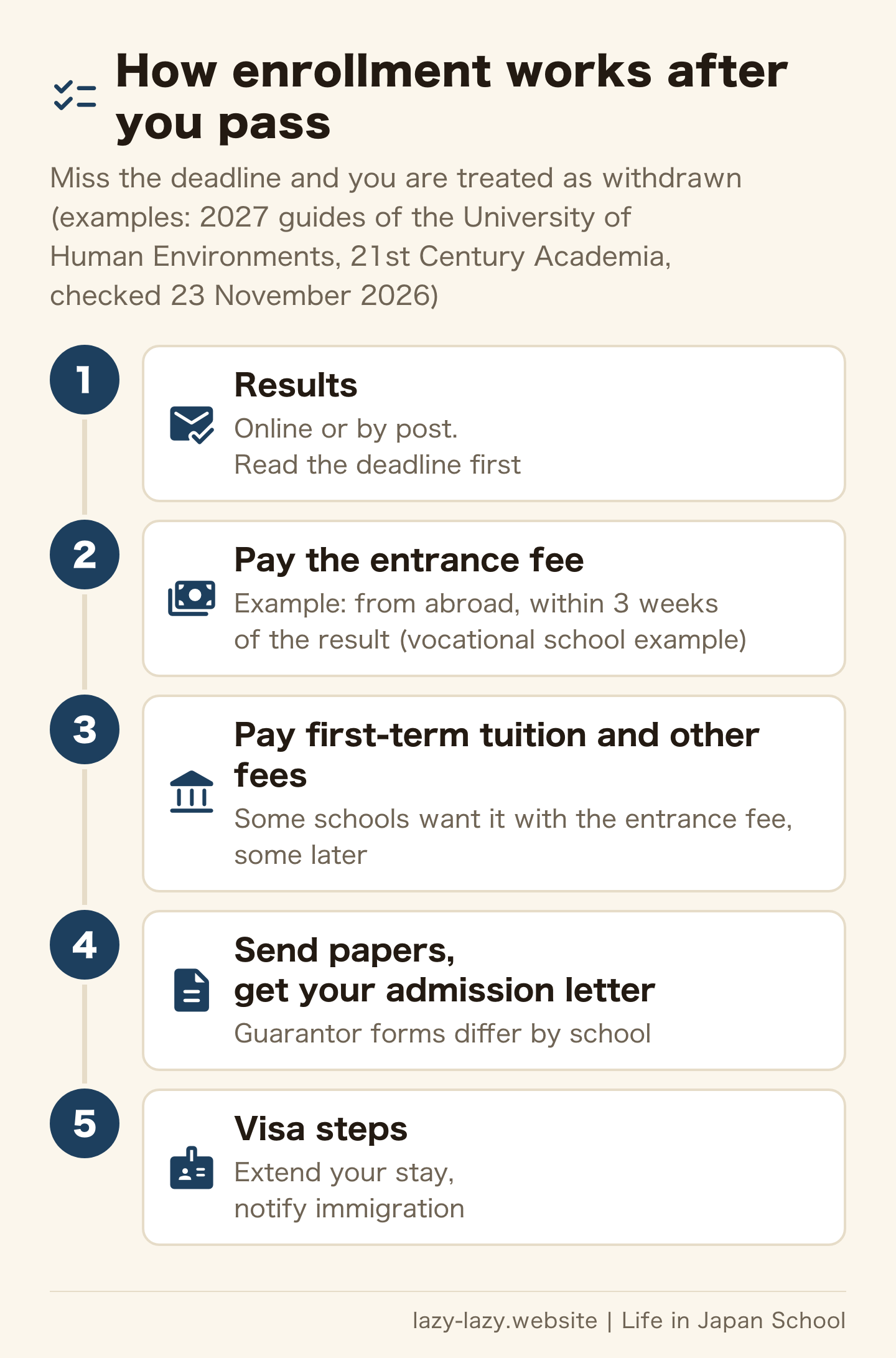
The order and timing of payments differ by school. 21st Century Academia tells applicants from abroad to pay the entrance fee within 3 weeks of the result. Tuition comes later, by a set date. The University of Human Environments wants the entrance fee and first-term fees together, by the deadline.
If you are still choosing a school, first read the 4 roads after Japanese language school.
Do you get the enrollment fee back in Japan? Not the entrance fee; tuition by 31 March
Once your first choice says yes, you tell the other school, “I won’t come.” You expect your money back. Where you come from, that may be normal. In Japan, the entrance fee usually stays with the school.
On 27 November 2006, the Supreme Court ruled on this. It said the entrance fee is the price of “the right to enter.” You bought that right. So the school does not have to return the fee. The exception is a fee that is unreasonably high.
Tuition and other fees are different. The same ruling treated your contract with the school as a consumer contract. If you withdraw by 31 March, a rule that “paid tuition is not returned” is, as a rule, void. The basis is Article 9 of the Consumer Contract Act. A cancellation charge above the business’s average loss is void.
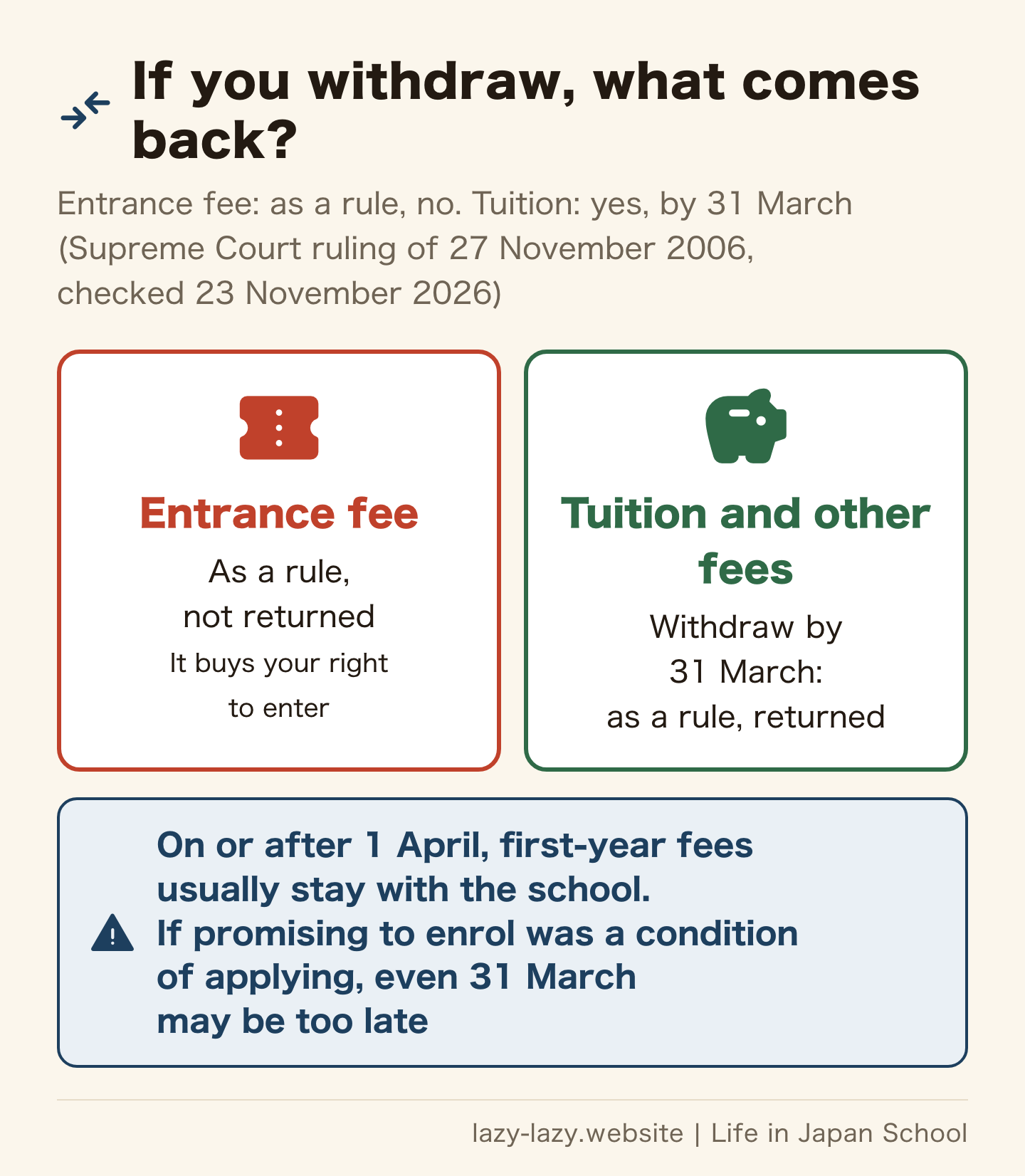
Why 31 March? The Japanese school year starts on 1 April. The court gave two reasons. National and public universities announce their last results by about 24 March. Private universities announce most waiting-list places by late March. Until then, a school can still fill your seat.
If you withdraw on or after 1 April, first-year tuition usually stays with the school.
There is an exception: entry where you promised to enrol. This means single-choice (sengan), first-choice, or recommended entry where promising to enrol is a condition of applying. For these, the court said a no-refund rule for first-year fees is usually valid. If you entered through such a recommendation, you may not get tuition back even before 31 March.
What about vocational schools? On 22 December 2006, the court ruled on a school for acupuncture. A student withdrew around 27 March. The court said the no-refund rule was fully void under the Consumer Contract Act. The 21st Century Academia guide, shared by its schools, also returns all but the application fee and entrance fee by 31 March.
Do some universities refund the entrance fee? A few, since 2025
Paying entrance fees to schools you never attend is a known burden. It came up in the Diet. On 26 June 2025, MEXT sent a notice to private universities. It asked them to “try to” lighten this burden. It is not a duty.
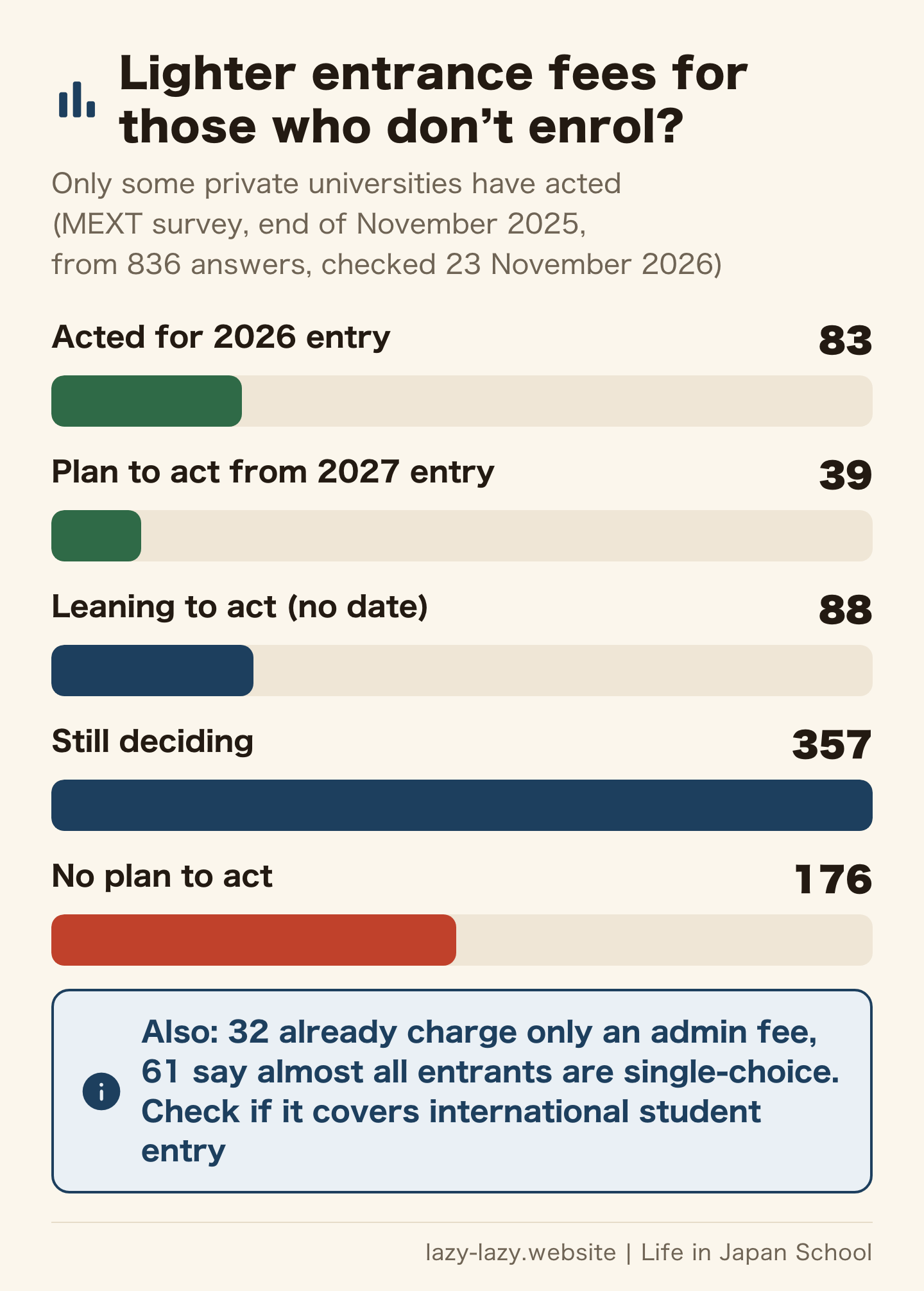
MEXT then published survey results. It covered 836 private universities and junior colleges, at the end of November 2025. 83 schools acted for 2026 entry. 357 were still deciding. 176 had no plan to act.
The 83 schools acted in different ways. 25 return all or part of the entrance fee, depending on when you withdraw. 39 moved the payment deadline later. One example: withdraw by 31 March and get the entrance fee back, minus a 5,000 yen admin fee and the bank fee.
Each school decides which entry routes this covers. Check this year’s guide to see if international student entry is included.
Applying to several schools? You pay the earliest deadline first
Applying to two or more schools at once is called heigan. The trouble starts when results and deadlines come in a different order.
Take the University of Human Environments, 2027 international student entry. Round I results come on 1 December. The deadline is 9 December. You pay 665,000 yen, of which 200,000 yen is the entrance fee. If you wait for results in February or March, you pay this first.
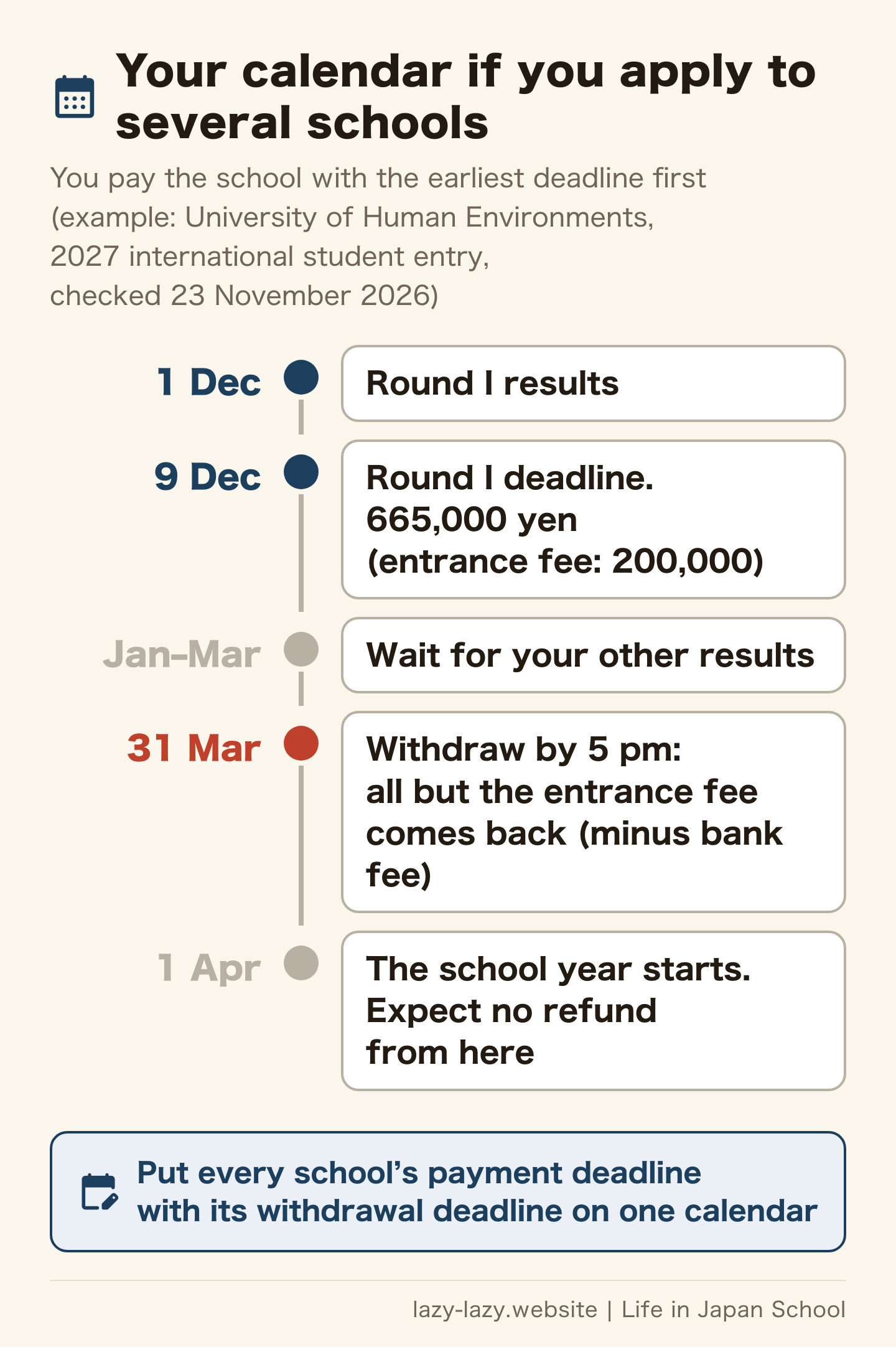
Under this guide, you can withdraw by 5 pm Japan time on 31 March 2027. You then get back everything except the entrance fee. You pay the bank transfer fee. So even if your first choice says yes, plan to lose the 200,000 yen.
Some vocational schools limit heigan itself. At 21st Century Academia, only general entry allows it, and only with graduate schools, universities or junior colleges. You cannot combine it with another vocational school. Fees differ too. At Tokyo Designer Academy, one school in the group, the year-1 first-term total (including the entrance fee) is 872,000 yen for single-choice. It is 922,000 yen for heigan.
Before you apply to several schools, copy these four things from each guide.
- The result date and the payment deadline
- How much you pay, and how much of that is the entrance fee
- The withdrawal deadline (day and time), and what comes back
- Whether the entry allows other applications, or is single-choice
How do you withdraw by 31 March? Send the form, keep proof
A court case shows one trap. You may think skipping the entrance ceremony counts as withdrawing, so you send nothing. In another ruling of 27 November 2006, school staff told a student just that. The student did not notify by 31 March and skipped the 2 April ceremony. Special facts saved this student, but only after going to court.
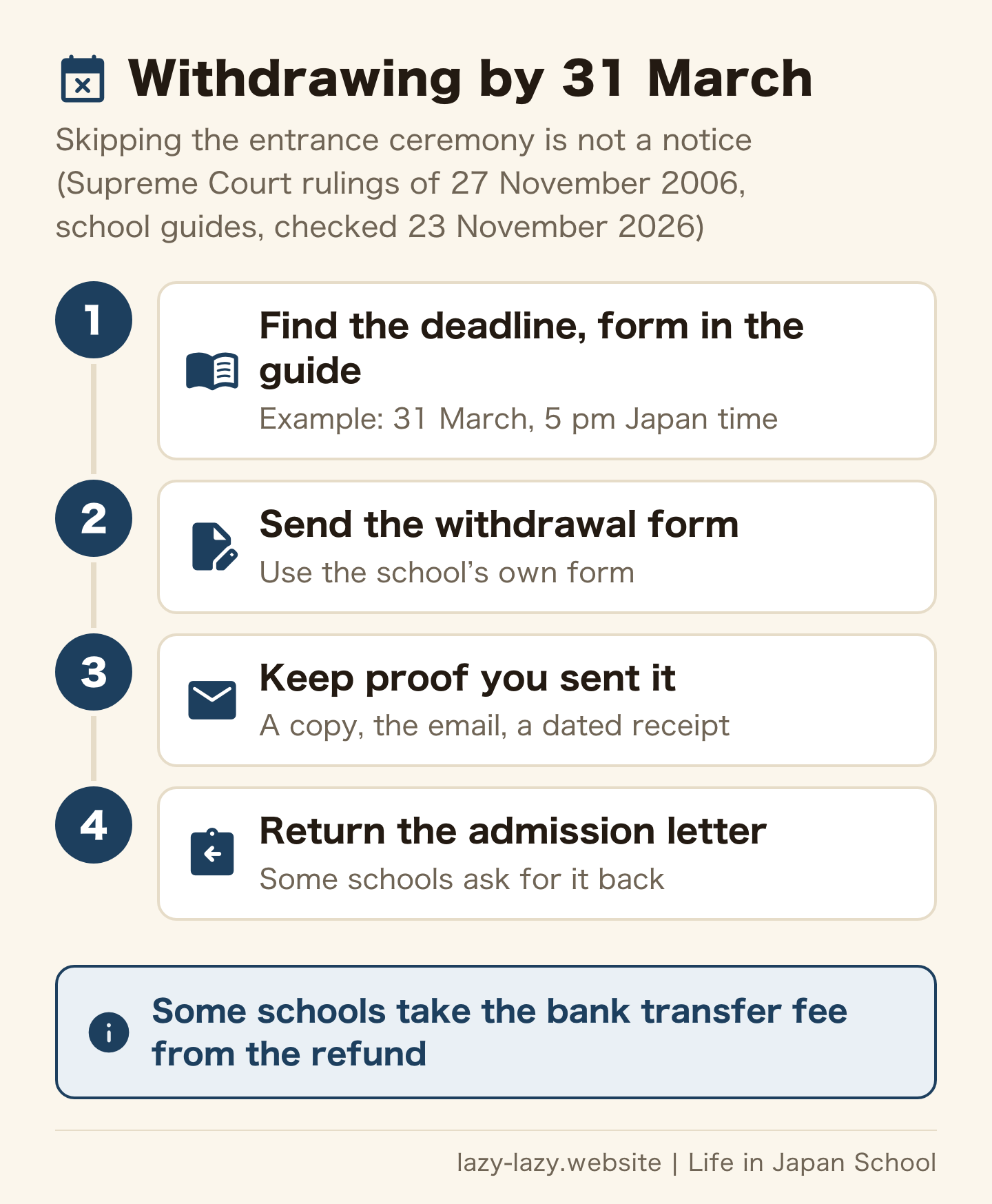
Do it in four steps.
- Find the withdrawal deadline, the time and the form in the guide. At the University of Human Environments, it is 5 pm Japan time on 31 March.
- Send the withdrawal form (nyugaku jitai todoke) the school asks for.
- Keep dated proof: a copy, the email you sent, or a post office receipt.
- Return the admission letter if asked. 21st Century Academia asks for it with the form.
The Supreme Court said a clear spoken notice is usually valid too. That holds even if the school asks for it in writing. Still, the school’s form plus your own record is the safest path. It avoids any “you never told us” argument.
How much are university fees in Japan? National: 282,000 yen entrance fee as standard
For national universities, the national university fee ordinance sets a standard entrance fee of 282,000 yen. Standard tuition is 535,800 yen a year. But Article 11 lets national universities set different fees for international students on a Student visa.
Tohoku University, for example, raises undergraduate tuition for international students to 900,000 yen a year. This starts with students entering in April 2027. A national university is not always the standard price.
| School example (entering 2027) | Entrance fee | First-term total (incl. entrance fee) | Withdraw by 31 March |
|---|---|---|---|
| National university (standard in the ordinance) | 282,000 yen | Varies by school | Varies by school |
| University of Human Environments, international student entry | 200,000 yen | 665,000 yen (paid at enrollment) | All but the entrance fee comes back |
| Tokyo Designer Academy (one school of 21st Century Academia; general entry, heigan, year 1) | 170,000 yen | 922,000 yen | All but the application fee and entrance fee comes back |
You need a large sum in a short time. If your family sends money from abroad, count the transfer days back from the deadline.
What if you miss the enrollment deadline? You can lose your place
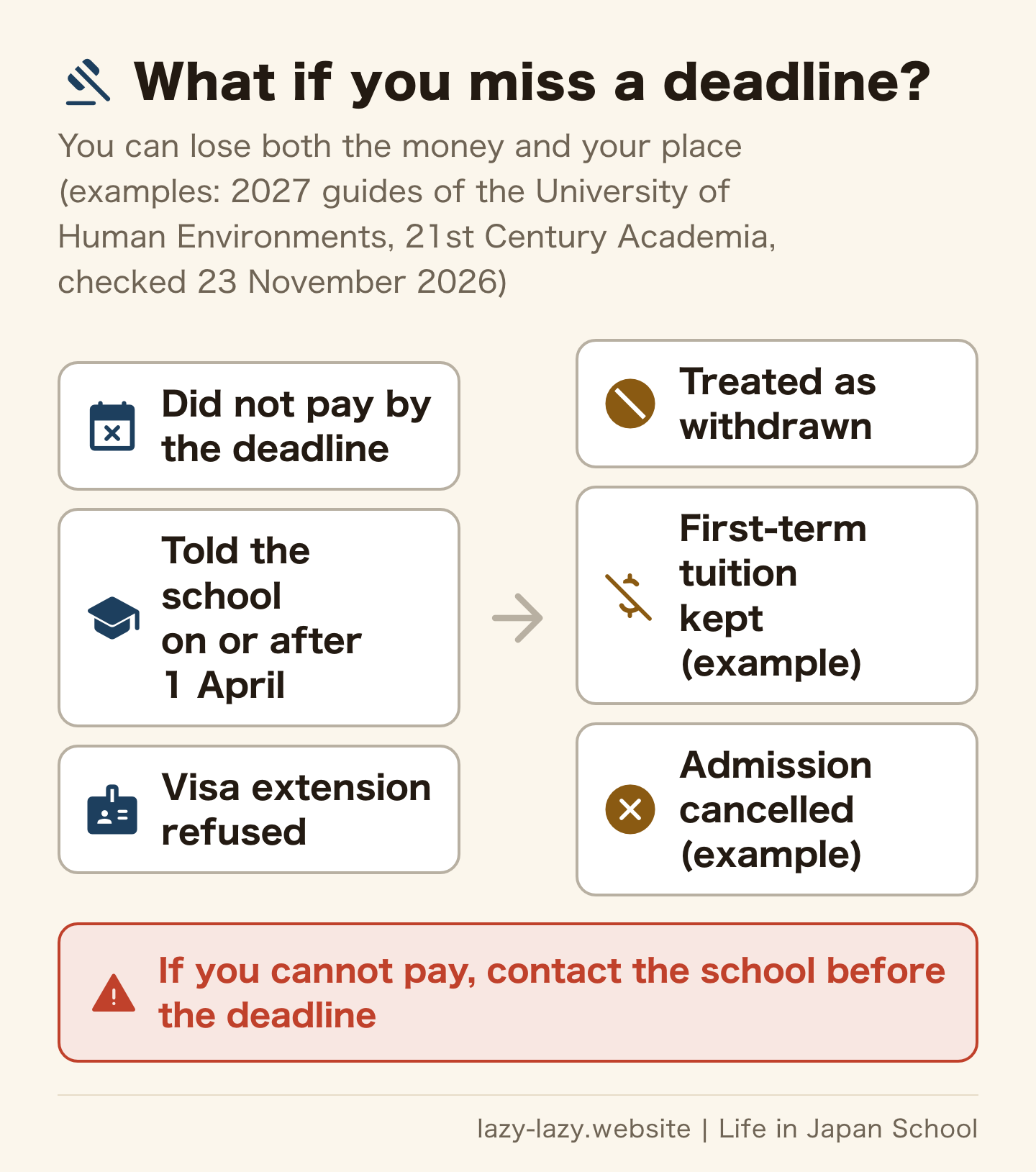
If you do not pay by the deadline, you are treated as withdrawn. The 21st Century Academia guide adds that your application papers become void. Think of your pass as gone once the deadline passes.
Telling the school on or after 1 April also costs you. In the same guide, if you leave on or after 1 April, first-term tuition is not returned.
Your visa matters too. The same guide says admission is cancelled if immigration refuses your visa extension. It also warns that your language school attendance is checked at that review, even after you pass.
Can’t pay or running late? Contact the school before the deadline
If you cannot pay, contact the school’s admissions or fees office before the deadline. MEXT has asked private universities to try to offer fee cuts, instalments and later payment for students in need. The 2025 notice repeats this. Each school decides, so you only find out by asking.
If you hope for a tuition exemption at a national university, mind the order. Some universities will not accept an application once you have paid. See tuition fee exemption in Japan for the timing first.
For money you do not pay back, scholarships for international students have their own deadlines and conditions.
If you withdrew by 31 March and the school refuses to return tuition, call the consumer hotline, 188. It connects you to a local consumer center. Advice is free, but you pay for the call.
After enrolling: what about your visa? Extend, then notify within 14 days
Moving on from language school, you may need to extend your stay. You use your admission letter and your current school’s graduation certificate. The papers are in student visa extension in Japan.
When you change schools, you must notify immigration yourself within 14 days. See the notification to immigration for how.
Which one are you?
- You are still applying and do not know the deadlines — today, open every school’s guide and put both deadlines on your calendar.
- You passed, and the deadline comes before your first-choice result — today, write down the entrance fee part and decide if you can lose it.
- You already paid, then chose another school — today, find the withdrawal form and plan to send it well before 31 March.
- You may not be able to pay by the deadline — today, call or email the school and ask about instalments or later payment.
FAQ
Q. Do I get the entrance fee back if I withdraw?
A. Usually not. In 2006 the Supreme Court said the entrance fee buys your right to enter, so the school does not have to return it. A few private universities now return it, depending on when you withdraw. Check the guide.
Q. Until when can I withdraw and get tuition back?
A. Withdraw by 31 March, and tuition with other fees usually comes back. On or after 1 April, first-year fees usually stay with the school. Some schools also set a time, such as 5 pm.
Q. I passed through single-choice or recommended entry. Do I get tuition back?
A. Maybe not. The Supreme Court said a no-refund rule for first-year fees is usually valid when you promised to enrol.
Q. If I skip the entrance ceremony, have I withdrawn?
A. Do not rely on that. Send the school’s withdrawal form by 31 March and keep proof that you sent it.
Q. What happens if I miss the enrollment deadline?
A. In both guides we checked, you are treated as withdrawn. Once you know you cannot pay, contact the school before the deadline.
Q. Does the 31 March rule apply to vocational schools?
A. In a 2006 case about a school for acupuncture, the Supreme Court also voided a no-refund rule for a late-March withdrawal. The vocational school guide we checked also refunds all but the application and entrance fees by 31 March. Check your own school’s guide.
Summary
Enrollment means paying the school you passed and securing your place. Miss the deadline and you are treated as withdrawn. The entrance fee usually does not come back. Tuition and other fees usually come back if you withdraw by 31 March.
If you apply to several schools, put each school’s payment deadline and withdrawal deadline on one calendar today. Know what you cannot get back before you pay. Withdraw in a way that leaves a record. That way you are far less likely to lose money you paid.
Sources (official): Supreme Court ruling of 27 November 2006, case 2005 (Ju) 1158 | ruling of the same day, case 2006 (Ju) 1130 | ruling of 22 December 2006, case 2005 (Ju) 1762 | Consumer Contract Act (e-Gov) | MEXT notice on lighter entrance fees at private universities (26 June 2025) | MEXT survey on entrance fees paid to schools students do not attend (December 2025) | National university fee ordinance (e-Gov) | Tohoku University: international student tuition from April 2027 | University of Human Environments, 2027 international student admission guide | 21st Century Academia, 2027 international student guide | Consumer Affairs Agency: consumer hotline (all checked 23 November 2026). The schools are examples of how rules look, not national rules. All sources are in Japanese.
Read next
WHO WROTE THIS

mori
Japanese. I read the ministries’ own notices, orders and Q&As in the original, and I start from what my Nepalese and Sri Lankan friends in Japan actually ran into. I do not write about what I have not checked or been told.
What this site can and cannot do →Looking for something else?
You may use the figures in this article, including commercially, if you credit this site with a link. How to use our figures