Last updated: August 2026
Summary
- Social media and a blog do different jobs. Social arrives fast. A blog gets found later, by search. Doing only one leaves half the value on the table.
- You do not need to monetise. Early on you are better off not doing it — the moment money appears, your residence status becomes part of the question.
- The real return is becoming someone with something to show. In Japan, 42% of mid-career recruiters check an applicant’s social media (Nikkei, July 2026).
- Which is exactly why negative posting is the most expensive thing you can do. Complaints about your employer or about Japan are seen. Deleting them does not delete what people remember.
- Don’t post the complaint. Post how you solved it. That one change turns the same event into an asset.
Knowing this, you post for the 42% of recruiters who will look, not for money – and nothing you write costs you a job.
The blog guide said a blog is worth keeping even at zero income. The same is true here. What differs is what each one is good at.
A blog and social media do different jobs
A blog is stock. Social media is flow.
Nobody reads a blog post the day you publish it. But six months later someone searches and finds it. It gets stronger with time.
A social post lands the same day. And is gone in three. Fast, but it does not accumulate.
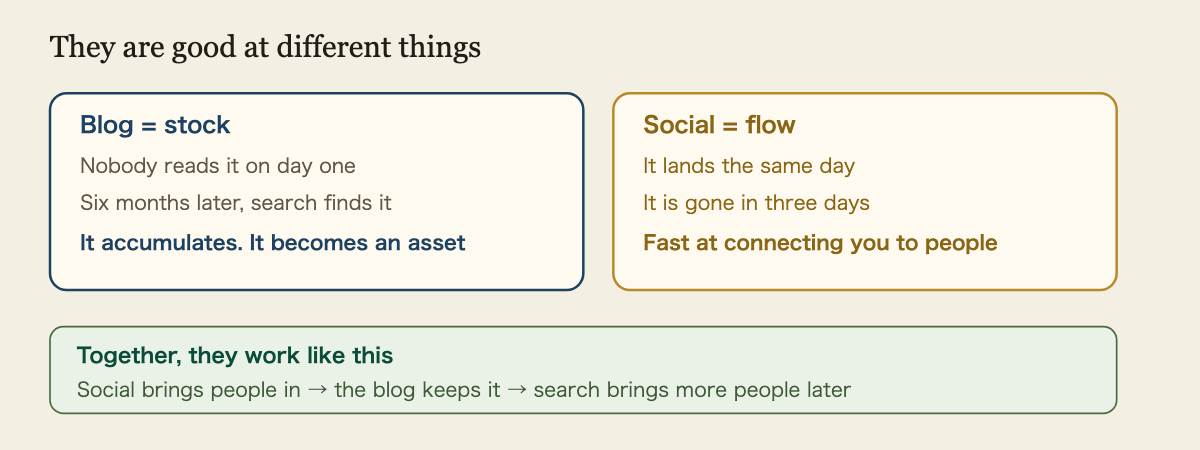
So it is not one or the other. Reach people on social; keep it on the blog. Read this together with starting a blog in Japan.
The returns arrive in order here too
Same as the blog. Judge it by the slowest return alone and you will quit before any of them arrive.
- Within days: you get better at short Japanese. Posts are short, so you can publish daily. This improves before long-form writing does
- Within months: you meet people. People in your field, people from your country, people with the same problem. This is the part a blog rarely does
- After a year or more, if at all: work or income. This one is last
The second return is the real prize. What someone newly arrived in Japan lacks most is not information and not Japanese. It is connections.
Where to post, and what
You do not need all of them. Different goals suit different places.
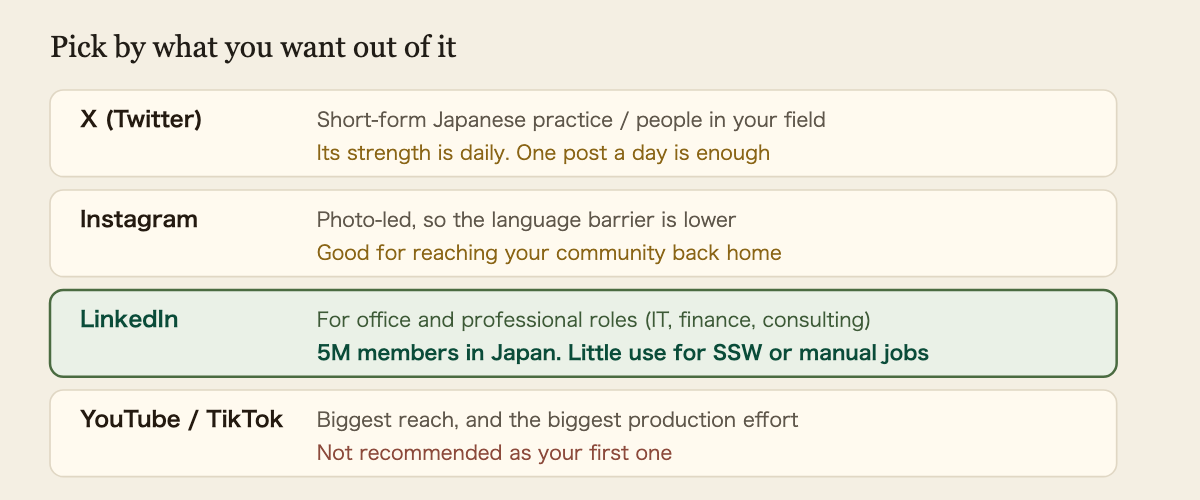
If you cannot decide, start with X. One post a day, in Japanese, about something you noticed in Japan. That alone builds keigo and everyday vocabulary. Posts are short, so mistakes cost you very little.
If you are aiming at office or professional work, set up LinkedIn. Japan passed 5 million members in 2026. It was written off as “never going to catch on here” a few years ago; today it is used for hiring in IT, finance and consulting, and the recruiters looking for people with language skills are on it. A profile showing your native language next to Japanese is, by itself, rare.
It is not universal, though. LinkedIn works for office and professional roles. If you are looking for Specified Skilled Worker jobs, or work in manufacturing, care or food service, you will find almost nothing there — job sites and Hello Work are faster. Working in Japan without a degree sets out which route leads where.
Negative posting is the most expensive thing you can do
This is the most important section in this guide.
42% of mid-career recruiters in Japan check an applicant’s social media (Nikkei, July 2026). The share of companies using social media in hiring has grown from 9.8% for 2021 graduates to 21.2% for 2025 graduates. Assuming nobody is looking no longer holds.
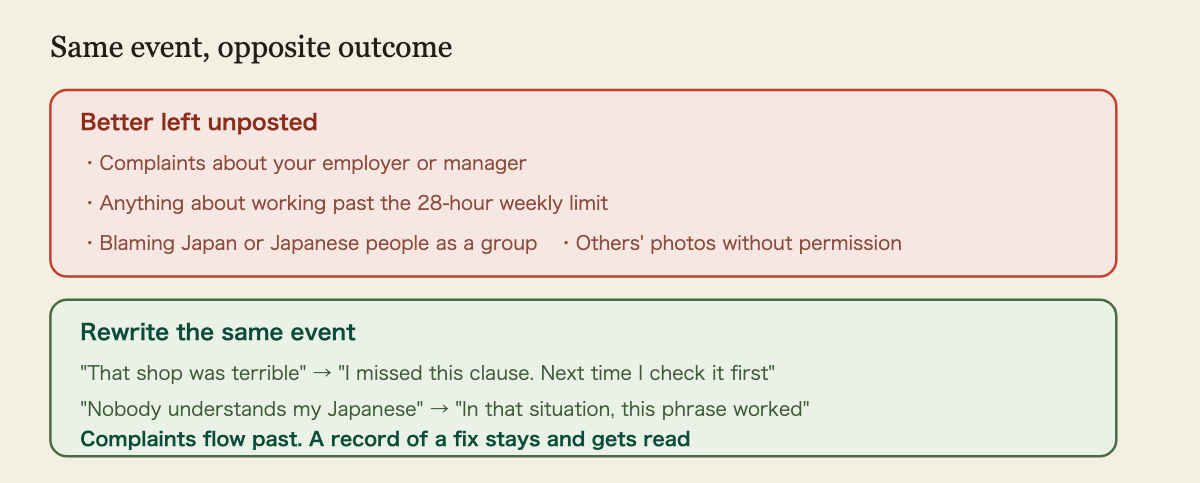
Complaining is not wrong in itself. When things are hard, of course you want to. But a complaint helps nobody, so nobody saves it. It is gone in three days and only your reputation stays behind.
Write the same event as “how I solved it” and it inverts. People save it, and later arrivals find it. If it tripped you up, it will trip somebody else up too.
One more: never post about working past the 28-hour weekly limit. Even as a joke, it is a record. The rules are in the part-time work guide.
You do not need to monetise
Early on you are better off not doing it. Two reasons.
One: the thresholds are far away. YouTube ad revenue needs 1,000 subscribers plus 4,000 hours of watch time in the past 12 months (or 10 million Shorts views in 90 days). Some fan-funding features open up from 500 subscribers, but none of it is a few months away. Aim at that and you burn out before you arrive.
Two: the moment money appears, your residence status is part of the question. Posting is free for anyone. But “earning” changes it into a question of whether the activity falls within what your status permits. For students that means permission for activities outside your status; on a work visa it is about the relationship to your permitted work.
Here is the part people miss. Posting in your own language, for people back home, does not change this. The income was still earned while you live in Japan. Before you monetise anything, read how much you can earn on your visa. If you are unsure, ask an immigration lawyer (行政書士).
Posting without monetising carries none of this. Which is why the first year is easiest if you simply ignore the numbers and write.
The minimum that keeps you going
Three rules:
- One post a day. Length does not matter. One line about something you noticed is fine
- Nothing that reveals your legal name or address. You do not need to show your face either. It is the content people judge
- Look at your numbers once a month. Daily checking is how people quit on a flat week
All of this works from a phone. If you expand into a blog, that is when a laptop starts to pay for itself.
FAQ
Q. Should I post in Japanese or in my own language?
A. It depends on the goal. Japanese, if you want language practice and work in Japan. Your own language, if you want to reach people back home. Both is strongest, but if that means you stop, pick one.
Q. I’m getting no followers. Should I stop?
A. The first few months are flat. That is normal. The second return of social media is not follower count, it is connections. Ten people who know your name can be worth more than a thousand followers.
Q. Is it illegal for a student to earn from social media?
A. Posting itself is free. Earning brings in permission for activities outside your status and the 28-hour weekly limit. A small amount is treated the same way. Check what your visa allows before you start.
Q. Should I delete my old negative posts?
A. Yes, delete them. But deleting does not remove what people remember, or their screenshots. What you do not post from now on matters far more.
Q. Who does LinkedIn actually help?
A. People aiming at office or professional roles. It is used for hiring in IT, finance and consulting. It is barely used for Specified Skilled Worker roles or jobs in manufacturing, care and food service. Judge it by the kind of work you are aiming at.
Q. I hear a lot of people abroad make money from social media. Is that true?
A. Globally it is a much bigger market than in Japan. But which monetisation programmes you can use differs by country, and while you live in Japan your income is handled under Japanese rules. Do not transfer “people abroad make money at this” directly onto yourself.
Official source: Consumer Affairs Agency: rules on disclosing advertising (stealth marketing)
In short
Social media and a blog do different jobs. Social arrives fast; a blog gets found later. Social brings people in, the blog keeps it. That is the clean version.
The returns arrive in order: Japanese within days, connections within months, income after a year or more if at all. Connections are the real prize.
And negative posting is the most expensive thing you can do. 42% of mid-career recruiters check applicants’ social media. Complaints are gone in three days; your reputation is not.
Don’t post the complaint. Post how you solved it. That alone turns the same event into an asset.
You do not need to monetise. Not doing it is lighter, and it keeps your residence status out of it. Start with one post a day.
Related guides
Found this useful? Share it
Send it to a friend who lives in Japan.
You also need a place that does not scroll away. A blog is what search finds later.
Start a Blog in Japan →READ THIS NEXT
Start a Blog in Japan →Japanese practice arrives in weeks, a portfolio in months, income maybe never.WHO WROTE THIS

mori
Japanese. I read the ministries’ own notices, orders and Q&As in the original, and I start from what my Nepalese and Sri Lankan friends in Japan actually ran into. I do not write about what I have not checked or been told.
What this site can and cannot do →Looking for something else?