Last updated: August 2026 (based on the National Tax Agency Q&A, June 2025 revision) / This article contains affiliate links.
Figures, prices and terms were checked against the National Tax Agency’s Q&A on overseas dependents and Taxanswer No.1180 on 5 August 2026. They change — check the current terms yourself before you sign up or file anything.
Summary
- If you send money home, you can claim those family members as dependents and pay less Japanese tax. ¥380,000 per person is deducted from your income — ¥630,000 in some cases.
- The rules tightened in January 2023. Relatives aged 30 to 69 are now excluded by default.
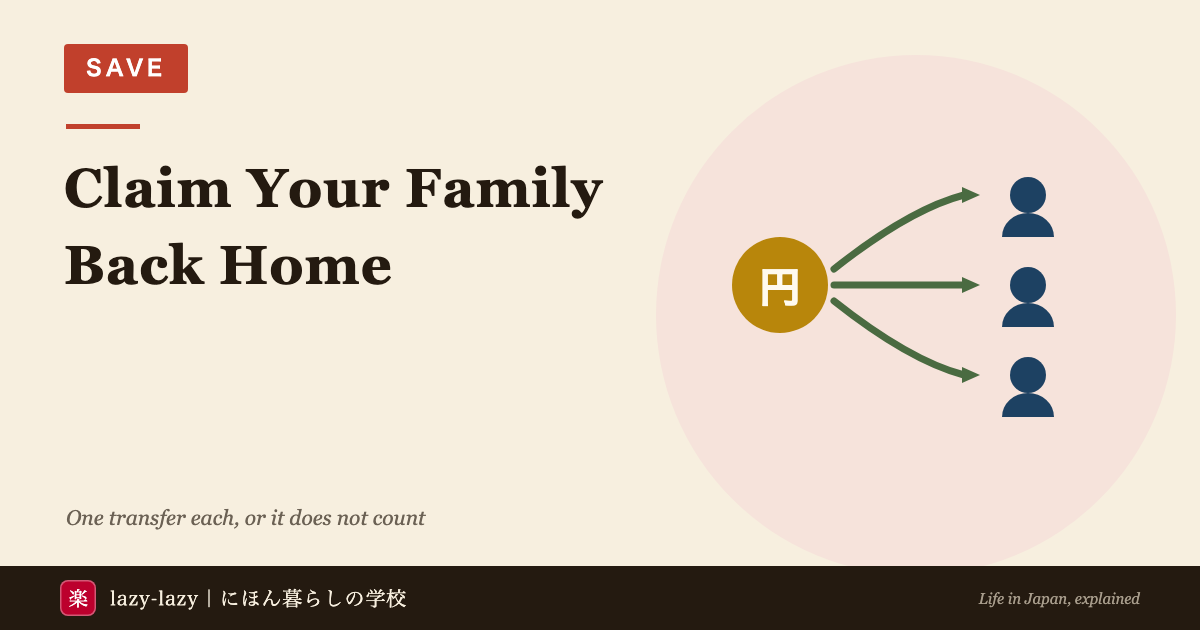
- The most common mistake is sending one lump sum to one person. If you do that, only that one person counts. You have to send separately to each family member.
- You need two things: proof of the family relationship and proof of the remittances. Documents in another language need a Japanese translation.
- Children under 16 do not qualify for the income tax deduction.
The dependent deduction (扶養控除 fuyō kōjo) reduces the income your Japanese tax is calculated on, when you are supporting family members. It works even when they live abroad.
A lot of people send money home every month and never claim this. They simply do not know it exists, and they pay tax they did not have to pay.
How much it is worth
Per family member, this much comes off your income:
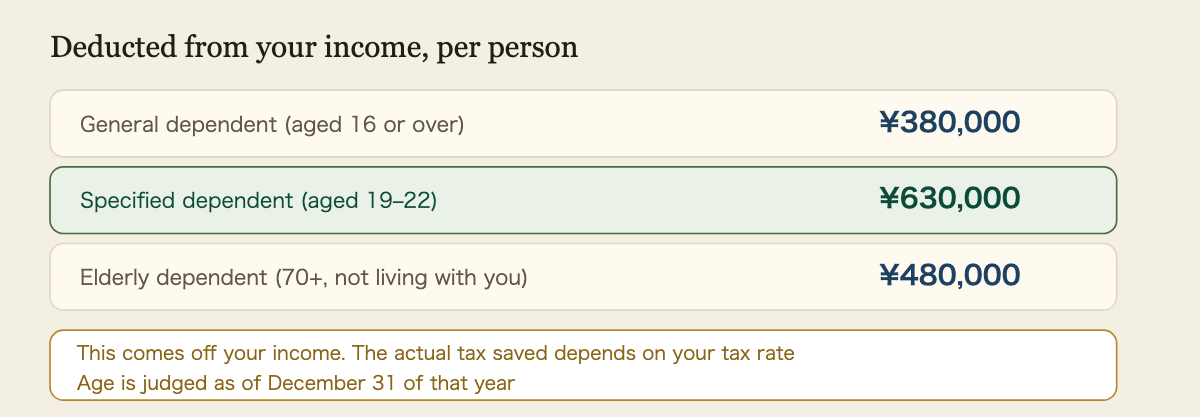
This does not mean your tax bill drops by ¥380,000. It means the amount your tax is calculated on drops by that much. See how income tax and resident tax work.
Still, your resident tax falls too, and with two or three family members the effect is not small.
Since January 2023, age decides it
People are still filing based on the old rules.
A relative living abroad now qualifies only if one of these applies:
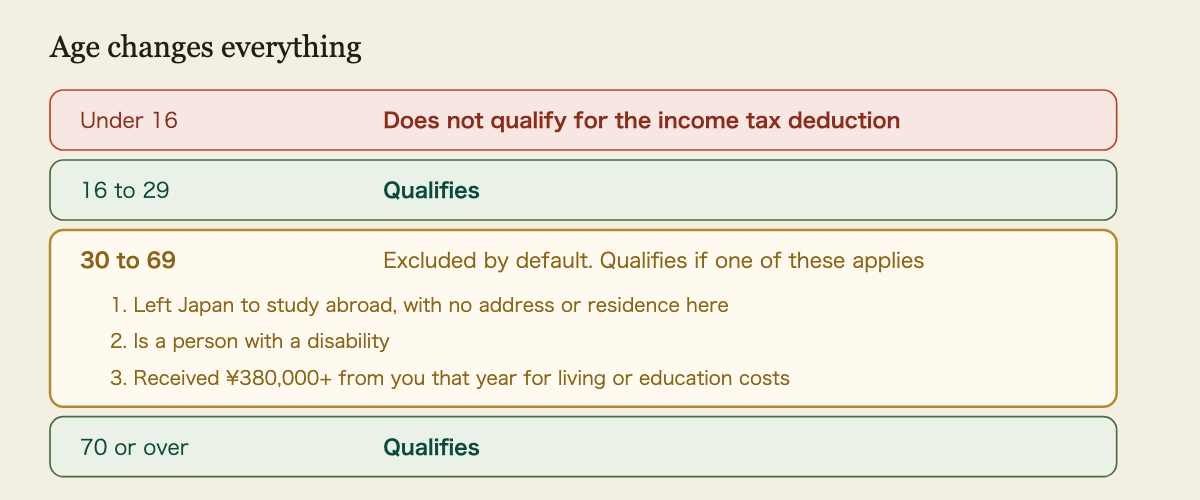
If you were claiming a brother or sister in their thirties or forties, that stops here. But option 3 keeps them in — send that person ¥380,000 or more during the year and they still qualify.
And a parent aged 70 or over qualifies with no extra condition. The deduction actually rises to ¥480,000.
The definition of “relative” is wide: blood relatives within six degrees, your spouse, and relatives by marriage within three degrees. Parents, children and siblings obviously — but also uncles, aunts, nephews and nieces.
The mistake that costs the most: one lump sum
This is where people lose the deduction without realising it.
Say you want to claim three family members. Transfer fees are expensive, so you send everything to your father in one go. Reasonable. Very common.
Only your father counts.
The National Tax Agency puts it plainly: the remittance documents must show that you made payments for living or education expenses “as needed, to each person.” A transfer to one representative is a remittance document for that representative only — not for anyone else.
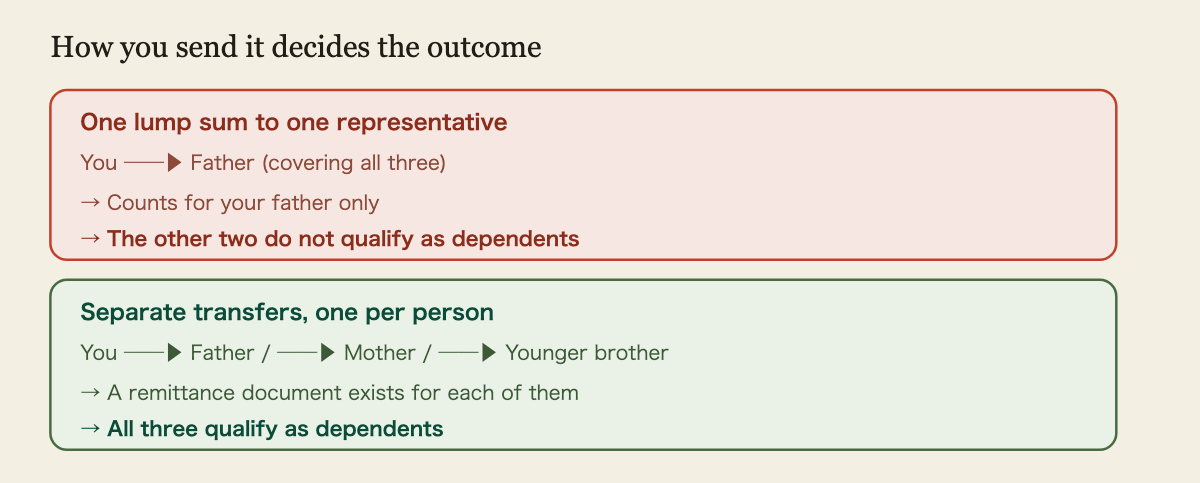
So split the transfers — one per person you want to claim. If your remittance service charges a lot per transfer, you will hesitate to do that. Cheap transfers are what make this deduction possible in practice.
Sending separately without losing money to fees
A bank counter transfer can cost several thousand yen each time, and splitting that across three people hurts. Wise is far cheaper and keeps a clear history of who received how much and when, which is exactly what you hand in at year-end. Full comparison in Sending money home from Japan.
You need exactly two kinds of document
Relationship documents and remittance documents. If you are an employee, you give them to your employer.
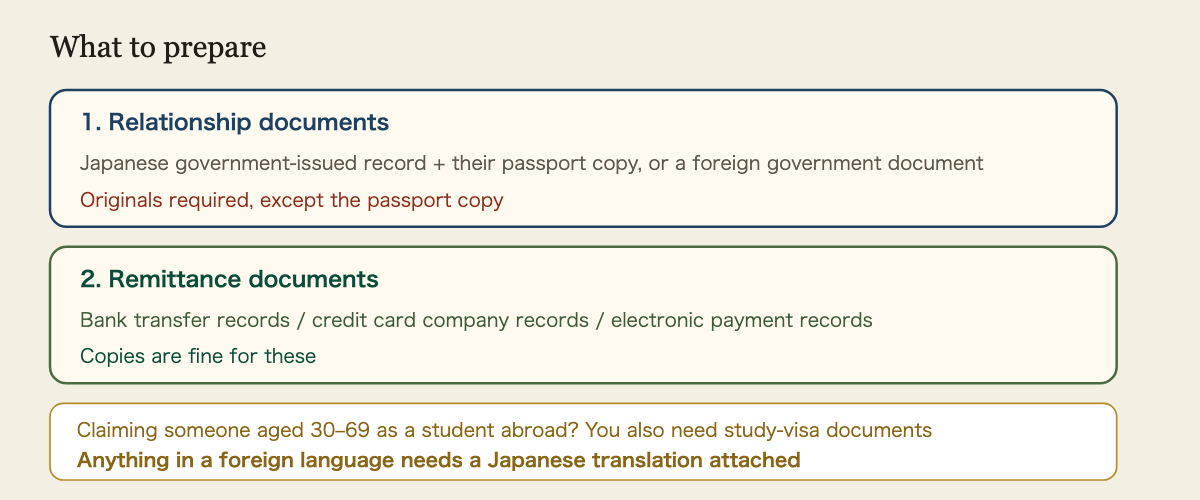
The translation is what people forget. Handing over a birth certificate from your home country as-is will not work. Attach a Japanese translation. You are allowed to translate it yourself.
If you are claiming someone aged 30 to 69 on the “¥380,000 or more” ground, what you need instead is a “¥380,000 remittance document” — records showing that that one person received at least ¥380,000 from you over the year. Again, per person.
When and where to submit
If you work for a company, you give everything to your employer, in two stages:
- When you submit the dependent declaration form (on joining, or at the start of the year) — relationship documents
- At year-end adjustment (around November–December) — remittance documents
Because the remittance records are handed in at the end of the year, you need a full year of them saved up. Realising this in January is too late. If you are sending money now, start keeping this year’s records today.
If you miss the year-end adjustment, or you file your own return, attach the documents to your tax return or present them when you file.
FAQ
Q. Is there a minimum amount I have to send?
A. Only for the “¥380,000 or more” route used for relatives aged 30 to 69. Otherwise no fixed threshold is set. But if the yearly total is very small, you will be asked what the money was for. You must genuinely be covering their living or education costs.
Q. Can I claim a child under 16?
A. Not for income tax. That is true for children living in Japan too. However, for resident tax, documents for under-16 dependents must be submitted to your city office in certain cases. Ask your municipality.
Q. What if my spouse is back home?
A. Then it is the spouse deduction, not the dependent deduction. The documents required are the same: relationship documents and remittance documents.
Q. How distant a relative can I claim?
A. Blood relatives within six degrees, your spouse, and in-laws within three degrees. Uncles, aunts, nephews and nieces are inside that range. But you must actually be supporting them.
Q. Can I claim for last year?
A. Possibly, by filing a tax return — if you met the conditions and still have the documents. You need the remittance records and relationship documents from that year. Without records it is difficult, so start by making sure this year is covered.
Q. I hand over cash when I visit. Does that count?
A. No. Only records from a financial institution, a credit card company, or an electronic payment provider are accepted. Cash handed over in person leaves no record, so no deduction.
In short
If you send money home, claim your family as dependents. ¥380,000 each, ¥630,000 for ages 19–22, ¥480,000 for 70 and over. Your resident tax falls as well.
Since January 2023, relatives aged 30 to 69 are excluded by default — but sending that person ¥380,000 or more during the year keeps them eligible.
And the costliest mistake is sending one lump sum to one person. That only counts for one. Send separately to each person you want to claim.
Two documents: proof of relationship, proof of transfer. Attach a Japanese translation if they are in another language. The transfer records are handed in at year-end, so start saving them today. January is too late.