Checked on 30 September 2026 against official pages from the Ministry of Health, Labour and Welfare (MHLW), Tokyo Metropolitan Government, Osaka City, the Fire and Disaster Management Agency, the National Police Agency, Yorisoi Hotline, TELL, and the University of Tokyo, University of Tsukuba and Osaka Metropolitan University. This is not medical advice.
The short answer
- To talk in your own language, call Yorisoi Hotline on 0120-279-338 and press 2. Every day 10:00 to 22:00, in 10 languages including English, Chinese, Vietnamese and Nepali. The call is free. In English, there is also TELL (0800-300-8355).
- If you can talk in Japanese, #Inochi SOS (0120-061-338) is open 24 hours. Public health centres also take mental health questions, free and in confidence.
- Psychiatric and psychosomatic clinics take Japanese health insurance, so you pay 30% at the counter. Most work by appointment, so call first.
- Jiritsu shien iryo (psychiatric outpatient support) cuts that share to 10%, with a monthly cap, for people who need ongoing outpatient treatment. You apply at your city office.
- If someone is unconscious or badly bleeding, do not call a helpline. Call 119. An interpreter can join the call.
Knowing this, you can make the first call the same day things get hard, in your language or in Japanese. And if you decide to see a doctor, you will know what you pay and how to bring it down to 10%.
You lie awake most nights. In the morning, getting to class or work feels impossible. You do not want to worry your family, and explaining feelings in Japanese feels out of reach. Ask a Japanese friend where people go with this and the answer is usually “a hospital, maybe?” Which department? Is there a helpline in English, or in Nepali? What does it cost? Few people know. The help exists. Each service just has its own languages and its own hours.
- Is there a mental health hotline in Japan in English or my language? Yorisoi Hotline, press 2
- Where can I get help if I speak Japanese? 24-hour lines and health centres
- Can international students get counselling? Start with your school
- Psychiatrist or psychosomatic clinic? Five steps to a first visit
- Does Japanese health insurance cover therapy? What does it cost?
- What is jiritsu shien iryo, and can foreigners use it?
- How do I apply for jiritsu shien iryo? Documents and yearly renewal
- What if it cannot wait? Call 119 or 110, with an interpreter
- Will what I say stay confidential?
- What if I cannot pay, or cannot get through?
- Which one are you?
- FAQ
- Summary
- Related reading
Is there a mental health hotline in Japan in English or my language? Yorisoi Hotline, press 2
Start with one number: Yorisoi Hotline, 0120-279-338. A message plays in Japanese. Press 2 and you are put through to the foreign-language line.
The foreign-language line is open every day from 10:00 to 22:00. It covers English, Chinese, Korean, Tagalog, Portuguese, Spanish, Thai, Vietnamese, Nepali and Indonesian, and a monthly schedule on its page shows which language is available on which day. It takes more than low mood: visas, discrimination and family trouble too. It says conversations are kept confidential.
It is a freephone number, so the call costs nothing. From Fukushima Prefecture the number is 0120-279-226. From an IP phone starting 050, the MHLW list gives 050-3655-0279.
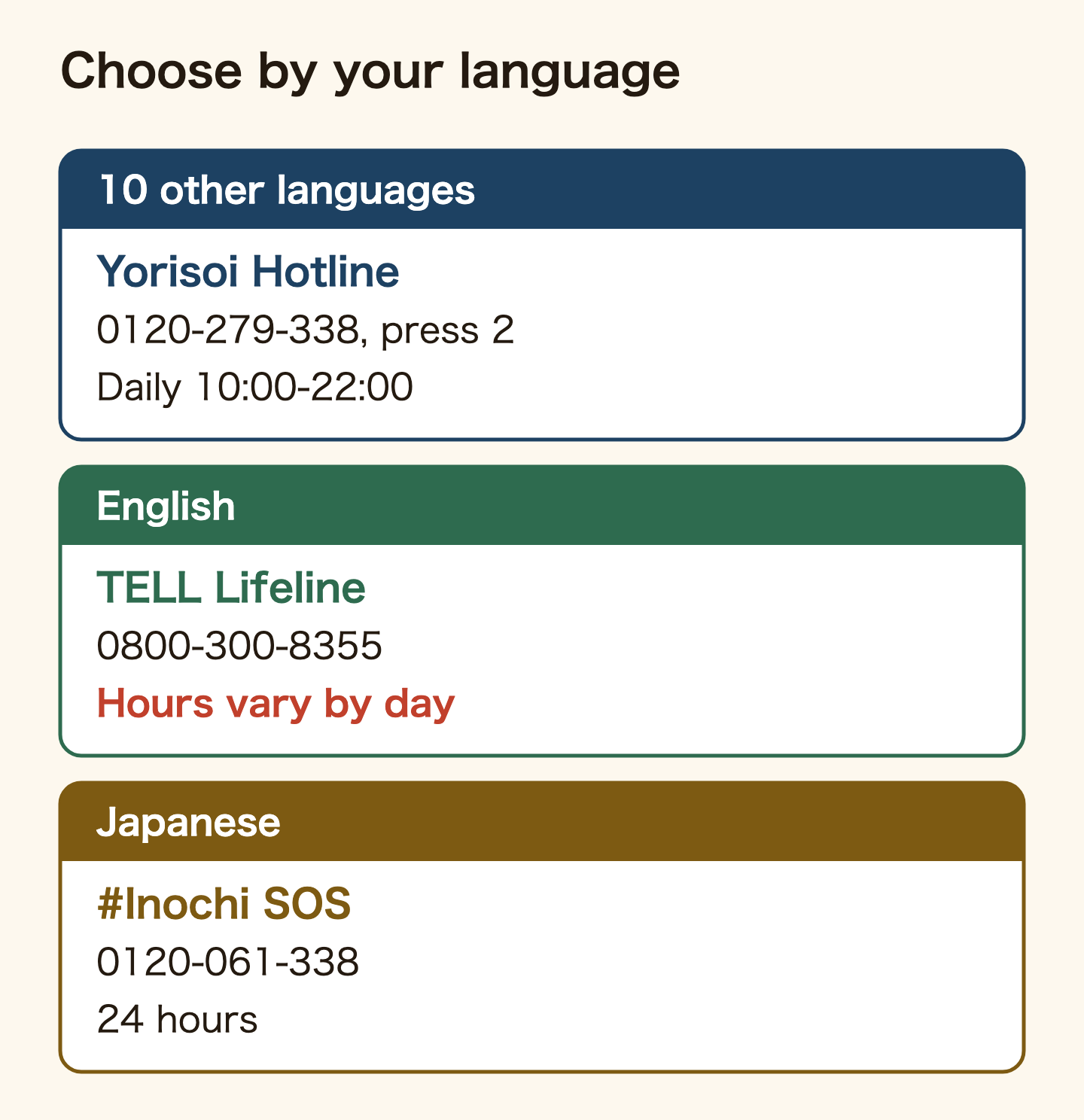
For English, there is also TELL Lifeline. It is a non-profit line that appears on the Tokyo Welfare Bureau’s list of helplines, and TELL’s own page gives 0800-300-8355, toll free. Phone and chat run on different hours, and the hours change by day, so check the page before you call.
Where can I get help if I speak Japanese? 24-hour lines and health centres
If you can manage in Japanese, you have more options. From the lines the MHLW lists, these are the ones for adults:
- #Inochi SOS: 0120-061-338. Free, 24 hours, every day. Trained counsellors listen when you feel you want to die or disappear
- Inochi no Denwa: 0120-783-556 (free), daily 16:00 to 21:00, plus from 8:00 on the 10th of each month to 8:00 the next morning. 0570-783-556 runs 10:00 to 22:00 and charges for the call
- National mental health line (Kokoro no Kenko Sodan Toitsu Dial): 0570-064-556. It connects you to the public service of the prefecture or major city you are calling from. Days and hours differ by prefecture, and it cannot be reached from 050 IP phones
If phone calls are hard, the MHLW also lists groups that take messages on LINE or web chat. Anata no Ibasho is a free, anonymous chat service open 24 hours.
If you would rather talk face to face, go to your local public health centre (hokenjo or hoken center) or the prefecture’s mental health and welfare centre. According to the MHLW, you can consult them by phone or in person, and you can get a psychiatrist’s view. It is free, and what you say is kept confidential. To find the centre for your prefecture or city, with its address and phone number, use the national list of mental health and welfare centres (in Japanese; click your area on the map). This is the place for “I do not know whether I need a doctor.” The MHLW page does not say these centres work in other languages, so ask on the phone, or go with someone who speaks Japanese.
Can international students get counselling? Start with your school
If you study at a university, there may be a counselling service on campus. Official pages from three universities show some work in English and other languages:
- University of Tokyo: a Student Counseling Center with professional counsellors, an office with psychiatrists and psychologists, and an International Student Support Room working in Japanese, English and Chinese
- University of Tsukuba: an International Student Consulting Room with clinical psychologists in Japanese, English and Chinese. Book by email; write the first email in English or Japanese
- Osaka Metropolitan University: counselling for students and international students is free, and available in English
On confidentiality, the University of Tokyo says it is strictly protected “except in the case of an emergency, such as when there is a risk of suicide.” Only when your life is at risk might they tell someone, to keep you safe.
Whether a Japanese language school or vocational school has a counselling room depends on the school. Ask the international student office or your homeroom teacher: is there someone I can talk to about how I feel? If you are missing so many classes that you are thinking of taking time off, read what a leave of absence does to your student visa before you decide.
Psychiatrist or psychosomatic clinic? Five steps to a first visit
You only see a doctor about your mind when things are very bad. Where you come from, that may be normal. In Japan, psychiatric and psychosomatic outpatient care is covered by health insurance. And if you are unsure whether you need it, you can ask a public health centre first.
The department names, as the MHLW explains them:
- Psychiatry (seishinka, also seishin shinkeika): different names, same work. They specialise in mental illness
- Psychosomatic medicine (shinryo naika): mainly for physical symptoms caused by stress and other psychological factors. Some also treat mental illness; some see only a few conditions
If the sign does not make it clear, it is fine to phone and ask what they treat.
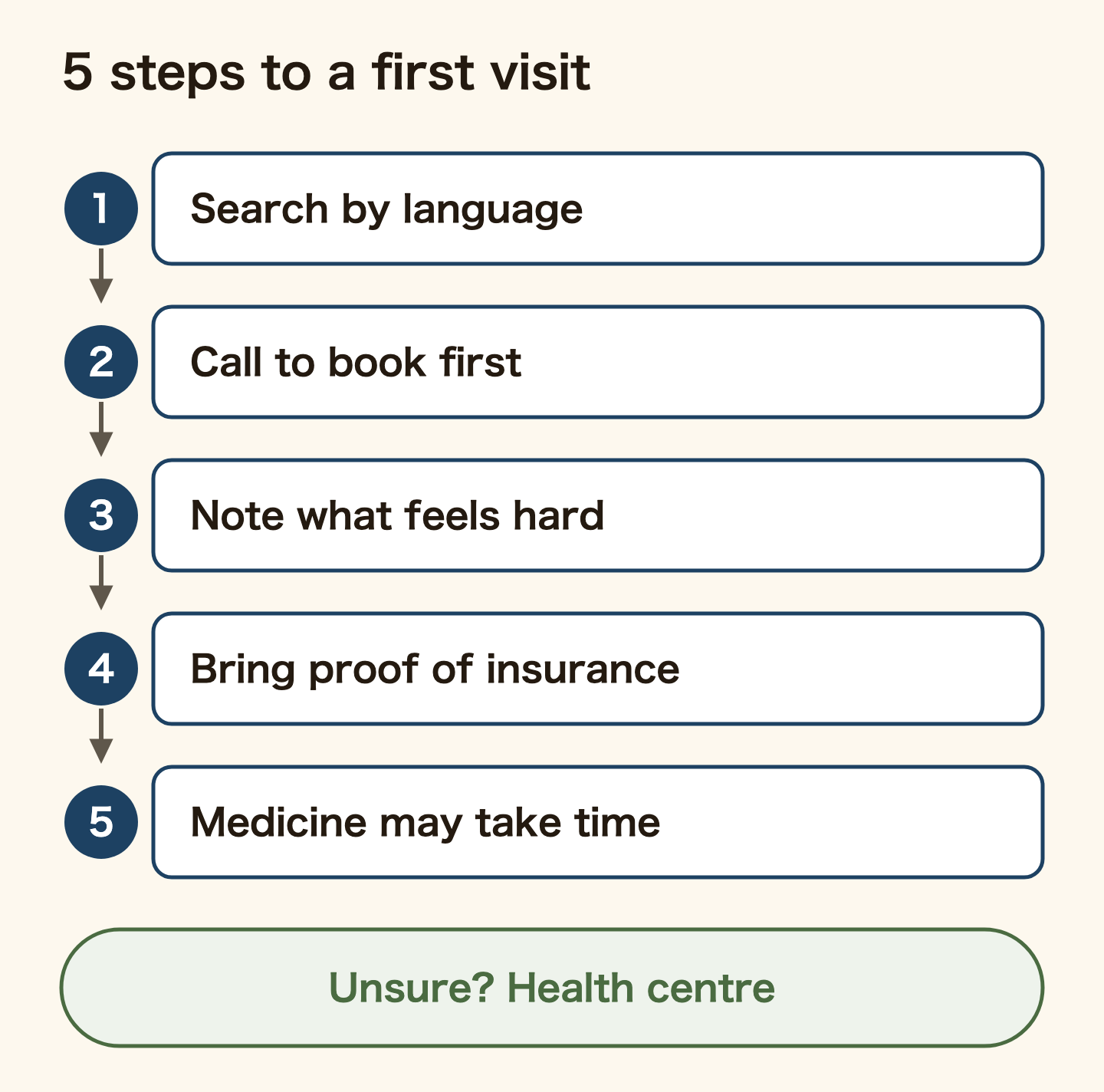
- Search by language. The Japan National Tourism Organization’s medical search filters by area, language and department, including psychiatry. Each prefecture’s consultation desk for foreign patients is on an MHLW list, with the languages it handles
- Call first. The MHLW notes that many psychiatric clinics are appointment-only
- Write down what feels hard. Physical symptoms, sleep and appetite matter as much as mood. If it is hard to say in Japanese, write it in your language and use an interpreter or a translation app
- Bring proof of insurance: your My Number Card registered as a health insurance card, or another document that confirms your insurance
- Give it time. The MHLW says psychiatric medicine may not work straight away, and a diagnosis may not be clear at first
For finding a clinic that speaks your language and booking an interpreter, see how to find an English-speaking doctor and get an interpreter.
Does Japanese health insurance cover therapy? What does it cost?
Foreign residents living in Japan for three months or more must join a public health insurance scheme (Tokyo Metropolitan Government). Show proof of insurance and you pay 30% of the cost at the clinic and the pharmacy. Psychiatric and psychosomatic outpatient care works the same way.
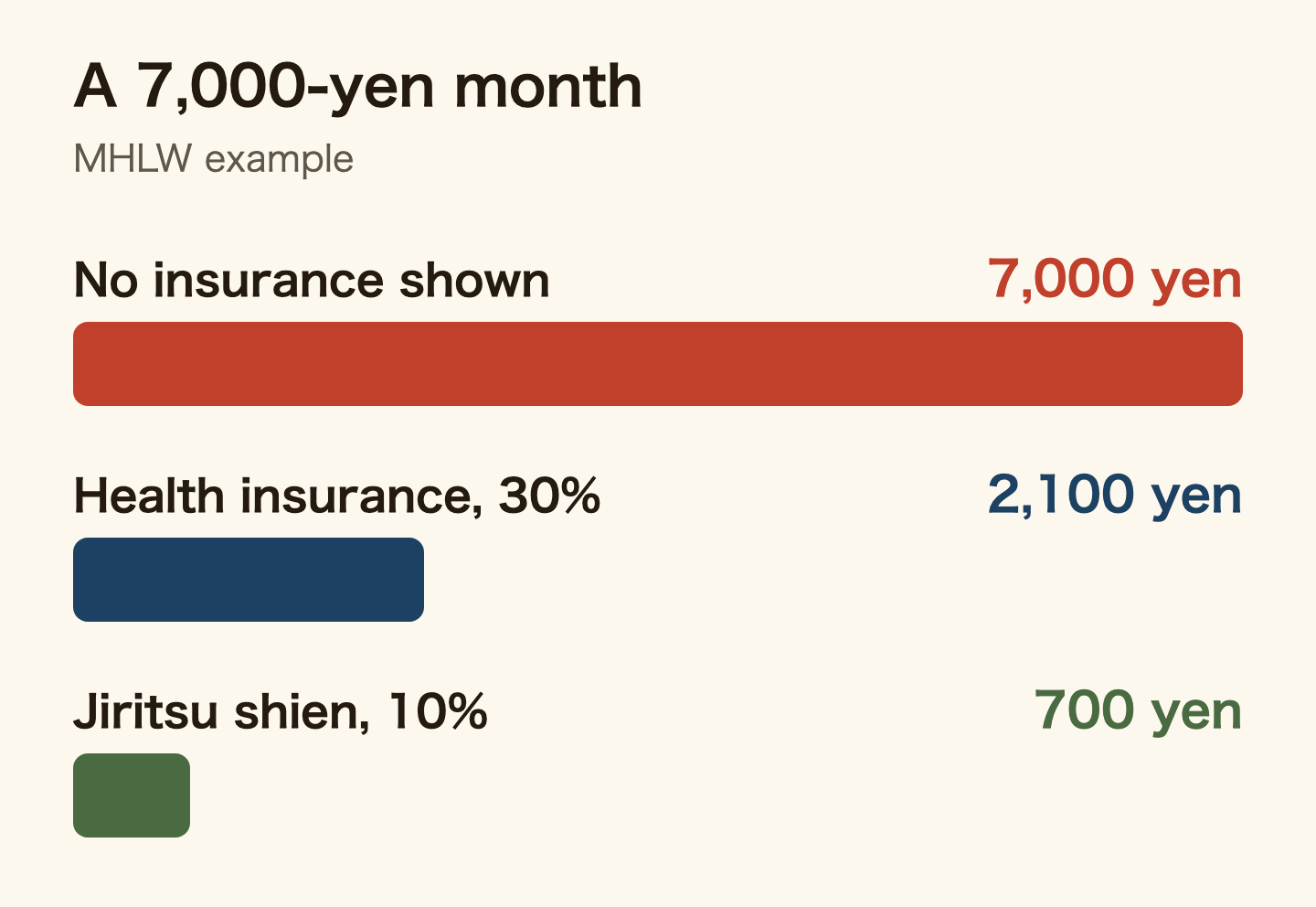
The price of one visit depends on the clinic and the treatment, so the share is the useful number. In an MHLW example, a month of care costing 7,000 yen means 2,100 yen for you under health insurance. With jiritsu shien iryo, the scheme in the next section, it is 700 yen.
Two things to watch:
- Forget your proof of insurance and you pay 100% that day. If you are insured, you can get the extra back later with some paperwork (Tokyo)
- Counselling outside a hospital or clinic is not covered by public health insurance. The MHLW gives it as an example of care outside insurance. Prices vary, so ask before you book
If treatment runs up a large bill in one month, the High Cost Medical Expense Benefit pays back what goes over a monthly limit.
What is jiritsu shien iryo, and can foreigners use it?
Jiritsu shien iryo (psychiatric outpatient support) is a public scheme that lowers the cost for people who need to keep seeing a psychiatrist as outpatients. The MHLW lists schizophrenia, mood disorders such as depression, addiction, stress-related disorders such as PTSD, anxiety disorders such as panic disorder, developmental disorders, dementia and epilepsy, among others. Whether you qualify depends on your doctor’s diagnosis.
Once approved, your share drops from 30% to 10% in principle. On top of that, there is a monthly cap based on the household’s income. “Household” here is not your resident register. It means the people on the same health insurance as you.
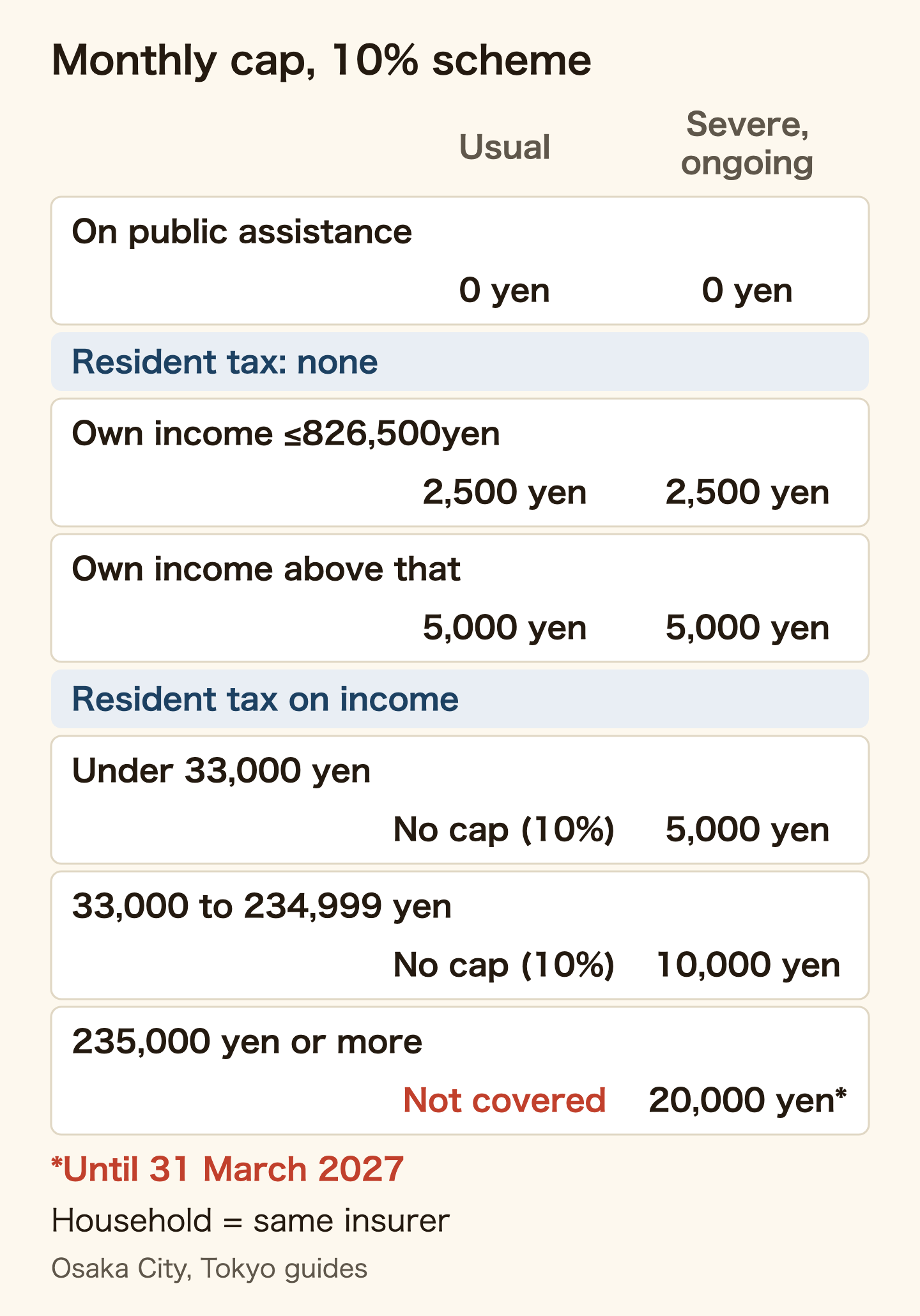
The table follows Osaka City’s income bands. “Severe and ongoing” (juudo katsu keizoku) covers people with long, costly treatment: certain conditions such as depression, or people who received the High Cost Medical Expense Benefit three or more times in the last 12 months, among others. Tokyo says households paying 235,000 yen or more in income-based resident tax are not covered in principle, and only severe and ongoing cases stay eligible under a transitional rule until 31 March 2027.
Can foreigners use it? The MHLW, Tokyo and Osaka pages set no nationality condition. Tokyo lists the residence card among the ID documents you can show when applying. What the scheme does require is an application to the city where you live and a document showing you are on public health insurance. The sure way to know is to ask your clinic and your city office: can I use jiritsu shien iryo?
It does not cover everything: hospital stays, care outside public insurance (such as counselling outside a clinic), and illnesses unrelated to the mental health condition are all excluded.
How do I apply for jiritsu shien iryo? Documents and yearly renewal
Apply at your city or ward office, usually the disability welfare or health and welfare section. In Tokyo’s 23 wards, it is handled by public health centres and similar offices. The MHLW guide lists roughly these documents:
- The application form (from the city office, and sometimes from the clinic)
- A doctor’s certificate written by a designated jiritsu shien iryo clinic
- Proof of income for the people on your health insurance (resident tax certificate showing tax paid or exemption)
- Proof that you are on health insurance
- Something that shows your My Number
Your first year in Japan needs extra care. Osaka City says that if you had no resident record in Osaka on 1 January of the year it checks, you may need a tax certificate from elsewhere. If you cannot get a document, ask the counter what you can bring instead.
Once approved, you receive a certificate (jukyusha-sho). Three rules for using it:
- The 10% rate applies only at the clinics and pharmacies named on the certificate. Your clinic can tell you whether it is designated
- Show the certificate and the monthly payment record sheet every visit. Osaka City says money you paid because you forgot them, or let the certificate expire, is not refunded
- It lasts one year at most. To continue, renew every year; you can apply from about three months before it expires
What if it cannot wait? Call 119 or 110, with an interpreter
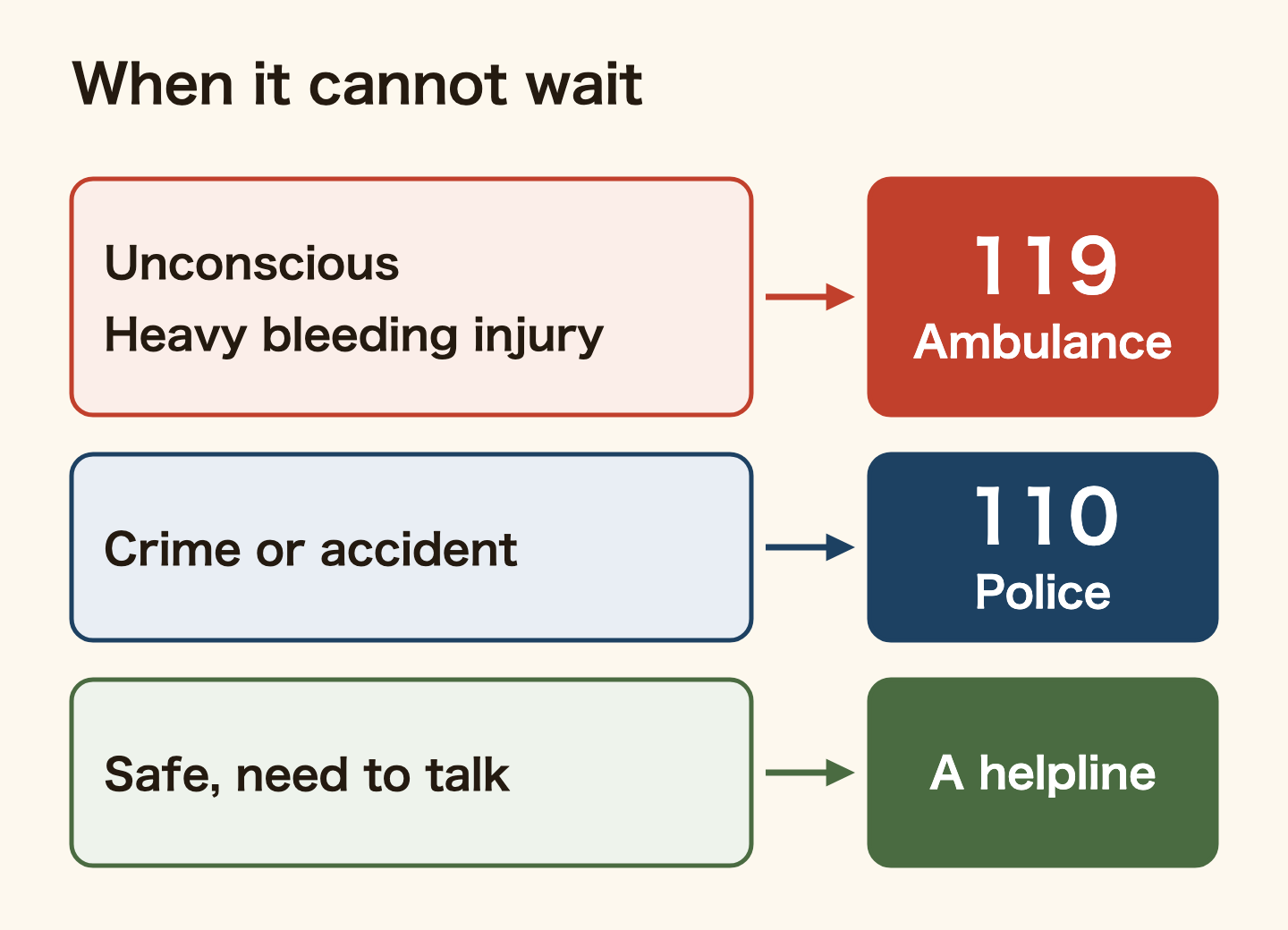
A helpline is not where you go when a life is in danger right now. If you, a family member or a friend is unconscious (no response when you call their name) or has an injury with heavy bleeding, the Fire and Disaster Management Agency lists these as reasons to call 119 at once. Do not hesitate.
You can call even if you speak no Japanese. Most fire departments add an interpreter to the call through a phone interpretation centre: 673 of 720 fire departments as of 1 January 2025. From a mobile, it can take time to find you, so give a building name, an intersection or a shop name, and keep your phone on until the ambulance arrives. What to say, in order, is in how to call an ambulance in Japan.
For a crime or an accident where you are not safe, call 110. The police also handle 110 calls from people who do not speak Japanese through three-way calls with interpreters (National Police Agency White Paper).
Will what I say stay confidential?
Some people never call because they fear their school, their employer or immigration will hear about it. Here is what the official pages say:
- Yorisoi Hotline: confidentiality is assured
- Public health centres and mental health and welfare centres: free, and kept confidential (MHLW)
- List of mental health and welfare centres across Japan (National Association of Directors of Mental Health and Welfare Centres, in Japanese)
- University of Tokyo Student Counseling Center: strictly protected, except in an emergency such as a risk of suicide
No official page gives a general answer on whether seeking help affects a visa review. If it worries you, ask before you give your name: will anything I say be passed on?
What if I cannot pay, or cannot get through?
Before you stop treatment because of money, there are options. Ongoing outpatient care can drop to 10% with jiritsu shien iryo. A large monthly bill is capped by the High Cost Medical Expense Benefit. If you cannot pay the National Health Insurance premium itself, ask your city office about the premium reduction. Tokyo’s guide also tells people who struggle to pay to talk to their city office.
If a line is busy, moving to another service can be quicker than redialling. Yorisoi Hotline’s foreign-language line closes at 22:00. Later than that, if you can talk in Japanese, #Inochi SOS runs 24 hours. Numbers starting 0120 are free to call. Numbers starting 0570 charge for the call, and free minutes on mobile plans do not apply.
Which one are you?
- Tonight is hard and you have no energy for Japanese: call Yorisoi Hotline on 0120-279-338 and press 2 (daily 10:00 to 22:00). For English, check TELL’s page for current hours and call.
- Days of poor sleep and low mood keep coming: find a psychiatric or psychosomatic clinic and book by phone. If you are unsure, call your public health centre today.
- You are already in treatment and it will continue: at your next visit, ask your doctor whether you can use jiritsu shien iryo, and pick up the form at your city office.
- You are a university student and want to talk to someone in person: email the student counselling or international student room today to book.
FAQ
Q. Is there a mental health hotline in Japan in English or other languages?
Call Yorisoi Hotline on 0120-279-338 and press 2 after the message to reach the foreign-language line. It is open daily 10:00 to 22:00 in 10 languages including English, Chinese, Vietnamese and Nepali, and the call is free. In English, TELL (0800-300-8355) is also available.
Q. What is the difference between psychiatry and psychosomatic medicine?
According to the MHLW, psychiatry specialises in mental illness, while psychosomatic medicine mainly treats physical symptoms caused by stress and other psychological factors. Some psychosomatic clinics treat mental illness too, but some see only a few conditions, so phone before booking.
Q. Does Japanese health insurance cover therapy?
Psychiatric and psychosomatic outpatient care is covered, and you pay 30%. The MHLW gives counselling outside a hospital or clinic as an example of care that public health insurance does not cover.
Q. What is jiritsu shien iryo, and can foreigners use it?
It is a public scheme that cuts the share for ongoing psychiatric outpatient care to 10% in principle, with a monthly cap based on income. The MHLW, Tokyo and Osaka pages set no nationality condition, and Tokyo lists the residence card as an accepted ID. Confirm with the office of the city where you live.
Q. What do I need to apply for jiritsu shien iryo?
The application form, a certificate from a doctor at a designated clinic, proof of household income (a resident tax certificate), proof of health insurance, and proof of your My Number. The certificate lasts one year at most and is renewed every year.
Q. What should I do if a life is in danger right now?
Call 119 if someone is unconscious or has an injury with heavy bleeding. Call 110 for a crime or an accident. Both handle callers who do not speak Japanese through three-way calls with interpreters.
Summary
When your mind is struggling, there is a line in your language. Call Yorisoi Hotline and press 2, any day from 10:00 to 22:00. In English there is TELL, and in Japanese there is #Inochi SOS around the clock, plus free, confidential public health centres. University students can start at the campus counselling room.
To see a doctor, find a psychiatric or psychosomatic clinic, book by phone and bring proof of insurance. You pay 30%, and if treatment continues, jiritsu shien iryo can bring it down to 10%. And if someone is unconscious or badly bleeding, call 119 without waiting.
Official sources: MHLW, phone helplines (Japanese) / MHLW, SNS helplines (Japanese) / Yorisoi Hotline, helpline for foreign languages / Tokyo Welfare Bureau, lifelines (Japanese) / TELL Lifeline / MHLW, public consultation windows (Japanese) / MHLW, types of clinics (Japanese) / MHLW, before your first visit (Japanese) / JNTO, medical search / MHLW, prefectural consultation desks / Tokyo Bureau of Public Health, medical insurance / MHLW, jiritsu shien iryo (PDF, Japanese) / Tokyo Welfare Bureau, jiritsu shien iryo (Japanese) / Osaka City, jiritsu shien iryo (Japanese) / University of Tokyo, Center for Research on Counseling and Support Services / University of Tsukuba, International Student Consulting Room / Osaka Metropolitan University, counselling room / FDMA, three-way interpretation (Japanese) / FDMA, using ambulances (PDF, Japanese) / National Police Agency White Paper 2025 (Japanese) (all checked 30 September 2026). For questions about conditions or medication, always ask a doctor.
Related reading
Found this useful? Share it
Send it to a friend who lives in Japan.
WHO WROTE THIS

mori
Japanese. I read the ministries’ own notices, orders and Q&As in the original, and I start from what my Nepalese and Sri Lankan friends in Japan actually ran into. I do not write about what I have not checked or been told.
What this site can and cannot do →Looking for something else?