Rates, due dates and exemption figures were checked on 11 September 2026 against the Ministry of Internal Affairs, the text of the Local Tax Act on e-Gov, and the Tokyo Bureau of Taxation. The exemption threshold differs by municipality. Check your own city’s page too.
In short
- No residence tax in the year you arrive. It is charged on last year’s income, and only to people with a Japanese address on 1 January.
- It starts in June of your second year. Twelve payroll deductions from June to May, or four bills in June, August, October and January.
- The rate is 10% of taxable income plus a flat 5,000 yen (4,000 yen per-capita plus 1,000 yen forest environment tax).
- Low income last year means no tax. In Tokyo’s 23 wards with no dependants: total income of 450,000 yen or less — roughly a salary of 1.1 million yen.
- Leaving Japan does not cancel it. Have your employer deduct the balance, appoint a tax agent, or pay before you go — one of the three, before departure.
A year in Japan, taxes handled by your employer or school, nothing happened. Then in June of year two a bill arrives that you have never seen before. That is residence tax. Your Japanese colleagues had the same shock in June of their second working year, which is why asking them gets you “that’s just how it is”.
- What is residence tax?
- When does it start? June of your second year
- How much is it? Ten percent plus 5,000 yen
- Who does not have to pay? People with low income last year
- What happens when you leave Japan? It does not disappear. You have three routes
- What if you leave without paying?
- Who can close this article now?
- Frequently asked questions
- Summary
What is residence tax?
Residence tax (juminzei) is a tax on your income from 1 January to 31 December of the previous year, charged by the municipality and prefecture where you had your address on 1 January of this year. Income tax is taken from this year’s salary as you earn it. Residence tax is last year’s income, paid this year. That one-year lag is the source of every confusion about it.
It has two parts.
- Income-based part — 10% of taxable income (4% prefectural, 6% municipal)
- Per-capita part — a flat 4,000 yen regardless of income (1,000 prefectural, 3,000 municipal). Since fiscal 2024 the 1,000-yen forest environment tax is collected with it, making 5,000 yen in total
When does it start? June of your second year
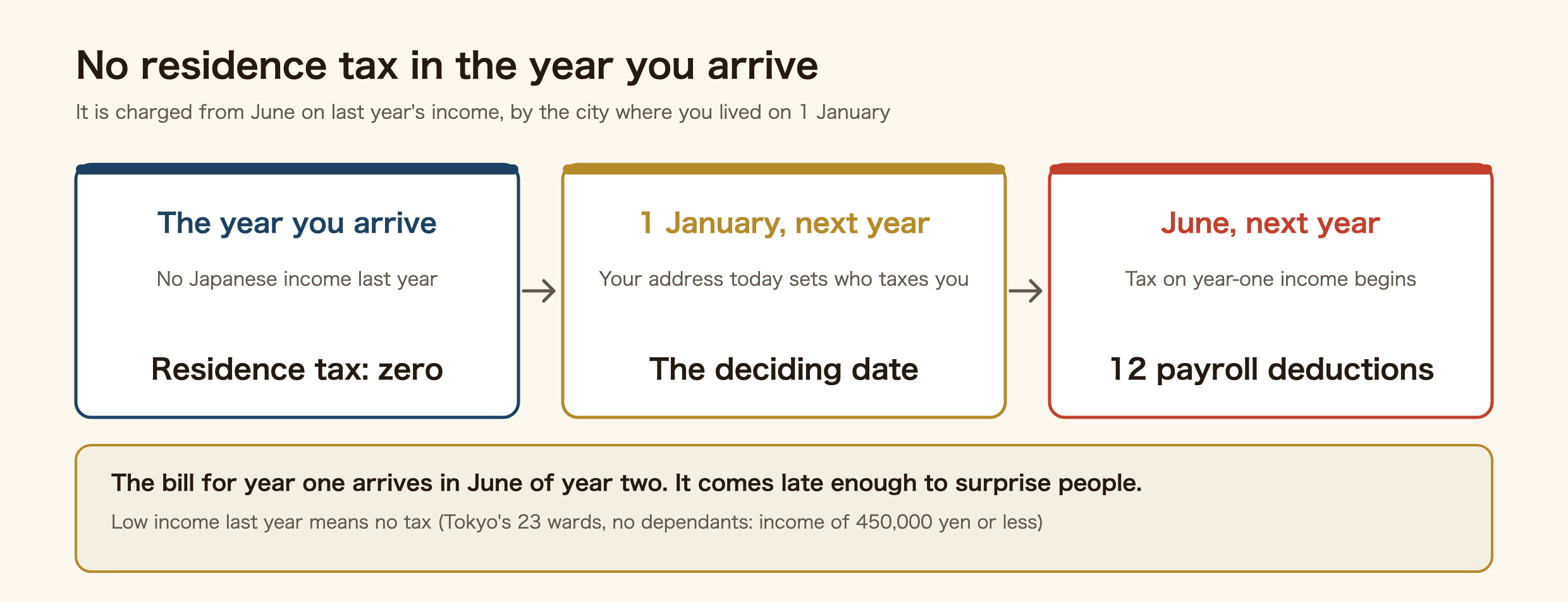
In the year you arrive you had no Japanese income the year before. So the tax is zero. When people say “you are exempt for the first year”, this is what they mean — not an exemption, simply no income to tax yet.
If you have an address in Japan on 1 January of the following year, that municipality taxes you. And in June of that year, tax on your first year’s income begins. Article 318 of the Local Tax Act fixes 1 January as the assessment date.
There are two ways it is collected.
- Special collection — your employer deducts it from salary, one twelfth each month from June to the following May. Company employees are on this by default.
- Ordinary collection — the city sends you bills and you pay them yourself, due in June, August, October and January (article 320). Students with part-time jobs and people whose employer does not deduct are on this.
When a bill arrives, do not leave it in a drawer. Convenience stores accept it.
How much is it? Ten percent plus 5,000 yen
The rough calculation has three steps.
- Take last year’s gross income and subtract the expense allowance (for salary, the employment-income deduction) to get income
- Subtract the basic deduction, social-insurance premiums and other deductions to get taxable income
- Take 10% of that and add 4,000 yen per-capita plus 1,000 yen forest environment tax
The deductions vary by person, so remember it as “about a tenth of taxable income, plus 5,000 yen”. Designated cities split the 10% as 2% prefectural and 8% municipal, but the total is the same.
Who does not have to pay? People with low income last year
Residence tax has an exemption threshold. If your total income last year was at or below it, neither part is charged. The figure is set by each municipality’s ordinance.
In the example the Tokyo Bureau of Taxation publishes for the 23 wards, a person with no spouse or dependants is exempt if last year’s total income was 450,000 yen or less. For someone with salary only, the minimum employment-income deduction is 650,000 yen, so a salary of roughly 1.1 million yen or less is the rule of thumb.
Outside the 23 wards the figure may differ — the bureau’s own page says so. Look up “residence tax exemption” on your municipality’s site. The same page also announces that from fiscal 2027 the minimum employment-income deduction rises to 740,000 yen, which lifts the salary rule of thumb accordingly.
Also exempt: people on public assistance, and disabled people, minors, widows and single parents with total income of 1.35 million yen or less last year (article 295).
What happens when you leave Japan? It does not disappear. You have three routes
This is the chapter that only applies to foreign residents, and the one that matters most.
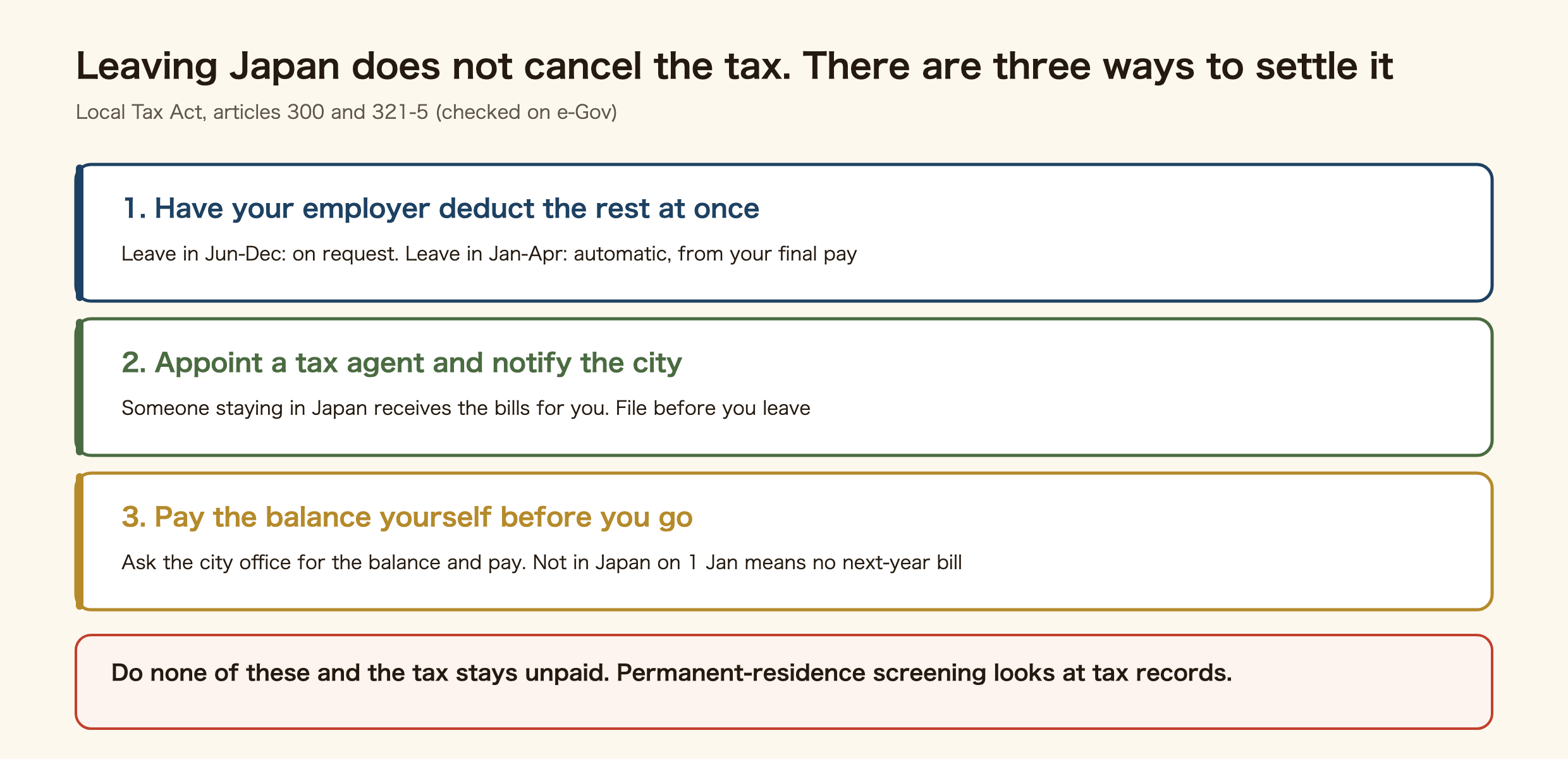
Because residence tax is last year’s income paid this year, what you are paying in the year you leave is tax on the previous year. Leaving does not erase the balance. Article 300 of the Local Tax Act says that a taxpayer who ceases to have an address in the municipality must appoint a tax agent and notify the city.
Three routes.
- 1. Have your employer deduct the balance at once. When a payroll-deducted employee leaves, the later monthly amounts stop being deducted (article 321-5). If you leave between June and December, you can ask for the balance to be taken from your final pay in one go. If you leave between January and April, it is taken automatically from pay or severance due by 31 May. This is the least work.
- 2. Appoint a tax agent and notify the city. A friend or your company who stays in Japan receives the bills and pays them for you. File the notification with the city before you leave. Use this when bills will still be arriving after you have gone.
- 3. Pay the balance yourself before departure. Ask the city tax office how much is outstanding, pay it, then leave.
And if you have no address in Japan on 1 January of the following year, there is no residence tax for that following year. Someone who leaves in December and someone who leaves in January end up with different bills. The leaving-Japan checklist puts these in order.
What if you leave without paying?
It stays on the books as unpaid. Municipal records do not forget it.
That matters most for people who go home and later come back to work. Permanent-residence screening looks at whether you have met your public obligations, tax included. “Nobody told me” is not an answer the examiner accepts.
Who can close this article now?
If this is your first year and you have not yet reached June, you need do nothing. Come back to this page when the bill or the payslip line appears next June.
Students whose salary last year stayed under about 1.1 million yen are exempt in most municipalities. Most, not all — check your city’s page once and you are done.
If you have a departure date, act now. Which of the three routes you use depends on the month you leave and whether you are on payroll deduction or bills. Tell your company’s HR and your city’s tax section “I am leaving Japan” and they will walk you through the rest.
Frequently asked questions
Q. Are foreigners exempt from residence tax in their first year?
It is not an exemption — there is simply no previous-year income to tax. Nothing is charged in the year you arrive. If you have a Japanese address on 1 January of the next year, tax on your first year’s income starts that June.
Q. When does residence tax start being deducted?
June of your second year. Twelve payroll deductions from June to May, or four bills in June, August, October and January.
Q. What is the rate?
10% of taxable income plus a flat 5,000 yen (4,000 yen per-capita and 1,000 yen forest environment tax).
Q. I am a student with only part-time income. Do I pay?
Not if last year’s total income was at or below the exemption threshold. In Tokyo’s 23 wards with no dependants that is 450,000 yen of income, roughly a salary of 1.1 million yen. The figure differs by municipality.
Q. What happens to residence tax when I leave Japan?
It does not disappear. Have your employer deduct the balance when you leave the job, appoint a tax agent, or pay it off before departure. If you have no address in Japan on 1 January of the following year, there is no tax for that year.
Q. My family says a residence-tax bill arrived after I left.
If you appointed a tax agent, that person can pay it for you. If you did not, contact the tax section of that municipality, file the tax-agent notification and ask how to pay.
Summary
Residence tax is last year’s income, paid this year. Zero in the year you arrive; it starts in June of year two. The rate is 10% plus 5,000 yen, and low income last year means exemption (Tokyo’s 23 wards, no dependants: total income of 450,000 yen or less).
Leaving Japan does not cancel it. Employer lump-sum deduction, a tax agent, or paying before you go — one of the three, before departure. Not in Japan on 1 January means no bill for the following year.
Sources (official): Ministry of Internal Affairs and Communications, individual inhabitant tax / Local Tax Act (e-Gov), articles 294, 295, 300, 318, 320 and 321-5 / Tokyo Bureau of Taxation, individual inhabitant tax (exemption and employment-income deduction) (all checked 11 September 2026)
Found this useful? Share it
Send it to a friend who lives in Japan.
WHO WROTE THIS

mori
Japanese. I read the ministries’ own notices, orders and Q&As in the original, and I start from what my Nepalese and Sri Lankan friends in Japan actually ran into. I do not write about what I have not checked or been told.
What this site can and cannot do →Looking for something else?