Checked on 26 November 2026. Main sources: official guides from Jinja Honcho, Izumo Taisha, Naritasan Shinshoji, Senso-ji, plus Meiji Jingu (full list at the end).
The short answer
- Hatsumode is your first visit to a shrine or temple in the new year. Shrines are Shinto. Temples are Buddhist.
- At many shrines, the common way is to bow twice, clap twice, then bow once. Some shrines differ. Izumo Taisha claps four times.
- At a temple, you put your palms together to pray. The way can differ by temple.
- If you are not sure, read the sign first. No sign? Watch the people in front of you, then do the same. (This is our advice.)
- There is no set amount for the coin offering. Most shrines take no cards. Bring a few coins you can easily spare.
Knowing this, you will not freeze at the front of the line, unsure what to do. You can skip the busiest hours and pray calmly at a shrine near you.
It is the morning of January 1. Outside the station, crowds walk the same way. You follow them to a big shrine with a long line. At the front, people clap their hands. How many times? How much money goes in the box? Your Japanese friend says, “Just do whatever.” Your religion is different, too. Is it even okay to go in? Most of the answers are on official shrine pages.
- What is hatsumode? Shrine or temple for your New Year visit?
- Until when can you do hatsumode?
- How to pray at a shrine in Japan: shrine etiquette step by step
- How to use the water basin before you pray
- Temple etiquette in Japan: put your palms together
- How much money do you put in the offering box?
- Omikuji in English, omamori, and returning old charms
- When is hatsumode busiest? 3 checks before you go
- Can foreigners visit shrines in Japan if they have another religion?
- Which one are you?
- Frequently asked questions
- Summary
- Related reading
What is hatsumode? Shrine or temple for your New Year visit?
Hatsumode is a visit to a shrine or temple at the start of the year. Jinja Honcho is the Association of Shinto Shrines, a national body for Shinto shrines. It says about 80% of people in Japan visit a shrine at New Year. It does not give the year or method of the survey. People also go to temples, such as Naritasan Shinshoji.
The main difference is religion. Shrines are for Shinto. Temples are for Buddhism. A shrine has a gate called a torii at its entrance. Jinja Honcho calls the torii the main sign that tells a shrine from a temple.
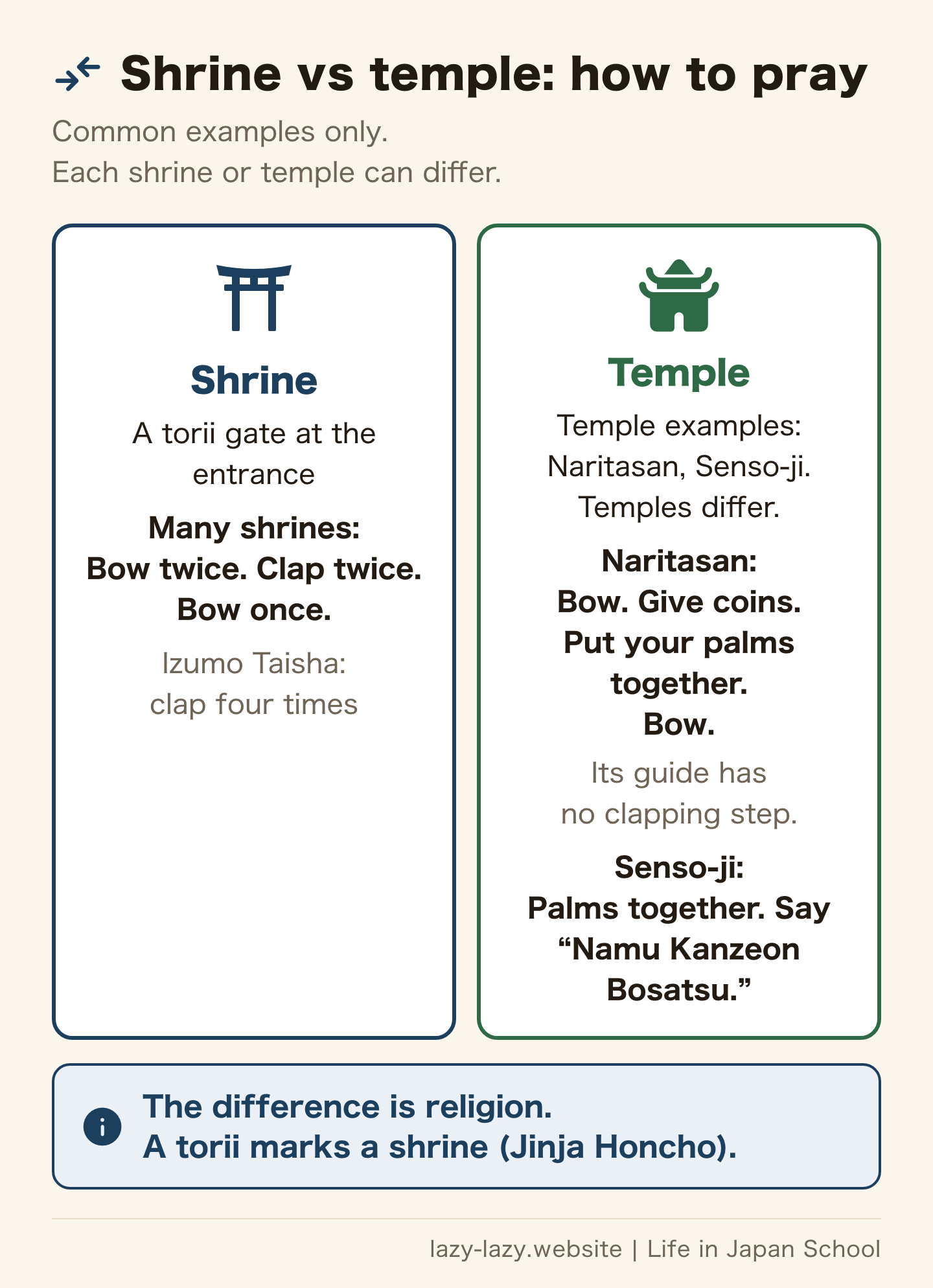
There is no rule about which one to visit. A small local shrine is fine. So is a famous one. Jinja Honcho notes that wherever you stay in Japan, a shrine will be near you. For your first time, a place you can walk to saves you from long crowds.
Until when can you do hatsumode?
We found no set deadline in the official pages we checked. So our advice is simple: go on a day that works for you. Opening hours differ by place. Jinja Honcho’s Q&A says shrine grounds usually open at sunrise. They usually close at sunset. If you plan to go at night, check the closing time on the website first.
How to pray at a shrine in Japan: shrine etiquette step by step
Jinja Honcho’s guide to entering a shrine gives the common way to pray. In Japanese it is called nirei nihakushu ichirei. That means two bows, two claps, one bow. The prayer hall is the building you stand in front of. The main sanctuary, where the kami (Shinto gods) are enshrined, is usually behind it.
Praying at a shrine (the common way at many shrines)
- Stand up straight. Face the prayer hall.
- If you wish, put some coins in the offering box.
- If there is a bell, shake the rope to ring it.
- Bow deeply two times.
- Stand up straight. Put your hands together in front of your chest. Clap two times.
- If you wish, say a quiet prayer.
- Bow deeply one time.
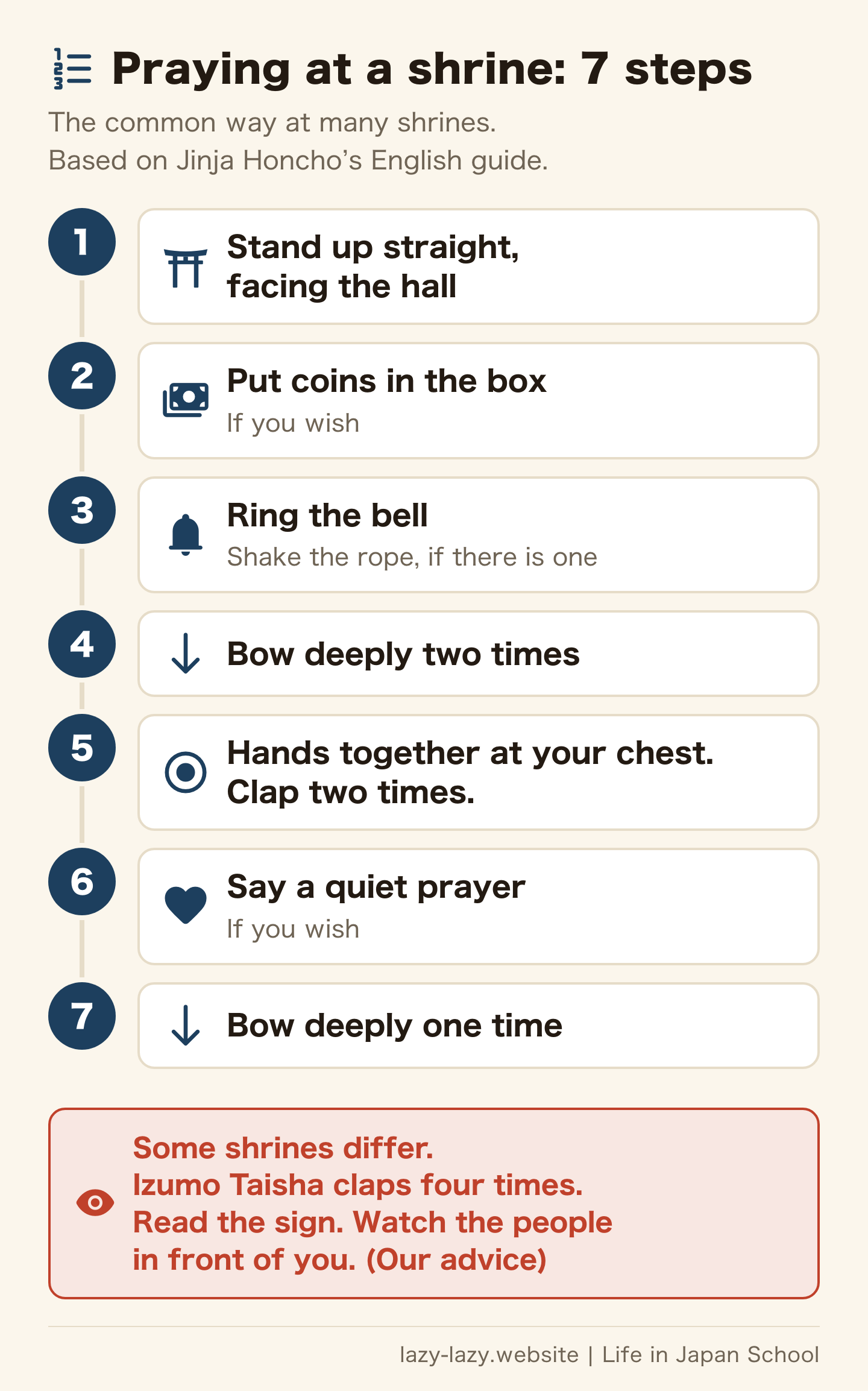
This is the common way at many shrines, but some shrines differ. Izumo Taisha is a Shinto shrine with its own way. Its FAQ (in Japanese) says the usual way is two bows, two claps, one bow. At Izumo Taisha, it is two bows, four claps, one bow. If you are not sure, read the sign first. No sign? Watch the people in front of you, then do the same. (This is our advice.)
If you clap the wrong number of times, do not panic. (This is our advice.) Jinja Honcho says it hopes visitors of other faiths also pray in a polite, sincere way. Keep your prayer silent.
How to use the water basin before you pray
Most shrines have a water basin for cleaning your hands and mouth before you pray. It is called temizu. You use a ladle, a long-handled cup, to clean your left hand, then your right hand, then your mouth. Do not touch the ladle to your mouth. Spit the water at the base of the basin, not into it. The four steps are in figure 3 (from Jinja Honcho’s English guide).
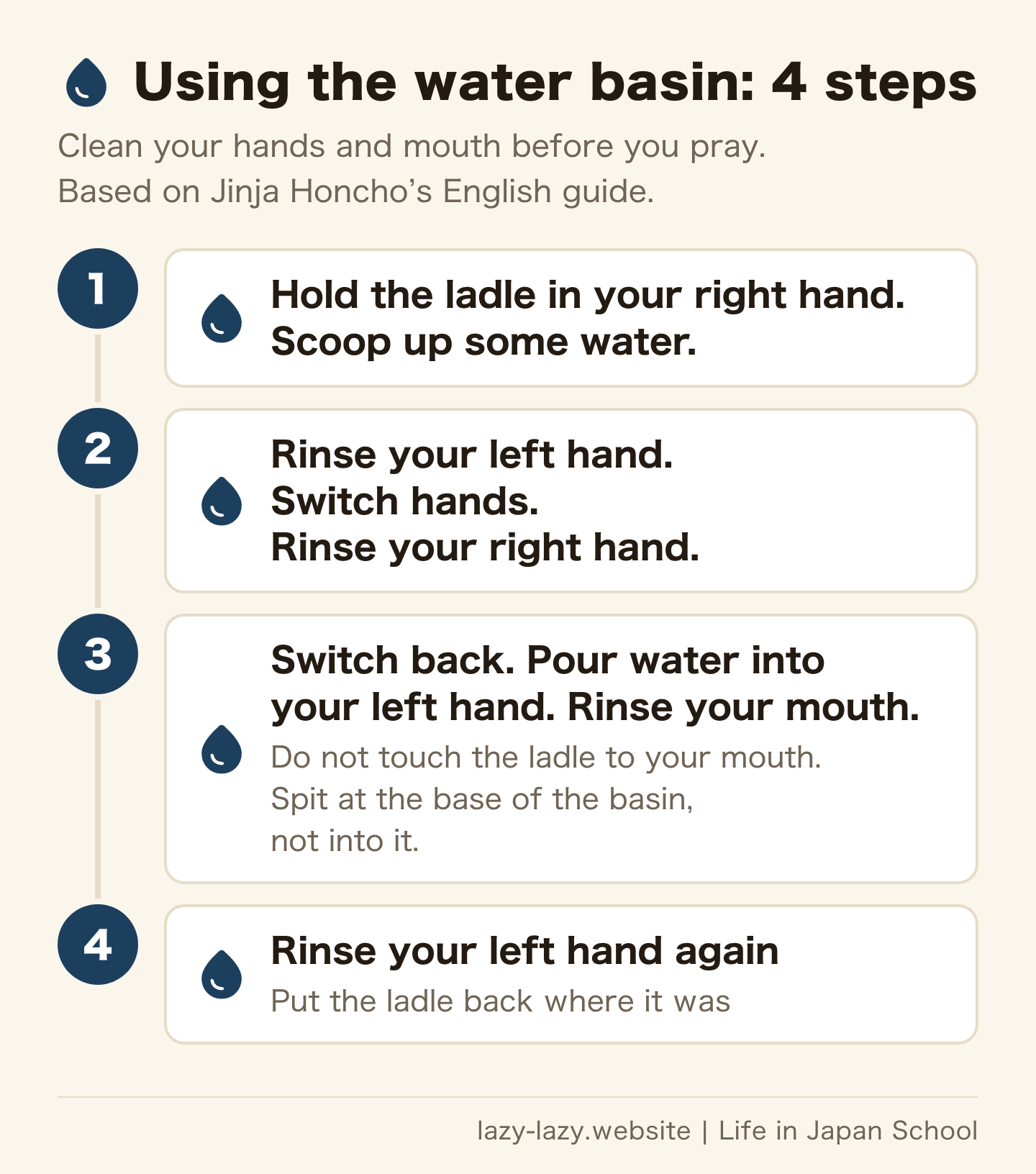
At New Year, the basin may look different. For New Year 2026, Meiji Jingu said it would add extra basins with running water.
Temple etiquette in Japan: put your palms together
At a temple, you put your palms together to pray. In Japanese this is called gassho. Naritasan Shinshoji’s visiting guide (in Japanese) gives these steps. Bow once at the offering box. Put in your coins. Put your palms together to pray. Then bow lightly. Its guide has no clapping step. Naritasan says its steps are one example, not something you must follow exactly.
Senso-ji’s FAQ (in Japanese) asks visitors to put their palms together and say “Namu Kanzeon Bosatsu.” As these two show, the way differs by temple.
How much money do you put in the offering box?
Saisen is the money you put in the offering box when you pray. Jinja Honcho’s Q&A says offering some coins is customary. It also says there is no fixed amount. Its steps say “if you wish,” so the choice is yours.
With no set amount, a few coins you can easily spare are enough. This is our advice. Jinja Honcho’s Q&A says most shrines do not accept credit cards. Most do not take e-money either. To check which ATMs work over New Year, see our guide to New Year closures in Japan.
Most shrines charge no entry fee. A museum or garden inside the grounds may charge one (Jinja Honcho’s Q&A).
Omikuji in English, omamori, and returning old charms
An omikuji is a paper fortune you draw for a small fee. Jinja Honcho’s guide to amulets says many people tie it to a string at the shrine. They do this most often when the fortune is bad.
Omikuji differ by place, too. Senso-ji asks you to put the stick back in its container. If you get bad luck, you tie the paper at the set place. Meiji Jingu’s Q&A (in Japanese) says its omikuji has no good luck or bad luck. It gives a poem by Emperor Meiji or Empress Shoken with an explanation. It comes with an English translation.
An omamori is a small charm that holds the power of the kami. Jinja Honcho says it is not a simple souvenir. Keep it yourself, or give it to family or friends. Do not open the pouch to look inside. Most shrines show the amount to offer, so follow the sign.
Shrines and temples have places to return old charms. Meiji Jingu has a spot called the koshinpu osamejo, where you return old ofuda (paper or wood charms) and omamori. It does not take New Year decorations or dolls. Naritasan’s Q&A (in Japanese) says old ofuda usually go back to the place you got them. About once a year is a good time to replace them. What each place takes differs, so check its website first.
When is hatsumode busiest? 3 checks before you go
At the front of the line, you may want to take a photo. Where you come from, that may be normal. In Japan, if you stop in front of the prayer hall, or sit on the steps, people behind you find it hard to pray (Jinja Honcho). Step to the side after you pray, then take your time with photos.
Some big shrines post their busy hours. Meiji Jingu’s New Year 2026 page (in Japanese) said it would stay open all night on New Year’s Eve. Its usual busy times were 22:00 on December 31 to 3:00 on January 1, then after 10:00 on January 1 to 3. This is an example from the 2026 page. For 2027, check each shrine’s official website.
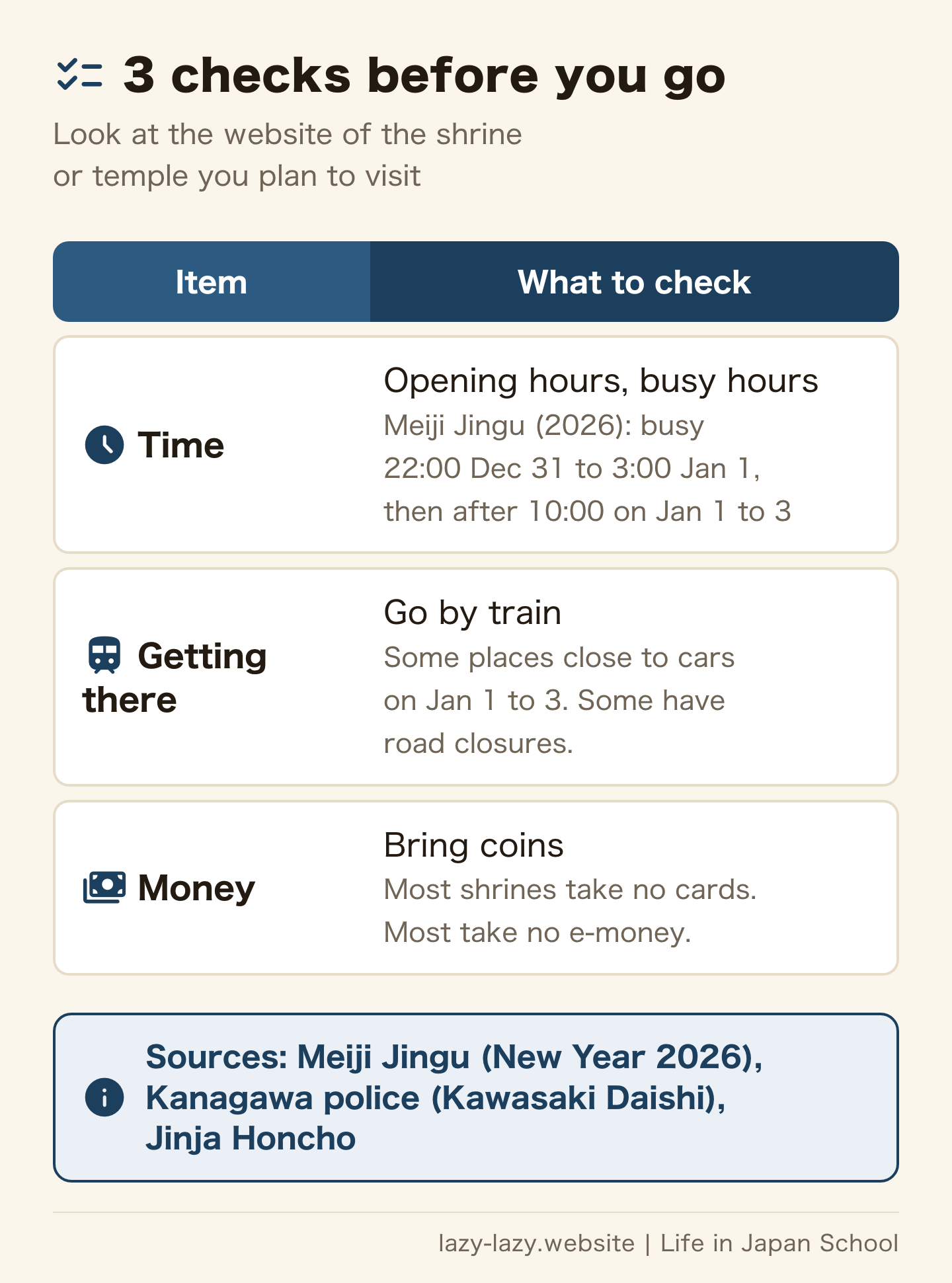
Go by train or bus, not by car. On its 2026 page, Meiji Jingu said no cars could enter its grounds on January 1 to 3. Around Kawasaki Daishi, roads close to cars from 22:00 on Dec 31 to about 19:00 on Jan 1, and from 10:00 to about 19:00 on Jan 2, Jan 3 (Kanagawa Prefectural Police, map, in Japanese). For tips on busy trains, see train etiquette in Japan before you go.
Can foreigners visit shrines in Japan if they have another religion?
Yes, you can enter a shrine whatever your religion. Jinja Honcho’s Q&A says there are no special limits for visitors of other faiths. It asks visitors to respect the shrine grounds. It hopes you pray in a polite, sincere way. It also says Shinto fits with following another religion, or with having none.
You can also just walk around the grounds without praying. If clapping feels wrong to you, a quiet bow is fine. (This is our advice.) We could not find an official view for temples. At a temple, too, follow the rules and signs on the grounds.
If a building is open, you may want to peek inside. Where you come from, that may be normal. In Japan, you do not enter shrine buildings unless invited, even if they look open. The same goes for areas behind fences or ropes (Jinja Honcho).
Jinja Honcho’s Q&A also says these things.
- Photos: You can usually take photos of buildings. Some areas forbid them. Follow the staff. Do not take photos of people without asking.
- Clothing: There is no strict dress code. Jinja Honcho asks you to dress modestly, since many people come to pray.
- Food: Bringing food is not recommended. If there are food stalls, eat in the set areas.
If someone points out a mistake, just fix it on the spot. Saying “Sumimasen, hajimete desu” (Sorry, it is my first time) is enough.
Which one are you?
- First hatsumode — today, pick one shrine or temple near your home. Check its New Year hours on its website.
- Worried about the steps — today, save a photo of the step box above.
- You dislike crowds — today, check the busy hours on the website of the place you want to visit. Pick a day and time outside them.
- You only carry cards — today, put some coins in your wallet. Also check which ATMs are open over New Year.
Frequently asked questions
Q. Until when should I do hatsumode?
We found no set deadline in the official pages we checked. Go on a day that works for you. Hours differ by place, so check the website.
Q. Is it two bows, two claps, one bow at every shrine?
It is the common way at many shrines, but some differ. Izumo Taisha uses two bows, four claps, one bow. If you are not sure, see the shrine etiquette section above.
Q. Do I clap at a temple?
Naritasan Shinshoji’s guide has no clapping step. You bow, put in coins, pray with your palms together, then bow. Temples can differ.
Q. How much should I put in the offering box?
There is no fixed amount (Jinja Honcho). A few coins you can easily spare are enough. Most shrines do not take cards.
Q. Can I visit a shrine if I follow another religion?
Yes. Jinja Honcho says there are no special limits for visitors of other faiths. It hopes visitors pray in a polite, sincere way.
Q. What if I get the steps wrong?
Do not panic. (This is our advice.) Jinja Honcho says it hopes visitors of other faiths also pray in a polite, sincere way.
Summary
Hatsumode is your first shrine or temple visit of the new year. At many shrines, the common way is two bows, two claps, one bow. Some shrines differ, such as Izumo Taisha. At a temple, you pray with your palms together. There is no fixed coin offering, and most shrines take no cards. Some big shrines post their busy hours.
The way differs by place. So if you are not sure, read the sign first. No sign? Watch the people in front of you, then do the same. Today, check the New Year hours on the website of the place you want to visit. Then put some coins in your wallet. To enjoy New Year food after your visit, read what osechi means next.
Official sources: Jinja Honcho, Q&A / Jinja Honcho, Entering a Jinja / Jinja Honcho, Taking It Home / Izumo Taisha, FAQ (Japanese) / Naritasan Shinshoji, how to visit (Japanese) / Naritasan Shinshoji, Q&A (Japanese) / Senso-ji, FAQ (Japanese) / Meiji Jingu, New Year page for 2026 (Japanese) / Meiji Jingu, Q&A (Japanese) / Kanagawa Prefectural Police, Kawasaki station: temporary permit desk for Kawasaki Daishi at New Year (Japanese) / Kawasaki Daishi New Year road closure map (PDF, Japanese) (all checked on 26 November 2026).
Related reading
Found this useful? Share it
Send it to a friend who lives in Japan.
WHO WROTE THIS
mori
Japanese. I read the ministries’ own notices, orders and Q&As in the original, and I start from what my Nepalese and Sri Lankan friends in Japan actually ran into. I do not write about what I have not checked or been told.
What this site can and cannot do →Looking for something else?
You may use the figures in this article, including commercially, if you credit this site with a link. How to use our figures