Checked against official sources on 26 November 2026. Laws: the University Establishment Standards, the Specialized Training College Standards, the School Education Act (e-Gov). Immigration: the document list for renewing a Student visa. Grants: the JASSO study grant page, JASSO rules. Universities: official pages of Ritsumeikan, Kobe, Tokyo University of Foreign Studies, Kyoto, Tokyo, Osaka. Each university rule is that school’s own example.
Short answer
- A credit (tan-i) is what your school gives you when you pass a course. By national standard, 1 credit equals 45 hours of study. That means class time and your study at home together.
- To graduate from a university, you need at least 124 credits (national rule). Your school sets the real number and the required courses. Day courses at vocational schools need 31 credits per year of the course, at least.
- You only get credit for courses that are registered (Ritsumeikan). Usually you register yourself in a set period. Some universities refuse registration for the whole term if you miss the dates (Tokyo University of Foreign Studies).
- GPA is your average grade. Each school scores it in its own way. A course you stop going to counts as a fail, unless you withdraw in time (Kobe University).
- Your transcript goes to immigration when you renew a Student visa. The JASSO study grant needs a grade score of 2.30+ for the last year. If you missed registration, go to the academic office the same day.
Knowing this, you will not lose a whole term of credits to a missed deadline. You will also see where credits and GPA show up: visa renewal and grants.
It is your first week at a Japanese university in April. You got a timetable and a link that says “Course registration here.” You go to every class. But you have not opened the registration page yet. A senior student says, “You haven’t registered? The deadline is tomorrow.” Your Japanese friends say, “Just don’t fail the required ones.” Nobody explains how it works.
- What is a credit at a Japanese university? 45 hours of study
- How many credits do you need to graduate in Japan? 124+ at university
- Required vs elective courses: what is the difference?
- What is course registration? Only registered courses count
- Missed course registration? The change period, then the office
- How to read a syllabus in Japan: always check the grading
- GPA in Japan: an average, but each school scores it differently
- Failing credits, repeating a year: what happens to your student visa?
- Not sure? Who to ask at a Japanese university
- Which one are you?
- FAQ
- Summary
- Related reading
What is a credit at a Japanese university? 45 hours of study
A credit is the number your school gives you when you pass a course. Earning a credit is called shutoku. Whether you can graduate depends on how many credits you earn in total.
The size of a credit is set by a national rule, the University Establishment Standards. One credit is 45 hours of study as a standard. Your school decides how many of those hours are class time, from 15 to 45. The rest is time for preparing and reviewing.
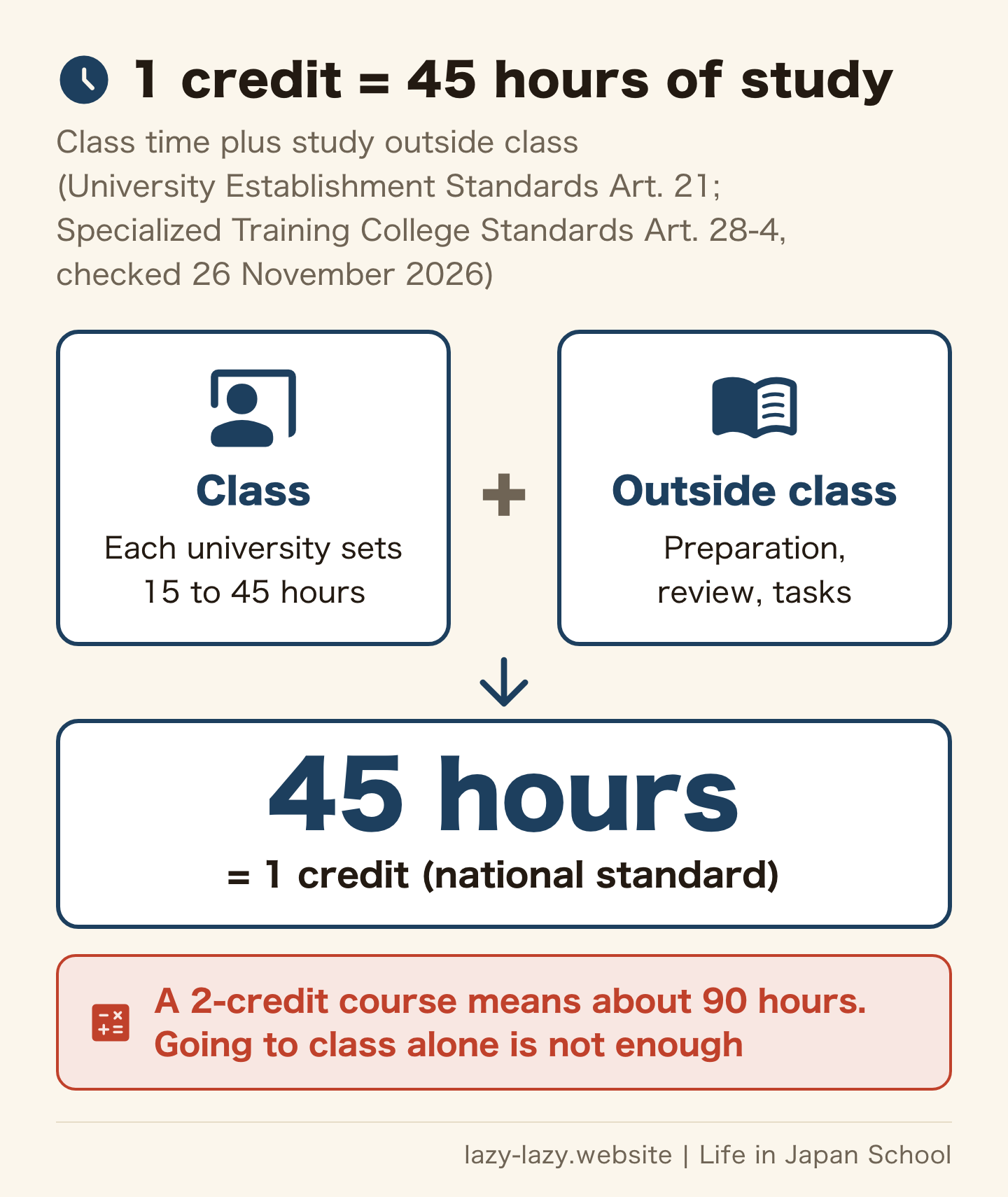
So a 2-credit course means about 90 hours of study. Your homework and review count toward the credit, not just your time in class.
Going to class is not enough on its own. The national rule says schools give credit after checking what you learned, for example with an exam. How each course checks this is written in its syllabus.
How many credits do you need to graduate in Japan? 124+ at university
A university degree needs at least 124 credits under the national rule. Medicine and dentistry need at least 188, 6-year pharmacy 186, and veterinary medicine 182. The length of study (shugyo nengen) is 4 years under the School Education Act. It is 6 years for medicine, dentistry, 6-year pharmacy and veterinary medicine. 124 credits over 4 years is 31 credits a year on average.
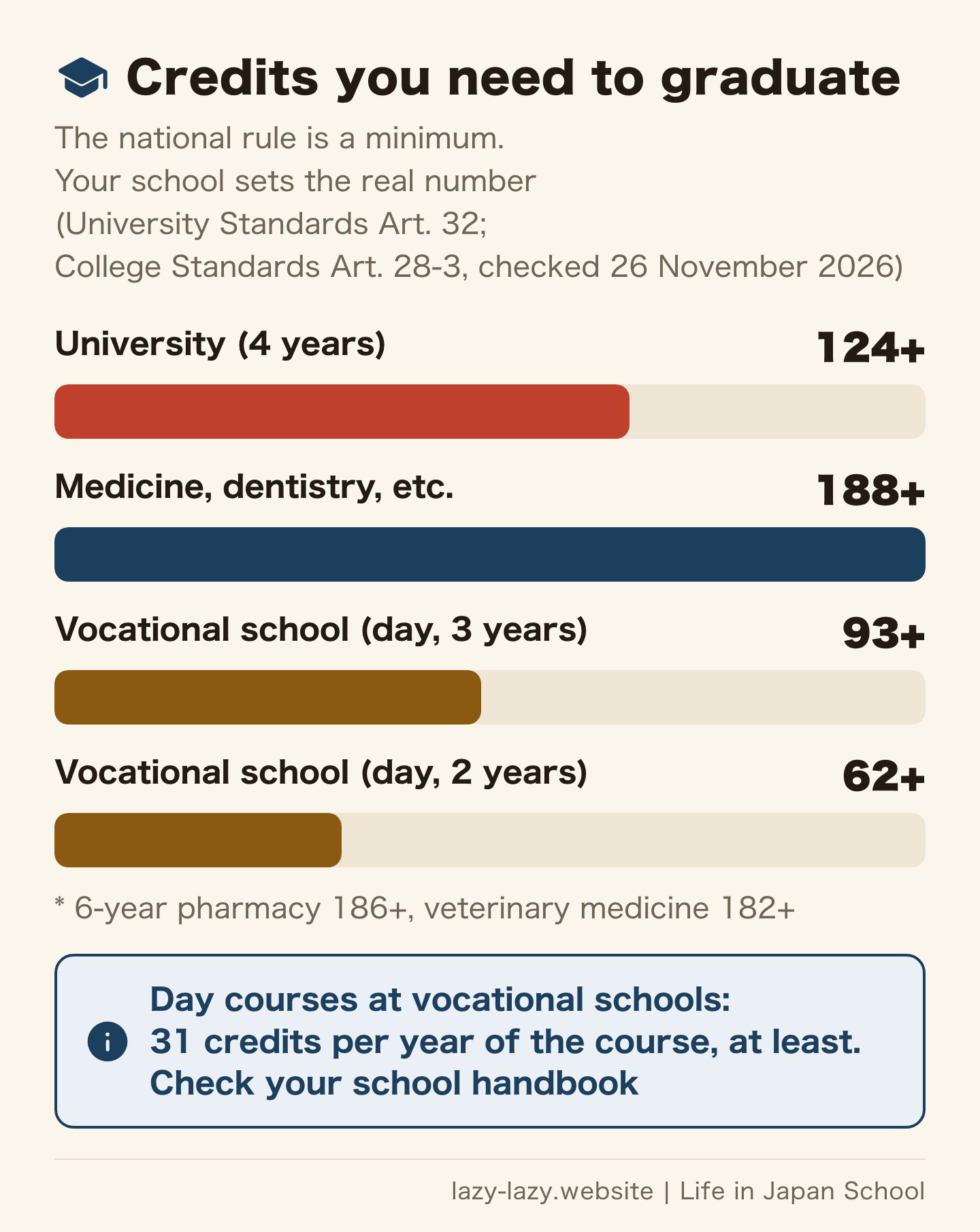
124 is the national minimum. The university sets the rest of the rules. Which courses you take, and how many from each group, is in the student handbook you get at entry.
At a vocational school: the national rule, then your handbook
Vocational schools (senmon gakko) have a national rule too. The Specialized Training College Standards ask day courses for at least 31 credits per year of the course. A 2-year course needs 62+, a 3-year course 93+. The 45-hour standard for 1 credit is the same as at university.
That is as far as the national rule goes. The rules for taking courses (rishu) are in each school’s handbook. When you start, ask the academic office: “How many credits do I need to finish? Which courses are required?” The JASSO study grant also covers regular (degree-course) students at vocational schools (senmon gakko) (JASSO). For choosing a school, see our guide to vocational schools in Japan.
Required vs elective courses: what is the difference?
University courses come in 3 types: required, elective and free. This split is also part of the national rule.
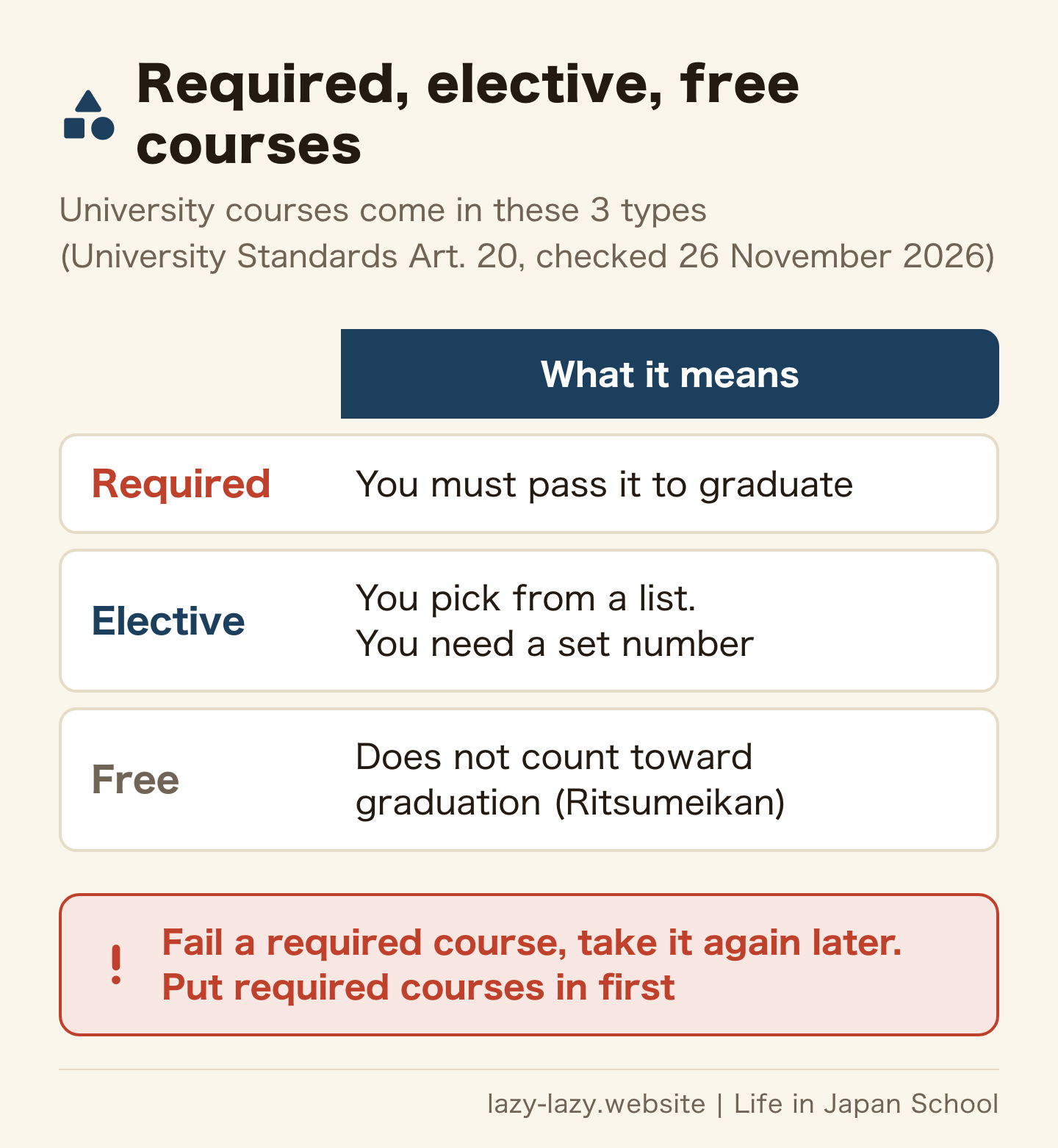
- Required (hisshu): you must pass it to graduate. If you fail, you take it again later.
- Elective (sentaku): you choose from a group. The rule says how many credits you need from that group.
- Free (jiyu): it does not count toward graduation. Ritsumeikan calls these courses that do not count toward graduation requirements.
Put required courses into your timetable first, then fill the gaps with electives. Check which courses are required in your faculty handbook.
What is course registration? Only registered courses count
You went to the first class and signed the attendance sheet. You thought that was enough. Where you come from, that may be how you join a class. In Japan, you usually register for each course yourself, online, in a set period. This is called course registration (rishu toroku).
You only get credit for registered courses. Ritsumeikan says you cannot take an unregistered course, so you cannot earn its credits. At some universities, a course you win in a lottery is registered for you (Tokyo University of Foreign Studies). Check the system screen to see that you are registered.
Registration has fixed dates. Here is the example of Tokyo University of Foreign Studies (TUFS), autumn 2026.
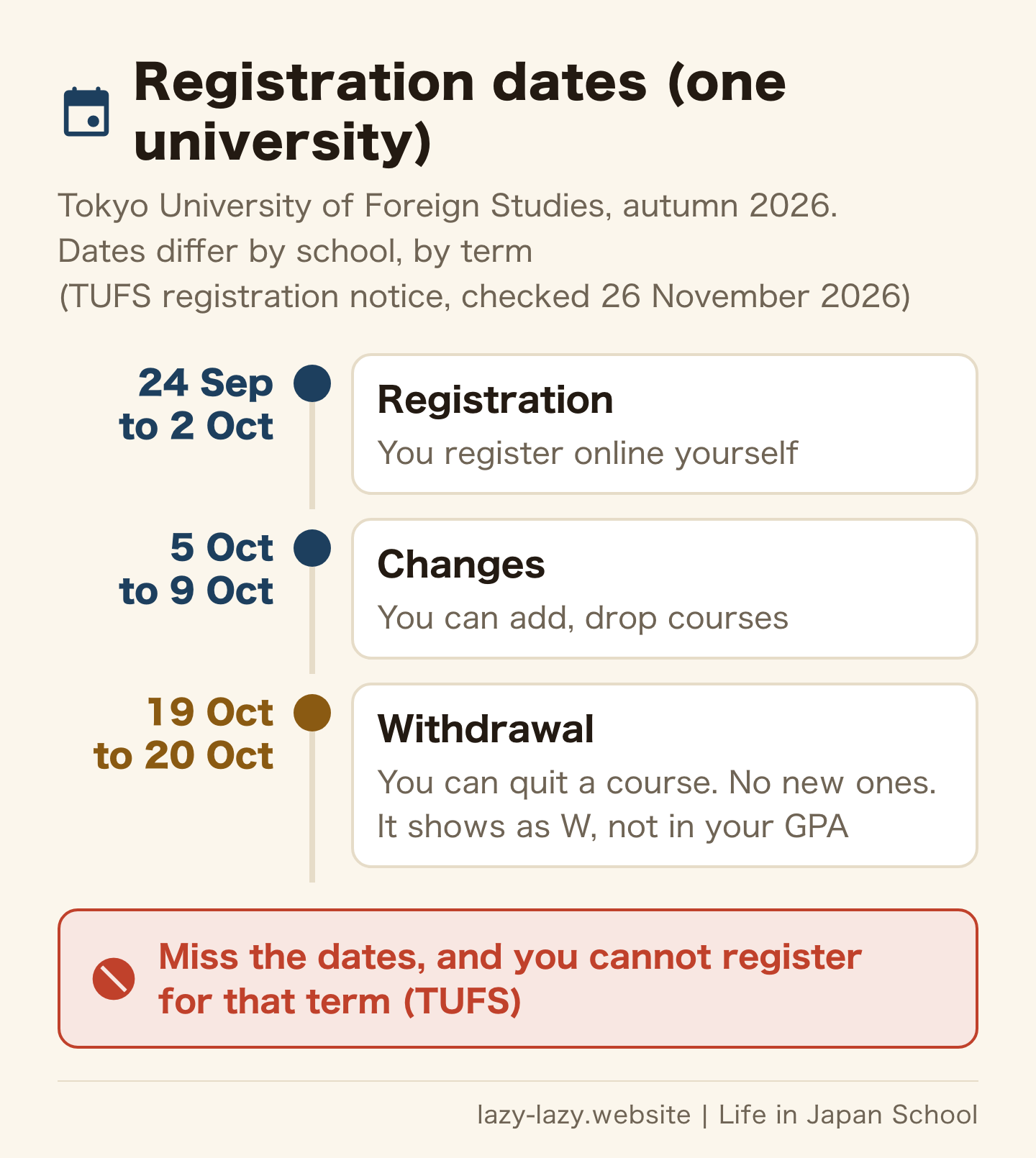
At this university, a change period follows registration. In it you can add and drop courses. Later comes a withdrawal period, when you can quit a course you registered for. A withdrawn course shows as “W” on your grades. It does not count in your GPA. Students who miss the dates cannot register for that term.
There is also a cap on credits. The national rule asks universities to try to set a limit per year, per term. It also lets them allow more for students with very good grades. TUFS has a rule called the “50 credits a year cap.” Because of caps like this, plan from your first year.
Popular courses may use a lottery before registration. At TUFS, basic seminars and some English courses use a lottery. The lottery comes before the main registration period. Check the dates as soon as you get your timetable.
Missed course registration? The change period, then the office
Dates are where students slip. At TUFS in autumn 2026, registration lasted 9 days and changes 5 days. Skip a notice in Japanese, and the period may be over when you notice.
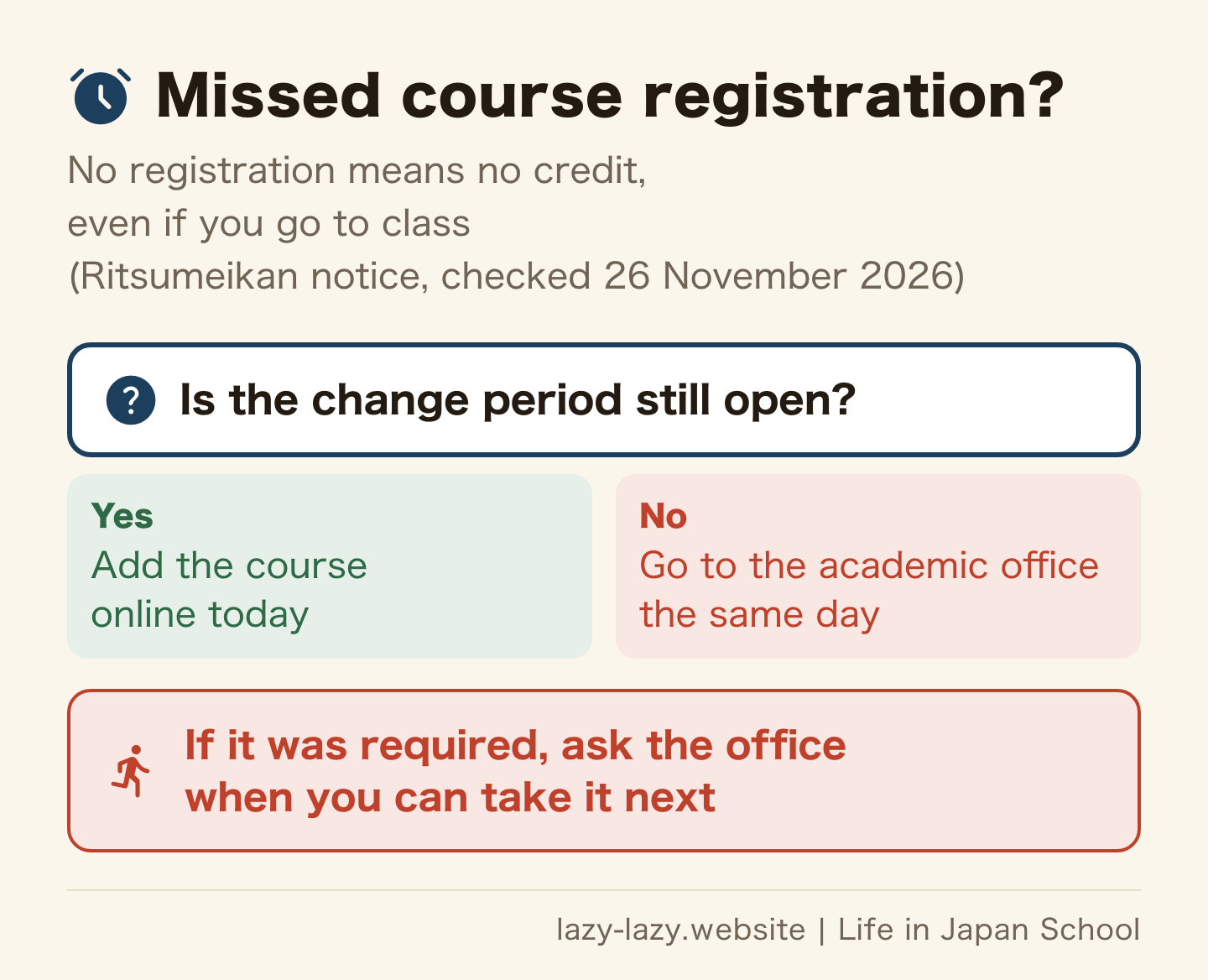
- If the change period is still open, add the course online today. Check the closing time too (for example, 16:59).
- If the change period is over, talk to the office without waiting. Only your school can decide on an exception.
- If the course was required, ask when you can take it next. You will also learn if your graduation will move.
At the office, one line is enough: “I missed registering for this course. Is there anything I can do now?” Bring your student ID and your timetable. If illness stopped you, bring those papers too. To tell a teacher by email, use our professor email templates.
Quitting a registered course also needs a step. Kobe University says if you stop going without a formal withdrawal in the withdrawal period, you get a fail. That fail counts in your GPA. A course you stop attending does not disappear by itself.
How to read a syllabus in Japan: always check the grading
A syllabus is the plan for each course. It says what you will learn and how you will be graded. The national rule asks universities to show students the method, content, yearly plan and grading rules in advance.
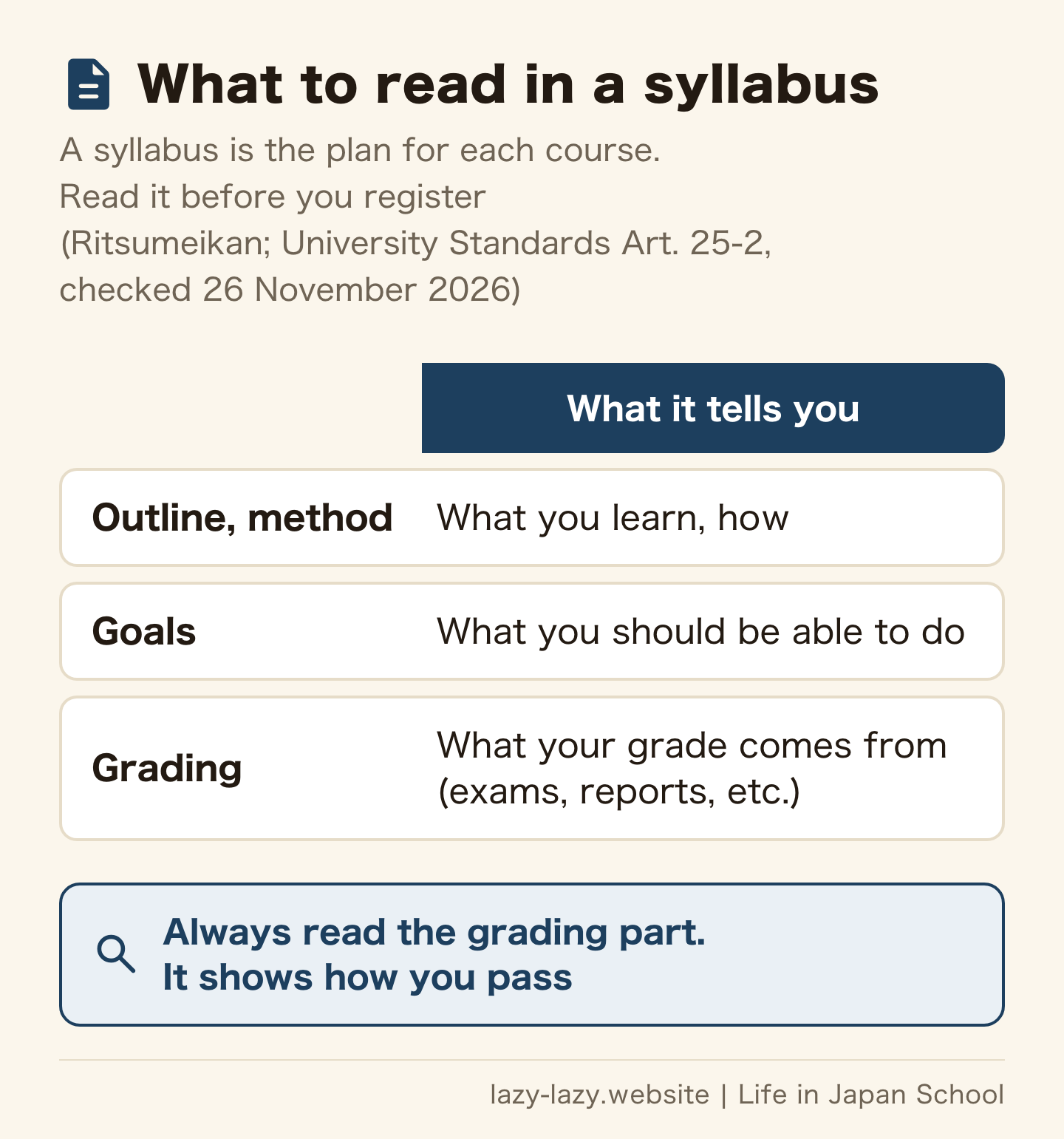
At Ritsumeikan, each syllabus lists the course outline and method, goals, and grading method. The university tells students to read it well before registering. Section names differ a little by school. What to look for stays the same.
- Grading: exam only, reports, quizzes? This is how you pass.
- Method: lectures, discussion, presentations? It shows how much Japanese you will speak.
- Goals: what you should be able to do at the end. Exam and report questions come from here.
Whether you may use AI, a translation tool for reports is often in the syllabus too. See our guide to report rules, AI use.
GPA in Japan: an average, but each school scores it differently
GPA (Grade Point Average) turns your grades into points and averages them by credits. Each school uses its own scale, so check the table in your student handbook.
For example, Ritsumeikan gives A+ 5 points, A 4, B 3, C 2 and F 0. Multiply each grade’s points by the course credits, add them up, then divide by the credits you registered for. The top GPA there is 5.
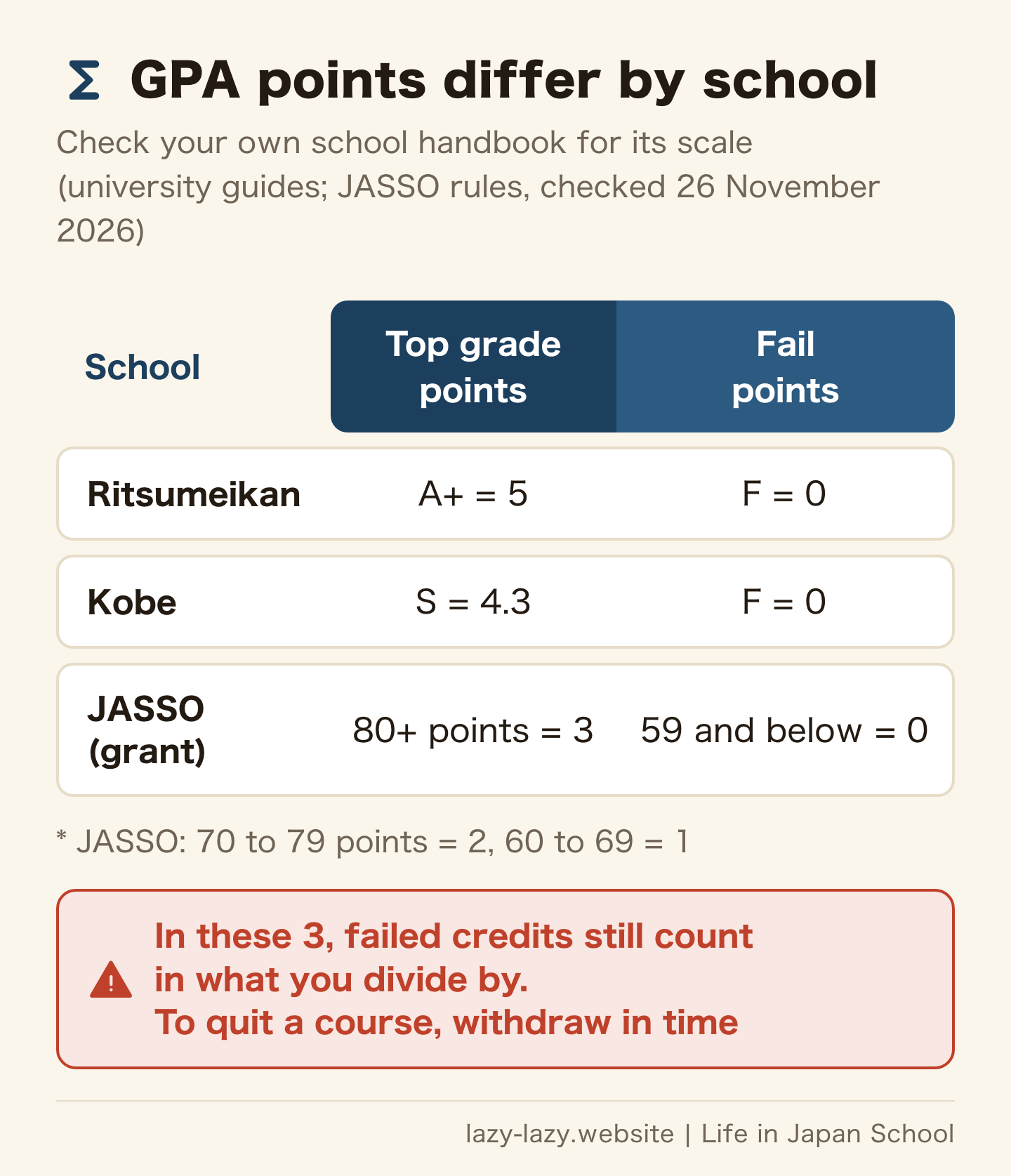
At Kobe University the top grade is 4.3 points. JASSO turns your school grades into its own 3-point scale. The average on that scale is called the grade score (seiseki hyoka keisu). A “GPA of 3.0” means different things on different scales.
In these 3, failed credits stay in the number you divide by. So a failed course pulls your GPA down. At Kobe, if you retake the course, the old fail usually leaves the formula (some faculties differ). Ritsumeikan puts neither GPA nor F grades on the transcript.
Failing credits, repeating a year: what happens to your student visa?
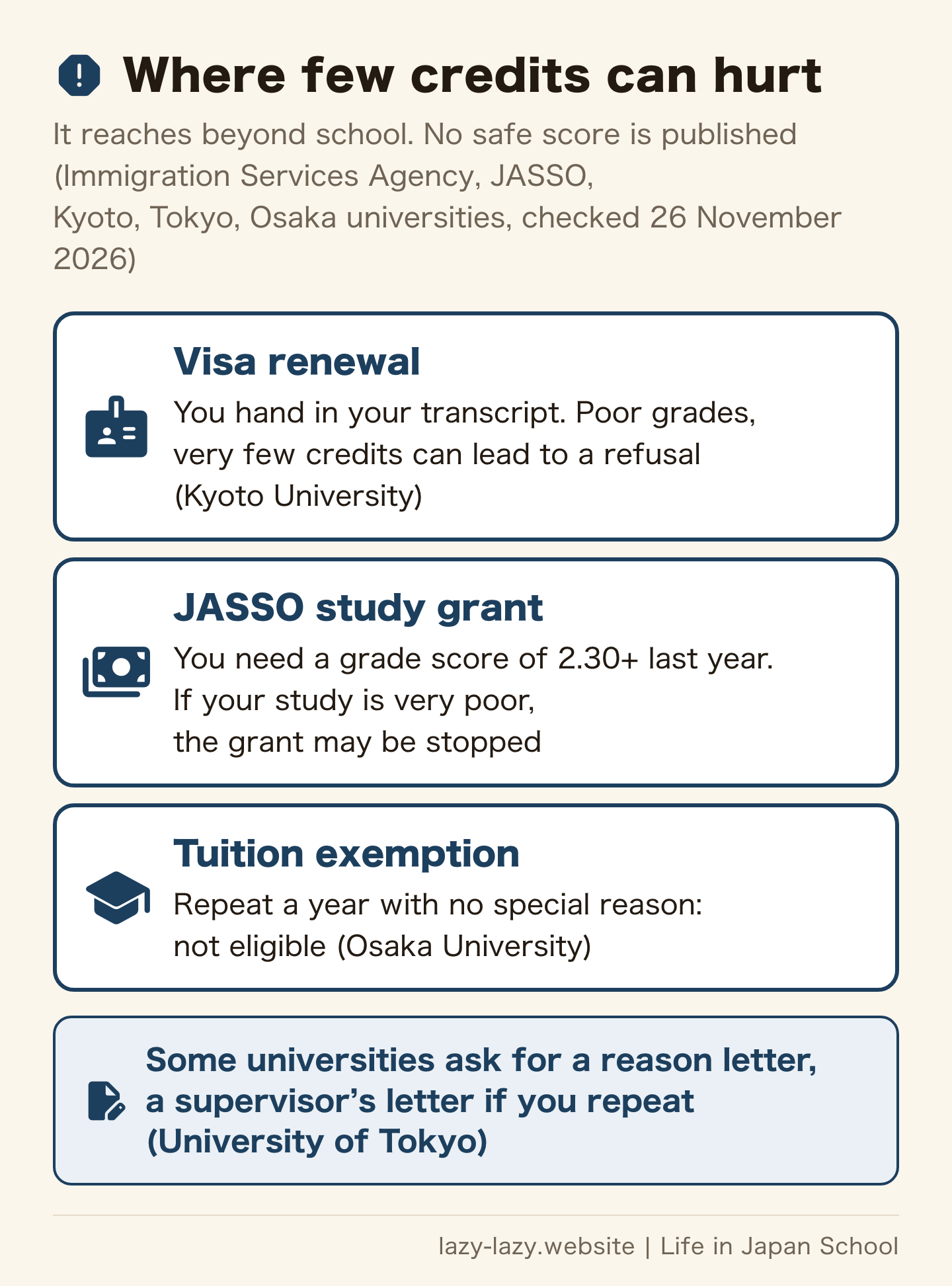
Repeating a year (ryunen) means you do the same year again, because you could not move up on time. Few credits can matter outside school too.
Visa renewal: your transcript goes to immigration
When you renew a Student visa, you hand in your transcript. The Immigration Services Agency document list names an attendance certificate (if the school issues one), a transcript and a graduation certificate.
Kyoto University warns that poor grades and very few credits can mean a renewal is refused. The University of Tokyo asks students with poor credits, and students who repeat a year, for a clear reason letter. It also asks for a letter from their supervisor. Immigration publishes no pass mark for credits and GPA. For the full list and timing, see our student visa extension guide.
Grants: the JASSO study grant needs 2.30+
The JASSO study grant needs a grade score of 2.30+ for the last school year. You must also be likely to keep it while you receive the grant. JASSO’s rules say your school reports very poor study, and then the grant may be stopped. For how to apply, see our JASSO scholarship guide.
Attendance also appears in your renewal papers. See how attendance is counted. If illness keeps you away for long, check the leave of absence rules first. For tuition exemption, Osaka University excludes students who stay in the same year with no special reason. To compare other schools, see our tuition exemption guide.
Not sure? Who to ask at a Japanese university
Credit rules and registration rules can differ by faculty. If you ask the right place, you get an answer faster.
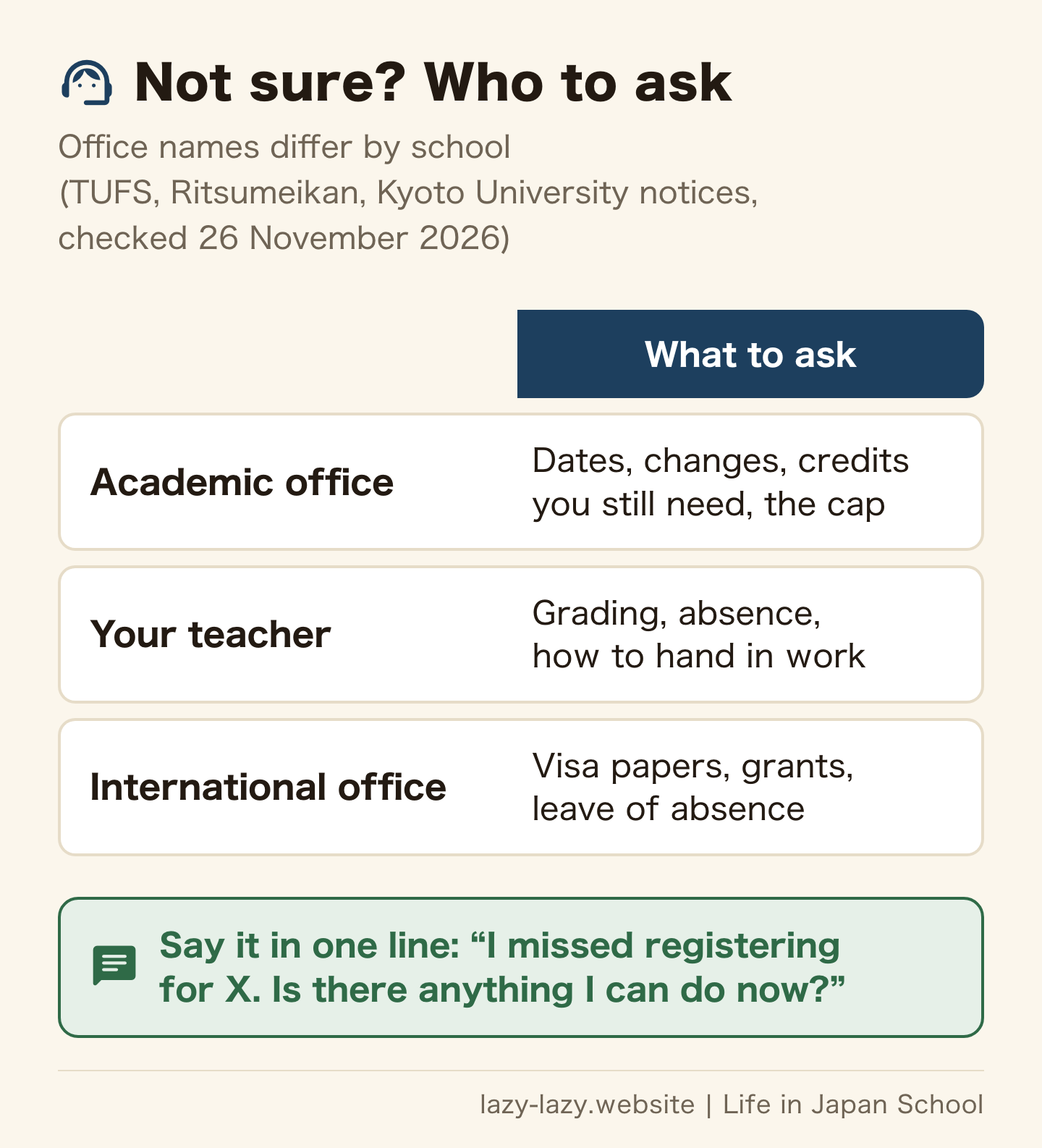
- Academic office: dates, changes, credits you still need, the cap. TUFS calls it kyomuka. Ritsumeikan calls it the faculty office.
- Your teacher: how you are graded, absences, how to hand in work. Ask what the syllabus does not say.
- International office: visa papers, grants, leave of absence. Kyoto University asks students to report any change in residence status to their faculty office.
Before you go, write down one question at a time. Make each one a single line: “How many more credits do I need?” “Is this course required?” Keep the answers in a note.
Which one are you?
- Starting soon: find the registration and change dates on your school’s site. Put them in your calendar today.
- Registration is open now: check required courses in your handbook and put them in first. Save the confirmation screen today.
- Missed registration: if the change period is open, add the course online first. If not, take your student ID and timetable to the academic office the same day.
- Worried about credits: count your earned credits on the grade page. Find the gap to graduation. If it is short, ask the office about next term today.
FAQ
Q. What is a credit at a Japanese university?
It is the number your school gives you when you pass a course. By national standard, 1 credit equals 45 hours of study. That means class time and study at home together.
Q. How many credits do you need to graduate in Japan?
At least 124 at university, by national rule. Medicine and dentistry need 188+, 6-year pharmacy 186+, veterinary medicine 182+. Your faculty sets the real number and the required courses, so check your handbook.
Q. What happens if I miss course registration?
A course that is not registered gives no credit, even if you attend. If the change period is open, add it now. If not, ask the office what you can still do.
Q. What is GPA in Japan?
It turns your grades into points, then averages them by registered credits. The top is 4.3 at Kobe and 5 at Ritsumeikan. At Kobe and Ritsumeikan, failed courses count in the credits you divide by.
Q. Does failing credits affect my student visa renewal?
Your transcript is part of the renewal papers. Poor grades and very few credits can mean a refusal (Kyoto University guide). No pass mark is published.
Q. What if I fail a required course?
You need it to graduate, so you take it again. Ask the academic office when it runs next.
Summary
Credits measure study time, and you need the number your school sets to graduate. Those credits only come from courses that are registered. GPA is your average grade, and every school has its own scale. Few credits can also affect your visa renewal papers and your grant.
Today, look up your school’s next registration and change dates, and put them in your calendar. Count the credits you still need too. It makes next term’s timetable easier to plan.
Official sources: University Establishment Standards (e-Gov), Art. 20, 21, 25-2, 27, 27-2, 32 / Specialized Training College Standards, Art. 28-3, 28-4 / School Education Act, Art. 87 / Immigration Services Agency, renewal document list (Student, universities) / JASSO, study grant page / JASSO, study grant rules / Ritsumeikan, course registration / Ritsumeikan, grading, GPA / Kobe University, About GPA / TUFS, autumn 2026 registration / Kyoto University, residence procedures / University of Tokyo, visa extension / Osaka University, tuition exemption guide (autumn 2026)
Related reading
Found this useful? Share it
Send it to a friend who lives in Japan.
WHO WROTE THIS

mori
Japanese. I read the ministries’ own notices, orders and Q&As in the original, and I start from what my Nepalese and Sri Lankan friends in Japan actually ran into. I do not write about what I have not checked or been told.
What this site can and cannot do →Looking for something else?
You may use the figures in this article, including commercially, if you credit this site with a link. How to use our figures