Checked on 24 November 2026 against official university guides on writing emails (6 schools), university guides on asking for a recommendation letter (2 schools), and the government Guidelines on Keigo. The sources are listed at the end. The example emails are our own, based on these sources.
The short answer
- An email to a professor in Japan has 6 parts, in this order: subject, name of the reader, greeting with who you are, message, closing, signature. Four university guides share this shape.
- Make the subject say what the email is about. 「質問」 (question) alone is not enough. Some universities warn that an email with no subject may be deleted unread.
- Send it from your school email address. End with a signature: your name, school name, faculty, year and student number.
- Ask, do not tell. Write 「〜していただけますでしょうか」 (could you…?) instead of 「〜してください」 (please do…). The professor decides.
- No guide we read says how many days to wait for a reply. If none comes, check that your email went out. Then send one more email.
Knowing this, a question, a deadline request and a recommendation letter request all use the same 6 parts. You only change the message. You will not freeze, worry about being rude, and miss a deadline.
Jump to what you need
It is 11 p.m. You do not understand the report topic, and you want to ask your professor. You open your email. You cannot write even the first line. Is 「こんにちは」 OK? Does your name go first? Your Japanese friend says, “Just ask normally.” But “normal” is the part you do not know. So you leave the subject empty and write only 「レポートが分かりません」 (I don’t understand the report). No reply comes.
- How do you email a professor in Japanese? The 6 parts, in order
- How do you write the subject line? Make it clear before they open it
- How do you start an email in Japanese, then end it?
- Template 1: asking a question about a class
- Template 2: asking for a deadline extension
- Template 3: asking to visit a lab or seminar
- Template 4, a recommendation letter: ask early (Rikkyo: 2 weeks ahead)
- Template 5: a thank-you reply. Keep “Re:”, keep it short
- No reply from your professor? Check first, then send once more
- What is the best time to email a Japanese professor?
- Email vs LINE: finish the whole message in one email
- What not to do: no subject, no name, “kudasai”
- Not sure about your Japanese? Get it checked before you send
- Which one are you?
- FAQ
- Summary
- Related reading
How do you email a professor in Japanese? The 6 parts, in order
First, three places where students often slip: no subject, no name, no signature at the end. One university says writing about yourself without saying who you are “lacks courtesy” (Seirei Christopher University).
The order is fixed. Kanda University of International Studies’ student office lists the body as: name of the reader, greeting, who you are, main point, details, closing, signature. Add the subject, join a few steps, and you get 6 parts.
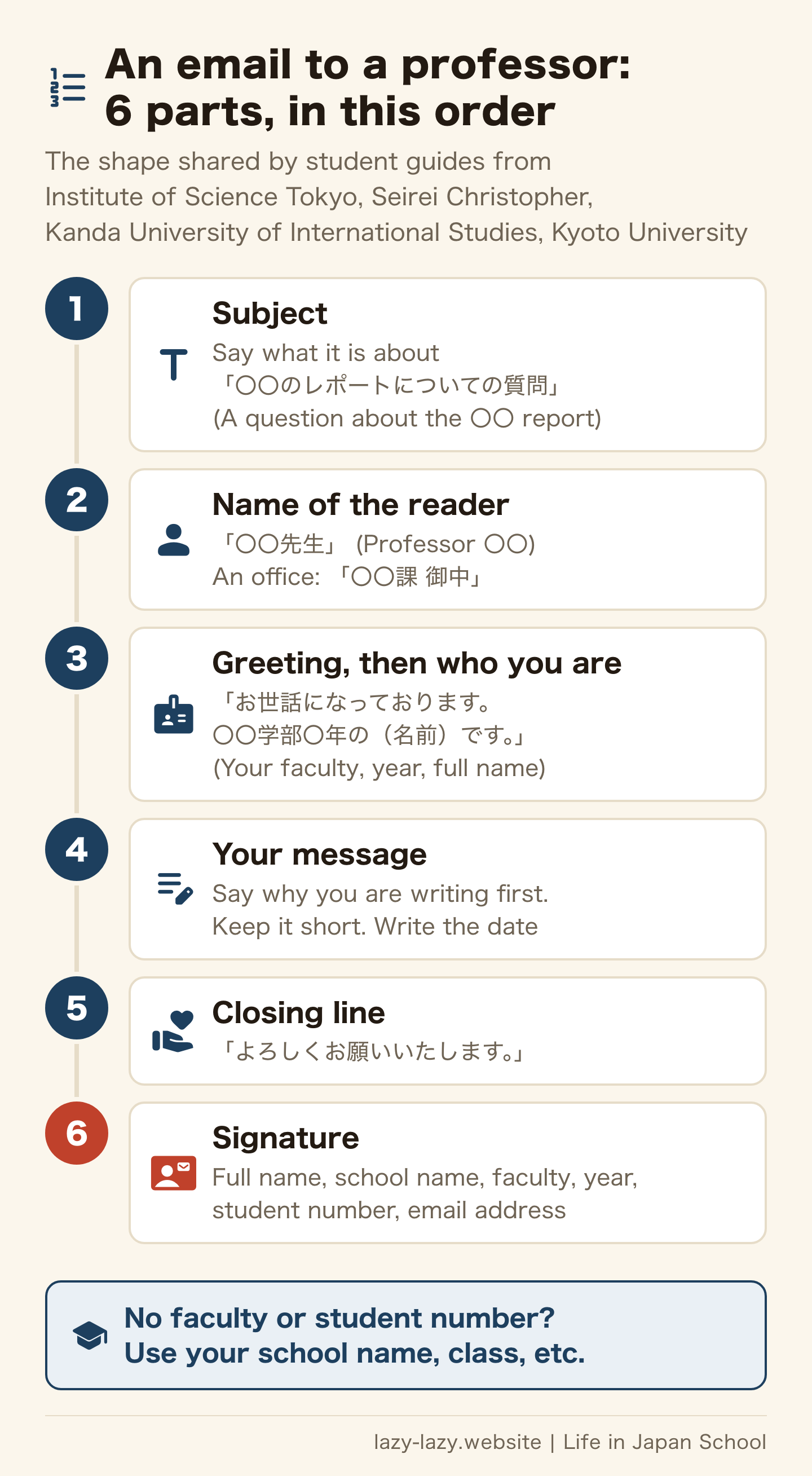
Why your school address? Institute of Science Tokyo’s guide says a university address makes clear you are a student there. From a phone address with no signature, the professor cannot tell who you are.
Faculty, year and student number are for university students. If you are not one, swap them like this. Do the same with 〇〇学部〇年 in the templates below.
- Japanese language school, vocational school: your school name, class, student number if you have one.
- Before you enroll: your current school or workplace.
- No school email: send from your usual address. Make your name clear in the body and the signature.
First check your school’s rules on how to contact teachers.
How do you write the subject line? Make it clear before they open it
The subject is the first line your professor sees in the inbox. Professors get many emails, so a clear subject helps them tell yours apart from spam (Seirei Christopher University). Institute of Science Tokyo says an email with no subject may be deleted without being read.
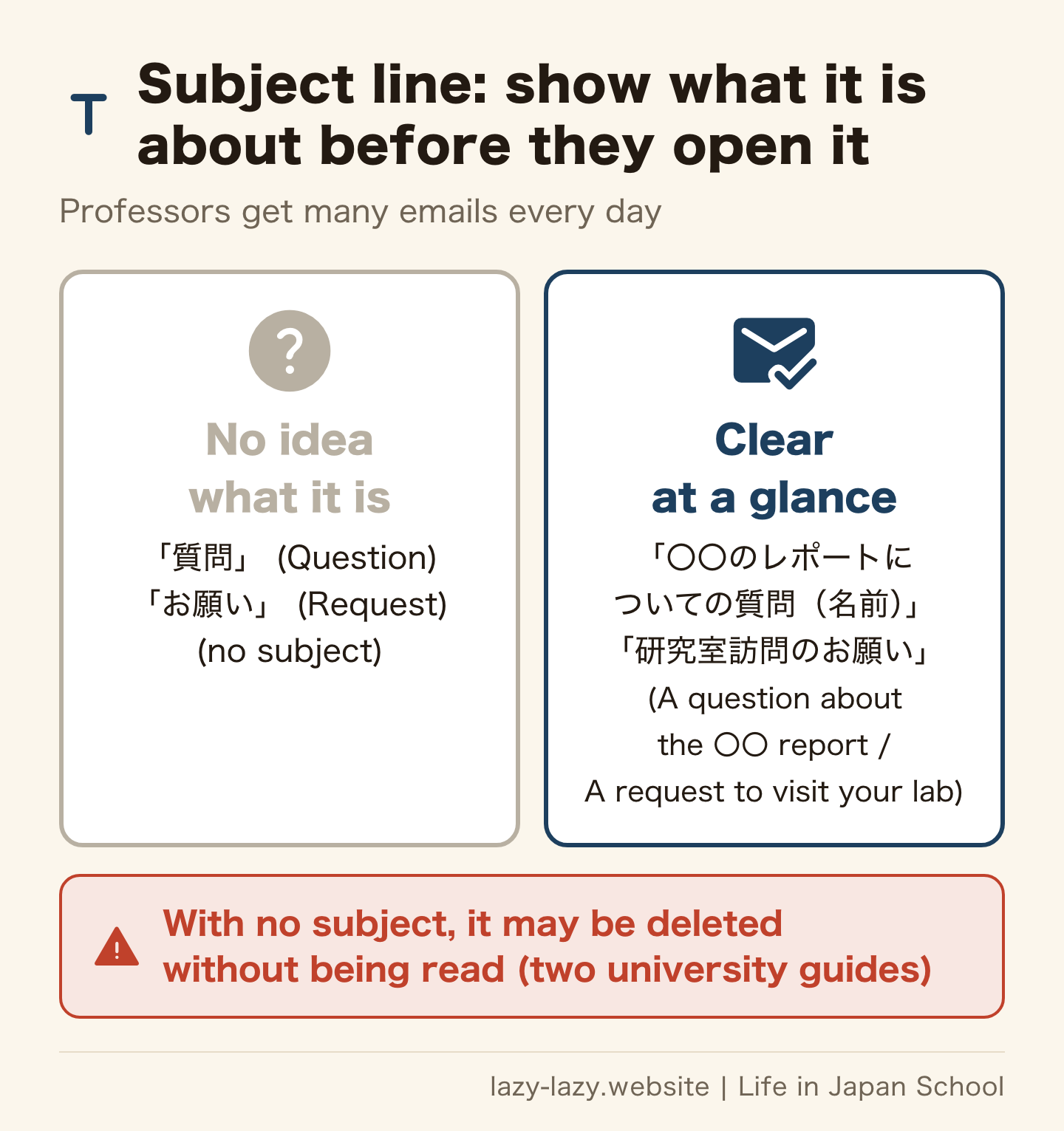
Put in the class and what the email is about. For example: 「〇〇のレポートについての質問」 (a question about the 〇〇 report). Seirei Christopher, Shizuoka and Rikkyo universities show examples with your student number or name at the end.
The first line of the body is the reader’s name. For a professor, write 「〇〇先生」 (Professor 〇〇). For an office, add 「御中」 (a word for writing to an office or a company, not a person) to the office name. For example: 「学生支援課 御中」 (Student Support Office). If you know the person’s name, write 「〇〇課 〇〇様」.
Check the kanji of your professor’s name before you send. A wrong name, even a typing slip, is very rude (Kanda University of International Studies).
How do you start an email in Japanese, then end it?
After the name comes a greeting and who you are. 「お世話になっております。」 (close to “thank you for your help”) is enough. Kyoto University’s email course calls it a phrase that works everywhere. You do not need a seasonal greeting.
For a professor you have never written to, use 「はじめてご連絡いたします。」 (I am writing to you for the first time). Then say who you are: 「〇〇学部〇年の(名前)です。」 (I am (name), a (year) student in (faculty)). For a class, add 「水曜2限の『〇〇』を受講しています。」 (I take “〇〇” on Wednesday, 2nd period).
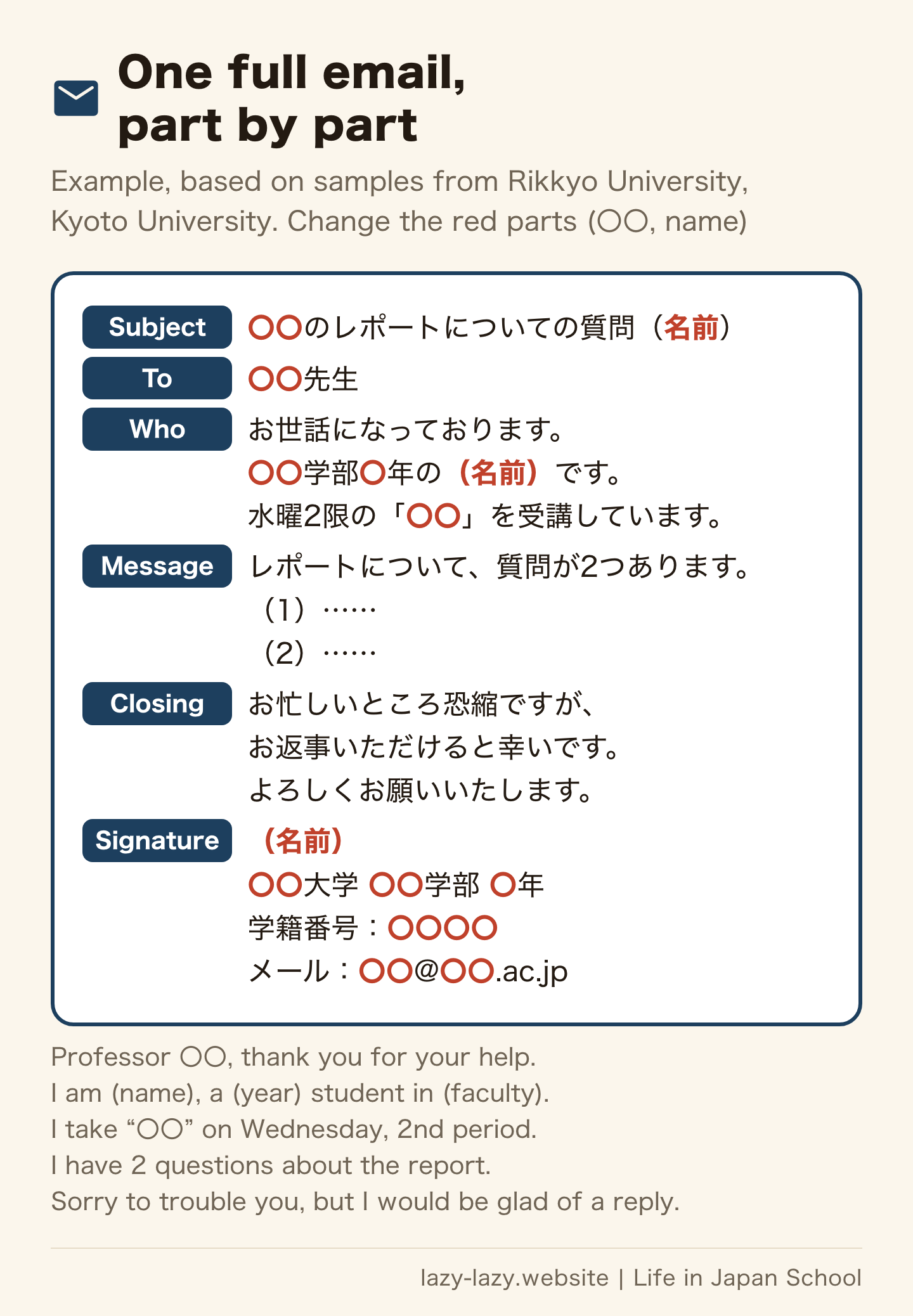
To end the email, write 「よろしくお願いいたします。」 (thank you in advance). If you need a reply, add this line before it: 「お忙しいところ恐縮ですが、お返事いただけると幸いです。」 (I am sorry to trouble you, but I would be glad of a reply). 「恐縮」 means feeling sorry to trouble someone. 「幸い」 means you would be glad if they did it. Rikkyo University’s sample ends with a similar line.
One difference to remember. When you want an answer, write 「お返事いただけると幸いです」 (I would be glad of a reply). When you ask the professor to think and decide, like a deadline extension or a letter, write 「ご検討いただけると幸いです」 (I would be glad if you could consider it).
The signature is your name tag at the bottom. List your full name, school name, faculty, year, student number and email address. Add it every time, even if you gave your name at the top. Save it in your mail settings once, and it is added for you. Seirei Christopher University also tells students to set up Gmail’s automatic signature.
Template 1: asking a question about a class
A good question email lets the professor answer right away. Kyoto University’s course says to write the date, like 「〇月〇日の授業」 (the class on 〇 〇), not 「今日の授業」 (today’s class). You cannot know when the professor will read it. If you have two or more questions, number them.
In the templates, the red parts are the ones you change.
(Example) 件名:〇〇の授業の〇〇についての質問(名前)
〇〇先生
お世話になっております。〇〇学部〇年の(名前)です。
先生の「〇〇」を受講しています。
〇〇について、質問があってご連絡しました。
〇月〇日の授業で、〇〇までは分かりました。
その後の〇〇が分かりませんでした。
次の授業の後に、少しお時間をいただけますでしょうか。
よろしくお願いいたします。
(署名)
Subject: A question about 〇〇 in the 〇〇 class (name)
Professor 〇〇,
Thank you for your help. I am (name), a (year) student in (faculty). I take your class “〇〇”.
I am writing with a question about 〇〇. In the class on (date), I understood up to 〇〇. I did not understand the part after that. Could I have a little of your time after the next class?
Thank you.
(Signature)
The key line is the last request, 「いただけますでしょうか」 (could I…?). Kyoto University’s course says 「〜してください」 sounds one-sided. A question form leaves the choice to the professor.
Template 2: asking for a deadline extension
Whether you get more time is up to the professor and the class rules. So write it as a request. The government Guidelines on Keigo (in Japanese) say asking puts a load on the other person. They suggest an opener like 「すみませんが」 (sorry, but) and soft forms like 「お願いできますか」 (could I ask…?).
(Example) 件名:〇〇のレポートの提出期限についてのお願い(名前)
〇〇先生
お世話になっております。〇〇学部〇年の(名前)です。
〇〇のレポートの提出期限について、お願いがあってご連絡しました。
期限は〇月〇日ですが、熱が出て〇日間休んだため、間に合いそうにありません。
〇月〇日まで延ばしていただくことはできますでしょうか。
ご迷惑をおかけして申し訳ありません。
お忙しいところ恐縮ですが、ご検討いただけると幸いです。
(署名)
Subject: A request about the 〇〇 report deadline (name)
Professor 〇〇,
Thank you for your help. I am (name), a (year) student in (faculty).
I am writing with a request about the deadline for the 〇〇 report. The deadline is (date), but I was off sick with a fever for (number) days, so I may not finish in time. Could you possibly extend it to (date)? I am sorry for the trouble.
I would be grateful if you could consider it.
(Signature)
Write three things: the deadline, the reason, and the new date you ask for. Send it before the deadline passes. If you were sick, say whether you can give a doctor’s note.
Telling school on the morning you are absent is a different message. For that, see how to tell school you’re absent or late in Japanese.
Template 3: asking to visit a lab or seminar
A lab visit email is often your first email to that professor. The subject 「研究室訪問のお願い」 (a request to visit your lab) works, as in Institute of Science Tokyo’s example. To ask for a meeting time, Kyoto University’s course offers 「ご都合の良い時間をご教示いただけますでしょうか」 (could you tell me a time that suits you?). 「ご教示」 means telling or teaching.
(Example) 件名:研究室訪問のお願い(〇〇大学・名前)
〇〇先生
はじめてご連絡いたします。〇〇大学〇〇学部〇年の(名前)と申します。
先生の〇〇の研究に関心があり、研究室を訪問させていただきたく、ご連絡しました。
(関心を持った理由を2〜3行)
ご都合のよい日時を教えていただけますでしょうか。
私は次の日時でしたら伺えます。
・〇月〇日(〇)〇時〜〇時
・〇月〇日(〇)〇時〜〇時
お忙しいところ恐縮ですが、よろしくお願いいたします。
(署名)
Subject: A request to visit your lab (university, name)
Professor 〇〇,
I am writing to you for the first time. My name is (name), a (year) student in (faculty) at (university).
I am interested in your research on 〇〇, and I would like to visit your lab. (2–3 lines on why.) Could you tell me a day and time that suits you? I am free at these times: (date, time) / (date, time).
I am sorry to trouble you. Thank you.
(Signature)
Give 2–3 times you are free. Then the professor only needs to pick one. For a seminar visit, change the subject to 「ゼミ見学のお願い」 (a request to visit your seminar).
Some universities need a professor to accept you before you apply as a research student. See research students in Japan for how that works.
Template 4, a recommendation letter: ask early (Rikkyo: 2 weeks ahead)
A recommendation letter takes the professor’s time. Rikkyo University’s scholarship guide says it is best to ask 2 weeks before you need it. Nagoya Institute of Technology’s request form says to allow at least about 5 days for the professor to write it.
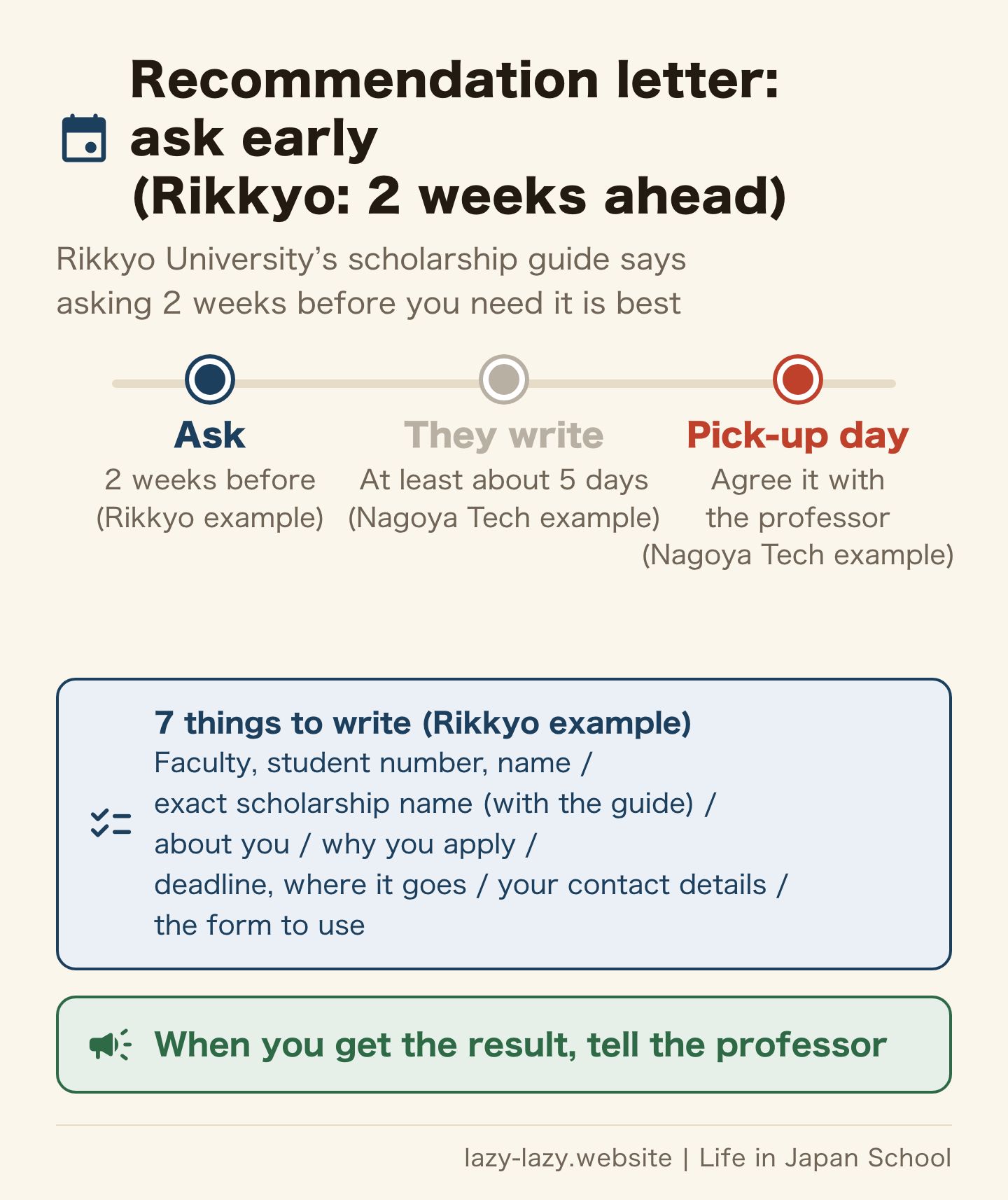
Rikkyo’s guide also lists 7 things to tell the professor. Put all 7 in your email.
(Example) 件名:推薦書作成のお願い(〇〇奨学金・名前)
〇〇先生
お世話になっております。〇〇学部〇〇学科〇年の(名前)です。学籍番号は〇〇です。
〇〇奨学金に応募するため、推薦書を書いていただけないかと思い、ご連絡しました。
・奨学金の正式名称:〇〇(募集要項を添付します)
・応募する理由:〇〇
・私について:〇〇の研究をしています。
・提出期限と提出先:〇月〇日までに〇〇へ
・推薦書の様式:添付のとおりです
・連絡先:〇〇@〇〇.ac.jp/電話 〇〇
お忙しいところ大変恐縮ですが、ご検討いただけますでしょうか。
(署名)
Subject: A request for a recommendation letter (scholarship, name)
Professor 〇〇,
Thank you for your help. I am (name), a (year) student in (department, faculty). My student number is 〇〇.
I am applying for the 〇〇 scholarship, and I am writing to ask if you could write a recommendation letter. Scholarship name: 〇〇 (guide attached). Why I apply: 〇〇. About me: I research 〇〇. Deadline: send to 〇〇 by (date). Form: attached. Contact: email, phone.
I am very sorry to trouble you. Could you consider it?
(Signature)
When the result comes, tell the professor, pass or fail. Rikkyo’s guide asks students to report the result to the professor who wrote the letter.
Template 5: a thank-you reply. Keep “Re:”, keep it short
When the professor replies, send one thank-you email. Do not change the subject. Just press reply. Kanda University of International Studies and Kyoto University both say to keep the “Re:” subject. A new subject breaks the thread in the professor’s inbox.
(Example) 件名:Re: 〇〇の授業の〇〇についての質問(名前)
〇〇先生
〇〇について質問させていただいた〇〇学部〇年の(名前)です。
お忙しいところ、お返事ありがとうございました。
次の授業で伺います。
(署名)
Subject: Re: A question about 〇〇 in the 〇〇 class (name)
Professor 〇〇,
This is (name), a (year) student in (faculty), who asked you about 〇〇.
Thank you for your reply. I will come to see you at the next class.
(Signature)
If the answer was enough, a short thank-you is all you need. Kyoto University also gives 「ご対応ありがとうございます。取り急ぎ、お礼のみ失礼します。」 (thank you for your help; just a quick note of thanks). Say who you are in every reply.
No reply from your professor? Check first, then send once more
None of the university guides we read says how many days to wait. Before you count days, check the email you sent.
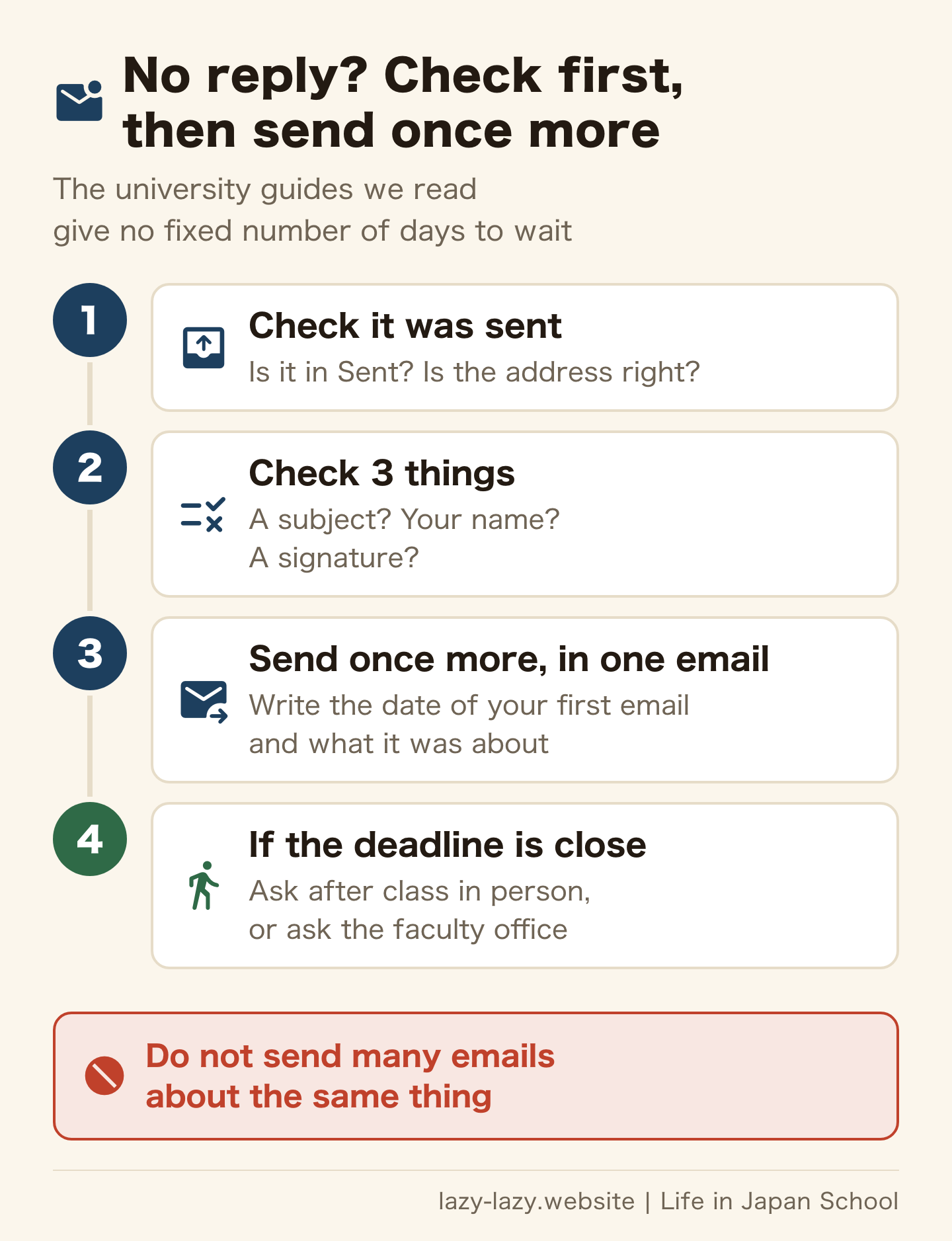
Start with your Sent folder. One wrong letter in the address, and the email never reaches the professor. Next, check the subject, your name and your signature. If something is missing, fix it and send again.
When you send again, quote your first email so it is all in one message.
(Example) 件名:〇〇のレポートについての質問(名前)
〇〇先生
お世話になっております。〇〇学部〇年の(名前)です。
〇月〇日に、〇〇のレポートについてメールをお送りしました。
届いていないかもしれないと思い、もう一度お送りします。
お忙しいところ恐縮ですが、ご確認いただけますでしょうか。
(署名)
(下に前のメールを引用)
Subject: A question about the 〇〇 report (name)
Professor 〇〇,
Thank you for your help. I am (name), a (year) student in (faculty).
On (date), I sent you an email about the 〇〇 report. In case it did not arrive, I am sending it again.
I am sorry to trouble you, but could you take a look?
(Signature)
(Quote your first email below.)
Do not send email after email about the same thing. Kyoto University’s course says to organise your message and cut needless back-and-forth. If the deadline is close and no reply comes, ask after class, or talk to your faculty office.
What is the best time to email a Japanese professor?
None of the guides we read sets a time. One example: a Shizuoka University student guide says not to send late at night or on holidays.
If you finish writing at midnight, send it in the morning. In Gmail, “Schedule send” lets you pick the time. Gmail Help says you can schedule up to 100 emails.
Email vs LINE: finish the whole message in one email
You message friends and teachers the same way, short and quick, in a chat app. Where you come from, that may be normal. In Japan, university guides treat an email to a professor differently from LINE. Institute of Science Tokyo’s guide says email, unlike LINE, has its own manners.
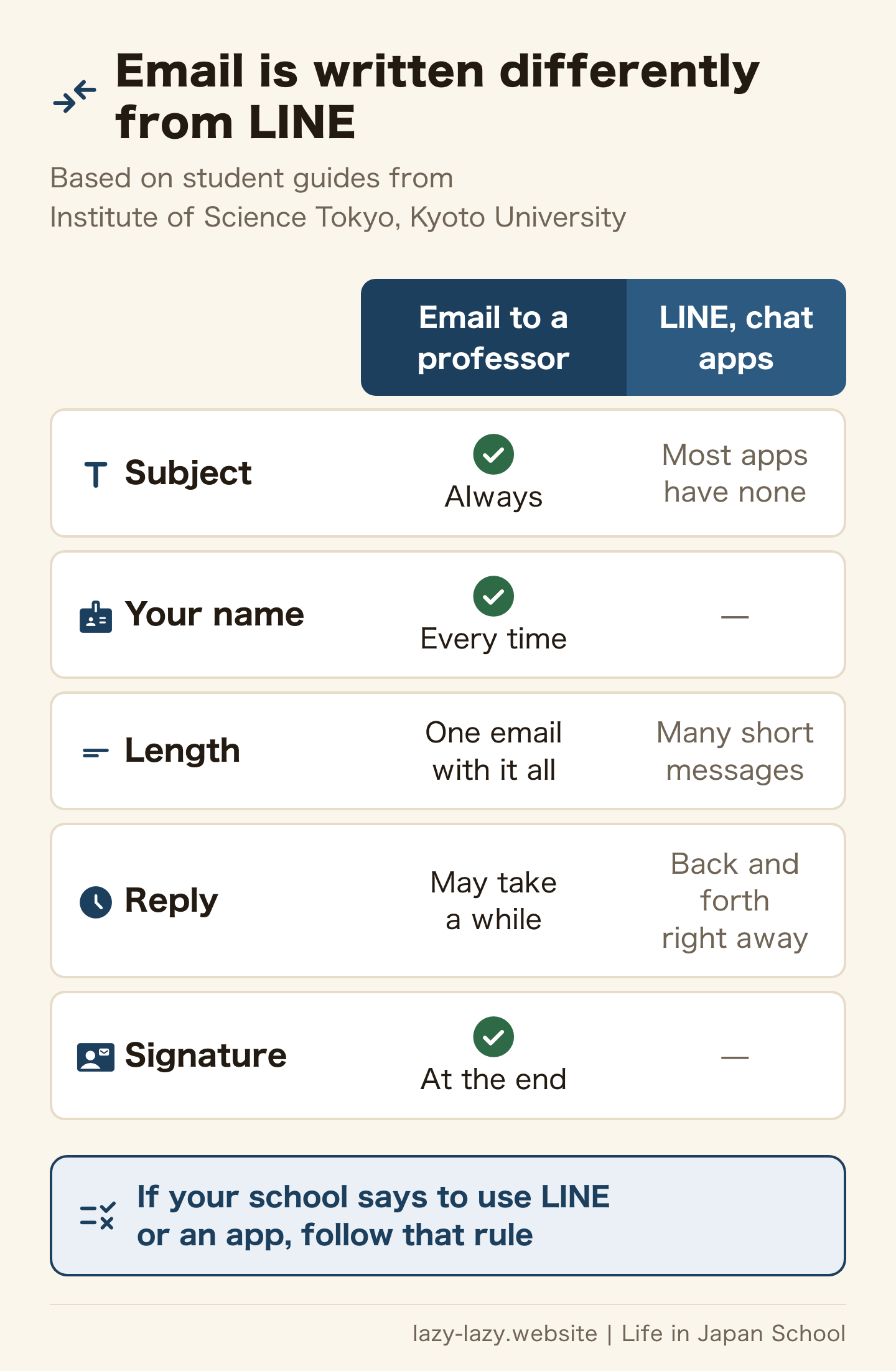
Kyoto University’s course also compares the two, as the writer’s own view: email is long, chat is short. You never know when the professor will read an email. So write it so one email says everything.
Some schools do use LINE or a school app with teachers. If yours does, follow your school’s rule.
What not to do: no subject, no name, “kudasai”
Here is what the university guides warn about, with a fix for each.
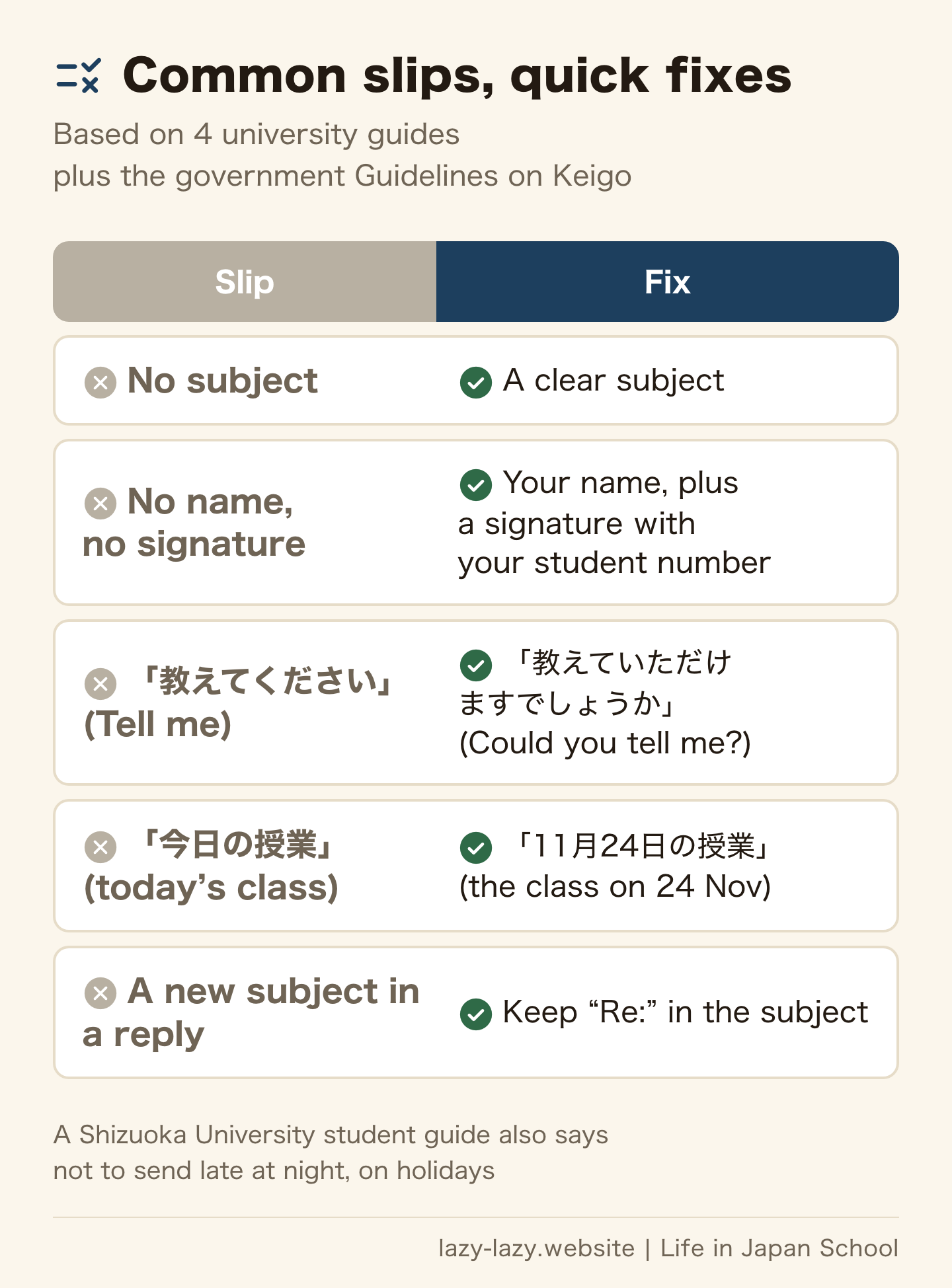
Kyoto University’s course adds two more. Before adding 【至急】 (urgent) or 【重要】 (important) to the subject, ask if it is urgent for the professor. And emoticons are best avoided. One university also says leaving out the reader’s name is rude (Seirei Christopher University).
The Guidelines on Keigo note criticism of a habit: people make emails short and drop keigo too. An email still has a person at the other end.
For how keigo itself works, see keigo vs casual Japanese.
Not sure about your Japanese? Get it checked before you send
Even with a template, the message part is in your own Japanese. If you have no one to read it, you can buy one-to-one Japanese lessons one at a time. italki showed 1,219 Japanese teachers available for lessons (checked 24 November 2026). No subscription is needed. Prices differ by teacher. Book a trial lesson first and say you want help with an email to a professor. Teaching style and fit vary from teacher to teacher. Find a Japanese teacher on italki (ad)
Which one are you?
- You have a question for your professor now — put the class and topic in the subject. Write the 6 parts in one email, with dates as dates.
- Your report will be late — before the deadline, write the deadline, the reason and the new date you ask for, as a request.
- You need a recommendation letter — check the deadline in your own university’s guide. Ask early, with all 7 details, and tell them the result later.
- You emailed but got no reply — check Sent, the address, the subject, your name, your signature. Then send one email that quotes the first.
- You have never emailed a professor — today, make a signature: name, school name, faculty, year, student number. Save it in your mail settings.
FAQ
Q. How do I start an email to a professor in Japanese?
After the subject, start the body with 「〇〇先生」 (Professor 〇〇). Then write 「お世話になっております。〇〇学部〇年の(名前)です。」 (thank you for your help; I am (name), a (year) student in (faculty)). For a first email, start with 「はじめてご連絡いたします。」 instead.
Q. Should I write 〇〇教授 or 〇〇先生?
All the university guides we read use 「〇〇先生」. For an office, write the office name plus 「御中」. If you know the staff member’s name, write 「〇〇課 〇〇様」.
Q. How do I end an email to a teacher in Japanese?
Write 「よろしくお願いいたします。」 (thank you in advance). If you need a reply, add 「お忙しいところ恐縮ですが、お返事いただけると幸いです。」 before it.
Q. My professor has not replied. How many days should I wait?
Before counting days, check the email you sent: Sent, the address, the subject, your name, your signature. Then send one more email that quotes the first one.
Q. Can I email my professor late at night?
None of the guides we read sets a time. A Shizuoka University student guide says not to send late at night or on holidays. If you write at night, you can schedule it for the morning, for example with Gmail’s “Schedule send”.
Q. How early should I ask for a recommendation letter?
It depends on the university and the scholarship, so check your own university’s guide. For example, Rikkyo University’s scholarship guide says it is best to ask 2 weeks before you need it.
Summary
An email to a professor in Japan has 6 parts, in this order: subject, name of the reader, greeting with who you are, message, closing, signature. A question, a deadline request, a lab visit and a recommendation letter all use the same shape. Only a few lines of the message change.
When in doubt, write requests as 「〜していただけますでしょうか」 (could you…?). Today, make your signature and save it in your mail settings. Next, read how to tell school you’re absent or late in Japanese, so you are ready for a sick morning too.
Official sources (in Japanese): Institute of Science Tokyo, email guide (PDF) / Seirei Christopher University, email guide for students (PDF) / Seirei Christopher University, basic email rules (PDF) / Kanda University of International Studies, student office email guide (PDF) / Kyoto University, email writing course (PDF) / Shizuoka University, student guide to emails (PDF) / Rikkyo University, Master of Writing: email manners (PDF) / Rikkyo University, notes on asking for a recommendation letter (PDF) / Nagoya Institute of Technology, recommendation request form (PDF) / Guidelines on Keigo (PDF) / Gmail Help: schedule emails (all checked 24 November 2026). Always check how to contact staff at your own school.
Related reading
Found this useful? Share it
Send it to a friend who lives in Japan.
WHO WROTE THIS
mori
Japanese. I read the ministries’ own notices, orders and Q&As in the original, and I start from what my Nepalese and Sri Lankan friends in Japan actually ran into. I do not write about what I have not checked or been told.
What this site can and cannot do →Looking for something else?
You may use the figures in this article, including commercially, if you credit this site with a link. How to use our figures