Checked on 21 November 2026. We used chapter 12 of the Immigration Services Agency’s guidebook for foreign residents, Seibu Railway, Tokyu and JR Hokkaido, the Japan Private Railway Association’s 2025 survey, Sapporo and Yokohama bus guides, and Saitama Prefecture’s escalator ordinance.
The short answer
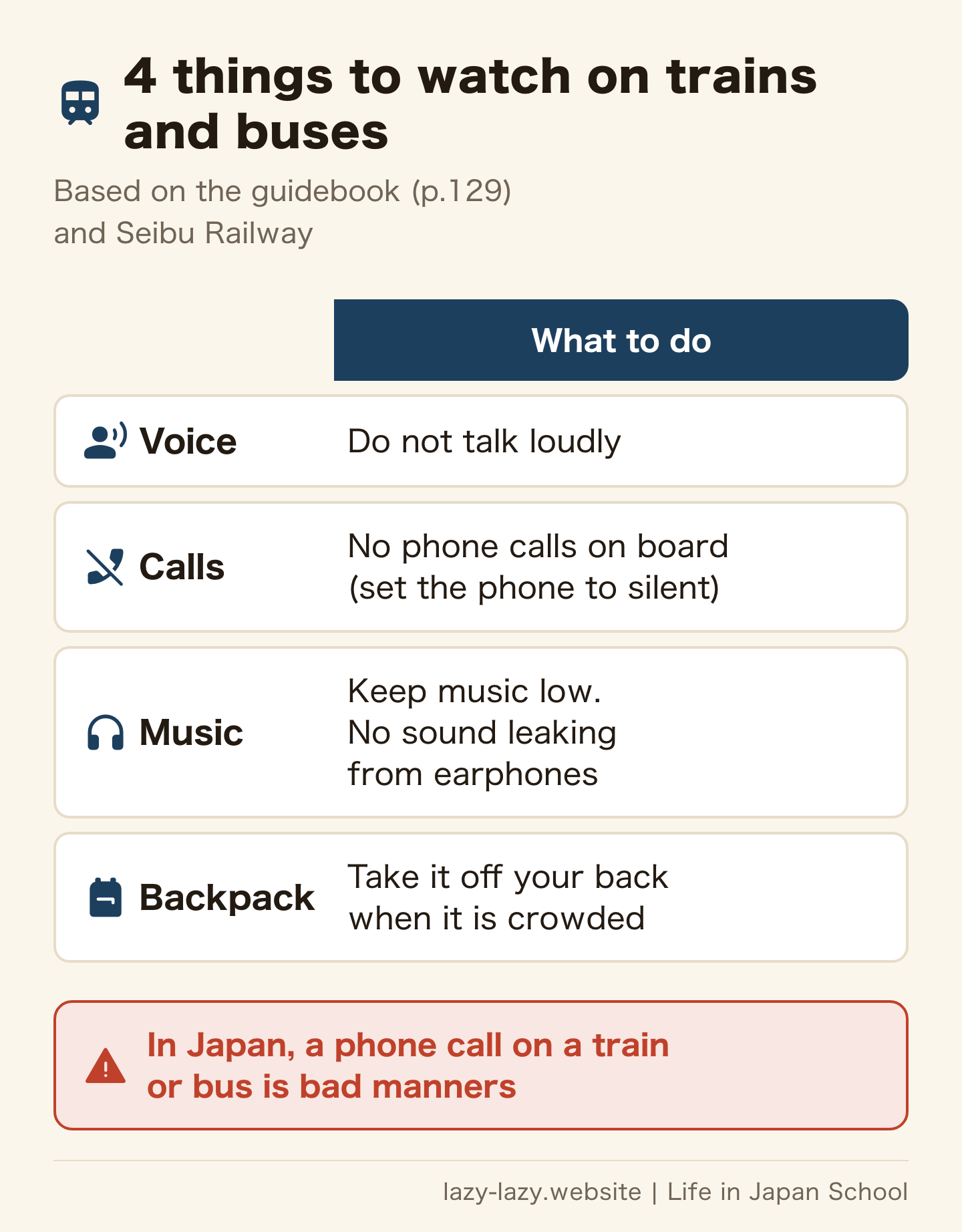
- On trains and buses, watch 4 things. Do not talk loudly. Do not make phone calls. Keep earphone sound in. Take your backpack off your back when it is crowded.
- Phone calls on trains are bad manners in Japan. Set your phone to silent before you board. Many railway companies in Kanto, Tohoku and other areas ask you to turn your phone off near priority seats when the train is crowded.
- On a crowded train, hold your backpack in front or put it on the rack. In front, keep it close so it does not hit anyone.
- Let people get off first. Move inside. If the doors are closing, wait for the next train.
- A seiriken is a small ticket with the number of your bus stop. It sets your fare when you get off. On these buses, touch your IC card twice: on and off.
Knowing this, you can avoid the moments that make people stare on your daily commute. Your first local bus will not catch you out at the exit.
Your first morning on the way to language school. The train is packed, and your backpack is pressing into the person behind you. A friend calls, and you answer as usual. People around you glance over. Your Japanese friend only says, “People don’t usually answer.” So what is not OK, and what is fine? The government guidebook and the railway companies spell it out.
- What is train etiquette in Japan? 4 things people notice
- Can you make phone calls on trains in Japan? No. Use silent mode
- Japan train backpack etiquette: in front or on the rack
- Getting on and off: let people off first
- Priority seats and women-only cars: who sits, who rides
- How to ride a bus in Japan: with or without a numbered ticket
- Bus etiquette in Japan: stay seated while it moves
- At stations and on the street: phones, escalators, signs
- What happens if you break these manners? Mostly no fine, but some are laws
- How much does it cost? Good manners are free
- Which one are you?
- Frequently asked questions
- Summary
- Related reading
What is train etiquette in Japan? 4 things people notice
Trains and buses are public places. The Immigration Services Agency’s guidebook for foreign residents (Japanese) lists 4 points for inside the train or bus (p.129).
- Talking loudly is bad manners.
- Talking on the phone on a train or bus is bad manners in Japan.
- Loud music bothers people. Do not let sound leak from your earphones.
- Keeping a backpack on your back in a crowded car hits people and bothers them.
Survey numbers show what bothers passengers. In the Japan Private Railway Association’s 2025 survey (5,202 people, up to 3 answers each), the top 5 were:
- 1. Coughing or sneezing without care for others (34.7%)
- 2. How people sit (31.9%)
- 3. Noisy talk and horseplay (30.2%)
- 4. Standing still near the doors (27.6%)
- 5. How people use smartphones (21.6%)
For seat etiquette, the top complaint was spreading, stretching or crossing legs (45.7%). When you cough or sneeze, cover your mouth and nose. Use a mask, a tissue, or your sleeve or inner elbow (guidebook p.132).
Can you make phone calls on trains in Japan? No. Use silent mode
Your phone rings, and you answer wherever you are. Where you come from, that may be normal. In Japan, a phone call on a train or bus is bad manners (guidebook p.129).
Railway companies say the same. Seibu Railway asks you to set your phone to silent and not to make calls on board. So switch to silent mode before you get on. Then a call will not surprise you.
If you really must talk, get off at the next station and call back. A short text works too: “I’m on the train. I’ll call you later.” On its limited express trains (Laview and Red Arrow), Seibu asks you to make calls only in the area between cars.
Priority seats have one more rule. Tokyu Railways announced that 37 operators in Kanto, Tohoku and Koshinetsu changed their message in October 2015. It now says: near priority seats, turn your phone off when the train is crowded. The same notice says calls on board are discouraged however crowded the train is. Seibu Railway and JR Hokkaido (local and rapid trains) say the same. Rules differ by company and train, so follow the stickers and announcements.
Just looking at the screen is not the same as a call. But in the survey, 28.4% of smartphone complaints were about use on crowded trains. On a packed train, some people mind even that.
Japan train backpack etiquette: in front or on the rack
Your backpack is behind you, so you may not notice when it hits someone. In the survey, the top luggage complaint was bags worn on the back (27.7%).
Seibu Railway asks you to hold backpacks in front or use the rack on crowded trains. The rack is the shelf above the seats.
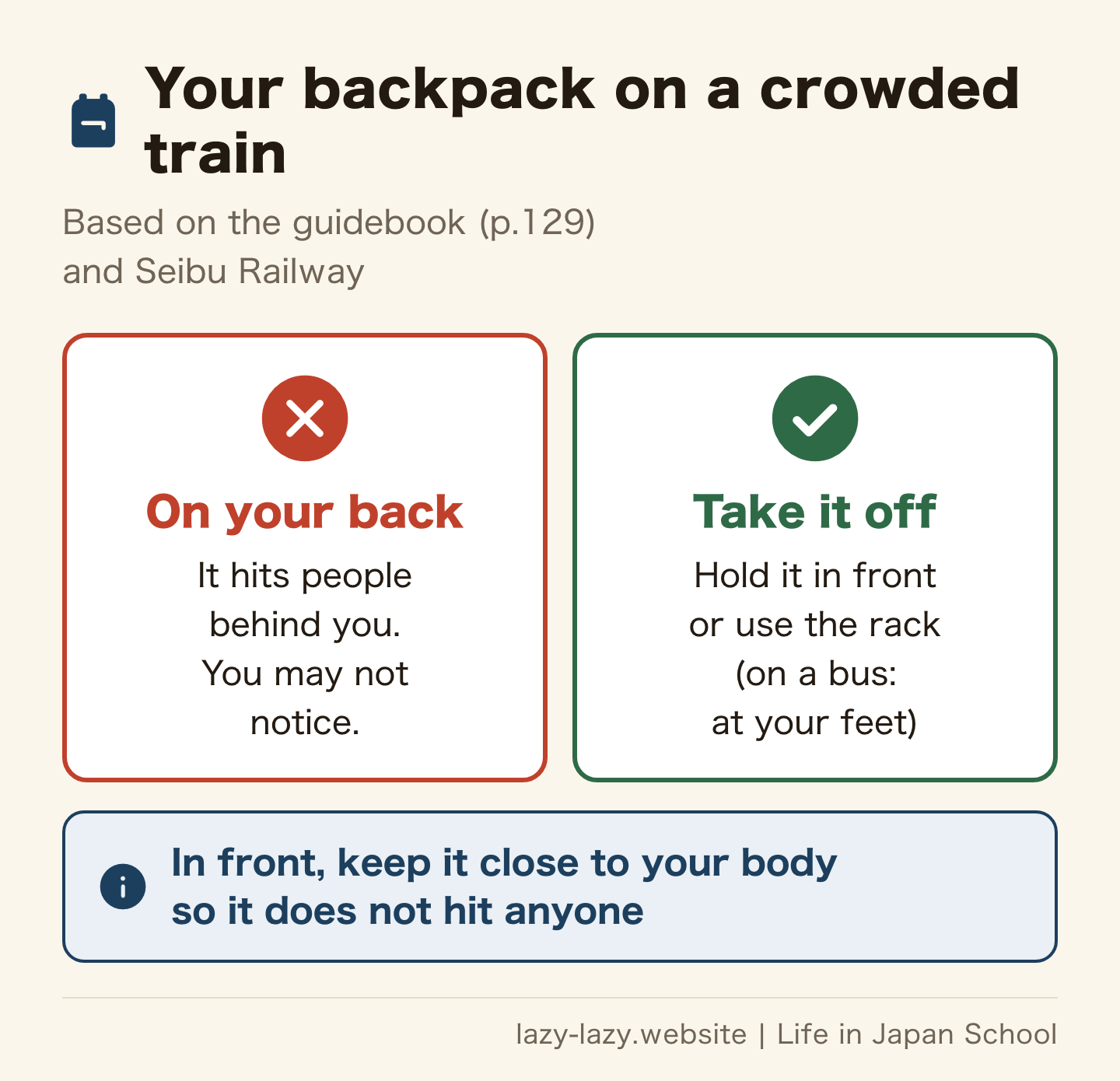
Holding it in front is not the end of it. In the same survey, 17.6% named bags held in front of the body. Keep it tight against you. Watch the corners and straps.
On buses, Sapporo City asks you to put big backpacks at your feet. Umbrellas came up too: 18.2% of luggage complaints were about wet umbrellas or tips pointed at people.
Getting on and off: let people off first
The doorway is where people notice. “Standing still near the doors” was 4th in the survey. It was a new item in 2025. The association says it slows boarding and can delay trains.
This order is based on the guidebook (pp.141-142) and the railway association’s survey:
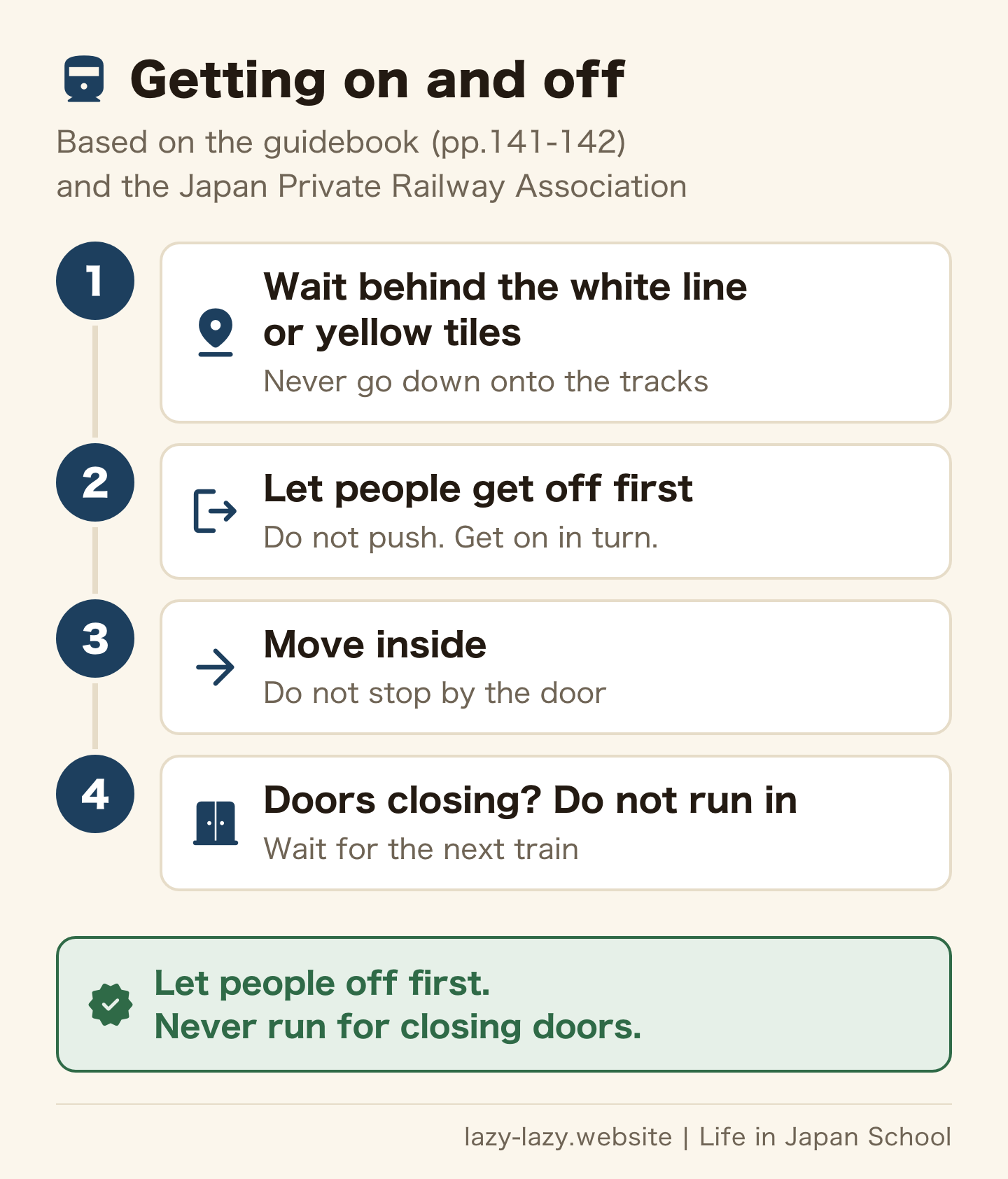
- On the platform, wait behind the white line or the yellow tiles.
- When the train comes, let people get off first. Do not push. Get on in turn.
- Once inside, move in. Do not stop by the door.
- If the door chime sounds, do not force your way in. Wait for the next train.
Never go down onto the tracks (guidebook p.142). Seibu also asks people not to run for the train, because it can cause injuries.
The guidebook also explains the ticket gates. To get a Suica or PASMO and a student commuter pass, see Suica and PASMO for foreigners.
Priority seats and women-only cars: who sits, who rides
Priority seats are seats set aside so that people who need them can sit safely. Seibu Railway asks you to give them to older people, people with disabilities, people with internal disabilities, people with babies or small children, and pregnant women.
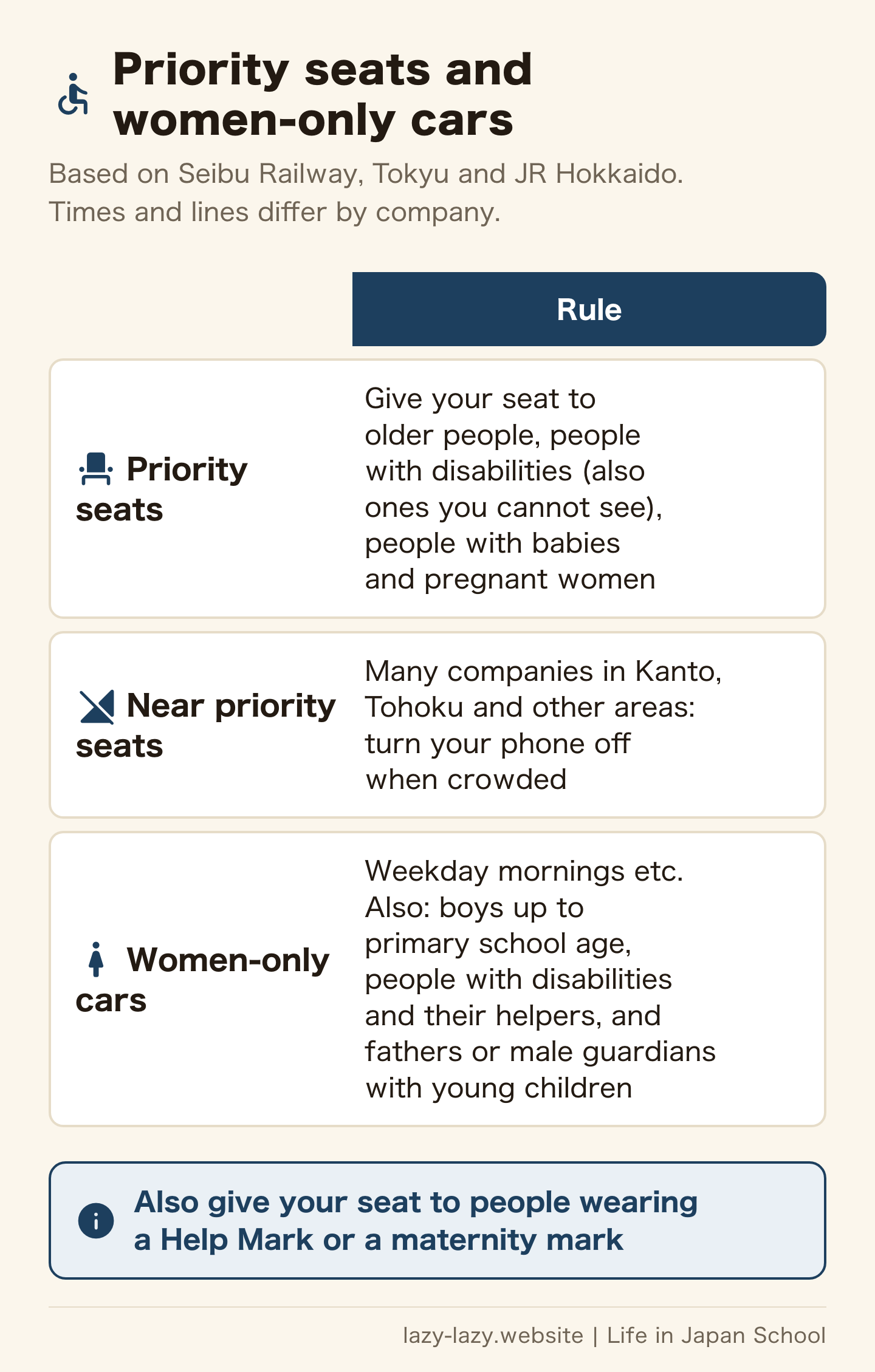
You cannot always tell by looking. JR Hokkaido notes that early pregnancy is hard to see, so some women wear a maternity mark. People with hidden illnesses or disabilities may wear a Help Mark. If you see one of these marks, offer your seat.
Women-only cars run mainly on weekday mornings so women can ride safely. On Seibu Railway, these people may also ride: boys of primary school age or younger, men with disabilities, men helping a person with a disability, and fathers or male guardians riding with children of primary school age or younger. Look for the stickers on the platform and windows.
Times and cars differ by company and line. If you are a man, check the stickers before you line up in the morning.
How to ride a bus in Japan: with or without a numbered ticket
On a bus, know how to pay before you reach the exit. The guidebook (p.142) says local buses use one of 2 ways to pay. Check which one before you get on.
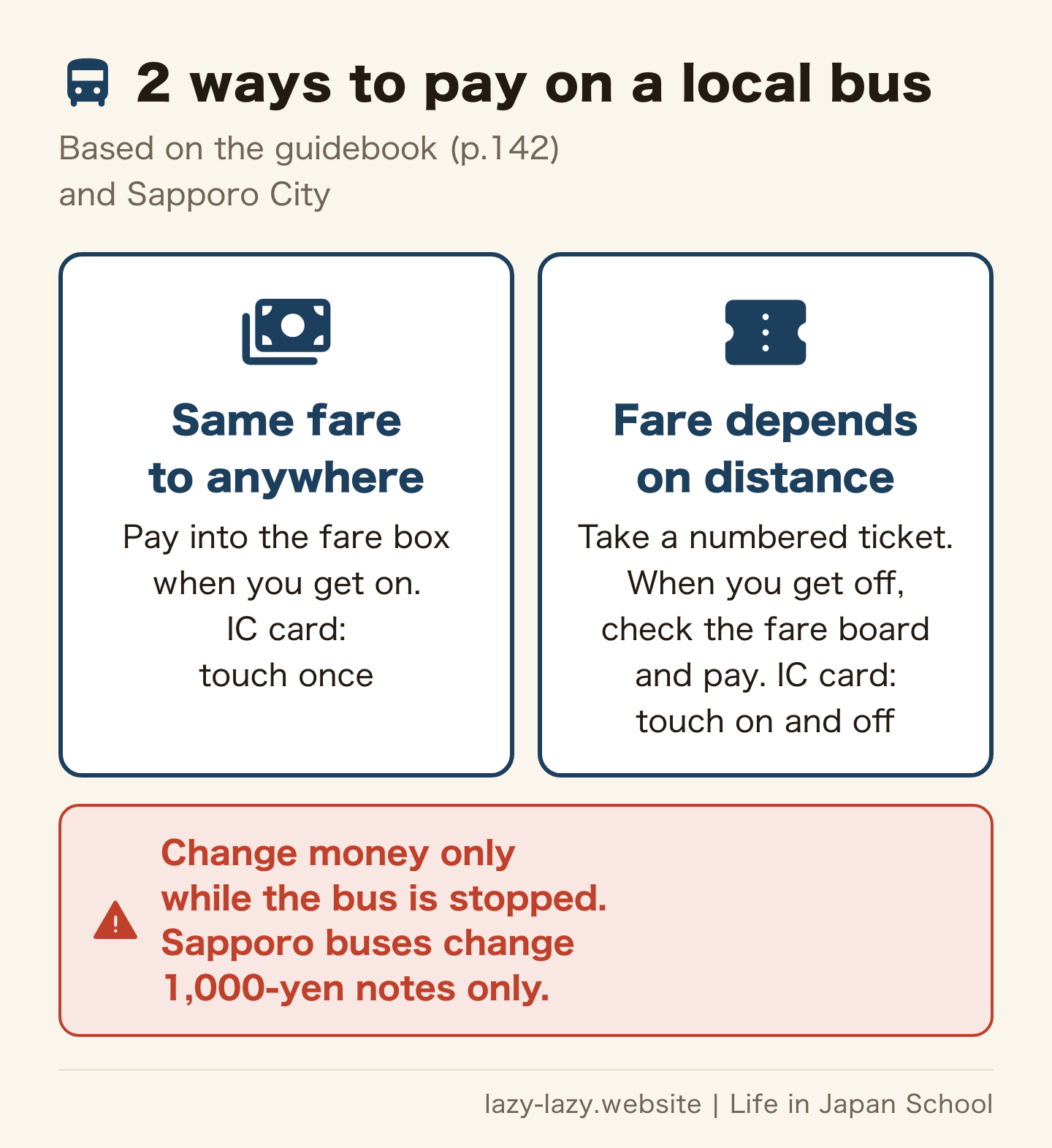
Type 1 has the same fare to any stop. You pay into the fare box when you get on. With an IC card, touch it on the fare box. For example, Yokohama city buses board at the front and you pay first. The adult fare is 220 yen, cash or IC (checked 21 November 2026).
Type 2 charges by distance. This is the bus with the numbered ticket (seiriken). Sapporo City explains the steps:
- If the bus has 2 doors, get on at the middle (rear) door.
- Take a numbered ticket from the machine at the door. With an IC card, touch it at the door instead. You do not need a ticket.
- When your stop is announced, press the stop button.
- Find your ticket number on the fare board at the front. The fare is shown under it.
- When you get off, put the ticket and the cash in the fare box. With an IC card, touch it on the fare box again.
No coins? Use the change machine on the fare box. On Sapporo buses, the only note it changes is a 1,000-yen note. Change money only while the bus is stopped. Do not fold the ticket. Put it in with the number showing.
Long-distance buses usually need you to pay first, for example by buying a ticket (guidebook p.142). Not sure how to pay? Ask the driver as you get on. Yokohama’s transport bureau also says to speak to the crew when you are unsure (if possible, while the bus is stopped).
Bus etiquette in Japan: stay seated while it moves
Buses can stop suddenly. Sapporo City’s bus requests say: sit if there is a free seat. If you stand, hold a handrail or strap. Do not change seats or change money while the bus is moving.
When you get off, wait until the bus has fully stopped and the door is open. Then walk to the front. When you get on, move inside instead of standing by the door. Silent mode, no calls and quiet voices apply here too.
At stations and on the street: phones, escalators, signs
Do not use your phone while walking (guidebook p.129). You can bump into people and hurt them, or hurt yourself. In the survey, the top smartphone complaint was using it while walking (39.1%). To check a map, step to the side and stop first.
Using a phone while riding a bicycle is against the law (guidebook p.129). The fines from April 2026 are in Japan bicycle rules.
Some areas have escalator rules. Since October 2021, Saitama Prefecture’s ordinance says you must stand still on escalators. Saitama’s campaign asks people to stand on both sides. Some people can only hold the handrail on one side.
Stations use picture signs to show what is not allowed. The guidebook (p.130) shows signs such as “no phones” and “no smoking”. Where you see a sign, follow it. Seibu says stations and trains are no-smoking all day, and asks people not to use e-cigarettes either.
What happens if you break these manners? Mostly no fine, but some are laws
The guidebook calls phone calls and backpacks “bad manners” or a “bother”. They are not fines. Still, they bother the people around you. If you notice, or someone tells you, just fix it then and there.
Some things are laws. Using a phone while driving a car or riding a bicycle is banned by law (guidebook p.129). Going onto the tracks is not allowed (p.142). For everyday things that can get you arrested in Japan, see things that are illegal in Japan.
How much does it cost? Good manners are free
Silent mode, holding your bag in front, waiting for people to get off: none of these cost money.
What costs money is the fare. Bus fares differ by company and route. Check at the bus stop or on the company’s website. IC cards can be cheaper than cash (guidebook p.140).
Which one are you?
- You just started commuting by train — today, set your phone to silent before you board. If it is crowded, hold your backpack in front.
- You always answer calls right away — today, save a quick reply on your phone: “I’m on the train. I’ll call you later.”
- You are taking a local bus for the first time — today, check before boarding: pay first, or numbered ticket? If unsure, ask the driver as you get on.
- You are a man riding a crowded morning train — today, look for the women-only stickers on the platform or windows, and line up somewhere else.
Frequently asked questions
Q. Can I answer my phone on a train in Japan?
Phone calls on trains are bad manners in Japan. Keep your phone on silent. If it is urgent, get off at the next station and call back. Many railway companies in Kanto, Tohoku and other areas ask you to turn your phone off near priority seats when the train is crowded.
Q. What should I do with my backpack on a train?
When it is crowded, take it off your back. Hold it in front or put it on the rack. In front, keep it close so it does not hit anyone.
Q. What is a seiriken on a bus?
It is a small ticket with the number of the stop where you got on. When you get off, find that number on the fare board at the front, and pay that fare with the ticket.
Q. How many times do I touch my IC card on a bus?
Once, when you get on, if the fare is the same to any stop. Twice, on and off, if the fare depends on distance.
Q. Who should get a priority seat?
Older people, people with disabilities, people with internal disabilities, people with babies or small children, and pregnant women. Also people wearing a Help Mark or a maternity mark.
Q. Can men ride in women-only cars?
Boys of primary school age or younger, men with disabilities, men helping a person with a disability, and fathers or male guardians riding with children of primary school age or younger may ride. Times and cars differ by company, so check the stickers on the platform and windows.
Summary
On trains and buses, watch 4 things: voice, phone calls, earphone sound and backpacks. Phone calls on board are bad manners in Japan. When it is crowded, hold your backpack in front or use the rack. Let people off first, and do not run for closing doors. On a bus, check whether you pay first or take a numbered ticket. With a numbered ticket, touch your IC card twice.
All of these are small and free. Start today: set your phone to silent before you board. Next, read Suica and PASMO for foreigners to cut your daily fares and get through the gates with ease.
Sources (official, Japanese): Immigration Services Agency, guidebook for foreign residents, ch.12 (pp.129, 130, 132, 140-142) / Seibu Railway, requests to passengers / Seibu Railway, women-only cars / Tokyu Railways, phone rule near priority seats (2015) / JR Hokkaido, manners / Japan Private Railway Association, FY2025 survey / Sapporo City, how to pay on buses / Sapporo City, requests on buses / Yokohama City, how to ride city buses / Saitama Prefecture, escalator ordinance / Saitama Prefecture, safe escalator use campaign (all checked 21 November 2026).
Related reading
Found this useful? Share it
Send it to a friend who lives in Japan.
WHO WROTE THIS
mori
Japanese. I read the ministries’ own notices, orders and Q&As in the original, and I start from what my Nepalese and Sri Lankan friends in Japan actually ran into. I do not write about what I have not checked or been told.
What this site can and cannot do →Looking for something else?
You may use the figures in this article, including commercially, if you credit this site with a link. How to use our figures