Checked on 12 November 2026 against official pages from the Financial Services Agency (FSA), the Immigration Services Agency, the National Police Agency, the Digital Agency, the Japan Consumer Credit Association, CIC, and the text of the Act on Prevention of Transfer of Criminal Proceeds and the Labor Standards Act enforcement rules (e-Gov). This guide does not recommend any bank or card.
The short answer
- A main account is the one your pay goes into and your monthly bills come out of. Give it 3 jobs: receiving pay, paying debits and sending money. Keep only savings in a separate account.
- Every extra account is extra paperwork. When your period of stay is extended, you tell each bank where you hold an account. If you do not, cash withdrawals and transfers can stop from the day after your period of stay ends.
- Move the debits, then close the accounts you do not use. Some banks charge a fee after 2 years of no use, and after 10 years the money becomes a dormant deposit. Selling an account, or handing it over for someone else to use, is a crime.
- Decide on unused cards by the annual fee and the statement. Credit card fraud losses in Japan were 51.05 billion yen in 2025. Check statements even for cards you do not use.
- Before you leave Japan, make the main account the last one standing. Clear out the extra accounts and cards first, and close the last one after the final bill is paid.
Knowing this, your accounts and cards fit on a single sheet of paper. Reporting your new period of stay, checking statements and closing up before you leave all happen in one place.
There are three cash cards in your wallet. One from the account you opened the week you arrived, one your part-time job asked for, and one where your company now pays your salary. You also have two credit cards. Which account pays your phone bill? You are not sure. A Japanese friend might just say, “If you don’t use it, leave it.” But that friend has never had to tell a bank about a new period of stay.
- Can you have multiple bank accounts in Japan? Yes, but give each one a job
- How do you choose your main bank account? 3 questions
- Why might your bank account in Japan be frozen? Each bank needs your new period of stay
- Should you close an unused bank account in Japan? Fees and dormant deposits
- How do you close a bank account in Japan? Move the debits first, close it last
- Should you cancel a credit card you don’t use in Japan? Check the annual fee and the statement
- Does tidying up cost money? The fees come from leaving things alone
- Do you have to close your bank account when you leave Japan? Make the main account the last one
- What if something goes wrong? A frozen account, a lost card
- Which one are you?
- FAQ
- Bottom line
- Related reading
Can you have multiple bank accounts in Japan? Yes, but give each one a job
Holding more than one account is not banned. Tidying up means giving each account and card one job, and closing anything without a job. There are 4 jobs: receiving pay, paying monthly debits, sending money home, and saving. Three of them go to your main account.
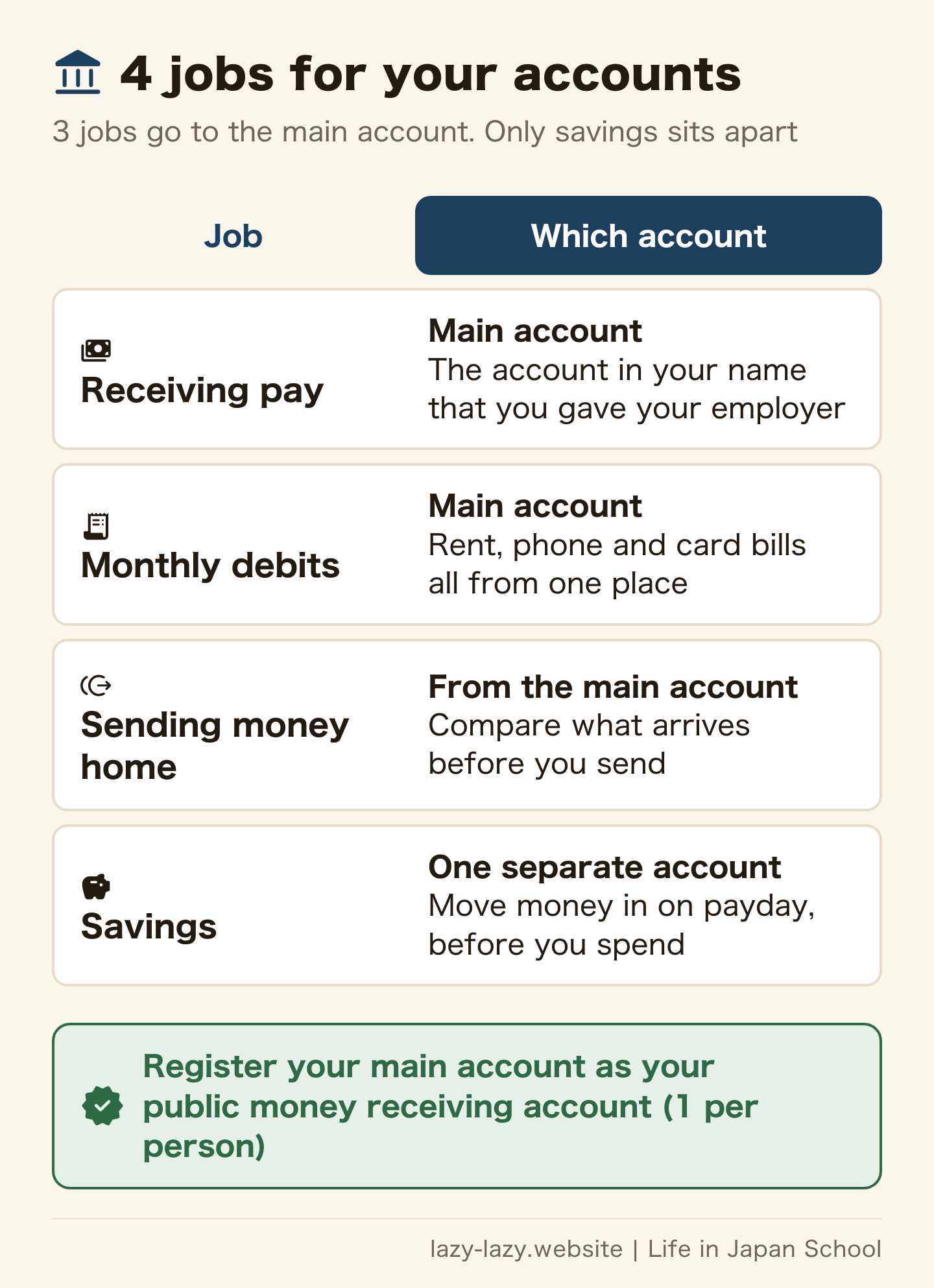
You choose the account your pay goes into. With your consent, your employer can pay wages by transfer to an account you name (Japanese). To switch your main account, give the new one to whoever handles payroll at work.
Money from the government can go to one place too. A public money receiving account (kokin uketori koza) is limited to 1 account per person, in your own name. It is used for more than 160 kinds of payments, including pensions, income tax refunds and child allowances. Foreign residents can register if they have a My Number Card.
Send money home from the main account. To choose how, see our comparison of ways to send money home. Savings are the one thing to keep away from the account you spend from. How much to move on payday is set out in how to start a monthly budget.
Also check you are not piling too much savings into one bank. Under Japan’s deposit insurance system (Japanese), interest-bearing ordinary and time deposits are protected up to 10 million yen of principal plus interest, per person, per financial institution. Settlement deposits, such as ordinary deposits that pay no interest, are protected in full.
How do you choose your main bank account? 3 questions
This site does not pick a bank for you. What decides it is how your accounts are used, not the bank’s name. Answer these 3 questions in order and you will land on one.
- Which account does your pay go into? If you keep that one as your main account, you do not need to tell your employer anything.
- Which account has the most debits? Count rent, phone, electricity and card bills. The fewer you have to move, the faster this goes.
- Which account can you update quickly? Check whether you can report a new period of stay or address at a counter or in an app, and whether you get balance and transaction alerts.
If 1 and 2 point to different accounts, leaning toward the pay account is usually less work. You can move a debit yourself, but a payroll change waits on your employer’s process. If little time is left on your period of stay, pick a main account from the ones you already have rather than opening a new one. Opening an account, and the stay conditions banks set, are covered in how to open a bank account in Japan.
Why might your bank account in Japan be frozen? Each bank needs your new period of stay
Your visa renewal is approved and you pick up a new residence card. Where you come from, the bank may simply update when the government record changes. In Japan, you tell each bank yourself that your period of stay has been extended.
The Immigration Services Agency warns that if you do not report to your bank by the day your period of stay ends (Japanese), transactions from the next day may be restricted. A 24 December 2024 notice from the National Police Agency (Japanese) asks banks to restrict cash withdrawals and transfers to other accounts from the day after expiry, until they can confirm a renewal or a pending application. It was agreed with the FSA and the Immigration Services Agency.
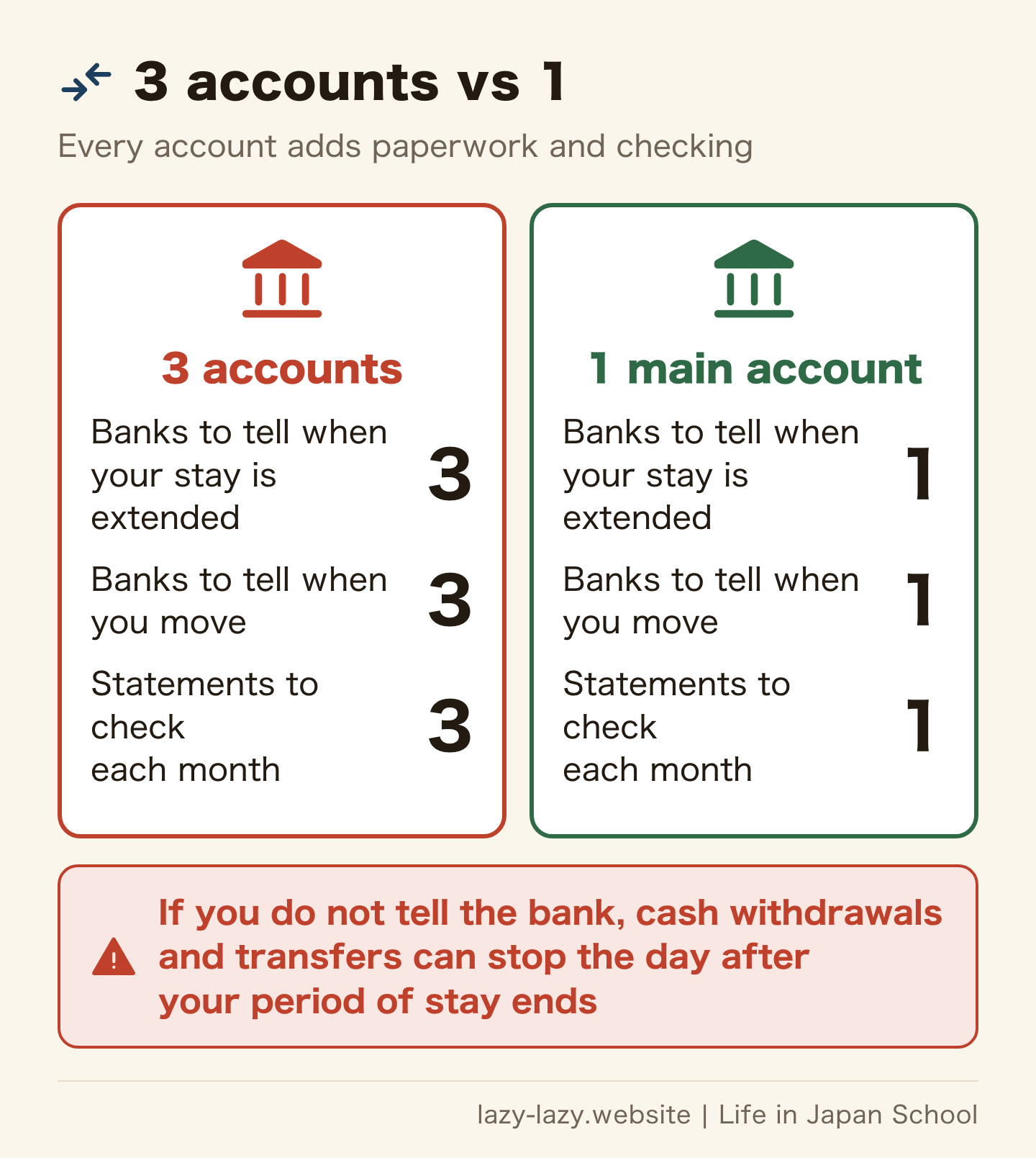
Three accounts means three banks to update at every renewal. Forget one, and that one stops. The accounts you rarely use are the easiest to forget. The same notice says automatic debits and internet banking are not, on that fact alone, grounds for suspicion. Still, it is the bank that decides how to handle your account. If it does stop, bring proof to the counter. If your renewal is done, show your new residence card, with the new expiry date on the front. If your application is still pending, show the application section on the back of your residence card, or the application receipt email from Immigration.
The same goes for moving house. Important notices from the bank go to the address it has on file. Fewer accounts means fewer places to forget. Renewal timing and steps are in visa renewal in Japan.
Should you close an unused bank account in Japan? Fees and dormant deposits
It is easy to assume an unused account just sits there. At some banks, it does not. MUFG Bank, for example, charges an inactive account fee of 1,320 yen a year, tax included (Japanese), on ordinary accounts opened on or after 1 July 2021 with no deposit or withdrawal for 2 years or more. The bank sends notice by post or email first, and takes the fee if the account is still unused 3 months later. Accounts with other holdings at the bank, such as time deposits, or with a loan there, are excluded. If the balance is below the fee, the balance goes toward the fee and the account is closed. Rules differ from bank to bank.
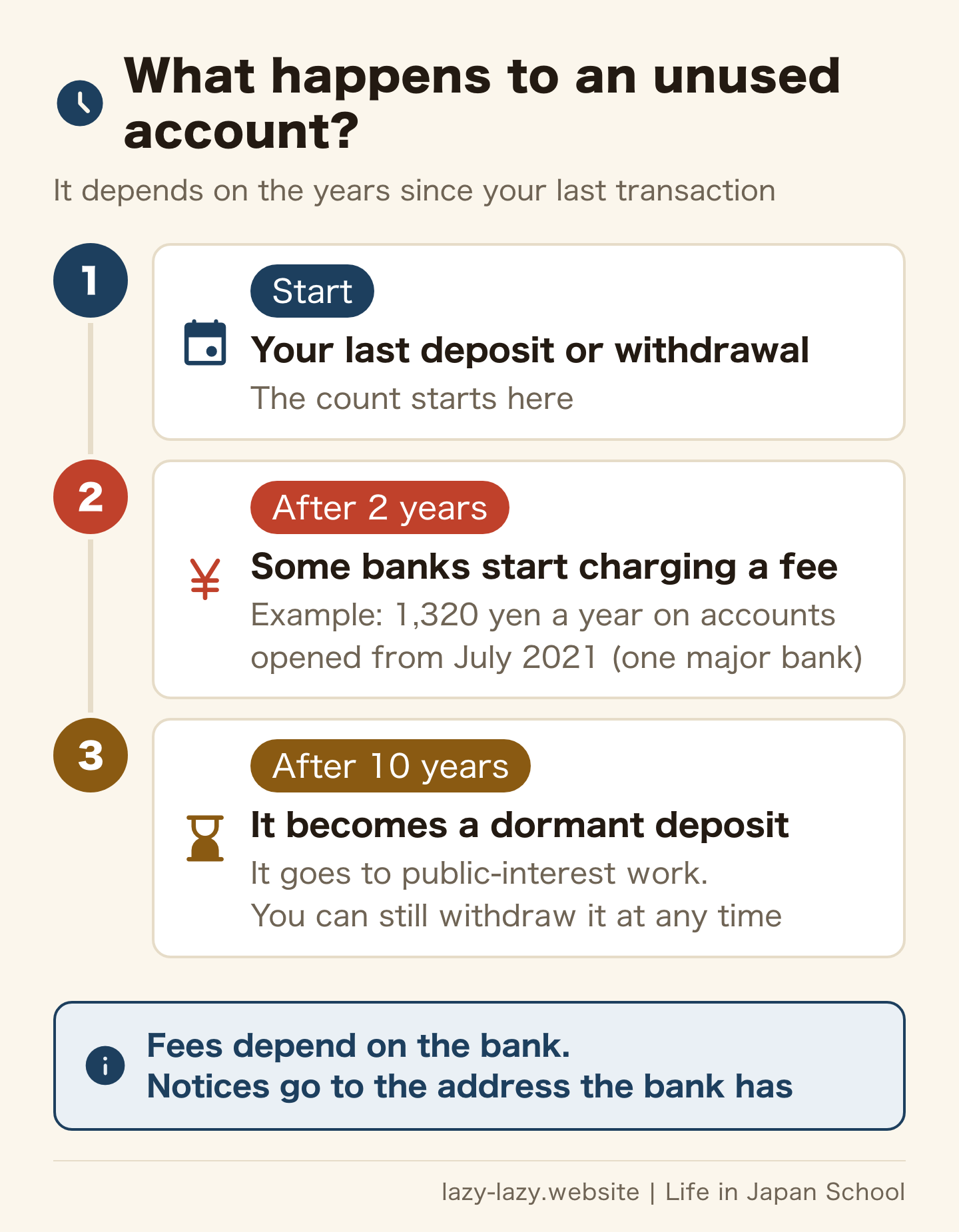
After 10 years, the money becomes a dormant deposit. According to the FSA (Japanese), deposits with no transactions for 10 years or more, counting from transactions on or after 1 January 2009, are used for private public-interest activities. Even then, you can withdraw the money at the bank you used, at any time. There is no deadline. Foreign currency deposits and some others are not covered.
The real danger of a forgotten account is not the fee. It is someone else using it. Some people hand an unused account to an acquaintance before going home. Where you come from, that may look like a favour. In Japan, handing over a passbook or cash card knowing someone else will use it, or for payment without a legitimate reason, can bring up to 3 years in prison, a fine of up to 5 million yen, or both, under the Act on Prevention of Transfer of Criminal Proceeds (Japanese). Close accounts you do not use; never pass them on. If someone asks to “borrow” your account or money, how to say no to a friend asking for money can help.
How do you close a bank account in Japan? Move the debits first, close it last
Close it too early, and any debit you forgot to move will bounce. Your phone bill or rent will then be paid late. The order is: move, confirm, close.
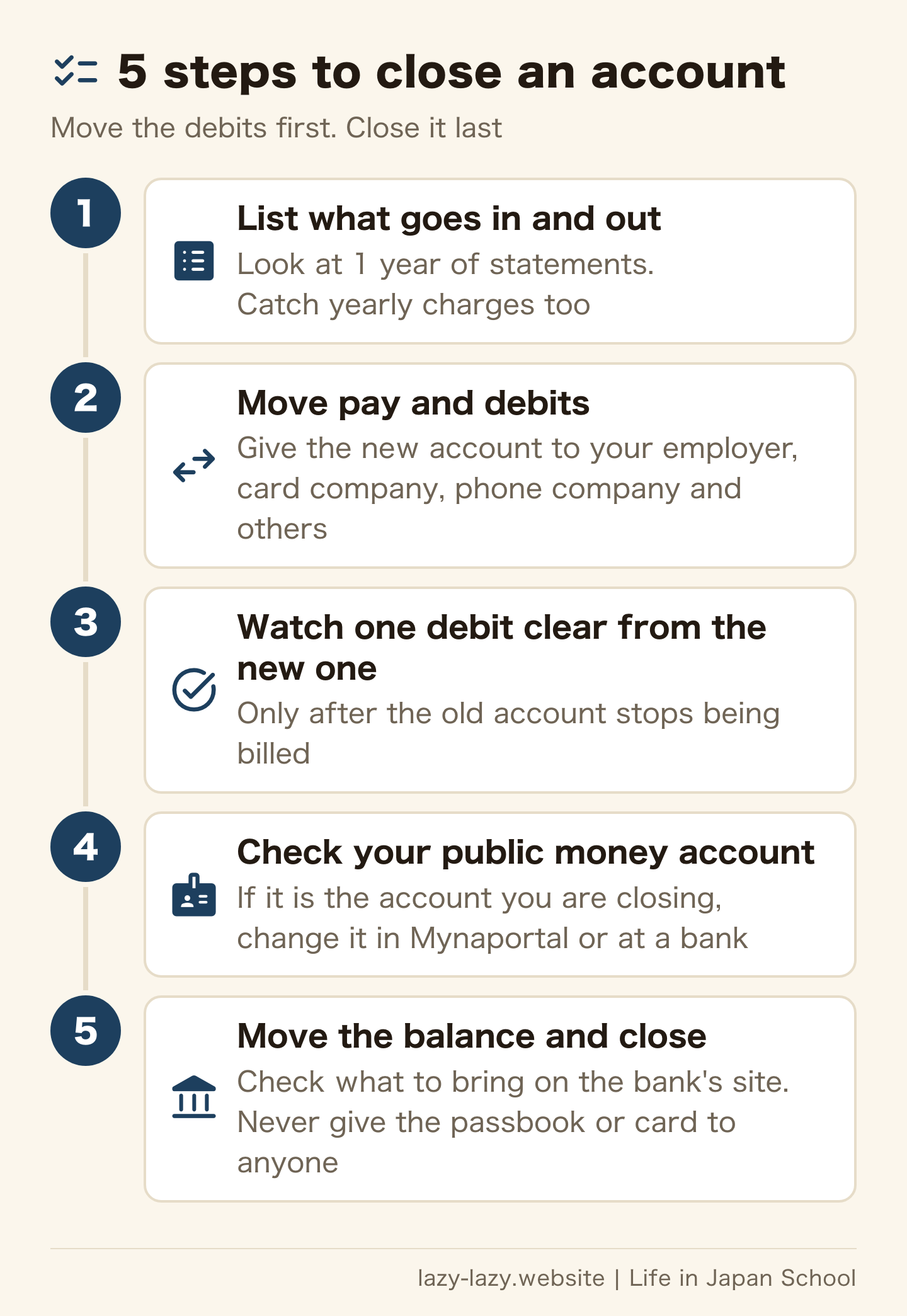
Look at a full year of statements, because some charges, such as annual fees and renewal fees, come out only once a year. You change the debit account with each company that bills you. The contract list in cutting fixed costs in Japan works for finding them all.
If the account you are closing is your public money receiving account, do not forget to change it. The Digital Agency asks that, when the registered account is closed, you change or delete it promptly in Mynaportal or at a financial institution (Japanese). Tax offices and pension offices cannot change it. You can see which account is registered in Mynaportal.
What to bring when closing differs by bank. Read that bank’s closing page before you go. Move the balance to your main account before you close.
Should you cancel a credit card you don’t use in Japan? Check the annual fee and the statement
Cards lose you money in places that are harder to notice than accounts. A card with an annual fee may still bill you that fee in a year you never use it. And if you close the account the card is paid from, that bill cannot be paid.
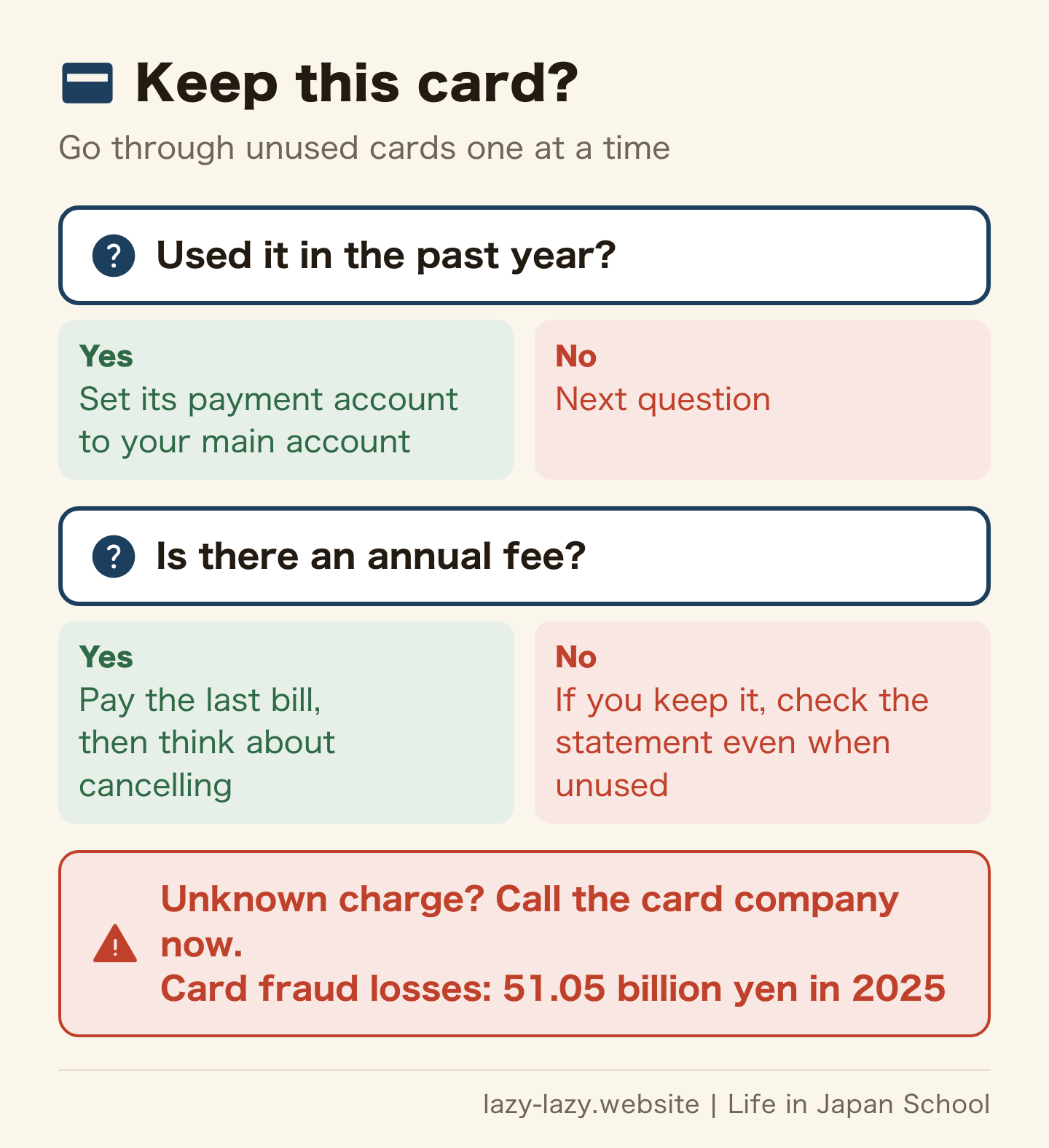
Fraud can hit a card you never use. In the Japan Consumer Credit Association’s figures (Japanese), credit card fraud losses in 2025 were 51.05 billion yen. Of that, 47.54 billion yen came from stolen card numbers. The association advises checking online statements often, even when you are not using the card (Japanese). If you see a charge you do not recognise, contact the card company straight away.
More cards means more statements to check. Cutting down to the number you will actually check each month is the quickest way to spot fraud early. Keep one card, and use it only for what you can pay in full. This site does not recommend revolving payments or cash advances. If you still have a revolving balance, read how to pay off revolving credit before you cancel.
Some people worry that cancelling will hurt their credit record. According to CIC (Japanese), credit information is kept for the length of the contract and for 5 years after it ends. We could not find an official explanation of how a cancellation itself is judged in screening. Either way, cancel only after the last bill is paid.
Does tidying up cost money? The fees come from leaving things alone
Tidying up costs little. It is the neglected accounts and cards that take money. You saw above the bank that charges 1,320 yen a year on accounts unused for 2 years. A card with an annual fee charges it even in years you do not use it.
Whether closing an account or a card costs anything is in each bank’s or card company’s fee table. The same goes for whether changing a debit account costs anything. We could not confirm a common amount, so we do not give one. What is worth adding up is how much each account and card costs you every year you keep it.
Do you have to close your bank account when you leave Japan? Make the main account the last one
Closing every account and card in the last week is hard work. So ask each company when its last bill will come, clear out the extra accounts and cards that much earlier, and leave only the main account. Final bills can arrive after you have left.
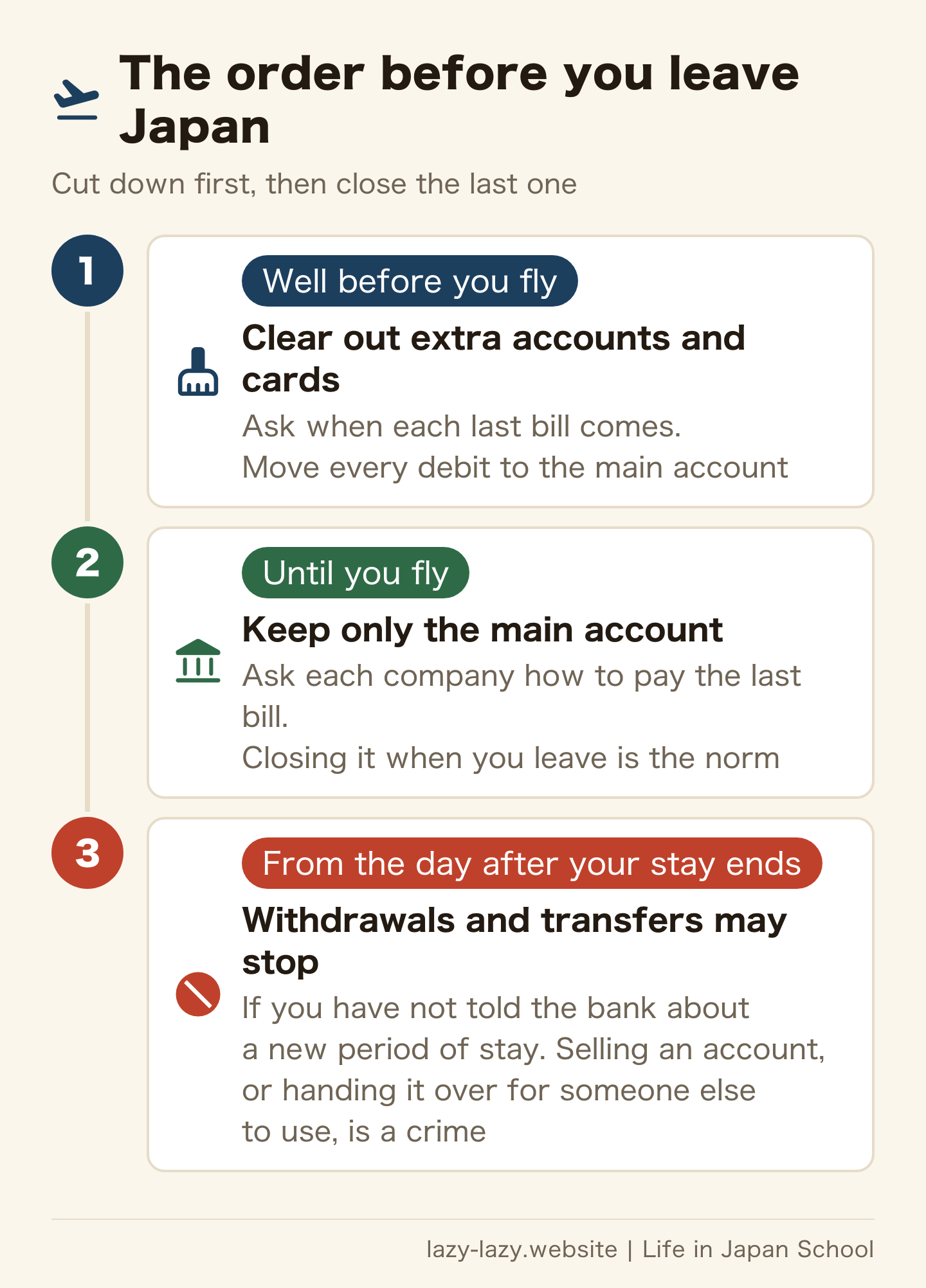
The last account to keep is the main account, where your debits now gather. How to pay your final phone bill is in the leaving section of cutting fixed costs in Japan. The full order, including your residence record and pension, is in the leaving Japan checklist.
From the day after your period of stay ends, as noted above, cash withdrawals and transfers may stop. The FSA lists (Japanese), among the points it checks at banks, whether they explain at account opening how to close the account when you leave Japan. Closing it when you leave is the norm. If you have a reason to keep a Japanese account, ask that bank before you fly. Whatever the reason, do not leave your passbook and card with anyone.
What if something goes wrong? A frozen account, a lost card
Three problems come up most while tidying. Each has a way back.
- You forgot to report your new period of stay and the account stopped: go to the bank counter with your new residence card (expiry date on the front) if the renewal is done, or, if it is pending, the application section on the back of your residence card or Immigration’s application receipt email. Once a renewal or pending application is confirmed, the bank is expected to allow transactions.
- You lost the passbook or cash card for an old account: even a dormant deposit can be withdrawn with ID (Japanese). Call that bank first and ask for the steps.
- A card you never use shows a charge you do not know: contact the card company that day. If you typed your card number after a fake text, also see what to do if you tapped a phishing SMS.
Sometimes the account registered as your public money receiving account gets closed before you change it. In that case, the Digital Agency suspends or deletes the registration (Japanese) and tells you through Mynaportal. Register a new account before your next payment.
Which one are you?
- You have 3 or more accounts and are not sure what each is for: today, write down what goes in and out of each one, from the passbook or app.
- You have chosen a main account but debits are scattered: today, ask one company with a big debit to switch to the main account.
- You have unused accounts and cards: today, check each account’s last transaction date and whether each card has an annual fee.
- Your period of stay ends soon: today, count the banks where you hold accounts and check each bank’s site for how to report.
- You are leaving Japan within 6 months: today, choose the one main account to keep until last, and start clearing the rest.
FAQ
Q. Can foreigners have multiple bank accounts in Japan?
Holding more than one account is not banned. But the more accounts you have, the more banks you must tell when your period of stay is extended or you move. An account you forget to update may stop allowing withdrawals and transfers from the day after your period of stay ends.
Q. What happens if I leave a bank account unused in Japan?
Some banks charge a fee on accounts unused for 2 years or more. One major bank, for example, charges 1,320 yen a year on accounts opened from July 2021 (conditions apply, with notice first). After 10 years with no transactions, the money becomes a dormant deposit, but you can still withdraw it at any time.
Q. When does an account become dormant, and can I get the money back?
Deposits with no transactions for 10 years or more, counting from transactions on or after 1 January 2009, become dormant deposits. You can still withdraw the money at the bank you used. There is no deadline. Even without the passbook, you can withdraw with ID.
Q. Where do I start when switching my main account?
Start by listing one year of money in and out. Then give the new account to your employer for pay, and to each company for debits. Close the old account only after one debit has cleared from the new one. If it was your public money receiving account, change it in Mynaportal or at a bank.
Q. Should I cancel a credit card I don’t use?
If it has an annual fee, pay the last bill and then think about cancelling. If it has no fee and you keep it, check the statement often even when you do not use it. Credit card fraud losses were 51.05 billion yen in 2025. Report any charge you do not recognise to the card company straight away.
Q. Do I have to close my bank account when I leave Japan?
Closing it is the norm. Ask each company when its last bill will come, clear out extra accounts and cards early enough, and make the main account the last one. Close it after the final bill is paid. If you have a reason to keep it, ask that bank before you leave. Selling an account, or handing it over for someone else to use, is a crime.
Bottom line
Collecting accounts and cards is a sign your life in Japan has moved on. But as long as there are many, every renewal report and every statement check multiplies with them. Put pay, debits and sending money in one main account, and keep only savings apart. Close any account or card without a job, after moving its debits.
Leaving things alone leads to fees and to fraud you do not notice. Selling an account, or handing it over for someone else to use, is a crime. One thing to do today: write every account and card on a sheet of paper, with its job next to it. Start with the ones where the job column is empty.
Sources (official, Japanese unless noted): FSA, dormant deposits / FSA, deposit insurance / FSA, points for serving foreign customers / Immigration Services Agency, applying within your period of stay / National Police Agency, accounts of foreign residents after expiry / Digital Agency, public money receiving accounts (English) / Digital Agency, FAQ on procedures / Japan Consumer Credit Association, fraud losses / JCA, checking statements / CIC, how long credit information is kept / MUFG Bank, inactive account fee / Act on Prevention of Transfer of Criminal Proceeds / Ordinance for Enforcement of the Labor Standards Act (all checked 12 November 2026)
Related reading
Found this useful? Share it
Send it to a friend who lives in Japan.
READ THIS NEXT
Sending Money Home from Japan →How to send money from Japan to Nepal or Sri Lanka, and how to compare what actually arrives.WHO WROTE THIS

mori
Japanese. I read the ministries’ own notices, orders and Q&As in the original, and I start from what my Nepalese and Sri Lankan friends in Japan actually ran into. I do not write about what I have not checked or been told.
What this site can and cannot do →Looking for something else?
You may use the figures in this article, including commercially, if you credit this site with a link. How to use our figures