Checked on 7 November 2026 against the National Consumer Affairs Center of Japan (NCAC), the Consumer Affairs Agency’s guide to the Specified Commercial Transactions Act, the Financial Services Agency (FSA), the Immigration Services Agency, the Japan Financial Services Association, and the text of the laws on e-Gov. This guide cannot tell you whether a particular company is breaking the law.
The short answer
- MLM is not automatically illegal in Japan, but pyramid schemes are banned. In an MLM you pay for goods or a membership and are told you will earn by recruiting the next person. In law it is mainly called rensa hanbai torihiki.
- You do not have to decide whether your friend is a bad person. Ask about the company, where the money comes from, the total cost, and whether you can take the papers home. For investments, ask about FSA registration too. One missing answer means stop.
- Do not say “I have no money”. Say “I won’t sign” (keiyaku shimasen). In reported cases, money as an excuse led to people being pushed towards loans and credit cards.
- If borrowing comes up, the talk ends there. This site generally does not recommend debt that carries interest or fees. The person who borrows repays, not the person who suggested it.
- Referral pay and side income can fall outside your residence status. Check with Immigration before you take any money. If unsure, call 188.
Knowing this, you can check the offer and refuse without calling your friend a scammer. You can also stop debt and visa trouble before they start.
On your way home from your part-time job, a message arrives from a senior from your home country: “I have a good offer for you.” This is the person who helped you find a flat when you first came. After this month’s rent, you will have almost nothing left. You do not think they are a bad person, so you cannot find a reason to say no. You still do not know what the offer is. And a Japanese friend may not understand what you owe someone from your own community.
- Is MLM legal in Japan? 4,003 consultations in fiscal 2025, most from people in their 20s
- How do you spot an MLM? 5 questions you can ask without accusing anyone
- Is “guaranteed profit” ever real? 6 kinds of money-making offers
- How much can these offers cost? The average contract amount was 2.57 million yen
- How do you check FSA registration? 4 steps to find unregistered firms
- How do you say no to an MLM friend? Do not say “I have no money”
- What if they say “just take out a loan”? The borrower repays
- Can referral pay or a side job hurt your visa? It may fall outside your status
- Already signed or paid? 20-day cooling-off and 188
- Which one are you?
- FAQ
- Bottom line
- Related reading
Is MLM legal in Japan? 4,003 consultations in fiscal 2025, most from people in their 20s
The Consumer Affairs Agency describes multi-level marketing (rensa hanbai torihiki) as a business that recruits individuals as sellers and has them recruit the next sellers, so the organisation grows in a chain. If you are told you can earn a referral fee and must carry any cost of 1 yen or more, such as a joining fee or products, it counts. The name of the payment does not matter.
Whether it is legal has no one-word answer. The law does not ban MLM as a whole. The Specified Commercial Transactions Act sets rules for it instead: state the company and the purpose before the pitch, do not lie, and hand over documents. Breaking those rules can lead to administrative action and, in some cases, penalties.
Pyramid schemes are different. The Act on the Prevention of Pyramid Schemes bans starting one, joining one and inviting others. Inviting someone can bring a fine of up to 200,000 yen. Doing it as a business can bring up to 1 year in prison or a fine of up to 300,000 yen.
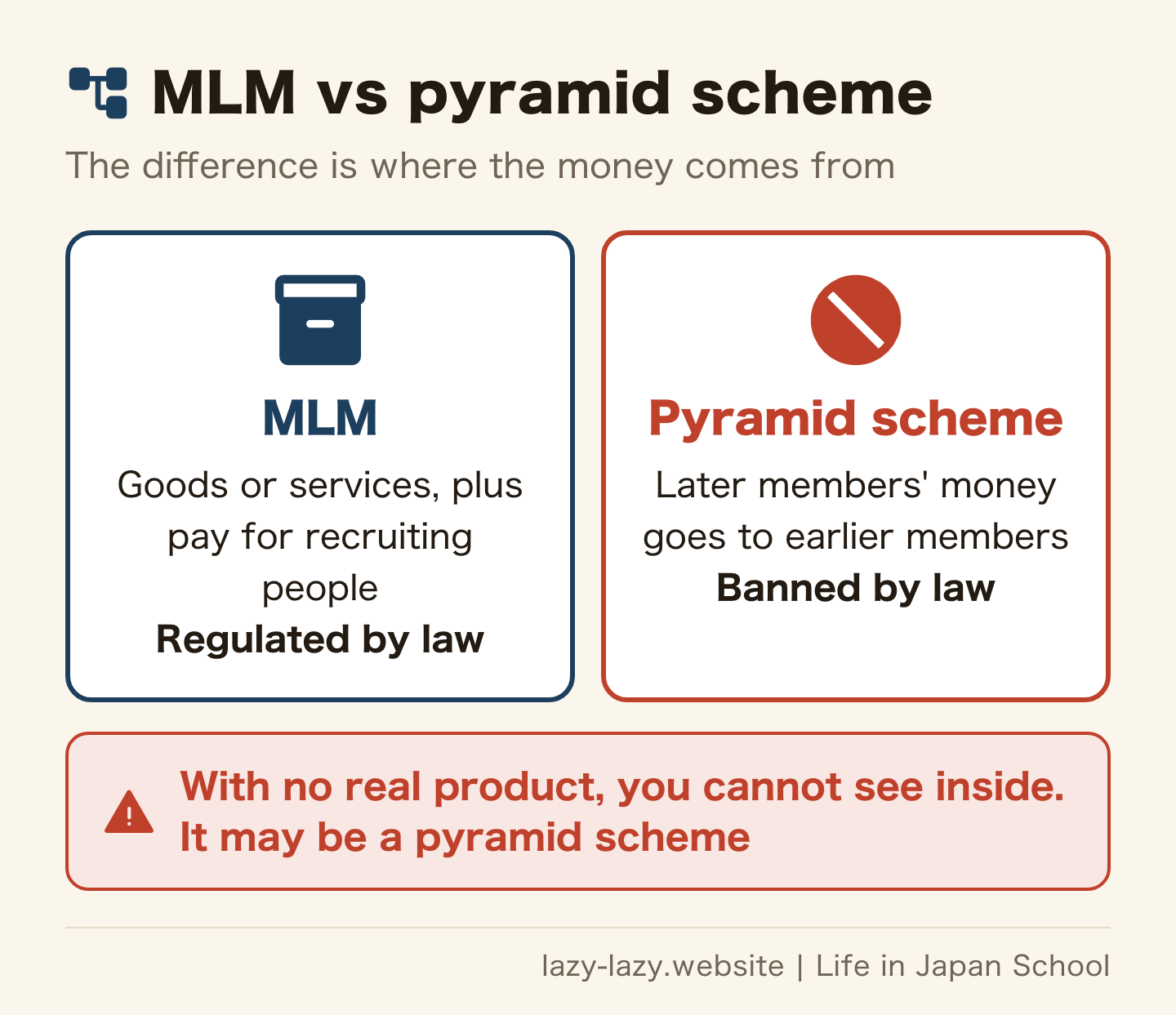
The hard cases have no real product. The NCAC warns about “no-product MLMs”, which invite people into crypto, overseas business investments or affiliate work with the line that referrals earn rewards. If later members’ money is simply paid to earlier members, it may be a pyramid scheme. The same report notes that the everyday word “MLM” and the legal category do not always match.
MLM consultations numbered 4,003 in fiscal 2025, after 5,158 in fiscal 2023 and 4,132 in fiscal 2024 (as of 31 May 2026, excluding referred consultations). People in their 20s were the largest age group, at 29.3%. We found no count limited to foreign residents.
How do you spot an MLM? 5 questions you can ask without accusing anyone
The person inviting you may truly believe in it. So judging their character will only confuse you. Look at the offer, not the person. You can ask a friend or a senior these 5 questions as they are.
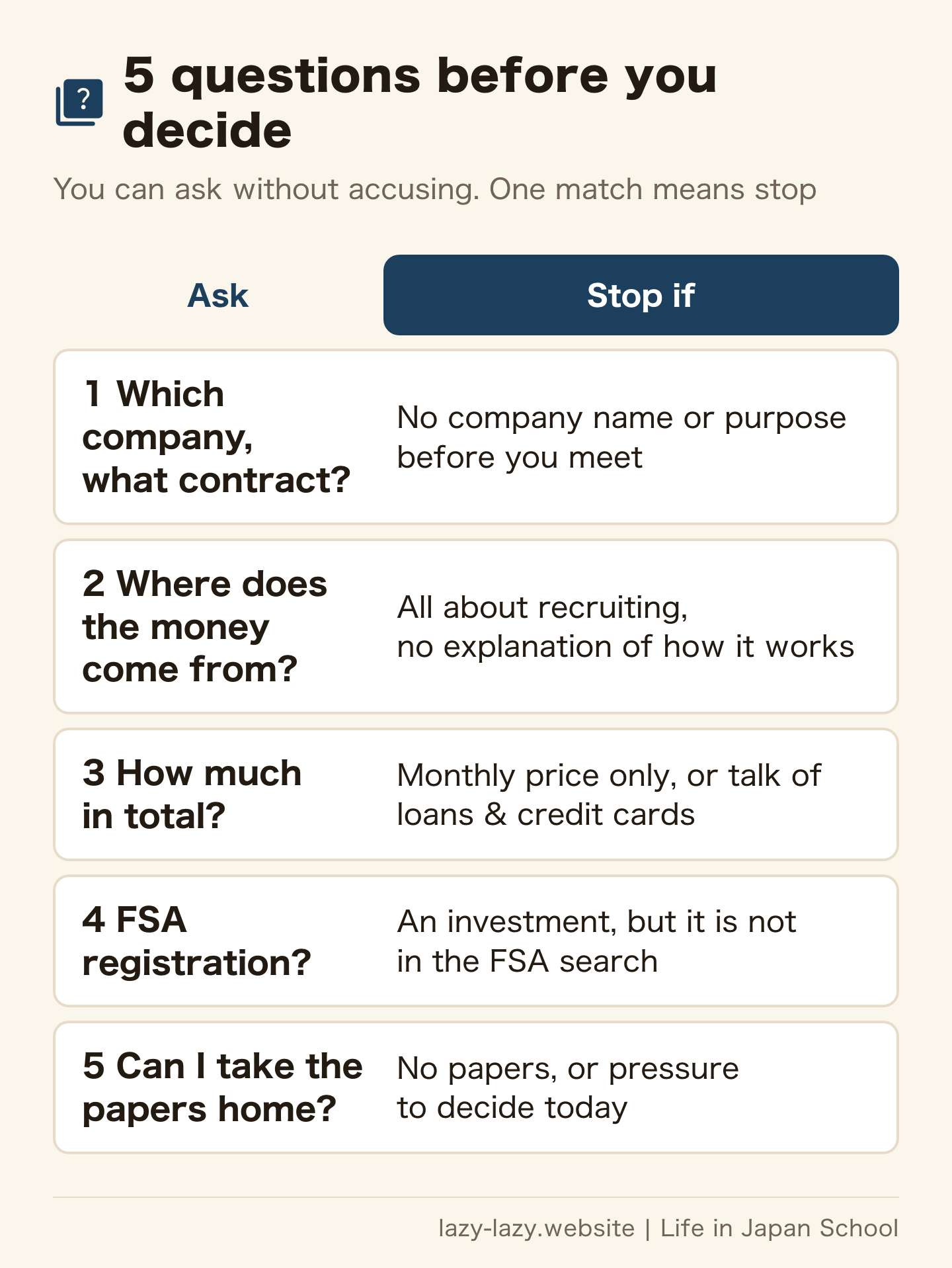
1. Which company is this, and what is the contract?
In an MLM, before the pitch they must state the name of the company running it, that the purpose is to sign you up, and the type of product. Hiding the purpose and then pitching you somewhere the public cannot freely enter is banned. In reported cases, people were drawn out with “there’s someone I want you to meet” or “let’s go to a seminar”, then found another recruiter waiting in a café or a flat. If you ask before meeting and get no answer, not going is your decision.
2. Where does the money come from?
Ask who pays for what, so that you get a reward. You want to know if the money comes from real sales or from the next member’s joining fee. In reported cases, recruiters stressed referral rewards and gave no explanation of how the money was made. If you cannot explain it in your own words after hearing it, do not pay.
3. How much up front, and how much in total?
Ask for the total: joining fee, monthly payments, products you must buy, seminars. In course contracts sold at a monthly price, the total ran from several hundred thousand yen to over 1 million yen. If loans or credit cards come up here, stop. Do not go on to the next question.
4. Are you registered with the FSA?
For investing, FX and crypto, this question gives a clear answer. Doing this business with people living in Japan requires registration, and operating without it is illegal. The same goes for overseas companies. Ask for the registration number and search it yourself, using the steps further down.
5. Can I take the papers home and decide later?
In an MLM, they must give you an overview document before the contract and a contract document after it. When someone from your own community introduces a deal, it may go ahead on trust, with no paper and cash by hand. Where you come from, that may be normal. In Japan, a contract with no paper leaves you not knowing who to cancel with or on what terms. If they press you with a special offer for signing today, the NCAC’s advice is not to sign on the spot.
Is “guaranteed profit” ever real? 6 kinds of money-making offers
The words “guaranteed profit” are reason enough to stop. The FSA lists “you will definitely profit, and your principal is guaranteed” among pitches that are likely to be fraudulent. Even a registered firm may not sell by stating uncertain things as certain, under the Financial Instruments and Exchange Act.
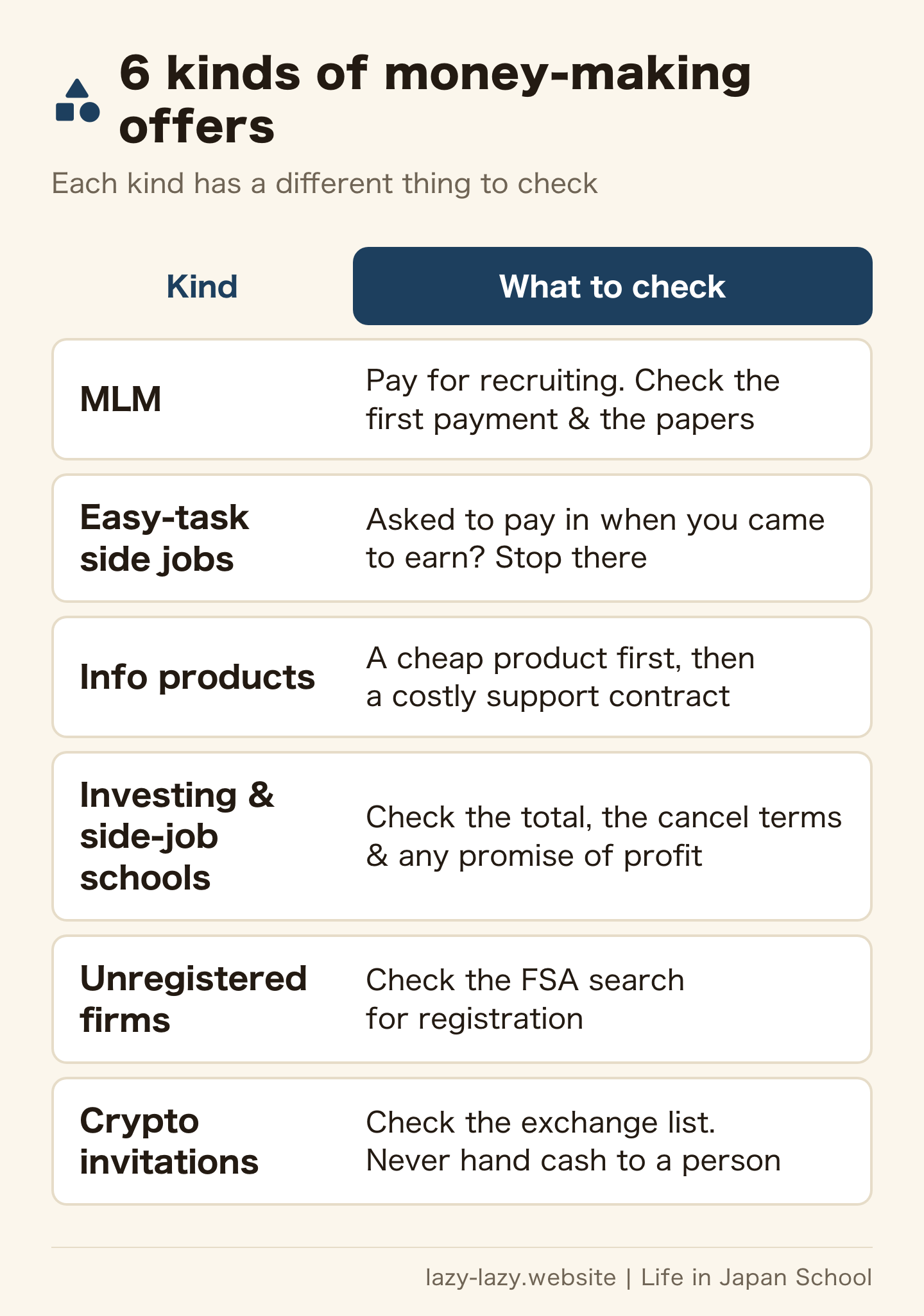
With easy-task side jobs, watch which way the money moves. In a case reported to the NCAC, someone was paid about 2,500 yen for liking videos, then told to pay in about 500,000 yen as “group responsibility”. If a job that was meant to pay you starts asking you to pay, stop there.
Info products are know-how sold online as a way to earn high income from side jobs or investing. Consultations fell from 6,256 in fiscal 2023 to 2,623 in fiscal 2025 (as of 31 May 2026, excluding referred consultations). But these products often lead to expensive support contracts sold by phone or video call. In one case a 10,000 yen product was followed by a course of about 800,000 yen, paid with a 36-instalment credit contract.
Side-job schools and AI or social-media courses fall under what official figures call “business courses”. Those consultations rose from 2,682 in fiscal 2024 to 3,551 in fiscal 2025 (entries up to the end of July 2026). Some people expected a job introduction, an interview or a networking event and got a course pitch. The data does not say whether investing schools are in that number, but check them the same way. Not every school is bad. Check the curriculum, the total and the cancellation fee before signing, and do not take any promise of future income at face value.
Unregistered firms are not only investment firms. Moneylenders must register too. Do not deal with an unregistered firm of either kind.
With crypto, one person borrowed 600,000 yen from consumer lenders after a co-worker’s invitation and handed it over. The FSA also describes cases where people gave cash after an acquaintance’s introduction and the service later stopped. As of 30 September 2026, there were 27 registered crypto exchanges.
Investment scams run by strangers on social media are a separate problem: National Police Agency figures show 9,523 cases and 128.8 billion yen in 2025. The tricks and the refund steps are in our guide to scams in Japan. If you want to start investing, why and in what order to invest lets you think it through without relying on someone’s pitch.
How much can these offers cost? The average contract amount was 2.57 million yen
NCAC reports give average amounts. In consultations involving loans from several lenders, the fiscal 2025 average contract amount was 2,570,000 yen. That is not the loan amount: it also includes non-loan money such as savings. The average leaves out consultations with an unknown amount and counts those at 0 yen. For business courses, the average was 870,000 yen when sold by phone or video call, and 640,000 yen by mail order.
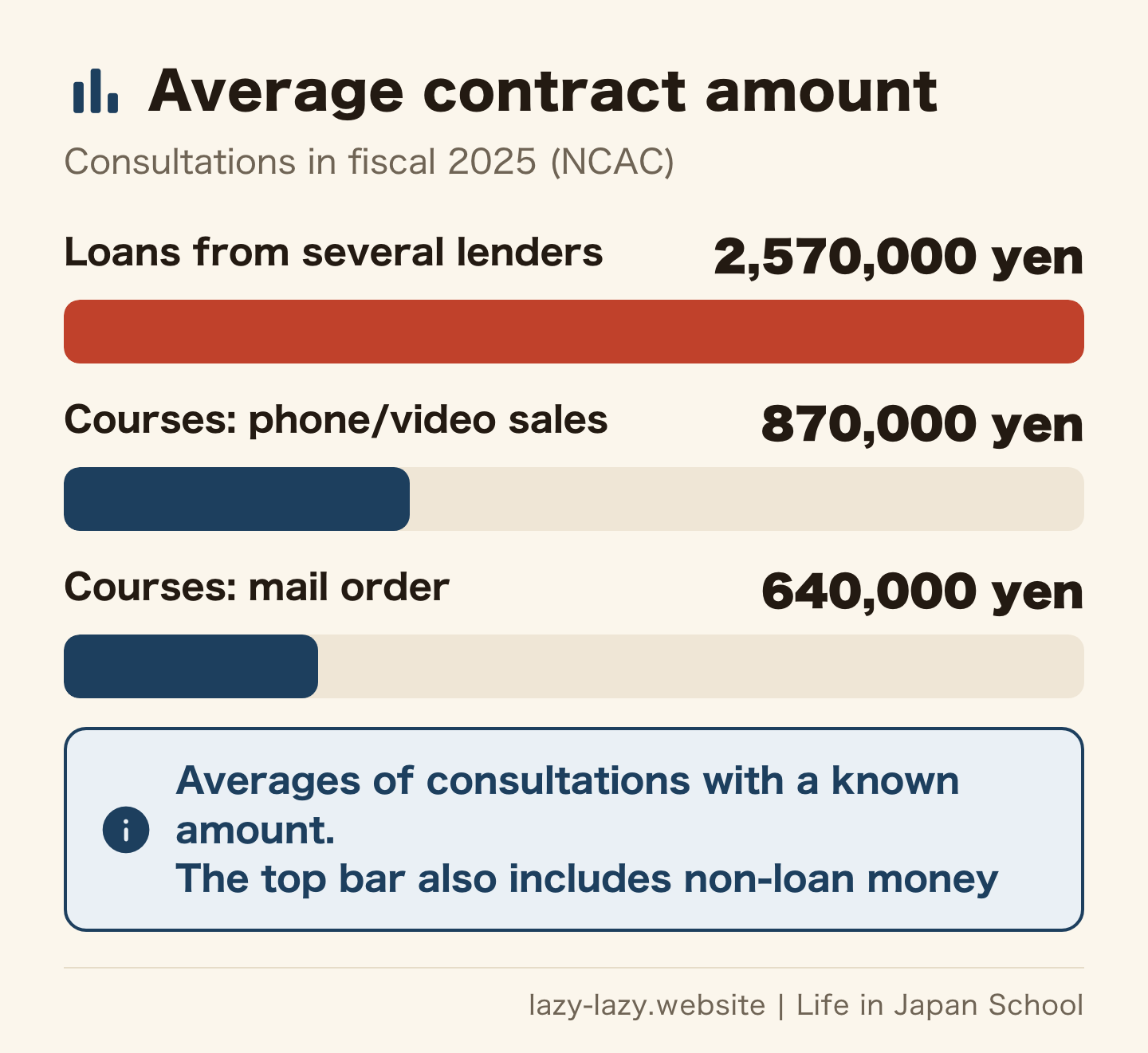
These are averages of consultations, not a market price for every offer. Even so, nobody short of money each month can repay amounts like these quickly.
How do you check FSA registration? 4 steps to find unregistered firms
You can check on your phone. Do not stop at asking the other person. Search it yourself.
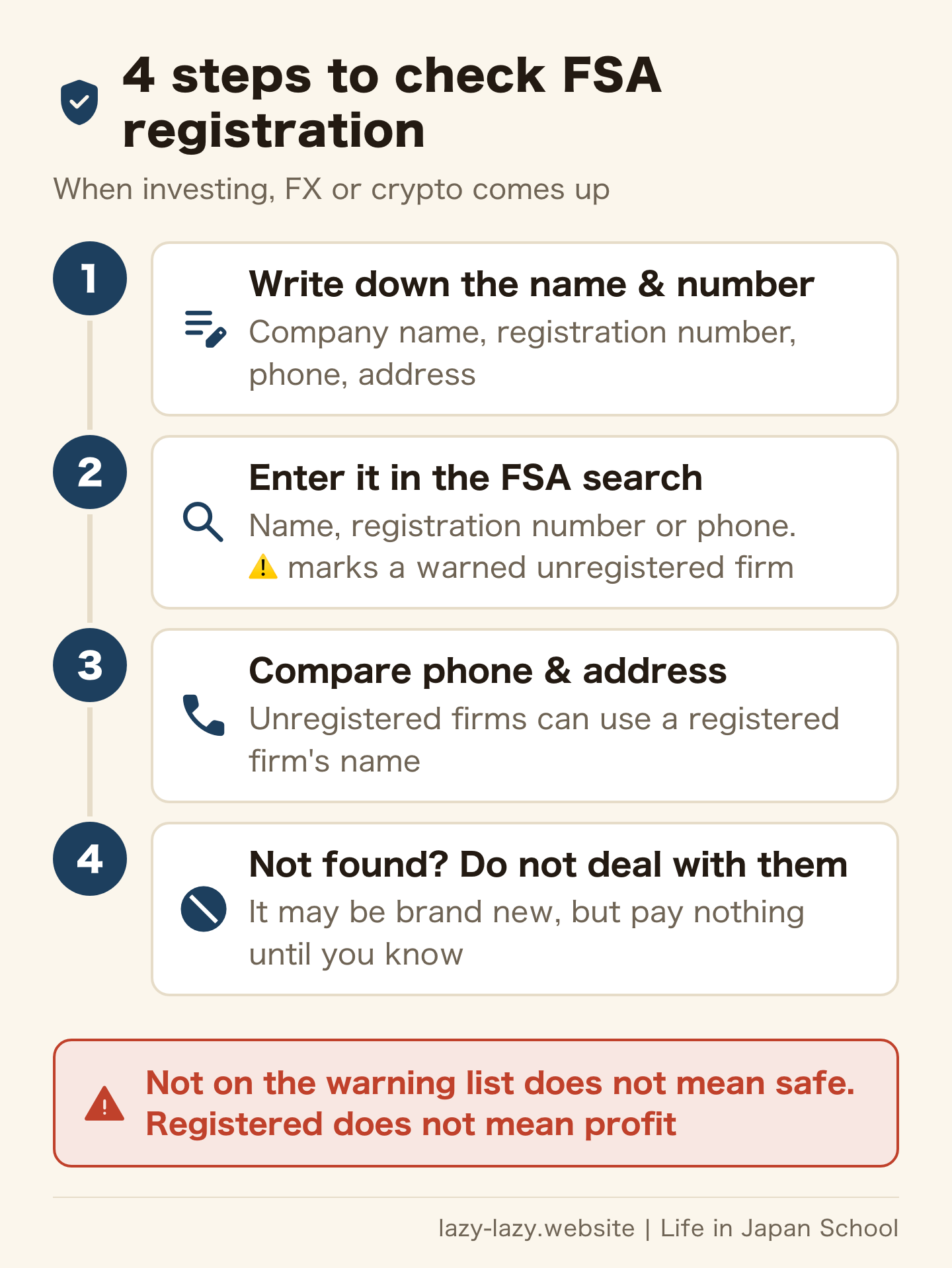
- Copy the company name, registration number, phone number and address from their materials.
- Open the FSA search for financial businesses (in Japanese) and enter the company name, registration number or phone number. The search target (検索対象) can be all (すべて), registered only (登録業者のみ) or unregistered only (無登録業者のみ).
- If ⚠️ appears before the name, the FSA or a Local Finance Bureau has warned that firm as unregistered. Do not deal with it. If there is no ⚠️, check that the phone number and address match their materials. Unregistered firms sometimes use a registered firm’s name. The FSA’s lists also show contact details.
- If you cannot find them, do not deal with them. The data is from the last update, so a brand-new registration is possible. Even so, pay nothing until you can confirm it.
The FSA also publishes the firms it has warned: unregistered financial instruments businesses and unregistered crypto exchanges. On a phone, open the HTML version of the first list and use find-in-page. Not being listed does not mean safe, because the lists only cover firms confirmed at the time of a warning.
For lenders, use the registered moneylender search. A registration number in an advert proves nothing by itself. The legal limit on interest is 15 to 20% a year, depending on the amount. Above 20%, it breaks the Investment Deposit and Interest Rate Act and can be punished.
Registration does not promise profit. If you do not understand the product, not signing is a good enough decision, even with a registered firm. If unsure, call the FSA’s fraudulent investment consultation line on 0570-050588 (weekdays 10:00 to 17:00; from IP phones, 03-6206-6066).
How do you say no to an MLM friend? Do not say “I have no money”
“I have no money right now” is the easiest thing to say and the weakest. It turns the talk into “you would sign if you had the money”. The NCAC report says that excuse can lead to pushes towards loans and credit, and advises stating clearly that you will not sign.
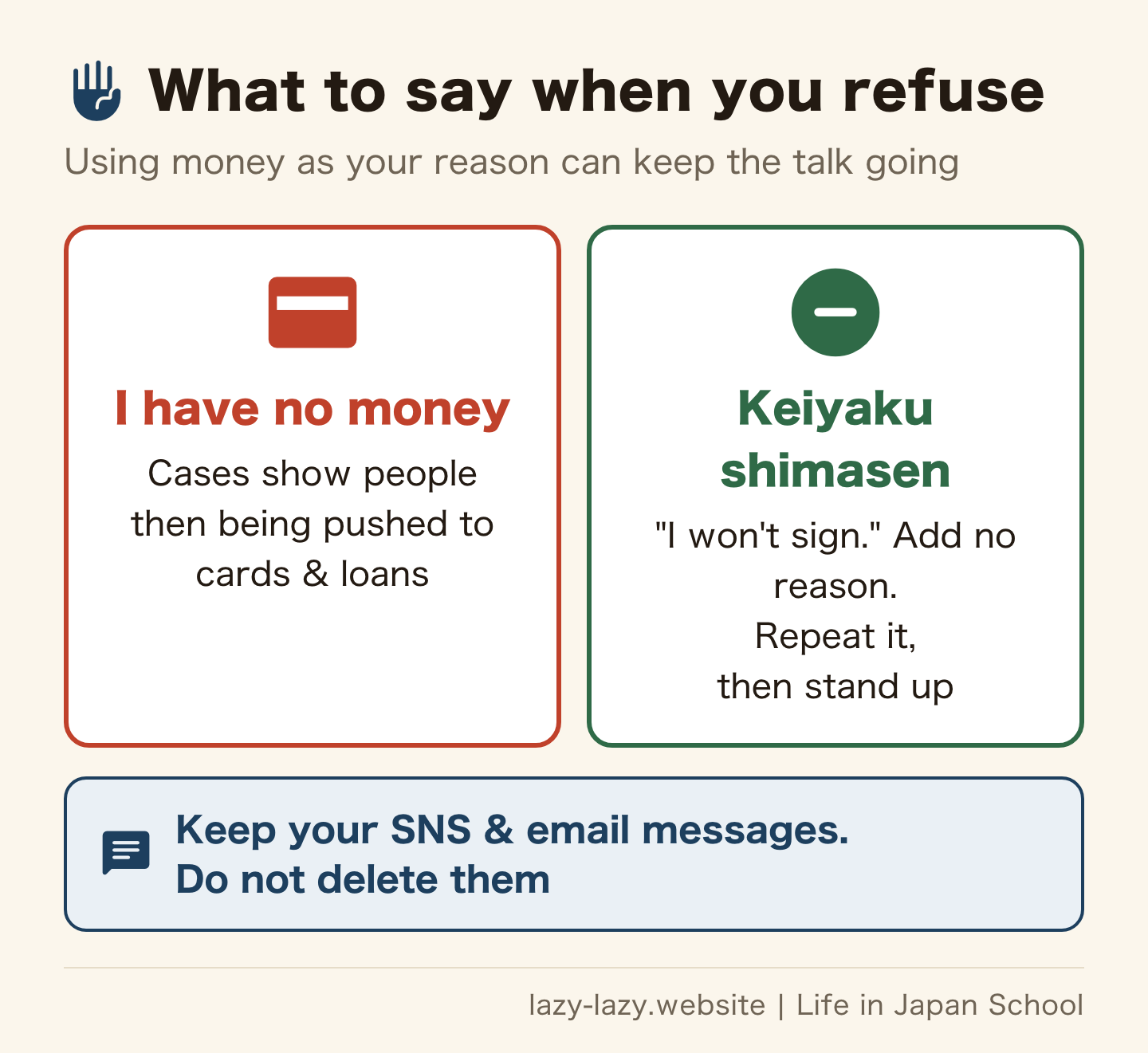
Have a line ready for each moment. Change the words to suit you.
- When invited: “I won’t join that, and I won’t come to hear about it.” (Sanka shimasen.)
- By message: “I’ve thought about it. I won’t sign. Please let’s leave it here.”
- At the table: “I won’t sign. I’m leaving now.” (Keiyaku shimasen. Kyou wa kaerimasu.)
- To a senior: “You’ve helped me a lot, so I’ll be honest. I’m not joining this.”
It is easier not to give a reason, because every reason gets an answer. The NCAC advises refusing from the start and not giving a vague reply. Keep your messages.
Sometimes it is hard to stand up. Some people signed after being surrounded and pitched for hours. Say you are leaving, then stand. If a business will not let you leave after you said so, and you signed because of that, the Consumer Contract Act may let you cancel the contract. The limit is 1 year from when you got out of that situation and 5 years from the contract. If you feel unsafe, call 110.
Losing the friendship may be your biggest fear. But once you join, your role is to invite the next person, and then you are the one pulling friends into trouble. A bad moment today is better than becoming the person who recruits your friends. If a friend asks to borrow money instead, see how to say no when a friend asks for a loan.
What if they say “just take out a loan”? The borrower repays
When borrowing comes up, you have your clearest reason to stop. This site generally does not recommend debt that carries interest or fees. The NCAC also warns against borrowing to sign a contract. Even if they said you could repay right away, the duty to repay stays with the person who borrowed.
Consultations involving several lenders, counted whether or not the seller told the person to borrow, rose from 1,796 in fiscal 2021 to 5,212 in fiscal 2024. Fiscal 2025 stood at 4,088, counting entries up to the end of March 2026. The NCAC says many come from people aged 29 and under. In one case, a part-timer earning just over 100,000 yen a month borrowed a total of 4.5 million yen in a single day.
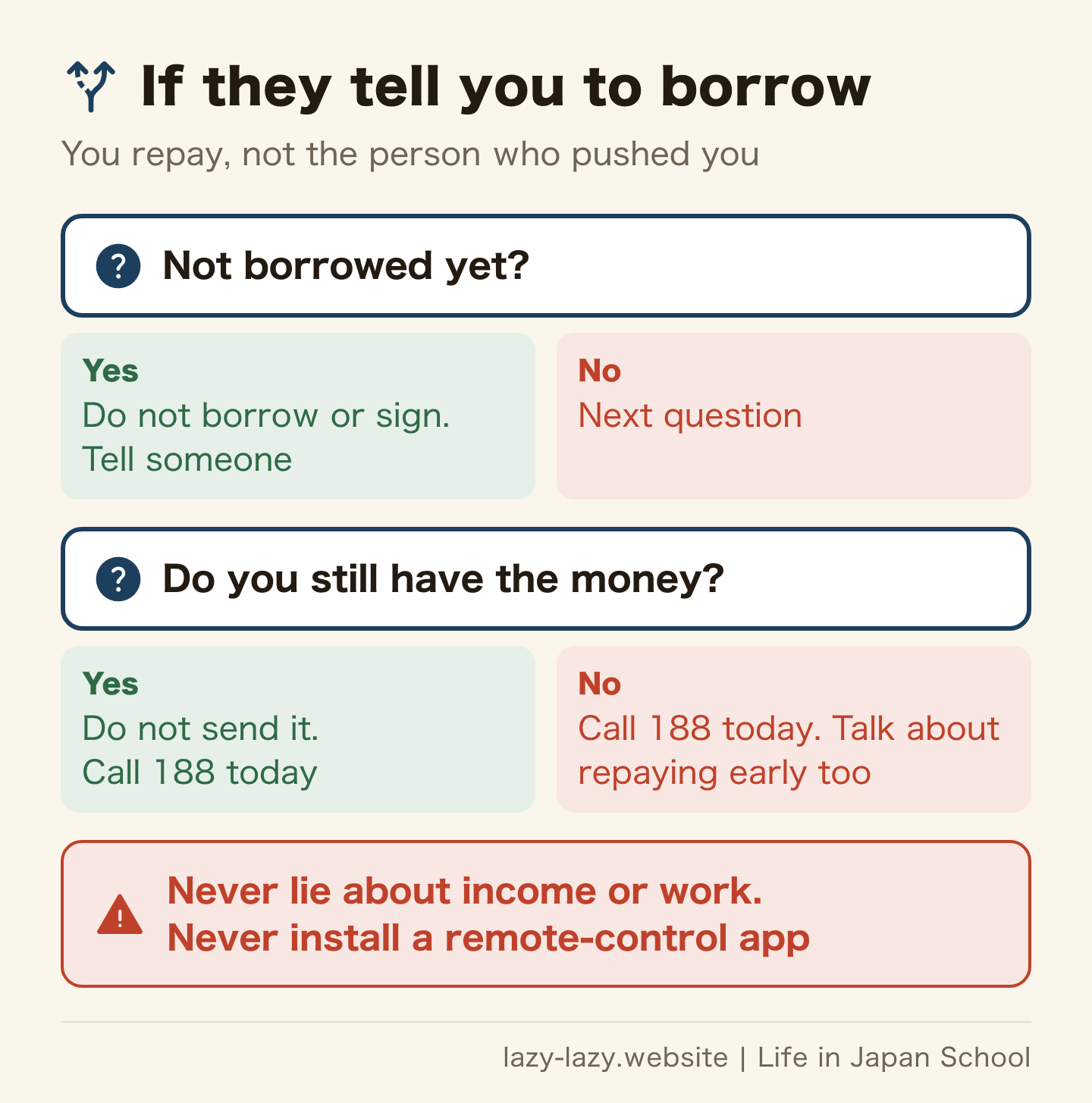
- If told to lie about your income or job, never do it. In one case a part-timer was told to apply as a full-time employee earning 3 million yen a year.
- Do not install remote-control apps or share your screen. Step-by-step instructions can leave you no time to think.
- Loans from moneylenders are capped at one third of your annual income, all lenders combined. False applications are a way around that cap.
- Before borrowing, tell someone. You can also explain the situation to the lender’s desk.
If you have already borrowed, call 188. For questions about a lender, there is the Japan Financial Services Association desk on 0570-051-051 (9:00 to 17:00, closed weekends, holidays & New Year; no fee). Public support for when money runs short is in our guide to avoiding debt.
Can referral pay or a side job hurt your visa? It may fall outside your status
We could not find an Immigration page that mentions MLM referral pay by name. So we cannot say it always breaks the rules. But the way the rules are built makes starting without checking a risk.
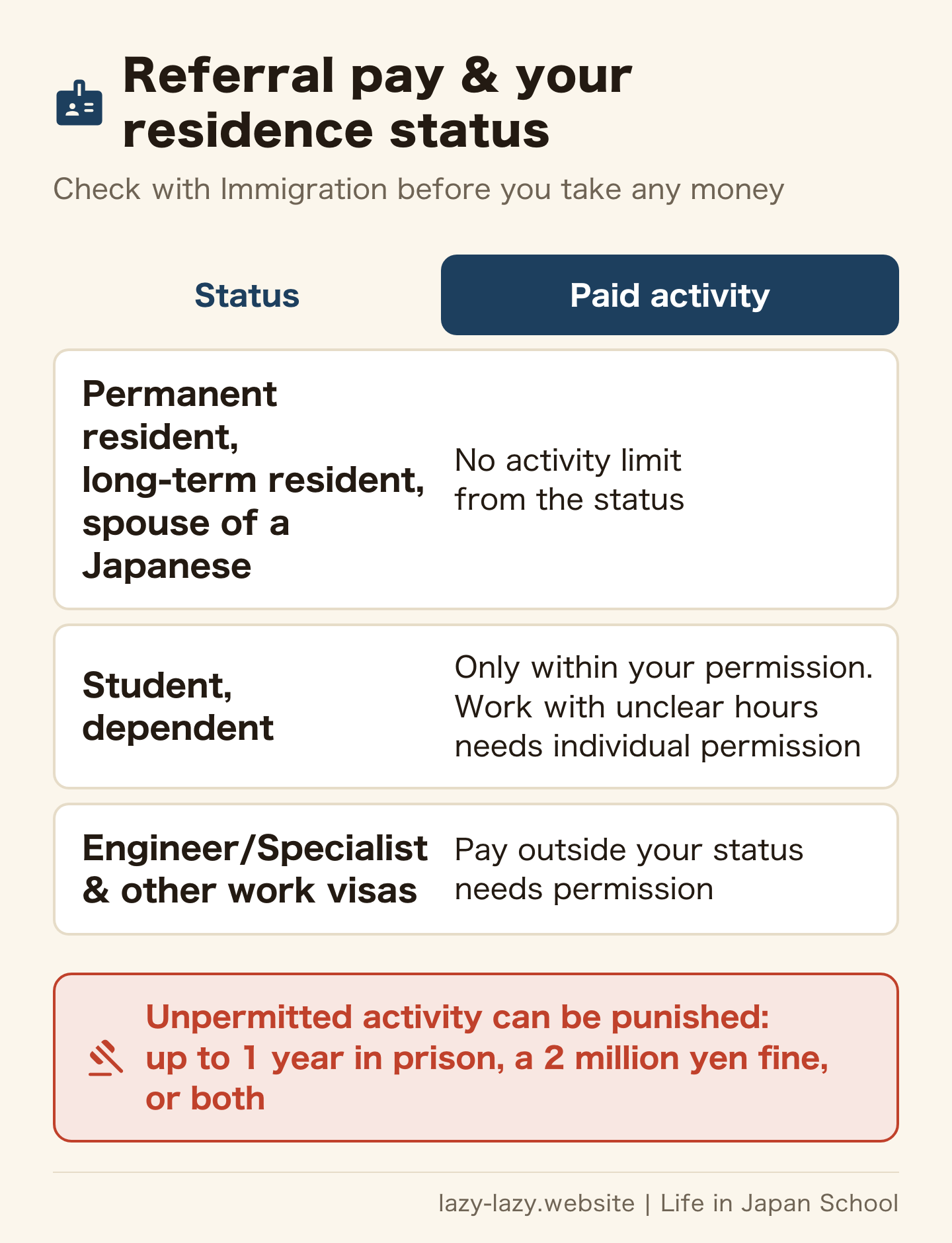
Article 19 of the Immigration Act bars people on a student status from running a business with income, or being paid, without permission. It bars people on work statuses from doing the same outside their status without permission. The law excludes things such as occasional pay connected with daily life. You cannot decide for yourself which side a single payment falls on.
Even with a student’s 28-hour permission, self-employed work whose hours cannot be objectively confirmed needs individual permission, which is not guaranteed. So does contract work without clear standard hours. Delivery-type work with hours that can be confirmed is treated differently. Referral pay and pay-by-results side jobs can look like the first kind. Activities found to break a law cannot get permission at all.
Doing unpermitted activity can bring up to 1 year in prison, a fine of up to 2 million yen, or both. If it is clear you are mainly doing such activity, that rises to up to 3 years in prison, a fine of up to 3 million yen, or both, and it is a ground for deportation. Renewals also look at conduct: acts that led to criminal punishment close to the grounds for deportation count as bad conduct.
Ask the Immigration Information Center, listed in our list of help desks, before signing. Explain the work and how you would be paid. The rules for each status are in our guide to side income.
Already signed or paid? 20-day cooling-off and 188
Do not decide it is too late. Depending on the contract, a way out may remain. First gather the date on the papers, their contact details, your messages and the transfer records.
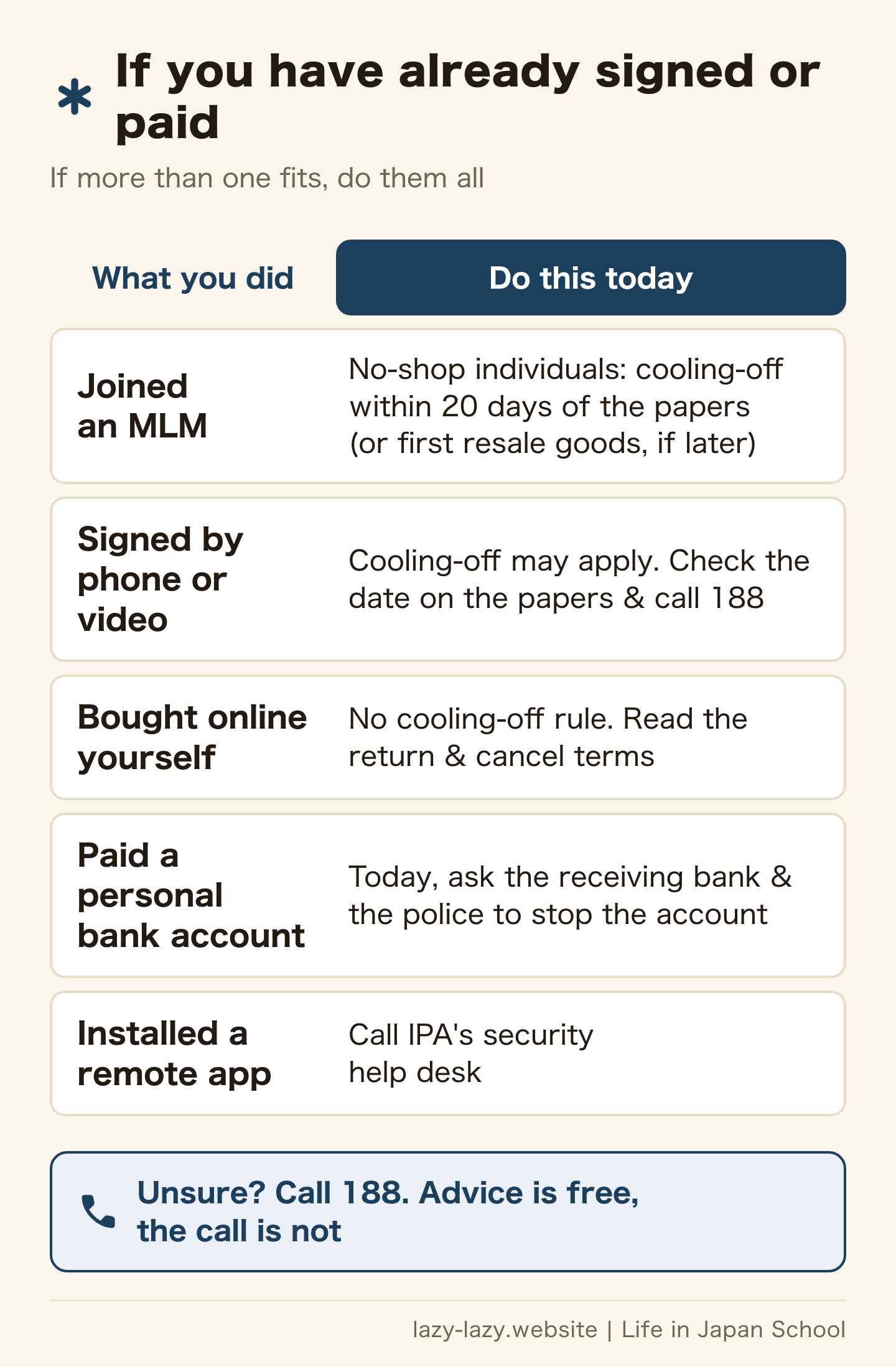
If you joined an MLM as an individual without a shop, you have 20 days from the day you received the document (or first received goods to resell, if that was later). How to write the notice and count the days is in our cooling-off guide. If lies or threats stopped you acting in time, you can still do it after 20 days. There are also rules on cancelling after being misled, and on leaving early under conditions.
Courses sold by phone or video call may also qualify for cooling-off. One person was told they could not cancel because it was a business-to-business contract. If you were not actually running a business, you may count as a consumer, so do not give up because of that line.
If you are told to send investment money to a personal bank account, the NCAC calls that fraud. If you already sent it, today contact the police and the receiving bank and ask them to stop the account. If you installed a remote-control app, read IPA’s warning and call its security help desk on 03-5978-7509 (10:00 to 17:00, closed weekends, holidays & New Year).
The main contact is the Consumer Hotline, 188. Advice is free, but you pay for the call. If you may have been deceived, you can also ask the police on #9110.
Which one are you?
- You were only told there is a good offer. Ask for the company and the purpose before meeting. Today, if there is no answer, reply “I won’t join”.
- You heard the pitch and are unsure. Send the 5 questions. Today, sign nothing and put the company name into the FSA search.
- You were pushed towards a loan or card payment. Say “I won’t sign”. Today, save the messages and leave the room or the chat.
- You were offered referral pay or side income. Today, take no money and ask the Immigration Information Center.
- You already signed or paid. Check the date on the papers. Today, call 188.
FAQ
Q. Is MLM legal in Japan?
It is not automatically illegal. The Specified Commercial Transactions Act sets rules for it. Lying and hiding the purpose of a pitch are banned. Pyramid schemes, where later members’ money goes to earlier members, are banned by law.
Q. What is the difference between MLM and a pyramid scheme?
An MLM adds pay for recruiting to a trade in goods or services. A pyramid scheme pays earlier members with later members’ money. Joining or inviting people to a pyramid scheme is banned, and inviting can bring a fine or more. With an investment offer that has no real product, you may not be able to tell which it is.
Q. A friend invited me to an MLM. How do I say no?
Do not say you have no money. Say you will not sign (keiyaku shimasen). Money as a reason can lead to pushes towards loans and card payments. Give no extra reason and no vague reply. By message, reply briefly and keep the chat.
Q. How do I check if an investment company is real?
Enter the company name, registration number or phone number in the FSA search for financial businesses. If ⚠️ appears, it is an unregistered firm that has been warned, so do not deal with it. If there is no ⚠️, compare the phone number and address with their materials, because unregistered firms can use a registered firm’s name. If you cannot find it, do not deal with them.
Q. Can an international student take referral fees?
Do not decide that for yourself. The Immigration Act bars paid activity without permission, and work whose hours cannot be objectively confirmed needs individual permission, which is not guaranteed. We found no official page on referral fees by name, so ask Immigration before you take any money.
Q. Can I still quit after borrowing to pay?
If you joined an MLM as an individual without a shop, you have 20 days for cooling-off from the day you received the document (or first received goods to resell, if that was later). The duty to repay the loan stays with you, though. Your options depend on the contract, so call 188 today.
Bottom line
The person who brought you a “good offer” is not necessarily a bad person. So look at the offer, not the person: the company, where the money comes from, the total, taking the papers home, and FSA registration for investments. If even one has no answer, stop there.
When you refuse, say “I won’t sign”. If borrowing comes up, your decision is made. Ask Immigration about referral pay before you take it. And if you have already signed, check the date on the papers and call 188 to learn what options remain.
Sources (official): NCAC, MLM consultations / NCAC, fiscal 2025 consultations / NCAC, no-product MLMs / NCAC, info products / NCAC, businesses that make you borrow / NCAC, business courses / NCAC, easy-task side jobs / Consumer Affairs Agency, MLM rules / FSA, unregistered firms / FSA, fraudulent investment pitches / FSA, illegal lenders / National Police Agency, social-media investment & romance scams / Deposit Insurance Corporation of Japan, if you sent money to a scam / Immigration Services Agency, permission for activities outside your status / Act on the Prevention of Pyramid Schemes / Immigration Control Act (all checked 7 November 2026)
Related reading
Found this useful? Share it
Send it to a friend who lives in Japan.
WHO WROTE THIS

mori
Japanese. I read the ministries’ own notices, orders and Q&As in the original, and I start from what my Nepalese and Sri Lankan friends in Japan actually ran into. I do not write about what I have not checked or been told.
What this site can and cannot do →Looking for something else?
You may use the figures in this article, including commercially, if you credit this site with a link. How to use our figures