This article contains affiliate links.
Last updated: July 2026 (prices are 2026 market rates)
In short
- If you already hold a licence from home, convert it instead. Conversion costs 4,850 yen. Starting from zero in Japan costs 200,000 to 400,000 yen.
- Starting from zero means every lesson, test and written exam is in Japanese. Driving schools require that you can converse at normal Japanese speaking speed.
- The price swings by more than 100,000 yen depending on when you can go. Spring and summer holidays cost 300,000 to 400,000. Other months start in the high 200,000s.
- People who work have the advantage here. Booking annual leave lets you go in the cheap season. People in school are locked into the expensive one.
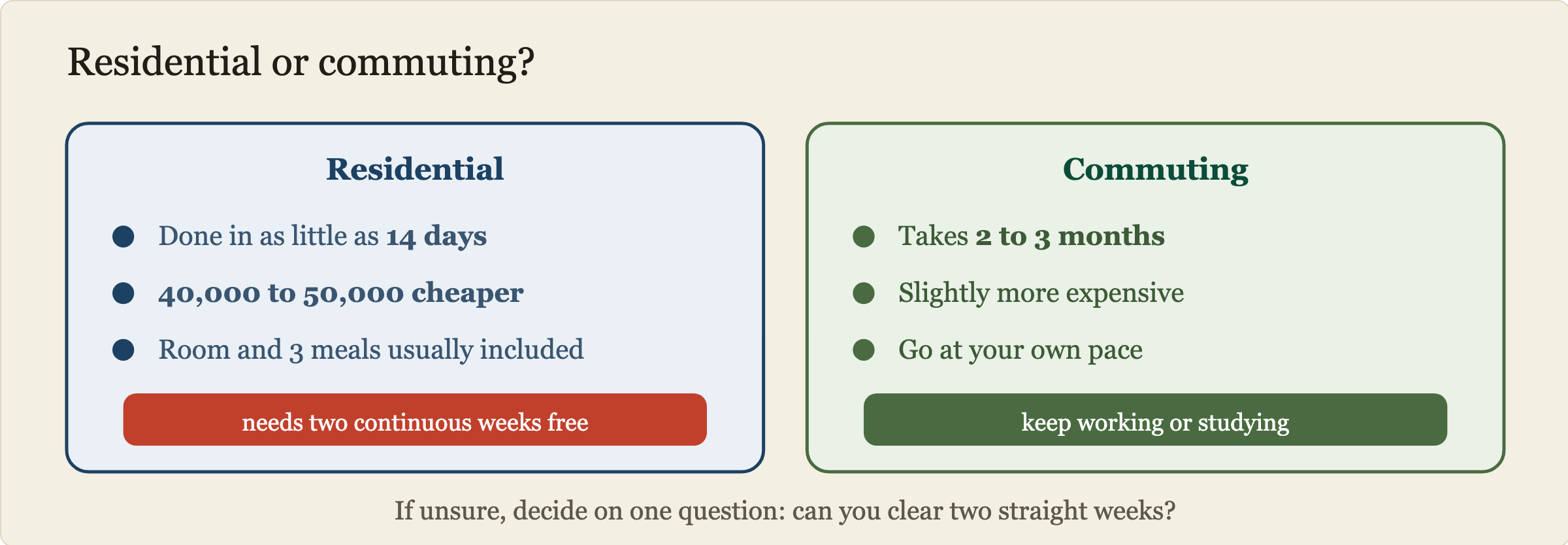
- Can you take two weeks off? Go residential (14 days, 40,000 to 50,000 cheaper). If not, commute to a local school over two to three months.
A driving school (kyoushuujo) is where almost everyone in Japan learns to drive. You complete lessons and tests there, then collect the actual licence at a licence centre. This guide is for people with no licence at all – if you already have one from home, start somewhere else.
- First: could you get a licence at home instead?
- The honest gate: Japanese, not money
- The price depends on when you can go
- Residential or commuting?
- What you need to enrol
- If you are working: a licence widens what you can apply for
- Once you have it: compulsory insurance is not enough
- Frequently asked questions
- Summary
- Related guides
First: could you get a licence at home instead?
Starting from zero in Japan costs 200,000 to 400,000 yen. Converting a licence you already hold costs 4,850 yen in fees. That is not a small difference – it is dozens of times cheaper.
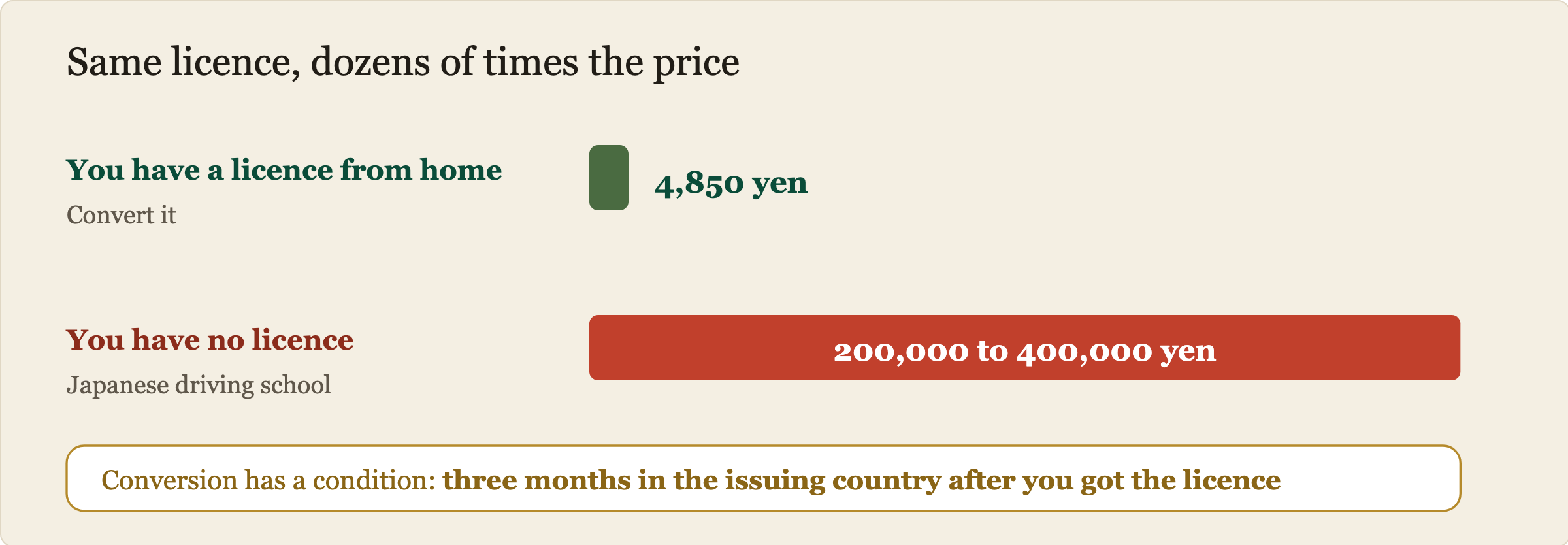
Conversion has conditions though. You need three months or more in the issuing country after getting the licence, and the rules differ sharply by country – a Nepali licence cannot be used in Japan at all, for instance. Read converting a foreign driving licence first if there is any chance this applies to you.
If you have no licence, or you cannot meet the conversion conditions, the rest of this guide is for you.
The honest gate: Japanese, not money
Every practical lesson, every classroom lesson, every test and the provisional licence written exam is conducted in Japanese. Driving schools state the entry requirement openly: you must be able to read and write Japanese and hold a conversation at the speed Japanese people normally speak.
This is a safety rule rather than a barrier for its own sake. An instructor’s correction has to land instantly while you are moving, and the classroom material is dense with traffic terminology. Conversational Japanese at around N4 is realistically not enough. N3 is a sensible floor, and N2 makes the classroom side comfortable.
Some schools stock foreign-language textbooks or have staff who speak another language, but which languages, and how far that support goes, varies completely between schools. Ask before you book whether they accept someone at your level. People who skip this step get turned away at enrolment after paying deposits.
The price depends on when you can go
Residential course prices move a long way with the season. Spring and summer holidays run 300,000 to 400,000 yen and up. Other months start in the high 200,000s, and discounted plans reach the 180,000s.
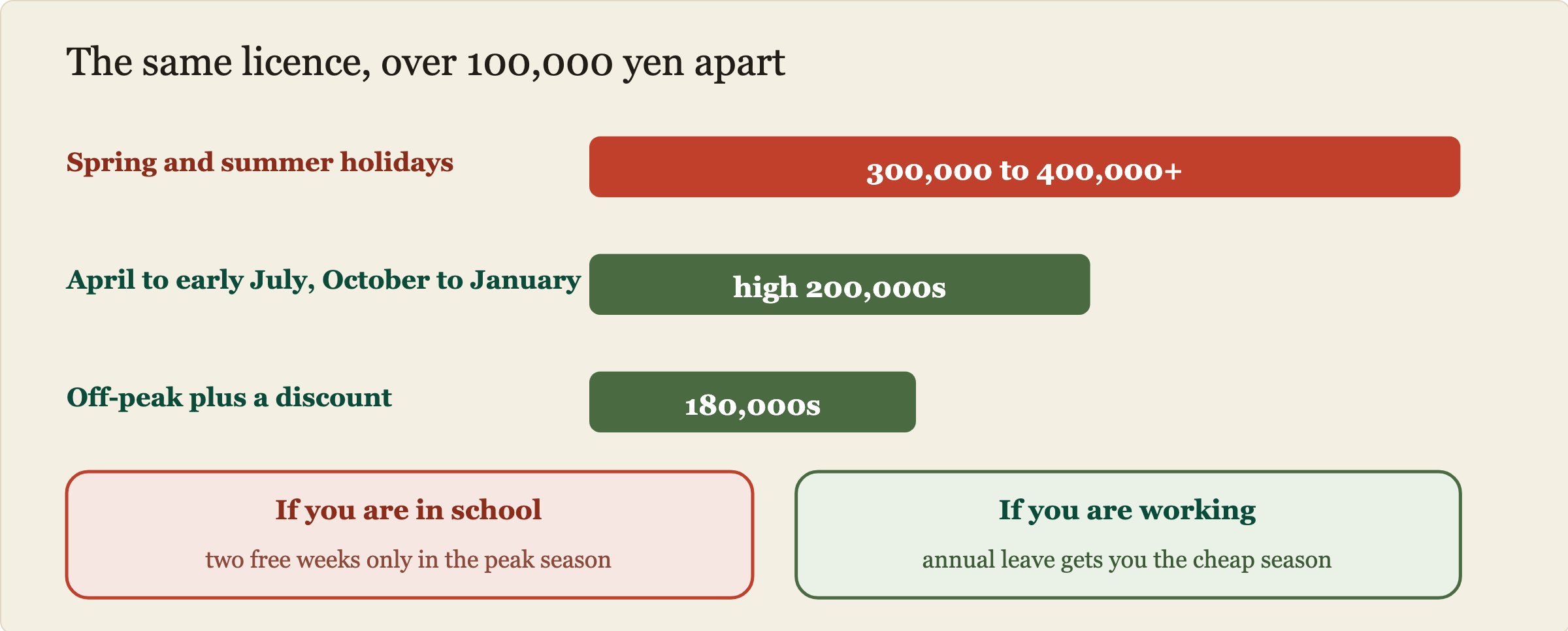
This is the part people miss. If you are studying, the only two-week gaps you get are the spring and summer holidays – which are exactly the most expensive weeks of the year. If you are working, a few days of annual leave around a weekend puts you in the off-peak season, and the identical course costs over 100,000 yen less.
Students are not stuck, though. The gap between finishing language school and starting the next course falls in late March and April, at the tail of the peak. And you can skip the residential format entirely and commute to a local school during a cheaper stretch of the year.
Residential or commuting?
If you can clear two straight weeks, go residential: it finishes in as little as 14 days and costs 40,000 to 50,000 yen less. If you cannot, commute to a local school over two to three months while keeping your job or your studies.
Compare residential courses by season and region
A booking service for residential driving courses across Japan, searchable by date, area and price. Because the same course swings over 100,000 yen with timing and location, it is worth comparing if your dates are flexible at all.
- If you can reach the off-peak months, start your search there
- Plans usually include accommodation and meals, and rural schools tend to be cheaper
- Acceptance of foreign students differs by school. Confirm before booking that they will enrol someone at your Japanese level

What you need to enrol
As a foreign national you need your residence card and a residence certificate that shows your nationality. The standard certificate is not enough, so say so at the city office counter.
| What to bring | Watch out for |
|---|---|
| Residence card | Check it does not expire during the course |
| Residence certificate | Must show nationality, status, expiry date and card number |
| Photo ID | Passport |
| ID photos, seal | Follow the school’s own list |
How to obtain one is covered in our residence registration guide. At the counter, ask specifically for the version showing nationality and residence status.
If you are working: a licence widens what you can apply for
Factory, logistics and care work outside the big cities is often at sites you simply cannot reach without a car. Holding a licence increases the number of jobs open to you, which shows up in both pay and choice.
200,000 to 400,000 yen is a serious amount of money, but it is the kind of spending that pays itself back by widening where you can work. Check what your residence status actually permits in making money in Japan, and if you are a student remember the 28-hour rule still applies.
Once you have it: compulsory insurance is not enough
The compulsory insurance attached to every car covers injury or death to other people only. It pays nothing for their vehicle, nothing for yours, and nothing for your own injuries. Optional insurance is not a nice-to-have here.
Premiums for identical cover differ by tens of thousands of yen a year between insurers, so compare rather than accepting the first quote.

Reference (official): Metropolitan Police Department, driving licences
Frequently asked questions
Q. Can I join a residential course with N4 Japanese?
Realistically it is very difficult. Lessons, tests and the written exam are all in Japanese, and schools require conversation at normal Japanese speed. N3 is a sensible floor and N2 makes the classroom comfortable. Ask the school directly about your level before booking.
Q. How much does it cost to get a licence in Japan?
For a residential automatic-transmission course, 300,000 to 400,000 yen and up during spring and summer holidays, and from the high 200,000s in other months. Discounted plans reach the 180,000s. Commuting costs roughly 40,000 to 50,000 more.
Q. Can I do this while working full time?
Yes. Two weeks off means a residential course; otherwise commute to a local school over two to three months. Workers often pay less overall, because annual leave lets them go in the cheap season.
Q. I have a licence from my country. Do I still need a driving school?
Usually not. Most people convert instead, for 4,850 yen in fees. You need three months or more in the issuing country after getting the licence, and whether tests are required depends on your country.
Q. Is a standard residence certificate enough to enrol?
No. It has to show your nationality, residence status, expiry date and residence card number. Ask for that version specifically at the city office.
Summary
- Holding a licence from home? Convert it for 4,850 yen instead
- Starting from zero, Japanese is the real gate. N4 is not enough; N3 is the floor
- Cost swings over 100,000 yen with timing (peak 300,000 to 400,000, off-peak from the high 200,000s)
- Working people can reach the cheap season with annual leave. Students cannot
- Two weeks free means residential; otherwise commuting
- A licence widens the jobs you can reach. Get optional insurance once you drive
Related guides
Found this useful? Share it
Send it to a friend who lives in Japan.
READ THIS NEXT
Social Media for Foreigners in Japan →Social media arrives fast; a blog gets found later by search. Use both.WHO WROTE THIS

mori
Japanese. I read the ministries’ own notices, orders and Q&As in the original, and I start from what my Nepalese and Sri Lankan friends in Japan actually ran into. I do not write about what I have not checked or been told.
What this site can and cannot do →Looking for something else?