This article contains affiliate links.
Last updated: July 2026 (covers the October 2025 rule change)
In short
- It depends on your country first. A Nepali licence does not work in Japan at all, not even with an International Driving Permit. Driving on one is driving without a licence.
- Sri Lanka and India are treaty countries, so an IDP does work – but if you have a residence registration here, the “three month rule” can cancel that.
- If you are staying in Japan, there is only one real answer: convert to a Japanese licence (gaimen kirikae).
- 29 countries skip the tests. Nepal, Sri Lanka and India are not among them, so you take both a knowledge check and a practical driving test.
- It got harder in October 2025. The knowledge check went from 10 to 50 questions and the pass mark from 70 to 90 percent. Fewer than 1 in 5 pass the practical test first time.
Gaimen kirikae is the process of converting a driving licence issued abroad into a Japanese one. Before you look at that process, you need to know whether your current licence lets you drive here at all – because for some countries the answer is simply no.
- First question: can you legally drive today?
- The trap for Sri Lankan and Indian licence holders
- Two conditions that stop people before they start
- The 29-country shortcut does not include South Asia
- What changed in October 2025
- The process and what it costs
- Once you have the licence: compulsory insurance is not enough
- Frequently asked questions
- Summary
- Related guides
First question: can you legally drive today?
Japan only recognises International Driving Permits issued by countries that signed the 1949 Geneva Convention on Road Traffic. Nepal did not sign it. Sri Lanka and India did.
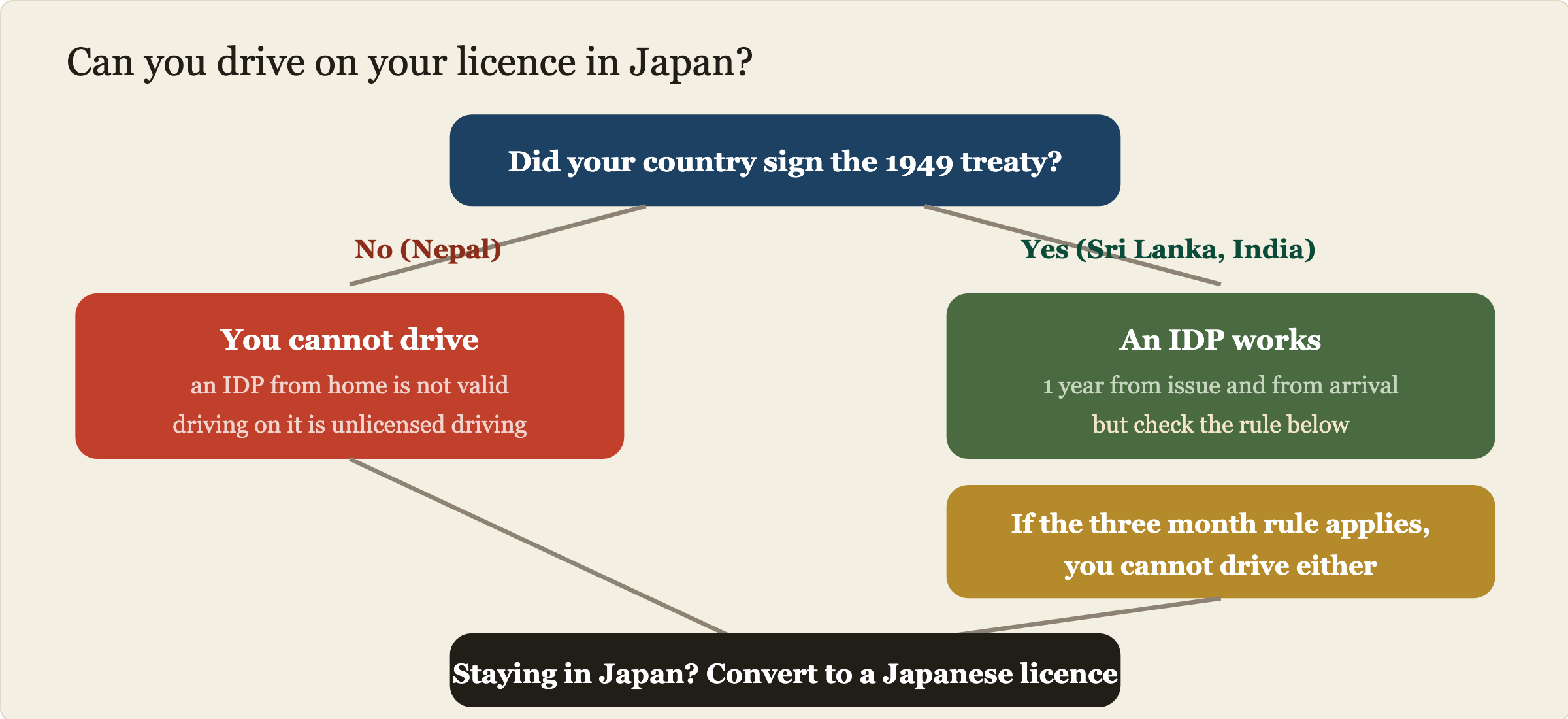
To be direct about Nepal, because this is the question people actually search for: Japan recognises IDPs only from countries in the 1949 Geneva Convention, Nepal is not a party to it, and there is no separate bilateral agreement between Japan and Nepal. A Nepali IDP therefore has no effect here. Driving on one counts as driving without a licence, which is a criminal offence and can affect your residence status.
The trap for Sri Lankan and Indian licence holders
Even with a valid IDP from a treaty country, having a residence registration in Japan can take your driving rights away. The clock only restarts if you spend three continuous months or more outside Japan before re-entering.
In practice it works like this. You live in Japan and are on the resident register. You go home for a visit and come back within three months. That re-entry does not count as a fresh “arrival,” so the one-year IDP period does not restart – and you are not permitted to drive on it.
The practical consequence catches people out constantly: picking up an IDP during a short trip home does not give you a year of driving in Japan. If you have a residence card and an address here, plan on converting rather than relying on an IDP.
Two conditions that stop people before they start
Before looking at the tests, check these two requirements. A lot of applicants are turned away at the counter for one of them.
- You must have stayed in the issuing country for a total of three months or more after getting the licence. If you passed your test and moved to Japan soon afterwards, you do not qualify. Your entry and exit records are checked
- You need a residence registration in Japan. Since the October 2025 change, short-stay visitors cannot convert. If you have not registered your address yet, do that first – see residence registration explained
You also need an official Japanese translation of your licence. You cannot translate it yourself – it has to come from an approved body such as JAF (the Japan Automobile Federation).
The 29-country shortcut does not include South Asia
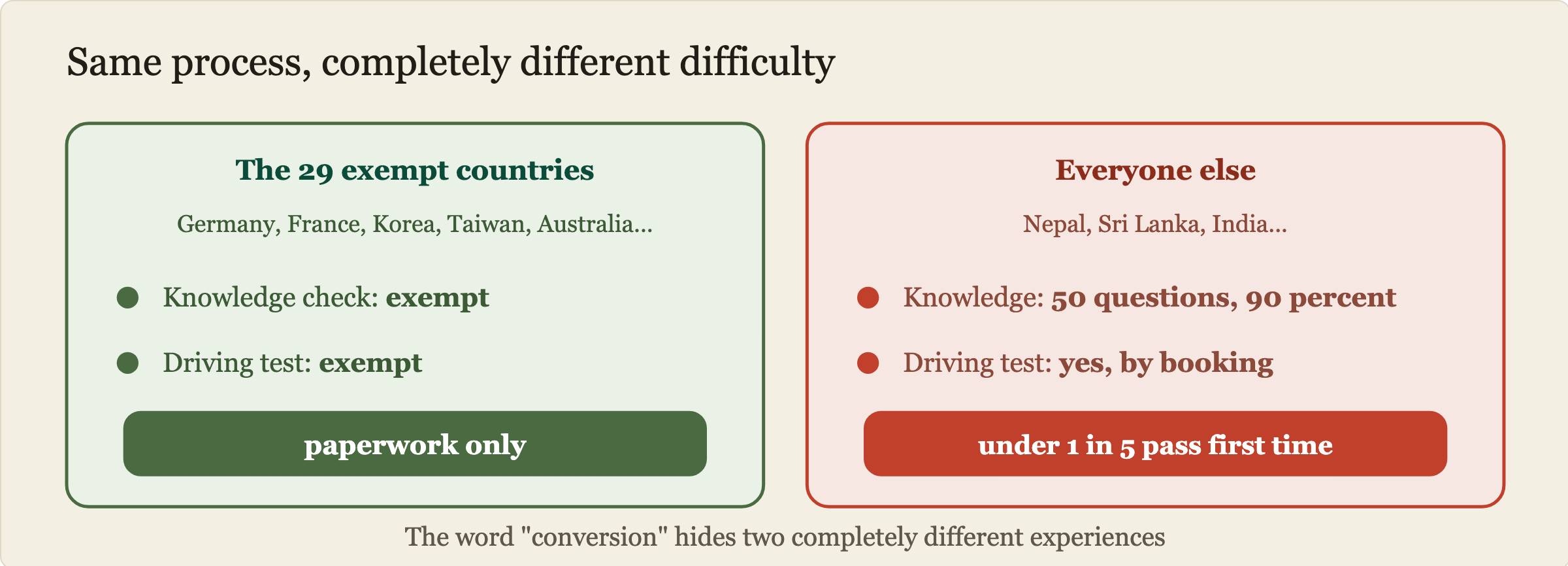
Twenty-nine countries and regions are exempt from both the knowledge check and the practical test. Nepal, Sri Lanka and India are not on that list, which means you take both.
What changed in October 2025
On 1 October 2025 the knowledge check went from 10 questions to 50, and the pass mark rose from 70 to 90 percent. The practical test gained a railway crossing and a hill start, and short-stay visitors lost the right to convert at all.
- Knowledge check: 50 questions, 90 percent to pass. That is 45 correct out of 50. Road signs and traffic rules need real study, not a skim
- A railway crossing and a hill start were added to the driving test. At the crossing you must stop completely and open your window to listen
- Short-stay visitors are excluded. Only people with a residence registration can apply now
The practical test starts you at 100 points and deducts as you go; you need 70 or more to pass. Points disappear fast for incomplete safety checks and late signalling, which is why fewer than one in five people pass on the first attempt. Plan for two or three attempts and book early.
The process and what it costs
For a standard car licence the fees are 2,500 yen to apply and 2,350 yen for issue, so 4,850 yen in total – plus translation, plus another fee each time you retake the driving test.
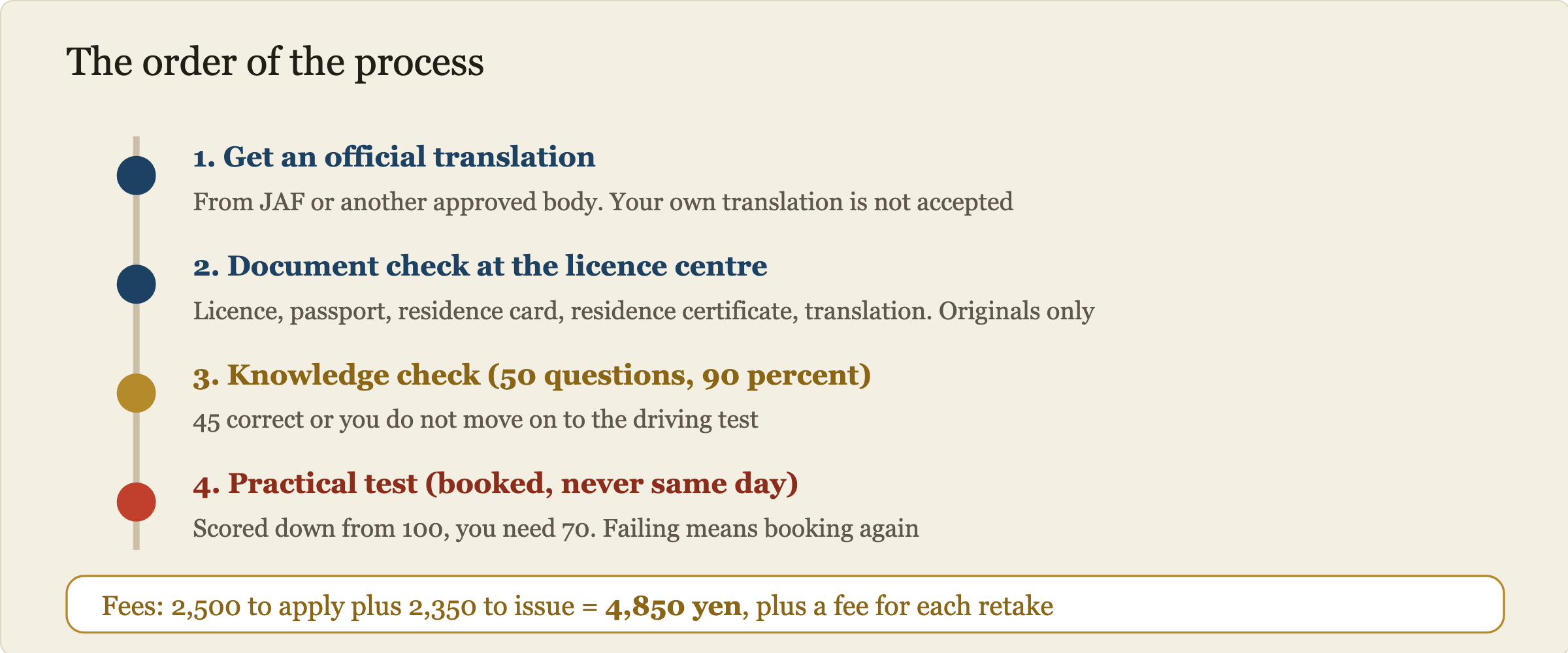
Required documents differ slightly by country of issue, so check the current list on your prefectural police site before you go – for Tokyo that is the Metropolitan Police licence conversion page. Originals are required; photocopies are not accepted.
Once you have the licence: compulsory insurance is not enough
The compulsory insurance that comes with every car (jibaiseki) only covers injury or death to other people. It pays nothing for damage to the other person’s car, nothing for your own car, and nothing for your own injuries.
People do drive without optional insurance, and it is a catastrophic risk. One at-fault accident can mean paying millions of yen out of your own pocket. In Japan, optional car insurance is not a nice-to-have – going without it is how a working life gets destroyed by a single afternoon.
Premiums vary a lot between companies for identical cover, often by tens of thousands of yen a year, so it is worth comparing rather than taking the first quote.
Compare car insurance quotes in one go
A free service that takes your car and driver details once and returns quotes from multiple insurers side by side. The same cover really does cost different amounts at different companies, so comparing changes what you pay every year.
Note: the form and the follow-up are in Japanese. If your Japanese is limited, going through the screen with a Japanese-speaking colleague or friend is the reliable way to do it.

Frequently asked questions
Q. Is a Nepali driving licence valid in Japan?
No. Japan only accepts International Driving Permits issued under the 1949 Geneva Convention, and Nepal is not a party to it. There is also no bilateral agreement between the two countries. Driving on a Nepali licence or IDP counts as unlicensed driving, so you need to convert to a Japanese licence.
Q. Can I drive in Japan on a Sri Lankan international driving permit?
Sri Lanka is a treaty country, so in principle yes. It must be within one year of issue and within one year of your arrival, and if you hold a residence registration the three month rule may stop you from using it. For anyone living here long term, converting is the safer route.
Q. How many attempts does the practical test take?
Fewer than one in five pass first time. The October 2025 additions of a railway crossing and a hill start made it harder still, so plan for two or three attempts when you book.
Q. I moved to Japan right after passing my test at home. Can I convert?
You need to have stayed in the issuing country for a total of three months or more after obtaining the licence. If you left soon after passing, you do not meet the requirement, and your entry and exit records are checked.
Q. How much does conversion cost?
For a standard car licence, 2,500 yen to apply and 2,350 yen for issue, so 4,850 yen in total. Add the cost of the official translation, and another fee for every retake of the driving test.
Summary
- A Nepali licence and IDP are not valid in Japan. Driving on one is driving unlicensed
- Sri Lankan and Indian IDPs work, but a residence registration plus the three month rule can cancel that
- Living here long term means converting to a Japanese licence
- Requirements: three months in the issuing country after getting the licence, plus a residence registration, plus an approved translation
- Harder since October 2025: 50 questions at 90 percent, and under 1 in 5 pass the driving test first time
- Once driving, compulsory insurance alone leaves you exposed – optional cover is essential
Related guides
Found this useful? Share it
Send it to a friend who lives in Japan.
READ THIS NEXT
Buying a Laptop in Japan →Pick the keyboard layout first, because it is the only part you cannot change later.WHO WROTE THIS

mori
Japanese. I read the ministries’ own notices, orders and Q&As in the original, and I start from what my Nepalese and Sri Lankan friends in Japan actually ran into. I do not write about what I have not checked or been told.
What this site can and cannot do →Looking for something else?